A Parking Management System based on
Background Difference Detecting Algorithm
Xiaoling Wu
1,2,3,4,5, Yanwen Wang
2, Hainan Chen
1,2, Kangkang Liang
1,2, and Lei Shu
3,∗ 1. Guangdong University of Technology, 510006, China2. Guangzhou Institute of Advanced Technology, Chinese Academy of Sciences, 511458, China 3. Guangdong Provincial Key Laboratory of Petrochemical Equipment Fault Diagnosis,
Guangdong University of Petrochemical Technology, 525000, China 4. Shenzhen Institutes of Advanced Technology, 518055, China
5. Information Technology Research Base of Civil Aviation Administration of China, Civil Aviation University of China, 300300, China
[email protected] (∗Dr. Lei Shu is the corresponding author)
Abstract—The number of vehicles in cities has increased
dramatically due to rapid economic development. However, the infrastructure for accommodating these vehicles has grown relatively slow. Alleviating the pressure on the urban transport system and solving the ‘parking difficulty’ problem have thus become hot topics recently. In this paper, an intelligent parking system based on geomagnetic field variations is presented to solve this problem. An algorithm which detects the presence of vehicles in parking spaces in a parking lot is designed and field test results are presented. Our results show that this system has an acceptably high accuracy with low cost, high feasibility, high efficiency and hence is recommended for wide use.
Index Terms—urban transport system, parking difficulty,
parking system, geomagnetic field.
I. INTRODUCTION
With the rapid development of the economy, vehicles have become an indispensable tool in people’s daily life. However, solving the ‘parking difficulty’ problem is now an emergent issue. Detecting the status of parking spaces in a parking lot is the most fundamental prerequisite in modern intelligent parking management and guidance systems.
In order to acquire accurate information of parking sta-tus, a magnetic field sensing technique is adopted to detect magnetic variation in the parking spaces in real time, since ferromagnetic materials are easily magnetized when placed in a magnetic field and magnetized ferromagnetic objects (for example, vehicles) are capable of changing the surrounding geomagnetic field.
The contribution of our work is three-fold.
(1) We choose a kind of effective and innovative sensors to detect the parking status, which could be further leveraged for smart parking system design.
(2) We propose a simple but very effective detective algorithms for this parking system.
(3) We make an extensive experimental study on our propose parking system. The evaluations include the accuracy, robust-ness, susceptibility, stability, etc.
The rest of the paper is organized as follows. We briefly de-scribe preliminary knowledge of some existing smart parking
systems and summarize the disadvantages of them in Section II. And Section III introduce the hardware frames of our smart parking system. After describing our algorithm design in detail in Section IV, we analyse the performance of our algorithm based on multiple factors in Section V. Finally, we conclude the work in Section VI.
II. RELATEDWORK
Recently, much work has been done based on wireless smart parking techniques. In the following sections, several widely used smart parking techniques will be briefly introduced and their disadvantages will also be indicated.
RFID technique normally consists of RFID readers, RFID writers, RFID tags, RFID car-code scanners, RFID smart sensors and RFID controllers [1]. In RFID based parking sys-tems, vehicles are identified and parking-lot fees are collected automatically without any personnel [2].
Some research has been done on RFID based smart parking systems. In [3], L.X. Wei and Q.S. Wu designed and imple-mented a smart parking management system based on the RFID. In [4], Z. Pala and N. Inanc provided a solution for the problems of parking-lot management systems via RFID technology.
Ultrasonic sensing techniques have become popular in re-cent smart parking systems. These techniques place an ultra-sonic generator on top of a parking space. When a vehicle enters the space, the reflected ultrasonic is received by the generator, determining that this parking space is no longer available and the status is “occupied”.
W.J. Park and B.S. Kim have used ultrasonic sensors to deal which parking space detection with increased the de-tection accuracy [5]. Abdel-Hafez, M.F. and Nabulsi, A.A. have presented a sequential fault detection and identification algorithm and applied it to ensure accurate operation of a vehicle’s ultrasonic parking sensors [6].
Electromagnetic induction coil techniques are very mature. When a car passes over a buried induction coil electric current is generated in the coil via the change of the electromagnetic
QSHINE 2015, August 19-20, Taipei, Taiwan Copyright © 2015 ICST
field caused by the car’s metal components. By monitoring this current change, it is easy to detect if there is a car present on the parking space.
Although the aforementioned traditional smart parking sys-tems have been widely studied and applied in practice, these systems suffer from many disadvantages. These systems de-pend heavily on the external environment, including tempera-ture, humidity, and the electromagnetic environment.
The disadvantages are summarized in Table.1. In general, traditional parking systems are susceptible to degradations due to environmental factors and have relatively high deployment costs [7].
III. SYSTEMOVERVIEW
To remedy these problems, a 3-Axis Digital Compass IC, the most advanced technology of its kind, is adopted to determine parking space status. An algorithm, Background Difference Detecting Algorithm based on Environment Learn-ing (BDDAEL), uses the determined parkLearn-ing space status information to efficiently solve the aforementioned problems. The entire system architecture is shown in Fig. 1.
Magnetic Sensors
Routers Coordinator
Parking System
Architecture
Fig. 1. Parking Space Detection System.
In this system, the Honeywell HMC5883L (3−AxisDigital Compass IC) is used to detect the geomagnetic field value of the parking space. Detailed specifications of HMC5883L are presented in [9]. Firstly, magnetic sensors which are capable of detecting geomagnetic variations are placed in each parking space, through which the status of the parking spaces can be easily determined. It is worth noting that, because the batteries need to be changed periodically, the magnetic sensors are fastened to the ground surface, instead of burying in the ground. This leads to lower deployment and maintenance costs (e.g., battery change) compared to traditional parking systems. Magnetic sensors are made from compressive materials which are very small and are placed in the center of each parking space. Hence it is relatively hard to crush them, even when the vehicle is driven by an inexperienced driver. Then by using Zigbee technology [8], the status information is wirelessly
transmitted and displayed on computer screens, which is very convenient for the drivers and employees of the parking lot.
In the system described here nodes are battery powered. A reasonable power management schemes is designed to extend the lifetime of the battery, including a system sleeping schedule and battery testing & alarming. Fig. 2(b) shows the Zigbee coordinator and a single end-device which is used in our system.
Fig. 2. Magnetoresistive Sensors HMC5883L and Zigbee Coordinator.
A. Research Contents
Wireless networking technology is a very mature technology with the development of wireless sensor networks [10]. In the system presented in this paper, Zigbee based technology is utilized to rapidly construct a wireless network and change the number and the status of parking spaces as required [11]. The key enabler of the parking status detection system is how precisely the lot status can be measured. In our system, magnetic sensors distinguish the status of parking spaces via the change of geomagnetic fields, which nearly instantly varies due to metallic materials.
IV. ALGORITHM
A. Signal Characteristics Analysis
Assume motorcycles and bicycles are not permitted to park at the vehicles’ parking spaces and everyone follows the parking space lines when parking his or her vehicle. Our experiments include an underground and an above ground parking lot environment and vehicles both driving forward into and backing into the parking space. In these field experiments only one magnetoresistive sensor is placed in the center of the parking space. In the experiment, the same car drives forward into and backs into this parking space twice. The data collected by this magnetoresistive sensor are shown in Fig.3. The blue, red and green lines stand forx-axis, y-axis andz-axis, respectively.
TABLE I
DISADVANTAGES OFTRADITIONALSMARTPARKINGSYSTEMS
Traditional Systems Disadvantages
RFID
1. Low anti-interference ability; 2. High deployment cost;
3. Low security levels (Tags are easy to be cracked); 4. Hard to manage;
5. High maintenance fee
Ultrasonic Sensing
1. Easy to be influenced by other high-frequency noise; 2. High cost, especially in outdoor parking-lot;
3. The direction of receivers (antennas) need to be extremely accurate, which is inconvenient for deployment
Electromagnetic Induction Coil
1. Need to be buried into the ground, high cost; 2. The coil are easily broken;
3. High maintenance cost; 4. Easy to be disturbed;
5. Short lifetime of coil leads to the decrease of accuracy
stops, the curve becomes flat and the magnetic value changes again until the car leaves.
Also, we can see that in Fig. 3(1) & Fig. 3(2) and Fig. 3(3) & Fig. 3(4), the initial magnetic value of the same axis is different, although the sensor is placed in the same environment. This is because the magnetic sensors are too sensitive. The data value exhibits large changes in response to very small variations of a sensor’s laying angles or a vehicle’s parking angles. Therefore, in this paper an innovative algo-rithm, called the Background Difference Detecting Algorithm based on Environment Learning (BDDAEL), is proposed to solve this problem. By environment learning, this problem can be effectively managed without affecting the detection accuracy.
B. BDDAEL Algorithm
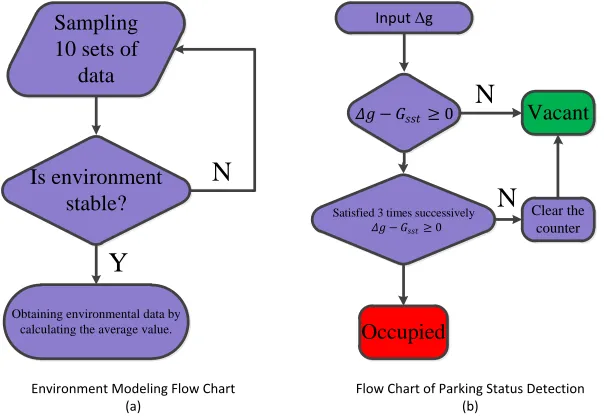
When a sensor is placed in the center of the parking space, it immediately starts to learn the environment after initializing the status to “vacant”. The environment learning is shown in Fig.4(a).
Firstly, the system starts sampling for 10 seconds with sampling rate 1 Hz. Ten sets of data, which include 3-axis geomagnetic values, are collected after 10 seconds. The mathematical description of our algorithm is shown in the following steps:
Step 1: Collect 3-axis data for 10 seconds at a 1 Hz
sampling rate. Assuming λi = {Xi, Yi, Zi}, where i is the sampling index, Xi,Yi,Zi represent the 3-axis values, λi is the data set collected in theithsec.
Step 2: Compare the values of each axis.
∆λk={|λk+1−λk|}, k∈[1,9]integer (1)
where {|λk+1 − λk|} = M ax{|Xk+1 − Xk|,|Yk+1 −
Yk|,|Zk+1 −Zk|} and ∆λ includes all the comparisons of any 2 adjacent sample values, k∈[1,9]integer. Assume λthd is the pre-defined threshold value. If all values in∆λ < λthd, then the environment is declared steady and the system goes to Step 3. Otherwise, the environment is declared unsteady, the
system returns to Step 1, and another10seconds of sampling ensues.
Step 3:Find the reference geomagnetic field value.
λref ={ P10
i=1Xi 10 ,
P10 i=1Yi
10 , P10
i=1Zi
10 } (2)
Through this environment learning method, problems men-tioned in previous section can be effectively managed without affecting the detection accuracy.
Step 4: Compare the current sampling value λcrt to the
λref.
The flow chart is shown in Fig. 4(b).
After finishing environment learning, the system samples the geomagnetic data in real time. In order to increase sam-pling accuracy, a moving average filter algorithm is used. In this filter algorithm, five successively sampled data form a sub-set. The first data in moving average is acquired by calculating the average value of the initial five sampled data. Then the first number of the series is excluded and simultaneously the next number is added into this subset, in which the averaged value is updated and regarded as the current geomagnetic data. Comparing the current sampling valueλcrtto theλref, that is ∆g =M ax|λcrt−λref|=M ax{|λcrtX−λref X|,|λcrtY − λref Y|,|λcrtZ−λref Z|}. AssumeGsstis the trigger threshold and Gsst = {GsstX, GsstY, GsstZ}. The value of Gsst will change according to different environments.
Generally,Gsstis within a range and can be approximately determined by several initializations (in our experiment the
Gsstis20for each axis). The sensitivity of the entire system can be controlled by setting a different trigger threshold for each axis. In our algorithms, the “occupied” status is determined by only 3 successive comparisons ∆g which are all larger than Gsst. Otherwise, the system determines that the geomagnetic field value changes due to some burst interference, and the parking status should be “vacant”.
C. Background Data Updating
20 40 60 80 100 −600
−400 −200 0 200
Number of samples
magnetic intensity(mG)
(2)Underground parking-->Back into
0 10 20 30 40 50 60
−400 −300 −200 −100 0 100
Number of samples
(3)surface parking lot-->Forward into
magnetic intensity(mG)
20 40 60 80 100
−600 −400 −200 0
Number of samples
magnetic intensity(mG)
(4)surface parking lot-->Back into
20 40 60 80 100
−800 −600 −400 −200 0
magnetic intensity(mG)
(1)Underground parking-->Forward into
Number of samples
drive into drive into
drive into drive into
leave leave leave
leave leave
drive into drive into leave
leave drive into leave
drive into
Fig. 3. Magnetoresistive Sensor Data Curves. The blue, red and green lines stand forx-axis,y-axis andz-axis, respectively.
Sampling
10 sets of
data
Is environment
stable?
Obtaining environmental data by calculating the average value.
N
Y
Input Δg
𝛥𝑔 − 𝐺𝑠𝑠𝑡≥ 0
Vacant
Satisfied 3 times successively
𝛥𝑔 − 𝐺𝑠𝑠𝑡≥ 0
Occupied
Clear the counter
N
N
Environment Modeling Flow Chart (a)
Flow Chart of Parking Status Detection (b)
Fig. 4. Environment Modeling Flow Chart and Parking Status Detection Flow Chart.
the geomagnetic field might vary in the detection area. If background data is not updated in time, the entire algorithm might fail due to the accumulated variations. Therefore, it is necessary to set an appropriate background data updating mechanism. In our algorithm, two methods are proposed to update background data in time. The first one is to update background data manually. This method can be realized by manual input in corresponding software; another method is an automatic mechanism accomplished by the sensors them-selves. When the system determines that a parking space has
been vacant after a period of time Tupdate, which implies a steady environment, the system goes to Step 1 mentioned in the previous section to restart the environment learning.
V. RESULTSANALYSIS
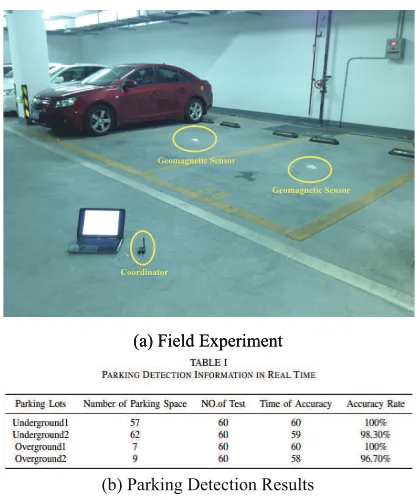
cars moving in and out) at each parking lot. Fig. 5(a)shows one of the parking lots in which the field experiments were performed.
Fig.5(b)shows the results of all four field experiment. On all four parking lots, the accuracy rate remains in a high level of over96%.
For robustness test, consider the characteristics of the magnetoresistive sensors, we designed a scenario that people carrying metal objects walks in and out of a parking space. In our BDDAEL algorithm, the sensitivity of the entire system can be determined by setting the trigger thresholdGsst, which is a convertible parameter according to different environments. If we set the trigger thresholdGsstat an appropriate value, such man-made interference can be neglected by the system itself. In our experiment, Gsst is set to 20 (in most case Gsst is within a range). In this configuration, when people carrying metal objects walk into and out of a parking space, the system is undisturbed and stays in stable. The system has high robustness.
Geomagnetic Sensor
Geomagnetic Sensor
Coordinator
(a) Field Experiment (a) Field Experiment
(b) Parking Detection Results
Fig. 5. Field Experiment Scene and Parking Detection Results in Real Time.
VI. CONCLUSION
Wireless sensor networks technology effectively provides an economic and convenient method for parking space detection systems. In this paper, geomagnetic sensors are utilized to detect the parking status. Also, an innovative BDDAEL al-gorithm, based on environment learning, energy conservation, detection accuracy and background data updating, is presented to solve some common problems existing in other parking space detection schemes. The results show that our system has high scalability, perfect accuracy, long lifetime, and low susceptibility properties, which is advanced compared to other existing parking space detection system. In future work, how
to further reducing the energy consumption will be a key study item. Moreover, how to appropriately place the router in the parking lot needs to be further studied.
VII. ACKNOWLEDGMENT
This work is supported by the 2014 Pearl River
S&T Nova Program of Guangzhou (No. 2014J2200023), the Natural Science Foundation of Guangdong Province (No.2014A030313685), the 2014 Shenzhen “City Knowledge Innovation Program” Project (No. JCYJ20140417113430604), the Open Fund of Guangdong Provincial Key Laboratory of Petrochemical Equipment Fault Diagnosis (No. GDUPTK-LAB201304), the Open Project Foundation of Information Technology Research Base of Civil Aviation Administration of China (NO. CAAC-ITRB-201406), the 2014 Foshan Sci-ence and Technology Project (NO. 2014HK100103), the 2013 Special Fund of Guangdong Higher School Talent Recruit-ment, Educational Commission of Guangdong Province, China Project No. 2013KJCX0131, Guangdong High-Tech Devel-opment Fund No. 2013B010401035, 2013 top Level Talents Project in “Sailing Plan” of Guangdong Province, National Natural Science Foundation of China (Grant NO. 61401107), and 2014 Guangdong Province Outstanding Young Professor Project.
REFERENCES
[1] Boaventura, A.J.S.; Carvalho, N.B., “A Batteryless RFID Remote Control System,” Microwave Theory and Techniques, IEEE Transactions on , vol.61, no.7, pp.2727,2736, July 2013.
[2] Pala Z., “Automation with RFID Technology as an application: Parking Lot Circulation Control (MSc),”Yuzuncu Yil University, Van,2007. [3] Lanxin, W.; Qisheng, W.; Mei, Y.; Wei, D.; Bo L.; Rong, G., “Design
and Implementation of Smart Parking Management System Based on RFID and Internet,”Control Engineering and Communication Technology (ICCECT), 2012 International Conference on, vol., no., pp.17,20, 7-9 Dec. 2012.
[4] Pala, Z.; Inanc, N., “Smart Parking Applications Using RFID Technolo-gy,”RFID Eurasia, 2007 1st Annual, vol., no., pp.1,3, 5-6, Sept. 2007. [5] Wan-Joo, P.; Byung-Sung, K.; Dong-Eun, S.; Dong-Suk, K.; Kwae-Hi, L., “Parking space detection using ultrasonic sensor in parking assistance system,” Intelligent Vehicles Symposium, 2008 IEEE , vol., no., pp.1039,1044, 4-6 June 2008.
[6] Abdel-Hafez, M.F.; Nabulsi, A.A.; Jafari, A.H.; Zaabi, F.A.; Sleiman, M.; AbuHatab, A., “A sequential approach for fault detection and identifica-tion of vehicles’ ultrasonic parking sensors,”Modeling, Simulation and Applied Optimization (ICMSAO), 2011 4th International Conference on
, vol., no., pp.1,6, 19-21 April 2011.
[7] Revathi, G.; Dhulipala, V.R.S., “Smart parking systems and sensors: A survey,” Computing, Communication and Applications (ICCCA), 2012 International Conference on ,vol., no., pp.1,5, 22-24 Feb. 2012. [8] Cui, S.Y.; Wu, M.; Liu, C.; Rong, N., “The Research and Implement
of the Intelligent Parking Reservation Management System Based on ZigBee Technology,”Measuring Technology and Mechatronics Automa-tion (ICMTMA), 2014 Sixth InternaAutoma-tional Conference on , vol., no., pp.741,744, 10-11 Jan. 2014.
[9] Honeywell International, Inc., “3-Axis Digital Compass IC HMC5883L,” http://honeywell.com/Pages/Search.aspx?k=HMC5883L.
[10] Ning, Z.; Bao, H., “Wireless Network Technology and its Applications,”
Networks Security, Wireless Communications and Trusted Computing, 2009. NSWCTC ’09. International Conference on ,vol.2, no., pp.635,638, 25-26 April 2009.
[11] Shim, S.; Park, S.; Hong, S., “Parking Management System Using Zig-Bee,”International Journal of Computer Science and Network Security ,