http://www.sciencepublishinggroup.com/j/ijdst doi: 10.11648/j.ijdst.20180404.11
ISSN: 2472-2200 (Print); ISSN: 2472-2235 (Online)
Fingerprint Classification Using Kernel Smoothing
Technique and Generalized Regression Neural Network and
Probabilistic Neural Network
Hemad Heidari Jobaneh
Department of Electrical Engineering, Azad University, South Tehran Branch, Tehran, Iran
Email address:
To cite this article:
Hemad Heidari Jobaneh. Fingerprint Classification Using Kernel Smoothing Technique and Generalized Regression Neural Network and Probabilistic Neural Network. International Journal on Data Science and Technology. Vol. 4, No. 4, 2018, pp. 106-111.
doi: 10.11648/j.ijdst.20180404.11
Received: February 27, 2019; Accepted: April 4, 2019; Published: April 26, 2019
Abstract:
Fingerprint classification is a significant process by which identification procedure can be accelerated. Feature extraction might be afflicted with rotation. Thus, all images get through an introduced criterion to rectify rotated images. The core point of fingerprints is utilized widely in both classification and recognition process. In some cases, however, inaccurate location of it might contribute to incorrect categorization. Therefore, the common point is initiated for the purpose of better performance. Features are extracted according to the way ridges’ angles are distributed across images. Plus, kernel smoothing technique is used to enhance the process. Generalized regression neural network (GRNN) and Probabilistic neural network (PNN) are employed to classify fingerprints in four categories. Fingerprint verification competition (FVC) database is used to evaluate and train the networks. The simulation is performed by MATLAB and 97.4% accuracy is achieved for both GRNN and PNN.Keywords: Common Point, Fingerprint Classification, GRNN, Kernel, Neural Network, PNN, Rotation Rectification
1. Introduction
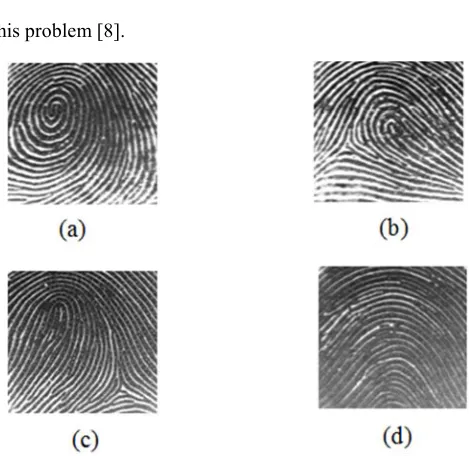
Henry system classified fingerprints in five categories called whorl, right loop, left loop, arch, and tented arch [1]. Given the considerable similarity between arch and tended arch, fingerprints can be categorized into four categories, demonstrated in figure 1.
Fingerprint classification systems carried out contain of different steps, including pre-processing, image enhancement, feature extraction, and classifiers. One of the most common elements in pre-processing is Gabor filter [2]. The frequencies of ridges can be emphasized via Gabor filter which is beneficial for both enhancement and feature extraction. In addition, core point detection is another common process [3-4]. By this approach, a point which is a decisive factor for feature extraction can be obtained. Plus, Singularities comprising of both core and delta points are useful points to classify fingerprints [5-7].
A common problem to commence the process is fingerprint rotation and an approach is brought up to solve
this problem [8].
Plus, a model is introduced according to the probability distribution of ridge directions and the main focus is on fingerprints which are incomplete or noisy [9]. Orientation of ridges is one the most common method used in the feature extraction procedure [10].
With respect to classifiers, many methods have been used. Fuzzy system is used in both classification and feature extraction [11-13]. Artificial Neural Network (ANN) is another popular method used for classification [14-15]. The combination of Markov models and decision trees is used for classification [16]. In this paper, an approach for rectifying the rotation of images is introduced. Next, a new point called common point is defined and compared to core point. Plus, two classifiers including Generalized Regression Neural Network (GRNN) and Probabilistic Neural Network (PNN) are designed to categorize fingerprints in four classes.
2. Rotation Rectification
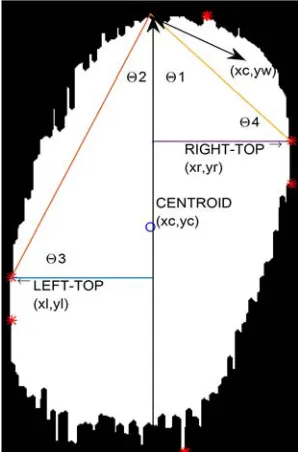
In the pre-processing stage, the rotation rectification criterion should be fulfilled in order to adjust the rotated images. Morphological processing is carried out to define the coordinates of centroid, (xc, yc), left-top, (xl, yl), and right-top, (xr, yr), depicted in figure 2. An image is considered without rotation provided that θ1and θ2are equal.
Once the coordinates of the centroid are achieved, the coordinates of the highest pixel of the image which is still on or 1 are obtained, designated (xc,yw). In fact, owing to crossing through the centroid, the first coordinate is always xc which is the same with the centroid. In order to calculate the rotation, θ3andθ4are calculated by:
1 3 t a n
− −
=
−
y w y l
x c x l
θ (1)
1 4 tan
− −
=
−
yr yw
xr xc
θ (2)
Knowing that the aggregate of any triangle’s angles is 180 degrees, θ1 and θ2 given by:
180 = θ2 + θ3 + 90 (3)
180 = θ1 + θ4 + 90 (4)
The rotation given by:
( )
1 2 1 2+
= −
ROTATION
θ θ
θ (5)
If θ1 and θ2 are equal, ROTATION is zero.
Figure 2. Rotated image with extrema.
3. The Common Point
The core point is a beneficial fact which has been used to facilitate the identification process. The error in locating the point might exacerbate the process considerably. In fact, even in pictures belonging to one person the core point algorithm might lead up to a different location, demonstrated in figure 3.
Owing to the fact that in many works fingerprints have been categorized according to blocks cropped around the core point, the aforementioned difference might bring about wrong classification. Therefore, a new point called the
common point is introduced. Two steps should be executed at
the first part, containing enhancement, and orientation angles extraction, depicted in figure 4 [17].
Figure 4. Enhancement and Orientation angles extraction [17].
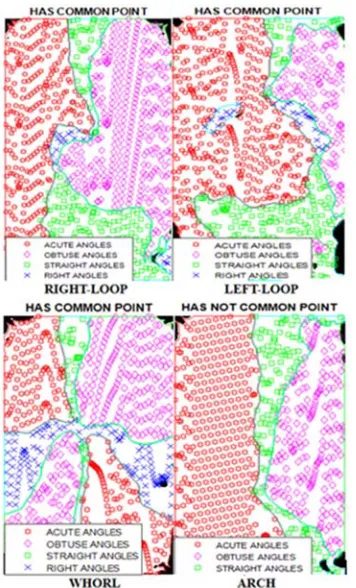
It is observed that all fingerprints consist of ridges with four types of angles, called acute angles, obtuse angles, right angles, and straight angles, shown in figure 5.
Figure 5. Distribution of different types of angles.
In order to define the common point, some definitions should be introduced, illustrated in figure 6.
1- Straight angles create an object called straight object.
2- Acute angles constitute an object called acute object. 3- Obtuse angles compose an object called obtuse object. 4- Right angles create an object called right object.
Figure 6. Different objects according to types of angles.
The common point is the point with a minimum distance
from these four objects, demonstrated in figure 7. However, unlike the core point, the common point might not exist in some fingerprints, especially in arch. In fact, the common point does not exist in images in which the straight object is distributed all over the height of images and right object does not exist.
4. Feature Extraction
Once the ridges’ angles are extracted, the following observation can be mentioned from figure 8.
1-Obtuse angles dominate right-loop.
2-Acute angles have a noticeable majority over others in the left-loop.
3-Right angles do not exist or have the minority in an arch. 4-Unlike right-loop, left-loop, and arch, whorl has the distribution of right angles, acute angles, and obtuse angles across its width.
5-unlike others, the arch has the distribution of straight angles all across its height.
Figure 8. the trend of divergent types of angles in each class.
Aforementioned observations can be utilized to obtain three parts of ultimate features. If the width of an image is considered as 100%, the width across which each type of angle is distributed is one part of final features. Indeed, these are probabilities by which different types of angles might occur through the width of images. For instance, the features are compared in table 1.
The second sets of features are achieved via kernel smoothing technique applied to ridges’ angles from the block cropped around the common point.
Table 1. Comparison between different types of angles across divergent types of fingerprints.
Type of fingerprint Acute-angles Obtuse angles Right angles
whorl 0.91 0.93 1 Right-loop 0.6 0.33 0.89 Left-loop 0.98 0.52 0.49 arch 0.61 0 0.43
Once the common point is obtained, a 30×60 block is cropped from the common point. The histogram of ridges’ angles is extracted and kernel smoothing technique is applied with the intention of obtaining nineteen parts of the final features, demonstrated in figure 9. The kernel smoothing technique is given by:
( )
1
1
ˆ ( ) ;
=
−
=
∑
− ∞ < < ∞n i h
i
x x
f x x
nh h (6)
In which K is the kernel smoothing function, h is bandwidth, and n is the sample size.
Figure 9. Kernel distribution of whorl, right-loop, and left-loop.
5. GRNN and PNN
GRNN and PNN are both kinds of radial basis networks with differences in the second layer. It is suggested that GRNN and PNN be used to approximate or classify data or functions [18-19]. The output of the kernel is considered as a function which should be approximated by GRNN or PNN.
The spread parameter is a decisive factor in both networks. It
affects the performance of both networks significantly. The designed networks are illustrated in figure 10.
The second layer of PNN is a competitive layer in comparison with GRNN which is a linear layer. Two hundred images in the database are used in the training phase. Each image includes twenty two figures. Plus, the spread is 0.1 and 3 for GRNN and PNN respectively. The performances of both networks are similar with mentioned spreads. However, the performance of PNN is afflicted with smaller spreads
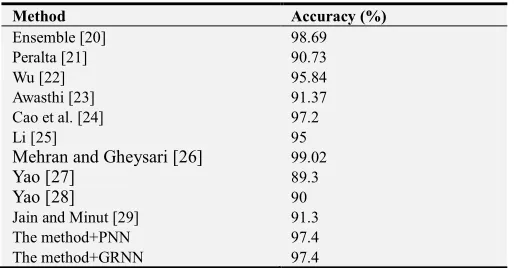
around one or lower. The accuracy of the results is shown and compared in table 2.
Table 2. Comparison of accuracy.
Method Accuracy (%)
Ensemble [20] 98.69 Peralta [21] 90.73 Wu [22] 95.84 Awasthi [23] 91.37 Cao et al. [24] 97.2 Li [25] 95
Mehran and Gheysari [26] 99.02
Yao [27] 89.3
Yao [28] 90
Jain and Minut [29] 91.3 The method+PNN 97.4 The method+GRNN 97.4
6. Conclusion
A fingerprint classification method is introduced in this paper. Ridges’ angles, the common point, and the way by which ridges’ angles are distributed in images play a significant role in feature extraction phase. A criterion by which all images are modified against rotation is mentioned. FVC2004 DB1_A database is used to train and test both networks [30]. Five hundred of images are used to test the networks. All rotated images are used to assess the performance of the system against rotation. Owing to the rotation rectification process and the common point, all features are rotation invariant and movement invariant. In big databases, classifiers should be fast and accurate. Thus, GRNN and PNN, which are both fast and accurate, are picked out.
References
[1] E. R. Henry. “Classification and Uses of Fingerprints,” HM Stationery Office, 1905.
[2] C. J. Lee, S. D. Wang, “Fingerprint feature reduction by Principal Gabor basis function,” Pattern Recognition, 34, 2001, pp. 2245-2248.
[3] C. Park, S. Oh, D. Kwak, B. Kim, Y Song, and K Park, “A new reference point detection algorithm based on orientation pattern labeling in fingerprint images”, pp. 697-703, Pattern Recognition and Image Analysis, First Iberian Conference, IbPRIA 2003.
[4] B. Bhanu and X. Tan, Fingerprint indexing based on novel features of minutiae triplets, IEEE Trans. PAMI, May 2003.
[5] L. Wei, "Fingerprint Classification using Singularities Detection", International Journal of Mathematics and computers in simulation, Vol. 2, No. 2, pp.158-162, 2008.
[6] Iwasokun, Gabriel Babatunde, and O. C. Akinyokun. “Fingerprint Singular Point Detection Based on Modified Poincare Index Method.” International Journal of Signal Processing Image Processing & Pattern Recognition 7, 2014.
[7] M. Liu. “Fingerprint Classification Based on Singularities,” Pattern Recognition, Nov. 2009, pp. 1-5. doi: 10.1109/CCPR.2009.5343966.
[8] P. Gnanasivam and S. Muttan, “An efficient algorithm for fingerprint preprocessing and feature extraction”, ICEBT 2010, Procedia computer Science, Vol. 2, 2010, pp.133-142.
[9] H. Jung, J. H. Lee. “Noisy and Incomplete Fingerprint Classification Using Local Ridge Distribution Models,” Pattern Recognition, vol. 48, Feb. 2015, pp. 473-484, doi: 10.1016/j.patcog.2014.07.030.
[10] S. C. Dass, A. K. Jain. “Fingerprint Classification Using Orientation Field Flow Curves,” Proc. Proceedings of the Fourth Indian Conference on Computer Vision, Graphics & Image Processing, Dec. 2004, pp. 650-655.
[11] S. M. Mohamed and H. O. Nyongesa, “Automatic Fingerprint Classification System Using Fuzzy Neural Techniques”, proc. Ofthe IEEE International Conference on Fuzzy System, 2002, Vol.1, pp. 358-362
[12] K. Nandakumar, A. K. Jain, and S. Pankanti, “Fingerprint-based Fuzzy Vault: Implementation and Performance,” IEEE Trans. on Info. Forensics and Security, vol. 2, no. 4, pp. 744– 757, December 2007.
[13] Surmacz, K., Saeed, K., Rapta, P., “An improved algorithm for feature extraction from a fingerprint fuzzy image”, Optica Applicata, Volume 43 – No. 3, 2013, Pages 515 – 527
[14] S. R. Patil and S. R. Suralkar, “Fingerprint Classification using Artificial Neural Network”, International Journal of EmergingTechnology and Advanced Engineering, Volume 2, Issue 10, pp.513-517, 2012, ISSN 2250-2459.
[15] V. Conti, C. Militello, S. Vitabile and F. Sorbello, “An Embedded Fingerprints Classification System based on. Weightless Neural Networks”, Frontiers in Artificial Intelligence and Applications – IOS Press Editor, Volume193: New Directions in Neural Networks, 2009, pp. 67-75, ISSN 0922-6389, doi:10.3233/978-1-58603-984-4-67.
[16] A. Senior, “A Combination Fingerprint Classifier”, IEEE Transaction on Pattern Analysis and Machine Intelligence, 2001, Vol. 23, No. 10, pp. 1165-1174
[17] R, Thai., Fingerprint Image Enhancement and Minutiae Extraction. The University of Western Australia. Retrieved from, 2003.
[18] Wasserman, P. D., Advanced Methods in Neural Computing, New York, Van Nostrand Reinhold, 1993, pp. 155–61.
[19] Wasserman, P. D., Advanced Methods in Neural Computing, New York, Van Nostrand Reinhold, 1993, pp. 35–55.
[20] Galar, M., et al. A survey of fingerprint classification Part II: Experimental analysis and ensemble proposal. Knowledge-Based Systems 81, 2015.
[22] C, Wu. S, Tulyakov., and V, Govindaraju., “Image quality measures for fingerprint image enhancement,” Multimedia Content Representation, Classification and Security, 2006, pp. 215–222.
[23] A, Awasthi., K, Venkataramani., and A, Nandini., “Image quality quantification for fingerprints using quality-impairment assessment,” in Applications of Computer Vision (WACV), IEEE, 2013, pp. 296–302.
[24] K, Cao. L, Pang. J, Liang. et al. “Fingerprint Classification by a Hierarchical Classifier,” Pattern Recognition, 2013, vol. 46, pp. 3186-3197, doi: 10.1016/j.patcog.2013.05.008.
[25] J, Li., W, Yau., H, Wang., “Combining Singular Points and Orientation Image Information for Fingerprint Classification,” Pattern Recognition, 2008, vol. 41, pp. 353-366, doi: 10.1016/j.patcog.2007.03.015.
[26] Yazdi M., and Gheysari K., “A New Approach for the
Fingerprint Classification Based on Gray-Level Co-Occurrence Matrix," Proceedings Of World Academy Of Science, Engineering And Technology, vol. 30, July 2008.
[27] Yao Y., et. al., “A new machine learning approach to fingerprint classification," 7th Congress of the Italian Association for Artificial Intelligence, pp. 57-63, 2001.
[28] Y. Yao, G. L. Marcialis, M. Pontil, P. Frasconi and F. Roli, Combining flat and structured representations for fingerprint classification with recursive neural networks and support vector machines, Pattern Recognition, vol. 36, no. 2, pp. 397-406, Feb. 2003.
[29] A. K. Jain and S. Minut, Hierarchical kernel fitting for fingerprint classification and alignment, Proc. ICPR, vol. 2, pp. 469-473, 2002.
![Figure 4. Enhancement and Orientation angles extraction [17].](https://thumb-us.123doks.com/thumbv2/123dok_us/8464963.1709548/3.595.348.511.517.751/figure-enhancement-orientation-angles-extraction.webp)