Pediatric Tuberculosis: What Needs to be Done to
Decrease Morbidity and Mortality
S. Jody Heymann, MD, PhD*‡; Timothy F. Brewer, MD, MPH‡§; Mary E. Wilson, MD*‡; Graham A. Colditz, MD, DrPH‡§; and Harvey V. Fineberg, MD, PhD储
ABSTRACT. Objective. Tuberculosis (TB) control programs have been less successful among children than among adults in the United States. Between 1992 and 1997, the rate of decline of TB cases among 0- to 14-year-old children was less than the rate of decline among any other age group of US-born persons. Because of the higher prevalence of active TB among adults and their higher infectivity, most programs for TB in the United States have targeted adults. The inherent assumption has been that by targeting adults, from whom children may become infected, TB morbidity and mortality among children also will be reduced effectively.
Methods. Using a semi-Markov model that divided the US population into age groups<15 years old and>15 years old and into 18 clinical states based on the risk for or presence of TB and human immunodeficiency virus infection, we developed a computer-based simulation model to examine the effect of a range of potential TB control strategies on projected TB cases and deaths in children. We compare the impact of interventions geted at children with the impact of interventions tar-geted at adults on pediatric morbidity and mortality.
Results. After 10 years, a 5% increase in the number of adults with TB who enter treatment would only lead to a .05% decline in TB cases among children, compared with predicted cases without this intervention. Improv-ing treatment efficacy among those adults who are al-ready receiving treatment for their TB leads to a smaller decline in cases among children of only .003%. In con-trast, a 5% increase in the number of children who enter treatment leads to a 25% decline, after 10 years, in the number of TB cases among children and a 16% decline in the number of TB deaths. In the presence of immigration of tuberculin-positive children, the benefit of targeting programs directly at children is magnified.
Conclusions. Marginal changes in programs targeted directly at children are significantly more effective at further reducing pediatric TB morbidity and mortality than the same changes in programs targeted at adults with the indirect goal of reducing spread to children.
Marginal increases in the number of children who enter treatment are far more effective at decreasing mor-bidity and mortality than equivalent marginal increases in treatment effectiveness. Unfortunately, declining in-surance coverage and increasing restrictions on services to immigrants have made it harder for those who are at
greatest risk of TB to get medical care. Marginal increases in preventive therapy rates substantially reduce future pediatric TB cases and deaths among children with TB infection and human immunodeficiency virus.Pediatrics
2000;106(1). URL: http://www.pediatrics.org/cgi/content/ full/106/1/e1;pediatric tuberculosis, tuberculosis control, tuberculosis prevention, computer simulation models.
ABBREVIATIONS. TB, tuberculosis; HIV, human immunodefi-ciency virus.
T
uberculosis (TB) control programs have beenless successful among children than among adults in the United States. In Boston and New Jersey, the percentage of school-aged children with a positive tuberculin skin test result substantially in-creased between 1985 and 1993.1The epidemic of TB
that occurred in the United States between 1985 and 1993 resulted in 64 000 excess cases of active TB with costs in excess of $1 billion.2,3Even when TB control
efforts reversed the rising incidence of TB and led to a decline in US TB cases, children at risk for TB did not share proportionally in the gains. TB cases in US-born children continued to rise for 2 years longer than in adults.4Between 1992 and 1997, the rate of
decline of TB cases among 0- to 14-year-old children was less than the rate of decline among any other age group of US-born persons.5 Microepidemics of TB
among children continue to occur.6 – 8 Furthermore,
even with recently intensified measures, we are fail-ing to meet national goals set in 1989 for decreasfail-ing the incidence of TB.9,10
Specific groups of children have been particularly hard hit. Children infected with human immunode-ficiency virus (HIV) are at high risk for developing TB.11,12The percentage of TB cases occurring in
for-eign-born individuals continues to increase13; in New
York City, 62% of TB cases occurring in children⬍5 years old during a 6-month period in 1992 were born outside the US or had foreign-born caretakers.14
Because of the higher prevalence of active TB among adults and their higher infectivity, most pro-grams for TB in the United States have targeted adults. The implicit assumption has been that by targeting adults from whom children may become infected, TB morbidity and mortality among children also will be reduced effectively. Treatment of adult active cases has been the foundation for most na-tional policies to control the spread of TB, including in children.15–17 Because TB case rates have not de-From *Harvard School of Public Health; ‡Harvard Medical School;
§Chan-ning Laboratory, Brigham and Women’s Hospital; and储Harvard Univer-sity, Boston, Massachusetts.
Received for publication Aug 23, 1999; accepted Feb 2, 2000.
Reprint requests to (S.J.H.) Department of Health and Social Behavior, Harvard School of Public Health, 677 Huntington Ave, Boston, MA 02115. E-mail: [email protected]
clined as markedly in children as they have in adults, it is appropriate to reevaluate this strategy.
We developed a computer-based simulation model to examine the effect of a range of potential TB control strategies on projected TB cases and deaths in children. We measured the impact on pediatric mor-bidity and mortality of interventions targeted at chil-dren in comparison with interventions targeted at adults. We modeled the impact of increasing the number of individuals who receive chemoprophy-laxis, increasing the number of individuals who re-ceive prompt treatment, and increasing the effective-ness of treatment. Finally, because a high number of cases occur among foreign-born and HIV-infected children, we modeled how immigration and HIV influence what policy approaches will be most effec-tive in eliminating TB among children.
METHODS
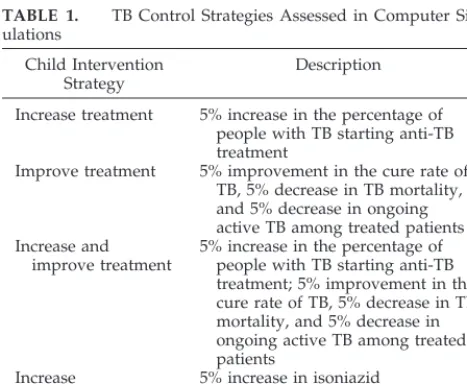
This study uses a computer simulation model to follow the US general population for 10 years and project the impact of TB control measures on morbidity and mortality in children. To as-sess the impact of different interventions currently used in the United States, a series of strategies are introduced, singly and in combinations in children or adults. The interventions include increasing the percentage of patients with active TB who start treatment by 5%, increasing treatment effectiveness by 5%, and increasing the proportion of tuberculin-positive persons who re-ceive isoniazid chemoprophylaxis by 5% (Table 1). The 5% value was chosen based on earlier work that suggested that this level of improvement was both realistic and obtainable. Sensitivity anal-yses were conducted varying the level of improvement in TB control interventions from 2.5% to 7.5%. The relationship among the different interventions was the same, although 2.5% improve-ments were, as expected, less effective than 5% improveimprove-ments, and 7.5% improvements were more effective. Only the results with 5% improvements in TB control interventions are reported.
The modeled outcomes are the prevalence of children ⬍15 years old with active TB (separated into drug-sensitive and mul-tiple-drug–resistant disease), and deaths (separated into tubercu-lous and nontubercutubercu-lous) as a function of the public health mea-sures taken to control and to eliminate TB. The effectiveness of marginal changes in control strategies was calculated as the per-centage difference between pediatric TB cases or TB deaths after 10 years with and without the changes.
The simulation model is based on a semi-Markov process. Briefly, the population is divided into 2 age groups:⬍15 years old andⱖ15 years old. (Because of limits in data availability, children
were not subdivided into narrower age categories.) Each age group is subdivided into 18 nonoverlapping, completely exhaus-tive clinical states based on TB and HIV status (Table 2). (Com-pletely exhaustive is a modeling concept that means that everyone in the model population can be placed in a category or state.) Examples of TB states in the model include no TB infection, latent TB infection, and active TB. The states are linked by transition equations developed from decision trees. These equations deter-mine the likelihood that individuals remain in 1 state, for example, and TB-uninfected, or move to another, for example, HIV-and TB-infected, from 1 period to the next. In all analyses, 1 period equals 1 year. This structure is reproduced to allow for 10 periods of observation of health outcomes.
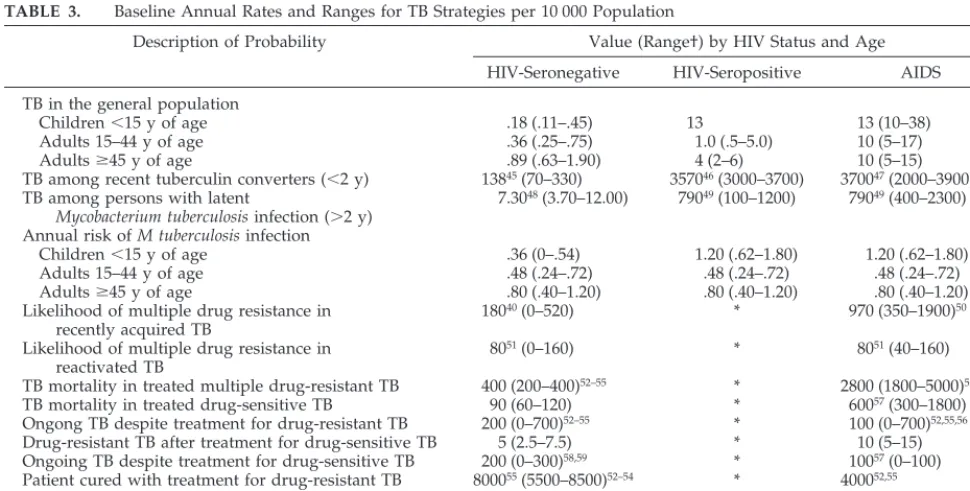
US population data for 1995 are used to calculate the initial population in each risk state. Transition probabilities are derived from the following sources: published literature, Centers for Dis-ease Control and Prevention data on TB epidemiology and control program participation rates and results, US population data from the Department of Commerce, immigration data from the Justice Department, and World Health Organization data on Bacille Calmette-Gue´rin vaccination rates (Table 3). In each period, the population is supplemented by live births with and without HIV infection, and immigrants with and without TB infection and Bacille Calmette-Gue´rin vaccination.
The accuracy of the baseline model was checked using national TB data for 1996 and 1997. The annual number of TB deaths reported by the Centers for Disease Control and Prevention for these years were 1336 in 1996 and 1194 in 1997.18The 1995 baseline model predicted these deaths within 1.3%; the model predicted 1341 TB deaths in 1996 and 1209 in 1997.
A sensitivity analysis of the impact of interventions was con-ducted by varying all transition probabilities simultaneously over defined ranges. The model was run 500 times using Latin hyper-cube sampling19 –21(Decisioneering Crystal Ball, Denver, CO) to create projected distributions for each baseline outcome. The tran-sition probabilities corresponding to an intervention or combina-tion of intervencombina-tions were adjusted and the model was rerun 500 times using the same method to generate a new set of projected TB cases and deaths. The projected TB cases and deaths with and without the intervention were compared.
Ranges used in the sensitivity analysis were derived from the literature (Table 3). Quality of parameter estimates was assessed by examining original research studies; sample size, study design, reliability, validity, and generalizability were all taken into ac-count. In a number of cases, best parameter estimates were found to occur close to the high or low end of the range used for sensitivity analyses. Because of this, best estimates of the impact of interventions may lie close to the high or low values of sensitivity analyses in some cases.
RESULTS
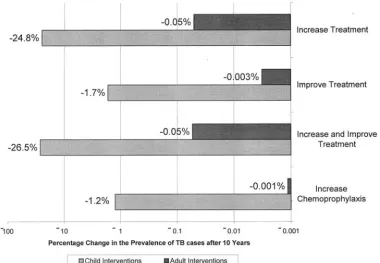
For every intervention or combination of interven-tions studied, control strategies targeted at children were significantly more effective in reducing pediat-ric TB cases over 10 years than the same increase in interventions in adults (Fig 1).
Therapeutic Interventions Targeted at Adults
A 5% increase in the number of adults with TB who enter treatment led to essentially no change in the prevalence of pediatric TB cases and deaths after 10 years, compared with the number projected with-out this intervention. TB cases in children declined .05%.
Marginal improvement in treatment effectiveness among adults already receiving TB therapy also had little effect on TB in children, compared with baseline strategies. Projected pediatric TB cases dropped .003% after 10 years compared with the baseline.
A combination of these 2 strategies targeted at adults was similar to the results from increased treat-ment rates alone in adults. The absolute change in
TABLE 1. TB Control Strategies Assessed in Computer Sim-ulations
Child Intervention Strategy
Description
Increase treatment 5% increase in the percentage of people with TB starting anti-TB treatment
Improve treatment 5% improvement in the cure rate of TB, 5% decrease in TB mortality, and 5% decrease in ongoing active TB among treated patients Increase and
improve treatment
5% increase in the percentage of people with TB starting anti-TB treatment; 5% improvement in the cure rate of TB, 5% decrease in TB mortality, and 5% decrease in ongoing active TB among treated patients
Increase
chemoprophylaxis
5% increase in isoniazid
chemoprophylaxis among groups for whom it is currently
the prevalence of pediatric TB cases and deaths by the introduction of the above adult TB control strat-egies was⬍1 case and 1 death after 10 years.
Pediatric Therapeutic Interventions
A 5% increase in the number of children who enter treatment leads to a 25% decline in the number of TB cases among children and a 16% decline in the num-ber of TB deaths after 10 years, compared with the baseline predicted without this intervention. Al-though increasing treatment efficacy among children is less effective than increasing the number of chil-dren who enter treatment, it remains more effective in reducing future pediatric cases and deaths than therapeutic interventions among adults. Improving treatment efficacy leads to a 1.7% decline in pediatric TB cases and a 1.3% decline in pediatric deaths (Fig 2).
The results of sensitivity analyses for targeted pe-diatric TB control strategies are shown in Table 4.
Preventive Measures Targeted at Adults
Increasing chemoprophylaxis among adults did not lead to substantial declines in pediatric TB cases or deaths after 10 years, compared with baseline projections. Increasing the probability that TB-in-fected adults receive chemoprophylaxis by 5% led to a .001% decline in pediatric TB cases and a .01% decline in pediatric TB deaths (Fig 1).
Preventive Interventions Targeted at Children
Increasing preventive chemoprophylaxis among children with positive tuberculin skin test results led to a 1.2% decline in projected pediatric TB cases and
TABLE 2. Initial Population Prevalence for Each Clinical State Based on HIV Status and Risk for TB Clinical State Number of Individuals
No Known HIV Infection
HIV-Seropositive
AIDS
No known infection 240 million 900 00015,34,35 67 00034–36 High risk for active TB† 29 000 3300 160037,38 Low risk for active TB‡ 9.1 million39 22 000 3400
Drug-sensitive active TB 1500 § 240
Drug-resistant active TB 17040 § 17041
Nontuberculosis deaths 2.3 million42 43 00043 46 00044
Death attributable to TB 800 § 540
AIDS indicates acquired immunodeficiency syndrome.
* Calculated by subtracting the number of persons with HIV infection, Mycobacterium tuberculosis infection, or both from the US population.
† Risk attributable to recentM tuberculosisinfection or partially treated active TB.
‡ Risk attributable to long-standingM tuberculosisinfection or partially completed chemoprophylaxis. § HIV-infected persons with active TB have AIDS by 1993 Centers for Disease Control and Prevention criteria.
TABLE 3. Baseline Annual Rates and Ranges for TB Strategies per 10 000 Population
Description of Probability Value (Range†) by HIV Status and Age
HIV-Seronegative HIV-Seropositive AIDS
TB in the general population
Children⬍15 y of age .18 (.11–.45) 13 13 (10–38)
Adults 15–44 y of age .36 (.25–.75) 1.0 (.5–5.0) 10 (5–17)
Adultsⱖ45 y of age .89 (.63–1.90) 4 (2–6) 10 (5–15)
TB among recent tuberculin converters (⬍2 y) 13845(70–330) 357046(3000–3700) 370047(2000–3900) TB among persons with latent
Mycobacterium tuberculosisinfection (⬎2 y)
7.3048(3.70–12.00) 79049(100–1200) 79049(400–2300)
Annual risk ofM tuberculosisinfection
Children⬍15 y of age .36 (0–.54) 1.20 (.62–1.80) 1.20 (.62–1.80) Adults 15–44 y of age .48 (.24–.72) .48 (.24–.72) .48 (.24–.72) Adultsⱖ45 y of age .80 (.40–1.20) .80 (.40–1.20) .80 (.40–1.20) Likelihood of multiple drug resistance in
recently acquired TB
18040(0–520) * 970 (350–1900)50
Likelihood of multiple drug resistance in reactivated TB
8051(0–160) * 8051(40–160)
TB mortality in treated multiple drug-resistant TB 400 (200–400)52–55 * 2800 (1800–5000)52,55,56 TB mortality in treated drug-sensitive TB 90 (60–120) * 60057(300–1800) Ongong TB despite treatment for drug-resistant TB 200 (0–700)52–55 * 100 (0–700)52,55,56 Drug-resistant TB after treatment for drug-sensitive TB 5 (2.5–7.5) * 10 (5–15) Ongoing TB despite treatment for drug-sensitive TB 200 (0–300)58,59 * 10057(0–100) Patient cured with treatment for drug-resistant TB 800055(5500–8500)52–54 * 400052,55 Patient cured with treatment for drug-sensitive TB 900058–60(5500–9200) * 655057
Isoniazid mortality 661,62(3–9) 42‡ 42‡
* HIV-infected persons with active TB have AIDS by 1993 Centers for Disease Control and Prevention criteria. † Ranges used in sensitivity analyses.
a 1.9% decline in TB deaths after 10 years (Fig 2). Increasing preventive chemotherapy use in skin test-positive children was even more effective at reduc-ing acquired immunodeficiency syndrome-associ-ated pediatric TB cases and deaths over 10 years (7% decline in TB cases and 4% decline in TB deaths among children with HIV) than pediatric TB cases (1.2% decline) and deaths (.9% decline) among chil-dren without HIV.
Fig 1. Comparison of effectiveness of adult and child interventions.
Fig 2. Percentage change in pediatric TB cases and deaths with the introduction of 1 or more control measures targeted at children.
TABLE 4. Sensitivity Analysis Providing Latin Hypercube Es-timate of Range of Impact
Child Intervention Strategy
TB Cases (%) TB Deaths (%)
Increase treatment ⫺29.5 to⫺8.0 ⫺20.7 to⫺12.6 Improve treatment ⫺2.6 to⫺1.1 ⫺2.4 to⫺1.1 Increase and improve
treatment ⫺
26.8 to⫺13.3 ⫺22.0 to⫺14.9
Understanding the Limited Effectiveness of Adult Interventions at Reducing Pediatric Cases and Deaths
Assumptions that improvements in US TB control programs targeted at adults would lead to effective elimination of TB among children rely on the suppo-sition that infectious adults have access to these pro-grams before transmission of TB to children occurs. This assumption may not be valid for children im-migrating to the United States from countries with high TB prevalence rates.
All adult TB control strategies were rerun with the assumption that there was no immigration of tuber-culin skin test-positive children into the US popula-tion. The effectiveness of TB control strategies tar-geted at adults at reducing TB cases and deaths in children increased by over 50-fold, compared with the results predicted when immigration of tuberculin skin test-positive children occurred (Fig 3). However, even under these extreme assumptions, strategies targeting adults remained less effective at reducing pediatric cases and deaths than the same interven-tion targeting children.
DISCUSSION
The results of this simulation model have impor-tant implications for reducing the morbidity and mortality from TB among children in the United States. First, programs and policies directly targeting children have a critical role to play. Both in the presence and in the absence of immigration, addi-tional programs targeted directly at children are sig-nificantly more effective at reducing pediatric TB morbidity and mortality than are additional pro-grams targeted at adults with the indirect goal of reducing spread to children. In the presence of im-migration of tuberculin-positive children, the benefit of targeting programs directly at children is magni-fied many-fold.
The proportion of US TB cases among the
foreign-born population continues to increase. In 1991,
⬎1 827 000 immigrants were admitted to the United States; ⬃148 400 were children ⬍15 years old.22 The
vast majority came from TB endemic countries, such as Mexico, the Philippines, the former Soviet Union, and Vietnam.22Treating adults with TB protects
chil-dren only when it prevents transmission from occur-ring. When transmission has already occurred, then further reductions in the TB burden in adults has little impact on TB case rates in children.
Second, marginal increases in the number of chil-dren who enter treatment are far more effective at decreasing morbidity and mortality than marginal increases in treatment effectiveness. This result is probably due to the already high level of efficacy of current treatment programs. Although a great deal of appropriate attention has been paid to improving the effectiveness of TB treatment in the United States, far less attention has been paid to the availability of treatment. Unfortunately, several national trends have made it harder for those who are at greatest risk of TB to get medical care. The number of Americans who lack health insurance has continued to rise. A total of 10.7 million children in the United States lacked health insurance in 1997.23 The health care
available to immigrants, who are at higher risk for TB, has been impeded by legislation limiting access among both documented and undocumented immi-grants to state and federally funded services.24 –28
Third, marginal increases in preventive therapy rates substantially reduce future pediatric TB cases and deaths among children with TB infection and HIV. Well-prepared models may predict the effectiveness of proposed interventions to control TB before such data exist from population-based trials.29 –33
How-ever, it is important to validate model results with ongoing clinical studies and epidemiologic surveil-lance.
In 1989, the United States set a goal of TB
tion. Although increased efforts have led to declines in TB caseloads, we are not currently meeting the goals set for reducing the burden of this preventable and treatable disease. Reductions in TB morbidity and mortality have been slower among children than among adults, undoubtedly reflecting the focus on adult interventions and their relative ineffectiveness in reducing pediatric illness and death. Improving the quality of existing adult treatment programs will not be enough. If 1 of our national goals is to reduce the burden of TB in children, we will need to aim interventions directly at children. TB programs that increase children’s access to diagnosis and treatment need to be developed and implemented, particularly as the TB burden among non-US-born individuals rises. These programs, targeted at children, will be far more effective than the same interventions aimed at adults, with the hope that children will benefit indirectly.
ACKNOWLEDGMENTS
This work was supported by the US Centers for Disease Con-trol and Prevention, Atlanta, Georgia through a collaborative agreement with the Association of Schools of Public Health and Clinical Investigator Award 1K08 AI01444-01A1 from the National Institute of Allergy and Infectious Diseases.
We thank Yvonne Wilson, Scott Korvek, Carolyn Kloek, Cara Bergstrom, and Maria Palacios for their invaluable research and staff assistance.
REFERENCES
1. Driver CR, Valway SE, Cantwell MF, Onorato IM. Tuberculin skin test screening in schoolchildren in the United States. Pediatrics. 1996;98: 97–102
2. Centers for Disease Control and Prevention. Expanded tuberculosis surveillance and tuberculosis morbidity—United States, 1993.MMWR CDC Surveill Summ. 1994;43:361–366
3. Frieden TR, Fujiwara PI, Washko RM, Hamburg MA. Tuberculosis in New York City: turning the tide.N Engl J Med. 1995;333:229 –233 4. Centers for Disease Control and Prevention. Tuberculosis morbidity—
United States, 1994.MMWR CDC Surveill Summ. 1995;44:387–395 5. Centers for Disease Control and Prevention. Tuberculosis morbidity
rates—United States, 1997.MMWR CDC Surveill Summ. 1998;47:13 6. Kimerling ME, Vaughn ES, Dunlap NE. Childhood tuberculosis in
Alabama: epidemiology of disease and indicators of program effective-ness, 1983 to 1993.Pediatr Infect Dis J. 1995;14:678 – 684
7. Nivin B, Nicholas P, Gayer M, Frieden TR, Fujiwara PI. A continuing outbreak of multidrug-resistant tuberculosis, with transmission in a hospital nursery.Clin Infect Dis. 1998;26:303–307
8. Hauger SB, Dooley L, Krotzer P, et al. Tuberculosis transmission from an infant in a day care center. Presented at the 38th Interscience Con-ference on Antimicrobial Agents and Chemotherapy; September 24 –27, 1998. Abstract L-28
9. Centers for Disease Control and Prevention. A strategic plan for the elimination of tuberculosis in the United States.MMWR CDC Surveill Summ. 1989;38(suppl S-3):1–25
10. Brewer TF, Heymann SJ, Colditz GA, et al. Evaluation of tuberculosis policies using computer simulation.JAMA. 1996;276:1898 –1903 11. Gutman L, Moye J, Zimmer B, Tian C. Tuberculosis in human
immu-nodeficiency virus-exposed or -infected United States children.Pediatr Infect Dis J. 1994;13:963–968
12. Hoffman ND, Kelly C, Futterman D. Tuberculosis infection in human immunodeficiency virus-positive adolescents and young adults: a New York City cohort.Pediatrics. 1996;97:198 –203
13. Centers for Disease Control and Prevention. Characteristics of foreign-born Hispanic patients with tuberculosis— eight US counties bordering Mexico, 1995.MMWR CDC Surveill Summ. 1996;45:1032–1036 14. Driver CR, Luallen JJ, Good WE, Valway SE, Frieden TR, Onorato IM.
Tuberculosis in children younger than five years old: New York City. Pediatr Infect Dis J. 1995;14:112–117
15. Centers for Disease Control and Prevention. National action plan to
combat multidrug-resistant tuberculosis.MMWR CDC Surveill Summ. 1992;41(RR-11):1– 45
16. Centers for Disease Control and Prevention. Prevention and control of tuberculosis in US communities with at-risk minority populations and prevention and control of tuberculosis among homeless persons. MMWR CDC Surveill Summ. 1992;41(RR-5):1–23
17. Centers for Disease Control and Prevention. Prevention of tuberculosis in migrant farm workers.MMWR CDC Surveill Summ. 1992;41(RR-10): 1–11
18. Centers for Disease Control and Prevention.Reported Tuberculosis in the United States, 1997. Atlanta, GA: Centers for Disease Control and Prevention; 1998:9
19. Seaholm SK, Ackerman E, Wu SC. Latin hypercube sampling and the sensitivity analysis of a Monte Carlo epidemic model.Int J Biomed Comput. 1988;23:97–112
20. Blower SM, McLean AR, Porco TC, et al. The intrinsic transmission dynamics of tuberculosis epidemics.Nat Med. 1995;1:815– 821 21. Blower SM, Dowlatabadi H. Sensitivity and uncertainty analysis of
complex models of disease transmission: an HIV model, as an example. Int Stat Rev. 1994;62:229 –243
22. US Immigration and Naturalization Service Statistics Division. Immi-grants Admitted by Country of Birth and Major Category of Admission: Fiscal Years 1991 and 1992. Washington, DC: US Immigration and Naturaliza-tion Service; 1994
23. US Census Bureau. March 1998 Current Population Survey. Available at: http://www.census.gov/hhes/hlthins/hthin97/hi97t5.html 24. Caswell EA. Immigrants and health care: mounting problems. Ann
Intern Med. 1995;122:309 –310
25. Ziv TA, Lo B. Denial of care to illegal immigrants—proposition 187 in California.N Engl J Med. 1995;332:1095–1098
26. Ladenheim K. Health insurance coverage of foreign-born US resi-dents—the implications of the new welfare reform law.Am J Public Health. 1997;87:12–14 Comment
27. Ellwood MR, Ku L. Welfare and immigration reforms: unintended side effects for Medicaid.Health Aff. 1998;17:137–151
28. Committee on Community Health Services. Health care for immigrant families.Pediatrics. 1997;100:153–156
29. Heymann SJ. Modelling the efficacy of prophylactic and curative ther-apies for preventing the spread of tuberculosis in Africa.Trans R Soc Trop Med Hyg. 1993;87:406 – 411
30. Heymann SJ. The influence of program acceptability on the effective-ness of public health policy: a study of directly observed therapy for tuberculosis.Am J Public Health. 1998;88:442– 445
31. Whalen CC, Johnson JL, Okwera A, et al. A trial of three regimens to prevent tuberculosis in Ugandan adults infected with the human im-munodeficiency virus.N Engl J Med. 1997;337:801– 808
32. Mwinga A, Hosp M, Godfrey-Faussett P, et al. Twice weekly tubercu-losis preventive therapy in HIV infection in Zambia. AIDS. 1998;12: 2447–2457
33. Zwarenstein M, Schoeman JH, Vundule C, Lombard CJ, Tatley M. Randomized controlled trial of self-supervised and directly observed treatment of tuberculosis.Lancet. 1998;352:1340 –1343
34. Centers for Disease Control and Prevention. HIV/AIDS Surveillance Report. Atlanta, GA: US Department of Health and Human Services; 1995:33
35. Centers for Disease Control and Prevention. HIV/AIDS Surveillance Report. Atlanta, GA: US Department of Health and Human Services; 1994;6:34
36. Centers for Disease Control and Prevention. National action plan to combat multidrug-resistant tuberculosis.MMWR CDC Surveill Summ. 1992;41(suppl RR-11):1– 45
37. Centers for Disease Control and Prevention, Division of Tuberculosis Elimination.Tuberculosis Program Management Report: Contact Follow-up for 1994. Atlanta, GA: US Department of Health and Human Services; 1995. Form CDC 72.16
38. Shafer RW, Edlin BR. Tuberculosis in patients infected with human immunodeficiency virus: perspective on the last decade.Clin Infect Dis. 1996;22:683–704
39. Centers for Disease Control and Prevention. Screening for tuberculosis and tuberculous infections in high risk populations—recommendations of the Advisory Committee for Elimination of Tuberculosis.MMWR CDC Surveill Summ. 1990;39(suppl RR-8):1–7
40. Centers for Disease Control and Prevention.Reported Tuberculosis in the United States, 1995. Atlanta, GA: US Department of Health and Human Services; 1996:26
42. Centers for Disease Control and Prevention.Monthly Vital Statistics Report. Atlanta, GA: US Department of Health and Human Services; 1997:46
43. Centers for Disease Control and Prevention. Summary of notifiable diseases, United States 1995.MMWR CDC Surveill Summ. 1996;44:916 44. Centers for Disease Control and Prevention. HIV/AIDS Surveillance
Report. Atlanta, GA: US Department of Health and Human Services; 1996:19 –20
45. Hart PD, Sutherland I. BCG and vole bacillus vaccines in the prevention of tuberculosis in adolescence and early adult life.Br Med J. 1977;2: 293–295
46. Dooley SW, Villarino ME, Lawrence M, et al. Nosocomial transmission of tuberculosis in a hospital unit for HIV-infected patients. JAMA. 1992;267:2632–2635
47. Daley CL, Small PM, Schecter GF, et al. An outbreak of tuberculosis with accelerated progression among persons infected with the human immunodeficiency virus: an analysis using restriction-fragment-length polymorphisms.N Engl J Med. 1992;326:231–235
48. Comstock GW, Woolpert SF, Livesay VT. Tuberculosis studies in Mus-cogee County, Georgia: twenty-year evaluation of a community trial of BCG vaccination.Public Health Rep. 1976;91:276 –280
49. Selwyn PA, Hartel D, Lewis VA, et al. A prospective study of the risk of tuberculosis among intravenous drug users with human immunode-ficiency virus infection.N Engl J Med. 1989;320:545–550
50. Gordin FM, Nelson ET, Matts JP, et al. The impact of human immuno-deficiency virus infection on drug-resistant tuberculosis.Am J Respir Crit Care Med. 1996;154:1478 –1483
51. Hobby GL, Johnson PM, Boytar-Papirnyk V. Primary drug resistance: a continuing study of drug resistance in a veteran population within the United States.Am Rev Respir Dis. 1974;110:95–98
52. Turett GS, Telzak EE, Torian LV, et al. Improved outcomes for patients
with multidrug-resistant tuberculosis.Clin Infect Dis. 1995;21:1238 –1244 53. Telzak EE, Sepkowitz K, Alpert P, et al. Multidrug-resistant tuberculosis
in patients without HIV infection.N Engl J Med. 1995;333:907–911 54. Goble M, Iseman MD, Madsen LA, et al. Treatment of 171 patients with
pulmonary tuberculosis resistant to isoniazid and rifampin. N Engl J Med. 1993;328:527–532
55. Park MM, Davis AL, Schuger NW, et al. Outcome of MDR-TB patients, 1983–1993: prolonged survival with appropriate therapy.Am J Respir Crit Care Med. 1996;153:317–324
56. Salomon N, Perlman DC, Friedmann P, et al. Predictors and outcome of multidrug-resistant tuberculosis.Clin Infect Dis. 1995;21:1245–1252 57. Small PM, Schecter GF, Goodman PC, Sande MA, Chassion RE,
Hopewell PC. Treatment of tuberculosis in patients with advanced human immunodeficiency virus infection. N Engl J Med. 1991;324: 289 –294
58. Cohn DL, Catlin BJ, Peterson KL, Judson FN, Sbarbaro JA. A 62-dose, 6-month therapy for pulmonary and extrapulmonary tuberculosis.Ann
Intern Med.1990;112:407– 415
59. China Tuberculosis Control Collaboration. Results of directly observed short-course chemotherapy in 112,842 Chinese patients with smear-positive tuberculosis.Lancet. 1996;347:358 –362
60. Combs DL, O’Brien RJ, Geiter LJ. US Public Health Service tuberculosis short-course chemotherapy trial 21: effectiveness, toxicity, and accept-ability.Ann Intern Med. 1990;112:397– 406
61. Rose DN, Schechter CB, Sacks HS. Preventive medicine for HIV-infected patients: an analysis of isoniazid prophylaxis for tuberculin reactors and for anergic patients.J Gen Intern Med. 1992;7:589 –594 62. Kopanoff DE, Snider DE, Caras GJ. Isoniazid-related hepatitis: a US
DOI: 10.1542/peds.106.1.e1
2000;106;e1
Pediatrics
Harvey V. Fineberg
S. Jody Heymann, Timothy F. Brewer, Mary E. Wilson, Graham A. Colditz and
Mortality
Pediatric Tuberculosis: What Needs to be Done to Decrease Morbidity and
Services
Updated Information &
http://pediatrics.aappublications.org/content/106/1/e1
including high resolution figures, can be found at:
References
http://pediatrics.aappublications.org/content/106/1/e1#BIBL
This article cites 45 articles, 5 of which you can access for free at:
Permissions & Licensing
http://www.aappublications.org/site/misc/Permissions.xhtml
in its entirety can be found online at:
Information about reproducing this article in parts (figures, tables) or
Reprints
http://www.aappublications.org/site/misc/reprints.xhtml
DOI: 10.1542/peds.106.1.e1
2000;106;e1
Pediatrics
Harvey V. Fineberg
S. Jody Heymann, Timothy F. Brewer, Mary E. Wilson, Graham A. Colditz and
Mortality
Pediatric Tuberculosis: What Needs to be Done to Decrease Morbidity and
http://pediatrics.aappublications.org/content/106/1/e1
located on the World Wide Web at:
The online version of this article, along with updated information and services, is
by the American Academy of Pediatrics. All rights reserved. Print ISSN: 1073-0397.