A Support Program for
Somali-born Parents on Children’s
Behavioral Problems
Fatumo Osman, RN, MPH, a, b Renée Flacking, RN, b Ulla-Karin Schön, b Marie Klingberg-Allvin, RN, RMa, b
abstract
OBJECTIVES: The objectives of this study were to evaluate a culturally tailored parentingsupport program (Ladnaan) for Somali-born parents and to determine its effectiveness on children’s emotional and behavioral problems.
METHODS: This randomized controlled trial included 120 Somali-born parents with children aged 11 to 16 years. The parents reported self-perceived stress in relation to parenting practices. The intervention consisted of culturally tailored societal information combined with the parenting program Connect. Parents received 12 weeks of intervention, 1 to 2 hours each week, in groups of 12 to 17 parents. Nine group leaders with a Somali background who received a standardized training program delivered the intervention. The primary outcome was a decrease in emotional and behavioral problems based on a Child Behavior Checklist. Parents were randomly allocated either to an intervention group or a wait-list control group. Covariance analyses were conducted according to intention-to-treat principles.
RESULTS: The results showed significant improvement in the children in the intervention group for behavioral problems after a 2-month follow-up. The largest effect sizes according to Cohen’s d were in aggressive behavior (95% confidence interval [CI], 1.06 to 3.07), social problems (95% CI, 0.64 to 1.70), and externalizing problems (95% CI, 0.96 to 3.53).
CONCLUSIONS: The large effect sizes in this study show that this 12-week culturally tailored parenting support program was associated with short-term improvements in children’s behavior. The study adds to the field of parenting interventions by demonstrating how to culturally tailor, engage, and retain parenting programs for immigrant parents.
aDepartment of Women’s and Children’s Health, Karolinska Institutet, Stockholm, Sweden; and bSchool of
Education, Health and Social Studies, Dalarna University, Falun, Sweden
All authors conceptualized and designed the study. Ms Osman collected the data, conducted the initial data analysis, and drafted the initial manuscript; Dr Flacking was responsible for data analyses and interpretation; Dr Schön reviewed and revised the manuscript; and Dr Klingberg-Allvin was responsible for data analyses and interpretation. All authors revised, reviewed, and approved the fi nal manuscript as submitted.
This trial has been registered at www. clinicaltrials. gov (identifi er NCT02114593). DOI: 10.1542/peds.2016-2764
Accepted for publication Dec 13, 2016
Address correspondence to Fatumo Osman, RN, MPH, Dalarna University, 79188 Falun, Sweden. E-mail: [email protected]
PEDIATRICS (ISSN Numbers: Print, 0031-4005; Online, 1098-4275).
Copyright © 2017 by the American Academy of Pediatrics To cite: Osman F, Flacking R, Schön U, et al. A Support Program for Somali-born Parents on Children’s Behavioral Problems. Pediatrics. 2017;139(3):e20162764
WHAT’S KNOWN ON THIS SUBJECT: Immigration and transition to a new country may render constraints and cause disharmony and power-confl ict problems in parent–child relationships. Parenting support programs have been shown to improve the health of parents and children. However, immigrants are underrepresented in parental programs.
Life and family events premigration and postmigration have been found to have a profound effect on the health and well-being of immigrant children. 1, 2 Risk factors include
trauma, separation from parents, nonvoluntary migration, obstacles in the acculturation process, 3 and
children who immigrate in their mid- or late teens. 1, 4 Research also shows
that parents who have experienced or witnessed violence have poorer mental health, 2, 5 which is likely to
affect parent–child attachment and negatively impact child development and mental health. 5 Transitioning
to a new country may be beneficial for both parents and children, but it may render new and unexpected constraints in the parent–child relationship (eg, children tend to acculturate to the new country faster than their parents), cause disharmony and power conflicts, 6–8
and, subsequently, affect the child’s mental health. 9
Parental mental health and positive parent–child relationships are protective factors for the mental health of adolescents and young children. 10–12 Parenting support
programs have repeatedly shown positive effects on children’s emotional and behavioral problems. 10, 13, 14 One
evidence-based parenting support program is Connect, which is derived from attachment theory. 15 It focuses
on strengthening parent–child relationships by having parents reflect on their parenting to form a secure attachment with their children.
Several studies have shown that immigrants and ethnic groups are underrepresented in parenting support programs and that the programs only reach native-born parents and those parents with higher levels of education. 16–18
There are also difficulties related to recruiting and retaining immigrant parents and hard-to-reach groups in interventions. 19, 20 There is limited
evidence on parenting intervention programs directed toward immigrant parents.
The Somali population is one of the largest asylum groups in Sweden. 21
A study 6 on Somali-born parents
showed a need for specific support to improve the transition to various new demands on parenthood in the host country. The parents expressed a need for information about parenthood for older children and related matters in the host country. 6
For this reason, a combination of culturally tailored societal information and a modified Connect parenting program 15 was developed
as the intervention protocol for the present study.
Our hypothesis was that a culturally tailored parenting support program (ie, Ladnaan [the Somali word meaning a sense of health and well-being]) targeting Somali-born parents would reduce children’s emotional and behavioral problems. The study aimed to evaluate a culturally tailored parenting support program for Somali-born parents and assess its effectiveness in improving children’s emotional and behavioral problems.
METHODS
Study Design
This study was designed as a randomized controlled trial. Parents were randomized either to an intervention group (IG) or a wait-list control group (CG). The parents in the CG received the tailored parenting intervention after all follow-up measurements were completed in both groups. This article followed the CONSORT guidelines for nonpharmacologic treatments. 22 All parents (ie, parents
in both the IG and CG) completed a baseline questionnaire before randomization and a follow-up questionnaire 2 months after the parents in the IG had completed the
intervention. Ethical approval was obtained from the Swedish Regional Ethical Review Board in Uppsala, Sweden (Dnr 2014/048).
Setting and Participants
The study was conducted in a city in the middle of Sweden with ∼50 000 inhabitants, of whom ∼4% are of Somali origin. 23 Inclusion criteria
were as follows: (1) Somali-born parents with children aged 11 to 16 years; and (2) reporting self-perceived stress related to parenting practices. Exclusion criteria were as follows: (1) parent participation in another parenting program; and (2) parents with severe mental illness (eg, psychosis, schizophrenia, bipolar disorder).
Participants were recruited from Somali associations, social services, and schools; a family center; and through key persons. All parents showing interest in participating were screened for the inclusion criteria after a brief screening protocol. Written informed consent was obtained from the participants in connection with baseline measures. Parents were asked to select 1 of their children as the target child for this study. When both parents participated in the intervention, only the same parent who was screened for the study completed the questionnaires throughout the study. The questionnaires were answered at a time and location chosen by the parent and facilitated by the first author or data collectors for the purpose of supporting parents in completing the questionnaires if problems arose. The majority of the data collections took place at the parents’ home. All parents who participated in the baseline and follow-up assessments were given 150 SEK in the form of a gift certificate.
Intervention
societal information combined with the Connect parenting support program. 24 The culturally
tailored societal information was developed based on an earlier finding from a qualitative focus group discussion. 6 This part of the
intervention constituted the first part of the program (2 sessions) and covered 3 themes: convention on the rights of the child, parenting styles (authoritarian and democratic parenting), and the aim and purpose of social services work with children. These themes were presented as group lectures, workshops, and discussions. After presentation of the societal information, the intervention proceeded with 10 sessions of the Connect parenting support program.
The Connect is a nonbehavioral program based on attachment theory. It addresses 9 principles on child development, parent–child relationships, and challenged interactions 24 that aim to
strengthen the parent–child relationship and attachment by encouraging parents to reflect on how their emotional responses affect their child’s behavior. The program instructs parents to first build a secure relationship with their child and then to develop sensitivity toward their behavior through reflection, role-play, and parenting discussions with other parents. 15, 24 The delivering of the
Connect program relies on a manual intended to guide the group leaders to structure the session. 24 Based on
our aim of providing a culturally tailored parenting program, it was necessary to translate and adapt the program to the needs of Somali-born parents living in Sweden. The aim of the adaptation was not to change the core components of the Connect program but rather to modify some examples, role-plays, and situations to be more culturally appropriate and understandable. Group leaders met together with
the first author several times before the intervention to discuss and determine a consensus over the various concepts that were used in the manual.
Parents received 12 sessions of the culturally tailored societal information part of the intervention combined with the Connect parenting program. Parents met together in mixed groups of 12 to 17 parents along with 2 group leaders for 1- to 2-hour sessions each week. Parents were offered some beverages and snacks 0.5 hour before the sessions began. There was also the possibility for parents to have child care (during the sessions) and to receive help (eg, reading letters from the municipality, migration agency, or hospitals before and after sessions). Sessions were held in a neighborhood facility where most of the parents lived. The intervention (societal information and Connect) was delivered by 9 group leaders of Somali background who received the standardized training program. 24
Outcomes
The primary outcome was to reduce children’s emotional and behavioral problems by using the Child Behavior Checklist for Ages 6 to 18 (CBCL 6–18). The parents answered the CBCL 6–18 from their perspective of their child. 25 The CBCL 6–18 consists
of 133 items comprising 2 sections: (1) competence scales; and (2) emotional and behavioral problems. In this study, 5 sex-related items (items 59, 60, 73, 96, and 110) were excluded. The α Cronbach coefficients for all the subscales in this study were ˃0.70. The questionnaire also included information about the sociodemographic characteristics of the participants.
An approval for translating and using the CBCL 6–18 was obtained from the instrument developers. The instrument was translated into the Somali language by following the 4 steps of the World
Health Organization’s process of translation. 26
Sample Size
A power analysis was conducted to determine the required sample size. The sample size estimation was based on a previous study indicating that, to detect a medium effect size of Cohen’s d = 0.5, a sample of 128 children (IG, n = 64; CG, n = 64) was required 27 at 80% power and with α
set at P < .05.
Randomization, Allocation, and Implementation
The participants were randomly allocated to the IG or CG by using a computer sequence generator. 28
Group affiliation and study number were placed in an opaque sealed envelope. Allocating parents to the IG and CG was conducted directly after the baseline questionnaire was completed. The parent selected 1 of the sealed envelopes and was allocated to the IG or CG. Both parents were invited to the parenting program, and they were randomized together as 1 family. Each family (parent or parents) had a personal identification number that appeared on the questionnaire instead of the parent’s name. The questionnaires were continuously collected, and the data collectors were not blinded to group assignment.
Statistical Methods
Analyses were conducted on the basis of intention-to-treat principles. Accordingly, all randomized parents in the groups to which they were allocated were included in the analysis, regardless of the number of sessions they participated in if data were available for follow-up. To analyze potential differences between the IG and CG regarding their sociodemographic data, χ2 tests
differences in the CBCL 6–18
between groups related to the number of sessions. To evaluate the effect of the intervention, an analysis of covariance (ANCOVA) was performed with the values at follow-up as dependent variables; group and baseline values served as independent variables. The results from the ANCOVA model are presented as the estimated group difference
with corresponding 95% confidence intervals (CIs). In addition, differences within each group were analyzed by using paired t tests presented as means ± SDs. Effect size was calculated by using Cohen’s d from F tests (d = 0.2, small; d = 0.5, medium; and d = 0.8, large). 27 SPSS version 23.0
(IBM SPSS Statistics, IBM Corporation, Armonk, NY) was used for statistical analyses.
RESULTS
Participant Flow
During May 2014 to March 2015, a total of 149 parents were assessed for eligibility according to the inclusion criteria. Of these 149 parents, 6 did not meet the inclusion criteria, 17 declined participation, and 6 could not participate because of illness or time constraints. In total, 120 parents were randomly assigned to the IG (n = 60) and CG (n = 60). Of the 60 parents randomized to the IG, 2 did not attend any session and did not participate in the follow-up. The flowchart in Fig 1 provides further details on enrollment.
Baseline Characteristics
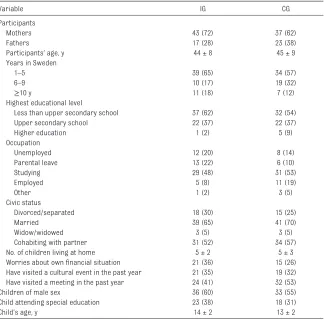
Participant sociodemographic characteristics are presented in Table 1.
Most of the participants were the biological parents of the child; only 2 parents were a stepparent or close relative, and they were the main caretakers of the child. In both groups, the age of the parents ranged from 30 to 70 years. The majority of parents had lived in Sweden for 1 to 5 years, had less than an upper secondary level of education, were cohabiting with their partner, and lived in a low socioeconomic residential area. The number of children living at home in the IG ranged from 1 to 11 children, and in the CG it ranged from 1 to 13. There were no statistically significant sociodemographic differences between the 2 groups.
At baseline, no significant differences between the 2 groups were noted in the CBCL 6–18 symptom subscales, FIGURE 1
except on the rule-breaking behavior in the CBCL 6–18, where parents in the IG reported more problems in their children than parents in the CG (P < .01). Less than 1% of the children were in the clinical range (>70th percentile). No significant differences were observed between girls and boys at baseline.
Analyses of the differences in relation to attendance were dichotomized into high or low attendees based on the distribution of attendance. Two-thirds of the parents (n = 40) attended ≥8 sessions (high attendees), and one-third (n = 17) attended <8 sessions (low attendees). The t test showed significant
differences between the high and low attendees at baseline; high attendees reported more externalizing
problems (P < .03) and had a higher total problem score (P < .03) compared with low attendees.
Effectiveness of a Culturally Tailored Parenting Intervention
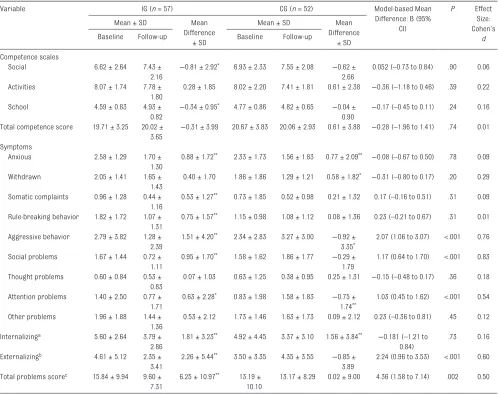
Findings from the paired t test revealed that parents in the IG scored their children significantly better (compared with baseline) 2 months after the intervention in 2 competence scales (social and school) with respect to the internalizing and externalizing problems and in the total problem score ( Table 2). Children in the IG had less aggressive and attention problems 2 months after the intervention compared with children in the CG.
The ANCOVA models indicated that there were no statistically significant differences on the competence scales and internalizing problems between the IG and CG. The analyses also demonstrated that children in the IG had improved significantly compared with children in the CG 2 months after the intervention in the symptoms of aggressive behavior (95% CI, 1.06 to 3.07; effect size, d = 0.76), social problems (95% CI, 0.64 to 1.70; d = 0.83), attention problems (95% CI, 0.45 to 1.62; d = 0.54),
and in the externalizing problems (95% CI, 0.96 to 3.53; d = 0.60) and the total problems score (95% CI, 1.58 to 7.14; d = 0.50). Thus, the effect sizes of these symptoms were medium to large. Our hypothesis was confirmed in that a culturally tailored parenting support program improved the children’s behavioral problems ( Table 2).
DISCUSSION
To our knowledge, this study is the first to evaluate a culturally tailored parenting support program for Somali-born parents to reduce children’s emotional and behavioral problems. Our overall findings found that the intervention reduced behavior problems in immigrant children 2 months after the intervention. This observation is in line with previous studies evaluating similar interventions
aimed at supporting parent–child relationships to improve the behavior. 10, 13, 14
An important finding of this study was the greater effect on children’s behavior problems in the short term (ie, 2 months after the intervention). The overall effect size was large compared with results from studies targeting minority groups 13, 29 or universal
parenting programs showing small to medium effect sizes. 18 Several
studies indicate that nonbehavioral parenting programs might not yield a short-term effect. 30–32 By contrast,
nonbehavioral programs that focus on strengthening parent–child relationships, particularly in older children, have been effective. 33 What
differentiates the Connect program from others is that Connect focuses on parents building a partnership with their child and jointly solving conflicts, whereas other parenting
TABLE 1 Sociodemographic Data on Participants and Children in the IG (n = 60) and the CG (n = 60)
Variable IG CG
Participants
Mothers 43 (72) 37 (62)
Fathers 17 (28) 23 (38)
Participants’ age, y 44 ± 8 45 ± 9
Years in Sweden
1–5 39 (65) 34 (57)
6–9 10 (17) 19 (32)
≥10 y 11 (18) 7 (12)
Highest educational level
Less than upper secondary school 37 (62) 32 (54)
Upper secondary school 22 (37) 22 (37)
Higher education 1 (2) 5 (9)
Occupation
Unemployed 12 (20) 8 (14)
Parental leave 13 (22) 6 (10)
Studying 29 (48) 31 (53)
Employed 5 (8) 11 (19)
Other 1 (2) 3 (5)
Civic status
Divorced/separated 18 (30) 15 (25)
Married 39 (65) 41 (70)
Widow/widowed 3 (5) 3 (5)
Cohabiting with partner 31 (52) 34 (57)
No. of children living at home 5 ± 2 5 ± 3
Worries about own fi nancial situation 21 (36) 15 (26)
Have visited a cultural event in the past year 21 (35) 19 (32)
Have visited a meeting in the past year 24 (41) 32 (53)
Children of male sex 36 (60) 33 (55)
Child attending special education 23 (38) 18 (31)
Child’s age, y 14 ± 2 13 ± 2
programs focus on approving positive or disapproving negative behavior in children. The Connect program motivates parents to understand and balance the adolescent’s need for autonomy and attachment. 15
This study showed that the Connect program can reduce behavioral but not emotional problems in the short term. One explanation could be that parents in the beginning focus on their child’s antisocial behavior rather than on the internalizing behaviors of anxiety, withdrawal,
and depression. Thus, to secure the parent–child relationship and the parents’ sensitivity to their child’s emotional needs might require a stepwise progression. 34 Furthermore,
the children in this intervention were in the normal range for internalizing behaviors. However, we have not tested the underlying mechanism of change that would likely play an important role in reducing children’s emotional and behavioral problems (eg, why the intervention worked). Studies that have used the Connect
program34, 35 have reported that
strengthened parental sensitivity toward their children’s behavior provides a secure and safe base for the child. The increased sensitivity shifts the focus from the specific problem to the parent’s desire to reflect on the reason behind the child’s behavioral patterns. These studies have shown that an increase in attachment security was associated with a reduction in emotional and behavioral problems.
TABLE 2 Paired t Tests and ANCOVA on Differences in CBCL 6–18 in the IG and CG at Baseline and at the 2-Month Follow-up
Variable IG (n = 57) CG (n = 52) Model-based Mean
Difference: B (95% CI)
P Effect
Size: Cohen’s
d
Mean ± SD Mean
Difference ± SD
Mean ± SD Mean
Difference ± SD
Baseline Follow-up Baseline Follow-up
Competence scales
Social 6.62 ± 2.64 7.43 ±
2.16
−0.81 ± 2.92* 6.93 ± 2.33 7.55 ± 2.08 −0.62 ± 2.66
0.052 (–0.73 to 0.84) .90 0.06
Activities 8.07 ± 1.74 7.78 ± 1.80
0.28 ± 1.85 8.02 ± 2.20 7.41 ± 1.81 0.61 ± 2.38 −0.36 (–1.18 to 0.46) .39 0.22
School 4.59 ± 0.83 4.93 ±
0.82
−0.34 ± 0.95* 4.77 ± 0.86 4.82 ± 0.65 −0.04 ± 0.90
−0.17 (–0.45 to 0.11) .24 0.16
Total competence score 19.71 ± 3.25 20.02 ± 3.65
−0.31 ± 3.99 20.67 ± 3.83 20.06 ± 2.93 0.61 ± 3.88 −0.28 (–1.96 to 1.41) .74 0.01
Symptoms
Anxious 2.58 ± 1.29 1.70 ±
1.30
0.88 ± 1.72** 2.33 ± 1.73 1.56 ± 1.83 0.77 ± 2.09** −0.08 (–0.67 to 0.50) .78 0.09
Withdrawn 2.05 ± 1.41 1.65 ±
1.43
0.40 ± 1.70 1.86 ± 1.86 1.29 ± 1.21 0.58 ± 1.82* −0.31 (–0.80 to 0.17) .20 0.29
Somatic complaints 0.96 ± 1.28 0.44 ± 1.16
0.53 ± 1.27** 0.73 ± 1.85 0.52 ± 0.98 0.21 ± 1.32 0.17 (–0.16 to 0.51) .31 0.09
Rule-breaking behavior 1.82 ± 1.72 1.07 ± 1.31
0.75 ± 1.57** 1.15 ± 0.98 1.08 ± 1.12 0.08 ± 1.36 0.23 (–0.21 to 0.67) .31 0.01
Aggressive behavior 2.79 ± 3.82 1.28 ± 2.39
1.51 ± 4.20** 2.34 ± 2.83 3.27 ± 3.00 −0.92 ± 3.35*
2.07 (1.06 to 3.07) <.001 0.76
Social problems 1.67 ± 1.44 0.72 ± 1.11
0.95 ± 1.70** 1.58 ± 1.62 1.86 ± 1.77 −0.29 ± 1.79
1.17 (0.64 to 1.70) <.001 0.83
Thought problems 0.60 ± 0.84 0.53 ± 0.83
0.07 ± 1.03 0.63 ± 1.25 0.38 ± 0.95 0.25 ± 1.31 −0.15 (–0.48 to 0.17) .36 0.18
Attention problems 1.40 ± 2.50 0.77 ± 1.71
0.63 ± 2.28* 0.83 ± 1.98 1.58 ± 1.83 −0.75 ± 1.74**
1.03 (0.45 to 1.62) <.001 0.54
Other problems 1.96 ± 1.88 1.44 ± 1.36
0.53 ± 2.12 1.73 ± 1.46 1.63 ± 1.73 0.09 ± 2.12 0.23 (–0.36 to 0.81) .45 0.12
Internalizinga 5.60 ± 2.64 3.79 ± 2.86
1.81 ± 3.23** 4.92 ± 4.45 3.37 ± 3.10 1.56 ± 3.84** −0.181 (–1.21 to 0.84)
.73 0.16
Externalizingb 4.61 ± 5.12 2.35 ± 3.41
2.26 ± 5.44** 3.50 ± 3.35 4.35 ± 3.55 −0.85 ± 3.89
2.24 (0.96 to 3.53) <.001 0.60
Total problems scorec 15.84 ± 9.94 9.60 ± 7.31
6.25 ± 10.97** 13.19 ± 10.10
13.17 ± 8.29 0.02 ± 9.00 4.36 (1.58 to 7.14) .002 0.50
A higher score (mean ± SD) in the competence scales and total competence score indicate higher competence. A lower score (mean ± SD) in the internalizing, externalizing, total problem score, and all 9 syndromes indicates reduced problems.
a Includes the symptoms of anxiety, withdrawal, and somatic complaints. b Includes the symptoms of rule-breaking and aggressive behavior.
c Includes the internalizing and externalizing groups of symptoms and the symptoms of social problems, thought problems, attention problems, and other problems. * P < .05;
The present study evaluated the effect of an intervention consisting of culturally tailored societal information combined with the Connect parenting support program. It is possible that the tailored societal information was not effective per se but addressed an important need 6
and therefore helped to support the parents.
Other studies have shown that immigrant parents can benefit from parenting interventions if they are tailored to their needs and facilitated with group leaders of a similar background, 16, 17, 36 which is
in agreement with the intervention in our study. The fact that our intervention targeted the specific needs of immigrant parents (eg, societal information, modification of the Connect parenting program to make it more culturally understandable, delivery of the intervention by group leaders of Somali background) may have been a contributing factor of its success. 37
Our study had several strengths and limitations. One strength of this study was the engagement of immigrant families. A further strength is that we retained almost all the parents who were randomized to the intervention and followed up with them. However, a limitation is that we cannot
determine whether it was the Connect program alone or the culturally tailored societal information alone, or
the combination of both factors that improved the children’s behavioral problems. Because the outcome was measured on the basis of the parents’ perspective of their child’s mental health, this factor is both a limitation and a bias. Children’s self-reports would have been desirable but were not feasible in this study because most of the parents refused to give informed consent for their children’s participation. Another limitation is that we have only short-term data and thus do not know whether the effect is long-lasting. A longer follow-up is necessary to determine whether improvement in children’s behavior is sustained after a longer period (eg, 1–2 years).
This study can be first and foremost generalized to Somali-born parents who brought their children to Sweden. However, it can also be generalized to other immigrants in Sweden who have fled their countries because of war or social or environmental conflict.
CONCLUSIONS
The present study found that culturally tailored parenting support (ie, the Ladnaan program) reduced children’s behavioral problems with large effect sizes on the outcomes. Our findings indicate that when developing and delivering parenting intervention, it is paramount to
consider the specific needs of immigrant families. This study adds to the field of parenting interventions in terms of how to culturally tailor, engage, and retain parenting programs for immigrant parents. We recommend that culturally tailored parenting programs be made accessible to immigrant parents. These programs should focus on strengthening parenting competencies and fostering parent involvement in all aspects of their child’s life.
ACKNOWLEDGMENTS
The authors thank all the parents who participated in this study, including the Somali nonprofit associations and key persons who assisted with the information meetings and recruitment. We also thank all the group leaders who delivered the intervention and the data collectors for assisting in the data collection process. We thank the Public Health Agency of Sweden for funding this study.
ABBREVIATIONS
ANCOVA: analysis of covariance CBCL 6–18: Child Behavior
Checklist for Ages 6 to 18
CG: control group CI: confidence interval IG: intervention group
FINANCIAL DISCLOSURE: The authors have indicated they have no fi nancial relationships relevant to this article to disclose. FUNDING: Supported by the Public Health Agency of Sweden (grant 802/2014-6.2).
POTENTIAL CONFLICT OF INTEREST: The authors have indicated they have no potential confl icts of interest to disclose.
REFERENCES
1. Fazel M, Reed RV, Panter-Brick C, Stein A. Mental health of displaced and refugee children resettled in high-income countries: risk and protective factors. Lancet. 2012;379(9812):266–282
2. Montgomery E. Trauma, exile and mental health in young refugees. Acta Psychiatr Scand Suppl. 2011;124(440):1–46
3. Hjern A, Bouvier P. Migrant children—a challenge for European paediatricians. Acta Paediatr. 2004;93(11):1535–1539 4. Hjern A, Angel B. Organized
violence and mental health of refugee children in exile: a six-year follow-up. Acta Paediatr. 2000;89(6):722–727
5. Jack G. Ecological infl uences on parenting and child development. Br J Soc Work. 2000;30(6):703–720
7. Renzaho AM, McCabe M, Sainsbury WJ. Parenting, role reversals and the preservation of cultural values among Arabic speaking migrant families in Melbourne, Australia. Int J Intercult Relat. 2011;35(4):416–424
8. Rick K, Forward J. Acculturation and perceived intergenerational differences among Hmong youth.
J Cross Cult Psychol. 1992;23(1): 85–94
9. Lincoln AK, Lazarevic V, White MT, Ellis BH. The impact of acculturation style and acculturative hassles on the mental health of Somali adolescent refugees.
J Immigr Minor Health. 2016;18(4): 771–778
10. Stewart-Brown SL, Schrader-McMillan A. Parenting for mental health: what does the evidence say we need to do? Report of Workpackage 2 of the DataPrev project. Health Promot Int. 2011;26(suppl 1):i10–i28
11. Stewart-Brown S, Patterson J, Mockford C, Barlow J, Klimes I, Pyper C. Impact of a general practice based group parenting programme: quantitative and qualitative results from a controlled trial at 12 months.
Arch Dis Child. 2004;89(6):519–525 12. Morgan Z, Brugha T, Fryers T,
Stewart-Brown S. The effects of parent-child relationships on later life mental health status in two national birth cohorts. Soc Psychiatry Psychiatr Epidemiol. 2012;47(11):1707–1715 13. Bjørknes R, Manger T. Can parent
training alter parent practice and reduce conduct problems in ethnic minority children? A randomized controlled trial. Prev Sci. 2013;14(1):52–63
14. Lindsay G, Strand S, Davis H. A comparison of the effectiveness of three parenting programmes in improving parenting skills, parent mental well-being and children’s behaviour when implemented on a large scale in community settings in 18 English local authorities: the Parenting Early Intervention Pathfi nder (PEIP). BMC Public Health. 2011;11(1):962
15. Moretti MM, Obsuth I. Effectiveness of an attachment-focused manualized intervention for parents of teens at risk for aggressive behaviour:
the Connect program. J Adolesc. 2009;32(6):1347–1357
16. Griner D, Smith TB. Culturally adapted mental health intervention: a meta-analytic review. Psychotherapy (Chic). 2006;43(4):531–548
17. Wells MB, Sarkadi A, Salari R. Mothers’ and fathers’ attendance in a community-based universally offered parenting program in Sweden. Scand J Public Health. 2016;44(3):274–280 18. Ulfsdotter M, Enebrink P, Lindberg L.
Effectiveness of a universal health-promoting parenting program: a randomized waitlist-controlled trial of All Children in Focus. BMC Public Health. 2014;14(1):1083
19. Baker CN, Arnold DH, Meagher S. Enrollment and attendance in a parent training prevention program for conduct problems. Prev Sci. 2011;12(2):126–138
20. Kazdin AE, Holland L, Crowley M. Family experience of barriers to treatment and premature termination from child therapy. J Consult Clin Psychol. 1997;65(3):453–463
21. Migration Board. Somalier i Sverige (Somalis in Sweden). Available at: www. migrationsverket. se/ om- migrationsverket/ statistik. Accessed March 21, 2014
22. Boutron I, Moher D, Altman DG, Schulz KF, Ravaud P; CONSORT Group. Methods and processes of the CONSORT Group: example of an extension for trials assessing nonpharmacologic treatments. Ann Intern Med. 2008;148(4):W60–W66
23. Dalarna R. Dalarnas
befolkningsutveckling 2013 (Dalarna’s population growth). Available at: www. regiondalarna. se/ dalafakta/ befolkning. Accessed October 26, 2015
24. Moretti MM, Braber K, Obsuth I.
Connect. An Attachment-focused Treatment Group for Parents and Caregivers—A Principle Based Manual. Burnaby, BC, Canada: Simon Fraser University; 2009
25. Achenbach TM, Dumenci L. Advances in empirically based assessment: revised cross-informant syndromes and new DSM-oriented scales for the CBCL, YSR, and TRF: comment on Lengua, Sadowksi, Friedrich, and
Fischer (2001). J Consult Clin Psychol. 2001;69(4):699–702
26. World Health Organization. Process of translation and adaptation of instruments. Available at: www. who. int/ substance_ abuse/ research_ tools/ translation/ en/ . Accessed February 5, 2016
27. Cohen J. A power primer. Psychol Bull. 1992;112(1):155–159
28. Saghaei M. Random allocation software for parallel group randomized trials. BMC Med Res Methodol. 2004;4(1):26
29. Leijten P, Raaijmakers MA, Orobio de Castro B, van den Ban E, Matthys W. Effectiveness of the Incredible Years Parenting Program for families with socioeconomically disadvantaged and ethnic minority backgrounds [published online ahead of print May 18, 2015]. J Clin Child Adolesc Psychol. 2015;10.1080/15374416.2015.1038823
30. Hogstrom J, Olofsson V, Ozdemir M, Enebrink P, Stattin H. Two-year fi ndings from a national effectiveness trial: effectiveness of behavioral and non-behavioral parenting programs [published online ahead of print June 22, 2016]. J Abnorm Child Psychol. 2016; doi: 10.1007/s10802-016-0178-0 31. Stattin H, Enebrink P, Özdemir M,
Giannotta F. A national evaluation of parenting programs in Sweden: the short-term effects using an RCT effectiveness design. J Consult Clin Psychol. 2015;83(6):1069–1084
32. Serketich WJ, Dumas JE. The effectiveness of behavioral parent training to modify antisocial behavior in children: a meta-analysis. Behav Ther. 1996;27(2):171–186
33. Cedar B, Levant RF. A meta-analysis of the effects of parent effectiveness training.
Am J Fam Ther. 1990;18(4):373–384
34. Moretti MM, Obsuth I, Craig SG, Bartolo T. An attachment-based intervention for parents of adolescents at risk: mechanisms of change. Attach Hum Dev. 2015;17(2):119–135
36. Koerting J, Smith E, Knowles MM, et al. Barriers to, and facilitators of, parenting programmes for childhood behaviour problems: a qualitative
synthesis of studies of parents’ and professionals’ perceptions. Eur Child Adolesc Psychiatry. 2013;22(11): 653–670
DOI: 10.1542/peds.2016-2764 originally published online February 24, 2017;
2017;139;
Pediatrics
Fatumo Osman, Renée Flacking, Ulla-Karin Schön and Marie Klingberg-Allvin
A Support Program for Somali-born Parents on Children's Behavioral Problems
Services
Updated Information &
http://pediatrics.aappublications.org/content/139/3/e20162764
including high resolution figures, can be found at:
References
http://pediatrics.aappublications.org/content/139/3/e20162764#BIBL
This article cites 32 articles, 1 of which you can access for free at:
Subspecialty Collections
http://www.aappublications.org/cgi/collection/immigration_sub Immigration
alth_sub
http://www.aappublications.org/cgi/collection/international_child_he International Child Health
al_issues_sub
http://www.aappublications.org/cgi/collection/development:behavior Developmental/Behavioral Pediatrics
following collection(s):
This article, along with others on similar topics, appears in the
Permissions & Licensing
http://www.aappublications.org/site/misc/Permissions.xhtml
in its entirety can be found online at:
Information about reproducing this article in parts (figures, tables) or
Reprints
http://www.aappublications.org/site/misc/reprints.xhtml
DOI: 10.1542/peds.2016-2764 originally published online February 24, 2017;
2017;139;
Pediatrics
Fatumo Osman, Renée Flacking, Ulla-Karin Schön and Marie Klingberg-Allvin
A Support Program for Somali-born Parents on Children's Behavioral Problems
http://pediatrics.aappublications.org/content/139/3/e20162764
located on the World Wide Web at:
The online version of this article, along with updated information and services, is
by the American Academy of Pediatrics. All rights reserved. Print ISSN: 1073-0397.