Mitigating the Impacts of the COVID-19 Pandemic
Response on At-Risk Children
Charlene A. Wong, MD, MSHP,a,b,c,dDavid Ming, MD,a,d,eGary Maslow, MD, MPH,a,d,fElizabeth J. Gifford, PhDa,b,c,d
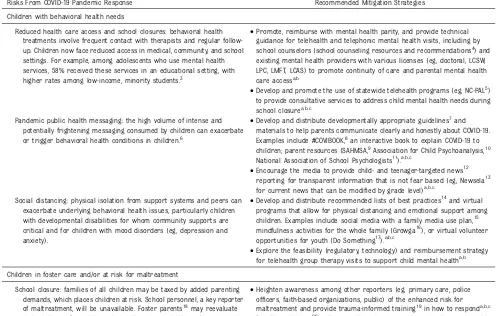
Although children are not at the highest risk for coronavirus disease 2019 (COVID-19)1severe illness, necessary pandemic public health measures will have unintended consequences for the health and well-being of the nation’s at-risk children. School closures, social distancing, reduction in health care services (eg, canceling nonurgent health care visits), and ubiquitous public health messaging are just some of the measures intended to slow the COVID-19 spread. Here, we (1) highlight the health risks of the pandemic response measures to vulnerable pediatric subpopulations and (2) propose risk mitigation strategies that can be enacted by policy makers, health care providers and systems, and communities (Table 1). The selected risks and proposed mitigation strategies are based on existing evidence and opinions of expert stakeholders, including clinicians, academicians, frontline service providers (eg, social workers), and public health leaders.
We focus on risks and mitigation strategies for 3 at-risk subpopulations of children: (1) children with behavioral health needs, (2) children in foster care or at risk for maltreatment, and (3) children with medical complexity (CMC). Mitigation strategies delineated for these at-risk populations are also likely beneficial for any child and family. Importantly, children not already in these groups are at risk for facing new medical, behavioral, or social challenges that develop during the pandemic. In particular, children in households of low socioeconomic status are likely at the highest risk for new or worsening issues, underscoring the critical leadership role of Medicaid programs in these risk mitigation strategies.
CHILDREN WITH BEHAVIORAL HEALTH NEEDS
The∼1 in 6 children with behavioral health conditions whose treatments involve regular and frequent therapist contact are at especially high risk of exacerbations during disasters.2In-person behavioral health care access during the pandemic has been reduced in medical, community, and school settings, where proportionally more low-income, minority students accessed care pre-pandemic.3Strategies to maintain access include the promotion and reimbursement of telehealth behavioral health visits by the full range of licensed providers, promotion of mental health parity, and use
This article has an accompanying video summary.
aDuke Children’s Health and Discovery Initiative, Durham, North Carolina;bDuke-Margolis Center for Health Policy, Durham, North Carolina;cSanford School of Public Policy, Duke University, Durham, North Carolina; anddDepartments of Pediatrics,eMedicine, and fPsychiatry, Duke University School of Medicine, Durham, North Carolina
Dr Wong conceptualized, coordinated, drafted, reviewed, and revised the manuscript; Drs Ming and Maslow drafted, reviewed, and revised the manuscript; Dr Gifford conceptualized, drafted, reviewed, and revised the manuscript; and all authors approved thefinal manuscript as submitted and agree to be accountable for all aspects of the work.
DOI:https://doi.org/10.1542/peds.2020-0973 Accepted for publication Apr 17, 2020
Address correspondence to Charlene A. Wong, MD, MSHP, School of Medicine, Duke University, 4020 N Roxboro St, Durham, NC 27704. E-mail: [email protected] PEDIATRICS (ISSN Numbers: Print, 0031-4005; Online, 1098-4275).
Copyright © 2020 by the American Academy of Pediatrics
FINANCIAL DISCLOSURE:The authors have indicated they have nofinancial relationships relevant to this article to disclose.
FUNDING:No external funding.
POTENTIAL CONFLICT OF INTEREST:The authors have indicated they have no potential conflicts of interest to disclose.
TABLE 1Selected Health Risks for Vulnerable Child Subpopulations From the COVID-19 Pandemic Response Initiatives and Recommended Mitigation Strategies
Risks From COVID-19 Pandemic Response Recommended Mitigation Strategies Children with behavioral health needs
Reduced health care access and school closures: behavioral health treatments involve frequent contact with therapists and regular follow-up. Children now face reduced access in medical, community, and school settings. For example, among adolescents who use mental health services, 58% received these services in an educational setting, with higher rates among low-income, minority students.3
•Promote, reimburse with mental health parity, and provide technical guidance for telehealth and telephonic mental health visits, including by school counselors (school counseling resources and recommendations4) and existing mental health providers with various licenses (eg, doctoral, LCSW, LPC, LMFT, LCAS) to promote continuity of care and parental mental health care accessa,b
•Develop and promote the use of statewide telehealth programs (eg, NC-PAL5) to provide consultative services to address child mental health needs during school closurea,b,c
Pandemic public health messaging: the high volume of intense and potentially frightening messaging consumed by children can exacerbate or trigger behavioral health conditions in children.6
•Develop and distribute developmentally appropriate guidelines7and
materials to help parents communicate clearly and honestly about COVID-19. Examples include #COVIBOOK,8an interactive book to explain COVID-19 to
children; parent resources (SAHMSA,9Association for Child Psychoanalysis,10
National Association of School Psychologists11).a,b,c
•Encourage the media to provide child- and teenager-targeted news12 reporting for transparent information that is not fear based (eg, Newsela13 for current news that can be modified by grade level)a,b,c
Social distancing: physical isolation from support systems and peers can exacerbate underlying behavioral health issues, particularly children with developmental disabilities for whom community supports are critical and for children with mood disorders (eg, depression and anxiety).
•Develop and distribute recommended lists of best practices14and virtual programs that allow for physical distancing and emotional support among children. Examples include social media with a family media use plan,15 mindfulness activities for the whole family (Growga16), or virtual volunteer opportunities for youth (Do Something17).a,b,c
•Explore the feasibility (regulatory, technology) and reimbursement strategy for telehealth group therapy visits to support child mental healtha,b Children in foster care and/or at risk for maltreatment
School closure: families of all children may be taxed by added parenting demands, which places children at risk. School personnel, a key reporter of maltreatment, will be unavailable. Foster parents18may reevaluate their ability tofinancially and socially support children who are not in school, resulting in placement disruption. Kinship families may be particularly stressed because they are provided fewer resources than other foster parents.
•Heighten awareness among other reporters (eg, primary care, police officers, faith-based organizations, public) of the enhanced risk for maltreatment and provide trauma-informed training19in how to responda,b,c •Provide paid leave20and economic assistance to allow caregivers to provide
adequate and safe child carea
•Enhance and connect parents and caregivers with online support resources,21parenting education (eg, Incredible Years, Triple P), best practices22for child and self-care (eg, setting and maintaining routines), and hotlines23for crisisc
College and university closures: closures of institutions of postsecondary education may leave current or former foster youth without stable housing options; one-fourth to one-third24of homeless youth have been
in foster care.
•Provide funding for room and board assistance to foster children between the ages of 18 and 21 (eg, Chafee Foster Care Program for Successful Transition to Adulthood funds25)a
Social distancing: for new reports of maltreatment and families receiving in-home child welfare services, case workers may be unavailable to complete important safety checks, biological parents may be unable to comply with court-ordered plans (eg, substance use testing), especially if courts close, and foster children may be isolated from birth families.
•Develop and promote virtual visits26and other strategies for child welfare
workers to safely conduct assessments and investigations and to allow contact between foster homes, group homes, and birth parentsa
•Provide alternative strategies for parents who have court-ordered substance use treatment plans to meet requirements (eg, Online Intergroup of Alcoholics Anonymous27)a,b
•States can fund28evidence-based family preservation services, such as parenting skills, mental health and substance use, and kinship navigator servicesa
Children with medical complexity
Reduced health care access: CMC are often dependent on medical technology (eg, feeding tubes, respiratory equipment) and need continuous care from multiple service providers (eg, home health, primary and specialty providers).
•Provide additional guidance29for pediatric home health30and durable medical equipment agencies on in-home care practices, isolation procedures, preservation of personal protective equipment used for daily in-home care (eg, gloves, masks); augmentation of home health workforce (eg, pediatric nurses with reduced in-person clinical responsibilities during the emergency response); and increased training for home health workforce on coordinating with remote medical providersa
of evidence-based systems (eg, statewide telehealth mental health service) to support behavioral health care in primary care. Intense and frightening pandemic media coverage may trigger behavioral health conditions in children; developmentally appropriate materials can help parents communicate transparently about COVID-19 with their children. Additionally, physical isolation from peers and support networks may exacerbate underlying behavioral health issues. Online programs and group teletherapy visits that provide emotional support while maintaining physical distance are novel mitigating strategies that should be considered for reimbursement. Importantly, parents also need support and access for their own behavioral health needs.
CHILDREN IN FOSTER CARE OR AT RISK FOR MALTREATMENT
As psychosocial andfinancial stresses build during the pandemic, children are vulnerable to new or additional abuse or neglect, similar to the increased interpersonal violence in
China during the quarantine periods.44Strategies outlined for children with behavioral health conditions will also benefit the
.400 000 US children in foster care and all children at risk for maltreatment in this stressful time. The added stress and school closures may lead foster parents to determine that they are unable to provide foster care, resulting in placement
disruptions. Broad-reaching paid leave, economic relief programs, and virtual emotional support for caregivers could reduce household stress and in turn, maltreatment rates. University closures and other economic hardships may leave many older current and former foster youth without stable housing. In response, funding from the John H. Chafee Foster Care Independence Program, which promotes current and former foster youth self-sufficiency, can support room and board assistance for these youth.25For new
maltreatment reports and families receiving child welfare services, case workers may be unavailable to complete important safety checks because of social distancing
mandates, and biological parents may be unable to comply with court-ordered plans (eg, substance use testing). New virtual options are therefore needed for making child welfare visits, meeting court requirements, and maintaining birth family rights. For candidates for foster care, the Family First
Prevention Services Act allows states to use title IV-E funds for child and family services (eg, mental health, substance use, and parenting programs) that could potentially be delivered virtually.
CHILDREN WITH MEDICAL COMPLEXITY
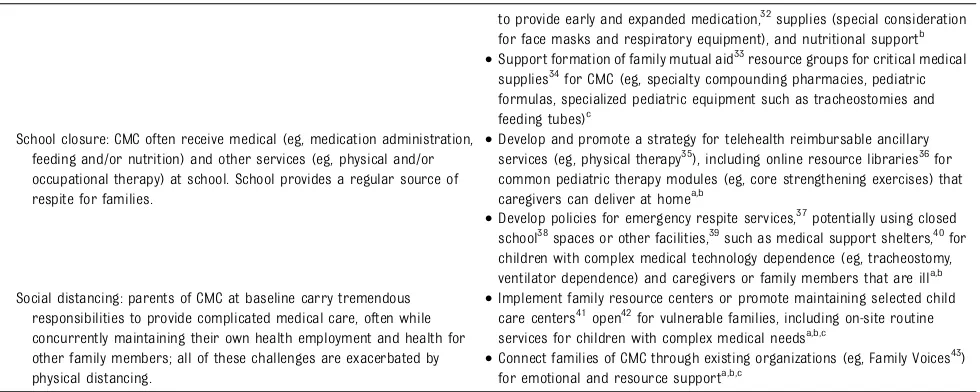
The risk for COVID-19 among CMC is unclear but presumed to be higher than among children without medical complexity. CMC typically have multiple chronic conditions, functional limitations, medical technology dependence (eg, feeding tubes), and a complex network of service providers and caregivers critical to maintain day-to-day health.45Care network disruptions could generate outsized adverse consequences for CMC. As primary TABLE 1 Continued
Risks From COVID-19 Pandemic Response Recommended Mitigation Strategies
to provide early and expanded medication,32supplies (special consideration for face masks and respiratory equipment), and nutritional supportb •Support formation of family mutual aid33resource groups for critical medical
supplies34for CMC (eg, specialty compounding pharmacies, pediatric formulas, specialized pediatric equipment such as tracheostomies and feeding tubes)c
School closure: CMC often receive medical (eg, medication administration, feeding and/or nutrition) and other services (eg, physical and/or occupational therapy) at school. School provides a regular source of respite for families.
•Develop and promote a strategy for telehealth reimbursable ancillary services (eg, physical therapy35), including online resource libraries36for
common pediatric therapy modules (eg, core strengthening exercises) that caregivers can deliver at homea,b
•Develop policies for emergency respite services,37potentially using closed
school38spaces or other facilities,39such as medical support shelters,40for
children with complex medical technology dependence (eg, tracheostomy, ventilator dependence) and caregivers or family members that are illa,b Social distancing: parents of CMC at baseline carry tremendous
responsibilities to provide complicated medical care, often while concurrently maintaining their own health employment and health for other family members; all of these challenges are exacerbated by physical distancing.
•Implement family resource centers or promote maintaining selected child care centers41open42for vulnerable families, including on-site routine services for children with complex medical needsa,b,c
•Connect families of CMC through existing organizations (eg, Family Voices43) for emotional and resource supporta,b,c
LCAS, licensed clinical addition specialist; LCSW, licensed clinical social worker; LMFT, licensed marriage and family therapist; LPC, licensed professional counselor; NC-PAL, NC Psychiatry Access Line; SAMHSA, Substance Abuse and Mental Health Services Administration; Triple P, Positive Parenting Program.
and specialty health care access is reduced, novel guidance for home health and medical equipment agencies is needed on in-home practices, including on conserving personal protective equipment and augmenting the home health
workforce.30Telehealth reimbursable services are essential to preserve access to tertiary care center–based multispecialty medical care and school-based ancillary services (eg, physical and/or occupational therapy). Novel ancillary service telehealth visits can educate parents on how to deliver the therapies at home. Telehealth medical visits can be strengthened with remote monitoring integration and interstate health care support. Like caregivers of other at-risk child groups, CMC caregivers will need support as their usual care networks shrink because of social distancing and/or COVID-19 illness. For these families, mutual aid resource groups, family resource centers, respite child care, and caregiver support groups with expertise in CMC care and supply needs can help mitigate increased psychosocial andfinancial stress.
LOOKING AHEAD
Beyond the risk of illness from COVID-19, the social and medical consequences of the unprecedented public health measures needed to slow the viral spread may pose an even greater threat to children, particularly those with behavioral health needs, in foster care or at risk for maltreatment, or with medical complexity. Common across the recommended risk mitigation strategies is the need for rapid implementation and reimbursement for virtual services, including cross-sector collaboration to maintain continuity of necessary supports and services (eg, in schools, child welfare, and child care settings). Many community-based and smaller agencies (eg, child welfare, home health agencies, therapy practices)
will require technical assistance to implement virtual services. Flexibility of roles across sectors can also be leveraged (eg, teachers in China contacted students daily for education as well as for health and safety screening). Also common across strategies is support at the family level. Primary care providers, who already engage with the family unit, can enact or promote the recommended strategies, including proactively reaching out to these at-risk populations and sharing local resources with families.
The pandemic response has forced the development of strategic relationships, policy reforms, and new practices, which will accelerate care integration and payment redesigns that at-risk children need now and in the future. The redesign will require determining which strategies (eg, expanded telehealth) are working and what can be continued as part of routine care delivery. Existing pediatric care transformation learning networks can lead the way in making such
recommendations, which will improve disaster preparedness for child-serving systems.
The social and health systems for children will be fundamentally transformed because of this pandemic. Clinicians, teachers, and social service providers are stepping out of their brick-and-mortar institutions to reach children in their homes and communities to deliver critical health and well-being services. The innovations in the systems that support at-risk children and families are long overdue and needed now more than ever; such innovations will position us to deliver higher value and better integrated care in the future for all children.
ACKNOWLEDGMENTS
We acknowledge Sallie Permar, MD, PhD (Duke Children’s Health and Discovery Initiative and Duke
University School of Medicine); Jillian Hurst, PhD (Duke Children’s Health and Discovery Initiative and Duke University School of Medicine); Kyle Walsh, PhD (Duke Children’s Health and Discovery Initiative and Duke University School of Medicine); Rebecca Whitaker, PhD (Duke-Margolis Center for Health Policy); Taruni Santanam (Duke-Margolis Center for Health Policy); Sahil Sandhu (Duke-Margolis Center for Health Policy); Megan Jiao (Duke-Margolis Center for Health Policy); William Song (Duke-Margolis Center for Health Policy); Carter Crew, MPH (Duke Children’s Health and
Department of Health and Human Services); Laura Faherty, MD, MPH, MSHP (RAND Corporation); Kristin Kan, MD, MPH, MSc (Ann & Robert H. Lurie Children’s Hospital of Chicago); Elizabeth Hudgins, MPP (North Carolina Pediatric Society); Carolyn Foster, MD, MSHS (Ann & Robert H. Lurie Children’s Hospital of Chicago); Sharon Hirsch (Prevent Child Abuse North Carolina); Eric Christian, MAEd, LPC, NCC (Community Care of North Carolina); and Emily Putnam-Hornstein, PhD (University of Southern California).
ABBREVIATIONS
CMC: children with medical complexity
COVID-19: coronavirus disease 2019
REFERENCES
1. Dong Y, Mo X, Hu Y, et al. Epidemiology of COVID-19 among children in China.
Pediatrics. 2020;145(6):e20200702
2. Substance Abuse and Mental Health Services Administration. Disaster Technical Assistance Center supplemental research bulletin: behavioral health conditions in children and youth exposed to natural disasters. 2018. Available at: https://www.samhsa. gov/sites/default/fi
les/srb-childrenyouth-8-22-18.pdf. Accessed May 29, 2020
3. Ali MM, West K, Teich JL, Lynch S, Mutter R, Dubenitz J. Utilization of mental health services in educational setting by adolescents in the United States.
J Sch Health. 2019;89(5):393–401
4. American School Counselor
Association. School counseling during covid-19: online lessons and resources. Available at: https://www.
schoolcounselor.org/school-counselors/professional-development/ learn-more/coronavirus-resources. Accessed May 29, 2020
5. Duke Integrated Pediatric Mental Health. North Carolina-psychiatry access line (NC-PAL). Available at:
https://ipmh.duke.edu/ncpal. Accessed May 29, 2020
6. Silverman W, La Greca A. Children Experiencing Disasters: Definitions, Reactions, and Predictors of Outcomes. In: La Greca A, Silverman W, Vernberg E, Roberts M, eds.Helping Children Cope with Disasters and Terrorism. American Psychological Association; 2002:11–33
7. The National Child Traumatic Stress Network. Partent/caregiver guide to helping families cope with the coronavirus disease 2019 (covid-19). Available at: https://www.nctsn.org/site s/default/files/resources/fact-sheet/su pporting_children_during_coronaviru s_covid19.pdf. Accessed May 29, 2020.
8. Mindheart. #Covidbook: supporting and reassuring children around the world. Available at: https://www.mindheart.co/ descargables?fbclid=IwAR1km1cej-R1sNCe6o2YK0vWrH27vDqWUo nMJtU1GCwNt2rAqWLdt0JFytM. Accessed May 29, 2020.
9. Substance Abuse and Mental Health Services Administration. Talking with children: tips for caregivers, parents, and teachers during infectious disease outbreaks. Available at: https://store. samhsa.gov/product/Talking-With- Children-Tips-for-Caregivers-Parents- and-Teachers-During-Infectious-Disease-Outbreaks/PEP20-01-01-006. Accessed May 29, 2020.
10. Hanna Perkins Center for Child Development. Talking with children about coronavirus. Available at: https:// hannaperkins.org/talking-with-children-about-coronavirus/. Accessed May 29, 2020.
11. National Association of School Psychologists. Helping children cope with changes resulting from covid-19. Available at: https://www.nasponline. org/resources-and-publications/ resources-and-podcasts/school- climate-safety-and-crisis/health-crisis- resources/helping-children-cope-with-changes-resulting-from-covid-19. Accessed May 29, 2020
12. Quartz. Norway’s prime minister held a 30-minute press conference to help kids process coronavirus. Available at: https://qz.com/1820098/norways-prime-
minister-shows-how-parents-can-help-kids-process-coronavirus/. Accessed May 29, 2020.
13. Newsela. Available at: https://newsela. com/. Accessed May 29, 2020.
14. Healthychildren.org. Working and learning from home during the covid-19 outbreak. Available at: https://www. healthychildren.org/English/health-issues/conditions/chest-lungs/Pages/ Working-and-Learning-from-Home-During-the-COVID-19-Outbreak.aspx. Accessed May 29, 2020.
15. Healthychildren.org. How to make a family media use plan. Available at: https://www.healthychildren.org/ English/family-life/Media/Pages/How-to-Make-a-Family-Media-Use-Plan.aspx. Accessed May 29, 2020.
16. Growga. Available at: https://www. mygrowga.com/growga-online. Accessed May 29, 2020.
17. Dosomething.org. Available at: https:// www.dosomething.org/us. Accessed May 29, 2020.
18. The Chronicle of Social Change. Coronavirus: what child welfare systems need to think about. Available at: https://chronicleofsocialchange.org/ child-welfare-2/coronavirus-what-child-welfare-systems-need-to-think-about/ 41220?fbclid=IwAR1kAeQyci
LsJHSpKDRwAtl0tz8Dic_2Hm1kynuFufca MLX7hlnq0DDSpvs. Accessed May 29, 2020.
19. The National Child Traumatic Stress Network. Training. Available at: https:// www.nctsn.org/resources/training. Accessed May 29, 2020.
20. Congress.gov. H.R.6201-familiesfirst coronavirus response act. Available at: https://www.congress.gov/bill/116th-co ngress/house-bill/6201/text?q=%7B% 22search%22%3A%5B%22chamberActio nDateCode%3A%5C%222020-03-11% 7C116%7C1000%5C%221AND1billIsRe served%3A%5C%22N%5C%22%22%5D%
7D&r=15&s=1#toc-H3E9F44D332E8480F875EF5CA40B3821D. Accessed May 29, 2020.
22. Child Trends. Resources for supporting children’s emotional well-being during the covid-19 pandemic. Available at: https://www.childtrends.org/
publications/resources-for-supporting- childrens-emotional-well-being-during-the-covid-19-pandemic. Accessed May 29, 2020.
23. Victim Connect Resource Center. National hotlines. Available at: https:// victimconnect.org/resources/national-hotlines/. Accessed May 29, 2020.
24. Capin Hall at the University of Chicago. Report: interrupting the pathway from foster care to homelessness. Available at: https://www.chapinhall.org/ research/interrupting-the-pathway-from-foster-care-to-homelessness/. Accessed May 29, 2020.
25. Congressional Research Service. John H. Chafee foster care program for successful transition to adulthood. 2019. Available at: https://fas.org/sgp/ crs/misc/IF11070.pdf. Accessed May 29, 2020.
26. U.S. Department of Health and Human Services. Notification of enforcement discretion for telehealth remote communications during the covid-19 nationwide public health emergency. Available at: https://www.hhs.gov/ hipaa/for-professionals/special-topics/ emergency-preparedness/notifi cation-enforcement-discretion-telehealth/ index.html. Accessed May 29, 2020.
27. Online Intergroup of Alcoholics Anonymous. Online meetings. Available at: https://aa-intergroup.org/oiaa/ meetings/. Accessed May 29, 2020.
28. Congress.gov. H.R. 1892-bipartisan budget act of 2018. Available at: https:// www.congress.gov/bill/115th-congress/ house-bill/1892/text. Accessed May 29, 2020.
29. Centers for Disease Control and Prevention. Interim guidance for implementing home care of people not requiring hospitalization for
coronavirus disease (covid-19). Available at: https://www.cdc.gov/ coronavirus/2019-ncov/hcp/guidance-home-care.html. Accessed May 29, 2020.
30. Foster CC, Agrawal RK, Davis MM. Home health care for children with medical complexity: workforce gaps, policy, and
future directions.Health Aff (Millwood). 2019;38(6):987–993
31. US Food and Drug Administration. Coronavirus (covid-19) update: FDA allows expanded use of devices to monitor patients’vital signs remotely. Available at: https://www.fda.gov/news-events/press-announcements/ coronavirus-covid-19-update-fda-allows- expanded-use-devices-monitor-patients-vital-signs-remotely. Accessed May 29, 2020.
32. NC Medicaid Division of Health Benefits. Special bulletin covid-19 #2: general guidance and policy modifications. Available at: https://medicaid.ncdhhs. gov/blog/2020/03/13/special-bulletin- covid-19-2-general-guidance-and-policy-modifications. Accessed May 29, 2020.
33. Mutual Aid Disaster Relief. Collective care is our best weapon against covid-19. Available at: https://
mutualaiddisasterrelief.org/collective-care/. Accessed May 29, 2020.
34. Palowski, A. Families of medically fragile kids swap supplies as coronavirus creates shortages. Available at: https://www.today.com/ parents/coronavirus-creates- shortages-families-medically-fragile-kids-swap-supplies-t175643. Accessed May 29, 2020.
35. American Physical Therapy Association. Increasing access to physical therapist services: research on telerehabilitation. Available at: https://www.apta.org/ uploadedFiles/APTAorg/Practice_and_ Patient_Care/Patient_Care/Technology/ Telehealth/Research-on-Telehealth.pdf. Accessed May 29, 2020.
36. Arlington Public Schools. Covid-19 school closure educational resources for families of students with disabilities. Available at: https://www. apsva.us/special-education/parent-resource-center/offi ce-special- education/covid-19-school-closure-resources/. Accessed May 29, 2020.
37. Kids Health. Finding respite care for your child with special needs. Available at: https://kidshealth.org/en/parents/ respite-care.html. Accessed May 29, 2020.
38. NC Department of Health and Human Services. Joint guidance for
superintendents from the NC Department of Public Instruction and the NC Department of Health and Human Services for the operation of school-based emergency child care during the covid-19 school closure. Available at: https://files.nc.gov/ncdhhs/ documents/fi les/covid-19/3.18.20-Joint-Guidance-to-Superintendents-FINAL.pdf. Accessed May 29, 2020.
39. Reeves, D. Oregon convention center could be used to house homeless during covid-19 pandemic. Available at: https://www.kptv.com/news/oregon- convention-center-could-be-used-to-house-homeless-during/article_
e0802b9a-6a32-11ea-a50d-b703b2c878c5.html. Accessed May 29, 2020.
40. Crump, E. State shelter in Clayton opens for medically fragile evacuees. Available at: https://abc11.com/state-shelter-in- clayton-opens-for-medically-fragile-evacuees/5516048/. Accessed May 29, 2020.
41. North Carolina Department of Health and Human Services. Interim coronavirus disease 2019 (COVID-19) Guidance for child care settings. Available at: https://files.nc.gov/ncdhhs/ documents/fi les/covid-19/NC-Interim-Guidance-for-Child-Care-Settings.pdf. Accessed May 29, 2020.
42. Washington State Department of Health. Chld care resources iand
recommendations. Available at: https:// www.doh.wa.gov/emergencies/ novelcoronavirusoutbreak2020/ childcare. Accessed May 29, 2020.
43. Family Voices. Coronavirus information and resources. Available at: https:// familyvoices.org/coronavirus/. Accessed May 29, 2020.
44. World Health Organization. COVID-19 and violence against women: what the health sector/system can do. 2020. Available at: https://www.who.int/ reproductivehealth/publications/ emergencies/COVID-19-VAW-full-text.pdf. Accessed April 1, 2020
DOI: 10.1542/peds.2020-0973 originally published online April 21, 2020;
2020;146;
Pediatrics
Charlene A. Wong, David Ming, Gary Maslow and Elizabeth J. Gifford
Children
Mitigating the Impacts of the COVID-19 Pandemic Response on At-Risk
Services
Updated Information &
http://pediatrics.aappublications.org/content/146/1/e20200973
including high resolution figures, can be found at:
References
http://pediatrics.aappublications.org/content/146/1/e20200973#BIBL
This article cites 4 articles, 1 of which you can access for free at:
Subspecialty Collections
http://www.aappublications.org/cgi/collection/disaster_prep_sub Disaster Preparedness
http://www.aappublications.org/cgi/collection/advocacy_sub Advocacy
following collection(s):
This article, along with others on similar topics, appears in the
Permissions & Licensing
http://www.aappublications.org/site/misc/Permissions.xhtml
in its entirety can be found online at:
Information about reproducing this article in parts (figures, tables) or
Reprints
http://www.aappublications.org/site/misc/reprints.xhtml
DOI: 10.1542/peds.2020-0973 originally published online April 21, 2020;
2020;146;
Pediatrics
Charlene A. Wong, David Ming, Gary Maslow and Elizabeth J. Gifford
Children
Mitigating the Impacts of the COVID-19 Pandemic Response on At-Risk
http://pediatrics.aappublications.org/content/146/1/e20200973
located on the World Wide Web at:
The online version of this article, along with updated information and services, is
by the American Academy of Pediatrics. All rights reserved. Print ISSN: 1073-0397.