International Journal of Applied Information Systems (IJAIS) – ISSN : 2249-0868 Foundation of Computer Science FCS, New York, USA
Volume 5 – No. 9, July 2013 – www.ijais.org
Wireless Ad hoc Network Simulators: Analysis of
Characterstic Features, Scalability, Effectiveness and
Limitations
Anita Sethi
Uttarakhand Technical
University Dehradoon
J. P. Saini
2MMEC
Gorakhpur
Manoj Bisht
3WWIL
Delhi
ABSTRACT
The nature of wireless ad hoc network is such that communication between the nodes is extremely volatile
,
resultantly t
he quality of the wireless links isheavily
unstable. Implementation of algorithms with enormous processing power and memory capacity for small and restricted resource-constrained wireless nodes is an inspiring task. Performance and behaviour estimation and comparison of wireless ad hoc network protocols, simulations are upright solution between cost and complexity, on the one side, and accuracy of the results, on the other side. Such simulation tools should allow researchers to verify new ideas and compare the proposed solutions in a virtual environment helping to avoid unnecessary, time-consuming or expensive hardware implementations. Difficulty arises in selection of wireless ad hoc network simulator for specific objective, features and usability due tothe prensence of
lots of simulators.
Reusability,
availability,
performance,
scalability,
support for rich-semantics,
scripting languagesand
graphical supportare the main requirments for best framework of
the wireless ad hoc network simulator
. Within the
study, wehave
described
desirable and valuable missing features of the simulators, demarcation of their strength and weaknesses. Lot of effort is required for installation, habituation, implementation and visualization of wireless ad hoc network simulator. A lot of researchers and Scholars can seek help from this paper to identify the suitability of simulator for their study.Keywords
W
ireless ad hoc network
, scalability, simulator, emulator
1.
INTRODUCTION
Wireless sensor networks (WSN) are one of themost actively developing areas in network research communities. As the technologies for wireless nodesimprove, the requirements for networking are increasing. Testbed implementation generate themost accurate results but required to acquire hardware, the severely restricted monitoring, debugging possibilities, as well as, excessive effort required to create a simulated environment approaching the real application scenario. Solution of Testbed implementation is
to
capture the reality models up to a limited extent, which implies that simulation results will generally not be as accurate as real implementations. Running a network simulation fundamentally involve implementation of a protocol, designing a network topology and traffic scenarioand visualization and analysis of simulation results. The conclusions of this study will permit a quick yet deep enough understanding of features, efficiency, extendibility, accuracy, and easiness of use, which can help other researchers to identify the wireless network simulator that is most suitable for their needs.
2.
REQUIREMENTS OF THE
MODELING
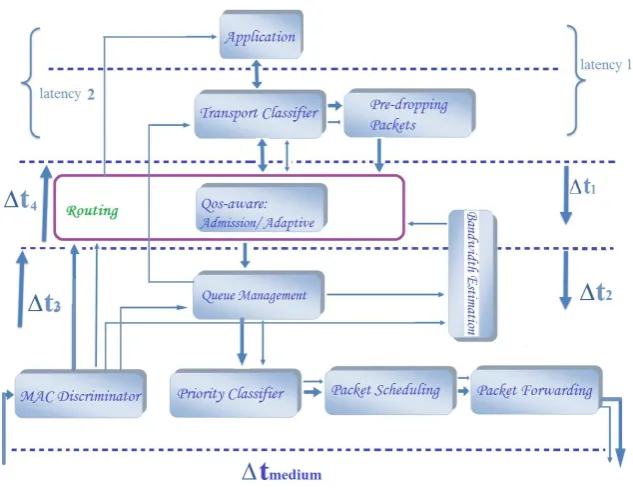
To model analytically a Wireless ad hoc network is complex and impractical which leads to oversimplified analysis with restricted assurance and deploying testbeds require huge effort. Simulation provides appropriate model based on hardware and physical layer assumptions and a suitable framework to ease implementation. The dynamics of the physical parameters sensed by the network govern the network traffic and topology and non-rechargeable batteries leads to oversimplified analysis with restricted assurance of network operation. The correctness of the model and suitability of a particular tool to implement the model should be evaluated before conducting experiments. Figure 1 illustrates the sensor node features that we require the simulation tool tomodel. In figure 1, sensor node 1 sends a message to sensor node 2 which receives and processes it after atime delay ∆ttotal. ∆ttotal is the most important quantity since it determines the response time of the network. The latencies between possible node operating systems, e.g., TinyOS and application layers, are built up by software execution in the nodes. Modeling of the routing layer is needed to evaluatethe effect of different routing protocols and network topologies on network operation and delay. MAC and physical layer model a specific radiosystem including the delays they produce. An example of this is 802.15.4 type MAC, commonly used forsensor networks, that also defines the physical layer. The physical layer handles data transmission and reception. It is usually interfaced with a wireless medium model that estimates the radio signal strength, quality and delay between the transmitter and receiver unit.
International Journal of Applied Information Systems (IJAIS) – ISSN : 2249-0868 Foundation of Computer Science FCS, New York, USA
Volume 5 – No. 9, July 2013 – www.ijais.org
Figure 1: Framestructure of Wireless ad hoc Network Simulator
abstract tiers of the node model. Protocol-tier comprises of MAC layer, a routing layer and a specific application layer whose operation depends on the state of the physical tier. Physical-node tier common elements contains are the set of physical sensors, the energy module and the mobility module. A node is connected with the environment through a radio channel in media-tier. The selection of a simulation framework for any type of network is a task that is worth to spend enough time. Indeed, this is particularly true for wireless sensors nets, because of the diversity and complexity of the simulation scenarios, protocols, and elements involved. In such a heterogeneous scope, different evaluation tools achieve different goals. This section identifies and discusses the main features to be considered in the selection of a WSN simulation framework.
3.
CLASSIFICATION CRITERIA
Algorithm level Simulators emphasize on the data structure, logic and semantics of the algorithms. Localization, distributed routing, flooding based protocols of wireless ad hoc network are analyzed in AlgoSensim. Effect caused by a phenomenon, improve scalability and support free choice of the implementation model are the objectives of Shawn. Message passing view of the network is supported in Sinalgo. Data link and physical layers features are modeled in Packet level Simulators. Battery, radio propagation and sensor channel models are provided in SensorSim, extension of ns-2. Loosely-coupled, component-based programming model, and real-time process-driven simulation is adopted in J-Sim. The parallel discrete event simulation capability is designed in GloMoSim. Instruction level simulator model the CPU
execution at the level of instructions or even cycles, called emulators. Atemu is an emulator that can run nodes with distinct applications at the same time. Avrova is a Java-based emulator used for programs written for the AVR microcontroller produced by Atmel.
4.
RELATED WORK
International Journal of Applied Information Systems (IJAIS) – ISSN : 2249-0868 Foundation of Computer Science FCS, New York, USA
Volume 5 – No. 9, July 2013 – www.ijais.org
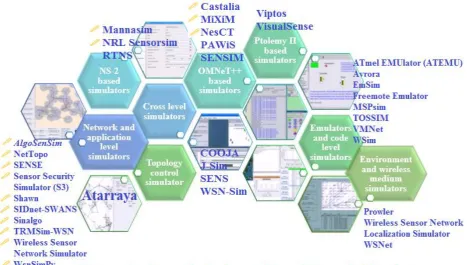
Figure 2
Topology construction and topology maintenance are two processes of Atarraya used for observing various solutions by comparing performance and efficiency in an environment providing a pre-defined energy consumption and communication models. Hierarchical structures of models formed in Ptolemy II based simulators contains Software components, called actors, execute simultaneously, exchanging messages through interconnected ports. Viptos is based on TOSSIM and Ptolemy II provides a low-level simulation of TinyOS programs supports experiments concerning heterogeneous networks where distinct nodes may use different models at each level of simulation. The framework of VisualSense consists of models representing communication channel and nodes with mobility, power management, packet losses, collisions, etc. of both Hierarchical and heterogeneous wireless ad hoc network. Ad hoc On-Demand Distance Vector (AODV), Directed Diffusion, Destination-Sequenced Distance-Vector Routing (DSDV), Dynamically Controlled Routing (DSR), Low-Energy Adaptive Clustering Hierarchy (LEACH) and Temporally Ordered Routing Algorithm (TORA) can be simulated with Mannasim, ns-2 based simulator. NRL Sensorsim simulates and detect parameters of carbon monoxide concentration, seismic activity or audible sound of wireless sensors and power utilization parameters may be described with the use of energy consumption model. Real Time Network Simulator (RTNS) is aimed at providing real time CPU simulations by the integration of the Ns-2 environment.
C++ and NED language is used in Castalia, MiXiM, NesCT, PAWiS, and SENSIM are OMNeT++ based simulators. SENSIM provides the feature of developing new sensor networks protocols and investigate networking and scalability. Radio model defines the antenna power requirements and battery model is used to control the amount of the remaining energy and processor model provides different levels of energy consumption in various states of operation in SENSIM. Concurrent simulation of the power consumption of every sensor is most crucial functionality of PAWiS. TinyOS applications can run in the OMNet++ environment using NesCT simulator. CHannel SIMulator, Mac Emulator, Mobility Framework and Positif Framework is designed in MiXiM comprises of environment, connectivity and mobility, reception and collision, experiment support and protocol library. Development of distributed algorithms or protocols and cross-level analysis is provided in Castalia.
5.
REVIEW OF WIRELESS AD HOC
NETWORK SIMULATORS
International Journal of Applied Information Systems (IJAIS) – ISSN : 2249-0868 Foundation of Computer Science FCS, New York, USA
International Journal of Applied Information Systems (IJAIS) – ISSN : 2249-0868 Foundation of Computer Science FCS, New York, USA
Volume 5 – No. 9, July 2013 – www.ijais.org
5.
ACKNOWLEDGMENTS
Our thanks to the experts who have contributed towards development of the template.
6.
CONCLUSIONS AND OPEN ISSUES
Simulation is an energetic tool to observe Wireless ad hoc Networks due to the impracticality of analysis and the difficulties of setting up real experiments. This artical
International Journal of Applied Information Systems (IJAIS) – ISSN : 2249-0868 Foundation of Computer Science FCS, New York, USA
Volume 5 – No. 9, July 2013 – www.ijais.org
Most of the Simulators use different approaches to solve different problem and hence are incomplete as they do not provide solution for all kinds of problems. The diversity of existing simulation tools has led to accuracy and authenticity issues. Comparison and imitation of evaluation results from competing simulation systems gets more difficult due to such variety of simulators.. Amongst other drawbacks include lack of conception, Graphical User Interface, lack of documentation and lack of illustrations. The predicament of precise, scalable and cost-effective simulation solution can be solved with the use of mixed-mode simulation as an effective midway solution. Mixed mode simulation enables simulation of algorithms partially in software and partially in WSN testbed real hardware. It integrates both simulated environment and a real test bed to improve both the precision and scalabilty of test results
Networking algorithms get strained in similar ways by randon error and as also by detailed model when the networking algorithm is strong to a range of errors and the error is not corelated. Visualisation techniques can help figure out wrong details and control overload. Improvement of correctness and precision can be done by reserchers by making the simulation code available for other reserchers also and description of their simulation setup. Using only real testbeds are not feasible due to their excessive cost and intricacy. Our view point says that theoritical validation of algorithm can serve as a good means for evaluating many algorithms. Further it is observed that the trend in the Wireless Adhoc Networkss field is to use mixed-mode simulation as a provisional solution.
7.
REFERENCES
[1] A. Boulis, “Castalia – A simulator for Wireless Sensor Networks and Body Area Networks,” User's Manual, October 2009. accessed June 2012.
[2] C. P. Singh, O. P. Vyas, and M. K. Tiwari, “A Survey of Simulation in Sensor Networks,” in Proceedings of CIMCA'08, 2008 International Conference on Computational Intelligence for Modeling Control and Automation, (Vienna, Austria), 10–12 December 2008. [3] M. Jevti´c, N. Zogovi´c, and G. Dimi´c, “Evaluation of
Wireless Sensor Network Simulators,” in Proceedings of TELFOR 2009, 17th Telecommunications forum, (Belgrade, Serbia), 24–16 November 2009.
[4] A. Kellner, K. Behrends, and D. Hogrefe, “Simulation Environments for Wireless Sensor Networks,” tech. rep., Institute of Computer Science, Georg-August-Universit¨at G¨ottingen, June 2010.
[5] S. Mahlknecht, S. A. Madani, and J. Kazm, “Wireless Sensor Networks: Modelling and Simulation, Discrete Event Simulations,” InTech, 2010.
[6] K. Garg, A. F¨orster, D. Puccinelli, and S. Giordano, “Towards Realistic and Credible Wireless Sensor Network Evaluation,” in Proceedings of ADHOCNETS 2011, 3rd International ICST Ad Hoc Networks Conference, (Paris, France), 21–23 September 2011. [7] H. Sundani, H. Li, V. K. Devabhaktuni, M. Alam, and P.
Bhattacharya, “Wireless Sensor Network Simulators A Survey and Comparisons,” International Journal of Computer Networks, vol. 2, pp. 249–256, February 2011. [8] M. Imran, A. M. Said, and H. Hasbullah, “A Survey of Simulators, Emulators and Testbeds for Wireless Sensor Networks,” in Proceedings of ITSim 2010, 4th International Symposium on Information Technology, vol. 2, (Kuala Lumpur, Malaysia), pp. 897–902, 15–17 June 2010.
[9] “TinyOS operating system.” http://www.tinyos.net. accessed June 2012.
[10]B. Titzer, D. Lee, and J. Palsberg, “Avrora: Scalable Sensor Network Simulation with Precise Timing,” in Proceedings of IPSN'05, Fourth International Conference on Information Processing in Sensor Networks, (Los Angeles, USA), 25–27 April 2005.
[11]B. Titzer and J. Palsberg, “Nonintrusive precision instrumentation of microcontroller software,” in Proceedings of LCTES'05, Conference on Languages, Compilers and Tools for Embedded Systems, (Chicago, USA), 15–17 June 2005.
[12]L. Girod, J. Elson, A. Cerpa, T. Stathopoulos, N. Ramanathan, and D. Estrin, “EmStar: a Software Environment for Developing and Deploying Wireless Sensor Networks,” in Proceedings of General Track: 2004 USENIX Annual Technical Conference, (Boston, USA), 27 June – 2 July 2004.
[13]IEEE Computer Society, “Wireless Medium Access Control (MAC) and Physical Layer (PHY) Specifications for Low-Rate Wireless Personal Area Networks (WPANs),” in IEEE Standard 802.15.4-2006, Part 15.4, (New York, USA), 8 September 2006.