Performance of Linear Block Coded OFDM system in
BER and PAPR under different channels
V.B.MALODE
Department of E&TC J.N.E.C.,N-6 Cidco Aurangabad,
Maharashtra,India
B.P.PATIL
Department of E&TC Army Institute of Technology Dighi, Pune,Maharashtra, India
ABSTRACT
Orthogonal Frequency Division Multiplexing (OFDM) plays a prominent role in wireless communication technology as multicarrier transmission scheme. The IEEE 802.11a standard uses coded OFDM scheme. This paper is to evaluate the performance of Coded OFDM system in different channels. Linear Block Code (LBC) with Extended Hamming is used to check the improvement of the system performance in BER (bit error rate). The results are obtained for different channels Like Additive White Gaussion Noise (AWGN), Rayleigh and Rician. The DQPSK modulation is used for scheme are comparison purpose. The Differential detection technique is used to avoid the need of a complex equalization process. PAPR for QPSK and DQPSK with conventional and SLM is computed for the comparison purpose.
Keyword
OFDM, Linear Block Code, BER, PAPR, SLM, AWGN , Rayleigh and Rician Channel.
1.
INTRODUCTION
OFDM is a very efficient technique for high-speed data transmission used in mobile communication, Digital Audio Broadcasting (DAB), Digital terrestrial mobile communication, Digital Video Broadcasting terrestrial (DVB-T), wireless asynchronous transfer mode (WATM), Modem/ADSL[1,2]. OFDM has many advantages such as High spectral efficiency, robustness in frequency
selective fading channels, immunity to inter-symbol interference and capability of handling very strong multipath fading.[3] Recently the advance system such as 3GPP LTE and terrestrial digital TV Broadcasting have been sophisticatedly developed using OFDM technology. Besides the above advantages, however, the bit error occurs in the presence of Doppler frequency shift because of the inter-carrier interference (ICI) in OFDM. OFDM is having major drawback of a high Peak-to-Average Power ratio (PAPR) [4, 5].This high PAPR increases complexity in the Digital Analog converter as well as affects the efficiency of power amplifier. In [6] the sub-block coding scheme for reducing the PAPR of OFDM has low complexity and is found that more than 3dB reduction in PAPR can be achieved when the code rate is ¾. The
(Fast Fourier Transform) algorithm. The implementation of FFT engine mainly depends on the number of input bit size. However the BER performance according to the input bit resolutions of FFT in AWGN channel. Orlandos Grigoriadis, H. Shrikanta Kamat have given the results of the BER as a function of Multi propagation for each set of carriers.[10] The effects of channel estimation error on the BER performance of BPSK and16-QAM modulated OFDM signal in multipath Rayleigh fading channels respectively has been shown. In [11] the high-order modulation like 16-QAM needs more accurate CFO and channel estimation to avoid performance loss. Whereas the Improvement of performance elevation criteria of RS coded OFDM transmission over noisy channel analyzed using simulink. Performance of a flat fading channel using Convolution Interleave that cuts down time delay and memory space increases considerably [12].
In this era the demand of mobile radio communication systems are increasing to provide a variety of high quality services, more features, compactness and other such variety of services to mobile users. Hence modern mobile radio transceiver systems must be able to provide high capacity and variable bit rate information with high bandwidth efficiency, efficient signal power as such[13,14]. Linear block coding is employed to improve the system performance in terms of BER.
Here in this paper Modified SLM method using the standard arrays of linear block codes and DQPSK modulation technique. In earlier paper [9] the same method was used with QPSK modulation whereas we have used DQPSK modulation, our method has shown better performance in PAPR reduction.
2. FADING CHANNEL
transmission frequency of the signal may increase or the frequency of the signal may increase to certain extent before decreasing depending upon the movement. This is the Doppler shift and collectively these are multipath fading. The signal in LOS or short distance propagation is categorize as Rayleigh fading. When the signal undergoes
a Non-LOS propagation or large distance propagation is consider to be Rician fading.
3. LINEAR BLOCK CODES
Consider an (n, k) Linear code C with parity-check matrix H, where n is the length and k is the dimension of C. Since
𝐻𝑐𝑡 = 0 for any codeword c C, any 𝑋 ∊ 𝑒 + 𝑐 has the
same syndrome as e, that is [15, 16]
𝐻𝑥𝑡= 𝐻(𝑒 + 𝑐)𝑡= 𝐻𝑒𝑡
A binary information sequence is divided into blocks of 4 bits. Each message block is encoded into a codeword C which is 7 bits by a (7, 4) hamming encoder. Hamming codes were designed for correction [17]. The parameters for the family of binary hamming codes are typically expressed as a function of a single integer m≥2 (for m=3, we have a (7,4) Hamming code) not necessarily prime, it is any positive integer. A hamming code on GF(2) has code length n=2m-1, message length k=2m-1-m , redundancy n-k=m and error connecting capability t=1bit.
3.1 Hamming codes
Hamming codes are only single error correcting codes. To improve the error detection and connection capability by adding parity check digit. The resulting code is called the extended binary hamming code. Suppose that c which is 7bits by a [7,4]. Let
c
ˆ
be the code obtained by adding a single character to the end of each word in c in such a way that every word inc
ˆ
has even weight. The parity checkmatrix of (8, 4) extended hamming code
c
ˆ
isH
ˆ
:
1 1 1
0 . . 0
ˆ
H H
According to the formula S=
e
H
ˆ
T, the syndromes which are corresponding to the non-error and one error patterns could be obtained. And other seven two errors patterns could be obtained from the other syndromes. So the standard array ofc
ˆ
is constructed. The standard array an [n, k] binary linear code C is a M×N array and forextended array an (8,4) for binary linear code
c
ˆ
is also M×N array. where M=2m-K, N=2K.Another Block code is the Reed-Muller code [11] using the Viterbi algorithm with soft decision it results a very attractive Implementation. As compared in our proposed scheme linear block code is used where decoding part of LBC is very simple structure. So in propose system due to DQPSK modulation technique and simple structure of the decoder reduce the complexity on the receiver side.
4. SLM TECHNIQUE
The probabilistic technique is a PAPR reduction technique which includes selective mapping (SLM) and the Partial transmit sequence (PTS) [8,9,19]. The redundancy of the PTS is larger than that of the SLM technique. PTS scheme requires the side information to be transmitted very carefully but in SLM method without explicit side information.SLM technique is an efficient and distortion less scheme. In SLM actual transmit signal lowest PAPR is selected from a set of different signals which represent the same information. PAPR reduction is achieved by multiplying independent phase sequences to the original data. The Combination of DQPSK with SLM not only reduces the complexity at receiver but also it reduces PAPR of OFDM signal. Block diagram of SLM Technique is shown in Figure 1. This SLM technique modified into to reduce PAPR and IFFT block. There is only one IFFT block at transmitter if the sequence which is the lowest PAPR can be found out by a decision algorithm before IFFT.[9] as in Figure2.
5. SIMULINK MODEL OF PROPOSED
SYSTEM
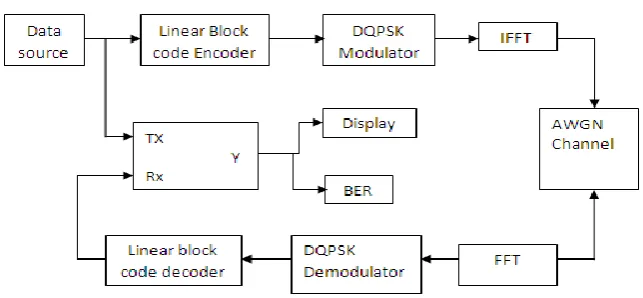
OFDM system is in Figure 3 which adopts DQPSK modulation,512 subcarriers and linear block codes with extended hamming. During the period of transmitting we adopt the generator matrix G. The code 512 bit makes 1024 possible values by generator matrix.
Generator Matrix G:
1 0 0 0 1 1 1 1
G =
0 1 0 0 1 1 0 1
0 0 1 0 1 0 1 1
Figure 1. Block Diagram of OFDM Transmitter with the Conventional SLM Technique
Figure 2. Block Diagram of Modified SLM Technique
Fig.3: Simulink Model of linear block code of OFDM system.
6. SIMULATION RESULTS
In this section we analyze the linear block coded OFDM system with DQPSK modulation technique. The decrease in bit error rate performance of OFDM system is investigated in different channels. It is observed that LBC
Maximum Doppler Shift 1Hz, 2Hz
Rician Parameter K=1,2,3,4
6.1 AWGN channel
end
ratio=error/N; y=[error, ratio];
end
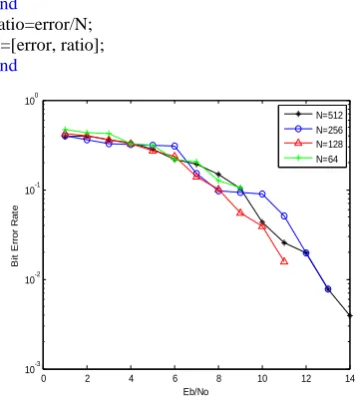
Figure 4:Bit Error Rate Performance of OFDM for different carriers under AWGN channel using LBC
When the results were tabulated and a graph was plotted with Eb/No against bit error rate. It is observed that as fig4 the number of carriers are increased the bit error rate of OFDM decreases under AWGN channel using linear block code with extended hamming code. For N=64 the bit error rate 10-1 dB as the number of carriers is increased the BER decreases to 10-2.5 dB.Fig 5 is a graph of uncoded and coded of OFDM system under AWGN channel. As compare after LBC coding with extended hamming of OFDM system gives good performance of bit error rate.
Figure 5. Bit Error Rate of OFDM under AWGN channel
6.2 Rayleigh channel
(a)
(b) Figure 6: Bit Error Rate of OFDM system Under Rayleigh channel using LBC (a)Doppler shift=1hz (b)
Doppler shift=2hz
Figure 7. Bit Error Rate Performance of OFDM system under Rayleigh channel using LBC
The results obtained under the Rayleigh channel using LBC for bit error rate and Eb/No for different values of maximum Doppler shift are showed in Fig7. Thus it is observed in Fig6 and Fig7 that the bit error rate is better for lower values of Doppler shift.
6.3 Rician channel
Figure 8. Bit Error Rate of OFDM system under Rician channel for Doppler shift=1hz
0 2 4 6 8 10 12 14 10-3 10-2 10-1 100 Eb/No B it E rr o r R a te N=512 N=256 N=128 N=64
0 2 4 6 8 10 12 14
10-3 10-2 10-1 100 Eb/No B it E rr o r R a te uncoded coded
0 5 10 15
10-3 10-2 10-1 100 Eb/No B it E rr o r R a te :B E R uncoded coded
0 5 10 15
10-2 10-1 100 Eb/No B it E rr o r R a te :B E R uncoded coded
0 5 10 15
10-3 10-2 10-1 100 Eb/No B it E rr o r R a te :B E R Doppler shift=1hz Doppler shift=2hz
0 2 4 6 8 10 12 14
Figure 9:Bit Error Rate Performance of OFDM system under Rician
channel using LBC for Doppler shift=1Hz
Figure 8 exhibits the results of uncoded and coded OFDM system under Rician channel for k=1.Coded graph shows better performance in bit error rate as compare to uncoded OFDM system. The Figure 9 highlights the results for Rician fading channel. Effect of changing Rician parameter is observed for BER. The results confirmed that for increase in Rician parameter „k‟ factor BER performance got better. Results were obtained by using linear block code with Extended hamming and DQPSK Modulation scheme.
Figure.10a: PAPR of basic QPSK-OFDM system
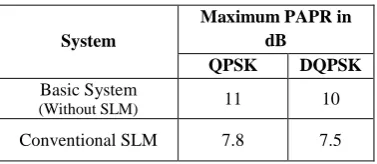
carried out in MATLAB for QPSK-OFDM, DQPSK-OFDM with and without SLM & modified SLM Technique.
Fig. 11a: PAPR of QPSK-OFDM system with Conventional SLM.
Fig.11b: PAPR of DQPSK-OFDM system with Conventional SLM
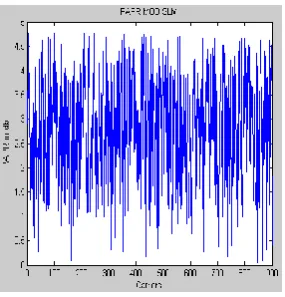
In Fig.12 With reference [9] the Peak value for the modified SLM technique is 5.5 dB but in our case it is 4.77 dB and average value of PAPR is 2.8dB. This result is better by 0.73 dB. So we concluded that PAPR of Modified SLM is better than conventional SLM.
System
Maximum PAPR in dB
QPSK DQPSK
Basic System
(Without SLM) 11 10 Conventional SLM 7.8 7.5
0 5 10 15
10-3
10-2
10-1
100
Eb/No
B
it
E
rr
o
r
R
a
te
k=1 k=2
k=3
Figure 12: PAPR of the modified SLM technique 7. CONCLUSION
The proposed scheme has used linear block code with extended hamming to improved the performance in BER and PAPR of OFDM system. Linear block code with Extended hamming is an correcting two error pattern so as to achieve good BER performance as compare to uncoded OFDM system under the different channels. A modified selective mapping technique scheme requires only one IFFT block at the transmitter. The differential detection system is advantageous to reduce complexity, PAPR and gives better performance of OFDM system.
Results of simulation of SLM technique show the PAPR reduction of OFDM system, which further results in high performance of wireless communication. This system provides Modern digital signal processing techniques to improve the reliability of the communication links.
7
.REFERENCES
[1] J. Bingham, “Multicarrier modulation for data: An idea whose time has come”, IEEE communication Mag., pp.5-14, May1990.
[2] Kyeongcheol Yang and Seok-II Chang, “ Peak- To-Average Power control in OFDM using standard Arrays of Linear Block Codes”, IEEE communication letters, Vol.7, No.4, pp. 174-176, April 2003
[3] Marvin k. Simon, Mohamed- Slim Alouini , “Digital communication over fading channels”, Second Edition, Wiley and Sons Publication
[4] A. Ghassemi and T. A. Gulliver, “Fractional Selective mapping using Decimation in time IFFT/FFT”, Publication in WCNC 2008 Proceedings IEEE, pp. 543-547.
[5] Abdulla A. Adouda, “PAPR Reduction of OFDM signal using Turbo coding and Selective Mapping”, Proceedings of 6th Nordic signal processing symposium-NORSIG2004.
[6] Zhang Y., Yongacoglu A., Chouinard J. and Zhang L. “OFDM Peak Power Reduction by sub block coding and its extended versions”, IEEE VehicularTechnologyconference,Vol.1,May199.
[7] Park M., Heeyong J., Cho.N., Hong D. and Kang C. “PAPR reduction in OFDM transmission using Hadamard Transform,” IEEE International Conference ON communications Vol.1 JUN2000.
[8] Sang-Woo Kim, Jin_Kwan Kim and Heung-Gyoon Ryu”, A computational complexity Reduction scheme using Walsh Hadamrd sequence in SLM method”, IEE2006, pp. 762-766.
[9] Yang Jie, Chen Lei, Liu Quan and Chan De, “A Modified selected mapping technique to reduce the Peak to Average Power Ratio of OFDM signal”, IEEE transaction on consumer Electronics, Vol53, No.3, pp. 846-851, August 2007.
[10] Orlands Grigoriadis, H. Shrikanta kamat, “BER Calculation using Matlab simulation for OFDM Transmission”, Proceeding of the international Multicarrier of Engineers & Computer Scientists IMECS 2008,Hong Kong, Vol. II, pp. 978-988, 19-21 March 2008.
[11] Abhishek katariya, Neha Jain, Amita Yadav, “Performance elevation criteria of RS Coded OFDM transmission over noisy channel‟‟, International Journal of Soft Computing and Engineering (IJSCE) ISSN: 2231-2307, Vol-1, pp.24-28, Issue-3, July 2011
[12] S. A. Hanna, “Convolutional Interleaving for Digital radio transmissions”, ICUPC Conference, pp.443- 447, IEEE 1993.
[13] Fumiaki Maehara, “Series Expression of BER Performance for DQPSK/OFDM Signals employing Selection Combing Diversity Reception over Nonlinear Fading Channels” IEEE 2005.
[14]Rappaport, T. S., Wireless Communication Principles and Practice, IEEE Press, New York, Prentice Hall
[15] Kyeongcheol Yang and Seok-II Chang, “Peak-To-Average Power control in OFDM using standard Arrays of Linear Block Codes”, IEEE communication letters, vol.7,No.4,April 2003,PP 174-176.
[16] Ranjan Bose, “Information theory, coding and cryptography”, Tata Mc-Graw Hill, Second Edition.
[17] F. J. MacWilliams and N. J. A. Sloane, The Theory of Error Correcting Codes, New York: North – Holand,1977.
[18] Tang Tao, “The block coding used in OFDM system to reduce the PAPR”, IEEE 2006, 14244-0517, pp.1-3
[19] Xin Chun Wu, Jin Xiang Wang, Zhi Gang Mao, “A Novel PTS Architecture for PAPR Reduction of OFDM signals”, ICCS IEEE 2008, pp. 1055-1060.
8. AUTHORS PROFILE
Dr. B. P. Patil received his Ph.D. in 2000 and has more than 25 years of teaching and industrial experience. He has published 75 papers in International and National journals and Conferences. He also guided four Ph.D. students and guiding two students towards Ph.D. He is involved in three various research projects from Univ. of Pune. He is
currently working as Professor and Head of Electronics Engineering Dept. at Army Institute of Technology, Dighi Pune. His area of research includes sensor network and wireless communication