Original Research Article
Prevalence of diabetes mellitus among patients with ophthalmic
morbidity in an urban population in Kanchipuram district
L. Neerajaa*, S. Gopalakrishnan, R. Umadevi
INTRODUCTION
Diabetes in simple terms is chronic hyperglycemia. As defined by the WHO in detail, it is the chronic, metabolic disease characterized by elevated levels of blood glucose (or blood sugar), which causes cardiac, vascular ophthalmic nephropathic and neuropathic complications in the long run.1
Diabetes was 8.5% prevalent worldwide affecting over 422 million people in the year 2014.1 More than 62 million Indians are reported to be afflicted with diabetes
mellitus, where an average Indian acquires diabetes when he turns 43 years old.49% of the diabetic burden of the world is carried in the shoulders of India, the rates are expected to boom to an appalling 134 million by 2025.2 Accounting to this, industrial nations are bound to have an increase of about 20% patients. Case fatality rate of diabetes is about 1 million in India.
Diabetic retinopathy is found to show its face in 80% of patients who are diabetic for more than 20 years.3 Many of them get diagnosed of diabetes on their regular
ABSTRACT
Background: Diabetes hastens the onset of cataract, so a patient may get diagnosed of cataract and diabetes at the
same time. Checking of random blood sugar values for all patients presenting with visual loss will be both a primary and secondary prevention strategy of diabetes, where in we could diagnose diabetes early and treat it promptly.
Methods: This is a Health centre based cross sectional study done in Anakaputhur-urban field practice area of Sree
Balaji Medical College and in Kanchipuram district, Tamil Nadu from September 1st to November 30th 2016, including people with visual complaints of all age groups in the study area, excluding severely ill, mentally challenged and those not willing to participate in the study. Based on convenient sample size calculation, prevalence was assumed to be 50%, with confidence interval 95%, relative precision was 9%, the sample size was calculated to be 494 participants. Previous health centre records dated September 1st to November 30th 2016the data was entered in MS excel and analaysed in SPSS 20 version.
Results: Significant proportion (36.7%) of our study population presenting with visual complaints were found to be
diabetic. Out of the diabetics, 69.7% presented with cataract. The other leading diagnoses were refractive error (17.7%), retinopathy (6.7%), glaucoma and others (5.7%) Other factors like positive family history, associated hypertension are significantly associated with diabetes mellitus.
Conclusions: Significant amount of patients presenting with various ophthalmic complaints, especially cataract and
refractive errors were found to be diabetic. So, it is recommended to check random blood sugar levels in all patients presenting to an ophthalmic outpatient setup with complaints of visual loss.
Keywords: Diabetics, Visual complaints, Blood sugar testing
Department ofCommunity Medicine, Sree Balaji Medical College and Hospital, Chennai, Tamil Nadu, India
Received: 08 August 2018
Accepted: 07 September 2018
*Correspondence:
Dr. L. Neerajaa,
E-mail: [email protected]
Copyright: © the author(s), publisher and licensee Medip Academy. This is an open-access article distributed under
the terms of the Creative Commons Attribution Non-Commercial License, which permits unrestricted non-commercial use, distribution, and reproduction in any medium, provided the original work is properly cited.
ophthalmic checkup for visual loss. Diabetes hastens the onset of cataract and thus, a patient may get diagnosed of cataract and diabetes (especially type II/non-insulin dependent diabetes) at the same time.4
Vigilant treatment of diabetes and regular ophthalmic checkup could reduce 90% cases of diabetic retinopathy. Blindness in adults ageing 20 to 74 years is predominantly caused by diabetes. It is said that if diabetes strikes the rest of the world in the next decade, it is striking India now, i.e. a decade earlier.5
When the depth of the anterior chamber was decreased, that per se increased the probability of getting an abnormal response to oral glucose tests as per study done by Mapstone et al.6 This association is rather explained by patients with shallow anterior chamber predominantly presenting with autonomic dysfunction. Because of this, acute glaucoma should be regarded as a symptom of diabetes.6
Checking of random blood sugar values for all patients presenting with visual loss will be both a primary and secondary prevention strategy of diabetes, wherein we could diagnose diabetes before it is too late and treat it promptly.
With this background this study was planned with the following objectives:
To screen patients coming with ophthalmic complaints/diseases in the urban field practice area to identify the presence of diabetes mellitus.
To correlate whether there is a direct relationship between diabetes and ophthalmic morbidity.
METHODS
Study design
Health center based descriptive cross sectional study
Study area
Anakaputhur-urban field practice area of Sree Balaji Medical College and Hospital in Kanchipuram district, Tamil Nadu.
Study period
September 1st to November 30th 2016
Study population
People with visual complaints of all age groups in the study area.
Inclusion criteria
Inclusion criteria were all age groups with visual complaints.
Exclusion criteria
Exclusion criteria were severely ill patients.
Sample size
Based on convenient sample size calculation, prevalence of diabetes mellitus among patients with visual complaints was assumed to be 50%, with confidence interval 95%, relative precision was 9%, the sample size was calculated to be 494 participants.
Sampling technique
Convenient sampling technique was used to collect the samples in this study.
Data collection
Retrospective record based study based on case sheet records of patients with ophthalmic complaints who presented with visual complaints to Anakaputhur-urban field practice area of Sree Balaji Medical College and hospital in Kanchipuram district, Tamil Nadu from September 1st to November 30th 2016.A total of 501 patients had attended the out-patient department with visual complaints and 494 were selected, 7 had insufficient data were unable to be contacted and were excluded from the study.
Study tool
Previous health centre records dated September 1st to November 30th 2016
Data analysis
The data was entered in MS Excel and analysed in SPSS 20 version.
RESULTS
Socio-demographic characteristics of the population
The socio-demographic characteristics of the study population are presented in Table 1. Among the study participants 55.1% were females and 44.9% were males. Around 44.1% belonged to 51-60 years of age followed by 20% belonging to 31-40 years of age. Nearly 32.7%of the study subjects had high school education and 23.8% had post high school education. Socio economic status was classified based on BG Prasad scale. Around 45.1% belonged to Class III socio economic status and 21.6% belonged to Class IV socio economic status.
Frequency of prevalence of diabetes mellitus among various ophthal diagnosis
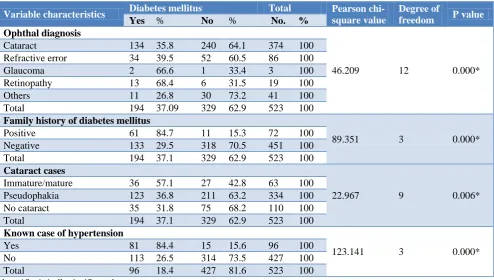
Moderate prevalence is present among diagnoses like refractory error (39.5%) and cataract (35.8%).The lowest prevalence of diabetes (26.8%) is among patients presenting with other complaints like conjunctivitis, uveitis etc.
Table 1: Socio-demographic characteristics of the study population.
Sociodemographic variables Frequency
(N=494) %
Age (in years)
20-30 84 17 31-40 99 20 41-50 93 18.9 51-60 218 44.1
Sex Male 222 44.9
Female 272 55.1
Education
Illiterate 74 14.9 Primary school 8 1.6 Middle school 89 18.1 High school 161 32.7 Post high
school diploma 119 23.8 UG/PG 28 5.7 Professional 15 3.2
Socioeconomic status
Upper class 59 12.1 Upper middle 84 17 Lower middle 223 45.1 Upper lower 107 21.6 Lower class 21 4.1
Association of diabetes mellitus with positive family history
The prevalence of diabetes among patients with positive family history is found to be 84.7%, while the prevalence of diabetes among patients with no family history of diabetes was only 29.5%.The association of diabetes mellitus with positive family history was statistically significant (chi square value=89.351, degree of freedom=3, p=0.000).
Association of diabetes mellitus with hypertension
The prevalence of diabetes among patients with hypertension is found to be 84.4%, while the prevalence of diabetes among patients with no family history of diabetes was only 26.5%. The association of diabetes mellitus with hypertension was statistically significant (chi square value=123.141, degree of freedom=3, p=0.000).
Sex prevelance of diabetes among patients with visual loss
Among the 313 people with visual complaints who were diagnosed with diabetes, 145 were male and 168 were female. Among the 181 people with visual complaints who were not diabetic, 77 were male and 104 were female. Overall, 34.8% of the males and 38.4% of the females with ophthalmic complaints were found to be diabetic.
Table 2: Frequency of prevalence of diabetes mellitus among various ophthal diagnosis, family history of diabetes, cataract and hypertension.
Variable characteristics Diabetes mellitus Total Pearson
chi-square value
Degree of
freedom P value
Yes % No % No. %
Ophthal diagnosis
46.209 12 0.000* Cataract 134 35.8 240 64.1 374 100
Refractive error 34 39.5 52 60.5 86 100 Glaucoma 2 66.6 1 33.4 3 100 Retinopathy 13 68.4 6 31.5 19 100 Others 11 26.8 30 73.2 41 100 Total 194 37.09 329 62.9 523 100
Family history of diabetes mellitus
89.351 3 0.000* Positive 61 84.7 11 15.3 72 100
Negative 133 29.5 318 70.5 451 100 Total 194 37.1 329 62.9 523 100
Cataract cases
22.967 9 0.006* Immature/mature 36 57.1 27 42.8 63 100
Pseudophakia 123 36.8 211 63.2 334 100 No cataract 35 31.8 75 68.2 110 100 Total 194 37.1 329 62.9 523 100
Known case of hypertension
123.141 3 0.000* Yes 81 84.4 15 15.6 96 100
No 113 26.5 314 73.5 427 100 Total 96 18.4 427 81.6 523 100
Figure 1: Sex prevalence of diabetes among patients with visual loss.
Figure 2: Prevalence of diabetes among patients with various visual complaints.
DISCUSSION
Diabetes is a highly prevalent non-communicable disease in India. Many health education methods and screening camps are conducted to diagnose diabetes promptly and treat them effectively. Once diabetes is diagnosed, the patients are constantly examined of their eyes, kidney and brain. These complications are treated effectively in the recent years. But those presenting merely with ophthalmic complaints having increased tendency to be diabetic is a new concept. The present study was conducted among urban patients presenting to the urban health centre various visual complaints.
A significant proportion (36.7%) of our study population presenting with visual complaints were found to be diabetic. Out of the positive cases of diabetes, 69.7%
presented to the clinic with cataract, in our study. In a study done by Lyons et al, cataract patients have relatively high HbA1c levels compared to those with clear lenses.4
The second leading ophthalmic diagnosis in which the patients were found to be diabetic was refractive error (17.7%). In a similar study done by Jain et al, the incidence of diabetes is increased in patients with refractive error for a long period of time.7
The next ophthalmic diagnosis in which the patient was found to be diabetic in our study was retinopathy (6.7%). In a similar study by Colagiuri et al, when diabetes-specific retinopathy was plotted against continuous glycemic measures, a curvilinear relationship was observed for FPG and HbA1c. Diabetes-specific retinopathy prevalence was low for FPG <6.0 mmol/L and HbA1c <6.0% but increased above these levels. Thresholds for diabetes-specific retinopathy from receiver operating characteristic curve analyses were 6.6 mmol/L for FPG, 13.0 mmol/L for 2-h PG, and 6.4% for HbA1c.
The other ophthalmic diagnosis in our study in which the patient was diagnosed to be diabetic was glaucoma & others (5.7%). According to a similar study by cologne et al, high prevalence of autonomic dysfunction like diabetes in patients with shallow anterior chambers and glaucoma explains similar association to our study.6 Acute glaucoma should be regarded as a symptom of diabetes.6
Other factors like positive family history was significantly associated with prevalence of diabetes mellitus.Ina similar study by Mohan et al, the prevalence of impaired glucose tolerance was 5.9%.8 The prevalence of glucose intolerance (Diabetes + IGT) was significantly higher among subjects with both parents diabetic (55%) compared to those with one parent diabetic (22.1%, p=0.005) and those with no family history (15.6%, p<0.0001).8
Other factors like associated hypertension are significantly associated with prevalence of diabetes mellitus in our study. In a similar study by Mclean et al 42.2% of diabetic patients were taking 1 antihypertensive agent at baseline, 28.6% were taking 2 agents, and 8.3% were taking 3 or more antihypertensive drugs; only 2.1% reported that they had seen a hypertension specialist.9
CONCLUSION
Significant proportion (36.7%) of our study population presenting with visual complaints were found to be diabetic. Out of the diabetics, 69.7% presented with cataract. The other leading diagnoses were refractive error(17.7%), retinopathy (6.7%), glaucoma and others (5.7%) Other factors like positive family history,
34.8 65
38.4
61.5
0 20 40 60 80 100 120 140
Diabetic Non Diabetic
Perc
entag
e
Male Female
35.8 39.5
6.7 6.84
21.9 64.1
60.4
3.4 3.15
73.1
0 10 20 30 40 50 60 70 80
cataract refractive error
glaucoma Retinopathy others
Perc
entag
e
associated hypertension are significantly associated with diabetes mellitus.
Recommendations
So, it is recommended to check random blood sugar levels in all patients presenting to an ophthalmic outpatient setup with complaints of visual loss, especially of those with high risk (obesity, hypertension, positive family history of diabetes).
Funding: No funding sources Conflict of interest: None declared
Ethical approval: The study was approved by the Institutional Ethics Committee
REFERENCES
1. Available at: http://www.who.int/news-room/fact-sheets/detail/diabetes. Accessed on 3 June 2018. 2. Sayin N, Kara N, Pekel G. Ocular complications of
diabetes mellitus. World J Diabetes. 2015;6(1):92. 3. Jeganathan VS, Wang JJ, Wong TY. Ocular
associations of diabetes other than diabetic retinopathy. Diabetes Care. 2008;31(9):1905-12. 4. Lyons TJ, Silvestri G, Dunn JA, Dyer DG, Baynes
JW. Role of glycation in modification of lens crystallins in diabetic and nondiabetic senile cataracts. Diabetes. 1991;40(8):1010-5.
5. Scott I, Flynn H, Smiddy W, editors. Diabetes and ocular disease: past, present, and future therapies. Oxford University Press; 2009.
6. Mapstone R, Clark CV. Prevalence of diabetes in glaucoma. Br Med J (Clin Res Ed). 1985;291(6488):93-5.
7. Jain IS, Luthra CL, DAS T. Diabetic retinopathy and its relation to errors of refraction. Archives of Ophthalmology. 1967;77(1):59-60.
8. Mohan V, Shanthirani CS, Deepa R. Glucose intolerance (diabetes and IGT) in a selected South Indian population with special reference to family history, obesity and lifestyle factors--the Chennai Urban Population Study (CUPS 14). J Association Physicians India. 2003;51:771.
9. McLean DL, McAlister FA, Johnson JA, King KM, Makowsky MJ, Jones CA, Tsuyuki RT. A randomized trial of the effect of community pharmacist and nurse care on improving blood pressure management in patients with diabetes mellitus: Study of Cardiovascular Risk Intervention by Pharmacists–Hypertension (SCRIP-HTN). Arch Internal Med. 2008;168(21):2355-61.
Cite this article as: Neerajaa L, Gopalakrishnan S,