Original Research Article
A cross sectional study of tobacco use among the college students of
B. G. Nagara, Karnataka
N. Sabari Raja*
INTRODUCTION
Tobacco is a leafy plant grown around the world. Nicotine is defined as: an alkaloid, which is the major psychoactive substance in tobacco. It has both stimulant and, subjectively, relaxing effects. It produces an altering effect in some individuals, an increased capacity to focus attention. In others, it reduces anxiety and irritability.
Tobacco is an addictive substance because it contains the chemical nicotine. Like heroin or cocaine, nicotine changes the way the human brain works and causes to crave more and more nicotine. This addiction to nicotine is what makes it so difficult to quit smoking and other
tobacco related products. Smoked tobacco products are cigarettes, cigars, pipes, beedis and hookahs.
A cigarette is any roll of tobacco wrapped in paper or in any substance. Tobacco smoke contains a deadly mix of more than 4000 chemicals. Hundreds of them are highly toxic and about 70 are known to be carcinogenic. The chemicals in cigarette smoke also affect those around us.
Smokeless tobacco is tobacco that is not burned. It comes in many forms, namely chewing tobacco, snuff, snus, dissolvable products, including lozenges, orbs, sticks and strips. Additionally, betel quid, common in India and Asia, is a combination of betel leaf, areca nut, and slaked lime. In many countries, tobacco is added and the product
ABSTRACT
Background: Tobacco is a leafy plant grown around the world with its addictive substance nicotine. It becomes the need of the hour to provide enough evidence on the correlates of tobacco use in the community to assist government policy makers, health professionals and the public in developing realistic models towards effective tobacco control to cater to sections of community in need. The present study was conducted to determine the prevalence and the pattern of tobacco use among the college students and to find out the reasons for the tobacco use among the college students.
Methods: A descriptive cross sectional study was conducted among various college students of B. G. Nagara with 1003 subjects selected. Data was collected with a pre-tested, semi-structured questionnaire and analysed. Results were expressed in percentages and proportions.
Results: The overall prevalence of tobacco use among the study subjects was found to be 5.8% and was exclusively among male students only. Cigarette smoking was the most commonly used form of tobacco, used by 89.7% of the tobacco users and the major reasons for initiation of tobacco use were due to friends (58.6%).
Conclusions: Present study showed that the prevalence of tobacco use (5.8%) was lower when compared to state and national average. But since majority of users were in the age group of 19 to 21 years and were away from their homes, strict measures should be enforced in hostel and college premises banning its use and sale.
Keywords: Tobacco use, Prevalence, Students
Department of Community Medicine, Thoothukudi Government Medical College, Thoothukudi, Tamil Nadu, India
Received: 24 June 2019
Revised: 04 August 2019
Accepted: 06 August 2019
*Correspondence:
Dr. N. Sabari Raja,
E-mail: [email protected]
Copyright: © the author(s), publisher and licensee Medip Academy. This is an open-access article distributed under the terms of the Creative Commons Attribution Non-Commercial License, which permits unrestricted non-commercial use, distribution, and reproduction in any medium, provided the original work is properly cited.
is known as ghutka or gutkha. Other ingredients and flavorings may be added according to local preferences and customs. No tobacco product is safe. Smokeless tobacco is not a safe alternative to smoking cigarettes.
The tobacco epidemic is one of the biggest public health threats the world has ever faced. It kills nearly 60 lakh people every year of whom more than 50 lakh are from direct tobacco use and more than 6,00,000 are non-smokers exposed to second-hand smoke (SHS). Approximately one person dies every six seconds due to tobacco and this accounts for one in 10 adult deaths. Up to half of current tobacco users will eventually die of a tobacco-related disease .Nearly 80% of the more than 100 crore smokers worldwide live in low and middle-income countries, where the burden of tobacco related illness and death is heaviest. Tobacco users who die prematurely deprive their families of income, raise the cost of health care and hinder economic development.1
Because there is a lag of several years between when people start using tobacco and when their health suffers, the epidemic of tobacco related diseases and deaths has just begun. Tobacco had caused 10 crore deaths in the 20th century. If this current trend continues, it may cause about one billion deaths in the 21st century. Unchecked, tobacco-related deaths will increase to more than 80 lakh per year by 2030. More than 80% of those deaths will be in low and middle income countries. Second-hand smoke (SHS) is the smoke that fills restaurants, offices or other enclosed spaces when people burn tobacco products such as cigarettes, beedis and water pipes. There is no safe level of exposure to SHS.2
About 5 million people die every year from tobacco consumption, the second leading cause of death worldwide and this figure is expected to increase to 1 crore deaths per year by 2020.3 China produces about a third of all the cigarettes in the world. It is also a major tobacco consumer, since nearly 60% of adult Chinese males smoke, representing one third of all smokers globally. Currently, it is estimated that one out of every three cigarettes in the world is smoked in China.4
According to global adult tobacco survey in India (2009-10), the prevalence of overall tobacco use among males was 48% and that among females was 20%. Nearly 38% adults in rural areas and 25% adults in urban areas use tobacco in some form. Prevalence of smoking among males was 24% and among females was 3%. The extent of use of smokeless tobacco products among males was 33% and in females, it was 18%.4 As early as in 1980, the World Health Day was celebrated with the theme of “Smoking or Health: Choice is yours” and later in 1988, the first World No Tobacco Day (WNTD) was celebrated with the positive theme of “Tobacco or Health: Choose Health”.5
Since then the World Health Organization is repeatedly stressing on the importance of controlling tobacco epidemic by marking May 31st of every year for celebrating WNTD with appropriate themes. The theme for the year WNTD 2008 was “Tobacco Free Youth”.6
India, now being a signatory to “Framework Convention on Tobacco Control” (FCTC-WHO, 2003), a first ever international public health treaty on any one health issue, is coming out with stringent tobacco control policies.7
It becomes the need of the hour to provide enough evidence on the correlates of tobacco use in the community to assist government policy makers, health professionals and the public in developing realistic models towards effective tobacco control to cater to sections of community in need. As no studies were carried out so far in B. G. Nagara, the present study was conducted to determine the prevalence of all forms of tobacco use among the college students of B. G. Nagara and the various reasons for their usage.
METHODS
An analytical cross sectional study was conducted in B. G. Nagara, Nagamangala Taluk, Mandya district, Karnataka which has college students population of around 4000 in 5 different colleges listed below (Table 1).
The study was conducted for a period of one year from January to December 2014. A sample size of 1003 was obtained [by using the formula, n=4pq/L²]with the lowest prevalence of tobacco usage as 15.7% using stratified proportionate sampling method.8-10 Institutional ethical committee approval was taken before conducting the study.
The data was collected using a pre-tested, semi structured, anonymous questionnaire from the college students, both male and female. After giving adequate information regarding the nature and the purpose of the study in their local language Kannada and also in English, an informed oral consent was obtained from the students before distributing the questionnaire. Those who were not willing to participate in the study, married female students who were pregnant and those who were suffering from any major illnesses or psychiatric disturbances were excluded from the study.
Students were also explained in detail about each question asked in the questionnaire and were requested to mark their answers neatly, legibly and truly without mentioning their names anywhere. They were allowed to ask us any doubts regarding the questionnaire filling. After providing them adequate time for filling, the questionnaires were collected back, counted, cross checked and verified. Data was entered in Microsoft Excel and was analysed using SPSS version 20.0. Results were expressed in percentages and proportions.
Table 1: List of various colleges in B. G. Nagara with total number of students.
S. no. Name of the colleges Total number of students
1 Adichunchanagiri Institute of Medical Sciences (AIMS) 760
2 BGS Institute of Technology (BGSIT) 1788
3 Sri Adichunchanagiri College of Pharmacy (SACP) 708
4 Adichunchanagiri Institute of Nursing (AIN) 250
5 Sri BhakthanathaSwamiji Composite PU College 585
Total 4091
RESULTS
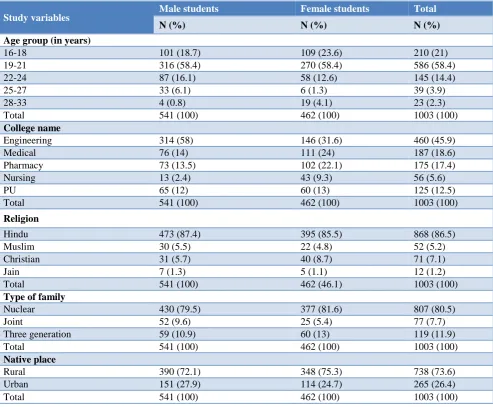
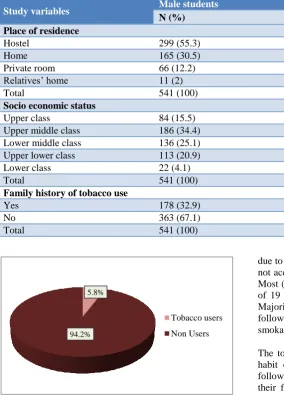
Majority (58.4%) of the study subjects were in the age group of 19 to 21 years followed by 16 to 18 years (21%). Most of them (45.9%) were from Engineering College, followed by Medical College (18.6%) and Pharmacy College (17.4%). Most of them were Hindus (86.5%) by religion. Most of the study subjects were from rural areas (73.6%) and majority (59.4%) were residing in their respective college hostels.
Nuclear family contributed to 80.5% of study subjects and the rest of the study subjects were from joint and three generation families (Table 2). According to modified BG Prasad’s classification (2015), more than half (61.2%) of the study subjects belonged to Class II and III socio economic status. A few (29.4%) of the study subjects’ family members were consuming some form of tobacco (Table 2).
Table 2: Socio demographic profile of study subjects.
Study variables Male students Female students Total
N (%) N (%) N (%)
Age group (in years)
16-18 101 (18.7) 109 (23.6) 210 (21)
19-21 316 (58.4) 270 (58.4) 586 (58.4)
22-24 87 (16.1) 58 (12.6) 145 (14.4)
25-27 33 (6.1) 6 (1.3) 39 (3.9)
28-33 4 (0.8) 19 (4.1) 23 (2.3)
Total 541 (100) 462 (100) 1003 (100)
College name
Engineering 314 (58) 146 (31.6) 460 (45.9)
Medical 76 (14) 111 (24) 187 (18.6)
Pharmacy 73 (13.5) 102 (22.1) 175 (17.4)
Nursing 13 (2.4) 43 (9.3) 56 (5.6)
PU 65 (12) 60 (13) 125 (12.5)
Total 541 (100) 462 (100) 1003 (100)
Religion
Hindu 473 (87.4) 395 (85.5) 868 (86.5)
Muslim 30 (5.5) 22 (4.8) 52 (5.2)
Christian 31 (5.7) 40 (8.7) 71 (7.1)
Jain 7 (1.3) 5 (1.1) 12 (1.2)
Total 541 (100) 462 (46.1) 1003 (100)
Type of family
Nuclear 430 (79.5) 377 (81.6) 807 (80.5)
Joint 52 (9.6) 25 (5.4) 77 (7.7)
Three generation 59 (10.9) 60 (13) 119 (11.9)
Total 541 (100) 462 (100) 1003 (100)
Native place
Rural 390 (72.1) 348 (75.3) 738 (73.6)
Urban 151 (27.9) 114 (24.7) 265 (26.4)
Total 541 (100) 462 (100) 1003 (100)
Study variables Male students Female students Total
N (%) N (%) N (%)
Place of residence
Hostel 299 (55.3) 297 (64.3) 596 (59.4)
Home 165 (30.5) 154 (33.3) 319 (31.8)
Private room 66 (12.2) 2 (0.4) 68 (6.8)
Relatives’ home 11 (2) 9 (1.9) 20 (2)
Total 541 (100) 462 (100) 1003 (100)
Socio economic status
Upper class 84 (15.5) 74 (16) 158 (15.8)
Upper middle class 186 (34.4) 143 (31) 329 (32.8)
Lower middle class 136 (25.1) 149 (32.3) 285 (28.4)
Upper lower class 113 (20.9) 68 (14.7) 181 (18)
Lower class 22 (4.1) 28 (6.1) 50 (5)
Total 541 (100) 462 (100) 1003 (100)
Family history of tobacco use
Yes 178 (32.9) 117 (25.3) 295 (29.4)
No 363 (67.1) 345 (74.7) 708 (70.5)
Total 541 (100) 462 (100) 1003 (100)
Figure 1: Distribution of study subjects according to their tobacco use.
Figure 2: Distribution of tobacco users according to the various forms of tobacco use.
In the present study, the overall prevalence of tobacco use among the college students was 5.8% which was exclusively among male students (Figure 1). Among 541 male students, 58 (10.7%) were tobacco users. It might be
due to our social structure in which female tobacco use is not acceptable and it is correlated with the moral values. Most (51.7%) of the tobacco users were in the age group of 19 to 21 years followed by 22 to 24 years (22.7%). Majority (89.7%) of the tobacco users were smokers followed by smokeless chewable forms (5.1%) and both smokable and smokeless forms (5.2%) (Figure 2).
The tobacco users in the present study had initiated the habit of tobacco use influenced from friends (58.6%) followed by inspiration from media (13.8%) motivated by their favourite actors using tobacco products on screen and just to try or with curiosity (10.3%) (Figure 3).
Figure 3: Distribution of tobacco users according to their various reasons for initiation.
In the present study, tobacco use was compared with the residence of study subjects. It was observed that 88% tobacco users were residing in hostels or outside their home while 12% tobacco users were residing in their home. The difference found in the tobacco use between the study subjects residing in hostels and those not residing in hostels were found statistically significant (Table 3).
5.8%
94.2%
Tobacco users Non Users
0 10 20 30 40 50 60 70 80 90 100
Cigarette Ghutka Both Forms
89.7%
5.1% 5.2%
58.6
13.8
10.3 8.6 5.2
3.4 0
10 20 30 40 50 60 70
Friends Media Just to try / Curiosity
Depression Stress Family
P
er
ce
n
Table 3: Distribution of tobacco users based on their residence.
Residence
Study subjects
Total
Tobacco users Non users
Frequency % Frequency % Frequency %
Home 7 12 312 33 319 31.8
Hostel/outside home 51 88 633 67 684 68.2
Total 58 100 945 100 1003 100
χ2
=11.055; df=1; p=0.001 (significant); OR=0.28; 95% CI= 0.125-0.621.
Table 4: Distribution of tobacco users based on their family history.
Family history
Study subjects
Total
Tobacco users Non users
Frequency % Frequency % Frequency %
Yes 49 84.5 246 26 295 29.4
No 9 15.5 699 74 708 70.6
Total 58 100 945 100 1003 100
χ2 =89.927; df=1; p=0.0001 (significant); OR = 15.470; 95% CI=7.489-31.957.
In the present study, tobacco use was compared with the family history of study subjects. It was observed that 84.5% tobacco users had any of their family members using tobacco and the difference of 69% was found to be statistically significant (Table 4).
DISCUSSION
In the present study, the overall prevalence of tobacco use among the college students was 5.8%. Similar prevalence was obtained in the study conducted by Prasanth et al 5.66% in Mangalore.11 The prevalence noted was still higher in studies conducted by Shah et al (28.9%) in Gujarat, in Chaudhari et al (40%), in Chatterjee et al (28.5%), in Kumar et al (16.2%), in Bhojani et al (15.7%) and in Sreeramareddy et al (13.9%).9,12-16
It was found that the overall prevalence of tobacco use in the present study was slightly lower than the state level estimates for boys in Karnataka (8%) andregional estimates for southern India (9.2%), as reported by the GYTS and was much lower than the national estimate (17.2%).17,18
In the present study, the prevalence of tobacco use was exclusively among male students. Among 541 male students, 58 (10.7%) were tobacco users. It might be due to our social structure in which female tobacco use is not acceptable and it is correlated with the moral values. This was in accordance with a study conducted in Gujarat in 2005 by Shah et al, wherein also tobacco use was reported to be exclusively among male students only.12
Among the total 187 medical college students interviewed in the present study, 12 (6.4%) students were using some form of tobacco which was similar to a study conducted among male medical students in Orissa by Ramakrishna et al (8.7%) and another study by Chaudhary et al.13,19
Most (51.7%) of the tobacco users were in the age group of 19 to 21 years followed by 22 to 24 years (22.7%). In a study conducted in Mathura city by Chaudhary et al also, majority (55.4%) of tobacco users were in the same age group of 20 to 25 years.13
In the present study, majority (89.7%) of the tobacco users were smokers followed by smokeless chewable forms (5.1%) and both smokable and smokeless forms (5.2%). Similar findings were seen in several other studies conducted in India, with smokable forms as the most prevalent form among the tobacco users in Prasanth et al (52.94%), 97.6% smokers, in Kumar et al,14.7% in Bhojani et al, 87.5% in Kumari et al.9,11,15,20 Even in another study conducted outside India, in Western Nepal, majority (58.7%) were smokers among the tobacco users.21
Majority of the tobacco users (88%) in the present study were residing in hostels or outside their homes in private rooms not under the supervision of their parents and the association was found statistically significant (p<0.001). Similar findings were also found in other studies-Bhimarasetty et al and Kumari et al.15,22
In the present study, majority (84.5%) of tobacco users had any of their family member using any form of tobacco and there was a significant relationship (p<0.0001) between the presence of a tobacco user in the family and picking up the habit in the present study as well as other studies.16,20,23
CONCLUSION
To conclude, the present study showed that the prevalence of tobacco use among the college students was slightly lower than the state level estimates for boys in Karnataka (8%) and regional estimates for southern India (9.2%), as reported by the GYTS and was much lower than the national estimate (17.2%). But since majority of users were in the age group of 19 to 21 years and were away from their homes staying in hostels, strict measures should be enforced in hostel and college premises banning the use as well as sales of tobacco products making them inaccessible by the vulnerable population.
This can be well implemented by parents-teachers association of the colleges and health education. There is necessity for initiation of school based anti-tobacco campaigns and inclusion of a separate subject or a weekly class in colleges of all branches to re-enforce about the various moral aspects of life and also aversion and de
addiction programmes clubbed with individual
counselling in achieving the objective of reducing the tobacco use.
Skin patches with nicotine are one option in de-addiction/giving up smoking, but the results are far from encouraging. Students, who are smokers and who are trying to give up the habit, can instead be advised to drop the money intended to buy cigarettes in a piggy bank and would be surprised at the savings.
Of late, there is student-mentoring or tutor-ward system in many colleges. This system can be well utilized in controlling the tobacco use among students. Discouraging use of tobacco and its products can be highlighted even more seriously at all public places and tea stalls. Documentaries in movie theatres to this end can be very effective.
At the policy making level, the use of tobacco and its products can be discouraged by levying exorbitant taxes on them. Incentivizing growers who opt to change from tobacco to any food crop is the combined responsibility of the agriculture ministry as well as the health ministry.
The fact that we are spending more money to treat tobacco related diseases rather than the income generated by sale of tobacco and its products must be well entrained among all sections of the society including consumers, bureaucrats/officials and policy makers.
Limitations
Under-reporting might have been a distinct
possibility. Thus the reported prevalence might be an under estimate.
Qualitative research methods like focused group discussions can be utilized in further studies to have in-depth analysis of the reasons for tobacco use among adolescent students.
Students who were tobacco users, might have been absent from the college/selected class, on the day of survey and also they were also not given the questionnaire on the following subsequent days of survey.
The findings and their interpretations are restricted only to college students, who are adolescents and young adults in the age group of 16 to 33 years. Further studies are needed to cover those groups of adolescents and young adults who are out of school or college, as the prevalence of health risk behaviors is likely to be higher among these adolescents and young adults, as they might be out of their parents and teachers supervision.
The study setting B. G. Nagara, was not an ideal sample when compared to the universe, it was only a convenient sampling. Hence extrapolation might be unreasonable.
ACKNOWLEDGEMENTS
The author would like to thank the study participants who have participated in this study. Author acknowledges the help received from the scholars whose articles are cited and included in references of this manuscript. He is also grateful to the authors/editors/publishers of all those articles, journals, and books from where the literature for this article has been reviewed and discussed.
Funding: No funding sources Conflict of interest: None declared
Ethical approval: The study was approved by the Institutional Ethics Committee
REFERENCES
1. About tobacco: tobacco facts and figures, tobacco and nicotine 2015. Available at: URL: http://betob accofree.hhs.gov/about-tobacco/facts-figures/. Accessed 26 March 2015.
3. The World Health Report 1999. Available at: URL: http://www.who.int/whr/1999/en/whr99_en.pdf. Accessed 26 March 2015.
4. Park K. Park’s Text book of Preventive and Social Medicine. 25th ed. Jabalpur: M/s Banarsidas Bhanot Publishers; 2019.
5. WHO. Previous World No Tobacco Days. Available
at: URL: http://www.who.int/tobacco/communicat ions/events/wntd/en/index.html. Accessed 26 March 2015.
6. WHO. World No Tobacco Day 2008. Available at: URL: http://www.who.int/tobacco/wntd/2008/en/ index.html. Accessed 26 March 2015.
7. WHO. The WHO Framework Convention on
Tobacco Control (WHO-FCTC). Available at: URL: http://www.who.int/fctc/en/index.html. Accessed 26 March 2015.
8. Dixith JV. Principles and Practice of Biostatistics. 5th ed. Jabalpur: M/S Banarsidas Bhanot publishers; 2011.
9. Bhojani UM, Chander SJ, Devadasan N. Tobacco use and related factors among pre- university students in a college in Bangalore, India. Natl Med J India. 2009;22(6):294-7.
10. Rao PSSS, Richard J. Introduction to Biostatistics and Research methods. 5th ed. New Delhi, India: Ashok K Ghosh Publishers; 2012.
11. Prasanth YM, Bhat M. Tobacco use and awareness patterns among students of an industrial training institute in Mangalore, South India. Int J Biomed Res. 2014;5(5):368-70.
12. Shah VN, Verma PB, Tripathi CB. Knowledge, attitude and practice regarding tobacoo consumption among the college students of Bhavnagar City (Gujarat). Indian J Community Med. 2005;30(1). 13. Chaudhary A, Ingle NA, Dhanker K, Kaur N.
Prevalence of tobacco use among the students in professional and non-professional colleges of Mathura city. J Oral Health Comm Dent. 2014;8(1):30-5.
14. Chatterjee T, Haldar D, Mallik S, Sarkar GN, Das S, Lahiri SK. A study on habits of tobacco use among medical and non-medical students of Kolkata. Lung India. 2011;28(1):5-10.
15. Kumar R, Alka S, Khushwah MA, Prakash S, Vijayan VK. A study of tobacco consumption among college students of University of Delhi, India. Indian J PrevSoc Med. 2010;41(3):198-202. 16. Sreeramareddy CT, Kishore PV, Paudel J, Menezes
RG. Prevalence and correlates of tobacco use amongst junior collegiates in twin cities of western Nepal: a cross-sectional, questionnaire-based survey. BMC Public Health. 2008;8:97.
17. Impact of tobacco use on women’s health. Available at: URL: http://www.who.int/tobacco/publications/ gender/en_tfi_gender_women_impact_tobacco_use _women_health.pdf. Accessed on 26 March 2015.
18. GYTS- Global Youth Tobacco Survey Atlas.
Centers for Disease Control and Prevention. Available at: URL: http://www.cdc.gov/tobacco /global/gtss/tobacco_atlas/pdfs/part3.pdf. Accessed on 29 March 2015.
19. Ramakrishna GS, SankaraSarma P, Thankappan
KR. Tobacco use among medical students in Orissa. Natl Med J India. 2005;18(6):285-9.
20. Kumari R, Nath B. Study on the use of tobacco among male medical students in Lucknow, India. Indian J Community Med. 2008;33(2):100-3. 21. Aryal RU, Deuba K, Subedi A, Shrestha R, Bhatta
L. Prevalence and determinants of cigarette smoking among the college students of Kathmandu valley. Asian J Med Sci. 2010;01:53-8.
22. Bhimarasetty DM, Sreegiri S, Gopi S, Koyyana S.
Perceptions of young male smokers In
Visakhapatnam about tobacco use and control measures. Int J Res Dev Health. 2013;1(3):129-35. 23. Sharma R, Grover VL, Chaturvedi S. Tobacco Use
among adolescent students and the influence of role models. Indian J Community Med. 2010;35(2):272-5.
Cite this article as: Raja NS. A cross sectional study of tobacco use among the college students of B. G. Nagara, Karnataka. Int J Community Med