Original Research Article
Menstrual hygiene practices of women in a rural area of
Kancheepuram district, India: a cross sectional study
Angeline Grace G.*, Arunkumar M., Umadevi R.
INTRODUCTION
Menstruation is a physiological process in females which serves as a beginning of their reproductive life.1 But this process is considered as an unclean one in the Indian society. Due to this, women do not get the correct information on the good practices to be followed during menstruation. This can lead to development of reproductive tract infections (RTI). Due to lack of awareness of the normal physiology, various restrictions are imposed on women during their menstruation in the
form of restriction to attend functions, to touch food items etc.2
Good hygienic practices like proper use of sanitary pads and adequate washing of the genital area are essential during menstruation. Women should have the access to clean sanitary products which can protect their health throughout their reproductive life.3 Menstrual hygiene depends on various factors such as educational level, socio economic status, cultural habits and their beliefs and values. Women particularly in rural areas commonly use disposable or reusable clothes as absorbents during
ABSTRACT
Background: Menstruation is a normal biological function in females and in the society, the practices followed are highly variable across different regions. This study aimed to determine the practices followed during menstruation by rural women in Kancheepuram district, Tamil Nadu, India.
Methods: This community based cross sectional study was carried out between August and October 2018. Sample size of 400 was calculated by using formula 4pq/d2 and female respondents were selected from sampled households using systematic random sampling. Data were collected using a pre-tested, structured questionnaire, which were analysed using SPSS version 16.0 and presented using descriptive and analytical statistics.
Results: A total of 395 women were included in the study. About 54% of females belonged to the age group of 26-35 years and 82.5% were married. Use of sanitary pads during menstruation was reported by 28.6% of the females. Other absorbents used were disposable cloths (46.3%) and reusable cloths (25.1%). About 79% of females practiced some form of restriction during menstruation. Females aged <35 years (OR: 2.55, 95% CI: 1.48-4.39) were more likely to use sanitary pad compared to older females. Females who used sanitary pad as absorbent were less likely to have symptoms of reproductive tract infections compared to those who didn’t (OR: 0.51, 95% CI: 0.28-0.94).
Conclusions: Menstrual hygiene practices were found be unsatisfactory among the rural women and various restrictions during menstruation were also in practice. Women should be educated about the importance of use of sanitary pads and the harms of using cloths. Awareness also needs to be created to abolish the unnecessary restrictions that are imposed on women to be followed during menstruation.
Keywords: Menstruation, Females, Rural community
Department ofCommunity Medicine, Sree Balaji Medical College and Hospital, Chennai, Tamil Nadu, India
Received: 07 February 2019
Accepted: 11 March 2019
*Correspondence:
Dr. Angeline Grace G.,
E-mail: [email protected]
Copyright: © the author(s), publisher and licensee Medip Academy. This is an open-access article distributed under the terms of the Creative Commons Attribution Non-Commercial License, which permits unrestricted non-commercial use, distribution, and reproduction in any medium, provided the original work is properly cited.
menstruation. Use of clothes as absorbents during menstruation increases the susceptibility of women to develop reproductive tract infections (RTIs).4
Women in their reproductive age need to maintain proper hygiene by regular use of sanitary pads during menstruation. Many studies have been done among adolescent girls.5-7 But very few reports have been published on the menstrual practices of women living in rural areas. We therefore conducted this study to investigate the menstruation related practices among women in a rural community.
METHODS
Study design
This is a community based, cross sectional study. Study area and population
The study was conducted in Serappananchery, the rural field practice area attached to a Medical College in Kancheepuram district, Tamil Nadu.
There are a total of twenty villages in the study area, the total population is 21187 (males-10817, females-10370) and the total number of households are 4489. The study population included females residing in the study area and aged 18 years and above. The study was done for a period of three months, from August 2018 to October 2018.
Sample size and sampling technique
Based on the study done by Sangeetha et al in the year 2014, which recorded the proportion of females who use sanitary pads as 35%, the sample size of 364 was calculated at 95% confidence interval using the formula 4pq/l2 where p is 35, q is 65, and l is 5% allowable error.8 Also accounting for 10% for non-response, the sample size was calculated to be 400.
Systematic random sampling was used to identify the study participants. Sampling interval was calculated as follows: total number of households in Serappanachery, N= 4489, sample size, n= 400, sampling interval is N/n=4489/400=11.2. Thus every 11th household from the first randomly visited household was selected for identifying an eligible study subject. If there was no eligible respondent in the selected household, the next house with the eligible study subject was selected. From that house, the next 11th household was selected. This procedure was followed till the desired sample size was reached.
Inclusion and exclusion criteria
Non-pregnant and non-lactating women aged 18 years and above were included in the study. Pregnant or lactating women, those who are sick due to any chronic
illness, those who have attained menopause were excluded from the study.
Data collection
Data was collected from eligible and willing participants using a pre-tested, structured questionnaire. Socio-demographic information including age, occupation, education and socio economic status were collected. The menstrual history, practices and restrictions (if any) followed during menstruation were also collected. Statistical analysis
Data collected were entered in Microsoft Excel and analysis was done in SPSS software version 16.0. Data were presented using descriptive and analytical statistics. Chi-square test was used to compare the differences in proportions with the significance level set at p<0.05. Odds ratio (OR) with 95% confidence intervals was used to report the association between the socio-demographic characteristics of the study participants and the overall practices.
Ethical approval and informed consent
Ethical approval was obtained from institutional ethics committee of Sree Balaji Medical College and Hospital. Written informed consent was obtained from the study participants after explaining about the objectives of the study.
RESULTS
Socio-demographic characteristics of the study population
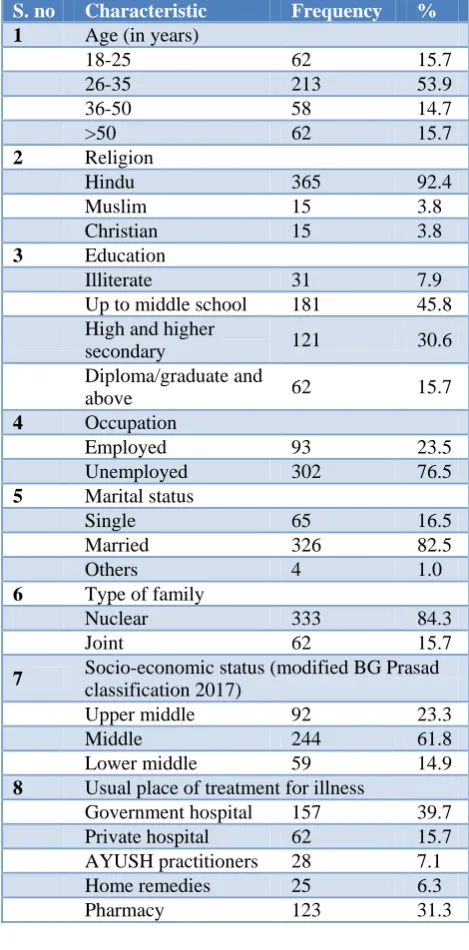
A total of 395 females participated in the study. The socio-demographic characteristics of the study participants are summarized in Table 1.
Nearly 54% of the participants were in the age group of 26-35 years, and 15.7% were aged more than 50 years. About 8% of the females were illiterates and 45.8% had education up to middle school level. With regard to employment status, 23.5% were employed in different sectors. About 83% of females were married and 84.3% belonged to nuclear type of family. Socio economic status was classified according to modified BG Prasad classification 2017; 23.3% of the subjects fell under upper middle class, 61.8% under middle class and 4.9% under lower middle class. Government health facilities were the preferred place of treatment for any illness for 39.7% of females, private hospitals for 15.7%, and AYUSH practitioners for 7.1%.
Menstrual practices by the study participants
cycles. Regarding the absorbents used during menstruation, 28.6% of females said they used sanitary pads, 46.3% reported use of disposable cloths and 25.1% reported use of reusable cloths. When enquired about the reasons for not using sanitary pad as absorbents, 42.5% of females said they were not comfortable with the use and 21.5% reported that they can’t afford the cost. About 7% of women reported that it’s not easily available and 8% of the women said they couldn’t use sanitary pads due to family restrictions.
Table 1: Sociodemographic characteristics of the respondents (n=395).
S. no Characteristic Frequency %
1 Age (in years)
18-25 62 15.7
26-35 213 53.9
36-50 58 14.7
>50 62 15.7
2 Religion
Hindu 365 92.4
Muslim 15 3.8
Christian 15 3.8
3 Education
Illiterate 31 7.9
Up to middle school 181 45.8 High and higher
secondary 121 30.6
Diploma/graduate and
above 62 15.7
4 Occupation
Employed 93 23.5
Unemployed 302 76.5
5 Marital status
Single 65 16.5
Married 326 82.5
Others 4 1.0
6 Type of family
Nuclear 333 84.3
Joint 62 15.7
7 Socio-economic status (modified BG Prasad
classification 2017)
Upper middle 92 23.3
Middle 244 61.8
Lower middle 59 14.9
8 Usual place of treatment for illness
Government hospital 157 39.7 Private hospital 62 15.7 AYUSH practitioners 28 7.1 Home remedies 25 6.3
Pharmacy 123 31.3
Regarding personal hygiene, about 14.4% reported use of soap and water for cleansing the external genitalia, whereas a majority (78.5%) mentioned use of plain water. Absorbents were disposed in routine waste by 85.6% of the females. Among females who practice use of reusable
cloths, about 60% of them washed and dried them inside the house, without any exposure to sunlight. A proportion of women reported symptoms of reproductive tract infections such as genital itching (7.6%), vaginal discharge (7.1%), lower abdominal pain (5.6%), and genital ulcer (0.7%).
Table 2: Practices of the respondents during menstruation (n=395).
S. no Practice Frequency %
1 Menstrual cycle
Regular 326 82.5
Irregular 69 17.5
2 Absorbents used
Sanitary pad 113 28.6 Disposable cloth 183 46.3 Reusable cloth 99 25.1
3 Reason for not using sanitary pad (multiple
responses)
High cost 85 21.5
Lack of awareness 29 7.3 Uncomfortable 168 42.5 Unavailability 28 7.1 Family restrictions 32 8.1
4 Cleaning external genitalia
Using water 310 78.5 Soap and water 57 14.4 Antiseptics 28 7.1
5 Disposal of absorbents
Routine waste 338 85.6
Burning 57 14.4
6 Drying re-usable
clothes (n=99)
Inside the house 59 59.6 Outside the house 40 40.4
7 Toilet facility
Separate toilet at home 278 70.4 Shared toilet 113 28.6 Public toilet 4 1.0
8 Symptoms of reproductive tract infections Vaginal discharge 28 7.1 Lower abdominal pain 22 5.6 Genital itching 30 7.6 Genital ulcer 3 0.7 Restrictions practiced during menstruation
the participants. Nearly 40% also reported restrictions to interact with the family members.
Table 3: Restrictions practiced by the respondents during menstruation.
S. no Restriction Frequency %
1 Restriction to attend family functions
Yes 310 78.5
No 85 21.5
2 Restriction to go to religious places
Yes 310 78.5
No 85 21.5
3 Restriction to do household work
Yes 221 55.9
No 174 44.1
4 Separation in room/ restriction to sleep in routine place
Yes 251 63.5
No 144 36.5
5 Restriction to touch food items
Yes 136 34.4
No 259 65.6
6 Restriction to interact with family members
Yes 157 39.7
No 238 60.3
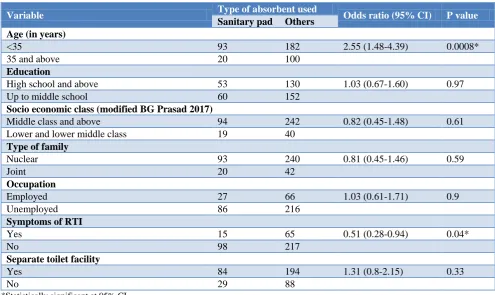
Table 4: Association between socio demographic characteristics of the respondents and use of absorbents.
Variable Type of absorbent used Odds ratio (95% CI) P value
Sanitary pad Others Age (in years)
<35 93 182 2.55 (1.48-4.39) 0.0008*
35 and above 20 100
Education
High school and above 53 130 1.03 (0.67-1.60) 0.97
Up to middle school 60 152
Socio economic class (modified BG Prasad 2017)
Middle class and above 94 242 0.82 (0.45-1.48) 0.61 Lower and lower middle class 19 40
Type of family
Nuclear 93 240 0.81 (0.45-1.46) 0.59
Joint 20 42
Occupation
Employed 27 66 1.03 (0.61-1.71) 0.9
Unemployed 86 216
Symptoms of RTI
Yes 15 65 0.51 (0.28-0.94) 0.04*
No 98 217
Separate toilet facility
Yes 84 194 1.31 (0.8-2.15) 0.33
No 29 88
*Statistically significant at 95% CI.
Association between socio-demographic characteristics of study participants and use of absorbents
We studied the association of various demographic variables with the use of sanitary pad as absorbent during menstruation by the study respondents (Table 4). Females
with sanitary pad use among the study participants. Analysis also showed that the symptoms of reproductive tract infections were less among the participants who used sanitary pads compared to those who used either disposable or reusable cloths (OR: 0.51, 95% CI: 0.28-0.94, p=0.04).
DISCUSSION
This study conducted among 395 adult females in a rural area of Tamil Nadu shows the present status of menstrual hygiene practices in the study population with interesting outcomes, which are discussed below.
Approximately only 29% of females used sanitary pads during menstruation. Rest of the study population used clothes and 25% of them re-used the clothes. Nearly 60% of the women who re-used cloth pieces practiced indoor drying of those clothes. In the study by Sangeetha et al, 35% of women used sanitary pads and 45.5% preferred to use same cloth pieces for each cycle.8 Khanna et al in a study from North India reported that only 20% of the females used sanitary pads.9 Misra et al in their study in North India reported that nearly 29% used sanitary pads and 25% of those who used cloths expressed their willingness to buy napkins.10 Study by Singh showed extremely low proportion of females using sanitary pads (0.4%).3 This is highly alarming as poor menstrual hygiene is strongly linked to increased chances of urinary and vaginal infections.
Nearly 43% of females reported that they would feel uncomfortable with use of sanitary pads. Focus group discussions (FGDs) could help to understand the reasons why women in rural areas are hesitant to use sanitary pads during menstruation. This will help to address the barriers identified and improve the menstrual hygiene among rural females. Regarding personal hygiene, about 15% of females practiced proper cleansing of external genitalia during menstruation. This was found to be high (83.5%) in the study by Sangeetha et al.8 More awareness need to be created among women living in rural areas about the significance of genital hygiene.
Majority of the study population followed one or many restrictions during menstruation. The predominant restriction was to visit religious places or attend family functions. Similar restrictions were reported in studies by Singh et al, Sangeetha et al and Misra et al.3,8,10 A systematic review on menstrual hygiene among adolescent girls in India by Van Ejik et al, reported various restrictions faced by adolescent girls especially for religious activities.11 Restrictions have been practiced for so long and are deeply embedded in the society and intensified health education is needed to create awareness and de mystify the unnecessary restrictions imposed on women during menstruation.
In our study, young females (age<35 years) were more likely to use sanitary pads compared to older females. This could be due to better awareness among the younger generation on the use of sanitary pads compared to older women. In our study, we did not find a significant association between education, socio economic status and use of sanitary pads. But in a similar study in Tamil Nadu by Sangeetha, those who completed high school education or more and those in the upper middle class or above were more likely to practice use of sanitary pads.8 We also found that symptoms of reproductive tract infections were less among females who used sanitary pads compared to those who used other absorbents. As reproductive tract infections can have serious impact on the reproductive system, it is very essential to practice hygienic measures during menstruation to prevent reproductive morbidity.6
CONCLUSION
This study showed that menstrual hygiene practices were poor among females residing in a rural area of Kancheepuram district. There were also a number of restrictions practiced including separation in rooms, restriction to do routine household work etc. So health education has to be given to women in rural areas to create awareness on the importance of maintaining proper menstrual hygiene, availability of low cost sanitary pads and prevention of reproductive tract infections. Myths regarding various restrictions practiced and use of sanitary pads need to be addressed by providing necessary information to the public. This can be done through health workers, trained school teachers and village leaders.
Limitations of the study
This study done in the rural field practice area of our institution with a sample of 395 adult females from a population of 10370 females could have been planned with a bigger sample size and an added qualitative component, to have a better understanding on practices and restrictions followed during menstruation. We also did not analyze the willingness of women who used clothes to buy sanitary pads in the future. The results may not be applicable to urban settings where the practices might be different from the rural population.
ACKNOWLEDGEMENTS
Funding: No funding sources Conflict of interest: None declared
Ethical approval: The study was approved by the Institutional Ethics Committee
REFERENCES
1. Jabbour HN, Kelly RW, Fraser HM, Critchley HOD. Endocrine regulation of menstruation. Endocr Rev. 2006;27(1):17–46.
2. Garg S, Anand T. Menstruation related myths in India: strategies for combating it. J Fam Med Prim Care. 2015;4(2):184.
3. Singh A J. Place of menstruation in the reproductive lives of women of rural North India. Indian J Community Med. 2006;(31):10–4.
4. Anand E, Singh J, Unisa S. Menstrual hygiene practices and its association with reproductive tract infections and abnormal vaginal discharge among women in India. Sex Reprod Healthc Off J Swed Assoc Midwives. 2015;6(4):249–54.
5. Paria B, Bhattacharyya A, Das S. A Comparative Study on Menstrual Hygiene Among Urban and Rural Adolescent Girls of West Bengal. J Fam Med Prim Care. 2014;3(4):413–7.
6. El-Gilany AH, Badawi K, El-Fedawy S. Menstrual hygiene among adolescent schoolgirls in Mansoura, Egypt. Reprod Health Matters. 2005;13(26):147–52. 7. Adhikari P, Kadel B, Dhungel SI, Mandal A.
Knowledge and practice regarding menstrual
hygiene in rural adolescent girls of Nepal. Kathmandu Univ Med J. 2007;5(3):382–6.
8. Balamurugan SS, Shilpa SS, Shaji S. A community based study on menstrual hygiene among reproductive age group women in a rural area, Tamil Nadu. J Basic Clin Reprod Sci. 2014(3):83–7. 9. Khanna A, Goyal RS, Bhaswar R. Menstrual
practices and reproductive problems: A study of adolescent girls in Rajasthan. J Health Manag. 2005;(7):91–107.
10. Misra P, Upadhyay RP, Sharma V, Anand K, Gupta V. A community-based study of menstrual hygiene practices and willingness to pay for sanitary napkins among women of a rural community in northern India. Natl Med J India. 2013;26(6):335–7.
11. van-Eijk AM, Sivakami M, Thakkar M, Bauman A, Laserson KF, Coates S, et al. Menstrual hygiene management among adolescent girls in India: a systematic review and meta-analysis. BMJ Open. 2016;6:010290.