Original Research Article
Post exposure compliance of rabies vaccination among cases attending
anti-rabies clinic at tertiary care centre, Rajasthan
Dilip Raj
1, Mahendra Kumar Verma
1,
Dharmesh Kumar Sharma
1*,
Sudhakar Sharma
1, Munmun Yadav
2INTRODUCTION
Rabies is one of the deadliest diseases of mankind since antiquity. It is 100 per cent fatal, however, 100% preventable.1 Despite this, rabies remains a neglected and under reported zoonotic disease in humans.2 Nearly 99% of all human rabies victims are attributed to canine rabies
in 87 countries or territories of the world.3 More than 99% of all human rabies deaths occur in the developing world.4 It is estimated that South East Asia Region accounts for approximately 60% of human death due to rabies.1 In India, every year, rabies causes an estimated 20,565 deaths with 17.4 million exposures to animal bites, mainly dog bites.5 In India a person is bitten by an animal in every 2 seconds and someone dies from rabies
ABSTRACT
Background: Rabies is one of the deadliest diseases of mankind, and has terrified since antiquity. It is 100 per cent fatal, however, 100% preventable. In India, rabies causes an estimated 20,565 deaths with 17.4 million exposures to animal bites, mainly dog bites, occurring every year. In India a person is bitten by an animal in every 2 seconds and someone dies from rabies every 30 second. Complete post-exposure prophylaxis is necessary among the animal bite cases for complete protection. Hence this study aims to determine the patient’s compliance for intradermal anti-rabies vaccination and also to determine the constraints for compliance.
Methods: A retrospective record based study was conducted in the ARC of S.M.S.M.C, Jaipur where patients were provided intradermal rabies vaccination (updated Thai Red Cross regimen) for post-exposure prophylaxis. The records maintained at ARC-SMSMC under department of community medicine from March 2016- February 2017 were analysed. The total number of patients was 8873 from which 8590 subjects were recruited for the study after excluding category I cases, pre-exposure cases rat bite, human bite, re-exposure and pre-exposure cases. The major constraints were found out by interviewing the patient/guardian through the telephone.
Results: The compliance rate for intradermal rabies vaccination (IDRV) is 81.87%. The major constraints were timings not convenient, personal or social workload, long distance from the hospital, forgotten the dates.
Conclusions: The compliance rate for rabies vaccination is considerably low for this highly fatal disease. Considering these major constraint factors, the animal bite victims should be motivated effectively through health education at the time of initiation of vaccination course to attain the goal of rabies free India.
Keywords: Compliance, Anti-rabies vaccination, Constraints
Department of 1Preventive and Social Medicine, 2Obstetrics and Gynaecology, SMS Medical College and Hospitals, Jaipur Rajasthan, India
Received: 28 January 2019
Revised: 06 March 2019
Accepted: 07 March 2019
*Correspondence:
Dr. Dharmesh Kumar Sharma, E-mail: [email protected]
Copyright: © the author(s), publisher and licensee Medip Academy. This is an open-access article distributed under the terms of the Creative Commons Attribution Non-Commercial License, which permits unrestricted non-commercial use, distribution, and reproduction in any medium, provided the original work is properly cited.
every 30 second.6 The preventive step consists of prompt wound treatment, administration of vaccine (with or without rabies immune globulin [RIG] depending upon the type of exposure) should be initiated immediately after a suspected rabid animal bite. Recommended first-aid procedures include immediate and thorough flushing and washing of the wound for a minimum of 15 minutes with soap and water, as well as disinfecting the wound with detergent or other substances of proven lethal effect on the rabies virus. Appropriate wound cleansing and disinfection can prevent one-third of rabies infections.7-9 Modern cell-culture vaccines utilized in combination with RIG are nearly 100% effective in preventing human deaths if inoculated promptly to rabies virus-exposed victims following appropriate wound management.10 Time of reporting and hence starting the right treatment is a crucial factor in prevention of rabies.11
Rabies is a vaccine preventable disease.12 Every year, more than 15 million people worldwide receive a post-exposure vaccination. This is estimated to prevent hundreds of thousands of rabies deaths annually.13 In India, intradermal schedule (updated Thai Red Cross regimen) of rabies vaccination was implemented in 2006.14 The Indian government has adopted ‘national guidelines for intradermal vaccination’ suggested by World Health Organization.15 In rabies endemic countries like India, preventive measures such as ARV and RIG are available in the hospitals and health centres. The anti-rabies clinic at S.M.S Medical College and attached hospital Jaipur has been providing intradermal pre and post-exposure vaccination against rabies to animal bite victims since January 2015.
On an average 25–30 patients are attending the clinic centre for vaccination daily. In spite of this, the reason for high death rate is due to lack of awareness among people regarding management of animal bites and also low compliance towards complete course of anti-rabies vaccination.16 Timely and complete PEP for the animal bite victims is necessary to prevent rabies.14 Therefore, this study aims to determine the compliance rate for completing the course of IDRV and also to determine the constraints for the compliance among animal bite cases.
METHODS
Study setting
This study was conducted at anti-rabies clinic of S. M. S. hospital, Jaipur, which is one of the largest anti rabies centre in India. This clinic was started in the year 1947 under department of preventive and social medicine and records on an average of 8100 new cases annually.
Data collection
A retrospective record based study was conducted on patients who received IDRV (updated Thai Red Cross regimen) for post–exposure prophylaxis from March
2016 to February 2017. All patients were given health education regarding the importance of completing the recommended course of vaccination at their first visit. The total number of patients was 8873 out of which 8590 subjects were included in the study after excluding category I and pre-exposure cases.
The data of all animal bites was obtained from the records maintained at ARC. Before collecting data, all due permissions was obtained. The data provided following information: socio-demographic variables, details of exposure, status of the biting animal, time interval between the animal bite and patient reaching the hospital, categories of bite, number of ARV doses administered and the number of ARV doses taken at the stipulated dates were collected. The patient’s phone number was noted down from the records for those who did not completed the full course of ARV. Then through telephonic survey they were interviewed about the reasons for their non–compliance. The animal bite cases that discontinued the vaccination at any point of time during the recommended course (except those who discontinued vaccination after 3 doses, where the dog/cat remains healthy and alive for at least 10 days after the exposure) were considered as non-compliant cases/dropouts.17
Data analysis
The data were entered and compiled in Microsoft excel.
Ethical clearance
This was a secondary data analysis; hence, ethical approval was obtained before starting the study from the institute ethics committee of S.M.S Medical College (Reference No. 3447 MC/EC/10/10/2017).
RESULTS
Total 8590 patients studied, 2458 (28.6%) of them belonged to ≤15 years of age group out of them 6621 (77.1%) were males constituting male: female ratio to 3.3:1. Further the results showed that 6586 (76.6%) animal bite cases were from urban areas, 6442 (75%) were literates and 2332 (38%) were unskilled workers.
Figure shows that dog was the most common (93.1%) animal associated with human bite cases during last one year period.
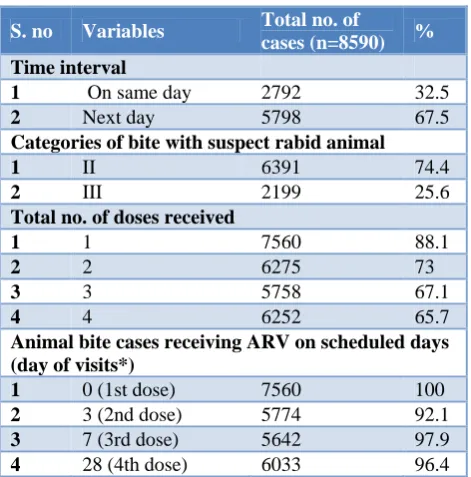
It was found that 2792 (32.5%) of patient reported immediately on the same day of bite for treatment and 5798 (67.5%) of patients attended the ARC clinic on the next day.
Table 1: Socio-demographic profile of animal bite cases (n=8590).
S. no Socio-demographic
variable Number %
Age (in years)
1 <15 2458 28.6
2 16-30 2152 25.1
3 31-45 1975 22.9
4 46-60 1290 15.1
5 >60 715 8.3
6 Total 8590 100
Sex
1 Male 6621 77.1
2 Female 1969 22.9
3 Total 8590 100
Residence
1 Rural 2004 23.3
2 Urban 6586 76.6
3 Total 8590 100
Education status
1 Profession or honours 172 2
2 Graduate 348 4.1
3 Intermediate or diploma 516 6
4 High school certificate 774 9.1
5 Middle school
certificate 2064 24.1
6 Primary school
certificate 2568 29.9
7 Illiterate 2148 25
8 Total 100 100
Occupations* (n=6132)
1 Profession 240 3.9
2 Semi – profession 675 11
3 Clerical, shop-owner,
farmer 614 10.1
4 Skilled worker 798 13
5 Semi – skilled worker 1292 21.1
6 Unskilled worker 2332 38
7 Unemployed 181 2.9
8 Total 6132 100
In this study it was observed that only 7560 (88.1%) had taken the first dose and the remaining 1030 (11.9%) had not taken even the first dose and among those who had taken the first doses only 6252 (65.2%) had completed the full course of IDRV schedule. It was also observed that, 6033 (96.4%) of the patients had taken all the four doses four on the scheduled dates but delayed by delayed only 3.6% of the cases.
Out of the total 8590 patients studied, 2662 completed their full course of vaccination in the SMS Hospital. The remaining 5928 were then contacted, through telephone. Among them 2549 had completed their vaccination course from the outside centres, 414 (6.02%) had
received only 3 doses stating that the dog was fine. About, 5625 (81.87%) patients were not satisfied with the vaccination schedule considered. Among the remaining, 1245 (18.12%) had no complains and 1720 cases did not responded the telephone even after 2 repetitive attempts thus their compliance could not be assessed and were subsequently excluded from the denominator in determining the compliance.
Figure 1: Distribution of the cases according to the type of animal bites.
*Bite by ‘others’ includes monkey, cat, cow, horse, bear, fox, and goat.
Table 2: Category of bite and time of receiving anti-rabies vaccine.
S. no Variables Total no. of
cases (n=8590) %
Time interval
1 On same day 2792 32.5
2 Next day 5798 67.5
Categories of bite with suspect rabid animal
1 II 6391 74.4
2 III 2199 25.6
Total no. of doses received
1 1 7560 88.1
2 2 6275 73
3 3 5758 67.1
4 4 6252 65.7
Animal bite cases receiving ARV on scheduled days (day of visits*)
1 0 (1st dose) 7560 100
2 3 (2nd dose) 5774 92.1
3 7 (3rd dose) 5642 97.9
4 28 (4th dose) 6033 96.4
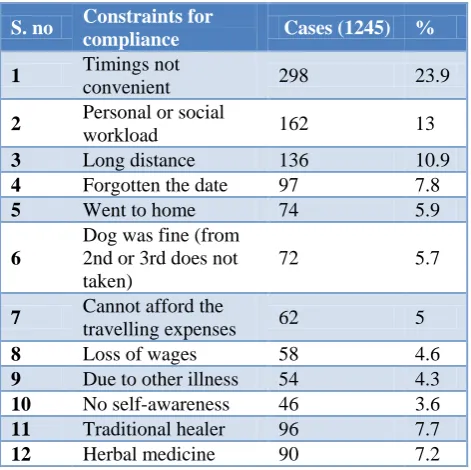
Among those 1245 (18.12%) non-compliant patients, further leading questions had been asked on the telephone and the constraints for their compliance had been found out. Majority of them i.e. 298 (23.9%) considered hospital timings inconvenient, 162 (13%) had personal or social workload, 136 (10.9%) long distance was one of
93.10% 6.90%
the constraint, 97 (7.8%) forgotten the date and the remaining patients had various reasons.
Table 3: Constraints for post exposure compliance of rabies vaccination.
S. no Constraints for
compliance Cases (1245) %
1 Timings not
convenient 298 23.9
2 Personal or social
workload 162 13
3 Long distance 136 10.9
4 Forgotten the date 97 7.8
5 Went to home 74 5.9
6
Dog was fine (from 2nd or 3rd does not taken)
72 5.7
7 Cannot afford the
travelling expenses 62 5
8 Loss of wages 58 4.6
9 Due to other illness 54 4.3
10 No self-awareness 46 3.6
11 Traditional healer 96 7.7
12 Herbal medicine 90 7.2
DISCUSSION
In the study, the compliance rate to complete the course of IDRV was found to be 81.87%. Similarly the studies done by Gudegowda et al in Bangalore, Shankaraiah et al in Bangalore and Bariya et al in Gujarat showed the compliance rate to IDRV to be 79.60%, 77% and 70% respectively.18-20 Whereas the studies done by Seenivasan et al in Tamil Nadu and Nikhil et al in Puducherry observed the compliance rate to IMRV to be 6% and 0%.21,22 This shows that the compliance to IDRV was found to be greater than IMRV which may be due to the reduced number of visits that in turn reduced the travelling charges, loss of wages and the vaccine costs. In contrast to this, a study conducted by Anandaraj et al in Davangere showed the compliance rate to be 82.6% for IMRV which was found to be higher but it may be due to the small sample size (n = 48).23
In the present study, it was observed that 88.1%, 73%, 67.1% and 65.7% of patients had received 1st, 2nd, 3rd and 4th dose respectively. 11.9% had not taken the first dose itself which may be due to their non-affordability or did not brought the BSY card but the difference between the 1st and 2nd dose is comparatively large when compared with the difference between the other doses and that could be due to the reason that the patients believes that only one injection is enough after seeing the dog status. Earlier studies done by Gudegowda et al18, Shankaraiah et al and Malkar et al showed that 89.2%, 72.1%, 65.1%, 61.5 and 100%, 91.9%, 88.1%, 77% and 100%, 82.9%, 70.1%, 46.2% of patients had received 1st ,2nd , 3rd and 4th doses respectively.19 In these studies
there was high drop out for 4th dose which may be attributed to comparatively longer interval (21 days) between 3rd and 4th dose as compared to the interval between 1st and 2nd dose (3 days) and 2nd and 3rd dose (4 days). Therefore, as the interval between the doses increases, the compliance rate decreases.
It was also found that only 32.5% of patients had come to the hospital on same day of exposure to the animal. Among the patients who were supposed to take the vaccine doses on the scheduled days, 7.5%, 2.4% and 3.6% were delayed for the 2nd, 3rd and 4th dose where more delay was seen for the 2nd dose. In contrast, the study done by Malkar et al in Maharashtra showed that 1.88%, 3.31% and 33.39% of the patients delayed for the 2nd, 3rd and 4th doses but more delay was seen for the 4th dose.19 In the present study, when there was delay for the 2nd dose, then counselling of the patients was done highlighting the importance of complete vaccination so that there was no delay observed for the further doses.
In the present study, the major constraints for compliance was found out to be inconvenient timings (23.9%), personal or social workload (13%), long distance from hospital (10.9) forgotten the dates (7.8%), went to their hometown (5.9%). Whereas in a study conducted by Anandaraj et al in Davangere showed 50% constraint was due to the lack of time.23 One more study done by Bariya et al in Gujarat showed the constraint factor to be personal or official workload, or patients had forgotten the scheduled dates of vaccination.20
CONCLUSION
The patient’s compliance to IDRV was found to be 81.87%, which is considered to be low for this highly fatal disease. The major constraints for compliance were inconvenient hospital timings, personal or social workload, long distances from the hospital, forgotten the dates, and went to their home town. Hence the animal bite cases should be motivated effectively through health awareness by interpersonal communication with the use of Information, Education and communication materials at the time of initiation of vaccination course and stressing about the timely and complete administration of anti-rabies vaccination for attaining the goal of rabies free India.
Funding: No funding sources Conflict of interest: None declared
Ethical approval: The study was approved by the Institutional Ethics Committee
REFERENCES
2. WHO. Rabies Elimination in South-East Asia. Report of a Workshop Colombo, Sri Lanka, 2005. WHO Project: ICP BCT001. Available at: http://apps.searo.who.int/PDS_DOCS/B0329.pdf. Accessed on 28 December 2018.
3. Operational-Guidelines-for Rabies-Prophylaxis and Intra Dermal Rabies Vaccination in Kerala. Available at: http://rabies.org.in/rabies/wp-content/uploads/2009/1/. Accessed on 28 December 2018.
4. Rambhau DG, DhekaleDilip N. Profile of Animal Bite Cases in Nanded District of Maharashtra State, India. Indian J Fundamental Applied Life Sci. 2011;1(3):188-93.
5. Ichhpujani RL, Bhardwaj M, Chhabra Mala, Datta KK. Rabies in India. Coumtry Report, 4th International symposium on Rabies control in Asia Vietnam; 2001: 35.
6. Manazee R. Rabies in India. CMAJ. 2008;178(5):564-8.
7. Kaplan MM, Cohen D, Koprowski H, Dean D, Ferrigan LW. Studies on the local treatment of wounds for the prevention of rabies. Bulletin World Health Organization. 1962:26:765-75.
8. Dean DJ, Baer GM, ThompsonWR. Studies on the local treatment of rabies-infected wounds. Bulletin World Health Organization. 1963;28:477.
9. Wilde H. Failures of post-exposure rabies prophylaxis. Vaccine. 2007;25:7605-9.
10. Quiambao BP, Dimaano EM, Ambas C, Davis RD, Banzhoff A, et al. Reducing the cost of post exposure rabies prophylaxis: efficacy of 0.1 ml PCEC rabies vaccine administered intradermally using the Thai Red Cross post-exposure regimen in patients severely exposed to laboratory-confirmed rabid animals. Vaccine. 2005;23:1709-14.
11. Malini DS, Satapathy DM, Tripathy RM. An analysis on late reporting animal bite case to the ARC of MKCG Medical college, Berhampur. APCRI J. 2010;12(1).
12. World Health Organization. Rabies, 2016. Available at: http://www.who.int/mediacentre/factsheets/fs09 9/en/. Accessed on 28 December 2018.
13. World Health Organization. WHO expert consultation onrabies-second report, 2013. Available at: http://apps.who.int/iris/bitstream/ 10665/85346/1/9789240690943_eng.pdf?ua=1. Accessed on 28 December 2018.
14. Sajna MV, Culas R. Cost Analysis of Post Exposure Prophylaxis of Rabies in A Tertiary Care Centre-A Cross Sectional Study. IOSR-JDMS. 2014;13(12):08-12.
15. Vinay M, Mahendra BJ, Nagaraj GB. Sociodemographic characteristics affecting compliance to intra dermal rabies vaccination at anti rabies clinic in a government tertiary care hospital in Karnataka. J Evolution Med Dental Sci. 2013;2(37):7090-5.
16. Malkar VR, Joge US. A study of compliance of animal bite victims to 4 dose intradermal schedule of anti-rabies vaccine and factors affecting it. Int J Community Med Public Health.2015;2(2):156-61. 17. World Health Organization. Rabies vaccines: WHO
position paper, Weekly Epidemiological Record, No. 32. Available at: http://www.who.int/ wer/2010/ wer8532.pdf. Accessed on 28 December 2018. 18. Gudegowda KS, Shivalingamurthy RK, Vengatesan
S, Sobagiah RT, et al. Compliance to post exposure vaccination among patients attending ant rabies clinic at tertiary care hospital Bengulare. Nat J Community Med. 2016;7(10):811-8.
19. Shankaraiah RH, Rajashekar RA, Veena V. compliance to anti-rabies vaccination in post-exposure prophylaxis. Indian J public health. 2015;59(1):58-60.
20. Bariya BR, Patel SV, Shringarpure KS. Comparison of Compliance of Animal Bite Patients to Two Different Routes of Post-Exposure Prophylaxis against Rabies. J Indian Association Preventive Social Med. 2015;6(1):30-5.
21. Seenivasan P, Priya CK, Vijayalakshmi M. Anti-rabies vaccination coverage among patients attending outpatient department in a tertiary care hospital in Tamil Nadu. International J Med Applied Sci. 2014;3(1):253-60.
22. Nikhil SV, Rizwan SA, Chellaiyan VG Kavita V. Profile of Patients Attending an Animal Bite Management Clinic in Rural Pondicherry, India. International J Tropical Dis Health. 2014;4(3):306-10.
23. Anandaraj R, Balu PS. Compliance to anti rabies vaccine and animal bite management practices in a rural area of Davangere, Karnataka, India. Int J Community Med Public Health. 2016;3(1):170-3.
Cite this article as: Raj D, Verma MK, Sharma DK, Sharma S, Yadav M. Post exposure compliance of rabies vaccination among cases attending anti-rabies clinic at tertiary care centre, Rajasthan. Int J