Int. J. Nanosci. Nanotechnol., Vol. 14, No. 2, June. 2018, pp. 165-175
165
Short Communication
Application of Functionalized Graphene Oxide
Nanosheet in Gas Separation
Jafar Azamat*
Department of Chemical Engineering, Ahar Branch, Islamic Azad University, Ahar, Iran.
(*) Corresponding author: [email protected] (Received: 12 August 2016 and Accepted: 02 October 2016)
Abstract
Graphene oxide nanosheet (GONS) can be a suitable membrane for gas separation with high permeability and selectivity. Separation of N2/CO2 using functionalized GONS was investigated by molecular dynamics simulations. The simulated systems were comprised of two types of GONS with a pore in their center, N2 and CO2 molecules. The selectivity and permeability of these molecules can be controlled by drilling various pores with different sizes and functionalized factors in the edge of pores of GONS. Modification of pores using attaching functional groups to the carbon atoms at the edge of pores leads to very different outcomes. Using hydroxyl group at the edge of GONS pore (pore 1) leads to a substantial increase in the selectivity for N2 over CO2 and using fluoride atoms at the edge of GONS pore (pore 2) actually inverts the selectivity. When the pore size further increases, selective separation of molecules does not happen and both molecules propagate through the pores. Due to the interactions between molecules and membrane pores, the energy barrier for gas molecules in two pores was different, so that, the low energy barrier was in the pore 1 for N2 and in the pore 2 for CO2 molecules. If the energy barrier difference between two types of molecules is high, complete separation occurs. The present research is valuable for designing the novel GONS membranes for gas separation.
Keywords: Graphene oxide nanosheet, Gas separation, PMF.
1. INTRODUCTION
Nanostructure membranes are one of the important structures used for gas separation process. Membranes for separation were expanded over the past decade for scientific and industrial applications due to its advantages including, its low energy consumption, being environmentally friendly and lack of pollution [1,2]. Membrane separation technology plays a significant role in many industrial processes such as gas separations and water treatment [3-5]. The good membrane for separation
must have efficient selectivity and permeability, stable structure and
166 Azamat
nanostructured membranes with high performance has become an important issue
in gas separation field. In the scientific
literatures, it was showed that the nanostructured membranes have better performance than the polymeric membranes [12-14].
The design of new nanostructured membranes via pores in their center is an important issue in gas separation field. Computational studies have confirmed that the pore size in two-dimensional membranes can influence in their selectivity and permeability [15]. A good separating membrane should have controllable pore size, stable structure and effective permeability. Graphene oxide nanosheet (GONS) is one of these thin membranes. Although graphene is one of the toxic materials, its chemical modification leads to a nontoxic two-dimensional nanomaterial named GONS. GONS is a chemically modified graphene with oxygen-containing functional groups on the graphene basal plane [16]. The two-dimensional structure and physicochemical properties of GONS offer an exciting opportunity to make a fundamentally new class of sieving membranes by stacking GO nanosheets. GONSs have been considered promising membrane materials, because they are only one carbon atom thick and, thus, may form separation membranes that minimize transport resistance and maximize flux. In recent years, GONS has become one of the most studied nanomaterials [17-19] and generated interest for energy-related applications [20]. Recent studies showed that separation of gas mixtures using GONS-based membranes represents remarkable po-tential of GONS in this field [21-23]. Pristine GONS is not permeable to gas molecules, thus for gas separation through it, drilling pore is required. The pores in GONS can be drilled by chemical etching or electron beam punching methods, and then, pores functionalized by passivating each
carbon atoms at the edges of pore by means of chemical functional groups.
N2/CO2 separation is an important process due to the rapid increase of carbon dioxide in recent decades, which has caused serious environmental contamination. [24]. Because N2 and CO2 have a similar kinetic diameter and no electric dipole moment, so the separation of carbon dioxide from mixture is more difficult [25]. Given the importance of the N2/CO2 separation, it would be desirable to understand the selective separation of N2/CO2 by a GONS. Recently, metal organic, zeolite, polymer, carbon membranes and anion-functionalized ionic liquids were used for the separation of CO2 [26,27]. The intrinsic energy efficiency and simplicity of membranes make them attractive for gas separation [28].
Inspired by the above studies, we designed two GONS with a functionalized pore in their center for N2/CO2 separation. The gas separation using GONS membrane was investigated by Molecular dynamics (MD) simulations. MD is a step-by-step computational technique that uses the concept of Newton’s second law of motion to observe the physical movement of atoms of a system and then predict properties for the system. MD is an interdisciplinary research field that can calculate various properties by combining theories from mathematics, chemistry, physics, and computer science so as to shed light on more practical sciences, including material science, biology, environmental science, nanotechnology, and membrane science.
International Journal of Nanoscience and Nanotechnology 167 to aid the design of energy efficient GONS
for gas separation.
2. SIMULATION PROTOCOLS
The N2/CO2 separation performance of
GONS was investigated using MD
simulations. We designed two GONS with different functionalized pores for gas separation (see Figure 1).
Figure1. Top GONS with a hydroxyl group
functionalized pore in its center (pore 1) and down GONS with a fluoride functionalized pore in its center (pore 2). (cyan: carbon, green: fluoride, white: hydrogen, and red: oxygen).
The system was comprised of two types of GONS with a pore in their center, N2 and CO2 molecules. The permeation process of
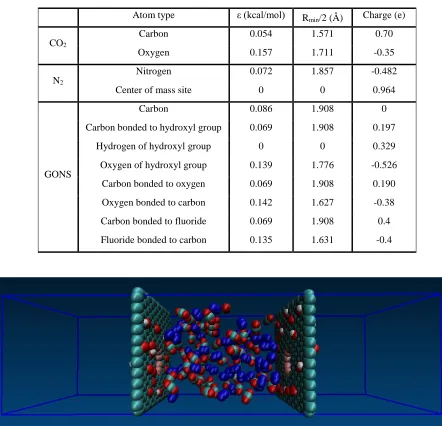
CO2 and N2 through GONS was investigated under atmospheric pressure conditions and in the room temperatures. Firs, we drilled atoms from the pristine GONS; then atoms of pore edge were substituted by functionalized groups. Designed poles were optimized using density functional theory method to obtain the charges of atoms on the GONS. DFT calculations were performed at the B3LYP level of theory using 6-311G basis sets in the GAMESS [31] to obtain the optimal structure and the Mulliken charges on the GONS. In this method GONSs were allowed to move in two dimensions. In this research, the GONS membrane size was selected big enough so that there was no need to use boundary conditions or periodic code in DFT calculations. Comparing with the systems of recent molecular simulation research in this field [32,33], we believe that this method as well as size system in this study is reasonable and we can get convincible results from it. The results of partial charges obtained from DFT calculations for the modified BNNSs are given in Table 1.
MD simulations were performed using NAMD 2.10 [34] with a 1 fs time step and data analysis were performed with VMD 1.9.2 [35] as a previously works [36-41]. The MD domain involved 50 CO2 and 50 N2 molecules at the initial step which were placed between two GONS (see Figure 2). According to these numbers of gas molecules, the gas pressure was about 57×105 Pa. The gas phase pressure is calculated by considering only the molecules in the bulk zone and the volume available to them.
168 Azamat
Table 1. Partial charges of GONS atoms obtained from DFT calculations and parameters for the 12-6 Lennard-Jones potential used in the simulations.
Atom type ε (kcal/mol) R
min/2 (Å) Charge (e)
CO2
Carbon 0.054 1.571 0.70
Oxygen 0.157 1.711 -0.35
N2
Nitrogen 0.072 1.857 -0.482
Center of mass site 0 0 0.964
GONS
Carbon 0.086 1.908 0
Carbon bonded to hydroxyl group 0.069 1.908 0.197
Hydrogen of hydroxyl group 0 0 0.329
Oxygen of hydroxyl group 0.139 1.776 -0.526
Carbon bonded to oxygen 0.069 1.908 0.190
Oxygen bonded to carbon 0.142 1.627 -0.38
Carbon bonded to fluoride 0.069 1.908 0.4
Fluoride bonded to carbon 0.135 1.631 -0.4
Figure 2. The size of the box is 3×3×12 nm3. Two GONS with is located in the simulation box and gas molecules are located in the central box. (Blue: nitrogen, cyan: carbon, white: hydrogen and red: oxygen).
In all simulations, to avoid vertical displacement of the GONS and also to substantially reduce the computational cost, GONS atoms were restrained with a harmonic constraint of 40 kcal/mol.Å2 during the simulations. The simulations were equilibrated in a NVT ensemble at 298 K and were controlled by the Langevin dynamics method through Langevin damping. To obtain meaningful statistics, all
MD simulations were carried out for 20 ns for six set independently with the different starting configurations.
International Journal of Nanoscience and Nanotechnology 1 GONS were taken from references [44,45],
are listed in Table 1.
Table 2. Pore area, the number of permeates gas molecules, the permeation ratio of gases, selectivity and gas permeance of
pores in 298 K.
System Pore 1 Pore 2
Pore area
(Å2) 49.42 55.45
Gas CO2 N2 CO2 N2
Passage 0 47 45 0
Pi100 0 94.0 90.0 0
Gas permeance
(GPU)
0 1.178×10⁵ 1.005×10⁵ 0
2 2
N CO
S 3.4×10⁷ 2.1×10⁻⁷
The interactions of gas-gas and gas-GONS were described as a combination of Lennard-Jones and electrostatic potentials [46]. The potential of mean force (PMF) of gases to pass through the GONS pore was calculated by umbrella samplings [47] and one can reconstruct the PMF using WHAM [48]. We sampled the distances between center-of-mass of gas molecular and the GONS pore from -3.5 Å to 3.5 Å in 0.2 Å increments. Each sampling window of PMF was run for 1 ns.
3. RESULTS AND DISCUSSION
To investigate the effect of pore size on the N2/CO2 separation performance, we first determined the candidate pore size that has the optimal balance between selectivity and permeability. Some GONS membrane models with different pore sizes were simulated. The pore size is determined by how the pore is created and how the dangling bonds are passivated. The pore size can restricts the gas from going through the pore. When the size of pore was too small
for N2 and CO2 to pass through, no gas was passing through it. With increasing the pore size, both N2 and CO2 can permeate through the pore and as the pore size increases more gas molecules permeate through the pore without selectivity. On the other hand, chemical functionalization of GONS pores changed the properties of the pore and may influence the gas permeability and selectivity. Accordingly, different pore sizes of GONS saturated with fluoride and hydroxyl group. Finally, the results demonstrated that pore saturated with hydroxyl group and fluoride (namely pore 1 and pore 2) with high permeability and selectivity is the best pore structure for N2/CO2 separation. Indeed, the dangling bonds saturated with atoms reduced the pore size of pore. The selective separation of these pores was studied by the MD simulations and also their result confirmed with the PMF calculations. PMF is relevant to correctly describe the molecule pass through pores.
3.1. PMF Calculations
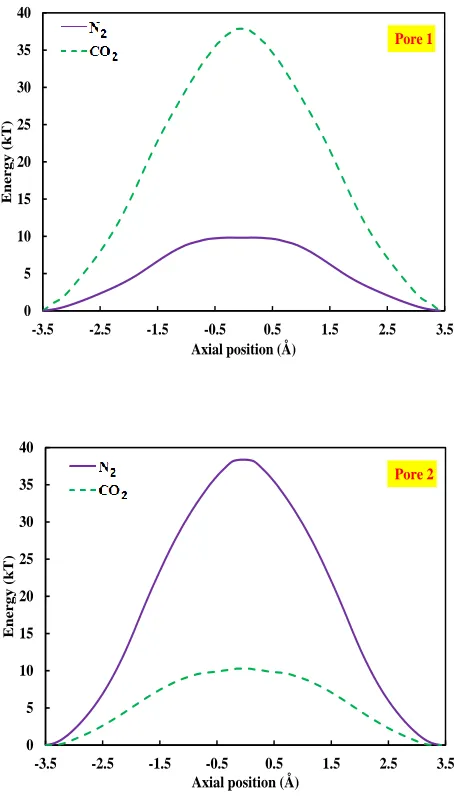
The thermodynamic nature of the observed designs regarding gas selectivity can be justified by the calculation of PMF. For separation of gas molecules through GONS pores, N2 and CO2 encountered with the energy barrier at the center of GONS pores. In each case the permeation barrier was low, the molecules were allowed to propagate through the pores. Figure 3 displays the PMFs for N2 and CO2 in two systems. The order of PMF for molecules in the pores 1 and 2 is different. In the pore 1, the PMF for N2 is smaller than that of CO2. This phenomenon leads to only N2 permeation from this pore. In the case of pore 2, PMF for N2 is greater than that of CO2. Thus, the N2 is not able to cross this pore, which is consistent with the results seen in the MD simulations (see Table 2).
1 Azamat Figure 3. The PMF for N2 and CO2 around
the GONS in pores 1 and 2. GONS membrane is located in 0 Å (Scale on the chart has changed compared to the dimensions of the original simulation box).
The MD results acknowledged these forecast, i.e., the lower the barrier, the higher the flux.
In the pore 2, the interaction of carbon dioxide with the functionalized pore was favourable because of the attractive interaction with rim atoms (fluoride atoms). Consequently, the charge distribution on functionalized pores can affect the selective molecule separation. In contrast, the interaction of N2 is repulsive at the center of
pore 2 which means that nitrogen molecule has the large energy barrier at the pore center.
For permeation of CO2 from pore 2, this molecule spends some time while reorienting itself from the parallel to perpendicular configuration [49]. With this change of orientation, the CO2 overcome the energy barrier in the center of pore 2. In this pore, electrostatic interactions can be well described within the acid-base concept of Lewis: due to charge separation effects in the CO2 molecule, the electron deficient carbon atom acts as a Lewis acid on fluoride atoms (i.e. Lewis bases). In the other words, the attractive components of the fluoride-CO2 interaction apparently reduce the activation energy of the CO2 in the transition state as it propagates through the pore.
3.2. Mechanisms of Gas Permeation
To clarify the gas permeation mechanism through the GONS pore, propagating event of one gas molecule was monitored during the simulation time. Initially, the gas molecules approached to the GONS. Then molecules permeated through its pore. Suitable orientation is important for molecule permeation through the pore. N2 molecules propagate the pores in a parallel mode with the molecular axis pointing to the pore. In contrast, CO2 molecules propagate the pore perpendicularly.
Gas adsorption on the surface of GONS can be effect on their separation through pore of membrane. For this purpose the distributions of gas molecules with z-position were scanned. At the beginning of simulations, the gases were uniformly distributed in whole of the central box. After the minimization, both gas molecules approached the face of GONS owing to the relatively strong attraction force of the GONS. Then, the molecules moved back and forth around the GONS pore. However, molecules have a high probable density to stay within the region of 3 Å around the
0 5 10 15 20 25 30 35 40
-3.5 -2.5 -1.5 -0.5 0.5 1.5 2.5 3.5
Ene
rg
y
(k
T)
Axial position (Å)
Pore 1
0 5 10 15 20 25 30 35 40
-3.5 -2.5 -1.5 -0.5 0.5 1.5 2.5 3.5
Ene
rg
y
(k
T)
Axial position (Å)
Pore 2
International Journal of Nanoscience and Nanotechnology 1 GONS because of strong van der Waals
interactions between gas molecules and the GONS atoms. Finally, molecules permeated across the pores of GONS. As the simulation time increases, more and more molecules propagatethrough pores and adsorbed on the other surface of GONS. The gas molecules have significant adsorption with the GONS which makes it more effective for gases to find the pore by diffusing onto the membrane surface. Such a preferential adsorption of CO2 and N2 on graphene surface was also observed in the other study [25]. When the pore size will be big enough for molecules to pass through it, the adsorption on the membrane becomes an important factor to affect the molecular selective permeation [33,32,50].
3.3. Gas Permeation and Selectivity
During the simulation, the number of permeative gas molecules was monitored. The permeation ratio for N2 and CO2 was used to describe their permeability. The permeation ratio (Pi) of gas is given by
i
i i
P = n
N where ni is the number of gas
molecules permeating through the membrane pore and Ni is the total number of gas in system. The results of gas permeation ratio are given in Table 2. Gas molecules spontaneously permeate from the gas box (central box) to the vacuum box through GONS pore without applied pressure. In the pore 1, Pi was 94.0 % and 0% for N2 and CO2, respectively, which indicated a very good separation performance. But in the pore 2, we can separate CO2 from gas mixture with Pi = 90.0 %. Therefore, results suggest that these pores are good membranes to separate the N2/CO2 from gas mixture. For the sake of a direct comparison to the experiment, we also provide permeance values in GPU (1 gas permeance unit = 3.35×10⁻¹⁰ mol.m-2.s-1.Pa-1), which are also listed in Table 2. Also to confirm our results
in the more time simulation, we accomplished 100 ns MD simulations for separation of N2/CO2 mixture at room temperature, and found the results were not different from the 20 ns. Our results showed that the pore 1 can be used for the N2 separation, while the pore 2 was favourable for the CO2.
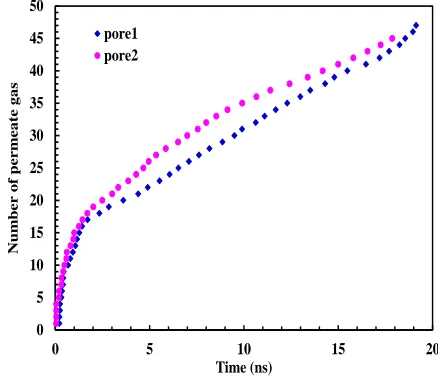
Figure 4 shows the number of permeated gas molecules through pores 1 and 2 with respect to the time steps. Permeability refers to the flux of a molecule propagating through the GONS pore. The number of propagating gas molecules increased as the time was going by during the simulation. It can be seen that during the simulation time in the considered pores, CO2 and N2 can diffuse through them to the vacuum phase. Of course in the pores 1 and 2, only N2 and CO2 propagated, respectively. The number of molecules propagating through the pores in to the vacuum phase was too much at the beginning of the simulation time and then gradually this trend was slow. It is due to after initial time steps the driving force of the permeation became moderate from the gas phase to the vacuum phase due to the decrease in pressure difference between the gas phase and vacuum phase two phases.
Figure 4. The number of N2 passing through pore 1 and CO2 passing through pore 2. Each data point represents the
0 5 10 15 20 25 30 35 40 45 50
0 5 10 15 20
N
um
ber
o
f
perm
ea
te ga
s
Time (ns) pore1
pore2
1 Azamat
average of six sets of simulations.
To investigate the effect of the GONS pores on N2/CO2 separation, we determined what kind of pore has a good selectivity. The selectivity of N2 over CO2 for the mixtures [26] is defined as follows:
2 2 2 2 2 2 N N N CO CO CO y x S = y x (1)
where y and x are the mole fractions of the components in the vacuum phase and gas phase. While the ration of N2/CO2 in initial gas phase is 1, the selectivity of N2 over CO2
can be defined as 2
2 2 2 N N CO CO S y y .
The results show a high selectivity of GONS pores 1 and 2 for N2/CO2 separation. As can be seen in Table 2, in the pore 1, during a 20 ns MD simulation no CO2 were observed to permeate through it, while 47 N2 permeated through this pore. Also in the pore 2, no N2 molecules were observed to permeate, while 45 CO2 permeated through it. Thus these two pores show a high selectivity to N2 and CO2, respectively. This is due to the selection of functionalization pores for the specific gas propagating through them.
To estimate the selectivity in pores 1 and 2 in room temperature, we accomplished new MD simulations for separation of N2/CO2 mixture in two high temperatures (573 K and 673 K). Using these data and the Arrhenius equation, we estimated the separation selectivity for two types of gases at these two temperatures and then extrapolated the results back to the room temperature (see Table 2). Our results show that under the high temperatures, as before, the pore 1 is favorable only for N2 passing through it, while the pore 2 is favorable only for CO2 passing through it.
In the other case, we chose a larger GONS pore size to investigate the effect of pore size on the selective gas separation performance. It can be observed that the large GONS pore size has no selectivity in the N2/CO2 mixture (results are not shown). This is because the pore size was large enough for both gases to propagate through pore. We found that the selectivity was reduced while the membrane pore size was increasing. Thus the suitable pore size and chemical functional groups have an important role in the improvement of gas selectivity of membranes. This trend is consistent with the results of other studies [51, 52].
4. CONCLUSION
The present study highlights benefits of MD simulations for gaining insights and quantitative estimates of gas separation with GONS membrane. To investigate the separation of N2/CO2 mixture by means of GONS, we have designed two types of GONSs with a pore in their center. It can be observed that the functionalized pore with the hydroxyl group is favourable for the selective separation of N2 from the N2/CO2 mixture and only N2 molecules pass through this pore; while the functionalized pore with the fluoride is an excellent membrane for separating CO2 from the N2/CO2 mixture. All the MD and PMF results are in good agreement with each other. Our work provides an effective way to design efficient and selective GONS for N2/CO2 separation, which is important in the field of environment and energy. Thus, chemical functionalization of the pore rim in GONS had significant effects on gas separation due to an enhanced electrostatic interaction. All the MD and PMF results are in good agreement with each other, which indicate that the functionalized pores have high selectivity for separating N2/CO2. Our work provides an effective way to design efficient
International Journal of Nanoscience and Nanotechnology 1 and selective GONS membranes for N2/CO2
separation, which is important in the field of environment and energy.
ACKNOWLEDGEMENT
Author thanks the Iranian Nanotechnology Initiative Council for the support provided.
CONFLICT OF INTEREST
The author declares that there are no conflicts of interest regarding the publication of this manuscript.
REFERENCES
1. Bernardo P., Drioli E., Golemme G., (2009). "Membrane gas separation: A review/state of the art ", Ind. Eng. Chem. Res., 48 (10): 4638-4663.
2. Yun S., Oyama S. T., (2011). "Correlations in palladium membranes for hydrogen separation: A review ", J. Membr. Sci., 375 (1): 28-45.
3. Geise G. M., Lee H. S., Miller D. J., Freeman B. D., McGrath J. E., Paul D. R., (2010). "Water purification by membranes: the role of polymer science ", J. Polym. Sci., Part B: Polym. Phys., 48 (15): 1685-1718.
4. Azamat J., Khataee A., Joo S. W., (2015). "Molecular dynamics simulation of trihalomethanes separation from water by functionalized nanoporous graphene under induced pressure ", Chem. Eng. Sci., 127 (0): 285-292. 5. Azamat J., Khataee A., Joo S. W., (2016). "Separation of copper and mercury as heavy metals from aqueous
solution using functionalized boron nitride nanosheets: A theoretical study ", J. Mol. Struct., 1108: 144-149. 6. Pandey P., Chauhan R. S., (2001). "Membranes for gas separation ", Prog. Polym. Sci., 26 (6): 853-893. 7. Li H., Song Z., Zhang X., Huang Y., Li S., Mao Y., Ploehn H. J., Bao Y., Yu M., (2013). "Ultrathin,
molecular-sieving graphene oxide membranes for selective hydrogen separation ", Science, 342 (6154): 95-98.
8. Abbasi H., Sedghi H., Khaje M., (2016). "Room Temperature Hydrogen Sensor Based on Single-Electron Tunneling Between Palladium Nanoparticles ", Int. J. Nanosci. Nanotechnol., 12 (2): 71-77.
9. Bunch J. S., Verbridge S. S., Alden J. S., van der Zande A. M., Parpia J. M., Craighead H. G., McEuen P. L., (2008). "Impermeable atomic membranes from graphene sheets ", Nano Lett., 8 (8): 2458-2462.
10. Pendergast M. M., Hoek E. M. V., (2011). "A review of water treatment membrane nanotechnologies ", Energy Environ. Sci., 4 (6): 1946-1971.
11. Marchetti P., Jimenez Solomon M. F., Szekely G., Livingston A. G., (2014). "Molecular separation with organic solvent nanofiltration: a critical review ", Chem. Rev., 114 (21): 10735-10806.
12. Celebi K., Buchheim J., Wyss R. M., Droudian A., Gasser P., Shorubalko I., Kye J.-I., Lee C., Park H. G., (2014). "Ultimate permeation across atomically thin porous graphene ", Science, 344 (6181): 289-292.
13. Azamat J., Sardroodi J. J., Mansouri K., Poursoltani L., (2016). "Molecular dynamics simulation of transport of water/DMSO and water/acetone mixtures through boron nitride nanotube ", Fluid Phase Equilib., 425: 230-236. 14. Jafarbeglou M., Abdouss M., Ramezanianpour A., (2015). "Nanoscience and Nano Engineering in Concrete
Advances, A Review ", Int. J. Nanosci. Nanotechnol., 11 (4): 263-273.
15. Hauser A. W., Schwerdtfeger P., (2012). "Methane-selective nanoporous graphene membranes for gas purification", Phys. Chem. Chem. Phys., 14 (38): 13292-13298.
16. Bagri A., Mattevi C., Acik M., Chabal Y. J., Chhowalla M., Shenoy V. B., (2010). "Structural evolution during the reduction of chemically derived graphene oxide ", Nat. Chem., 2 (7): 581-587.
17. Smith S. C., Ahmed F., Gutierrez K. M., Rodrigues D. F., (2014). "A comparative study of lysozyme adsorption with graphene, graphene oxide, and single-walled carbon nanotubes: Potential environmental applications ", Chem. Eng. J., 240: 147-154.
18. Kuila T., Mishra A. K., Khanra P., Kim N. H., Lee J. H., (2013). "Recent advances in the efficient reduction of graphene oxide and its application as energy storage electrode materials ", Nanoscale, 5 (1): 52-71.
19. Chen D., Feng H., Li J., (2012). "Graphene oxide: preparation, functionalization, and electrochemical applications ", Chem. Rev., 112 (11): 6027-6053.
20. Dreyer D. R., Jia H. P., Bielawski C. W., (2010). "Graphene oxide: a convenient carbocatalyst for facilitating oxidation and hydration reactions ", Angew. Chem., 122 (38): 6965-6968.
21. Mi B., (2014). "Graphene oxide membranes for ionic and molecular sieving ", Science, 343 (6172): 740-742.
174 Azamat
22. Joshi R., Carbone P., Wang F.-C., Kravets V. G., Su Y., Grigorieva I. V., Wu H., Geim A. K., Nair R. R., (2014). "Precise and ultrafast molecular sieving through graphene oxide membranes ", Science, 343 (6172): 752-754.
23. Kim H. W., Yoon H. W., Yoon S.-M., Yoo B. M., Ahn B. K., Cho Y. H., Shin H. J., Yang H., Paik U., Kwon S., (2013). "Selective gas transport through few-layered graphene and graphene oxide membranes ", Science, 342 (6154): 91-95.
24. Yang Q., Ma L., Zhong C., An X., Liu D., (2011). "Enhancement of CO2/N2 mixture separation using the
thermodynamic stepped behavior of adsorption in metal-organic frameworks ", J. Phys. Chem. C, 115 (6): 2790-2797.
25. Shan M., Xue Q., Jing N., Ling C., Zhang T., Yan Z., Zheng J., (2012). "Influence of chemical functionalization on the CO2/N2 separation performance of porous graphene membranes ", Nanoscale, 4 (17): 5477-5482.
26. Wall Y., Braun G., Kaltenborn N., Voigt I., Brunner G., (2012). "Separation of CO2/N2 by means of a carbon
membrane ", Chem. Eng. Technol., 35 (3): 508-512.
27. Li P., Paul D., Chung T.-S., (2012). "High performance membranes based on ionic liquid polymers for CO2
separation from the flue gas ", Green Chem., 14 (4): 1052-1063.
28. Du N., Park H. B., Dal-Cin M. M., Guiver M. D., (2012). "Advances in high permeability polymeric membrane materials for CO2 separations ", Energy Environ. Sci., 5 (6): 7306-7322.
29. Lourenço M. A. O., Siquet C., Sardo M., Mafra L., Pires J., Jorge M., Pinto M. L., Ferreira P., Gomes J. R. B., (2016). "Interaction of CO2 and CH4 with functionalized periodic mesoporous phenylene–silica: Periodic DFT
calculations and gas adsorption measurements ", J. Phys. Chem. C, 120 (7): 3863-3875.
30. Krokidas P., Castier M., Moncho S., Sredojevic D. N., Brothers E. N., Kwon H. T., Jeong H.-K., Lee J. S., Economou I. G., (2016). "ZIF-67 Framework: A promising new candidate for propylene/propane separation. Experimental data and molecular simulations ", J. Phys. Chem. C, 120 (15): 8116-8124.
31. Schmidt M. W., Baldridge K. K., Boatz J. A., Elbert S. T., Gordon M. S., Jensen J. H., Koseki S., Matsunaga N., Nguyen K. A., Su S., et a., (1993). "General atomic and molecular electronic structure system ", J. Comput. Chem., 14 (11): 1347-1363.
32. Wu T., Xue Q., Ling C., Shan M., Liu Z., Tao Y., Li X., (2014). "Fluorine-modified porous graphene as membrane for CO2/N2 separation: Molecular dynamic and first-principles simulations ", J. Phys. Chem. C, 118
(14): 7369-7376.
33. Du H., Li J., Zhang J., Su G., Li X., Zhao Y., (2011). "Separation of hydrogen and nitrogen gases with porous graphene membrane ", J. Phys. Chem. C, 115 (47): 23261-23266.
34. Kalé L., Skeel R., Bhandarkar M., Brunner R., Gursoy A., Krawetz N., Phillips J., Shinozaki A., Varadarajan K., Schulten K., (1999). "NAMD2: Greater scalability for parallel molecular dynamics ", J. Comput. Phys., 151 (1): 283-312.
35. Humphrey W., Dalke A., Schulten K., (1996). "VMD: Visual molecular dynamics ", J. Mol. Graphics, 14 (1): 33-38.
36. Khataee A., Azamat J., Bayat G., (2016). "Separation of nitrate ion from water using silicon carbide nanotubes as a membrane: Insights from molecular dynamics simulation ", Comput. Mater. Sci, 119: 74-81.
37. Azamat J., Khataee A., Joo S. W., (2016). "Molecular dynamics simulations of trihalomethanes removal from water using boron nitride nanosheets ", J. Mol. Model., 22 (4): 1-8.
38. Azamat J., Balaei A., Gerami M., (2016). "A theoretical study of nanostructure membranes for separating Li+
and Mg2+ from Cl− ", Comput. Mater. Sci, 113: 66-74.
39. Azamat J., Sattary B. S., Khataee A., Joo S. W., (2015). "Removal of a hazardous heavy metal from aqueous solution using functionalized graphene and boron nitride nanosheets: Insights from simulations ", J. Mol. Graphics Modell., 61: 13-20.
40. Azamat J., Khataee A., Joo S. W., Yin B., (2015). "Removal of trihalomethanes from aqueous solution through armchair carbon nanotubes: A molecular dynamics study ", J. Mol. Graphics Modell., 57: 70-75.
41. Azamat J., Sardroodi J. J., (2014). "Ion and water transport through (7, 7) and (8, 8) carbon and boron nitride nanotubes of different electric fields: a molecular dynamics simulation study ", J. Comput. Theor. Nanosci., 11 (12): 2611-2617.
42. Peng D.-Y., Robinson D. B., (1976). "A New Two-Constant Equation of State ", Industrial & Engineering Chemistry Fundamentals, 15 (1): 59-64.
43. Ciccotti G., Frenkel D., McDonald I. R. (1987). "Simulation of liquids and solids: Molecular dynamics and monte carlo methods in statistical mechanics", North Holland, New York.
International Journal of Nanoscience and Nanotechnology 175 45. Liu H., Dai S., Jiang D., (2013). "Insights into CO2/N2 separation through nanoporous graphene from molecular
dynamics ", Nanoscale, 5 (20): 9984-9987.
46. Nath S. K., (2003). "Molecular simulation of vapor-liquid phase equilibria of hydrogen sulfide and its mixtures with alkanes ", J. Phys. Chem. B, 107 (35): 9498-9504.
47. Torrie G. M., Valleau J. P., (1977). "Nonphysical sampling distributions in monte carlo free-energy estimation: Umbrella sampling ", J. Comput. Phys., 23 (2): 187-199.
48. Kumar S., Payne P. W., Vásquez M., (1996). "Method for free-energy calculations using iterative techniques ", J. Comput. Chem., 17 (10):1269-1275.
49. Liu H., Dai S., Jiang D.-e., (2013). "Insights into CO2/N2 separation through nanoporous graphene from
molecular dynamics ", Nanoscale, 5 (20): 9984-9987.
50. Sun C., Wen B., Bai B., (2015). "Application of nanoporous graphene membranes in natural gas processing: Molecular simulations of CH4/CO2, CH4/H2S and CH4/N2 separation ", Chem. Eng. Sci., 138:616-621.
51. Sun C., Wen B., Bai B., (2015). "Recent advances in nanoporous graphene membrane for gas separation and water purification ", Science Bulletin, 60 (21): 1807-1823.