Ethical Leadership: A South African Financial
Sector Perspective
EE Smith
Department of Business Management, Nelson Mandela Metropolitan University, PO Box 77 000, Port Elizabeth, South Africa, 6034.
Tel: +27 41 5042033. E-mail: [email protected]
Abstract
This article sets out to investigate perceptions regarding ethical leadership in selected organisations within the Nelson Mandela Bay region of South Africa. Research literature on ethical leadership in the financial sector within South Africa seems to be limited. To be able to achieve the research objectives of this research project, both a literature study and an empirical investigation were conducted. The comprehensive literature study, mainly based on journal articles, formed the theoretical framework for collecting the primary data. One hundred and twenty self-administered structured questionnaires were returned from organisations within the selected population. In this study, the main factors that influence ethical leadership were identified as: honesty, integrity, fairness, role clarification and power sharing. Practical guidelines are provided as to ensure effective implementation of ethical leadership practices in the financial sector.
Key phrases: ethics; ethical leadership; financial sector
“The recent high-impact ethics scandals in the banking sector and the oil industry have aroused strong public concern and led to a lively debate on business ethics, making ethical leadership one of the “hot topics” in organizational practice. In view of these distressing events, organizations are expected to assume responsibility and to increase their efforts in demonstrating ethical governance and promoting ethical leadership … the body of social scientific research on ethical leadership still is rather small. The widely shared definition of ethical leadership appears to be rather vague as it does not specify any particular norms ethical leaders can refer to … Without a reference point in the tradition of ethical reflection, the very categories of social thought would be empty.” (Eisenbeiss 2012:797)
INTRODUCTION AND BACKGROUND
Interest in the study of ethical leadership sprung from various scandals that erupted in the financial sector. Investors lost millions of dollars, some even their life-savings as a result of unethical and illegal practice. Case studies based on companies like Enron Corp. and WorldCom Inc. reveal that unethical conduct is partially responsible for one of the biggest bankruptcy cases being debated and researched at credible business schools around the world (Trevino, Brown & Hartman 2003:3). Ethical leadership plays an important part in the sustainability of any organisation. The role of leadership is commonly viewed as defining a group’s mission, vision and how they go about executing tasks in order to achieve varied or specific goals and objectives (Palmer 2009:525). Griffin (2002:29) states that leadership is the role of sustaining an on-going purpose of an organisation and over the years employers and executives have been seen to be exercising enormous power to produce results. This brings about the key link between ethics and leadership and the considerations employers and executives should take when making organisational decisions. An important aspect of leadership, according to Dalglish, Du Plessis, Lues and Pietersen (2009:6-9) is the important role of a leader is to affirm and reaffirm the ethical values of the organisation. Employers and executives are expected to have integrity and they must be trust worthy.
be it in their personal or professional lives (Brown & Trevino 2006:3). The traits of an ethical leader such as integrity, concern for others and being just form the bases of how an ethical leader deals with those they lead in organizations (Mayer, Kuenzi, Greenbaum, Bardes & Salvador 2009:1). The characteristics which make up an ethical leader are the reason why Manning (2003:9), De Hoogh and Den Hartog (2008:3) and Mayer et al.
(2009:2) believe that ethical leaders are transformational leaders because of their ability to convince employees to put organisational goals first.
The first part of this article covers the problem statement, research objectives and literature overview. Thereafter, the research methodology and empirical results are outlines. Lastly, the main conclusions and recommendations are highlighted.
PROBLEM STATEMENT
There are many ethical issues in the financial sector. The financial sector is often unstable as a result of unethical leadership. In an organisation individuals from different cultural backgrounds and beliefs are brought together in order to achieve certain objectives. These individuals are different and their interpretations of what is ethical and unethical depend on their cultural backgrounds and beliefs (Landy & Conte 2010:638). Organisations should have a code of conduct, uniform procedures and processes that employees must adhere to in order to neutralise the problem of unethical conduct (Gesteland 2005:19). Trevino and Nelson (2003:146), state that ethical leaders must communicate clearly, motivate, empower, reward and punish their employees. If employees observe their employers and executives, and their conduct contradicts the rules and regulations of the organisation, the perceptions and attitudes of the employees towards the organisation as well as their employers and executives will be negatively affected and they may be driven to follow suit (Trevino et al.
2003:111). Limited research has been done on ethical leadership in the financial sector. This study aims to shed light on what employees regard as ethical leadership in an organisation. Based on these arguments, the following research question will be addressed: “What are the perceptions of employees regarding ethical
leadership in the financial sector of Nelson Mandela Bay in South Africa?”
OBJECTIVES OF THE STUDY
The primary objective of this study is to investigate employee perceptions regarding ethical leadership in the financial sector.
To help achieve this primary objective, the following secondary goals: • To conduct a comprehensive literature overview of ethical leadership.
• To conduct an empirical investigation regarding the perceptions of employees in the financial sector regarding ethical leadership.
• To provide guidelines to employers and executives in the financial sector regarding behaving ethically.
PROPOSED THEORETICAL FRAMEWORK AND HYPOTHESES
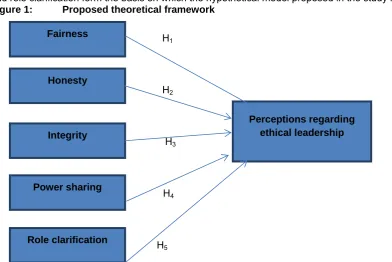
Analysis of the literature provided in the introduction one can deduce that ethical leadership consists of five main factors. The five factors which ethical leadership consists of are fairness, honesty, integrity, power-sharing and role clarification form the basis on which the hypothetical model proposed in the study is formulated.
Figure 1: Proposed theoretical framework
H1
H2
H3
H4
H5 Fairness
Honesty
Integrity
Power sharing
Role clarification
For the purpose of the study the following five factors will be considered independent variables; fairness, honesty, integrity, power sharing and role clarification with ethical leadership as the intermediate variable and ethical leadership outcomes as the dependent variable. The following directional hypotheses have been formulated to test the relationships proposed in the theoretical framework:
H1: There is a positive relationship between perceptions regarding fairness and ethical leadership.
H2: There is a positive relationship between perceptions regarding honesty and ethical leadership.
H3: There is a positive relationship between perceptions regarding
integrity and ethical leadership.
H4: There is a positive relationship between perceptions regarding power sharing and ethical leadership. H5: There is a positive relationship between perceptions regarding role clarification and ethical leadership.
CLARIFICATION OF KEY CONCEPTS Ethics
Ethics is regarded as a set of principles prescribing a behaviour code that explains what is good or bad and wrong; it may even outline moral duty and obligations (Chryssides & Kaler 2001:51). According to Shaw (2011:7), ethics focus on individual moral values and characteristics that govern and restrain conduct by focusing on the moral responsibility of doing what is right over what is wrong as a duty and obligation.
Leadership
Gill (2011:7) alleges that it is an individual or a group of individuals who equip and influence employees (followers) who possess diverse abilities and skills and aligning them with the organisation’s mission and objectives allowing them to willingly expend emotional and physical energy in a concerned coordinated effort to achieve the mission and objectives. Einarsen, Aasland and Skogstad (2007:1) describe leadership as a process, an individual quality or an organisational role of an individual. It encompasses exemplary behaviour, influence and persuasion.
Ethical leadership
Ethical leadership is based on the extent to which employers and executives are motivated by ethical values when influencing their employees (a leader’s moral development) rather than the style of leadership (Abrhiem 2012:1). Freeman and Stewart (2006:3) explain the concept of ethical leadership as a leader who embodies ethical ideals in the vision and values of the organisation and in the pursuit of achieving the goals and objectives. Various authors (see for example Brown et al. 2003; De Hoogh & Den Hartog 2008 and Kanungo.
2001) have considered ethical leadership as a combination of behaviours that make up a separate leadership style that not only focuses on the ethical components of leadership but ethical leadership holistically Ethical leaders are role models whose behaviour and actions reflect and have a direct influence on values like honesty and compassion.
Financial sector
The Business Dictionary (2013) defines the financial sector as the part of an overall economy primarily made up of money markets, banking institutions and brokers. The financial sector not only provides payment services, it enables individuals and organisations to cope with economic uncertainties by hedging, pooling, sharing, and pricing risks. An efficient financial sector reduces the cost and risk of producing and trading goods and services and thus makes an important contribution to raising standards of living (Herring & Santomero 1996: 1-3).
LITERATURE OVERVIEW
General overview of ethical leadership
Scholars such as Fulmer (2004), Jennings (2003) and Neubert, Wu and Roberts (2013) seem to all agree that ethical leadership encourages ethical conduct in its true sense by practicing as well as managing ethics and holding everyone accountable for their own behaviour. Ethical leaders have to incorporate moral principles in their beliefs, values and behaviours. An ethical leader has the ability to influence the attitudes of employees and these employee attitudes towards the organisation could have a significant impact on their performance and dedication in executing their duties. The concept of ethical leadership is broad and may contain different types of values relevant to the construct domain including altruism, compassion, fairness, honesty and justice. According to Yukl, Mahsud, Hassan and Prussia (2013: 2), a certain set of behaviours reflect these values and indicate the presence of ethical leadership. According to Mayer et al. (2009:4), injunctive norms are another
method that employee’s perceptions and attitudes could be influenced by ethical conduct and looks at how leadership or the organisation has put processes, procedures and policy in place that encourages work groups to interact with each other in a manner that is appropriate and reflects leadership organisational views.
leadership lies on behavioural traits that reflect being a moral person such as being trustworthy and fair. A moral individual will go through the lengths of punishing unethical behaviour and constantly communicating the importance of ethics that reflect being a moral member of an organisation. Ethical leadership is unique when it comes to affirming the morality of avoiding negative behaviours and the morality of aspiring to engage in positive behaviours amongst all the individuals of an organisation (Neubert et al 2013: 5). Kanungo (2001:4)
suggests that ethical leaders possess a unique drive and motives that influence their behaviour. An ethical leader acts and conveys certain behavioural traits and from this they can be judged as ethical or not. The idea is to understand the moral logic of subordinates and why they do what they do as well as to encourage and provide a platform for subordinates to understand each other. On the other hand, behavioural ethics seem to suggest that sometimes unethical decisions are not made because leaders are unethical but because ethical leaders are often placed in situations which require them to act unethically (Brown & Trevino 2006:3) and Van Dijke, Cremer, Mayer and Quaquebeke (2012:3).
Factors influencing ethical leadership
This section outlines the factors of ethical leadership, namely fairness, integrity, power-sharing, honesty and role clarification.
• Fairness
Fairness and justice are measured based upon past events, perceptions or both and are formed upon the reflection of the merits of the event that has taken place (Landy & Conte 2010:500). Fairness is an important attribute of ethical leadership and the display of fairness by leaders is likely to influence how employees receive information, instructions and positive/negative criticism of their work efforts (Van Dijke & Cremer 2009:4). There has been a significant amount of research conducted by scholars on the topic of fairness because according to them it plays a very important role in not only defining ethical leadership but also in forming the bases for effective organisational leadership (Van Dijke, et al. 2012:1). Sparr and
Sonnentag (2008:), suggest that there are four justice dimensions that could ultimately measure fairness and how it should be displayed by leadership, namely, distributive, procedural, interpersonal, and informational justice, and developed a measure to assess these dimensions.
• Integrity
The bond of trust between leadership and employees is established on the fact that employees feel that leaders have created a culture of integrity in the organisation (Martin, Keating, Resick, Szabo, Kwan & Peng 2013:1). The definition of integrity according to Parry and Proctor-Thomson (2002:3) would consist of actions based on values accepted by society. Integrity is based on three key principles namely, authenticity with self, authenticity with others and keeping commitments (Hendricks & Ludeman 1996:3). Leaders who display integrity promote open communication, involvement in decision-making and transparency when interacting with employees; these values are consistent with ethical leaders (Parry & Proctor-Thomson 2002).
• Power sharing
Power sharing does not mean dividing decision making responsibilities only but rewards, outcomes and resources as well (Coleman 2004:3). According to DuBrin (2007:4), ethical leadership is centred on individuals work together as a group or team in order to obtain a common goal and it therefore involves the sharing of responsibilities. Since ethical leadership is based on transformational leadership and authoritarian leadership, it therefore means it is also based on a partnership, using principles such as: exchange of purpose, right to say no, joint accountability and absolute honesty. Hellriegel, Jackson, Slocum, Staude, Amos, Klopper, Louw and Oosthuizen (2008:303 discusses how a leader should decide whether or not to share power with employees depending on the readiness and skills of the employees. • Honesty
All actions taken by ethical leaders should be on the basis of honesty because trust, integrity, fairness and all involve honesty. Organisations are concerned about the individuals who represent them hence they introduced integrity tests in order to test honesty (Landy & Conte 2010: 644 and Kalshoven & Den Hartog 2009:1). Helliriegel et al (2008:106-125) highlight are a number of steps an organisation can take to ensure
ethical behaviour and honesty, namely, a code of conduct or/ethics, ethics committee, ethics training and whistle-blowing.
• Role clarification
Importance of ethical leadership
According to Weiss (2006:11,) employees of an organisation are greatly influenced by how the organisation conducts their trade. The conduct of the organisation shapes and influences the culture and values of the organization. The costs of behaving unethically can lead to a deterioration of strategic relationships, damage the organisations reputation, lead to a decline in employee productivity, creativity and loyalty. An organisation is always embedded in social relations and the success and survival is dependant of ethics, doing the right things the right way. Social relations are based on ethics, without them organisations risk alienation and this will eventually translate to extra costs such as fines and legal restrictions for unethical behaviour (Rossouw 2002:26–27). According to Dalglish et al. (2009:150–152), corruption and unethical practices have over the
years tarnished the image of organisations.
The events of the 2008 world economic recession have brought forward questions of ethics, values and trust as far as leadership in the financial sector is concerned. The profitability of ethical leadership as compared to that of unethical leadership is a challenge regulators are responsible for and must promote ethical leadership in order to overcome it (Fulmer 2004:2). Often organisations adopt and comply with the bare minimum requirements of ethical regulation at the behest of leadership because although compliance raised the image of the organisation it did raise some ethical issues that organisations would prefer not to deal with (Jennings 2003:2). Various university programs are including ethics in their curricula because not only do organisations seek to employ learned individuals, they also seek to employ ethical individuals. In organisations, ethics are institutionalised through values and norms often entrenched in the code of conduct or by an ethics committee. Ethical interventions have led to a rise in ethical governance, ethical organisations and ethical schools (Langlois & Lapointe 2010: 147). In order to overcome unethical behaviour and behave themselves in a manner which would be beneficial to all stakeholders, it is proposed by Yulk (2008:508), that ethical leaders should lead by example, focus on their strengths, create an inclusive organisational culture, procedures and processes that deal with whistle blowing and the flow of information and finally be publicly responsible as well as ethical in general. This in line with Jennings (2003) encouraging leaders not only to wear the ethical leadership coat, but to enforce the ethos of ethical leadership on a daily basis. Employees develop a heightened sense of attention for cues set by their leaders and in particular their language use and symbols in order to ascertain unwritten expectations (Mayer, Kuenzi & Greenbaum (2011). The practice of unethical leadership leads to less than desirable outcomes because it breaks down the basis of trust that employees, organisational and leadership interaction is built on. Other organisations, consumers and employees are all attracted and want to interact with organisations that have healthy reputations, production processes and relationships with stakeholders (Fulmer 2004:2 and Weiss 2006:11).
RESEARCH METHODOLOGY
• Research paradigm
The paradigm adopted in this study is positivistic research. Positivistic research approach is directly linked to quantitative research methodology therefore meaning the approach aims to collect substantial amount of data and present quantifiable results therefore easy to interpret and leave little room for manipulation. (Creswell 2007:206).
• Research approach
In this study descriptive research is used and reflects the relationship of different variables with each other, describing the perceptions regarding ethical leadership in the financial sector. Exploratory research was also usedasethical leadership in the finical sector is a relatively new field
• Population
A population is a set group or items which form the basis on which generalizations of the research outcomes will be assumed to apply to. The population for this study are all employees employed in the financial industry in Nelson Mandela Bay of South Africa.
• Sampling
A sample is a portion drawn from the population (Maxfield & Babbie 2012:153). There are but two categories of sampling namely, probability and non-probability sampling. For the purpose of this study the non-probability convenience sampling technique will be used, the reasoning being the time frame, costs and accessibility of respondents.
• Data collection
financial organisations. A total of 120 useable questionnaires were obtained. The effective response rate of the study was thus 81%.
• Questionnaire design
For the purpose of this research a five-point Likert-type scale was used and the questionnaire was composed of primarily of close-ended questions. The questionnaire was divided into three parts:
Section A was aimed at obtaining biographical data from respondents such as gender, ethnic group,
age, period of current employment, size of organization, highest level of education, sector of employment, type of financial activity and form of ownership.
Section B consisted of questions aimed to ascertain respondent’s general perceptions regarding ethical
leadership.
Section C compromised questions related to perceptions regarding the five factors of ethical leadership.
• Data analysis
The statistical program STATISTICA was used to process the data. Data analysis techniques used included, descriptive statistics (mean, mode, median), frequency distributions, exploratory factor analysis, reliability analysis (Cronbach’s alpha values), regression and correlation analysis.
• Validity and reliability of the measuring instrument
Validity in this research was tested by means of exploratory factor analysis (EFA) using construct validity to confirm convergent and discriminant validity. Face and content validity were also confirmed using expert judgement and a pilot study. Internal reliability was confirmed using Cronbach’s alpha values.
VARIABLES OF THE STUDY
Table 1 provides a layout and description of the variables used in the measuring instrument (questionnaire).
Table 1: Layout of variables in the questionnaire
Section Description No. of variables
Section A
A1 – A9 Biographical information 9
Section B
B1 – B10 General perceptions regarding ethical leadership 10
Section C
C1 – C5 C6 – C10 C11 – C15 C16 – C20 C21 – C25
Employee perceptions regarding aspects of ethical leadership
• Fairness
• Honesty
• Integrity
• Power Sharing
• Role Clarification
5 5 5 5 5
EMPIRICAL RESULTS Biographical results
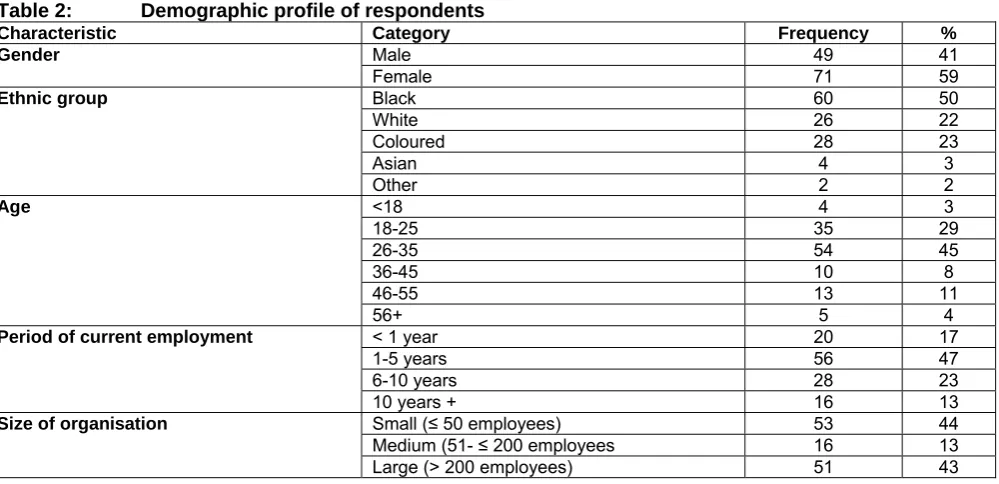
Table 2 will provide a general over view of the demographic information of the respondents. Table 2: Demographic profile of respondents
Characteristic Category Frequency %
Gender Male 49 41
Female 71 59
Ethnic group Black 60 50
White 26 22
Coloured 28 23
Asian 4 3
Other 2 2
Age <18 4 3
18-25 35 29
26-35 54 45
36-45 10 8
46-55 13 11
56+ 5 4
Period of current employment < 1 year 20 17
1-5 years 56 47
6-10 years 28 23
10 years + 16 13
Size of organisation Small (≤ 50 employees) 53 44
Medium (51- ≤ 200 employees 16 13
Characteristic Category Frequency %
Highest level of education Grade 12/Equivalent 15 13
National Certificate/Diploma 45 38
Bachelor’s degree 26 22
Honours degree 24 20
Masters/MBA 4 3
PhD/DBA 0 0
Other 3 3
Employment sector Private 107 89
Public 13 11
Type of financial activity Banking 56 47
Insurance 14 12
Real estate 13 11
Financial planning 13 11
Accounting and auditing 11 9
Brokerage 0 0
Investments 2 2
Other 11 9
Form of ownership Sole trader 0 0
Partnership 14 12
Close corporation 6 5
Private company 69 58
Public company 19 16
Other 8 7
The majority of the respondents were females (59%) and from the black (50%), coloured (23%) and white (22%) ethnic group. Most of the respondents were between the ages 18-25 (32%) and 26-35 (45%). The majority were employed with current employer between one and five years (47%) in small (44%) and large organisations (43%). Most of them have a highest educational level with a bachelors or honours degree (42%) and a national certificate or diploma (38%). Eight-nine per cent were employed in the private sector, mainly in the banking industry (47%) and insurance/real estate industry (23%) as private companies (58%).
Descriptive statistics for Section B of the questionnaire
Descriptive statistics like the mean, standard deviation and percentage representation of the overall make-up of responses of each category in Section B and C of the questionnaire will be provided in Table 3 below.
Table 3: Descriptive statistics
Factors Mean Std. Dev Disagree% Neutral% Agree%
Section B:
General perceptions regarding ethical leadership 3.90 1.19 9 19 72
Section C:
Ethical leadership factors
Honesty 3.87 1.02 11 16 73
Integrity 3.70 1.09 18 13 69
Fairness 3.85 1.02 11 17 72
Role-clarification 3.81 1.01 10 22 69
Power-sharing 3.89 0.99 7 17 76
score of 3.85 was reported and most of the respondents (72%) agreed that organisations should allow for the delegation of duties and distribution of power to employees who are rewarded and compensated for based on performance with all conflicts of interest disclosed. A mean score of 3.81 was reported for role clarification. The majority (69%) of the respondents agreed that employees must be allowed to express their views on ethical issues, provided with activities to accomplish and discouraged from behaviours that do not form part of the performance appraisal system. For the dimension of power-sharing, a mean score of 3.89 was recorded with 76% of the respondents agreeing that employees should be delegated with duties that are clear and whose responsibilities are well explained and these employees must comply with the relevant legislation governing the organisation and more importantly their ethical leaders must convey behaviour that can be emulated by employees when faced with similar ethical issues.
Exploratory factor analysis (EFA)
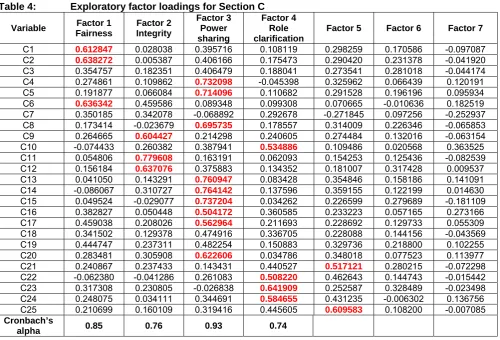
Results captured on an Excel spread sheet were uploaded on to STATISTICA and an exploratory factor analysis was conducted on all the factors. The exploratory factor analysis for Section C is represented by Table 4 as shown below.
Table 4: Exploratory factor loadings for Section C
Variable Factor 1 Fairness
Factor 2 Integrity
Factor 3 Power sharing
Factor 4 Role clarification
Factor 5 Factor 6 Factor 7
C1 0.612847 0.028038 0.395716 0.108119 0.298259 0.170586 -0.097087
C2 0.638272 0.005387 0.406166 0.175473 0.290420 0.231378 -0.041920
C3 0.354757 0.182351 0.406479 0.188041 0.273541 0.281018 -0.044174
C4 0.274861 0.109862 0.732098 -0.045398 0.325962 0.066439 0.120191
C5 0.191877 0.066084 0.714096 0.110682 0.291528 0.196196 0.095934
C6 0.636342 0.459586 0.089348 0.099308 0.070665 -0.010636 0.182519
C7 0.350185 0.342078 -0.068892 0.292678 -0.271845 0.097256 -0.252937
C8 0.173414 -0.023679 0.695735 0.178557 0.314009 0.226346 -0.065853
C9 0.264665 0.604427 0.214298 0.240605 0.274484 0.132016 -0.063154
C10 -0.074433 0.260382 0.387941 0.534886 0.109486 0.020568 0.363525
C11 0.054806 0.779608 0.163191 0.062093 0.154253 0.125436 -0.082539
C12 0.156184 0.637076 0.375883 0.134352 0.181007 0.317428 0.009537
C13 0.041050 0.143291 0.760947 0.083428 0.354846 0.158186 0.141091
C14 -0.086067 0.310727 0.764142 0.137596 0.359155 0.122199 0.014630
C15 0.049524 -0.029077 0.737204 0.034262 0.226599 0.279689 -0.181109
C16 0.382827 0.050448 0.504172 0.360585 0.233223 0.057165 0.273166
C17 0.459038 0.208026 0.562964 0.211693 0.228692 0.129733 0.055309
C18 0.341502 0.129378 0.474916 0.336705 0.228088 0.144156 -0.043569
C19 0.444747 0.237311 0.482254 0.150883 0.329736 0.218800 0.102255
C20 0.283481 0.305908 0.622606 0.034786 0.348018 0.077523 0.113977
C21 0.240867 0.237433 0.143431 0.440527 0.517121 0.280215 -0.072298
C22 -0.062380 -0.041286 0.261083 0.508220 0.462643 0.144743 -0.015442
C23 0.317308 0.230805 -0.026838 0.641909 0.252587 0.328489 -0.023498
C24 0.248075 0.034111 0.344691 0.584655 0.431235 -0.006302 0.136756
C25 0.210699 0.160109 0.319416 0.445605 0.609583 0.108200 -0.007085
Cronbach’s
alpha 0.85 0.76 0.93 0.74
Table 4 shows that three items loaded together to measure Fairness. Factor loadings of between 0.730 and 0.617 were obtained for this factor. Fairness explains 18.16% of the variance in the data. Cronbach’s alpha value of 0.85 was obtained for fairness. Sufficient evidence of convergent validity and reliability for the scale measuring fairness is thus provided. A Cronbach’s alpha value of 0.76 was obtained for Integrity. Table 4
Correlation analysis
Table 5 indicates the correlation coefficients of the variables used in the study. Table 5: Correlation coefficients
Factor 1 2 3 4 5 6 7
1 Fairness 0.679446 0.516993 1.000 0.635757 0.204129 0.575500 0.662251
2 Integrity 0.496528 1.000 0.516993 0.439789 0.466740 0.458154 0.392516
3 Power sharing 0.239602 0.466740 0.204129 0.239015 1.000 0.054681 0.119463
4 Role clarification 0.668289 0.439789 0.635757 1.000 0.239015 0.512441 0.543300 5 Ethical leadership 0.497056 0.458154 0.575500 0.512441 0.054681 1.000 0.546719 (*p<0.05)
The correlation coefficient takes into consideration how factors relate or correlate towards each other. The closer to 1 (when correlation is 1 it therefore indicates a perfect correlation between factors) the correlation between factors translates into a high correlation relationship between factors. In relation to the intermediate factor perceptions regarding ethical leadership, the highest correlation coefficient was reported for the
independent variables of fairness, role clarification and power sharing (r > 0.5). Integrity also reported a high
correlation coefficient but the relationship with the intermediate variable was weaker (r < 5).
CONCLUSIONS AND RECOMMENDATIONS
The concept of ethical leadership can be applied in any organisation and more importantly across the financial sector. In general, ethical leadership is leadership that is involved in leading in a manner that respects the rights and dignity of other individuals. By nature, leaders are in a position of power and ethical leadership focuses on how leaders use this power in the decisions they make, actions they engage in and ways they influence other individuals in their organisations. Ethical leaders must make decisions that will not only benefit them, but more importantly they should consider how the other individuals will be affected. The best leaders make known their values and their ethics and preach them in their leadership style and actions.
In this study, the main factors that influence ethical leadership were identified as: honesty, integrity, fairness, role clarification and power sharing. This particular leadership style allows the leader to make ethical choices in the midst of ambiguous and complex situations. Moral managers make ethics an explicit part of their leadership agenda by communicating an ethics and values message, by visibly and intentionally role modelling ethical behaviour, and by using the reward system (rewards and discipline) to hold employees accountable for ethical conduct.
It appears that financial institutions have realised the importance of making sure that their codes of conduct set clear ethical standards and guidelines for employees to follow. The following conclusions could be drawn from the empirical results:
• In terms of honesty, the respondents agreed that the organisation should raise tough questions in order to
solve issues that will allow the organisation to be effective. Yet, no statistical significance could be found between honesty and perceptions regarding ethical leadership and H1 could thus not be accepted.
• Regarding integrity, the respondents seem to agree that ethical principles should apply to everyone in the
organisation without discrimination under an impartial, reliable and participative leadership (H2 accepted). • With regards to fairness, the respondents agreed that the delegation of duties and distribution of power
should be carried out (H3 accepted).
• With regards to role clarification, the respondents agreed that employees should be awarded the
opportunity to express their views on ethical issues (H4 accepted).
• In terms of power sharing, the respondents agreed that employees should be delegated with duties that are
clear and well explained (H5 accepted).
Respondents further agreed that leaders should be responsible for creating an ethical culture in their organisation and should provide some sort of ethical training for employees and this could be ethical leadership courses or workshops. Ethical leaders are conscious of cultural differences and always conduct themselves in a certain manner because they are aware that their actions and behaviours filter down to employees who are likely to mimic the same mannerisms and actions when faced with similar situations according to respondents. Ethical leaders are always willing to reward those who perform their duties efficiently and diligently by meeting their performance goals. Respondents acknowledged that ethical leaders do not discriminate and value those who perform their duties well by compensating their hard work with performance incentives. Based on this study it is recommended that ethical leaders should:
• Encourage the discussion of ethics and ethical choices as an on-going feature of the organisational culture. • Ensure that it is everyone’s responsibility to conduct themselves in an ethical manner.
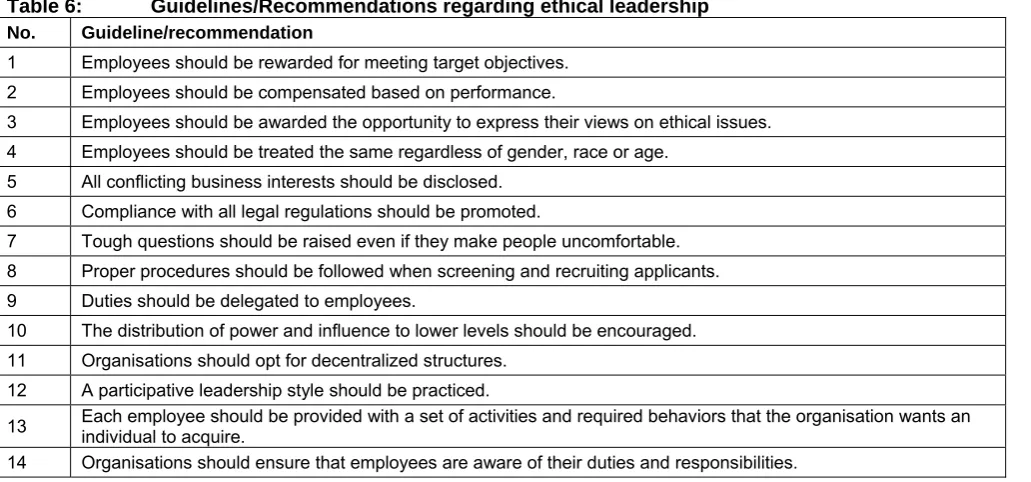
Table 6 presents some general guidelines and recommendations ethical leadership.
Table 6: Guidelines/Recommendations regarding ethical leadership
No. Guideline/recommendation
1 Employees should be rewarded for meeting target objectives. 2 Employees should be compensated based on performance.
3 Employees should be awarded the opportunity to express their views on ethical issues. 4 Employees should be treated the same regardless of gender, race or age.
5 All conflicting business interests should be disclosed. 6 Compliance with all legal regulations should be promoted.
7 Tough questions should be raised even if they make people uncomfortable. 8 Proper procedures should be followed when screening and recruiting applicants. 9 Duties should be delegated to employees.
10 The distribution of power and influence to lower levels should be encouraged. 11 Organisations should opt for decentralized structures.
12 A participative leadership style should be practiced.
13 Each employee should be provided with a set of activities and required behaviors that the organisation wants an individual to acquire.
14 Organisations should ensure that employees are aware of their duties and responsibilities.
LIMITATIONS OF THE RESEARCH
The study was conducted well with a few problems faced while carrying out the literature review. Ethical leadership stands as a relatively new topic. Most of the information available covers either ethics or leadership as separate topics of discussion and this somehow proved to be a limitation to the research. Another limitation to the research was the reluctance of respondents to fill in questionnaires. The search method that was chosen limited the sample representatives; however, it simplified the process of collecting information.
The following extract seems appropriate to conclude this article with:
“The topic of ethical leadership has received significant attention in recent years due to the plethora of corporate scandals … The shocking financial irregularities that have been uncovered bring to fore the need for ethical leadership … The common thread underlying these corporate scandals is the failure of corporate leadership to demonstrate ethical leadership… leaders are not as concerned about ethics as perhaps they should be … ethical leadership entails more than fostering of ethical behavior … ethical leaders must focus more effort on creating the right conditions and organizational culture, which is also the organizational soil, to foster the development of ethical behaviour … they must make ethics the cornerstone of how they conduct business …” (Ponnu & Tennakoon 2009:21)
REFERENCES
Abrhiem, T.H. 2012. Ethical leadership: Keeping values in business cultures. Business and Management Review, 2(7): 11-19
Brown, M.E. & Trevino, L.K. 2006. Ethical leadership: A review and future directions. The Leadership Quarterly, 17(1): 595-616.
Business Dictionary. 2013. Available: http://www.businessdictionary.com/definition/finacial-sector. (Accessed on 16 November 2013).
Chryssides, G.D. & Kaler, J. 2001. Business ethics. London: Thomson Learning.
Coleman, P.T. 2004. Implicit theories of organizational power and priming effects on managerial power-sharing decisions: An experimental study. Journal of Applied Social Psychology, 34(2): 297-321.
Creswell, J.W. 2007. Qualitative, quantitative and mixed method methodologies. Los Angeles: Sage.
Dalglish, C., Du Plessis, M., Lues, L. & Pietersen, E. 2009. Leadership in the African context. Cape Town: Juta.
De Hoogh, A.H.B. & Hen Hartog, D.N. 2008. Ethical and despotic leadership, relationships with leaders’ social responsibility, top management team effectiveness and subordinates’ optimism: A multi-method study, The Leadership Quarterly, 19(1): 297-311.
Don Murray & Associates. 2006. Seven steps to role clarification. Available: http://www.teambased.com/images/pdf/Seven+Steps+to+Role+Clarification.pdf. (Accessed on 4 September 2014).
DuBrin, A. 2007. Leadership: Research findings, practice and skills. Ohio: South-Western/Cengage.
Eisenbeiss, S.A. 2012. Re-thinking ethical leadership: An interdisciplinary integrative approach. The Leadership Quarterly, 23(5): 791-808.
Freeman, E.R. & Stewart, L. 2006. Developing ethical leadership. USA: Bridge papers.
Fulmer, R.M. 2004. The challenge of ethical leadership. Organizational Dynamics, 33(3): 307-317. Gesteland, R.R. 2005. Cross cultural business behaviour. USA: Copenhagen.
Gill, R. 2011. Theory and practice of leadership. Thousand Oaks: Pine Forge Press.
Griffin, D. 2002. The emergence of leadership: Linking self-organisation and ethics. London: Routledge.
Grojean, M.W., Resick, C.J., Dickson, M.W., & Smith, D.B. 2004. Leaders, values, and organizational climate: Examining leadership strategies for establishing an organizational climate regarding ethics. Journal of Business Ethics, 55(3): 223-241.
Helliriegel, D., Jackson, S.E., Slocum, J., Staude, G., Amos, T., Klopper, H.B., Louw, L. & Oosthuizen, T. 2008. Management. Cape Town: Oxford Press Southern Africa.
Hendricks, G., Ludeman, K. 1996. The corporate mystic. New York: Bantam.
Herring, R.J. & Santomero, A.M. 1996. The role of the financial structure in economic performance. Stockholm: SNS Publishing.
Jennings, M.M. 2003. The critical role of ethics. Internal Auditor, 60(6): 46-51.
Kalshoven, K. & Den Hartog, D.N. 2009. Ethical leader behaviour and leader effectiveness: The role of prototypically and trust. International Journal of Leadership Studies, 5(2): 102-120.
Kanungo, R.N. 2001. Ethical values of transactional and transformational leaders. Canadian Journal of Administrative Sciences, 18(4): 251-265
Landy, F.J. & Conte, J.M. 2010. Work in the 21st century: An introduction to industrial and organisational psychology. USA: Wiley.
Langlois, L. & Lapointe, C. 2010. Can ethics be learned: Results from a three‐year action‐research project. Journal of Educational Administration, 48(2): 147-163.
Lombaard, C., Van der Merwe, L., Kele, T. & Mouton, S. 2011. Introduction to statistics. Cape Town: Pearson Education. Manning, S.S. 2003. Ethical leadership in human services, USA: Pearson Education Inc.
Martin, G.S., Keating, M., Resick, C., Szabo, E.C. Kwan H.K. & Peng, A.C. 2013. The meaning of leader integrity: A comparative study across Anglo, Asian & Germanic cultures. The leadership Quarterly, 24(1): 445-461.
Maxfield, M.G. & Babbie, E.R. 2012. Basics of research methods for criminal justice and criminology. USA: Wadsworth. Mayer, D..M, Aquino, K., Greenbaum, R.L. & Kuenzi, M. 2012. Who displays ethical leadership and why does it matter?
An examination of antecedents and consequences of ethical leadership. Academy of Management Journal, 55: 151-171.
Mayer, D.M., Kuenzi, M., Greenbaum, R.L. 2011. Examining the link between ethical industrial and organisational psychology. USA: Wiley.
Mayer, D.M., Kuenzi, M., Greenbaum, R.L., Bardes, M. & Salvador, R.B. 2009. Organisational behavior and human decision processes, 108(1): 1-13.
Neubert, M.J., Wu, C. & Roberts, J.A. 2013. The influence of ethical leadership and regulatory focus on employee outcomes. Business Ethics Quarterly, 23(2): 269-296.
Palmer, D.E. 2009. Business Leadership: Three levels of ethical analysis. Journal of Business Ethics, 88(3): 525-536. Yukl, D., Mahsud, R., Hassan, S. & Prussia, G. 2013. An improved measure of ethical leadership. Journal of Leadership
and Organization Studies, 20(1): 38-48.
Parry, K.W. & Proctor-Thomson, S.B. 2002. Perceived integrity of transformational leaders in organisational settings. Journal of Business Ethics, 35(2): 75-96.
Ponnu, C.H. & Tennakoon, G. 2012. The association between ethical leadership and employee outcomes – the Malaysian Case. Electronic Journal of Business Ethics and Organization Studies, 14(1): 21-31.
Rossouw, D. 2002. Business Ethics in Africa. 2nd Edition. Cape Town: Oxford University Press Southern Africa. Shaw, W.H. 2011. Business Ethics. 7th Edition. USE: Wadsworth.
Sparr, J.L. & Sonnentag, S. 2008. Fairness perceptions of supervisor feedback. LMX and employee well-being at work. European Journal of Work and Organizational Psychology, 17: 198-225.
Thomas, R. 2002. Conflict management systems: A methodology for addressing the cost of conflict in the workplace. Oregon: Mediate.com
Trevino, L.K., Brown, M. & Hartman, L.P. 2003. A qualitative investigation of perceived executive ethical leadership: Perceptions from inside and outside the executive suite. England: Sage Publications.
Van Dijke, M, De Cremer, D. 2009. Procedural fairness and endorsement of prototypical leaders: leader benevolence or follower control. Journal of Experimental Social Psychology, 46(1): doi: 10.1016/j.jesp.2009.10.004.
Van Dijke, M, De Cremer, D., Mayer, D.M. & van Quaquebeke, N. 2012. When does procedural fairness promote organizational citizenship behavior? Integrating empowering leadership types in relational justice models. Organizational Behavior and Human Decision Processes, 117(2): 235-248.
Weiss, J.W. 2006. A stakeholder and issues management approach. Canada: Thomson.