Original Research Article
Quality of life among patients on MDR-TB treatment in a district
tuberculosis centre of a metropolitan city
Apoorva E. Patel
1, K. Lalitha
2*, Dinesh Rajaram
2, K. Radhika
2, N. S. Murthy
2INTRODUCTION
Tuberculosis is a top infectious disease killer worldwide. The 6 countries that stand out as having the largest number of incident cases in 2014 were India, Indonesia, Nigeria, Pakistan, People‘s Republic of China and South Africa. Globally, an estimated 3.3% of new cases and 20% of previously treated cases have MDR-TB. An estimated 480 000 people developed MDR-TB in 2014.1,2 In India the estimated MDR-TB among new and retreatment TB cases is2.2% and 15% respectively.2,3
Management of MDR-TB cases is more challenging
requiring the use of second-line drugs that are more costly, cause more severe side effects and requires longer duration of treatment.2 Though in medical practice, the method of assessing patient health status and disease is by laboratory or clinical tests, it becomes impossible to separate the disease from the individual's personal and social context, especially in chronic and progressive disease. It has been seen that apart from physical symptoms, TB patients face various problems that are psychological, social and economic in nature. Therefore,
ABSTRACT
Background: MDRTB is a global health concern with its current prevalence in India being 2.3% and 17.2% respectively among newly diagnosed and previously treated cases. Besides its clinical impact, the disease affects the QOL of patients suffering from TB. The objective of the study was to assess the quality of life among MDR-TB cases in comparison with non-MDR MDR-TB cases and MDR-TB cured subjects (Category I, RNTCP).
Methods: A cross sectional study was conducted in all the 14 TUs under District Tuberculosis Centre of Municipal Corporation of Bengaluru (BBMP). Study subjects comprised of 52 MDR-TB Cases, 53 Non-MDR-TB cases and 54 Category I TB cured subjects. WHOQOL BREF questionnaire was used to assess the QOL among study subjects. Median [IQR] scores of QOL in each of the domains among various groups were compared using Kruskal Wallis test. P<0.05 was considered as statistically significant.
Results: Median age among MDRTB cases was 35 years [IQR: 26-50] whereas it was 37 years [IQR: 28-47] among Non MDRTB cases and 30.5 years [IQR: 22-45] among TB cured subjects. Out of 52 MDRTB cases, 26(50%) were females compared to 14 (26.4%) among Non MDRTB cases and 26(48.1%) among TB cured subjects (p=0.0024). As compared to non MDRTB cases, physical and environmental domains’ scores of MDRTB cases were significantly low (p=0.01 and p=0.001 respectively).Whereas, as compared to TB cured subjects, physical and psychological domains’ scores of MDRTB cases were significantly low (p<0.001 and p<0.001 respectively).
Conclusions: The QOL of patients suffering from TB is affected and the impact is even worse in MDRTB. Hence prompt treatment of TB and early diagnosis of MDRTB will reduce the disease severity and improve the QOL.
Keywords: MDR-TB, Quality of Life, BBMP, Bengaluru, QOL
Department of Community Medicine, 1Akash Institute of Medical Sciences & Research Centre, Devanahalli, Bengaluru rural, 2Ramaiah Medical College & Hospitals, Bengaluru, Karnataka, India
Received: 25 September 2018
Revised: 31 October 2018
Accepted: 03 November 2018
*Correspondence:
Dr. K. Lalitha,
E-mail: [email protected]
Copyright: © the author(s), publisher and licensee Medip Academy. This is an open-access article distributed under the terms of the Creative Commons Attribution Non-Commercial License, which permits unrestricted non-commercial use, distribution, and reproduction in any medium, provided the original work is properly cited.
for a comprehensive assessment of patients' health status, it is very much essential to assess the overall impact of MDRTB on health and patients' perception of well-being, besides routine clinical, radiological and bacteriological assessments.3 Limited research looks into QOL on TB and MDR-TB. Hence this study makes an attempt to assess the QOL among MDR-TB cases in comparison with Non MDR-TB cases.
METHODS
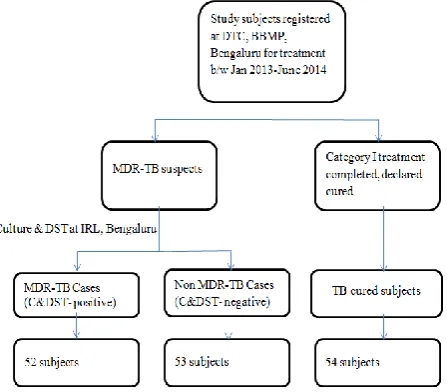
The present study was a cross sectional study, conducted in all the 14 tuberculosis units (TUs) under district tuberculosis centre (DTC) of Municipal Corporation of Bengaluru [BBMP- Bruhat Bengaluru Mahanagara Palike area], Karnataka. Study subjects were those cases diagnosed and put on treatment during the period January 2013- June 2014.Source of study subjects was the Register maintained at the District Tuberculosis Centre (DTC), BBMP, Bengaluru. Study subjects were selected at least in the ratio of 1:1:1 using simple random sampling technique. Accordingly, the study subjects consisted of 52 MDR-TB cases-confirmed with culture and drug susceptibility test (C&DST) at the intermediate reference laboratory (IRL), Bengaluru and put on MDR-TB treatment. The other two groups consisted of 53 Non MDR-TB cases who were diagnosed at IRL, Bengaluru and were continuing RNTCP treatment regimen in BBMP area during the same period and 54 TB cured subjects, who were declared cured under Category 1 of RNTCP in BBMP during the same period. Selection of study subjects was done as explained in Figure 1.
Figure 1: Flowchart depicting the selection of study subjects.
To calculate the sample size, a study conducted by Dhuria et al was considered, wherein comparison of QOL of TB cases with that of controls revealed- a least difference in the mean scores of 1.33 for social domain
and power of the study at 80%, it was estimated that, a minimum of 41 subjects need to be studied in each group.
Review of previous records from BBMP showed that the required sample size for the cases would be met between January 2013 to June 2014. Hence, a complete enumeration of all the MDR-TB cases registered during that period was done with at least similar number of subjects in the other two groups, selected by simple random sampling technique.
Data collection
Institutional ethical clearance was obtained. Prior permission was obtained from the District Tuberculosis
Officer (DTO), BBMP, Bengaluru. A standard
WHOQOL BREF questionnaire was used to assess the Quality of Life among MDR-TB, Non MDR-TB and TB cured subjects.5 This questionnaire has 26 questions and covers four domains - physical health, psychological
health, social relationships and environment.
Transformed domain scores in each of the 4 domains range from 0-100. Interpretation of the scores follows a simple rule- Higher the scores better the quality of life.
Study subjects were identified from the DTC registry and traced to their residence with the help of the Senior Treatment Supervisor (STS), Health Visitor (HV) and DOTS provider of the respective TU, Designated Microscopic Centre (DMC) and Peripheral Health Institute (PHI). Interview technique was employed for collecting the data. A good rapport was established with the study subjects before collecting the data, explaining about the objective of the study and its usefulness to the community. Informed consent was taken from all the study subjects on a written consent form in the local language, in the form of a signature or left thumb impression. Confidentiality of the patient’s personal details was assured by the interviewer. The study subjects were interviewed at their residence or at the nearest TU/ PHI (based on subject‘s choice). In case of emergency, prompt referral to the concerned MOTC was done. Appropriate counselling of the patients was done regarding the disease, treatment adherence and the side effects of the drugs used in the treatment regimen.
Statistical analysis
Domain wise median scores (along with Inter Quartile Range [IQR]) were computed and compared. Kruskal Wallis test was used to compare the different domains of quality of life between the groups. This was followed by post hoc multiple comparison using LSD test. P<0.05 was considered statistically significant. All the analyses was carried out using IBM SPSS version 18.0.
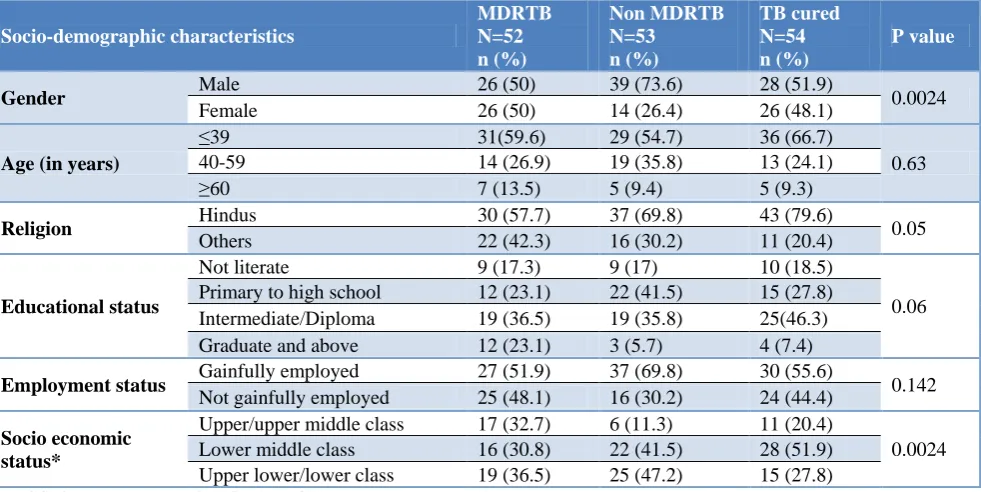
among control II (p=0.024). Median age among MDRTB cases was 35 years [IQR: 26-50] whereas it was 37 years [IQR: 28-47] among Control I and 30.5 years [IQR: 22-45] among Control II. Majority of the cases, 30 (57.7%) were Hindus followed by Muslims 16 (30.8%) and Christians 6 (11.5%). Whereas 37 (69.8%) among Non MDRTB cases and 43 (79.6%) among TB cured subjects were Hindus. 16 (30.2%) among Non MDRTB cases and 11 (20.4%) among TB cured subjects were Muslims and Christians combined (p=0.05). 23.1% of MDR TB cases
were Graduates and above in contrast to 5.7% among Non MDRTB cases and 7.4% among TB cured subjects, although this difference was not statistically significant (p=0.06). 17 (32.7%) of MDRTB cases belonged to upper or upper middle class, whereas 6 (11.3%) of Non MDRTB cases and 11 (20.4%) of TB cured subjects belonged to upper or upper middle class and this difference in proportion observed between different socio-economic status was statistically significant (p=0.024) (Table 1).
Table 1: Socio-demographic characteristics of the study subjects.
Socio-demographic characteristics
MDRTB N=52 n (%)
Non MDRTB N=53
n (%)
TB cured N=54 n (%)
P value
Gender Male 26 (50) 39 (73.6) 28 (51.9) 0.0024
Female 26 (50) 14 (26.4) 26 (48.1)
Age (in years)
≤39 31(59.6) 29 (54.7) 36 (66.7)
0.63
40-59 14 (26.9) 19 (35.8) 13 (24.1)
≥60 7 (13.5) 5 (9.4) 5 (9.3)
Religion Hindus 30 (57.7) 37 (69.8) 43 (79.6) 0.05
Others 22 (42.3) 16 (30.2) 11 (20.4)
Educational status
Not literate 9 (17.3) 9 (17) 10 (18.5)
0.06
Primary to high school 12 (23.1) 22 (41.5) 15 (27.8)
Intermediate/Diploma 19 (36.5) 19 (35.8) 25(46.3)
Graduate and above 12 (23.1) 3 (5.7) 4 (7.4)
Employment status Gainfully employed 27 (51.9) 37 (69.8) 30 (55.6) 0.142
Not gainfully employed 25 (48.1) 16 (30.2) 24 (44.4)
Socio economic status*
Upper/upper middle class 17 (32.7) 6 (11.3) 11 (20.4)
0.0024
Lower middle class 16 (30.8) 22 (41.5) 28 (51.9)
Upper lower/lower class 19 (36.5) 25 (47.2) 15 (27.8)
*Modified Kuppuswamy’s classification of SES.
Table 2: Comparison of QOL scores (transformed scores) among the study subjects in different domains.
Domains Median [IQR] P value
MDR-TB (N=52) Non MDRTB (N=53) TB cured (N=54)
Physical 39.3 [25.0-56.3] 53.6 [39.3-64.3] 89.3 [82.1-96.4] <0.001
Psychological 50.00 [38.5-62.5] 54.2 [50.0-66.7] 87.5 [79.2-95.8] <0.001
Social 75.0 [66.7-75.0] 66.7 [58.3-75.0] 62.5 [50.0-75.0] 0.11
Environmental 65.6 [60.2-75.0] 75.0 [70.3-82.8] 62.5 [53.1-81.3] <0.001
*Kruskal Wallis test. p<0.05 is considered statistically significant.
Table 3: Multiple comparisons of QOL scores (transformed scores) among the study groups in different domains.
Domains
Median [IQL]
P value
MDRTB (n=52) Non MDRTB (n=53)
TB cured
(n=54) Overall 1 v/s2 1 v/s3 2 v/s3 Physical 39.3 [25.0-56.3] 53.6 [39.3-64.3] 89.3 [82.1-96.4] <0.001 0.01 <0.001 <0.001
Psychological 50.00 [38.5-62.5] 54.2 [50.0-66.7] 87.5 [79.2-95.8] <0.001 0.266 <0.001 <0.001
Social relationship 75.0 [66.7-75.0] 66.7 [58.3-75.0] 62.5 [50.0-75.0] 0.11 0.210 0.152 0.860
Environmental 65.6 [60.2-75.0] 75.0 [70.3-82.8] 62.5 [53.1-81.3] <0.001 0.001 0.495 <0.001
It was observed that the transformed median scores of MDRTB cases in physical, psychological, social and environmental domains were 39.28 [25.00-56.35], 50.00 [38.54-62.50], 75.00 [66.66-75.00] and 65.62 [60.15-75.00] respectively. Overall there was a statistically significant difference in the median scores in physical, psychological and environmental domains between the groups (Table 2).
Physical and environmental domains’ scores of MDRTB cases were significantly low as compared to Non MDRTB cases and this difference was found to be
statistically significant (p=0.01 and p=0.001
respectively). This indicates that these two domains were significantly affected in MDRTB. Whereas, as compared to TB cured subjects, physical and psychological domains’ scores of MDRTB cases were significantly low (p<0.001 and p<0.001 respectively) indicating that these two domains were significantly affected in MDRTB (Table 3).
DISCUSSION
In several studies it was observed that TB affects all the predicted domains of QOL i.e. physical, psychological, health perceptions and social role functioning. In the present study, transformed- median domain scores in physical (39.3 vs. 53.6 vs. 89.3) and psychological (50.0 vs. 54.2 vs. 87.5) domains were significantly lower among MDRTB cases as compared to non MDRTB cases and TB cured subjects respectively, which is similar to several other studies.6-10 The impact of the disease on physical functioning was in the form of easy fatigability, regular body ache, and lack of sleep, unrest and decreased working capacity. There were reports regarding restrictions towards their freedom of movement, participation in home and day to day recreation/leisure activities.6 Besides treatment regimen for MDR-TB involves several months of complex drug combinations including extended periods of injectables, which are associated with significant adverse effects.11 The respondents reported the wide range of psychological reactions like negative feelings of their survival, poor health and self-esteem. This along with the prolonged disease course (multiple episodes of TB) may affect physical and psychological domains of QOL.
Also in the present study, both MDR-TB (75.0, 65.6) and Non MDRTB (66.7, 75.0) cases accorded the highest transformed- median scores in the social and environmental domains respectively, which is similar to a study conducted by Qahtani et al in Saudi Arabia.12 This may be attributed to the Higher educational and Socio-Economic Status among MDRTB and Non MDRTB cases as compared to TB cured subjects. This is in contrast to a study conducted by Sharma et al in North India6 wherein it was observed that the mean differences in scores for the cases (MDRTB and PTB) were highly
shown that there is significant impact (p>0.01) on
Psychological (F-ratio=49.201) and Environmental
domains (F-ratio=65.311). Most patients claim that with the passage of time they have developed constraint relations with their family and friends as they get lesser support from their wards. The environmental domain related to the sense of safety, security, home environment, transport and financial security was also negatively affected in MDRTB and PTB patients.
CONCLUSION
Quality of life of patients suffering from TB is affected and the impact is even worse in patients suffering from MDR-TB. Providing care and support to MDR-TB cases in the form of physical, financial, psycho-social and nutritional support, through various social welfare programmes would go a long way in improving their condition. Also counselling the patients with respect to treatment adherence, adverse drug reactions and disease prognosis will improve the compliance of the patients. Hence all these measures will reduce the disease severity and improve the QOL of patients suffering from MDRTB.
ACKNOWLEDGEMENTS
Our sincere thanks to the Management of Ramaiah Medical College and Hospitals, Bengaluru and Dr Arundathi Das H.P- District Project Co-Ordinator, RNTCP, BBMP, Bengaluru for extending their immense support in conducting this study. We extend our special thanks to all the MO-TCs, STS, STLS and Health visitors of all the 14 TUs of BBMP for their help and Co-operation. Finally we thank all the study subjects for their co-operation, without which this study wouldn’t have surfaced.
Funding: No funding sources Conflict of interest: None declared
Ethical approval: The study was approved by the Institutional Ethics Committee
REFERENCES
1. WHO. Tuberculosis factsheets. WHO. Available at:
http://www.who.int/mediacentre/factsheets/fs104/en /. Accessed on 28 March 2016.
2. WHO. Global tuberculosis report 2015. WHO.
Available at: http://www.who.int/tb/publications/ global_report/en/. Accessed on 28 March 2016.
3. DOTS Plus Guidelines 2010. Cent TB Div Dir Gen
Health Serv Health Fam Welf Govt India. Available at: health.bih.nic.in/Docs/Guidelines/ Guidelines-DOTS-Plus.pdf. Accessed on 28 March 2016.
4. Dhuria M, Sharma N, Ingle G. Impact of
5. WHO. WHOQOL User Manual: Prgramme on Mental Health. Available at: www.who.int/mental_ health/evidence/who_qol_user_manual_98.pdf. Accessed on 11 March 2016.
6. Sharma R, Yadav R, Sharma M, Saini V, Koushal V. Quality of life of multi drug resistant tuberculosis patients: a study of north India. Acta Med Iran. 2014;52(6):448–53.
7. Aggarwal AN. Health-related quality of life: A neglected aspect of pulmonary tuberculosis. Lung India. 2010;27(1):1–3.
8. Kakhki AD, Masjedi MR. Factors Associated with Health-Related Quality of Life in Tuberculosis Patients Referred to the National Research Institute of Tuberculosis and Lung Disease in Tehran. Tuberc Respir Dis. 2015;78(4):309–14.
9. Chamla D. Chamla D. The assessment of patients’ health-related quality of life during tuberculosis treatment in Wuhan, China. Int J Tuberc Lung Dis. 2004;8(9):1100–6.
10. Ayub T, Nazir U, Sideeq K. Quality Of Life of Multi Drug Resistant Tuberculosis Cases of Kashmir Valley. IJIRMS. 2017;02(08):1113-7.
11. Dhiman S, Bansal R, Kansal D, Sharma PK.
Assessment of health related quality of life of drug resistant Tuberculosis patients. India J Pharmacy Pharmacol. 2018;5(2):62-5.
12. Qahtani MFA, Mahalli AA, Dossary NA,, Muhaish
AA, Otaibi SA, Baker FA. Health-related quality of life of tuberculosis patients in the Eastern Province,
Saudi Arabia. J Taibah Univ Med Sci.
2014;9(4):311–7.