Journal of Engineering Sciences, Volume 6, Issue 1 (2019), pp. G 1–G 5 G 1 JOURNAL OF ENGINEERING SCIENCES
ЖУРНАЛ ІНЖЕНЕРНИХ НАУК
ЖУРНАЛ ИНЖЕНЕРНЫХ НАУК
Web site: http://jes.sumdu.edu.ua DOI: 10.21272/jes.2019.6(1).g1 Volume 6, Issue 1 (2019)
UDC 621.436
Compression Ignition Engine Performance as a Function of the Fuel Properties
Towoju O. A.1, Jekayinfa S. O.1, 2
1
Adeleke University, P.M.B 250, Ede-Osogbo Rd, Ede, Osun State, Nigeria;
2 Ladoke Akintola University of Technology, P.M.B 4000, Ogbomoso Rd, Ogbomoso, Nigeria
Article info: Paper received:
The final version of the paper received: Paper accepted online:
June 7, 2018 December 20, 2018 December 25, 2018
*
Corresponding Author’s Address:
[email protected]
Abstract. Compression ignition engines have wide application in the transportation, agricultural, construction and industrial sectors which are critical for the economic sustainability of any nation. These engines are powered with pe-troleum diesel which is however, been threatened by the reality of crude oil going into extinction in some couple of years if new reserves are not discovered, and also the need to reduce global warming; a consequence of the effect of its combustion products. Biodiesel is a renewable fuel with similar properties to petroleum diesel, and can be used purely or in blends without the need for modifying the existing engines. The thermal efficiency of an engine is a very important performance indicator, and researchers would stop at nothing to ensure its improvement. The kinematic viscosity is one of the fuel’s properties which contribute to an engine thermal efficiency. This work is thus designed to review some past studies on the use of biodiesels and its blends in engines and find a correlation between the kin-ematic viscosity and the thermal efficiency. A correlation was established to exist between the fuel kinkin-ematic viscosi-ty and the engine thermal efficiency.
Keywords: biodiesels, kinematic viscosity, calorific value, pure biodiesel properties, thermal efficiency.
1
Introduction
The rapid dwindling rate of the world fossil energy re-serves has continued to be unmatched by new discover-ies. However, the comfortable existence of the present age mankind has been tailored towards his large depend-ence on generated energy used in transportation from a location to another (air, land, and marine), powering of construction and agricultural equipment, and for electrici-ty generation utilized in powering of household equip-ment and industrial machines/ equipequip-ment.
To meet this energy requirement, the dwindling fossil energy reserves are being continually called into play, as the bulk of the generated energy consumed by man is produced from it and only a fraction, about 13% of the whole is generated from nuclear, wind, solar and hydrau-lic sources. The generation of energy from fossil energy resources however also comes with an attendant cost of environmental pollution asides the possibility of it getting into extinction in a couple of years if new reserves are not discovered.
The transportation sector and agricultural and con-struction equipment generate its energy largely from crude oil, while a small fraction of the world’s electricity is also generated from it. The major process of converting
the inherent energy of crude oil utilized in these sectors employs basically the use of internal combustion engines. Crude oil forms about 38% of the amount of fossil energy used in generating energy for the use of mankind, and is a major contributor to the much talked about climatic change caused by global warming.
In order to continue to meet the huge demand of ener-gy for transportation, agricultural and construction equipment, and electricity generation placed on internal combustion engines while placing a premium on the maintenance of a cleaner environment, alternative energy sources to crude oil are been sought for, and one of such is the use of renewable and bio-degradable biofuels.
G 2 CHEMICAL ENGINEERING: Energy Efficient Technologies Researchers are thus busy carrying out studies on the
production and use of biodiesels in compression ignition engines, its desired properties and the impact of its com-bustion products on the environment.
The impact of some of the properties of fuels, bio-diesels inclusive such as calorific value on thermal effi-ciency [2–4] flash point on storage of fuels [5], cetane number on the fuel auto-ignition [6], and viscosity on flow rate and thermal efficiency [7–13].
This study is thus designed to review the literature and find a correlation between the kinematic viscosities of biodiesels / biodiesel blends and engine thermal efficien-cy.
2
Literature Review
2.1
Kinematic viscosity and thermal efficiency
Kinematic viscosity is the ratio of the fluid dynamic viscosity to its density and has a significant impact on fuel delivery and power output. It determines the rate of flow of the fuel, and too high a value can lead to pumping issues and atomization in the injection system [14].
Thermal efficiency is the fraction of the heat input that is converted into useful work by the device, in other words, it is the percentage of fuel energy converted into useful power output [11, 15]. The thermal efficiency of an engine has a direct relationship to its power output and is inversely proportional to the rate of mass of fuel con-sumption, hence a high value of thermal efficiency is an indication of better fuel economy and by extension re-duced spending and lower exhaust of emission products.
In the quest to investigate the effect of the utilization of biodiesels and petroleum biodiesel blends on engine performance several researchers have conducted experi-ments using biodiesels produced from different sources and different blend fractions. Biodiesels produced from different sources have their own characteristic physico-chemical properties which are a function of the produc-tion process and have an impact on the performance of the engine.
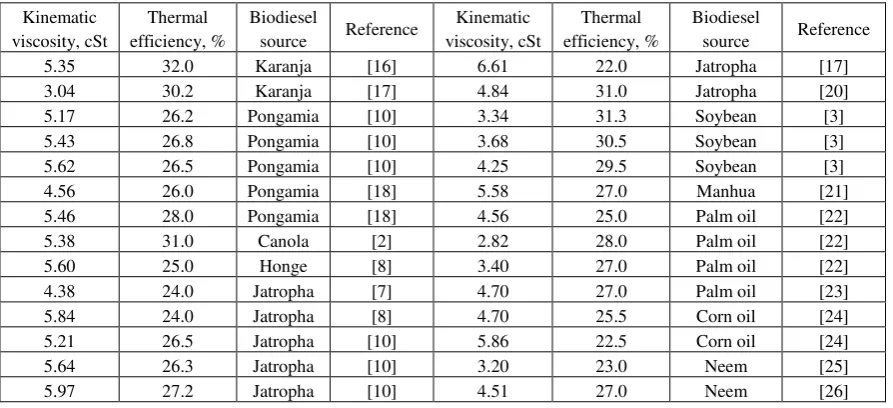
Independent studies with the use Karanja oil biodiesel and its blend (B20) with determined kinematic viscosities of 5.35 cSt at 40 °C and 3.04 cSt resulted into engine thermal efficiencies of 32.0 % and 30.2 % respectively [16, 17]. With biodiesel/biodiesel blends of Pongamia origin, kinematic viscosity values of 5.17 (B10), 5.43 (B20), and 5.62 cSt (B30) at 40 °C, the engines thermal efficiency were 26.2 %, 26.8 %, and 26.5 % respectively [10], while with values of 4.56 cSt (B100) at 33 °C and 5.46 cSt (B20) as determined from other studies resulted into engine thermal efficiency values of 26.0 % and 28.0 % respectively [18].
Studies on biodiesels with Canola oil and Honge oil as their origin with kinematic viscosity values of 5.38 and 5.60 cSt respectively measured at 40 °C resulted into thermal efficiency values of 31 % and 25 % respectively [2–8].
Jatropha oil is commonly used as a source of biodiesel in many parts of the world because of its ease of propaga-tion [19]. Several studies have been conducted on the
performance and emission characteristics of compression ignition engines using biodiesels produced from Jatropha and its blends with petroleum diesel, some of interest to the authors have been selected. Kinematic viscosity val-ues of 4.38 (B100), 5.84 (B100), 5.21 (B10), 5.64 (B20), 5.97 (B30), 6.61 (B100), and 4.84 cSt (B100) measured at 40 °C as determined by some researchers for Jatropha biodiesel and its blends used in fuelling of an engine resulted into thermal efficiency values of 24.0, 24.0, 26.5, 26.3, 27.2, 22.0, and 31.0 % respectively [7, 8, 10, 15, 20].
Biodiesels with Soybean, Manhua and Palm oil as sources have also been worked upon by researchers. With Soybean oil as source, the use of its biodiesel with kine-matic viscosity values of 3.34 (B20), 3.68 (B40), and 4.25 cSt (B100) measured at 40 °C in compression igni-tion engine resulted to thermal efficiency values of 31.3, 30.5, and 29.5 % respectively [3].
Manhua oil biodiesel with a kinematic viscosity of 5.58 cSt measured at 40 °C gave a thermal efficiency value of 27 % when used to fuel an engine [21]. Studies on biodiesel derived from Palm oil with kinematic viscos-ity values of 4.56 (B100), 2.82 (B20), and 3.40 cSt for petroleum diesel-palm oil blend in the ratio 1:4 measured at 40 °C resulted into thermal efficiency values of 25, 28 and 27 % respectively [22], while with kinematic viscosi-ty of 4.70 cSt (B100) measured at 30 °C during another study, the thermal efficiency of the fuelled engine was 27 % [23].
Working with biodiesel produced from used and fresh Corn oil, the kinematic viscosity values measured at room temperature were gotten to be 4.70 and 5.86 cSt gave engine thermal efficiency values of 25.5 and 22.5 % re-spectively [24]. With Neem oil biodiesel having a kine-matic viscosity value of 3.20 cSt, the engine’s thermal efficiency was found to be 23.0 % [25], and as reported by Tutak et al., the use of B100 as fuel in their test engine with kinematic viscosity value of 4.51 cSt measured at 40 °C gave thermal efficiency value of 27.0 % [26].
A summary of the literature values of kinematic vis-cosities and the corresponding engine thermal efficiencies is as shown in Table 1 below.
Plots of thermal efficiency against kinematic viscosity values of biodiesel and some of its blends are as depicted in Figures 1–2.
Figure 1 is a plot of the thermal efficiency values against the kinematic viscosity values of some biodiesels and biodiesel blends. The thermal efficiency values can be seen to be indirectly proportional to the kinematic viscosity values, although this cannot be said to be appli-cable in some instance given an indication that other fuel properties will have an impact on the engines thermal efficiency.
Journal of Engineering Sciences, Volume 6, Issue 1 (2019), pp. G 1–G 5 G 3
Figure 1 – Thermal efficiency kinematic viscosity plots of biodiesels and its blends
Figure 2 – Thermal efficiency kinematic viscosity values at 40 °C plots of biodiesels
Table 1 – Summary of thermal efficiency values
Kinematic viscosity, cSt
Thermal efficiency, %
Biodiesel
source Reference
Kinematic viscosity, cSt
Thermal efficiency, %
Biodiesel
source Reference 5.35 32.0 Karanja [16] 6.61 22.0 Jatropha [17] 3.04 30.2 Karanja [17] 4.84 31.0 Jatropha [20] 5.17 26.2 Pongamia [10] 3.34 31.3 Soybean [3] 5.43 26.8 Pongamia [10] 3.68 30.5 Soybean [3] 5.62 26.5 Pongamia [10] 4.25 29.5 Soybean [3] 4.56 26.0 Pongamia [18] 5.58 27.0 Manhua [21] 5.46 28.0 Pongamia [18] 4.56 25.0 Palm oil [22] 5.38 31.0 Canola [2] 2.82 28.0 Palm oil [22] 5.60 25.0 Honge [8] 3.40 27.0 Palm oil [22] 4.38 24.0 Jatropha [7] 4.70 27.0 Palm oil [23] 5.84 24.0 Jatropha [8] 4.70 25.5 Corn oil [24] 5.21 26.5 Jatropha [10] 5.86 22.5 Corn oil [24] 5.64 26.3 Jatropha [10] 3.20 23.0 Neem [25] 5.97 27.2 Jatropha [10] 4.51 27.0 Neem [26]
To mitigate the impact of some of the differences which exist between biodiesels and biodiesel-petroleum diesel blends on its performance when used as a fuel in engines, the impact of kinematic viscosity on an engine thermal efficiency is viewed from the aspect of only pure biodiesels, also the obtained kinematic viscosity values utilized in arriving at the plot in Figure 1 were not all determined at a uniform temperature, and as it has been stated in different literature that fluid viscosity is depend-ent on temperature [30–32], the plot of thermal efficiency against fuel kinematic viscosity values all measured at 40°C was done and is as shown below in Figure 2.
The thermal efficiency values are seen to be a function of the fuels kinematic viscosity values except for some of the few cases where despite the relatively low values of the fuels kinematic viscosity, the thermal efficiency value was lower (4.38 cSt – 24.0 %, 4.56 cSt – 25.0 %, and 4.51 cSt – 27.0 %).
As stated earlier, literature has established that the thermal efficiency of an engine is a function of its calorif-ic value [2–32], and as shown in Figure 2, the thermal efficiency is also a function of the fuels kinematic viscos-ity, except for the stated observed exceptions, it is hence imperative to examine if the reasons for the exception can be attributed to the calorific value property of the fuel. This table shows biodiesels with kinematic viscosity values of lesser than 5 cSt and the corresponding calorific and thermal efficiency values is presented in Table 2.
Table 2 – Pure biodiesel properties
Kinematic viscosity, cSt
Calorific value, kJ/kg
G 4 CHEMICAL ENGINEERING: Energy Efficient Technologies The Biodiesel with a kinematic viscosity value of
4.56 cSt despite having a higher value of calorific value than the others listed in Table 2 gave a lower value of thermal efficiency, given an indication that the observed few exceptional cases in the thermal efficiency against kinematic viscosity value plot in Figure 2 could have been due to other factors not directly related to the prop-erties of the fuels.
3
Conclusions
Compression ignition engines have wide application in the transportation, agricultural, construction and industri-al sectors which are criticindustri-al for the economic sustainabil-ity of any nation. These engines are powered with petro-leum diesel which is however, been threatened by the
reality of crude oil going into extinction in some couple of years if new reserves are not discovered, and also the need to reduce global warming; a consequence of the effect of its combustion products.
In this paper, research works of literature on the study of biodiesel and biodiesel-petroleum diesel blends have been reviewed, and a correlation has been shown to exist between the fuels kinematic viscosity value and the ther-mal efficiency of an engine operated on it.
4
Acknowledgements
The support of our colleagues at the Department of Mechanical Engineering, Adeleke University is appreci-ated for their understanding during the period of carrying out this research work.
References
1. Tat, M. E., & van Gerpen, J. H. (1999). The Kinematics Viscosity of Biodiesel and its Blends with Diesel Fuel. JAOCS, Vol. 76 (12), pp. 1511–1513.
2. Anbarasu, A., & Karthikeyan, A. (2014). Performance and Emission Characteristics of Direct Injection Diesel Engine Running On Canola Oil / Diesel Fuel Blend. American Journal of Engineering Research, Vol. 3(8), pp. 202–207.
3. Al-Dawody, M. F., & Bhatti, S. (2014). Effect of Variable Compression Ratio on the Combustion, Performance and Emission Parameters of a Diesel Engine Fuelled with Diesel and Soybean Biodiesel Blending. World Applied Sciences Journal, pp. 1852– 1858.
4. Xue J., Grift, T. E., & Hansena, A. C. (2011). Effects of Biodiesel on Engine Performance and Emissions. Reneable and Sustainable EnergyReviews, Vol. 15, pp. 1098–1116.
5. Altin, R., Cetinkaya, S., & Yucesu, H. S. (2001). Potential of using Vegetable Oil Fuels as Fuel for Diesel Engines. Energy Coversion Manage, Vol. 42, pp. 529–538.
6. Li, R., Wang, Z., Ni, P., Zhao, Y., Li, M., & Li, L. (2014). Effects of Cetane Number Improvers on the Performance of Diesel Engine Fuelled with Methanol / Biodiesel Blend. Fuel, Vol. 128, pp. 180–187.
7. Dwivedi, G., Jain, S. & Sharma, M. P. (2011). Impact of Biodiesel and Its Blends with Diesel and Methanol on Engine Performance”International Journal of Energy Science, Vol. 1(2), pp. 105–109.
8. Basavarajappa, Y., Banapurmath, N., & Sangameshwar, A. (2014). Performance, Combustion and Emission Characteristics of a Dual Fuel Engine Operated with Compressed Natural Gas (CNG) and Honge and Jatropha Biodiesels. Universal Journal of Petroleum Sciences, Vol. 2, pp. 46–73.
9. Mamilla, V. R., Mallikarjun, M., & Rao, G. N. (2013). Effect of Combustion Chamber Design on a DI Diesel Engine Fuelled with Jatropha Methyl Esters Blends with Diesel. International Conference On Design and Manufacturing, IConDM 2013, Elsevier Ltd., pp. 479–490.
10. Anandan, M., Sampath, S., & Sudharsan, N. M. (2014). Study of Combustion and Performance Characteristics on a Single Cylinder DI Diesel Engine with Jatropha and Pongamia Methyl Ester Blends. Global Journal of Researches in Engineering: A Mechanical and Mechanics Engineering, Vol. 14(7), pp. 26–40.
11. Naveen, K., Parameshwaran, T. P., & Azhagiri, P. (2014). Experimental Investigation of Variable Compression Ratio Diesel Engine using Ziziphus Jujuba Oil. 2014 International Conference on Innovations in Engineering and Technology, ICIET’14, International Journal of Innovative Research in Science, Engineering and Technology, pp. 1134–1139.
12. Selvam, D., Panner, J., & Vadivel, K. (2012). Performance and Emission Analysis of DI Diesel Engine Fuelled with Methyl Esters of Beef Tallow and Diesel Blends. Proceedia Engineering, Vol. 38, pp. 342–358.
13. Nandi, S. (2013). Performance of C.I. Engine by Using Biodiesel-Mahua Oil. American Journal of Engineering Research, Vol. 2(10), pp. 22–47.
14. Nazal, I. T., & Al-Kayiem, H. H. (2012). Experimental Characterization of Diesel Engine Performance Fuelled By Various Sunflower Oil-Diesel Mixtures. Journal of Applied Sciences, Vol. 12(24), pp. 2604–2609.
15. Gaurav, P., Ambarish, D., & Bijan, K. M. (2014). An Experimental and Numerical Investigation of the Performance, Combustion and Emission Characteristics of a Diesel Engine Fueled with Jatropha. Energy Procedia, Vol. 54, pp. 455–467. 16. Bhabani, P. P., Chandrakanta, N., & Basanta, K. N. (2013). Investigation on utilization of biogas and Karanja oil biodiesel in
Journal of Engineering Sciences, Volume 6, Issue 1 (2019), pp. G 1–G 5 G 5
17. Sivaramakrishnan, K. (2017). Investigation on Performance and Emission Characteristics of a Variable Compression Multi Fuel Engine Fuelled with Karanja Biodiesel – Diesel Blend. Egypt. J. Petrol, pp. 1–10.
18. Haribabu, N., Rao, B. V. A., Adinarayana, S., Sekhar, Y. M. C., & Rambabu, K. (2010). Performance and Emission Studies on Di-Diesel Engine Fuelled with Pongamia Methyl Ester Injection and Methanol Carburetion. Journal of Engineering Science and Technology, Vol. 5(1),pp. 30–40.
19. Jaichander, S., & Annamalai, K. (2012). Performance and Exhaust Emission Analysis on Pongamia Biodiesel with Different Open Combustion Chambers in a DI Diesel Engine. Journal of Scientific and Industrial Research, Vol. 71, pp. 487–491. 20. Nasim, M. N., Yarasu, R. B., & Sarda, R. H. (2013). Experimental Investigation on Compression Ignition Engine Powered by
Preheated Neat Jatropha Oil. Journal of Petroleum Technology and Alternative Fuels, Vol. 4(7), pp. 119–124.
21. Savariraj, S., Ganapathy, T., & Saravanan, C. (2011). Experimental Investigation of Performance and Emission Characteristics of Mahua Biodiesel in Diesel Engine. Renewable Energy, pp. 1–6.
22. Gad, M. S., El-Araby, R., Abed, K. A., El-Ibiari, N. N., El Morsi, A. K. & El-Diwani, G. I. (2017). Performance and Emission Characteristics of C.I. Engine Fuelled with Palm Oil/Palm Oil Methyl Ester Blended with Diesel Fuel. Egypt. J. Petrol, pp. 1–5. 23. Patil, S. (2013). Thermodynamic Modelling for Performance Analysis of Compression Ignition Engine Fuelled with Biodiesel
and its Blends with Diesel. International Journal of Recent Technology and Engineering, Vol. 1(6), pp. 134–138.
24. Jehad, Y., Nina, S., & Hamdan, M. (2009). Performance of CI Engines using Biodiesel as Fuel. GCREEDER International Conference, pp. 1–13.
25. Dharmadhikari, H. M., Kumar, P. R., & Rao, S. S. (2012). Performance and Emission of C.I. Engine using Blends of Biodiesel and Diesel at Different Injection Pressures. International Journal of Applied Research in Mechanical Engineering, Vol. 2(2), pp. 1–6.
26. Tutak, W., Jamrozik, A., & Pyrc, M. (2016). Experimental Investigation on Combustion, Performance and Emission Characteristics of Compression Ignition Engine Powered by B100/Ethanol Blend. Energy and Fuels, pp. 1–10.
27. Nair, J. N., Kaviti, A. K. & Daram, A. K. (2017). Analysis of Performance and Emission on Compression Ignition Engine Fuelled with Blends of Neem Biodiesel.”Egyptian Journal of Petroleum, Vol. 26(4), pp. 927–931.
28. Ramos, J. N., Fernandez, C. M., Casas, A., Rodriguez, L., & Perez, A. (2009). Influence of Fatty Acid Composition of Raw Materials on Biodiesel Properties. Bioresources Technology, Vol. 100(1), pp. 261–268.
29. Yasin, M. H. M., Mamat, R., Ali, O. M., Yusop, A. F., Hamidi, M. A., Ismail, M. Y., & Rasul, M. (2016). Study of Diesel-Biodiesel Fuel Properties and Wavelet Analysis on Cyclic Variations in A Diesel Engine. Energy Procedia, Vol. 110,pp. 498– 503.
30. Ra, Y., Reitz, R. D., Mcfarlane, J., & Daw, S. C. (2008). Effects of Fuel Physical Properties on Diesel Engine Combustion Using Diesel and Bio-Diesel Fuels. SAE International, pp. 1–16.
31. Dwivedi, S. D., Akshay, A., Shrivastav, S., & Padwa, G. (2015). Study of dependency of Temperature on Kinematic Viscosity for Blended Oils.”International Journal of Engineering Research and Technology, Vol. 4(10), pp. 486–492.
32. Boda, M. A., Bhasagi, P. N., Sawade, A. S., & Andodgi, R. A. (2015). Analysis of Kinematic Viscosity for Liquids by Varying Temperature. Internal Journal of Innovative Research in Science, Engineering and Technology, Vol. 4(4), pp. 1951–1954.
Продуктивність двигунів із запалюванням стисненням
від властивостей біопалива
Товоджу О. А.1, Жекаїнфа С.О.1, 2
1 Університет Аделеке, Еде
-Осогбороуд, м. Еде, штат Осун, Нігерія;
2 Технологічний університет А. Акінтола, Огбомосо роуд
, м. Огбомосо, Нігерія
Анотація. Двигуни із запалюванням стисненням мають широке застосування у транспортній,
сільськогосподарській, будівельній і промисловій галузях, що є надважливими для економічної стійкості будь-якої країни. Ці двигуни працюють на нафтовому дизельному паливі. При цьому видобутоксирої нафти
через кілька років перебуватиме під загрозою, якщо не будуть виявлені нові запаси. Також при цьому необхідно враховувати загрози глобального потепління як наслідок суттєвого збільшення викидів продуктів згорання. Біодизель є поновлюваним паливом зі схожими властивостями з нафтовим дизелем. Він може
використовуватися самостійно або в сумішах. Тепловий коефіцієнт корисної дії двигуна є надважливим
показником ефективності, а науковці робліть усе необхідне для забезпечення зростання цього показника.
Кінематична в’язкість є однією із властивостей палива, що сприяє тепловій ефективності двигуна. Таким
чином, ця робота спрямована на огляд попередніх досліджень у розробленні біодизеля та його сумішей для двигунів. У результаті знайдено зв’язок між кінематичною в’язкістю і тепловою ефективністю. Також
встановлено кореляцію між кінематичною в’язкістю палива і тепловою ефективністю двигуна.