Original Research Article
Prevalence of urinary incontinence and its severity among women in
urban Chidambaram – a cross sectional study
Boornema A. R., Kalyani P.*, John William Felix A.
INTRODUCTION
Genitourinary problems are the most common complaint among adult women affecting all aspects of their life. Among genitourinary problems, urinary incontinence (UI) is one of the most significant and prevalent condition.1 The prevalence ranges from 8-45% in various studies across the world.2 In 2008, a total of 250 million women from developing countries of Asia were affected with urinary incontinence and this is expected to increase by 303 million by 2018.3
International continence society has defined urinary incontinence as “the complaint of any involuntary loss of urine which is a social and hygienic problem”.4
The two
main types of urinary incontinence are stress incontinence and urge incontinence. In stress incontinence, there is urine leakage associated with physical exertion and in urge incontinence urine leaks in association with a sudden compelling desire to void. Women who experience both symptoms are considered having mixed incontinence.3
Women in developing countries face an increased risk due to low educational level, poor standard of living, poor nutrition, anaemia and regular heavy physical work. The impact is much higher among middle aged and older women. It causes significant medical and psychological morbidity.4 Many women assume this as a normal process of ageing and childbirth and many tolerate the problem for long-time and seek medical care only when
ABSTRACT
Background: Urinary incontinence (UI) is a chronic debilitating condition affecting women causing significant impact on the physical, psychological and socio-economic aspects of life. It is essential to estimate the disease burden that will help in formulating preventive strategies and early intervention. Hence, the present study has been carried out to determine the prevalence of UI and its severity among women residing in urban field practice area of Chidambaram.
Methods: This was a cross sectional study conducted among 350 women aged between 30-65 years from the month of January 2018 to April 2018. Data was collected using a pre tested proforma consisting of socio demographic details, questionnaire for female urinary incontinence diagnosis (QUID) and questions to assess the severity of UI.
Results: The prevalence of UI was 29.4%. Stress incontinence was the most common type (52.43%) followed by urge incontinence (29.12%) and mixed incontinence (18.45%). Out of 103 women with UI, 43.68% had symptoms for a period of 5-10 years. Majority (67.96%) were suffering from mild UI. 41.9% of them had moderate impact on daily life due to UI.
Conclusions: Urinary incontinence is a significant health problem among women. Awareness has to be created about the importance of getting treated early to prevent medical and psychological morbidity.
Keywords: Prevalence, Urinary incontinence, QUID questionnaire
Department of Community Medicine, Rajah Muthiah Medical College, Chidambaram, Cuddalore, Tamil Nadu, India
Received: 06 August 2018
Accepted: 05 September 2018
*Correspondence:
Dr. Kalyani P.,
E-mail: [email protected]
Copyright: © the author(s), publisher and licensee Medip Academy. This is an open-access article distributed under the terms of the Creative Commons Attribution Non-Commercial License, which permits unrestricted non-commercial use, distribution, and reproduction in any medium, provided the original work is properly cited.
the condition becomes severe.3 In India, it is estimated that only one in four women report their symptoms to medical practitioners as many of them hesitate to seek help due to embarrassing and culturally sensitive nature of this condition.5
Very few community based studies are available from our state on the prevalence of UI and its severity affecting the quality of life. Identification of the disease burden can help in formulating the preventive strategies and early intervention. Hence, the present study has been carried out to determine the prevalence of UI and its severity among women residing in urban field practice area of Chidambaram.
METHODS
Study design
Descriptive cross sectional study.
Study period
Four months from 2nd of January 2018 to 30th of April 2018.
Study area
Urban health centre attached to Rajah Muthiah medical college and hospital (RMMCH) a tertiary care institute under Annamalai University located in Chidambaram, Tamil Nadu.
Inclusion criteria
Inclusion criteria were all women in the age group of 30– 65 years giving consent for the study.
Exclusion criteria
Exclusion criteria were pregnant women and women with any neurological disorders.
Sample size
Sample size was calculated based on the prevalence rate of 33.8%.3 Considering relative precision of 20% and confidence level of 95%, the required sample size was calculated to be 188. Since single stage area wise cluster sampling was planned, the design effect was considered as 1.8 and the required sample size was calculated as 338.
Sampling technique
Single stage area cluster sampling was done. The total population covered by the urban field practice area was 21,435 with 10,575 males and 10,860 females. The population was distributed among seven areas (clusters). One cluster (Nellukadai street) was randomly selected.
Nellukadai street comes under ward 17 of Chidambaram municipality. It covers a population of 1797 with 886 males and 911 females. Among 911 women, all eligible women in the age group of 30-65 years were included for the study. The entire cluster was surveyed and a total of 350 participants were enumerated.
Data collection
Data collection was done using a pre tested proforma. The proforma consists of three sections. Section 1 includes socio demographic details like name, age, sex, occupation and income of the family members. It also includes the Marital status and Educational level of the study participants.
Section 2 includes QUID questionnaire. It's a validated tool to diagnose the type of UI. It consists of six questions. The first three questions were used for diagnosing stress incontinence and next three questions for urge incontinence. Each item was given a score of 0 to 5. (0 – none of the time, 1 – rarely, 2 – once in a while, 4 – most of the time and 5 – all the time) Individuals with a total score of ≥4 for the first three questions were diagnosed with stress incontinence and ≥6 for the last three questions were diagnosed with urge incontinence. Section 3 consisted of questions to assess the severity of UI. It includes the duration, amount of leakage and self-reported impact on daily life. The severity was classified as mild, moderate and severe.Those who had one or two times of incontinence per week which did not require the usage of pad were classified as “mild UI”. Those who had more than two times of incontinence per week for whom the usage of pad was not consistent were classified as “moderate UI”. Those who had incontinence almost every day and had to use pad continuously were classified as “severe UI”. Impact on daily life was assessed using International Consultation on Incontinence Questionnaire Short Form (ICIQ-SF). (0: 'not at all', 1-3: 'mildly', 4-6: 'moderately', 7-9: 'severely' and 10: 'to a great extent')
Data collected was entered in Microsoft excel spread sheet, compiled and analysed using IBM SPSS version 21 statistical package.
Ethical consideration
Institutional ethical clearance was obtained before commencing the study. The participants were explained about the purpose of the study and informed consent was obtained.
RESULTS
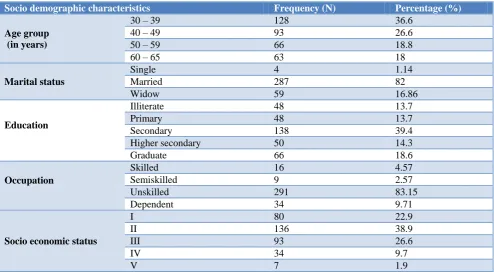
Socio-demographic characteristics of respondents
participants. 128 (36.6%) of the respondents were within the age group of 30-39 years. Out of the total respondents, 287 (82%) were married. Regarding educational status, 138 (39.4%) women were educated up
to secondary level and 48 (13.7%) were illiterates. 83.15% of them were unskilled workers. Majority (38.9%) of women belonged to social class II according to modified BG Prasad scale.
Table 1: Socio demographic characteristics of study participants (n=350).
Socio demographic characteristics Frequency (N) Percentage (%)
Age group (in years)
30 – 39 128 36.6
40 – 49 93 26.6
50 – 59 66 18.8
60 – 65 63 18
Marital status
Single 4 1.14
Married 287 82
Widow 59 16.86
Education
Illiterate 48 13.7
Primary 48 13.7
Secondary 138 39.4
Higher secondary 50 14.3
Graduate 66 18.6
Occupation
Skilled 16 4.57
Semiskilled 9 2.57
Unskilled 291 83.15
Dependent 34 9.71
Socio economic status
I 80 22.9
II 136 38.9
III 93 26.6
IV 34 9.7
V 7 1.9
Table 2: Distribution of study population based on UI type.
Type of UI Frequency (N) Percentage (%)
Stress incontinence 54 52.43
Urge incontinence 30 29.12
Mixed incontinence 19 18.45
Total 103 100
Table 3: Distribution of study population according to severity of UI.
Severity of UI Frequency
(n=103) Percentage (%)
Duration in years
<5 40 38.84
5 – 10 45 43.68
>10 18 17.48
Total 103 100
Amount of leakage
Mild 70 67.96
Moderate 31 30.09
Severe 2 1.95
Scoring for Impact on daily life
1 – 3 13 12.6
4 – 6 43 41.9
7 – 9 42 40.6
10 5 4.9
Prevalence and severity of UI
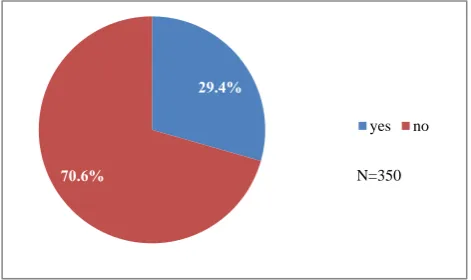
Out of 350 participants, 103 (29.4%) of the women had UI (Figure 1). Stress incontinence was the most common
43.68% had symptoms for a period of 5-10 years. Majority (67.96%) were suffering from mild UI. 41.9% of them had moderate impact on daily life due to UI.
Figure 1: Distribution of study population based on the presence of UI.
Out of 350 women, 103(29.4%) had urinary incontinence.
DISCUSSION
The prevalence of Urinary incontinence in this study was 29.4%. This finding is almost similar to studies done in pondicherry and West Bengal which reported a prevalence of 34.1% and 27.7% respectively.4,6 But few studies done in India reported a low prevalence rate. Studies done by Bodhare et al in Andhra Pradesh and by Agarwal et al in Uttar pradesh reported a prevalence of 10% and 12% respectively.2,7 This variation in prevalence may due to difference in survey methods, level of education of study participants, sample size, difference in definition used in the study and duration of study.
In the present study, stress incontinence was the most common type (52.43%) followed by urge incontinence (29.12%) and mixed incontinence (18.45%). This finding was in accordance to studies done by Sankarasubbu in Chennai, Biswas et al in West Bengal and Uma singh et al in Lucknow.4,8,9 But, in contrast, a study conducted by Agarwal et al in Uttar Pradesh found that urge UI was more prevalent followed by mixed and stress UI.2 Study done by Kocak et al in Turkey and by Ahmed et al in Irag reported that mixed UI was more common compared to stress UI and urge UI.10,11
Women are at a higher risk of developing urinary incontinence compared to men of the same age group.12 Among women, the risk of UI increases with age. This can be attributed to progressive senile loss of muscle tone causing abnormality in detrusor contractility and urinary sphincters, changes in hormone levels and repeated genital tract injuries during parturition. A study done by Danforth et al found that urinary incontinence affects 7% of women in 20 to 39 years of age, 17% of women in 40 to 59 years of age, 23% of women in 60 to 79 years of age and 32% of women more than 80 years of age.9 Similarly, in this study, majority (57.1%) of women with UI were in the age group of 60-65 years.
Urinary incontinence was more common women with low educational status. Similar results were reported in studies done by Seshan et al in Coimbatore, Saadia in Saudi and Wu et al in United States.3,12,13 High prevalence among women with lower level of education can be attributed to lack of general information about this condition and inadequate hygiene. Women with a higher educational level have a better lifestyle and greater awareness to seek medical help early if they develop symptoms.
In this study, majority (52.9%) of women with UI were sedentary workers. This is similar to the finding by Aniuliene et al.12 Another study done by Liu et al in china found that UI was common among women who lack physical exercise.14
In this study, majority (43.68%) of women had symptoms for a period of 5-10 years and 38.84% of women had symptoms for a period of less than five years. About 67.96% of women were suffering from mild UI and 41.9% of them had moderate impact on daily life due to UI. The above findings shows that most of them had tolerated this problem for long time. This might be due to embarrassment and shyness to consult a doctor. Awareness has to be created among women about the importance of getting treated early to prevent medical and psychological morbidity.
Considering the limitations of the present study, as the findings were based on self-report of the participants there might be chance for recall bias.
CONCLUSION
Urinary incontinence is a significant health problem in the community. Estimating the prevalence can help us to identify the disease burden and thereby necessary steps can be taken for prevention and early treatment. The prevalence of urinary incontinence was found to be 29.4%. Among the various types of UI, stress incontinence (52.43%) was most common followed by urge and mixed incontinence. 43.68% had symptoms for a period of 5-10 years and (67.96%) were suffering from mild UI. 41.9% of them had moderate impact on daily life due to UI.
Funding: No funding sources Conflict of interest: None declared
Ethical approval: The study was approved by the Institutional Ethics Committee
REFERENCES
1. Komeilifar RM, Javadifar NP, Afshari PM, Haghighizade MHM, Honarmandpour AM. The Prevalence, Subtypes and Obstetric Risk Factors of Urinary Incontinence in Reproductive Age Women Referred to Community Health Care Centers of
29.4%
70.6%
yes no
Dezful, Iran- 2015. Int J community based Nurs midwifery. 2017;5(3):275–83.
2. Agarwal BK, Agarwal N. Urinary incontinence: prevalence, risk factors, impact on quality of life and treatment seeking behaviour among middle aged women. Int Surg J. 2017;4(6):1953.
3. V. S. Self-reported urinary incontinence and factors associated with symptom severity in community dwelling adult women: Implications for women’s health promotion. BMC Women's Health. 201313:16.
4. Mangla M, Singla D. Gestational Gigantomastia: A sistematic review of case reports. J Midlife Health. 2017;8(4):40–4.
5. Aoki Y, Brown HW, Brubaker L, Cornu J-N, Daly JO, Cartwright R. Urinary incontinence in women. Nat Rev Dis Prim. 2017;3:17042.
6. Poomalar GK, Priyadharshini M. Prevalence of urinary incontinence in reproductive women and its impact on quality of life. Int J Reprod Contraception Obstet Gynecol. 2015;4(5):1353–8.
7. Bodhare T, Valsangkar S, Bele S. An epidemiological study of urinary incontinence and its impact on quality of life among women aged 35 years and above in a rural area. Indian J Urol. 2010;26(3):353.
8. Selvakumari S. A study on detection of prevalence of dengue, chikungunya, Leptospirosis and their coinfection in acute febrile patients. Univ J Pre Para Clin Sci Leptospirosis Their Coinfection In Acute Febrile Patients. 2018;4(1):1–4.
9. Singh U, Agarwal P, Verma M, Dalela D, Singh N, Shankhwar P. Prevalence and risk factors of urinary incontinence in Indian women: A hospital-based survey. Indian J Urol. 2013;29(1):31.
10. Ahmed HM, Osman VA, Al-Alaf SK, Al-Tawil NG. Prevalence of urinary incontinence and probable risk factors in a sample of Kurdish women. Sultan Qaboos Univ Med J. 2013;13(2):269–74.
11. Kocak I, Okyay P, Dundar M, Erol H, Beser E. Female urinary incontinence in the west of Turkey: Prevalence, risk factors and impact on quality of life. Eur Urol. 2005;48(4):634–41.
12. Aniuliene R, Aniulis P, Steibliene V. Risk factors and types of urinary incontinence among middle-aged and older male and female primary care patients in Kaunas region of Lithuania: Cross sectional study. Urol J. 2016;13(1):2552–61. 13. Saadia Z. Effect of Age, Educational Status, Parity
and BMI on Development of Urinary Incontinence - a Cross Sectional Study in Saudi Population. Mater Sociomed. 2015;27(4):251–4.
14. Liu B, Wang L, Huang S-S, Wu Q, Wu D-L. Prevalence and risk factors of urinary incontinence among Chinese women in Shanghai. Int J Clin Exp Med. 2014;7:686–96.