Original Research Article
Psychological well-being and substance abuse among adolescents
(13 to 19 years) in Central Kerala
Rajalakshmy Aiyappan
1, Sherin Billy Abraham
1*, Aneeta Veronica Mary
2,
Amritalakshmy K. J.
2, An Rahael V.
2, Anagha K. U.
2, Vijay Lal
3, Rajeev Aravindakshan
1INTRODUCTION
One-fifth of the Indian population constitutes the adolescent group, belonging to 10-19 years age-group. Adolescence is a precarious phase of life where changes in physical, emotional, social and spiritual aspects occur
in order to develop individuality, attain skills and capability for abstract reasoning which finally forms a foundation for their better quality of life and health.1 It is during this period that they are being influenced by various environmental or social factors including their family, peer groups, school, neighbourhood, media portrayals and advertisements which in turn motivates
ABSTRACT
Background: Adolescence is a developmental phase between childhood and adulthood, a period where one gains a desire of intimacy and increased responsibilities. Based on their interaction with family and society, adolescents develop positive outcomes such as getting involved in healthy behaviour and negative outcomes such as depression and substance abuse. The objectives of the study were to determine the prevalence of poor psychological well-being and substance abuse among adolescents (13 to 19 years) in Central Kerala, and to assess the role of substance abuse in psychological well-being in adolescents.
Methods: A cross sectional study was conducted among 300 secondary and higher secondary school students in three government aided institutions in Central Kerala. All students available in the school at the time of the study formed the inclusion criteria; however, 10th standard students were excluded. Data on basic demographic variables were collected. General Health Questionnaire and Adolescent Alcohol Drug Involvement Scale (AADIS) were used to collect information on psychological wellbeing and alcohol use. The data were entered and analysed using standard statistical package. For significance testing, Chi square test was carried out.
Results: Mean age was 14.49 years with a standard deviation of 1.31. Males were 64.5% and 82.6% belonged to nuclear family. Psychological wellbeing was significantly better in males compared to females (p=0.025). Males (7.6%) and females (4.3%) were found to be using alcohol by AADIS questionnaire. Those who were not under the influence of alcohol had better well-being when compared to those who consumed alcohol (p=0.0016).
Conclusions: Prevalence of poor psychological wellbeing and substance abuse among adolescents was 7.8% and 6.4% respectively. Females were more emotionally unstable than males. Substance abuse cause further deterioration of mental function in adolescents.
Keywords: Adolescents, Substance abuse, Psychological wellbeing, Alcohol use, Well-being
1
Department of Community Medicine, 3Department of Psychiatry, Pushpagiri Institute of Medical Sciences and Research Centre, Thiruvalla, Pathanamthitta, Kerala, India
2Pushpagiri Institute of Medical Sciences and Research Centre, Thiruvalla, Pathanamthitta, Kerala, India
Received: 18 July 2018
Revised: 27 August 2018
Accepted: 27 August 2018
*Correspondence:
Dr. Sherin Billy Abraham,
E-mail: [email protected]
Copyright: © the author(s), publisher and licensee Medip Academy. This is an open-access article distributed under the terms of the Creative Commons Attribution Non-Commercial License, which permits unrestricted non-commercial use, distribution, and reproduction in any medium, provided the original work is properly cited.
them to adopt healthy behaviours or high risk behaviours such as getting involved in alcohol, drugs, tobacco, opioid and heroin which comes under the common term “substance abuse”.2,3
Globally, alcohol and substance use among youth have emerged as a serious issue of concern resulting in a pattern of deceit and irresponsible behaviour.3 According to Jayasoorya et al, lifetime usage of alcohol among adolescents was 15 percent.4 The proportion (20.9%) of students in whom substance abuse was maximum belonged to 16-19 year age group followed by 14-15 years (18.7%) and minimum in 10-13 year age group (4.8%) according to Ahmad et al.5 Many studies have demonstrated that the family members constitute the role models for their children in inculcating this unhealthy behaviour thereby resulting in poor quality of life.6,7 A study on youth and drugs state that they initiate this habit on experimental basis, for enjoyment and out of curiosity.8
Psychological health is defined as a “state of being in which a student is balanced both emotionally and intellectually” (Zulkefly and Baharudin). During the transitional phase from adolescence to adulthood, youth are susceptible to experience mental illness during this major phase of development. A psychologically sound student will have the capacity to think clearly, develop socially and to learn new skills without any difficulty.9 The distinguished negative effects among adolescents who consume alcohol included higher rates of psychological distress, anxiety and depression, suicidal tendencies and sexual abuse.10 Less than a third (30%) of India’s population is under the influence of alcohol as of 2010. The individual per capita consumption of alcohol above 15 years in the country increased to 6.2 litres during 2014 and Kerala is one of the states that stood in the forefront when it comes to alcohol consumption.11,12 Keeping these in mind, we felt the need to estimate the prevalence of poor psychological well-being and substance abuse among high school children was mandatory.
METHODS
Study design, site and study population
A cross sectional study was conducted among high school students belonging to classes of 8th, 9th, 11th and 12th standards of three government aided institutions for a period of two months from September 2016 to October 2016 in Central Kerala. Out of the 58 government aided schools13 in the study universe; three were selected by lottery method.
Inclusion criteria
All the high school students belonging to 13 to 19 years age group, who were available at the time of study and consented to participate, were included in study.
Exclusion criteria
10th standard students were excluded since they were approaching their high school certificate examination.
Study tools
In this study, substance abuse refers to only alcohol use. A self-administered questionnaire was administered by the final year part 1 medical students who were trained beforehand by the investigators. Participants were asked to answer the questions with regards to the last six months.
The first section of questionnaire contained general information like age, gender, type of family and section two contained a standard questionnaire (GHQ) to assess the psychological wellbeing and the third section being another structured validated questionnaire (AADIS) to assess the alcohol use in adolescents. These were chosen after consulting with the clinical psychologist of our institution.
General health questionnaire (GHQ) is a twelve-item questionnaire to assess the psychological wellbeing in adolescents. The scores were summed up by adding all the items on the scale and were classified on the basis of cut-off which was roughly estimated as the mean GHQ score for a population of respondents.9 In this study, psychological wellbeing was classified as poor, moderate and good by choosing the simple Likert scale of 0-1-2-3 for items rather than the (0-0-1-1) scheme and was coded as poor when scores ranged from 0 to 12, moderate (score between 13 and 24) and good psychological well-being when the scores were 25 to 36.
AADIS (Adolescent alcohol and drug involvement scale):
This tool reflects expert opinion on symptoms, problems and consequences of alcohol use. This questionnaire consists of two parts one being history related to drug use and the other part containing a 14 item questionnaire where each question contains 4 options and scores were obtained by adding the weights associated with the highest category circled in each item 1-14 and it is interpreted as,
0= no alcohol or other drug use
1-36=alcohol and/or other drug use present, does not reach threshold for substance use disorder based on DSM-IV criteria.
37 or higher=alcohol and/or other drug use present; full assessment is indicated.13,14
Data analysis
Data were entered in MS Excel 2010 and analysed using a statistical package after data cleaning and coding. The categorical variables were expressed in percentages. The Chi-square test was used to test for association between categorical variables and the outcomes and ANCOVA was used to find the association between psychological well-being and alcohol use considering age as covariate. P<0.05 was considered as statistically significant.
Ethical considerations
Ethical approval was obtained from the Institutional Ethics Committee prior to the study. Informed consent from the participants and permissions from the concerned authorities of the selected schools were also obtained.
RESULTS
The mean age of 265 students who consented to participate out of 300 was 14.49 years (±1.315). Among the study participants, 94 (35.5%) were females and 171 (64.5%) were males and 219 (82.6%) belonged to nuclear families. Males had better psychological wellbeing compared to females which was statistically significant (Table 1).
Table 1: Relation of gender with psychological well-being.
Well-being Females
No. (%)
Males No. (%)
Poor 12 (12.8) 8 (4.7)
Moderate 44 (46.8) 73 (42.7)
Better 38 (40.4) 90 (52.6)
Total 94 (100) 171 (100)
Chi square =7.36, p=0.025
The prevalence of alcohol use was found to be 7.6% among males and 4.3% among females. Overall prevalence of alcohol use was observed to be 6.4% (Table 2).
Table 2: Relation of gender with alcohol use
AADIS score Female
No. (%)
Male No. (%)
Non user 90 (95.7) 158 (92.4)
Alcohol user 4 (4.3) 13 (7.6)
Total 94 (100) 171(100)
Chi square=1.51, p=0.47.
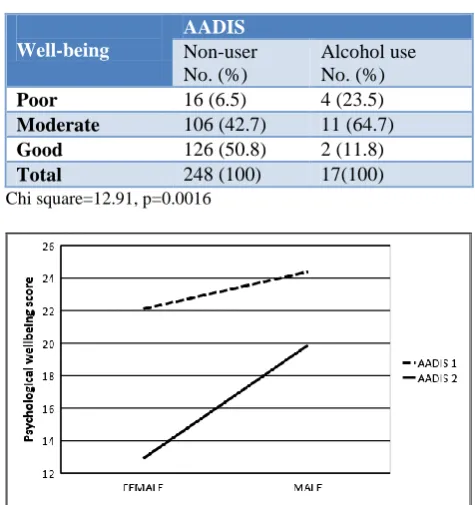
Alcohol use and psychological wellbeing had significant relation with each other that those who were not consuming alcohol had “good” wellbeing compared to those who consumed alcohol. Out of 248 non users, 50.8% had good wellbeing whereas out of 17 alcohol users that we found out in our study population, only 2
were having good psychological wellbeing whereas majority fell under moderate psychological well-being (64.7%) (Table 3).
Table 3: Relation with psychological wellbeing and alcohol use.
Well-being
AADIS
Non-user No. (%)
Alcohol use No. (%)
Poor 16 (6.5) 4 (23.5)
Moderate 106 (42.7) 11 (64.7)
Good 126 (50.8) 2 (11.8)
Total 248 (100) 17(100)
Chi square=12.91, p=0.0016
Figure 1: Line diagram indicating combined influence of substance use and psychological wellbeing on gender (evaluated at age=14.49 years) by ANCOVA.
We found that females were comparatively more emotionally unstable than males and alcohol use had an impact on their wellbeing (Figure 1).
DISCUSSION
alcohol use and males 7.6%. The reported adult proportion of substance abuse has a greater value among the males (79.84%).16 We found that females were comparatively more emotionally unstable than males and alcohol use further deteriorated their wellbeing. There was further deterioration in the wellbeing of females who were consuming alcohol which was well supported in another study, where girls were more likely than boys to report emotional problems and hyperactivity related to weekly alcohol drinking.17 It has been highlighted in a study that those having higher education and good family support dropped out of substance use highlighting ways of reducing substance abuse.18 Effective measures are required to encourage shaping the attitude of school children toward self-confidence and adequacy, as also to prevent risk behaviour among adolescents. There is a need to initiate necessary educational programs for addressing issues such as peer pressure, finding healthy avenues to feel good about oneself, family history of substance and family values related to substance use behaviours among the adolescents before the age of 15 years along with consistent, regular reminders on the negative impact of substances on health.3
CONCLUSION
The prevalence of adolescents with poor psychological wellbeing was 7.8% (12.8% among females and 4.7% among males). The prevalence of adolescents with moderate psychological wellbeing was 44.1% whereas that of good wellbeing was 47.1%. The pooled prevalence of substance abuse was 6.4%. Prevalence of the same among males was 7.6% and 4.3% for females. It was found that females were more emotionally unstable than males and substance abuse caused further deterioration in their wellbeing.
There was significant association between alcohol use and psychological wellbeing. Hence, there is a need for spreading awareness among adolescents about the outcomes of substance use. It still remains a question whether they are involved in these activities after gaining adequate knowledge about substance use, its harmful effects and consequences. If so, that requires further investigation to find out what all will be the reasons behind that.
Limitations
Due to ethical and temporal reasons, we could not collect data regarding the socioeconomic aspects and about the role of household members which might have shown significant relation between alcohol habits and family. The results were analysed according to a self-reported questionnaire so chances of under reporting and over reporting may be possible. Hence a detailed assessment is necessary regarding the factors responsible for the initiation of alcohol use.
ACKNOWLEDGEMENTS
We would like to extend our sincere gratitude to Dr. Joice Geo, Assistant Professor of Psychiatry for her guidance in our study. We would also like to thank our biostatistician Mrs. Nisha Kurian who helped us with analysis.
Funding: No funding sources Conflict of interest: None declared
Ethical approval: The study was approved by the Institutional Ethics Committee
REFERENCES
1. Sunitha S, Gururaj G. Health behaviours & problems among young people in India: Cause for concern & call for action. Indian J Med Res. 2014;140(2):185–208.
2. Ramadass S, Gupta SK, Nongkynrih B. Adolescent health in urban India. J Fam Med Prim Care. 2017;6(3):468–76.
3. Gopiram P, Kishore MT. Psychosocial Attributes of Substance Abuse Among Adolescents and Young Adults: A Comparative Study of Users and Non-users. Indian J Psychol Med. 2014;36(1):58–61. 4. Jaisoorya TS, Beena KV, Beena M, Ellangovan K,
Jose DC, Thennarasu K, et al. Prevalence and correlates of alcohol use among adolescents attending school in Kerala, India. Drug Alcohol Rev. 2016;35(5):523–9.
5. Ahmad A, Khalique N, Khan Z, Amir A. Prevalence of psychosocial problems among school going male
adolescents. Indian J Community Med.
2007;32(3):219.
6. 6. Ljubotina D, Galić J, Jukić V. Prevalence and risk factors of substance use among urban adolescents: questionnaire study. Croat Med J. 2004;45(1):88– 98.
7. Tsering D, Pal R. Role of family and peers in initiation and continuation of substance use. Indian J Psychol Med. 2009;31(1):30-4.
8. Tsering D, Pal R, Dasgupta A. Licit and illicit substance use by adolescent students in eastern India: Prevalence and associated risk factors. J Neurosci Rural Pract. 2010;1(2):76–81.
9. Zulkefly SN, Baharudin R. Using the 12-item General Health Questionnaire (GHQ-12) to assess the psychological health of Malaysian college students. Glob J Health Sci. 2010;2(1):73.
10. The Effects of Alcohol Abuse on Teens. 2009. Available at: https://casapalmera.com/blog/the-effects-of-alcohol-abuse-on-teens/. Accessed on 20 February 2018.
12. Alcohol Consumption in India - An Infographic | My India. Available at: https://www.mapsofindia. com/my-india/india/alcohol-consumption-in-india. Accessed on 20 February 2018.
13. Aided Schools. Available at: http://thrissur education.com/showcontent.php?cid=28. Accessed on 20 February 2018.
14. AADIS/ADIS Scale, Evaluation Research,
Programs, UWPHI. Available at: https://uwphi.pop health.wisc.edu/programs/evaluation-research/ adis.htm. Accessed on 23 February 2018.
15. Jayakrishnan R, Geetha S, Mohanan Nair JKKP, Thomas G, Sebastian P. Tobacco and Alcohol Use and the Impact of School Based Antitobacco Education for Knowledge Enhancement among Adolescent Students of Rural Kerala, India. J Addict. 2016;2016:9570517.
16. Dadwani R, Thomas T. Prevalence of substance abuse: a community based study. Int J Community Med Public Health. 2016;647–50.
17. Huang R, Ho SY, Wang MP, Lo WS, Lam TH. Reported alcohol drinking and mental health problems in Hong Kong Chinese adolescents. Drug Alcohol Depend. 2016;164:47–54.
18. Arya S, Gupta R, Rathee S, Rawat V. Immediate drop-out rate in adolescent substance abusers: an out-patient chart review from North India. Int J Adolesc Med Health. 2016.