Original Research Article
A cross sectional study to determine the health profile
of brick kiln workers
Rufiat N. Kazi
1, Mangala M. Bote
2*
INTRODUCTION
Work related illnesses are very common in the brick kiln workers as their job profile exposes them to adverse occupational health conditions and safety risks. Occupational hazards related to respiratory illnesses such as chronic cough, chronic phlegm and chest tightness result from exposure to high concentration of dust from the manual breaking of coal, bottom ash (present at the bottom of the kiln) and open fire during manual coal
feeding.1-3Also inappropriate working postures involved in brick making with repetitiveness of the movements at the upper limbs, insufficient recovery time makes them prone to work related musculoskeletal disorders.4-6 The fumes also tend to cause irritation of skin and eyes in these workers.7 The process of brick making involves heavy physical work in hot, humid environment, which can put the workers through considerable heat stress disorders ranging from minor discomforts (like heat rash, heat cramps) to the major life threatening conditions (like heat exhaustion, heat stroke).8 In spite of these adverse
ABSTRACT
Background: Occupational hazards involving the respiratory system, musculoskeletal system, skin and eyes are very commonly seen in the workers involved in the brick kiln industry. This study was designed to assess health profile of the brick kiln workers and to discuss sociodemographic profile affecting their health.
Methods: This was a cross sectional study. 420 workers falling into the eligibility criteria, were selected from the 65 brick kiln factories in the study area. Multi-stage cluster sampling method was used to select the brick kiln factories and the participants of the study. The responses given by the participants were entered in Microsoft Excel 2010 and analyzed using SPSS version 20. Chi Square test was used to determine the association between the morbidities and sociodemographic variables.
Results: Mean age of the workers was 35.34±10.96 years. 96.7% of the respondents were suffering from some or the other complaints, while 3.3% were not suffering from any complaints. Addiction was seen in 37.9% of the participants. Musculoskeletal complaints were the most common complaints followed by respiratory and skin complaints.
Conclusions: Health of workers is affected due to conditions they work under. The older age group had more respiratory, dermatological and ophthalmic complaints. The group of workers employed as bigaaris as well as those who were working for more than 10 years had more respiratory and dermatological complaints.
Keywords:Occupational hazards, Brick kiln workers, Health profile, Musculoskeletal problems, Occupational health
1
Indian Council of Medical Research- National Institute for Research in Reproductive Health (ICMR-NIRRH), Mumbai, Maharashtra, India
2Department of Community Medicine, T.N.M.C. and B.Y.L. Nair Hospital, Mumbai, Maharashtra, India
Received: 06 September 2019
Revised: 20 October 2019
Accepted: 05 November 2019
*Correspondence:
Dr. Mangala M. Bote,
E-mail: [email protected]
Copyright: © the author(s), publisher and licensee Medip Academy. This is an open-access article distributed under the terms of the Creative Commons Attribution Non-Commercial License, which permits unrestricted non-commercial use, distribution, and reproduction in any medium, provided the original work is properly cited.
health conditions, there is no documentation that will attract attention of public health authorities to the plight of these workers. Hence, this study was planned to document the health problems of the Brick-Kiln Workers and get an idea about the proportional morbidity amongst them. This study aims to explore and analyse the health problems of brick kiln workers and study the factors which affect them and to suggest measures pertaining to both curative and preventive aspects of occupational health.
METHODS
This was a cross sectional study carried out for a period of 10 months from December 2016 to October 2017, in the rural field practice area of Department of Community Medicine, TNMC and Nair Hospital. A previous study reports a morbidity of around 50%,which has been used for sample size determination in the study using the formula, sample size=4pq/l2.9 The calculated minimum sample size came to 400. However, we recruited 420 participants in our study to simplify the process of sample selection. Sample selection had been done using Multi-stage cluster sampling method. A Cluster was defined as assemblage of at least more than or equal to 10 labourers at a work place as reported by the in charge of the PHC and verified by the brick kiln owner. The labourers were selected from the cluster on the basis of their availability and duration of work (i.e., those involved in the brick industry for more than or equal to 6 months). In case the worker was less than 18 years or was only involved in the transportation of the brick for the purpose of distribution once the final product was made or was a casual labourer (i.e., not involved in the brick making process every year but only working for the current period when the interview was carried out, because of unemployment or financial constraints) or in case of non-response from the worker, he/she was not included in the study.
Study procedure
The study subjects were approached at the site of their settlements during their non-working hours. After having taken informed consent, the study subjects were interviewed using a semi-structured questionnaire. Post interview they were subjected to detailed examination (General and systemic) at the same site taking privacy and confidentiality into consideration. In case it was found that the participant needed medicines for their ailments, the participant was referred to the nearest PHC for the same. If during the physical examination it was felt that the participant needed additional investigations the participants were referred to the tertiary care medical college.
Ethical approval
Ethical clearance was obtained from the institutional ethics committee (date of approval 12th May 2016; Ref. No. ECARP/2015/158).
Permission was obtained from the owner of each of the brick kiln factories selected to carry out the study. Written informed consent was obtained from all the participants included in the study.
Statistical analysis
Data were entered into Microsoft Excel 2013 and analyzed using the Statistical Package for the Social Sciences (SPSS) version 20. Chi-square test was used to determine the association between the morbidities and sociodemographic variables. P<0.05 was considered to be significant.
RESULTS
Out of the 420 workers, 89.5% of the workers working in the kilns were migrants while 10.5% were locals. The workers are involved in the brick making process every year from the months of October to May.
The workers generally migrate from their native village during this season and build temporary huts at the site. Table 1 shows the sociodemographic profile of the workers.
Table 2 shows the job profile of the participants.
Table 1: Sociodemographic profile of the workers (n=420).
Socio-demographic
characteristics Frequency (%)
Age groups (years)
18-25 92 (21.9)
26-40 217 (51.7)
>40 111 (26.4)
Sex
Males 186 (44.3)
Females 234 (55.7)
Nutritional status and addictions
263 (62.6%) of the participants had normal Body mass index (BMI) while 157 (37.4%) were malnourished. Pallor was present in 247 (58.8%) of the participants. Females were more malnourished and anemic as compared to males. This was found to be significantly associated. (Chi-square=26.86; p=0.0000 and Chi- square=27.73; p=0.0000 respectively).
Table 2: Job profile of the participants (n=420).
Variable Frequency %
Job category
Paatla * 261 62.1
Mhaapa † 103 24.5
Bigarii ‡ 39 9.3
Bhatkar § 17 4.1
Years of working in the present factory
<5 254 60.5
≥5 166 39.5
Total number of years of working in the brick industry
≤5 156 37.1
6-10 150 35.7
>10 114 27.2
Are you involved in brick making every season?
Yes 401 95.5
No 19 4.5
*Paatla: Involved in the process of brick making.
†Mhaapa: Carry the bricks made by the paatla to the furnace. ‡Bigaari: Labourers involved in carrying raw materials to the paatla for the brick making, breaking stones, coal and sorting the raw materials. They also carry the baked bricks for the purpose of transportation to the vehicle.
§Bhatkar: Readying the furnace for the purpose of baking bricks.
Morbidity profile
406 (96.7%) of the respondents were suffering from some or the other complaints, while 14 (3.3%) were not
suffering from any complaints. Table 3 shows the morbidities as reported by the participants.
Table 3: Morbidities as reported by the participants.
Morbidities as reported by the
participants Frequency*
Musculoskeletal complaints 284
Respiratory complaints 115
Skin complaints 81
Heat stress 48
Fever 44
Others (urinary complaints,
menstrual disorders etc.) 38
Injuries 28
Eye complaints 18
Gastrointestinal complaints 17
Burns 3
Total complaints 676
*Frequency of morbidity is more than 420 since one participant may have more than one morbidity.
Musculoskeletal disorders
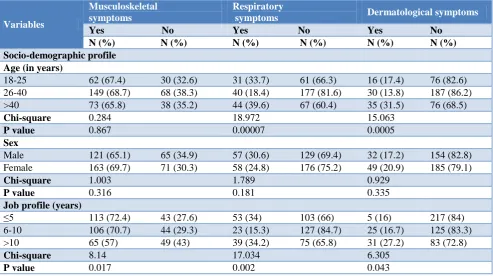
Most common musculoskeletal symptom experienced by the participants was pain in the lower back in 279 (66.4%) participants. Those who were working for less than/ equal to 5 years and 6-10 years (72.4% and 70.7%) reported more musculoskeletal symptoms as compared to those who were working for more than 10 years. This was found to be statistically significant (Table 4).
Table 4: Association between the symptoms reported by the participants and sociodemographic profile and the job profile of the participants.
Variables
Musculoskeletal symptoms
Respiratory
symptoms Dermatological symptoms
Yes No Yes No Yes No
N (%) N (%) N (%) N (%) N (%) N (%)
Socio-demographic profile
Age (in years)
18-25 62 (67.4) 30 (32.6) 31 (33.7) 61 (66.3) 16 (17.4) 76 (82.6) 26-40 149 (68.7) 68 (38.3) 40 (18.4) 177 (81.6) 30 (13.8) 187 (86.2) >40 73 (65.8) 38 (35.2) 44 (39.6) 67 (60.4) 35 (31.5) 76 (68.5)
Chi-square 0.284 18.972 15.063
P value 0.867 0.00007 0.0005
Sex
Male 121 (65.1) 65 (34.9) 57 (30.6) 129 (69.4) 32 (17.2) 154 (82.8) Female 163 (69.7) 71 (30.3) 58 (24.8) 176 (75.2) 49 (20.9) 185 (79.1)
Chi-square 1.003 1.789 0.929
P value 0.316 0.181 0.335
Job profile (years)
≤5 113 (72.4) 43 (27.6) 53 (34) 103 (66) 5 (16) 217 (84) 6-10 106 (70.7) 44 (29.3) 23 (15.3) 127 (84.7) 25 (16.7) 125 (83.3) >10 65 (57) 49 (43) 39 (34.2) 75 (65.8) 31 (27.2) 83 (72.8)
Chi-square 8.14 17.034 6.305
P value 0.017 0.002 0.043
Variables
Musculoskeletal symptoms
Respiratory
symptoms Dermatological symptoms
Yes No Yes No Yes No
N (%) N (%) N (%) N (%) N (%) N (%)
Type of work
Paatla 183 (70.1) 78 (29.9) 72 (27.6) 189 (72.4) 44 (16.9) 217 (83.1) Mhaapa 66 (64.1) 37 (35.9) 19 (18.4) 84 (81.6) 18 (17.5) 85 (82.5) Bigaari 25 (64.1) 14 (35.9) 18 (46.2) 21 (53.8) 14 (35.9) 25 (64.1) Bhatkar 10 (58.8) 7 (41.2) 6 (35.3) 11 (64.7) 5 (29.4) 12 (70.6)
Chi-square 2.153 11.58 9.238
P value 0.541 0.008 0.026
Respiratory disorders
Most commonly experienced respiratory symptom was cough in 103 (24.5%) participants followed by coryza in 67 (15.9%). Significant association was seen between respiratory complaints and age, years of work of the worker and type of work done by the participants, where workers more than 40 years of age, those working for more than 10 years at the brick kilns and bigaaris showed respiratory symptoms more as compared to the other categories of workers and this was found to be statistically significant (Table 4).
Dermatological disorders
Itching over hands and feet was the commonest dermatological symptom in 44 (10.5%) workers. Those in the elder age groups reported more symptoms as compared to those in the younger age groups (Table 4).
Gastrointestinal disorders
Also, gastrointestinal disorders (GI) complaints like diarrhea and dysentery were found in those with bad personal hygiene as compared to those with good personal hygiene. This was found to statistically significant (Chi-square=6.381; p=0.012).
DISCUSSION
Mean age of the workers was 35.34 years. Around 74.2% of the respondents were found to be in the younger age group and were less than 40 years (Table 1). From moulding to carrying the finished products all operations have to be carried manually by the workers. This could be the reason for employing manpower in their youthful and physically agile age. This was similar to the findings of study done by John et al.10
Illiteracy was highly rampant amongst these workers. Most of the tribal children as was noted in the study area were enrolled in schools or anganwadis in their native village. However as they migrate for work to the kilns they drop out of school. This cycle continues leaving the child with incomplete education and ultimately the child drops out of school.
96.7% of our workers had some morbidity. 3.3% said they did not have any complaints. 59% was reported in a study done in South India.11 In a study done in Ahmedabad more than 50% morbidity was reported.9 The high prevalence of morbidity in our study could be due to broad definition of symptoms which were considered as morbidity and included in our study.
In our study significant 37.4% were underweight which is similar to 31% in a study.11 58.1% of our respondents showed pallor which reflects their poverty and low socioeconomic status (Table 3). 37.9% showed some form of addiction like smoking, chewing tobacco etc. Physiological and psychosocial stress behaviours such as long working hours without adequate rest, low wages, job insecurity and bullying by superiors contributing to stress among brick workers could lead to addictions.
Musculoskeletal disorders
In our study it was found that those who were working for less than 5 years were more prone to develop musculoskeletal symptoms and this was found to be statistically significant (Table 4). In a study done in South India, chronic low back pain was found to be statistically significant in those who worked for more than 10 years. The results in our study can be explained by Heuer et al, who found that musculoskeletal complaints among bricklayers decreased with the length of employment. Further investigation revealed this was most likely due to a “healthy worker effect” where individuals’ susceptible to musculoskeletal complaints leave the trade, leaving their more resilient colleagues in the workforce. This is an important phenomenon to be considered while attempting to assess morbidity among the workers in the unorganized sector.5
A study done to identify ergonomic hazards in brick factory of Faizabad district, concluded that improper designing of tools, workplace, and manual material handling, lifting and lowering the load were responsible for the various musculoskeletal problems. In order to minimize the ergonomic risk factors in the workplace and benefit the workers to improve health and productivity, it made recommendations like providing mechanical aids (e.g., arm and wrist rests) for employees that do repetitive work, incorporating task rotation, modifying the work load required of the individual in a particular time frame, etc.6
Respiratory disorders
Next to smoking, occupational risk factors are a major cause of chronic respiratory illnesses and account for 13% of COPD, 11% of asthma and almost all cases of silicosis, asbestosis and pneumoconiosis worldwide. A study by Sheta et al showed a significant higher prevalence of chronic respiratory problems in brick kiln workers compared to control group.2
26.4% of the study subjects interviewed were suffering from Respiratory complaints. This was similar to a study done in South India which reported 27% of the respondents to have respiratory complaints like acute cough, chronic cough, rhinitis, sore throat etc.11
A study done on brick manufacturing workers in Croatia shows that there is a significantly higher prevalence of respiratory symptoms such as chronic cough (31.8%), chronic phlegm (26.2%) and chest tightness (24%) in exposed workers as compared to control workers. (20.1%, 18.1% and 0%) respectively.12 In another study in Pakistan, 22.4% suffered from chronic cough.1 Epidemiological studies done in different places around the world have found evidence that increase in rate of bronchitis, asthma; decrease lung function are linked with deteriorating ambient air quality at brick kilns.13
Myer et al identified the various factors which could possibly lead to the respiratory complaints.14 He found
that work conditions in brick kilns were rather dusty with much pollution from coal fires in the kilns and from clay used for bricks making. There is also the risk of exposure to dust from bottom ash spread on the kiln and additionally during manual breaking of coal. They are exposed to high concentrations of respirable suspended particulate matters (RSPM), during monitoring and regulating the fire, as the furnace chamber is covered with ash during the kiln unloading and shipping process.15 In our study, the elder age group reported respiratory complaints more as compared to the younger age groups (Table 4). This was similar to a study done in Pakistan.1 These findings are understandable as lung function starts declining progressively after 20–25 years.16
Those who were working for more than 5 years were more prone to develop respiratory symptoms (Table 4). This was similar to a study which showed significant high prevalence of respiratory problems among brick kiln workers especially the bakers, smokers, and those >10 years work duration.2
Those working as bigaaris reported more of respiratory symptoms (Table 4). This could be because the bigaaris are more exposed to the raw materials and the dust generated while handling them, as compared to the other workers. However, no statistically significant difference in the respiratory morbidity was found between workers of different job categories in another study.11
Dermatological disorders
Navya et al reported 12% of the respondents having skin problems like itching and rash.11 The older age group was more likely to develop dermatological complaints as compared to the younger age groups (Table 4). As people age, their chances of developing skin-related disorders increase. Two types of skin aging exist, which may be divided into intrinsic aging, which includes those changes that are due to normal maturity and occur in all individuals, and extrinsic aging, produced by extrinsic factors such as ultraviolet light exposure, smoking, and environmental pollutants.17 In our study both factors seem to play a role. Bigaaris in our study reported more of dermalogical complaints (Table 4). Inspite of an extensive literature search we could not find any studies that could help us understand this phenomenon. More studies need to be done to record epidemiological data among the Brick Kiln workers to understand the nature of their dermatological morbidity.
Gastrointestinal disorder
work, washing hands after visiting the toilet, bathing every day, cutting the nails regularly and changing clothes everyday) was found to be significantly associated with the symptoms. Poor sanitary facilities and polluted drinking water has been attributed to GIT symptoms like diarrhea and dysentery. A study in Iran done during an outbreak of diarrhoeal diseases in the brick kiln factories points that low education and their lifestyle is responsible for their disease outbreak.19
CONCLUSION
Low literacy levels and lack of vocational job skills could be the prime reason for migration of the workers and them taking up unskilled and low paying jobs like working in the kilns. Apparently, the definite income at the kilns seemed to be an attraction for them, compelling the workers to migrate every year from October to May, to the brick kiln, builds temporary houses and work for 15-16 hours, under degrading working conditions with poor wages and job insecurity. Their health is affected due to conditions they work under. Necessary administrative controls in the brick kilns by the employers like fixed timing on the job to reduce cumulative exposure to toxicants, job rotations, adjusting workstations, providing personal protective equipment for the workers and installing proper hygiene and water facilities will help improve the conditions they work under.
Strengths of the study
The present study is unique in nature as it comprehensively helps identify the health problems and the factors associated with them in the brick kiln workers of rural Maharashtra which has not been explored in detail in the past.
Limitations of the study
Since the study was restricted only to a rural Maharashtra, the socio-economic and socio demographic characteristics of the workers may be different in other parts of the country. The evidence generated by this study needs to be further strengthened by conducting a more objective research on a larger scale, along with a qualitative aspect which can provide an effective foundation for probing the relevant findings further.
ACKNOWLEDGEMENTS
We thank the study participants for their full cooperation during the study.
Funding: No funding sources Conflict of interest: None declared
Ethical approval: The study was approved by the Institutional Ethics Committee
REFERENCES
1. Shaikh S, Nafees AA, Khetpal V, Jamali AA, Arain AM, Yousuf A. Respiratory symptoms and illnesses among brick kiln workers: a cross sectional study from rural districts of Pakistan. BMC Public Health. 2012;12(1):999.
2. Sheta S, El Laithy N. Brick kiln industry and workers’ chronic respiratory health problems in mit ghamr district, dakahlia governorate. Egyptian J Occup Med. 2015;39(1):37-51.
3. Zuskin E, Mustajbegovic J, Schachter EN, Kern J, Doko-Jelinic J, Godnic-Cvar J. Respiratory findings in workers employed in the brick-manufacturing industry. J Occup Environ Med. 1998;40(9):814-20. 4. Bijetri B, Sen D. Occupational stress among women
moulders: a study in manual brick manufacturing industry of West Bengal. Int J Scienti Res Public. 2014;4(6):4-16.
5. Inbaraj LR, Haebar OJ, Saj F, Dawson S, Paul P, Prabhakar AK, et al. Prevalence of musculoskeletal disorders among brick kiln workers in rural Southern India. Indian J Occup Environ Med. 2013;17(2):71.
6. Pandey K, Vats A. Ergonomic hazard identification of workers engaged in brick making factories. J Appl Nat Sci. 2013;5(2):297-301.
7. Sanjel S, Khanal SN, Thygerson SM, Khanal K, Pun Z, Tamang S, et al. Airborne particulate matter and health condition in brick kiln workers in Kathmandu Valley, Nepal. Kathmandu Univ Med J. 2016;14(54):159-66.
8. Rastogi SK. Enironmental factors and physiological strain in workers employed in brick kilns. Indian Indian J Occup Environ Med. 2002;6(2):66-70. 9. Rajesh M, Niraj P. Morbidity profile of brick kiln
workers around Ahmedabad city, Gujarat. Healthline. J Indian Assoc Prev Soc Med. 2010;1(1):55-9.
10. John J, Ateeq N. Migrant Labour in the Brick Kilns of Punjab. Working Paper, Center for Education and Communication (CEC), New Delhi, 1998. Available from: www.cec-india.org/archs/Migrant-Labour-in-the-Brick-Kiln-Labourin-Punjab-1998.pdf.
Accessed on 4 August 2018.
11. Navya CJ, Shanbhag D, Naveen R, Swathi S, Laviena M, Krupa T. Morbidity Profile of Workers in Brick Kilns under a Gram Panchayat, South India. Ntl J Community Med. 2017;8(3):104- 8.
12. Zuskin E, Mustajbegovic J, Schachter EN, Kern J, Doko-Jelinic J, Godnic-Cvar J. Respiratory findings in workers employed in the brick-manufacturing industry. J Occup Environ Med. 1998;40(9):814-20. 13. Fingerhut MA, Nelson DI, Driscoll T, Concha-Barrientos MA, Steenland KY, Punnett LA, et al. The contribution of occupational risks to the global burden of disease: summary and next steps. La Medicina del lavoro. 2006;97(2):313-21.
indicators and permissible exposure limits. Scandinavian J Work Environ Health. 1989:198-202.
15. Monga V, Singh LP, Bhardwaj A, Singh H. Respiratory health in brick kiln workers. Int J Phys Soc Sci. 2012;2(4):226-44.
16. Sharma G, Goodwin J. Effect of aging on respiratory system physiology and immunology. Clin Interven Aging. 2006;1(3):253.
17. Norman RA. Review Common Skin Conditions In Geriatric Dermatology. Annals of long term care. 2008;16(6):40.
18. Shewale A, Acharya S, Shinde RR. Nutritional and morbidity profile of brick kiln workers in Sakwar, tribal area of Thane district. Med J Western India. 2013;41(1):27-9.
19. Riabi HR, Ahmadi R, Atarodi A. Correlation between some risk factors and the incidence of diarrhea outbreak in Kosar Industrial estate, a case-control study in 2013. Razavi Int J Med. 2015;3(1).