Original Research Article
Evidence based practice: knowledge, attitude and practice among
undergraduate and postgraduate medical students of a medical college
in North Karnataka, India
Manjula R., Anjani Kumar Srivastava*, Ashok S. Dorle
INTRODUCTION
Evidence-based practice (EBP) is the justified use of current best evidence to related clinical expertise and patient values to guide in making health care decisions.1-4 However, these practices are not always implemented in care delivery.5 Traditionally, patient safety research has focused on data analyses to identify patient safety issues and to demonstrate that a new practice will lead to
improved quality and patient safety.6 Much less research attention has been paid to how to implement practices. Yet, only by putting into practice what is learned from research will care be made safer.6 Implementing evidence-based practices are difficult and need strategies that address the complexity of systems of care, individual practitioners, and changing health care cultures to be evidence-based practice environments.6
ABSTRACT
Background: Evidence based practice (EBP) is based on the integration of the best research evidence with clinical expertise to facilitate clinical decision making. Those patients who receive evidence-based therapies have better outcomes than those who do not.Evidence-based medicine is becoming a specialty in its own right, and it's an area that medical students should pay close attention to when determining their path. The objective of the study was to assess the knowledge, attitude and practice regarding evidence based practice among the undergraduate and postgraduate students of a medical college in North Karnataka.
Methods: After obtaining ethical clearance from institutional ethical committee, this cross-sectional study was conducted in a Medical College in North Karnataka from November 2016–January 2017. All the interns and postgraduates studying in the College were included in the study. After obtaining informed consent, data was collected through pre-designed semi-structured questionnaire. Data was compiled and tabulated by using MS Excel and was analyzed.
Results: Overall, majority of the participants hold positive attitudes toward EBP but lack sufficient knowledge and skills for implementation. The main barriers to implement EBP are insufficient time to read scientific research articles and the cost to its access.
Conclusions: More focus should be given to EBP from the medical school itself, either through continuing medical education or various workshops, it can even be included in the curriculum so that all the undergraduate medical students can be sensitized to it from a very initial stage.
Keywords: Evidence based practice, Medical students, Health care decisions
Department of Community Medicine, S. Nijalingappa Medical College, Bagalkot, Karnataka, India
Received: 14 March 2018 Revised: 04 April 2018 Accepted: 05 April 2018
*Correspondence:
Dr. Anjani Kumar Srivastava,
E-mail: [email protected]
Copyright: © the author(s), publisher and licensee Medip Academy. This is an open-access article distributed under the terms of the Creative Commons Attribution Non-Commercial License, which permits unrestricted non-commercial use, distribution, and reproduction in any medium, provided the original work is properly cited.
Best evidence comes from randomized controlled trials; and from other scientific methods such as descriptive and qualitative research; as well as from case reports, scientific principles, and expert opinion. The practice should be guided by research evidences available, in conjunction with clinical expertise and patient values. In some cases, however, a sufficient research base may not be available and health care decision making is derived principally from non research evidence sources such as expert opinion and scientific principles.7 As more research is done in a specific area, the research evidence must be incorporated into the EBP.4
Little research has been done regarding the attitudes and behaviours of healthcare professionals relative to the use of evidence in practice. Evidence-based medicine is becoming a specialty nowadays, and it's an area that medical students should pay close attention to when making any health care decisions.
Objective
To assess the knowledge, attitude and practice regarding evidence based practice among the undergraduate and postgraduate students of a medical college in North Karnataka. India
METHODS
A cross-sectional study was carried out in a Medical College in North Karnataka from November 2016 to January 2017.
Sample size was calculated using open EPI software, taking confidence interval of 95%, absolute precision of 3% and prevalence of awareness about evidence based practice as 95% according to a study done by Weng et al in Taiwan, it comes out to be 203.8 A total of 208 students were interviewed in the study.
Inclusion criteria
All the interns and postgraduates studying in the College were included in the study.
Exclusion criteria
Students not willing to participate.
Students who cannot be reached on three consecutive attempts
After obtaining ethical clearance from institutional ethical committee and informed consent from study participants, data was collected through pre-designed semi-structured questionnaire.
Questionnaire included general information about the participants and items for measuring the awareness of, attitudes toward, knowledge of, barriers to, and implementation of EBP.9
The questionnaire contained 5-point Likert-type scale (1=strongly disagree, 2=disagree, 3=neutral, 4=agree, and 5=strongly agree) and multiple choice questions to assess the KAP about EBP.
Data was compiled and tabulated by using MS Excel and was analysed using proportions.
RESULTS
Study participants included 64.4% intern and 35.6% postgraduates. Majority of the participants were female (55.3%) and belonged to 20–24 years age group (59.1%). Only 1.4% participants reported that they take some formal training in evidence based practice.
About 49% of the participants mentioned that they are aware of EBP, while rest were unsure about the term EBP and its principles (Table 1).
About 50-60% of the study subjects intend to undergo formal training about EBP and its principles (Table 2 and 3).
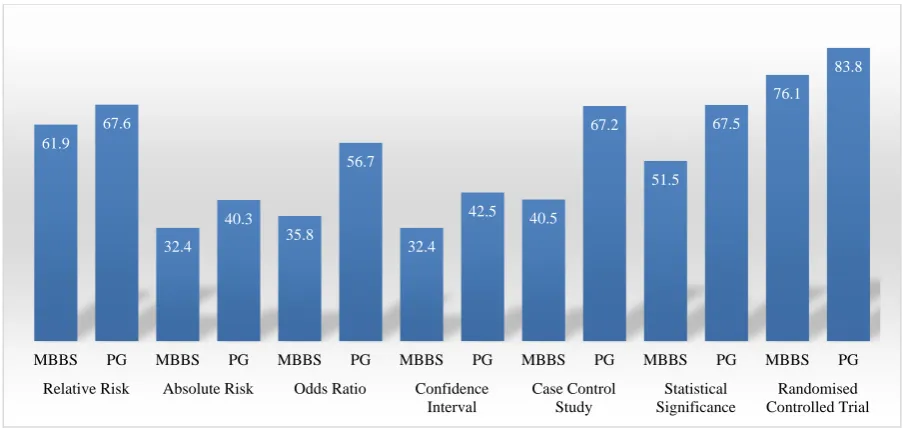
It was observed (Figure 1) that postgraduates gave more correct answers regarding some specific epidemiological terms as compared to interns.
Table 4 shows that majority of participants were found not using any sort of questionnaire that can define their patient or the intervention required to manage them. And majority of participants are not in the habit of searching electronic database or read published research reports or informally share or discuss research findings with their colleagues.
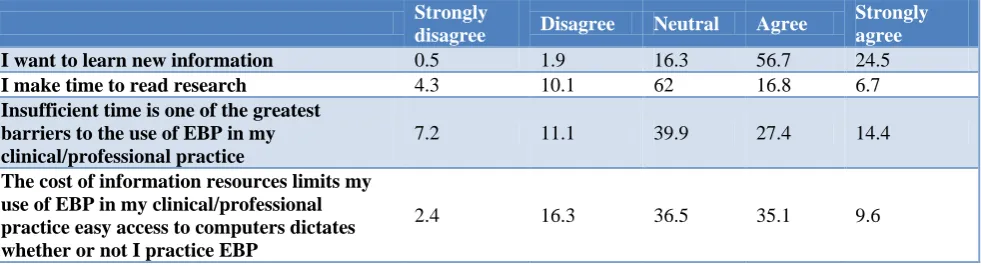
Table 5 shows that majority of participants have a desire to learn new information and researches but the main barriers they come across is insufficient time to use EBP and the cost of information resources.
Table 1: Awareness about evidence based practice.
Not true at all
Not really true
Possibly true
Quite likely true
Very true
I understand what is meant by the term EBP 3.4 5.3 42.3 25.5 23.6
I am aware of EBP in my profession 3.4 7.7 26 29.3 33.7
I am aware of current developments in EBP in
Table 2: Desire to develop knowledge and implement EBP.
No
intention at all
Unlikely to consider doing it
Could consider doing it
Highly likely to consider doing it
Absolutely intend to do it/ keep doing it
I intend to develop knowledge about EBP 0.5 1.9 38.9 32.7 26
I intend to develop skills in accessing,
acquiring and appraising evidence relevant to my area of practice
0.5 3.4 29.8 32.7 32.7
I intend to read relevant literature to update
knowledge 0 2.9 28.4 39.4 29.3
I intend to apply best available evidence
findings to improve practice 1 1.4 25 51.4 21.2
Table 3: Understanding regarding the application of EBP.
Strongly
disagree Disagree Neutral Agree
Strongly agree
Application of EBP is necessary in my work 0 1 22.6 56.7 19.7
Literature and research findings are useful in
my day-to-day work 0.5 1 16.3 63.9 18.3
I need to increase the use of evidence in my
daily work 0 3.4 16.8 69.7 10.1
I am interested in learning or improving the skills necessary to incorporate EBP into my work
0 5.3 16.3 67.8 10.6
EBP helps me make decisions about clients in
my work 0.5 4.8 20.2 64.4 10.1
Table 4: Implementation of EBP.
Never Monthly
or less Fortnightly Weekly Daily
Formulated a clearly answerable question that defines the client or problem, the intervention and outcome(s) of interest
44.2 13 14.9 21.2 6.7
Searched an electronic database 39.9 19.7 12 20.2 8.2
Integrated research evidence with your
expertise 39.9 26.4 10.1 18.8 4.8
Read published research reports 27.9 36.1 16.8 12 7.2
Informally shared and discussed
literature/research findings with others in your workplace
25 27.9 29.8 7.7 9.6
Table 5: Barriers in implementing EBP.
Strongly
disagree Disagree Neutral Agree
Strongly agree
I want to learn new information 0.5 1.9 16.3 56.7 24.5
I make time to read research 4.3 10.1 62 16.8 6.7
Insufficient time is one of the greatest barriers to the use of EBP in my clinical/professional practice
7.2 11.1 39.9 27.4 14.4
The cost of information resources limits my use of EBP in my clinical/professional practice easy access to computers dictates whether or not I practice EBP
2.4 16.3 36.5 35.1 9.6
Figure 1: Proportion of participants giving correct answers for specific epidemiological terms.
DISCUSSION
In the present study 49.1% participants were well aware about EBP while in a study done by Gupta et al in Bhopal among dentist practitioners it was 70.5%, while it was 95% in a study done by Weng et al.8,10 So we can see, though in this study almost half of the participants were aware about EBP, it was still less than some other studies, which calls for a need to introduce some workshops or maybe as a subject within the medical curriculum to expose the students more with the research activities and skills.
82.2% participants in this study agree that research findings are useful in their day-to-day work, similar to a study done by Silva et alin Brazil, where it was found in 76.5%.11
Routine access to database was done daily by just 8.2% participants in this study however it was 44.5% in the study done by Silva et al.11 This shows that there is a need to stimulate the students to make use of the available resources more frequently, so that later in life when they graduate they can make use of the knowledge gained from various researches.
Lack of time is one of the main barriers in the use of EBP (41.8%), which is similar to the study done by Majid et al 42.3%.12
Overall, most of the participants hold positive attitudes toward EBP but lack sufficient knowledge and skills for implementation.
Undergraduate curriculum especially in India is vastly based on textbooks and theoretical and students do not
Although continuing education programs are quite regular now but they tend to focus more on postgraduate students.
CONCLUSION
Therefore, it is strongly recommended that concept of EBP should be introduced into the curriculum as an integral part of continuing medical education.
ACKNOWLEDGEMENTS
The authors would like to thank the Head of the department, Department of community medicine, for his continuous support and guidance and the students who participated, for their co-operation and valuable time.
Funding: No funding sources Conflict of interest: None declared
Ethical approval: The study was approved by the Institutional Ethics Committee
REFERENCES
1. Cook D. Evidence-based critical care medicine: a potential tool for change. New Horiz. 1998;6(1):20-5.
2. Jennings BM, Loan LA. Misconceptions among nurses about evidence-based practice. J Nurs Scholarsh. 2001;33(2):121-7.
3. Sackett DL, Straus SE, Richardson WS, Rosenberg W, Haynes RB. Evidence-based medicine: how to practice and teach EBM. 2nd ed. London: Churchill-Livingstone; 2000.
4. Titler MG. Developing an evidence-based practice. 6th ed. St. Louis, MO: Mosby; 2006.
61.9 67.6
32.4 40.3
35.8 56.7
32.4
42.5 40.5 67.2
51.5 67.5
76.1 83.8
MBBS PG MBBS PG MBBS PG MBBS PG MBBS PG MBBS PG MBBS PG
Relative Risk Absolute Risk Odds Ratio Confidence
Interval
Case Control Study
Statistical Significance
5. Hughes RG. Patient safety and quality: an evidence-based handbook for nurses. Volume 1. Rockville, MD: Agency for Healthcare Research and Quality; 2008: 113.
6. Leape LL. Implementation issues. Volume 3. Rockville, MD: Agency for Healthcare Research and Quality; 2005.
7. Titler MG, Kleiber C, Steelman VJ, Rakel BA, Budreau G, Everett CLQ, et al. The Iowa model of evidence-based practice to promote quality care. Crit Care Nurs Clin North Am. 2001;13(4):497-509. 8. Weng YH, Kuo KN, Yang CY, Lo HL, Chen C, Chiu YW. Implementation of evidence-based practice across medical, nursing, pharmacological and allied healthcare professionals: a questionnaire survey in nationwide hospital settings. Implementation Sci. 2013;8:112.
9. Evidence-Based Practice Profile Questionnaire. Available at: https://static-content.springer.com/
esm/art%3A10.1186%2F1472-6920-11-100/MediaObjects/12909_2011_538_MOESM1_ES M.PDF. Accessed 5 November 2016.
10. Gupta M, Bhambal A, Saxena S, Sharva V, Bansal V, Thakur B. Awareness towards Evidence Based Dental Practice in Bhopal City. J Clin Diagnostic Res. 2015;9(8):49-54.
11. Silva TM, Costa LCM, Costa LOP. Evidence-Based Practice: a survey regarding behavior, knowledge, skills, resources, opinions and perceived barriers of Brazilian physical therapists from São Paulo state. Braz J Phys Ther. 2015;19(4):294-303.
12. Majid S, Foo S, Luyt B, Zhang X, Theng YL, Chang YK, et al. Adopting evidence-based practice in clinical decision making: nurses’ perceptions, knowledge and barriers. J Med Libr Assoc. 2011;99(3):229-36.