Original Research Article
Occupational stress and its coping strategies among the police personnel
of the Chitradurga city: a cross-sectional study
Sameeya Furmeen
1, Mayuri Reddy Reddy
2*
INTRODUCTION
Everyone relishes having a peaceful and safe society to live in. But very few pause for a minute to think about the people who indeed work hard to keep our community safe and secure. The police men have to face potentially hazardous situations that can result in physical or mental trauma or even death in the line of duty.1 In 2010 the police suicide rate in US was 11 per lakh for general public, 17 per lakh for the police and 20 per lakh for the army; whereas in India the suicide rate for 2006-07 was 7.5 per lakh for the army.2,3 The suicide rate in Maharashtra Police force was 17 per 1 lakh, while the
national average was 10.5 per 1 lakh population.4 Police in India are truly stressed a lot and it was reported that nearly 168 personnel of various departments of Mumbai police ended their lives between 2002 and 2012. A National Crime Records Bureau report shows that the bleakness extends to the entire state. Over the last five years, Maharashtra has witnessed the maximum cases (144) of suicides by police personnel in the country and had the worst figures for 2007 and 2008. Madhya Pradesh and Haryana topped the list in 2009 and 2010 respectively. The report placed Maharashtra second behind Tamil Nadu, for 2011 and 2012.5
ABSTRACT
Background: Everyone relishes having a peaceful and safe society to live in. But nobody thinks about the police who
work hard to keep our community safe and secure. They have to face potentially hazardous situations that can result in physical or mental trauma or even death in the line of duty. This study will help to reveal the stress and coping strategies employed by the police personnel of Chitradurga city. To determine the stressful situations faced by the police personnel and to ascertain the positive & negative coping strategies employed by the study participants.
Methods: A cross sectional study was conducted among the police personnel in all the five police stations in Chitradurga city for a period of one year. Complete enumeration method was used to include 282 police men and women in the study. A pre-designed, pre-structured questionnaire was used to collect the data. The analysis was done using SPSS version 20. Appropriate statistical tests were applied.
Results: The mean age of the participants was 36.13±10.33. Majority of them were males (89%), Hindus (95.4%),
graduates (49.6%), living in their own house (38.7%), hailing from a nuclear family (62.1%) and belonged to socio-economic status class I (50%) according to modified BG Prasad’s classification.
Conclusions: The stress was found to be significantly associated with work-related factors like difficulties in meeting
deadlines, insufficient personal time, inadequate family time, needing changes in the department, eagerness to go to work and job satisfaction.
Keywords: Police personnel, Health, Occupation, Stress, Coping strategies
Department of Community Medicine, 1Stanley Govt. Medical College & Hospital, Chennai, Tamil Nadu, 2Bhaskar Medical College, Hyderabad, Telangana, India
Received: 16 May 2019
Accepted: 06 July 2019
*Correspondence:
Dr. Mayuri Reddy Reddy, E-mail: [email protected]
Copyright: © the author(s), publisher and licensee Medip Academy. This is an open-access article distributed under
the terms of the Creative Commons Attribution Non-Commercial License, which permits unrestricted non-commercial use, distribution, and reproduction in any medium, provided the original work is properly cited.
All the policemen do not react similarly when facing the same situation. Something that may severely stress one person may not stress another in the same way. One might thrive if given a project deadline while another may feel all types of pressures and stressors to make the deadline. Stress can cause a multitude of problems in their professional and social life. Stress can lead to numerous sicknesses and when they bring that stress home it can cause their family to feel negative towards their job. This is just another added form of stress that they have to attempt to manage. The police is expected to jump from driving around in a patrol car to immediately diffusing someone else’s family argument or arresting a bank robber. They must be able to turn their feelings off at the flick of a switch. This also often carries over into their personal life causing them to not be able to turn their emotions back on because of the feeling of weakness or even fear. Police are trained to put these walls up around their emotions to keep from being hurt or take the things that they see on a daily basis too personally.6 Hence this study is conducted to highlight the stressful situations which the police personnel face daily and the coping strategies most commonly employed by them to tackle their stress.
Objectives
To determine the stressful situations faced by the police personnel.
To ascertain the positive and negative coping strategies employed by the study participants.
METHODS
After getting approval from the Institutional Ethics Committee, permission was obtained from the Superintendent of Police to conduct this study in all the five police stations of Chitradurga city. The data collection was done from March 2014 to February 2015 by complete enumeration. A total of 282 police personnel who were available at that time constituted the study sample. Routine roll-call was selected as the most
appropriate time to undertake the study to ensure most of the participants were present. The purpose of the study and how to respond the questions was explained to each and every participant. Informed consent was taken before they participated in the study. A structured questionnaire, written in the local language (Kannada), was given to all the participants. Stress was assessed using the Operational Police Stress Questionnaire.7 The police personnel in all the five police stations of Chitradurga city were included in the study. Those who were not willing to participate in the study, who had not completed a minimum of one year of service, who remained absent even after five visits were excluded from the study. The data thus collected was entered in excel spread sheet and analysis was done using SPSS version 20. Mean and standard deviations were estimated for continuous variables. Chi-square test was used for qualitative variables.
RESULTS
A total of 282 policemen in the five police stations of the Chitradurga city were studied. The mean age of the participants was 36.13±10.33. Majority of them were males (89%), Hindus (95.4%), graduates (49.6%), living in their own house (38.7%), hailing from a nuclear family (62.1%) and belonged to socio-economic class I (50%) according to modified BG Prasad’s classification. Only 29.1% of the study participants were not stressed, the remaining 70.9% were found to be stressed.
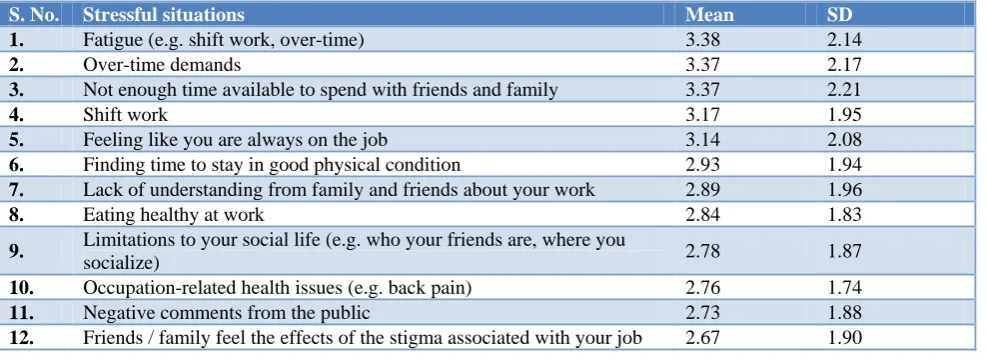
Table 1 shows the twenty stressful questions as per the Operational Police Stress Questionnaire. In this study, the situation perceived most stressful was getting fatigued, followed by over-time demands, inadequate time to spend with friends and family, shift work, feeling like always being on the job. Other situations like Social stigma – limitations to social life, negative comments from the public; working alone at night were found to be moderately stressful. The risk of being injured on the job was perceived to be least stressful among the study participants.
Table 1:Situations perceived stressful by the participants.
S. No. Stressful situations Mean SD
1. Fatigue (e.g. shift work, over-time) 3.38 2.14
2. Over-time demands 3.37 2.17
3. Not enough time available to spend with friends and family 3.37 2.21
4. Shift work 3.17 1.95
5. Feeling like you are always on the job 3.14 2.08
6. Finding time to stay in good physical condition 2.93 1.94
7. Lack of understanding from family and friends about your work 2.89 1.96
8. Eating healthy at work 2.84 1.83
9. Limitations to your social life (e.g. who your friends are, where you
socialize) 2.78 1.87
10. Occupation-related health issues (e.g. back pain) 2.76 1.74
11. Negative comments from the public 2.73 1.88
12. Friends / family feel the effects of the stigma associated with your job 2.67 1.90
S. No. Stressful situations Mean SD
13. Working alone at night 2.63 2.00
14. Managing your social life outside of work 2.63 1.90
15. Work related activities on days off (e.g. court, community events) 2.61 2.03
16. Upholding a "higher image" in public 2.57 1.89
17. Making friends outside the job 2.56 1.84
18. Paperwork 2.45 1.74
19. Traumatic events (e.g. Motor Vehicle Accident, domestics, death,
injury) 2.37 1.80
20. Risk of being injured on the job 2.32 1.79
Table 2:Work-related factors and stress among the police personnel.
Work-related factors Stress χ2 value df P value
Present (%) Absent (%)
Difficulties in meeting deadlines
Yes 149 (78) 42 (22)
14.421 1 0.000
No 51 (56) 40 (44)
Insufficient personal time
Yes 142 (78.9) 38 (21.1)
15.316 1 0.000
No 58 (56.9) 44 (43.1)
Inadequate family time
Yes 148 (78.3) 41 (21.7)
15.156 1 0.000
No 52 (55.9) 41 (44.1)
Relationship with colleagues
Very friendly 13 (86.7) 2 (13.3)
14.661 3 0.000
Friendly 156 (74.3) 54 (25.7) Not so friendly 21 (47.7) 23 (52.3) Discordant 10 (76.9) 3 (23.1)
Share your problems
Colleagues 39 (79.6) 10 (20.4)
34.392 3 0.000
Family members 108 (76.6) 33 (23.4)
Friends 50 (69.4) 22 (30.6)
None 3 (15) 17 (85)
Eager to go to work
Never 4 (25) 12 (75)
23.793 4 0.000
Sometimes 30 (65.2) 16 (34.8)
Often 15 (57.7) 11 (42.3)
Very often 11 (78.6) 3 (21.4)
Always 140 (77.8) 40 (22.2)
Satisfied with your job
Never 15 (55.6) 12 (44.4)
25.374 4 0.000
Sometimes 29 (56.9) 22 (43.1)
Often 7 (38.9) 11 (61.1)
Very often 6 (66.7) 3 (33.3)
Always 143 (80.8) 34 (19.2)
Need changes in the dept.
Yes 118 (77.6) 34 (22.4)
7.198 1 0.007
No 82 (63.1) 48 (36.9)
Table 2 shows the association between stress and the work-related factors among the study participants. The stress was seen more in those who had difficulty in meeting deadlines, insufficient personal time, and inadequate family time [p = 0.000]. Even though the participants said that their relationship with colleagues was very friendly and shared their problems with the colleagues; were very often eager to go to work and always satisfied with their job, they were found to be stressed when compared to others [p = 0.000]. Those who felt that changes were needed in the department were more stressed (77.6%) than the others (63.1%) [p=0.007].
All the association found with the work-related factors was found to be statistically highly significant.
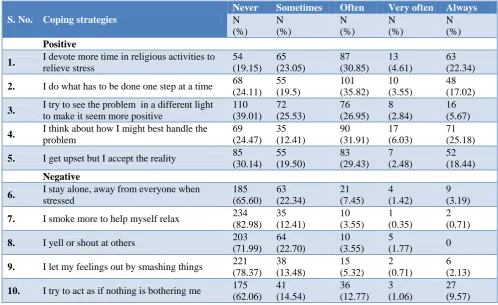
Table 3:Coping strategies among the study participants.
S. No. Coping strategies
Never Sometimes Often Very often Always
N (%) N (%) N (%) N (%) N (%) Positive
1. I devote more time in religious activities to
relieve stress 54 (19.15) 65 (23.05) 87 (30.85) 13 (4.61) 63 (22.34)
2. I do what has to be done one step at a time 68 (24.11) 55 (19.5) 101 (35.82) 10 (3.55) 48 (17.02)
3. I try to see the problem in a different light
to make it seem more positive
110 (39.01) 72 (25.53) 76 (26.95) 8 (2.84) 16 (5.67)
4. I think about how I might best handle the
problem 69 (24.47) 35 (12.41) 90 (31.91) 17 (6.03) 71 (25.18)
5. I get upset but I accept the reality 85 (30.14) 55 (19.50) 83 (29.43) 7 (2.48) 52 (18.44) Negative
6. I stay alone, away from everyone when
stressed 185 (65.60) 63 (22.34) 21 (7.45) 4 (1.42) 9 (3.19)
7. I smoke more to help myself relax 234 (82.98) 35 (12.41) 10 (3.55) 1 (0.35) 2 (0.71)
8. I yell or shout at others 203
(71.99) 64 (22.70) 10 (3.55) 5
(1.77) 0
9. I let my feelings out by smashing things 221 (78.37) 38 (13.48) 15 (5.32) 2 (0.71) 6 (2.13)
10. I try to act as if nothing is bothering me 175 (62.06) 41 (14.54) 36 (12.77) 3 (1.06) 27 (9.57)
Table 4 shows that majority (60.6%) of them was using positive coping methods and only 4.6% were using negative coping methods.
Table 4:Positive and negative coping among the participants.
Coping Yes (%) No (%)
Positive 171 (60.6) 111 (39.4)
Negative 13 (4.6) 269 (95.4)
Table 5:Stress and coping methods among the police personnel.
Stress
Coping methods χ2
value df P value Positive (%) Negative (%)
Present 138 (80.7) 13 (100)
1.886* 1 0.20
Absent 33 (19.3) 0
*with Yates correction (as expected frequency less than 5 in one cell)
Table 5 shows that among those using positive coping methods, 80.7% were stressed, whereas all of those using negative coping methods were stressed. However the association between stress and the coping method used was not statistically significant.
Among the positive coping strategies, the most commonly used strategy was to think how best to handle the problem (63.12%), followed by devoting more time in religious activities (57.8%), doing what needed to be done one step at a time (56.39%), accepting the reality (50.35%) and trying to see the problem in a different light to make it seem more positive (35.46%) (Figure 1).
Figure 1:Positive coping strategies among the study participants.
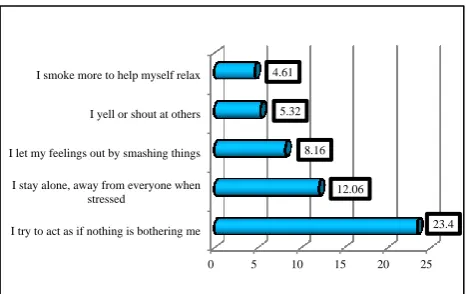
Among the negative coping strategies, the most commonly used strategy was to act as if nothing was bothering them (23.4%), followed by staying alone
0 10 20 30 40 50 60 70
I think about how I might best handle the problem
I devote more time in religious activities to relieve stress I do what has to be done one step at a time
I get upset but I accept the reality I try to see the problem in a different light to make it seem more positive
(12.06%), smashing things (8.16%), shouting at others (5.32%) and smoking (4.61%) (Figure 2).
Figure 2:Negative coping strategies among the study participants.
DISCUSSION
In this study, 70.9% were found to be stressed. The stress levels found in other studies were Ramakrishnan et al (74%), Deschamps et al (33%), Deb et al (54%).8-10 The situation perceived most stressful was getting fatigued, followed by over-time demands, inadequate time to spend with friends and family, shift work, feeling like always being on the job, which is in corroboration with the other studies as well.11-13 The risk of getting injured on the job was perceived least stressful. Similar report was given by Suresh et al.11
The most commonly used positive coping strategy was to think how best to handle the problem, followed by devoting more time in religious activities, doing what needed to be done one step at a time, accepting the reality and trying to see the problem in a different light to make it seem more positive. A study done by Deb et al in traffic constables in Kolkata police also reported similar coping strategies used by them.12 In the study conducted by Geetha et al it was reported that such positive coping methods reduce psychological stress considerably.14 The most commonly used negative coping strategy was to act as if nothing is bothering them, followed by staying alone, smashing things, shouting at others and smoking. All of them who followed such negative coping methods were stressed, which is in corroboration with the studies conducted by Gershon et al and Violanti.15,16 A study by Madu et al also lists using humour, social support, meditation, and delegation of responsibilities as coping strategies used by police persons.17
CONCLUSION
The current study on the police personnel affirmed that the policemen are indeed stressed because of the demanding nature of their job. The work obligations drain their energy and they are left with little time to spend for themselves and their family. Such
circumstances in the long run will leave them deprived of fulfillment in life in spite of the accomplishments in their career. The health of the policeman is at stake when he is left dissatisfied with only pressures from all sides. If better coping methods are adopted, it can help them to tackle the stress.
Recommendations
Stress is inevitable in the police department because of their job profile and the nature of work. It is very difficult to make a police department stress free, but few steps can be taken to reduce stress among the employees of police department. Reducing work load and working hours can give them more personal and family time. Relief camps, yoga sessions, training programs, counseling and other such programmes should be organized for the policemen regularly. Periodical health examination should be conducted to detect any morbidity developing or existing at the earliest.
Funding: No funding sources Conflict of interest: None declared
Ethical approval: The study was approved by the Institutional Ethics Committee
REFERENCES
1. Kaur R, Chodagiri VK, Reddi NK. A psychological study of stress, personality and coping in police personnel. Indian J Psychol Med. 2013;35(2):141-7. 2. Tracking Police Suicides 2008, 2009, 2012.
Available at http://www.badgeoflife.com/suicides. php. Accessed 10 May 2019.
3. Suicides in India AASRA 21. Available at http:// www.aasra.info/articlesandstatistics.html. Accessed 10 May 2019.
4. Umranikar JY. Police Reforms in India: a Sisyphean Saga: functional Review of India Police, a step towards good governance. Pune, India: Ameya Prakashan; 2009:292.
5. National Crime Records Bureau report. Available at http://articles.timesofindia.indiatimes.com/2013-10- 17/mumbai/43143655_1_police-personnel-sanjeev-dayal-maharashtra. Accessed 10 May 2019.
6. Haines C. Police Stress and the Effects on the Family. An applied research project submitted to the Department of Interdisciplinary Technology as part of the School of Police Staff and Command Program. 2003.
7. McCreary DR, Thompson MM. Development of two reliable and valid measures of stressors in policing: The Operational and Organizational Police Stress Questionnaires. Int J Stress Manag. 2006;13(4):494-518.
8. Ramakrishnan J, Majgi SM, Premarajan KC, Lakshminarayanan S, Thangaraj S, Chinnakali P. High prevalence of cardiovascular risk factors among policemen in Puducherry, South India. J Cardiovasc Dis Res Jun. 2013;4(2):112-5.
0 5 10 15 20 25 I try to act as if nothing is bothering me
I stay alone, away from everyone when stressed
I let my feelings out by smashing things I yell or shout at others I smoke more to help myself relax
23.4 12.06
9. Deschamps F, Paganon-Badinier I, Marchand AC, Merle C. Sources and assessment of occupational stress in the Police. J Occup Health. 2003;45(6):358-64.
10. Deb S, Chakraborty T, Chatterjee P, Srivastava N. Are West Bengal police officers stressed? The Indian Police J. 2005;2:63-72.
11. Suresh RS, Anantharaman RN, Angusamy A, Ganesan J. Sources of Job Stress in Police Work in a Developing Country. Int J Business Manag. 2013;8(13):102-10.
12. Deb S, Chakraborthy T, Chatterjee P, Srivastava N. Job-related stress, causal factors and coping strategies of traffic constables. J Indian Acad Appl Psychol. 2008;34(1):19-28.
13. Saha A, Sahu S, Paul G. Evaluation of cardio-vascular risk factor in Police Officers. Int J Pharma and Bio Sci. 2010;1(4):263-71.
14. Geetha PR, Subbakrishna DK, Channabasavanna SM. Subjective well being among police personnel. Indian J Psychiatry. 1998;40(2):172–9.
15. Gershon RRM, Lin S, Li X. Work stress in aging police officer. J Occup Environ Med. 2002;44(2):160-7.
16. Violanti JM. Coping strategies among police recruits in a high-stress training environment. J Soc Psychol. 1992;132(6):717-29.
17. Madu SN, Poodhun SE. Stress symptoms and substance use among police officials in the central region of Limpopo Province, South Africa. J Soc Sci. 2006;12(3):213-24.
Cite this article as: Furmeen S, Reddy MR.