Original Research Article
Nomophobia: mobile phone dependence among students of a medical
college in Central Odisha, India
Swetaleena Ashe, Dipanweeta Routray*, Rama Chandra Giri
INTRODUCTION
Nomophobia is the fear of being out of mobile phone contact. It is a new form of stress and anxiety among mobile phone users. It has become the modern day pathology or better described as phobia of 21st century. The term is an abbreviation for “no-mobile phone phobia” which was coined in 2010 during a study by the UK Post Office who commissioned YouGov, a UK based research organization that sampled 2163 people to look for anxieties suffered by mobile phone users.1 The study
found that nearly half of mobile phone users in Britain tend to be anxious when they “lose their mobile phone, run out of battery or have no network coverage.” It is considered as a disorder of the contemporary digital and visual society which causes nervousness, discomfort and anxiety. Various studies report the prevalence of nomophobia among medical students ranging from 18.5% to 75%.2,3 Nomophobia affecting the mental status of the mobile phone users has been proposed to be included in the DSM-V (Diagnostic and Statistical
ABSTRACT
Background: Nomophobia, stands for “no mobile phone phobia". The tremendous increase in mobile phone usage among youngsters has led to negative impact on their mental health status. Current study aims at finding out the prevalence of nomophobia (mild, moderate, and severe), various health related conditions and independent risk factors of severe nomophobia among medical students of a tertiary care college and Hospital of Central Odisha. Methods: A cross sectional study carried out among 450 students of a medical college of Central Odisha. Simple random sampling was done. Predesigned pretested questionnaire including Nomophobia questionnaire (NMP-Q) was used for data collection. Data was analyzed using SPSS and logistic regression was used to evaluate the independent risk factors of severe nomophobia.
Results: Out of 450 students, 246 (54.6%) were boys and rest were girls. Nomohobia was universally present and students suffering from mild, moderate and severe form of nomophobia comprised of 33 (7.3%), 327 (72.7%) and 90 (20%) respectively. Independent risk factors of severe nomophobia were fourth year of study and above (aOR=2.69), use of costly handsets (aOR=4.56), monthly bill of more than rupees 500 for cell phone use (aOR=6.09) and anxiousness of staying updated with news all the time (aOR=4.86).
Conclusions: Nomophobia is a highly prevalent condition among the medical students found across age groups, gender and socio-economic status which depends on phone usage. It is recommended that screening and proper counselling should be available in order to decrease the burden and create awareness about nomophobia among the medical students.
Keywords: Risk factors of nomophobia, Nomophobia questionnaire, Binary logistic regression, Simple random sampling
Department of Community Medicine, SCB Medical College and Hospital, Cuttack, Odisha, India
Received: 23 June 2019 Accepted: 02 August 2019
*Correspondence: Dr. Dipanweeta Routray,
E-mail: [email protected]
Copyright: © the author(s), publisher and licensee Medip Academy. This is an open-access article distributed under the terms of the Creative Commons Attribution Non-Commercial License, which permits unrestricted non-commercial use, distribution, and reproduction in any medium, provided the original work is properly cited.
Manual of Mental disorders, fifth version), a gold standard for assessing psychiatric diseases.4
The techno world of today offers man a portable, electronic device i.e., a smartphone. These smartphones are seen as a lucrative item as it serves varied purposes such as playing internet games, sharing pictures and documents, communication, watching videos or news and access to a wide variety of information at a reasonable cost. The fast growing world of smartphones along with its internet usage has stealthily captivated the young minds and created psychological dependence, thereby deteriorating physical, mental and social health of individual. Physical problems like headache, insomnia, eyestrain, accidents etc., and psychological pathologies like anxiety, nervousness and stress are seen to be prevalent among nomophobes.5
The main objectives of the study were to study the prevalence of different grades of nomophobia (mild, moderate, severe) among the medical students of a tertiary Medical College and Hospital of Central Odisha, to find the association of various health conditions and factors related to mobile phones with nomophobia and to assess the independent risk factors of severe nomophobia.
Youngsters of today’s world having easy access to smartphones and net packs at reasonable cost, usage of internet for a long time and spending time in being socially active on various social medias, playing online games etc., have been earmarked as symptoms of being nomophobic.6 The keen interest of the authors regarding the alarming rise in prevalence of nomophobia has mandated to take up the study for further research.
METHODS
Study design and participants
It was a cross-sectional study carried out among the medical students of a tertiary care hospital and associated Medical College of Central Odisha. The study was conducted from July 2018 to March 2019. The sample size (450) was calculated by formula where p=prevalence of nomophobia among medical students in another study18.5%, q=81.5%, L=20%.2 The 450 students were divided equally as 75 students from 1st year through interns (six years). These 75 students were selected randomly by using random number tables from the attendance register, which served as the sampling frame for each year. Among those roll numbers; students who gave consent for the study and could be contacted in at least in one of the three visits to their classroom were taken as study participants. Students who were absent were supplemented by another roll number with the help of random number table. Those who were previously diagnosed with any kind of psychiatric illness, could not be contacted in the successive three visits and had no mobile phones were excluded from the study. Informed written consent was taken from all the participants.
Data collection
A pre-tested, semi-structured questionnaire comprising of questions on socio-demographic factors and nomophobia questionnaire (NMP-Q) were used.7 Socio-demographic assessment included socio-economic status classified by Modified B.G. Prasad, current place of stay, duration of mobile phone ownership, average time spent in phones, various purposes for which they used cell phones etc.
The nomophobia questionnaire (NMP-Q) constructed by Caglar Yildrim, Iowa State University was used to identify various levels and dimensions of nomophobia. NMP-Q had 20 items which were measured using a 7 point Likert scale ranging from 1 (strongly disagree) to 7 (strongly agree). Four dimensions were covered in NMP-Q: not being able to communicate, losing connectedness, not being able to access information and giving up convenience.
Data analysis
Descriptive statistics were used and results were expressed as mean±standard deviation or frequencies and percentages. Categorical variables were compared using Pearson Chi-square test. The risk factors were dichotomized into two categories i.e., severe nomophobia and moderate/mild nomophobia. Binary logistic regression was used to find the independent predictors of nomophobia. Dependent variables were severe nomophobia or moderate/mild nomophobia, dichotomous in nature, where severe nomophobia=1, moderate/mild nomophobia=0. Data was entered using Microsoft Excel 2010 and analyzed using Statistical Package for Social Sciences version 18 (PASW statistics for Windows, Chicago: SPSS Inc).
RESULTS
The questionnaire based study was carried out among 450 medical students. The study group included 75 students (16.7%) from each academic year along with interns. They comprised of 246 (54.6%) males and 204 (45.3%) females. Mean age of respondents was 21.49±1.93. Maximum individuals 312 (69.3%) were of age group less than 23 years. Majority of them (60%) belonged to upper socio-economic class. The prevalence of severe nomophobia was present among 90 (20%) students, moderate degree among 327 (72.7%) and mild nomophobia among 33 (7.3%) students. The mean nomophobia score was 84.27±18.06. The NMP questionnaire which is broadly divided into four factors, factor 3 i.e., not being able to access information was found to have a higher mean (27.5±7.38) than the rest.
10000. Those students using internet for more than two years, used net plans and possessed gadgets were 345 (76.7%), 402 (89.3%) and 192 (42.7%) respectively.
Nearly half of the students i.e., 237 (52.7%) spent more than four hours on cell phones and 255 (56.7%) paid Rs. 500 or more as monthly bill towards cell phone.
Table 1: Sociodemographic factors and factors related to mobile phone use among study subjects (n=450).
S. no. Characteristics Number %
1 Age (in years) <23 ≥23 312 69.3
138 30.7
2 Gender Girls 204 45.3
Boys 246 54.7
3 Socio Economic status Upper 338 75.2
Others 112 24.8
4 Place of stay Hostel 429 95.3
Home/PG 21 4.7
5 Duration of smartphone ownership (in years) ≥2 348 77.3
<2 102 22.7
6 Price of cell phone Rs. >10000 327 72.7
Rs. ≤10000 123 27.3
7 Duration of net ownership (in years) ≥2 345 76.7
<2 105 23.3
8 Using net plan Yes 402 89.3
No 48 10.7
9 Monthly bill Rs. <500 195 43.3
Rs. ≥500 255 56.7
10 Owning gadgets Yes 192 42.7
No 258 57.3
11 Average time spent in phone (in hours) >4 ≤4 237 52.7
213 47.3
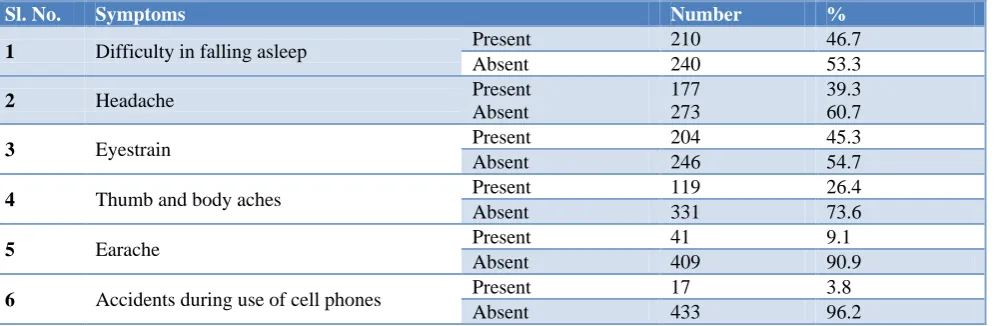
Table 2: Health symptoms seen among mobile phone users of the study (n=450).
Sl. No. Symptoms Number %
1 Difficulty in falling asleep Present 210 46.7
Absent 240 53.3
2 Headache Present
Absent
177 273
39.3 60.7
3 Eyestrain Present 204 45.3
Absent 246 54.7
4 Thumb and body aches Present 119 26.4
Absent 331 73.6
5 Earache Present 41 9.1
Absent 409 90.9
6 Accidents during use of cell phones Present 17 3.8
Absent 433 96.2
Table 2 describes the health symptoms reported among the mobile phone users. Majority i.e., 210 (46.7%) complained of difficulty in falling asleep followed by eyestrain among 204 (45.3%), headache among 177 (39.3%), thumb pain and body ache among 119 (26.4%), earache among 41 (9.1%) and accidents during mobile phone use among 17 (3.8%).
Table 3 shows the varied usage of cellphones among the students. Students using it for social networking were 429 (95.3%), for listening music were 429 (95.3%), for
communication 432 (96%), for sharing pictures and documents 405 (90%), playing games 183 (40.6%), for online education 420 (93.3%), watching videos 435 (96.6%), for news 315 (70%), for online shopping 372 (82.6%), for navigation purposes 327 (72.6%) and for reading e-books were 240 (53.3%).
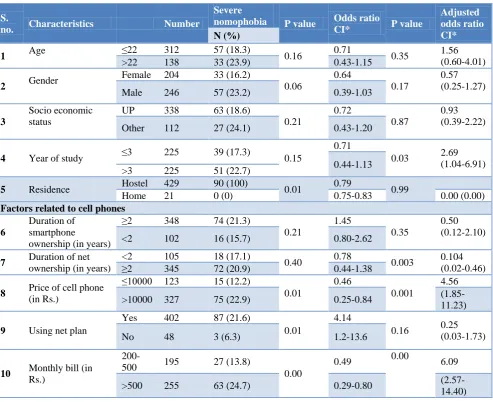
Continued. year and above were seen to be at risk of suffering from
severe nomophobia 51 (22.7%) and were nearly three times [OR=2.69, (CI: 1.04-6.91)] at risk as compared to students of first year through third year. Those who owned new cell phones within a period of two years were found to be significantly at risk of severe nomophobia. Majority of students belonged to upper class 338 (75.1%) and hence could afford costly handsets and were thus four times at risk of being severe nomophobic. Students who spent more than Rs. 500 as monthly bills of cell phones were found to be six times [OR-6.09, (CI: 2.5-14.4)] at higher risk than their counterparts. Study subjects who suffered from insomnia or headache with aORs of 3.9 and 2.29 respectively were rather protected from the risk of severe nomophobia. Students suffering from thumb and shoulder pain were found to be twice at risk of severe nomophobia but the association did not have a significant difference as compared to those not suffering from these ailments. Subjects using cell phones for definite purposes such as sharing pictures, playing games, using cell phones for travelling using the maps for navigation and using it for online education in form of
e-books were significantly found to be at lesser risk of severe nomophobia. Among them, who were particular about getting updated by news were significantly at risk [aOR = 4.86, (CI: 2.35-9.97)] of severe nomophobia.
Table 3: Purpose of internet use among the respondents (n=450).
S. no Purpose of internet
use Number %
1 Social networking 429 95.3
2 Listening music 429 95.3
3 Communication 432 96
4 Sharing pics 405 90
5 Games 183 40.6
6 Education 420 92.3
7 Watching videos 435 96.6
8 Listening news 315 70
9 Online shopping 372 82.6
10 Navigation 327 72.6
11 Reading e-books 240 53.3
Table 4: Risk factors of severe nomophobia among the study subjects (n=450).
S.
no. Characteristics Number
Severe
nomophobia P value Odds ratio
CI* P value
Adjusted odds ratio CI*
N (%)
1 Age ≤22 312 57 (18.3) 0.16 0.71 0.35 1.56
(0.60-4.01)
>22 138 33 (23.9) 0.43-1.15
2 Gender
Female 204 33 (16.2)
0.06
0.64
0.17
0.57 (0.25-1.27)
Male 246 57 (23.2) 0.39-1.03
3
Socio economic status
UP 338 63 (18.6)
0.21
0.72
0.87
0.93 (0.39-2.22)
Other 112 27 (24.1) 0.43-1.20
4 Year of study ≤3 225 39 (17.3) 0.15
0.71
0.03 2.69 (1.04-6.91) 0.44-1.13
>3 225 51 (22.7)
5 Residence Hostel 429 90 (100) 0.01 0.79 0.99
Home 21 0 (0) 0.75-0.83 0.00 (0.00)
Factors related to cell phones
6
Duration of smartphone
ownership (in years)
≥2 348 74 (21.3)
0.21
1.45
0.35
0.50 (0.12-2.10)
<2 102 16 (15.7) 0.80-2.62
7 Duration of net ownership (in years)
<2 105 18 (17.1)
0.40 0.78 0.003 0.104
(0.02-0.46)
≥2 345 72 (20.9) 0.44-1.38
8 Price of cell phone (in Rs.)
≤10000 123 15 (12.2)
0.01
0.46
0.001
4.56
>10000 327 75 (22.9) 0.25-0.84
(1.85-11.23)
9 Using net plan
Yes 402 87 (21.6)
0.01
4.14
0.16 0.25 (0.03-1.73)
No 48 3 (6.3) 1.2-13.6
10 Monthly bill (in Rs.)
200-500 195 27 (13.8)
0.00
0.49 0.00 6.09
>500 255 63 (24.7) 0.29-0.80
S.
no. Characteristics Number
Severe
nomophobia P value Odds ratio
CI* P value
Adjusted odds ratio CI*
N (%)
11 Owning electronic gadgets
Yes 192 42 (21.9)
0.39 1.22 0.02 0.41
No 258 48 (18.6) 0.77-1.94 (0.19-0.88)
12 Average time spent in phone (in hours)
>4 237 54 (22.8)
0.11
1.45
0.54
0.78 (0.36-1.70)
≤4 213 36 (16.9) 0.90-2.32
Health related conditions
13 Difficulty in falling asleep
Yes 240 33 (13.8)
0.00 4.28 0.001 3.97
(1.77-8.90)
No 210 57 (27.1) 0.26-0.68
14 Headache Yes 177 27 (15.3) 0.04 0.6 0.04 2.29
(1.00-5.23)
No 273 63 (23.1) 0.36-0.98
15 Eyestrain Yes 204 47 (23) 0.14 1.41 0.23 0.65
(0.32-1.32)
No 246 43 (17.5) 0.88-2.24
16 Thumb and body ache
Yes 119 26 (21.8)
0.55 1.16 0.05 2.22
(0.99-4.96)
No 331 64 (19.3) 0.69-1.94
17 Earache
Yes 41 10 (24.4)
0.46
1.32
0.98
0.98 (0.26-3.75)
No 409 80 (19.6) 0.62-2.81
18 Accidents during use of cell phones
Yes 0 (0)
0.03
1.26
0.99
1.19 (0.00)
No 90 (20.8) 1.20-1.32
Purpose of cell phone use
19 Social networking
Yes 429 87 (20.3)
0.50
1.52
0.23
0.26 (0.02-2.42)
No 21 3 (14.3) 0.44-5.29
20 Listening music
Yes 429 90 (21)
0.01
0.79
0.99
0.00 (0.00)
No 21 0 (0) 0.75-0.83
21 Communication
Yes 432 90 (20.8)
0.03
0.79
0.99
0.00 (0.00)
No 18 0 (0) 0.75-0.83
22 Sharing pics Yes 405 87 (21.5) 0.01 3.83 0.02 0.11
No 45 3 (6.7) 1.15-12.65 (0.01-0.71)
23 Games Yes 183 54 (29.5) 0.000 2.68 0.000 0.16
No 267 36 (13.5) 1.67-4.31 0.06-0.39
24 Education Yes 420 87 (20.7) 1.13 2.35 0.17 0.24
(0.03-1.87)
No 30 3 (10) 0.69-7.93
25 Watching videos Yes 435 87 (20) 1.00 1.00 1.00 1.1
(0.99-1.32)
No 15 3 (20) 0.27-3.62
26 Listening news Yes 315 81 (25.7) 0.00 4.84 0.000 0.13
No 135 9 (6.7) 2.35-9.97 0.05-0.36
27 Online shopping
Yes 372 84 (22.6)
0.003
3.50
0.56 0.69
No 78 6 (7.7) 1.47-8.33
(0.20-2.41)
28 Navigation Yes 327 66 (20.2) 0.87 1.04 0.01 3.41
No 123 24 (19.5) 0.61-1.75 1.33-8.75
29 Reading e-books Yes 240 51 (21.3) 0.47 1.18 0.000 6.16
No 210 39 (18.6) 0.74-1.88 2.43-15.63
DISCUSSION
Mobile phone usage has been acclaimed to be “possibly the biggest non-drug addiction of the 21st century.” It is
from severe nomophobia which was similar to study conducted by Sonali et al among medical students in Odisha and Kanmani et al among students from various states of India.8,9 Other similar studies which found a high prevalence of nomophobia were ones conducted by Sharma et al and Masthi et al on rising concern of nomophobia among Indian medical students in Indore and college students of Bangalore respectively where they found 7 out of 10 students suffering from nomophobia.3,10 The prevalence of nomophobia as reported from different parts of the world has been quite varied from 18.5% to 73%. The rising trend in the prevalence of nomophobia over the years as found in studies, hints at the increasing mobile phone usage and consequently higher dependence on it.
The mean age of our study participants was 21.49±1.93 years as found in a study by Pavithra et al among medical students of Bangalore where they found mean age to be 21.33+2.36.11 This finding can be attributed to the increasing use of mobile phones among younger generation. So, this could lead the enlightened minds of future to enter a doom of virtual world with deleterious effects to both body and mind. Although more number of younger students was found to be severely nomophobic, we found students of fourth year and above to be nearly at three times more risk of severe nomophobia than the juniors. Gezgin et al and Pavithra et al reported no significant association between year of study (grades of study or academic sessions) and nomophobia which was contrary to the finding of our study.11,12 This could probably be due to more freedom and less vigilance of parents for the grown up kids and also longer duration of usage of cell phones with increasing age.
In our study we found nearly an equal representation of male and female students which was similar to study conducted by Pavithra et al.11 However, in study by Ashwini et al four-fifths of participants were males.5 We did not find significant association between severe nomophobia and gender. Similar findings were obtained in study conducted by Dixit et al and Adnan which showed no significant gender distribution of nomophobia.2,13 This could be explained by equitable usage of mobile phones among males and females and hence nomophobia being prevalent in both the genders equally. On the contrary, different studies by Envoy, 2012; Tavolacci et al, Yildirim et al found females to be more nomophobic than males.14-17
Majority of our participants were from upper SES showing no association with severe nomophobia, contrary to the findings of Ashwini et al.5 However, those using cell phones of worth more than ten-thousand rupees were almost four times more at risk of severe nomophobia. Cost of the mobile phone was also shown to be an independent risk factor by Dasgupta et al among medical students.6 This finding suggests that the cost of the hand set and not the overall economic status that determines the risk of being nomophobic. To suffice, a
study by Pavithra et al also showed that nearly 60% of students changed their cell phones in every two years.11 Nearly six out of ten students spent more than Rs. 500 on monthly bills of cell phones which is similar to findings of Ashwini et al and Pavithra et al where nearly 7 out of 10 study participants spent nearly Rs. 500-1000 monthly on cell phones.5,11 Young mass being addicted to cell phones could be probably due to its easier access to them irrespective of their SES due to their availability at reasonable prices. Our study revealed those students who started using internet within the preceding two years were found to be more nomophobic. This suggests that the newer users of internet through mobile phones are at risk of having nomophobia. But availability of internet plan in the phone did not significantly affect nomophobia in the study by Dasgupta et al, which was rather due to availability of wi-fi in their own campus.6 On the contrary, our students complained of poor Wi-Fi connection and explaining the dependence on mobile internet.
Nearly one fifth of our subjects who stayed in hostel suffered from severe nomophobia however the association was not significant as also found by Dixit et al and Pavithra et al.2,11 Every fourth individual had new smart gadgets and those using these gadgets along with mobile phones were found to be protected from the risk of nomophobia. This could be due to indulgence of oneself in other devices which led to lesser dependence on cell phones.
We did not find any significant association between duration of smartphone ownership and time spent in using smartphones with severe NMP. Similar findings were seen in study by Ashwini et al where association between duration of mobile phone use and nomophobia was not significant. On the contrary, Nikhita et al found significant association between mobile phone dependence with increasing numbers of years of use.18 These findings could probably be due to the varied usage of cell phones which creates dependence among many, irrespective of individual characteristics.
These findings clearly reveal that mobile phone dependence is captivating all irrespective of age, sex, SES and place of stay.
asleep or with headache were aware of the fact that using cell phones for long term would entail them to more health related issues. Headache and eyestrain were common complaints of many students, as also supported by the findings of Acharya et al who reported headache and irritability among nearly half of the participants and eye strain among 36.5% of them.19
However, Sharma et al reported headache and lethargy to be present among 60% of the students which was nearly twice than our present study.3 These findings very well depict the health impacts of using mobile phones for longer duration of time. Lack of sleep could be a precipitating factor for various psychological disturbances and can affect both the body and mind.
The four factors of NMP were assessed and a higher mean was found with factor 3 i.e., not being able to access information with a mean score of 27.5±7.38. Similar findings were seen in studies by Dasgupta et al and Gezgin et al.6,12 Students using cell phones for definite purposes such as sharing pictures, playing games, using cellphones for navigation and online educative material were significantly at a lesser risk for being nomophobic. Students as high as 8 out of 10 responded that cellphones are absolutely necessary in academics.11 On the other hand, those who remain anxious of being updated with the latest news are found to be glued to cell phones.
This study had been taken up with a keen interest of understanding the rampant usage of mobile phones among the students and its effects on their mental health conditions. It is a similar study carried out by Sonali et al in Odisha yet different in being vivid, extensive with a larger sample size.8 NMP-Q being a screening tool may exaggerate the real prevalence of nomophobia yet a 7 point Likert scoring adds to the value of its reliability. The study can be more generalized to the whole of population if community based studies regarding the prevalence of nomophobia among younger mass could be carried out. Further research is recommended to know the long term health effects. Most of the respondents belonged to younger age group and hence awareness programs or health education strategies need to be taken up to prevent the ill effects of this wonderful creation. Particularly students getting large pocket money need to be kept an eye for their excess indulgence in cell phones leading to disharmony in both body and mind. It is recommended to interview students and conduct further qualitative researches in order to understand the factors related, negative impacts on students and its remedial measures.
NMP, the fear of losing mobile phone contact is a new form of anxiety among cell-phone users. It is found to be highly prevalent among all students of the Medical College of Central Odisha dissolving all barriers of age, sex and social status. However, the major independent determinants found to be associated with severe
nomophobia were fourth year of study and above (aOR=2.69), use of costly handsets (aOR=4.56), monthly bill of more than rupees 500 for cell phone use (aOR=6.09) and anxiousness of staying updated with news all the time (aOR=4.86). Majority were seen to use cell phones for accessing information rather than for communication. So it has been recommended to have regular screening of these youngsters and the need for counselling by a clinical psychologist. Multi-centric study regarding the prevalence and the health impacts of nomophobia would add more to the value of the study. Alternatives to reduce the usage of cell phones would be a major step towards decreasing the inclination towards cell phones and thereby leading to reduction in burden of nomophobia. Reading newspaper rather than surfing all the time for e-news would be a small step towards the initiative for a better mental health status among the medical students.
ACKNOWLEDGEMENTS
We acknowledge the cooperation of all the medical students who participated in this study. We would also thank especially the class representatives for their immense cooperation.
Funding: No funding sources Conflict of interest: None declared
Ethical approval: The study was approved by the Institutional Ethics Committee
REFERENCES
1. Nomophobia. Available at: http://wikipedia.org/wiki /Nomophobia. Accessed on 1 May 2019.
2. Dixit S, Shukla H, Bhagwat A, Bindal A, Goyal A, Zaidi AK, et al. A study to evaluate mobile phone dependence among students of a medical college and associated hospital of central India. Indian J Community Med. 2010;35:339-41.
3. Sharma N, Sharma P, Wavare RR. Rising concern of nomophobia among Indian medical students. Int J Res Med Sci. 2015;3(3):705-7.
4. Bragazzi NL, Puente DG. A proposal for including nomophobia in the new DSM-V. Psychol Res Behav Manag. 2014;7:155-60.
5. Dongre AS, Inamdar IF, Gattani PL. Nomophobia: a study to evaluate mobile phone dependence and impact of cell phone on health. Natl J Community Med. 2017;8(11):688-93.
6. Dasgupta P, Bhattacherjee S, Dssgupta S, Roy JK, Mukherjee A, Biswas R. Nomophobic behaviors among smartphone using medical and engineering students in two colleges of West Bengal. Indian J Public Health. 2017;61:199-204.
8. Kar S, Sarma NN, Mistry C, Pal R. Prevalence of nomophobia among medical students in a private college of Bhubaneswar, Odisha. J Bio Innov. 2017;6(6):914-20.
9. Kanmani A, Bhavani U, Maragatham R. Nomophobia- an insight into its psychological aspects in India. Int J Indian Psychol. 2017;4(2):87. 10. Masthi NR, Yashasvini Y. Mobile phone
dependence among college students in Bangalore. RGUHS J Med Sciences. 2012;2(2):84-7.
11. Pavithra MB, Madhukumar S, Murthy TS. A study on nomophobia- mobile phone dependence, among students of a medical college in Bangalore. Ntl J Community Med. 2015;6(3):340-4.
12. Gezgin DM, Cakir O, Yildirim S. The relationship between levels of nomophobia prevalence and internet addiction among high school students: The factors influencing Nomophobia. Int J Res Educ Sci. 2018;4(1):215-25.
13. Adnan M, Gezgin DM. A modern phobia: prevalence of nomophobia among college students. Ankara University J Faculty Educ Sci. 2016;49(1):141-58.
14. Secur Envoy, 2012. 66% of the population suffer from nomophobia the fear of being without their phone. Available at: http://www.securenvoy.com/ blog/2012/02/16/66-of-the-population-suffer-from-nomophobia-the-fear-of-being-without-their-phone/. Accessed on 1 May 2019.
15. Hwang KH, Yoo YS, Cho OH. Smartphone overuse and upper extremity pain, anxiety, depression, and interpersonal relationship among college students. J Korea Contents Assoc. 2012;12(10):365-75. 16. Tovolacci MP, Meyrignac G, Richard L, Dechelotte
P, Ladner J. Problematic use of mobile phone and nomophobia among French college students. Europ J Public Health. 2015;25(3):ckv172.088.
17. Yildirim C, Sumuer E, Adnan M, Yildirim S. A growing fear prevalence of nomophobia among Turkish college students. Inform Develop. 2016;32(5):1322-31.
18. Nikhita CR, Jadhav PR, Ajinkya SA. Prevalence of mobile phone dependence in secondary school adoloscents. J Clin Diagnos Res. 2015;9(11):6-9. 19. Acharya JP, Acharya I, Waghrey D, A study on
some of the common health effects of cell-phones amongst College Students. J Community Med Health Educ. 2013;3(4):1-4.