Original Research Article
Efficiency of emergency services in under developed district of the
Punjab, Pakistan
Mariam Sughra
1, Farwa Fatima
2, Mouzma Marrium
3, Khizer Abbas
4*
INTRODUCTION
An emergency department or emergency room is a medical treatment facility specializing in emergency medicine, the acute care of patients who present without prior appointment either by their own means or by that of an ambulance. Emergency department is usually found in a hospital or other primary care center.1
According to report, 3.5 million people die every year because of RTAs. 10-15 million are injured every year due to vehicular or other accidents. There is one death every 50 seconds. Emergency services are organizations which ensure public safety and health by addressing different emergencies. The availability of emergency services depends very heavily on location, and may in some cases also rely on the recipient giving payment or
ABSTRACT
Background: An emergency department or emergency room is a medical treatment facility specializing in emergency medicine, the acute care of patients who present without any prior appointment either by their own means or by that of an ambulance. The main objective of this study was to determine the efficiency of emergency service in Shaykh Zayed Hospital Rahim Yar Khan, Pakistan.
Methods: This cross sectional study was carried out in the Emergency Department of Shaykh Zayed Hospital Rahim Yar Khan, Pakistan, from 05-06-2017 to 04-11-2017. A total of 139 subjects were involved in the study. Patients attending Emergency Department of Shaykh Zayed Hospital Rahim Yar Khan, Pakistan were included. Patients were observed and followed silently through their stay in the Emergency Department. All the data taken was entered in predesigned perform.
Results: In the Emergency Department, among all the patients, 25.9% came with GIT complaints and only 3.6% had eye, ENT and Dental issues. About 48.2% of the patients had the first contact within 4 minutes. This study shows that the treatment of 49.7% patients started within 10 minutes after entering the emergency however for only 3.5% of the patients it took more than 25 minutes to start the treatment. About 42.4% of all the patients left the emergency after treatment within 20 minutes.
Conclusions: Emergency medical services are a critical component of national health system in developing countries. Governments and ministries of health need to pay specific attention to develop emergency services and also to increase the health care staff.
Keywords: Emergency services, Efficiency of hospital services, Under developed district
1Nishtar Hospital, Multan, Pakistan 2
Nishter Medical University, Multan, Pakistan
3Avicenna Hospital, Lahore, Pakistan
4Shaykh Zayed Hospital Rahim Yar Khan, Pakistan
Received: 30 May 2018
Revised: 13 June 2018
Accepted: 14 June 2018
*Correspondence:
Dr. Khizer Abbas,
E-mail: [email protected]
Copyright: © the author(s), publisher and licensee Medip Academy. This is an open-access article distributed under the terms of the Creative Commons Attribution Non-Commercial License, which permits unrestricted non-commercial use, distribution, and reproduction in any medium, provided the original work is properly cited.
holding suitable insurance or other surety for receiving the services.2 The accident and emergency (A&E) department in a hospital is one of the most important players in delivery of healthcare services to patients. It has been demonstrated that about 50% of the visits to the ED are for non-emergency reasons
This issue has been adequately addressed by development of emergency triage systems in different countries where it has eased the burden on emergency department, the triage system takes into account patient requirements of healthcare services and allocates valuable finite resources available to the A&E department to those who require it the most.3
The current state of emergency medicine in Pakistan leaves a lot to be desired. Lack of basic healthcare facilities, poor funding status of the hospital departments by state and lack of triage system in most centers are important problems in emergency medicine. Hospital with no triage systems generally follow the “first come-first served” pattern of provision of healthcare services. This system neither takes into account the severity of symptoms of the patients nor fully assesses the relative needs of patients requiring treatment. This often leads to patients with severe underlying conditions waiting for their turns in the populous A&E department.The purpose of conducting this s is to study is to determine the current pre-hospital timing patterns of the patients and the time spent in A&E department. We also aim to determine factors responsible for delayed presentation to the ED. This study is a pioneer study as it aims to broadly assess the time intervals and factors important in healthcare provision. This study will enable us in critical analysis of the prevalent conditions and the will highlight the need of development of a triage system for our setting.4-6
Studies show that decisiveness is a key issue in managing patient flow. And while those who choose emergency medicine as a specialty do tend to be decisive, it really takes four to five years of experience to fully develop this quality. There are, however, many strategies for doing things faster that can be practiced by physicians at all levels of experience.7
Medical services exists to fulfill the basic principles of first aid, which are to arms’ to the
1. Early detection: Members of the public, or another agency, find the incident and understand the problem 2. Early reporting: The first person on scene make a call to the emergency medical services (911) and provide details to enable a response to be mounted.
3. Early response: The first professional (EMS)
rescuers are dispatched and arrive on scene as quickly as possible, enabling care to begin. Generally speaking, the levels of service available will fall into one of three categories; Basic Life Support (BLS), Advanced Life Support (ALS), and Critical Care
Transport (CCT) by traditional healthcare
professionals, meaning nurses and/or physicians working in the pre-hospital setting and even on ambulances.8-11
The objectives of study were to assess the efficacy of emergency services provided to the people attending the emergency department of Sheikh Zayed Hospital, Rahim Yar Khan.
METHODS
This cross-sectional study was conducted by the study was conducted from 05-06-2017 to 04-11-2017, over the duration 6 months. A total of 139 patients were selected through Convenient Sampling Technique from the Emergency Department of Sheikh Zayed Hospital, Rahim Yar Khan. Patients included in the study were those entering at the time of data collection and were willing to answer the questions. Patients who were unconscious were excluded from the study.
In this study, the patients were observed silently and followed through their stay in the Emergency Department After a brief introduction with the patient/attendant and taking their verbal consent, they were asked for age, occupation and presenting complaints. Information inquired also included the time of their entry, time of first contact with the doctor/health care provider, designation of health care provider, time of start treatment, first aid given to the patient, further investigations advised, provisional diagnosis, treatment, the time of admittance, referral to OPD/ward and exit from the Emergency Department. All the data was entered in pre-designed performa.
All this data was recorded and analyzed in a computer based program named SPSS Version 16. The results were then generated accordingly. Quantitative data was analyzed by mean, mode, median, standard deviation and standard error of mean. The data was further analyzed by making variables i.e. age, sex, occupation, education, residence, presenting complaint (s), investigation (s), treatment, health care worker, door the contact time, door to treatment time and door to exit time. Test statistics were tested with 5% significance level.
RESULTS
Table 1: Residence of subjects.
Residence Sex Total (%)
Male (%) Female (%)
Rural 35 (62.5 ) 21 (37.5 ) 56 (100 )
Urban 48 (57.8 ) 35 (42.2 ) 83 (100 )
Total 83 (59.7 ) 56 (40.3 ) 139 (100 )
Table 2: Employment status of patients.
Employment
status Frequency Percentage (%)
Housewife 35 25.2
Student 34 24.5
Unemployed 18 12.9
Laborers 15 10.8
Farmer 14 10.1
Employee 13 9.4
Businessman 10 7.2
Total 139 100.0
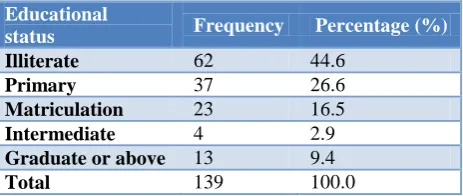
Table 3: Education status wise distribution of patients.
Educational
status Frequency Percentage (%)
Illiterate 62 44.6
Primary 37 26.6
Matriculation 23 16.5
Intermediate 4 2.9
Graduate or above 13 9.4
Total 139 100.0
When their educational status was observed, 44.6% were illiterate, 26.6% had primary education, 16.5% had done matriculation, 2.9% did intermediate and 9.4% were graduate and above 59.7% of patients belonged to urban areas while 40.3% to the rural areas (Table 3).
Table 4: First contact of healthcare provider with patients.
Health care
provider Frequency Percentage (%)
Doctor 105 75.5
Dispenser 23 16.5
Nurse 9 6.5
OT Boy 2 1.4
Total 139 100.0
Table 5: Door to first contact time (minutes).
Time (minutes) Frequency Percentage (%)
1-4 67 48.2
5-8 48 34.5
9-12 15 10.8
13-16 6 4.3
>16 3 2.2
Total 139 100
This study revealed that 48.2 % of patients got their first contact with the health care provider within 1-4 minutes, 34.5% within 5-8 minutes, 10.8% within 9-12 minutes, 4.3% within 13-16 minutes, while 2.2% of patients had to wait for more than 60 minutes (Table 4 and 5).
Table 6: Presenting complaints of patients.
Presenting
complaints Frequency Percentage (%)
GIT 36 25.9
RTA 25 18
Respiratory 14 10.1
CVS 12 8.6
Dematology 12 8.6
CNS 12 8.6
Fever 8 5.8
Musculoskeletal 8 5.8
Genitourinary 7 5
Eye/ENT/Dental 5 3.6
Total 139 100
Presenting complaints of these observed patients were as follows: GIT 25.9%, RTA 18%, Respiratory 10.1%, CVS 8.6%, Dermatology 8.6%, CNS 7.9% Fever 5.8%,
Musculoskeletal 5.8%, Genitourinary 5%, and
ENT/Eye/Dental 3.6% (Table 6).
Table 7: Investigations advised to patients.
Investigations
advised Frequency Percentage (%)
None 50 36
X-ray/Ultrasound 27 19.4
Blood Pressure 20 14.9
Fever 13 9.4
ECG 12 8.6
Lab investigations 9 6.5
BSR 8 5.8
Table 8: Treatment given to the patients.
Treatment Frequency Percentage
(%)
First Aid 4 2.9
Injection 37 26.6
Medication 21 15.9
Referral 36 25.9
First aid+injection 7 5
Injection+medication 26 18.7
First aid+medication 3 2.2
First aid+injection
+medication 5 3.6
Total 139 100
Temperature), 12.3% for lab investigation, 19.4 % for X-ray/USG and 8.6% for ECG. Among these subjects 2.9% were given first aid, 26.6% were advised for injection, 15.9% were asked to take medication while on the other hand 29.9% were advised more than one mode of treatment and 25.9% were referred to either OPD or ward (Table 7 and 8).
DISCUSSION
In this study, out of 139 patients 59.7% were males and 40.3% were females. Age for all patients is in the range of 8 months to 85 Years, among which 34.5% were under 25 years of age while 65.5% were above 25. This study showed that mean age of patients was 33.26 years, mode 45 years, median 30 years, standard deviation ±19.67 and standard error of mean 1.66. The findings of current study are comparable to another study from New York that showed that 39.6% patients were between ages 18-44 years.12
Occupations of the subjects were as follows: Housewives 25.2%, students 24.5% employee 9.4% formers 10.1% Labors 10.8% businessman 7.2% and unemployed 12.9%. Our study relates with a study conducted in USA.13 When their educational status was observed, 44.6% were illiterate, 26.6% had primary education, 16.5% had done matriculation, 2.9% did intermediate and 9.4% were graduate and above 59.7% of patients belonged to urban areas while 40.3% to the rural areas. This study relates with the preliminary findings of the study by Scott et al.14 This study revealed that 48.2 % of patients got their first contact with the health care provider within 1-4 minutes, 34.5% within 5-8 minutes, 10.8% within 9-12 minutes, 4.3% within 13-16 minutes, while 2.2% of patients had to wait for more than 60 minutes. This study correlates with that of a study conducted in Ethiopia for delayed presentation of patients to rural areas.15 Another survey conducted by Ibtisam and Sana in line with our study.16 Among the subjects under study 49.7% received treatment within 10 minutes, 41% within 20 minutes and 9.3% after 20 minutes. There was significantly increased risk of being attended late when arriving on evening.17
Presenting complaints of these observed patients were as follows: GIT 25.9%, RTA 18%, Respiratory 10.1%, CVS 8.6%, Dermatology 8.6%, CNS 7.9%, Fever 5.8%,
Musculoskeletal 5.8%, Genitourinary 5%, and
ENT/EYE/Dental 3.6%.% This study is compared with that of conducted in New York showing 7% proportionate were having of GIT, 5% with dermal problems.18
75.5% of patients had their first contract directly with doctor, 23% had with dispenser/nurse while only 1.4% came across with OT boy. 36% of patients were not advised any investigation while 24.3% were advised for baseline investigation (B.P, Temperature), 12.3% for lab investigation, 19.4 % for X-Ray/USG and 8.6% for ECG.
Among these subjects 2.9% were given first aid, 26.6% were advised for injection, 15.9% were asked to take medication while on the other hand 29.9% were advised more than one mode of treatment and 25.9% were referred to either OPD or ward. Total time spend by patients in emergency department is as follows: 42.4% spend less than 20 minutes, 44.7% spent 20-40 minutes, 5.7 % up to an hour and 7.2 % more than one hour. All these above mentioned findings are comparable to a study done in Baltimore which shows that 68.1% patients were discharged above 30 minutes while 31.9% spend 30 or less than 30 minutes in emergency department.19
CONCLUSION
Emergency medical services are a critical component of national health system in developing countries. Governments and ministries of health need to pay specific attention to develop emergency services and also to increase the health care staff.
Funding: No funding sources Conflict of interest: None declared
Ethical approval: The study was approved by the Institutional Ethics Committee
REFERENCES
1. Baker L, Baker L. Excess cost of emergency
department visits for non urgent care. Health Affairs. 1994;13(5);162-71.
2. Doobinin K, Heidt-Davis P, Gross T, Isaacman D. Nonurgent pediatric emergency department visits: care-seeking behavior and parental knowledge of insurance. Ped Emer Care. 2003;19(1):10-4.
3. Noorani M, Khaliq M, Shoaib M. Time intervals and associated factors of emergency treatment: first insight into Pakistan system. Int Arch Med. 2014;7(1):41.
4. Smart America I Smart Emergency Response
System (SERS) [Internet]. Smartamerica.org 5. The Five giants by Nicholas Timmins – Paperback
Revised edition I HarperCollins Harper Collins UK.
Available at: https://www.researchgate.net/
publication/272727357_When_the_five_giants_of_ post_war_reconstruction_meet_the_four_pillars_of_ welfare_reform-young_people_lose_out_again. Accessed 10 January 2018.
6. Abel-Smith B. A history of the nursing profession. 1st ed. London [u.a]: Heinemann; 1970.
7. Emergency medical service. En Wikipedia.org.
Available at: https://en.wikipedia.org.wiki/
Emergency_medical_services. Accessed 10 January 2018.
8. Available at: http:// “Questions and Answer”.
Jumbulance Travel Trust. Archived from the original on 2 July 2007. Accessed 10 January 2018.
9. Available from http:// “Design, Origin and meaning
10. Carter EJ, Pouch SM, Larson EL. Association between waiting times and short term mortality and hospital admission after departure from emergency department; population based cohort study from Ontario, Canda. British Med J. 2011;342:d2983.
11. Shortening Emergency Department Waiting Times
Evidenced-Based Practice”. Available at:
https://www.linkedin.com/pulse/shortening- emergency-department-waiting-times-through-dr-thomas-a-. Accessed 10 January 2018.
12. Raven M, Lowe R, Maselli J, Hsia R. Comparison of Presenting Complaint vs Discharge Diagnosis for
Indentifying “Nonemergency” Emergency
Department Visits. JAMA. 2013;309(11):1145.
13. Available AT: http://www.bls.gov/opub/mlr/2007/
06/art2full.pdf. Accessed 10 January 2018.
14. Jolly B, Scott J, Feied C, Sanford S Functional illiteracy among emergency department patients: A preliminary study. Ann Emer Med. 1993;22(3):573-8.
15. Cambanis A, Yassin M, Ramsay A, Bertel Squire S,
Arbide I, Cuevas L. Rural poverty and delayed presentation to tuberculosis services in Ethiopia; 2017.
16. Sabbah I, Drouby N, Sabbah S, Retel-Rude N, Mercier M. Health and Quality of Life Outcome. 2003:1(1):30.
17. Nielsen R, Perez N, Petersen P, Biering K.
Assessing time to treatment and patient inflow in a Danish Emergency department: a cohort study using data from electronic emergency screen boards. BMC Res Notes. 2014;7(1):690.
18. Ravan M, Lowe R, Maselli J, Hsia R. Comparison of Pre senting Complaint Vs Discharge Diagnosis for Identifying “Nonemergency” Emergency Department Visits. JAMA. 2013;309(12):1146. 19. E1sayed M, E1-Eid G, Saliba M, Jabbour R, Hitti
EA. Improving Emergency Department Door to Doctor Time and Process Reliability. Medicine. 2015;94(42):1679.