Abstract—Mobile devices (e.g., PDAs, smart phones and notebooks) currently have become the trend for personal use and are equipped with the capability of wireless communications. To authenticate the mobile user who transfers to the foreign area, the roaming authentication protocol is needed and usually requested for low costs to meet the requirements of lightweight communication devices. With the development of powerful functionalities on the mobile devices, the roaming payment service seems to be practical and with high commercial value. This paper proposes an efficient roaming payment protocol with low communication costs by using group signatures, inspired by the roaming authentication schemes proposed by Yang et al. and He et al. The major contribution of this paper is to integrate the PayWord-based micropayment scheme and the group signature scheme to enhance the effectiveness of the anonymous signatures and extend the fast authentication in roaming to perform lightweight payments by using hash chains.
Index Terms—Mobile payment, secure wireless
communication, group signature, roaming authentication.
I. INTRODUCTION
High functionality mobile devices like PDAs and smart phones have become the mainstream in personal communication and entertainment. Some business activities have been conducted in the cell phone environments, e.g., Android market and App Store, even though they are limited to purchasing software merchandise. To build an anonymous roaming payment system, the mobile payment protocol must surmount two critical challenges. The first challenge is the user authentication with anonymity. A mobile user must present his identity to the home agent for secure communication with others and can be anonymous when roaming to the foreign area. The second one is efficiency. The mobile user can pay rapidly for the small amounts of money without frequently connecting to his home agent.
Since a mobile user moves to the foreign area and cannot directly connect to his home location register (HLR), the user usually needs an authentication by the foreign network. Many kinds of secure roaming protocols have been proposed in the previous literature [1]-[3]. In general, the visitor location register (VLR) (or called foreign server) and HLR (or called home server) have a roaming agreement and share a common session key which can be used to encrypt the Manuscript received November 9, 2012; revised January 23, 2013. This work was supported in part by the National Science Council under the Grant NSC 101-2219-E-415-001.
The authors are with the Department of Computer Science and Information Engineering, National Chiayi University, Chiayi City 60004, Taiwan (e-mail: [email protected], [email protected], [email protected]).
further communication messages or applied to the validity checking in the fast authentication stage. The roaming scenario generally includes three parities: a mobile user MU, a foreign server VLR and a home server HLR at which the mobile user registers. Upon roaming, MU sends the request to VLR. After receiving the request messages, VLR contacts with HLR and asks it for assistance to confirm the legality of the roaming user. The genuine identity of the roaming user cannot be revealed to the foreign server for the privacy considerations. Therefore in the above general case, the communication cost between VLR and HLR will be high since there are more and more roaming requests for the mobile users and they even ask for commercial services with strict authentication such as on-line payments.
The previous approaches to the roaming authentication [2], [4], [5] may have some security and performance problems. First, these protocols may suffer from denial of service (DoS) attacks [6], since they allow the VLR unconditionally to forward the user’s authentication messages to HLR without preliminary verification. Further, as mentioned above, VLR needs to on-line contact with HLR when the roaming starting that may have a high overhead in communication. In 2010, Yang et al. proposed a new model to achieve universal authentication in roaming by using group signatures [7]. Afterwards, He et al. pointed out the problem of privacy-preserving and proposed an improved one [6].
Applying the group signature scheme and revocation list to the roaming authentication to achieve both anonymity and untraceability is a subtle idea. However, it uses the time-consuming computation operations of public-keys such as pairings and elliptic curve scalar multiplications. In this paper, we propose a new model of roaming payment protocol that felicitously integrates the roaming authentication by group signatures and PayWord-based micropayments [8]. The group signature can be used to sign a commitment of a hash chains and the untraceability can be preserved in our protocol. Furthermore, we use Unbalanced One-way Binary Tree (UOBT) [9] to provide an efficient mechanism for multiple vendors architecture and a convenient paying procedure in the fast authentication phase.
The remainder of this paper is organized as follows. In Section II, we review some related works and improvements used in this paper. An efficient roaming payment protocol by using the group signatures is described in Section III. Section IV provides the security issues and performance discussions. Finally, we conclude this paper in Section V.
II. PRELIMINARY
A. Group Signatures
The original concept of group signature is proposed by
An Anonymous Roaming Payment System with Low
Communication Cost by Using Group Signatures
Chaum and van Heyst [10]. It has a nice property for anonymity that any one of the group member can sign the messages on behalf of the group without revealing his real identity. Therefore, this property can be used in this paper to authenticate the signer (i.e., the mobile user in roaming) having registered at HLR. He et al. [6] have proposed a roaming authentication by the group signature with verifier-local revocation. The group signature scheme is originated from Nakanishi and Funabiki’s paper [11]. We briefly review it in the following.
1) VerLR-GSKeygen(N,T): The algorithm takes the two integers N, Tas the input, where N denotes the number of subscribers and T denotes the number of time intervals. The algorithm randomly chooses a generator
gG and gRG. Moreover, it also chooses hjRG for all j[1, ]T . Then the algorithm chooses *
R P
and calculates g . It also chooses *
i R p
x and calculates 1/ ( xi)
i
Ag for all i[1,N] . Finally it calculates xi
ij j
B h for all i and j. The master public key gpk is ( , , ,...,g g h 1 hT, ) . Each subscriber’s secret key gsk i[ ] is ( , )A xi i . The revocation token at interval j of subscriber Ui with secret key ( , )A xi i is
[ ][ ] ij
grt i j B .The algorithm outputs a master public key
gpk= ( , , ,...,g g h 1 hT, ) , the subscribers’ secret keys
( [ ] ( , ) |i i [1, ])
gsk gsk i A x i N , and revocation tokens ( [ ][ ] ij| [1, ] & [1, ])
grt grt i j B i N j T .
2) VerLR-GSSign(gpk, g [ ], , sk i j M): The algorithm takes the public key gpk, secret key gsk i[ ], the present time interval j and the message *
{0,1}
M as the input. The signed message *
{0,1}
M is assumed including time interval j in order to bind the signature to the interval. The followings are executing steps.
a) The algorithm chooses random
numbers *
, , R p . b) The algorithm calculates
1 , 2 , 3 ( , )
i
x
i j
TA g T g g T e g h andT4g. c) The algorithm calculates
1
2 3
{( , , , , ) :
( i, ) i i i
x j
V SPK x A T A g T g g T e g h
4 ( , ) ( , )}( ).
i
x i
T ge Ag e g g M
Notably, the readers can refer Nakanishi and Funabiki’s paper [11] for the details of SPK (signatures converted by Fiat-Shamir heuristic from zero-knowledge proofs of knowledge).
a) The algorithm outputs the group signature
1 2 3 4 ( , , , , )T T T T V
.
3) VerLR-GSVerify( gpk j RL, , j, , M ): The algorithm takes public key gpk, the current time interval j, the revocation list RLj, the signature , and the message
M . The algorithm performs (1) Signature check: checking SPK V to determine the validity of ; (2)
Revocation check: if T3e T B( ,4 ij)for all BijRLj, the signer was not revoked at the interval j.
B. Unbalanced One-Way Binary Tree
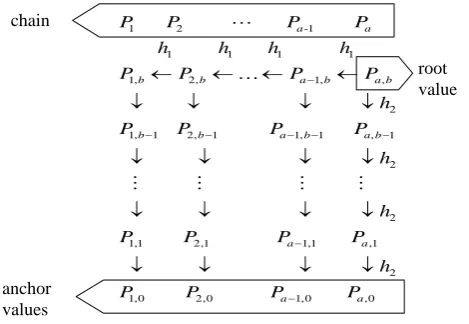
To support the multiple-vendors functionality in roaming payment, our protocol adopts the unbalanced one-way binary tree (UOBT) propoded by Yen et al. [9] in 1999 to construct the generalized PayWord chains. The UOBT can establish a two-dimensional matrix by deriving from a root value. Assume that the UOBT consists of the hash chains
1,..., a
P Pand Pa b, is a hash chain root value.Pa b, is extended by
using hash function h1 to generate a1 subroots. Each
subroot can derive an individual hash chain by applying another hash functionh2. The UBOT structure is shown in
Fig. 1.
Fig. 1. Unbalanced one-way binary tree.
III. PROPOSED PROTOCOL
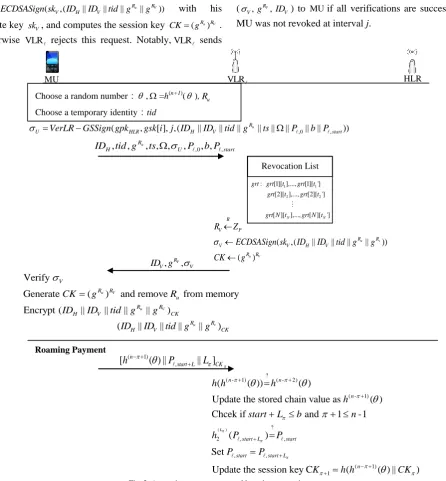
The proposed protocol employs the group signature to eliminate the communications between VLR and HLR in roaming. When a mobile user reaches the circumscription controlled by the foreign server, he signs a UOBT matrix on behalf of HLR as a commitment for paying later on. VLR and the valid mobile user can share a common session key at the end of authentication stage. The session key can be used in fast payment to confirm the validity of the requesting user and protect the payment information. The details of the proposed protocol are shown below (also see Fig. 2).
Step 1: The mobile user MU chooses a random number u
R and a temporary identity tid . MU computes
U
VerLR GSSign
-,0 ,
( , [ ], ,( || || || Ru|| || || || || ))
HLR H V start
gpk gsk i j ID ID tid g ts P b P
where P,0 denotes the chain anchor value of UOBT for
VLR, P,start denotes the chain starting in this payment event,
ts denotes a timestamp and denotes a root value of the hash chain used in the fast roaming payment (see below).
MUsends , , , Ru, , , U IDH tid g ts
P,0, , b P,start to VLR.
Step 2: Upon receiving the messages from MU, VLR verifies whether the group signature is valid or not. If the verification passes, VLR chooses a random number RV and computes an elliptic curve digital signature algorithm:
1 2 -1
1 1 1 1
1, 2, 1, ,
2
1, 1 2, 1 1, 1 , 1
a a
b b a b a b
b b a b a b
P P P P
h h h h
P P P P
h
P P P P
2 2
1,1 2,1 1,1 ,1
2 1,0 2,0 a a h h
P P P P
h P P
1,0 ,0
a a
P P
root value
anchor values
( ,( || || || Ru|| RV)) V ECDSASign skV IDH IDV tid g g
with his
private key skV, and computes the session key ( ) u V
R R
CK g . Otherwise VLR rejects this request. Notably,VLR sends
( , RV, V g IDV
) to MUif all verifications are successful and MU was not revoked at interval j.
Fig. 2. A roaming payment protocol by using group signatures.
Step 3: Upon receiving the messages from VLR, MU
verifies V by ( ,( || || || || ), )
u V
R R
V H V V
ECDSAVer pk ID ID tid g g . If the verification passes, MU computes the session key
( Ru)RV
CK g and removes Ru from its memory. Then MU
encrypts , , , Ru, RV
H V
ID ID tid g g by the session key CK and sends the encrypted message to VLR. Afterwards, VLR decrypts the message and verifies it. If the verification passes, the session key CK can be established between VLR and
MU.
Roaming Payment: This phase provides fast authentications and payments. The session key would be updated in each round by using hash chain technique from
[12]. MU prepares a hash chain
( ) ( 1) ( ) ( 1)
{ i( ) | [1, 1], i ( )= ( i( )) and n ( ) }
h i n h h h h in advance by selecting a random . Assume that CK denotes
th
session for MU to connect to VLR during the roaming service, and MU spends L dollars in th session.
Furthermore, we assume that VLR have stored
( 2) ( )
n
h before running thsession payment. The details of payment at thsession are shown in the following.
Step 1: MU sends ( 1) ,
[ n ( ) || || ]
start L CK
h P L to VLR.
Step 2: VLR uses session key CK to decrypt the received messages, and then checks if the equation
( 1) ( 2)
( n ( )) n ( )
h h h holds. If the verification passes, VLR updates the stored chain value to be ( 1)
( ) n
h , and then VLR checks if ( )
2 ( , ) ,
L
start L start
h P P
, 1 n 1and
startLb. If the above verifications pass, VLR sets ,start ,start L
P P and updates the session key
( 1)
1 ( ( ) || )
n
CK h h CK .
IV. ANALYSIS AND DISCUSSION
In this paper, the session key can be established by using Choose a random number:,=h(n+1)(),Ru
Choose a temporary identity:tid
,0 ,
, , Ru, , , , , ,
H U start
ID tid g ts P b P
,0 ,
( , [ ], ,( || || || Ru|| || || || || ))
U VerLR GSSign gpkHLR gsk i j IDH IDV tid g ts P b Pstart
MU VLR HLR
Revocation List
1 1
2 2
: [1][ ],..., [1][ ']
[2][ ],..., [2][ ']
[ ][ ],...,N [ ][ ']N
grt grt t grt t
grt t grt t
grt N t grt N t
( ,( || || || || )) ( ) u v u V R V P R R
V V H V
R R
R Z
ECDSASign sk ID ID tid g g
CK g
( || || || Ru|| Rv)
H V CK
ID ID tid g g
Verify
Generate ( ) and remove from memory
Encrypt ( || || || || )
u V u V V R R u R R
H V CK
CK g R
ID ID tid g g
, RV,
V V
ID g
Roaming Payment
( 1)
,
[ n ( ) || || ] start L CK
h P L
( ) ? ( - 1) ( - 2)
( - 1)
?
2 , ,
, ,
( 1) 1
( ( )) ( )
Update the stored chain value as ( )
Chcek if and 1 -1
( )
Set
Update the session key C ( ( ) || L
n n
n
start L start
start start L
n
h h h
h
start L b n
h P P
P P
K h h C
variant Diffie-Hellman protocol and the challenge-response technique. Therefore the robustness of the session key can be guaranteed. Moreover, by using the group signature scheme, the property of existential unforgeability can be achieved that means only a legitimate mobile user who has registered at HLR can generate a valid group signature on behalf of HLR. The proposed payment protocol, similar to He et al.’s
scheme[6], also can achieve anonymity and untraceability. We especially explain the case that the mobile user MU’s revocation token grt i j[ ][ ] appears in RLj (jth interval of the revocation list). Although VLR can make sure that the connecting mobile user has been revoked at interval j, but it cannot link the real identity of the mobile user and cannot connect grt i j[ ][ ]to other revocation tokens for different time
intervals.
The performance of the proposed protocol is analyzed as follows. First, the user public key operations in group signature, ECDSA and session key calculations, according to the estimations by He et al. [6], are about four pairings plus 15.75 elliptic curve scalar multiplications. Second, our payment procedure cannot increase the costs of the authentication. We only add one symmetric encryption for MU and L2 hash operations for VLRin the roaming payment procedure. It would be valuable to combine the payment into signature-based roaming authentication protocol, since the overhead is low and the practicality is high for some commercial applications.
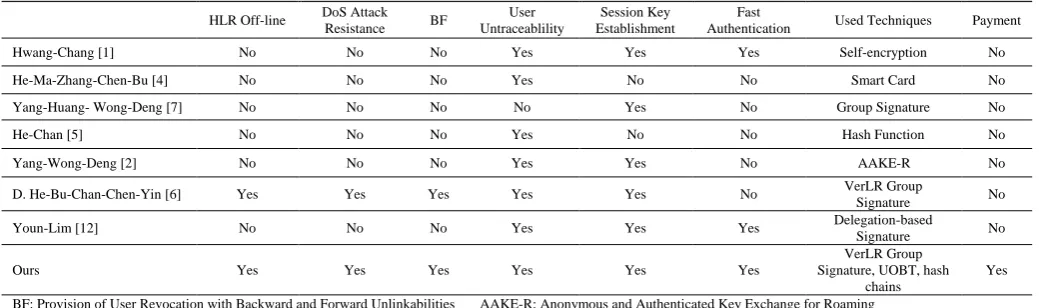
Table I shows the comparison in functionalities among the proposed protocol and other previous schemes.
V. CONCLUSION
It can be predicted that the roaming applications for business such as payments will be popular in the near future. Although the proposed authentication mechanism applied Diffie-Hellman-like protocol to construct the sharing key CK
between MU and VLR, it can resist against the man-in-the-middle attack since the signatures VerLR-GSSign
and ECDSASign are used to protect the exchanged
parameters. This paper proposed an efficient roaming payment protocol with session key update and UOBT chains to rapidly pay for small amounts of money. The user authentication uses a group signature to make HLR off-line in the protocol, which can eliminate DoS attacks and reduce the communication costs.
REFERENCES
[1] K. F. Hwang and C. C. Chang, “A self-encryption mechanism for authentication of roaming and teleconference services,” IEEE Trans.
on Wireless Communications, vol. 2, pp. 400-407, Mar. 2003.
[2] G. Yang, D. S. Wong, and X. Deng, “Anonymous and authenticated key exchange for roaming networks,” IEEE Trans. on Wireless
Communications, vol. 6, pp. 3461-3472, Sep. 2007.
[3] G. Yang, D. S. Wong, and X. Deng, “Formal security definition and efficient construction for roaming with a privacy-preserving extension,” Journal of Universal Computer Science, Special Issue on
Cryptography in Computer System Security, vol. 14, pp. 441-462, Feb.
2008.
[4] D. He, M. Ma, Y. Zhang, C. Chen, and J. Bu, “A strong user authentication scheme with smart cards for wireless communications,”
Journal Computer Communications, vol. 34, pp. 367-374, Mar. 2011.
[5] D. He, S. Chan, C. Chen, J. Bu, and R. Fan, “Design and validation of an efficient authentication scheme with anonymity for roaming service in global mobility networks,” Wireless Personal Communications: An
International Journal, vol. 61, pp. 465-476, Nov. 2011.
[6] D. He, J. Bu, S. Chan, C. Chen, and M. Yin, “Privacy-preserving universal authentication protocol for wireless communications,” IEEE
Trans. on Wireless Communications, vol. 10, pp. 431-436, Feb. 2011.
[7] G. Yang, Q. Huang, D. S. Wong, and X. Deng, “Universal authentication protocols for anonymous wireless communications,”
IEEE Trans. on Wireless Communications, vol. 9, pp. 168-174, Jan. 2010.
[8] R. L. Rivest and A. Shamir, “Payword and micromint: two simple micropayment schemes,” in Proc. the International Workshop on Security Protocols, Lecture Notes in Computer Science, vol. 1189, 1996, pp. 69-87.
[9] S. Yen, L. Ho, and C. Huang, “Internet micropayment based on unbalanced one-way binary tree,” in Proc. International Workshop on
Cryptographic Techniques and E-Commerce, July 1999, pp.155-162.
[10] D. Chaum and E. van Heyst, “Group signatures,” in Proc. the 10th annual international conference on Theory and Application of
Cryptographic Ttechniques, EUROCRYPT'91, 1991, pp. 257-265.
[11] T. Nakanishi and N. Funabiki, “Verifer-local revocation group signature schemes with backward unlinkability from bilinear maps,” in
Proc. the 11th international conference on Theory and Application of
Cryptology and Information Security, ASIACRYPT'05, vol. 3788, 2005,
pp. 533-548.
[12] T. Youn and J. Lim, “Improved delegation-based authentication protocol for secure roaming service with unlinkability,” IEEE
Communications Letters, vol. 14, pp. 791-793, Sep. 2010.
Chih-Hung Wang was born in Kaohsiung, Taiwan in 1968. He received the BS degree in Information Science from Tunghi University and MS degree in Information Engineering from National Chung Cheng University, Taiwan in 1991 and 1993, respectively. He received the Ph.D. degree in Information Engineering from National Cheng Kung University, Taiwan in 1998. He is presently an associate professor of Department of Computer Science and Information Engineering, National Chiayi University, Taiwan. His research interests include cryptography, TABLEI:THE COMPARISON AMONG THE PROPOSED PROTOCOL AND THE PREVIOUS SCHEMES
HLR Off-line DoS Attack
Resistance BF
User Untraceablility
Session Key Establishment
Fast
Authentication Used Techniques Payment
Hwang-Chang [1] No No No Yes Yes Yes Self-encryption No
He-Ma-Zhang-Chen-Bu [4] No No No Yes No No Smart Card No
Yang-Huang- Wong-Deng [7] No No No No Yes No Group Signature No
He-Chan [5] No No No Yes No No Hash Function No
Yang-Wong-Deng [2] No No No Yes Yes No AAKE-R No
D. He-Bu-Chan-Chen-Yin [6] Yes Yes Yes Yes Yes No VerLR Group
Signature No
Youn-Lim [12] No No No Yes Yes Yes Delegation-based
Signature No
Ours Yes Yes Yes Yes Yes Yes
VerLR Group Signature, UOBT, hash
chains
Yes
information security and data compression.
Chih-Yu Lin is a master student of Department of Computer Science and Information Engineering, National Chiayi University, Taiwan. Her research interests include cryptographic protocols and information security.