* To whom all correspondence should be addressed. Tel.: +98(912)2497906; Fax: +98-2188202520 E-mail: [email protected]
The Effects of Portfolio Method on
Self-directed Learning (SDL) of Nursing Students
Malahat Nikravan Mofrad1* and Maryam Karami2
Shahid Beheshti University of Medical Sciences, Tehran, Iran. DOI: http://dx.doi.org/10.13005/bbra/1201
(Received: 10 October 2013; accepted: 22 November 2013)
The teacher-centered learning methods provide fewer opportunities compared to student-centered methods. This study aims to determine the impact of the portfolio method on self-directed learning.This semi-empirical study conducted on 48 nursing students in medical-surgical ward. The sample was selected using census sampling method and classified into intervention and control groups. Data were collected using self-directed learning (SDL). Statistical analysis was performed using t-test, ANOVA, Kruskal-Wallis test, Chi-square and Pearson correlation coefficient with the help of SPSS-18.The intra-group comparison and total scores indicated the conventional teaching and portfolio methods increased the scores of self-control and self-management in both intervention and control groups. The intergroup comparison showed the same outcomes. So no statistically significant differences were observed. The total scores of self-directed learning showed the conventional teaching and portfolio methods will increase nursing students’ self-directed learning (P=0.001 and P=0.003 for intervention and control groups, respectively). However, self-directed learning in intervention group showed a significant increase compared to the control group (P=0.006). It can be inferred that the conventional method has been able to strengthen self-direction in nursing students in the field internship and the homework assignments in the form of a portfolio will increase its impact on self-direction.
Key words: Portfolio, Self-Directed Learning, Field Internship.
Due to increased production of knowledge, information and technology, the medical knowledge is very short-lived. To overcome this situation, students should become lifelong learners, instead of transferring a set of information and knowledge to them. Due to the necessity of lifelong learning, self-directed learning theory is increasingly arising as a requirement in medical education. The medical students enter a field with professional training courses in which updated knowledge, skills and self-direction is necessary to succeed in this
arena1. According to the self-direct learning theory, students are encouraged to assess their knowledge deficits and act to resolve the defects. To reach this goal, they might make use of their knowledge, available resources or informed judgment to select appropriate solutions2. Nursing education, like most medical disciplines involves both theoretical and practical processes. The clinical training is the most important and integral part of nursing education. In terms of importance, it is considered as the heart of professional education3.
their families4. Training competent graduates, as the objective of nursing education is of great importance. Thus, to ensure the achievement of this goal, it is necessary to receive feedback on the training of learners, graduates and recipients of health care in the community. Medical educators use several methods and tools to evaluate the level of student skills as an essential part of the clinical training5. Portfolio along with functional tests resulted in a small revolution in the definition and implementation of this evaluation6. Portfolio is defined as “a bag for keeping documents and work samples” in oxford Dictionary7. This vocabulary is derived from an Italian expiration “portarefogliou”8. It was utilized in educational arena from 1980th in order to evaluate the learner performance8. Portfolio is a tool for collecting learning documents that presents picture of individual and professional development9. Accordingly, this can be used in order to offer learning, previous experiences and proof of eligibility for entrancing to new course of study or new job. To tell the truths, it is not a simple tool for collecting learning data and documents. Now it develops like as useful tool to reinforce general and specific skills such as critical thinking and reflection10, apply theoretical knowledge to practical11, and knowledge development12. In general, a portfolio is a set of evidence, usually in written form, of learning products and processes. The portfolio shows achievements and personal and professional developments through a critical analysis of the content13.
Since the nursing students enter the fields with professional education courses, updated knowledge, skills and self-direction are necessary for the success in this arena. Medical educators need appropriate tools for assessment of the self-directed abilities of students to adjust learning resources and teaching methods to develop the SDL ability of students14. The teacher-centered learning methods provide fewer opportunities for nursing students’ personal experiences compared to student-centered methods15. Therefore, the present study aims to determine the impact of the portfolio method on self-directed learning of nursing students in ShahidBeheshti University of Medical Sciences.
Materials and Methods
The population consisted of all nursing students in semester 8 who passed medical-surgical internship course in the first and second semesters of 2012-2013 in the hospitals affiliated to ShahidBeheshti University of Medical Sciences. The sample size was 48 selected by census method. The subjects passed the theoretical courses of internal-surgery and had not unallowable absence during the internship course. The data were collected using fisher questionnaire and portfolio evaluation checklist. The content validity of the tool was confirmed with amendment comments of 10 members of the faculty.
The questionnaire included demographic information and self-direction scale (with three sub-scales of willingness to learn, self-control and self-management). This scale is a self-assessment tool consisted of 40 items which has been developed and validated for the first time by fisher and his colleagues16. The subject responded to a 5-degree scale with a very high5 to a very low1 score. Portfolio evaluation checklist was developed by Davis et al. The checklist includes 6 criteria, each criterion with a minimum score of 1 and a maximum score of 4. The criteria include the portfolio content, discussion on portfolio, patient management, the ability to use theoretical information at bedside, use of educational resources and academic behavior (learning from patients). The Cronbach’s alpha was used to calculate the reliability of the two tools. The reliability for fisher questionnaire and portfolio evaluation checklist was calculated equal to 0.86 and 0.83, respectively.
results
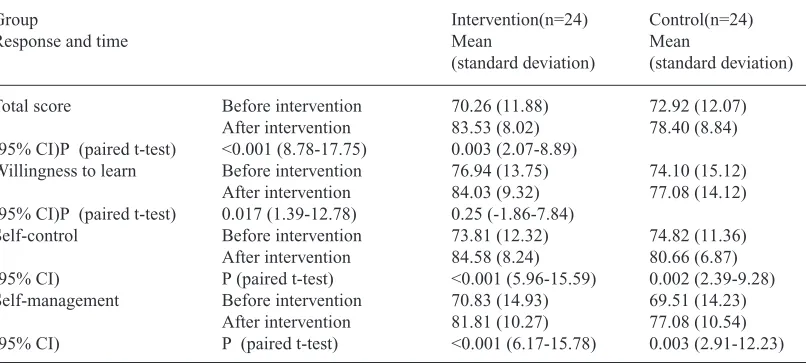
The intra-group comparison of three domains of self-directed learning questionnaire and total scores indicated that the conventional teaching and portfolio methods increased the scores of self-control (P=0.001 and P=0.002 for the intervention and control groups, respectively) and self-management (P=0.001 and P=0.003 for the intervention and control groups, respectively) in both intervention and control groups. The intergroup comparison showed that same improvements in both the intervention and control groups. In this regard, no statistically significant differences were
observed between the two groups (P=0.091 and P = 0.299 for self-control and self-management, respectively). The intragroup comparison showed that the score of willingness to learn increased after training in the intervention group (P=0.017). However, no significant difference was observed before and after training in the control group (P=0.215). The total scores of self-directed learning of students in both control and intervention showed that the conventional teaching and portfolio methods will increase nursing students’ self-directed learning (P=0.001 and P=0.003 for intervention and control groups, respectively). However, the difference between the intervention
table 1. Description and comparison of background variables in intervention and control groups
Intervention group Control group P
(n=24) (n=24)
Mean (Standard Deviation)
Age 22.21(1.38) 22.71 (0.86) 0.140
6 Semester GPA 15.6 (1.10) 16.27 (1.17) 0.053
Number (%)
Gender female 12 (50) 15 (62.5) 0.383
Male 12 (50) 9 (37.5)
Interest in nursing High 9 (37.5) 10 (41.7) 0.946
Moderate 9 (37.5) 8(33.3)
Low 6(25) 6(25)
A history of student work Yes 10 (41.7) 10 (41.7) 1
No 14 (58.3) 14 (58.3)
table 2.Description and comparison of mean difference of self-directed learning scores of students in each group before and after intervention (intra-group difference)
Group Intervention(n=24) Control(n=24)
response and time Mean Mean
(standard deviation) (standard deviation)
Total score Before intervention 70.26 (11.88) 72.92 (12.07)
After intervention 83.53 (8.02) 78.40 (8.84)
(95% CI)P (paired t-test) <0.001 (8.78-17.75) 0.003 (2.07-8.89)
Willingness to learn Before intervention 76.94 (13.75) 74.10 (15.12)
After intervention 84.03 (9.32) 77.08 (14.12)
(95% CI)P (paired t-test) 0.017 (1.39-12.78) 0.25 (-1.86-7.84)
Self-control Before intervention 73.81 (12.32) 74.82 (11.36)
After intervention 84.58 (8.24) 80.66 (6.87)
(95% CI) P (paired t-test) <0.001 (5.96-15.59) 0.002 (2.39-9.28)
Self-management Before intervention 70.83 (14.93) 69.51 (14.23)
After intervention 81.81 (10.27) 77.08 (10.54)
and control groups was significant, so that self-directed learning in intervention group showed a significant increase compared to the control group (P=0.006).
discussion
Preliminary statistical results showed that the mean age of students in both groups was between 22 to 23 years. Therefore, no statistically significant correlation was found between the two groups. Smedley et al. (2007) observed no statistically significant correlation between the mean level of clinical skills and nursing students’ learning and age. However, Nadi and Sajjadian (2011) found that the older students have higher self-direction than younger students. The mean GPA of six last semesters of students in control and intervention groups was 15.6 and 16.27, respectively. The difference between the two groups was not statistically significant. These results showed a significant correlation between readiness for self-directed learning, the total score, GPA and the score of basic sciences exam. Smedley (2007) found a significant correlation between the GPA of past semesters and the mean clinical skill in the intensive care unit (0.009). In other words, students with higher GPA had higher skill levels in the intensive care unit. Yassini et al. (2003) found a significant correlation between the mean scores of pre-internship test, basic sciences comprehensive exam and the mean score of clinical examination quality, so that the increase in test scores resulted in higher scores of physical examination. The few samples probably led to inconsistent results with above studies17.
The effect of interest in nursing on self-directed learning was also investigated. The results indicated that upon completion of the internship in the control group, the mean score of the willingness to learn was significantly increased. The students with a passion for nursing have more self-direction in terms of willingness to learn. In the intervention group, at the end of the internship, self-directed learning showed a significant improvement in all three areas in terms of interest in nursing. The results of the present study are consistent with the results of BeigMoradi and Nazeri (2004) who found that students with more interest in nursing have higher clinical skills18.
The total score of the students’ self-directed learning in the intervention and control groups were compared (intergroup comparison). The training times of conventional training and portfolio methods will increase nursing students’ self-directed learning in both groups. However, the interaction between group and time showed a significant difference between the intervention and control groups (P= 0.006). In other words, self-directed learning using a portfolio in the intervention group showed a significant increase compared to the control group. The use of portfolios in the field internship could be more effective on self-direction of students. According to Tiwari and Tung (2003), the students who used portfolio method in their clinical training, believed that the use of this method as a method for clinical training and evaluation improved their clinical learning19. Karimi et al. (2010) found that portfolio approach improved learning through increasing students’ participation in the learning process and assisting them in the application of theoretical principles and concepts of clinical education. Kumar et al. (Graduate Education and research Center, 2008) showed that students’ learning significantly enhanced using the portfolio method compared to conventional methods20. The results of Namdarpour (2008) also confirmed that there is a significant correlation between self-directed learning and academic skills of students21. Valizadeh et al., (2011) indicated that portfolio is a suitable method in order to enhance cognitive learning for nursing student during clinical settings. The results of Bahreini’s survey showed a positive impact on reflective thinking skills of nurses by use of portfolio22. Heidari stated that this tool can enhance learning rate by increasing the student participation in clinical training23.
conclusion
that the homework assignment in the form of a portfolio will increase its impact on self-direction. Therefore, it is recommended that the portfolio method would be used for homework assignment in field internship.
references
1. Cheng S-f, Kuo C-L, Lin K-C, Lee-Hsieh J. Development and preliminary testing of a self-rating instrument to measure self-directed learning ability of nursing students. International journal of nursing studies. 2010;47(9):1152-8. 2. Karimi r, Arendt CS, Cawley P, Buhler AV,
Elbarbry f, roberts SC. Learning bridge: curricular integration of didactic and experiential education. American journal of pharmaceutical education. 2010;74(3).
3. Elcigil A, Yýldýrým Sarý H. Determining problems experienced by student nurses in their work with clinical educators in Turkey. Nurse Education Today. 2007;27(5):491-8.
4. Council SP. Curriculum of nursing education, nursing courses, approved by Supreme Planning Council. Tehran: Ministry of Health and Medical Education 2006.
5. Gaberson KB, oermann MH. Clinical teaching strategies in nursing: Springer publishing company; 2010.
6. Kubiszyn T, Borich G. Educational Testing and Measurement: classroom application and practice 17th ed. ed. NewJersey: John Wiley & Sons; 2010.
7. Second Edition ed. oxford: oUP oxford; 2003. oxford Dictionary of english.
8. Valizadeh S, rahmani A, Davoodi A, Aminiaee N. Comparison of the effect of clinical education and assessment using portfolio and blended methods on cognitive learning of nursing students in clinical settings. Iranian Journal of Medical Education. 2011; 11(3): 245-53.
9. McMullan M, Endacott r, Gray MA, Jasper M, Miller CM, Scholes J, et al. Portfolios and assessment of competence: a review of the literature. Journal of Advanced Nursing. 2003;
41(3): 283-94.
10. Kennison MM, Misselwitz S. Evaluating reflective writing for appropriateness, fairness, and consistency. Nursing education perspectives. 2002; 23(5): 238-42.
11. Taylor C. Narrating practice: reflective accounts and the textual construction of reality. Journal of advanced nursing. 2003; 42(3): 244-51. 12. Johns C. reflective practice: revealing the [he]
art of caring. International journal of nursing practice. 2001; 7(4): 237-45.
13. McMullan M. Students’ perceptions on the useof portfolios in pre-registration nursing education: a questionnaire survey. International Journal of Nursing Studies. 2006; 43(3):333-43.
14. Nadi M, Sajjadian A. Validation of self-directed learning readiness scale for medical and dental students,. Iranian Journal of Medical Education.
2011; 11(2): 174-82.
15. Sajjadi Hezaveh M, Berimnezhad L. Learning contract: an approach in nursing education.
Iranian Journal of Medical Education. 2011;
11(7): 696-700.
16. Smedley A. The self-directed learning readiness of first year bachelor of nursing students. Journal of Research in Nursing. 2007;12(4):373-85. 17. Yassini S, et al Evaluation of the quality of
physical examination skills of interns in Shahid Sadoghi Yazd University of Medical Sciences.
Journal of YazdUniversity of Medical Sciences, Medical Education Special Issue. 2003; 2: 28-31.
18. Beig Moradi A, Nazeri H. Evaluation of achievement of educational objectives of nursing, midwifery and operating room courses at Hamedan University of Medical Sciences andShiraz University of Medical Sciences. Iranian Journal of Medical Education, 5th National Conference on Medical Education special issue 2004;1 (2):33.
19. Tiwari A, Tang C. from process to outcome: the effect of portfolio assessment on student learning.
Nurse Education Today. 2003; 23(4): 269-77. 20. Sahu SK, Soudarssanane M, roy G, Premrajan
K, Sarkar S. Use of portfolio-based learning and assessment in community-based field curriculum. Indian journal of community medicine: official publication of Indian Association of Preventive & Social Medicine. 2008; 33(2): 81.
21. Namdarpour f. The relationship between self-regulation of learning, skills and academic achievement among students of Islamic Azad University, Khomeini Shahr Branch, Journal of New Ideas inEducational Sciences. 2008;
4(1):137-52.
22. Bahreini M, Shahamat S, Moattari M, Akaberian S, Sharifi S, Yazdankhah fard M. Development of reflective skills among nurses through portfolio: a Qualitative study. Iranian Journal of Medical Education. 2012; 12 (2): 120-30.
23. Heidari T. The effect of Portfolio’s evaluation on learning and satisfaction of midwifery students.