R E S E A R C H A R T I C L E
Open Access
Longitudinal patterns of poverty and health in
early childhood: exploring the influence of
concurrent, previous, and cumulative poverty on
child health outcomes
Nikiéma Béatrice
*, Gauvin Lise, Zunzunegui Maria Victoria and Séguin Louise
Abstract
Background:Although the links between poverty and health have often been studied , the dynamics of poverty and physical health in early childhood remain under-investigated. In particular, it is not known whether the health of young children is affected differently from that of adults by patterns of poverty unique to them.
Methods:We examined patterns of health from 5 to 41 months of age as a function of concurrent, lagged, and chronic exposure to insufficient income. Using data from the first four rounds of the Quebec Longitudinal Study of Child Development, we performed multilevel logistic and multilevel Poisson regressions and latent growth curve analyses to explore associations between exposure to poverty and mother-reported asthma-like attacks, and maternal perception of health status controlling for neonatal, maternal, and environmental characteristics. Results:The mean number of mother-reported asthma-like attacks significantly decreased as children aged. The likelihood of being perceived in a poorer health status also decreased across time.Concurrent povertywas associated with more mother-reported asthma-like attacks and with a higher risk of being perceived in poorer health status.One-period-lagged povertywas associated with more mother-reported asthma-like attacks and this remained significant after controlling for concurrent poverty. The number of mother-reported asthma-like attacks was significantly higher among children in thechronic povertyclass compared to those in the never-poor class, particularly at 17 and 29 months. Perceived health status at 5-months was significantly poorer among chronically poor children compared to never-poor children.
Conclusion:Exposure to poverty negatively affects two major health indicators in early childhood–maternal perception of child health and mother-reported asthma-like attacks. Patterns of the effects vary according to timing and duration of poverty exposure. Further longitudinal research is warranted to disentangle time-specific from cumulative effects of poverty on child health.
Background
Although the links between poverty and health have often been studied, the dynamics of poverty across time and their association with health outcomes have not been examined extensively among young children. Pov-erty is not a static condition. There are many transitions in and out of poverty, even more so for parents of young children [1]. Previous research [2-6] suggests that
chronic or sustained poverty is more deleterious than intermittent poverty or episodes of shorter duration. However, it is not known whether the health of young children is affected differently from that of adults by pat-terns of poverty unique to them. Although the import-ance of poverty related to children’s health during the first years of life for adult health is well established [7-14], there is a dearth of information regarding the dynamics of poverty and health during the early child-hood years. Therefore, the main objective of this article was to examine how the timing and duration of epi-sodes of poverty (as measured by income sufficiency) * Correspondence:[email protected]
Department of Social and Preventive Medicine, Université de Montreal, C.P. 6128 succ Centre-Ville, Montreal, Quebec H3C 3 J7, Canada
are related to the probability of the mother reporting asthma-like attacks and of perceiving her child to be in less than very good health during early childhood. To this end, we analyzed data from 1998 to 2001 in the Quebec Longitudinal Study of Child Development (QLSCD) birth cohort.
Existing evidence
Few studies have examined the interrelationships be-tween children’s exposure to poverty at various times in their lives and their health status. Among American chil-dren, McLeod and Shanahan [15] and Macmillan et al. [16] found that early childhood exposure to poverty fos-ters antisocial behaviour and depression later on in life, for example in adolescence. They also found that stabil-ity or transitions in parents’ poverty status resulted in changes in children’s antisocial behaviour. MacMillan et al. [16] reported that compared to children who were better-off over the entire study period, those exposed to persistent poverty presented aggravated antisocial behav-iour. Longer-term exposure to poverty was associated with increasing antisocial behaviour whereas movement out of poverty did not significantly change trajectories of antisocial behaviour. Strohchein (17) observed somewhat similar patterns in Canada after analysing data on chil-dren who were monitored between the ages of 4 and 14 years. In addition to an association between lower household income and higher depression and antisocial behaviour at baseline, the author observed that improve-ments in income attenuated mental health problems while a decrease in income was associated with an in-crease in mental health problems. Despite these findings, it should be noted that associations between patterns of poverty and children’s mental health may not replicate across health outcomes. This was exemplified in Stroh-chein’s study [17]. The association between initial house-hold income and the rate of change in depression became weaker over time whereas the association be-tween initial household income and the rate of change in antisocial behaviour became stronger. In a study con-ducted by McLeod and Shanahan [15], changes in anti-social behaviour were positively correlated with the number of years spent living in poverty whereas histories of poverty subsequent to baseline status were unrelated to children’s trajectories of depression.
However, compared to mental health, the ways in which children’s physical health are influenced by their household income histories have been less explored. When examining what differentiates early onset from late onset of persistent wheezing in a cohort of children followed from birth to 10 years of age, research has shown that, in addition to a strong genetic component of persistent asthma common to both types, lower social class at birth was related to early onset of wheezing in
infancy [18,19]. This effect was not associated with ex-posure to smoking and to formula feeding which also play a role in respiratory health problems. Another lon-gitudinal investigation involving children from the ages of 6 through 14 years showed that exposure to chronic poverty was associated with the incidence of persistent asthma [20]. Finally another study showed that persist-ent maternal distress was also associated with a greater likelihood of childhood asthma [21].
Moreover, Chen et al. [3] analyzed how trajectories of socioeconomic status over time were linked to children’s health at 10–11 years and 14–15 years of age. The cumu-lative effect of low family income over time was more deleterious to children’s physical health than variability in socioeconomic status (measured by the standard devi-ation in income) or changes in socioeconomic status (measured by income levels). Their results also suggested that exposure to economic hardship before five years of age strongly increases the likelihood of experiencing poor health in later childhood. Other studies have shown that exposure to low income in early childhood is a strong predictor of systolic blood pressure in adolescence, but childhood socioeconomic status seemed unrelated to heart rate or body mass index in the teenage years [22].
Plausible hypotheses
downward mobility. For example, Matthews et al. [30] found that downward mobility was associated with a higher incidence of hypertension. Moreover, McDo-nough et al. [24] suggest that all of these potential path-ways may exert an influence and thus each may contribute to explaining a different facet of the poverty-health relationship. In particular, they analyzed the effects of four long-term poverty patterns comprising stable absence of poverty, exiting poverty, entering pov-erty, and stable povpov-erty, and concluded that different trajectories of poverty affect self-rated health in“distinct ways. . .in concert with age, education, and race to create gaps in initial health status that were constant over time.”
Framed within this lifecourse perspective, we exam-ined how concurrent poverty, prior poverty occurring at specific times, and cumulative poverty across time may lead to differential patterns of health in a birth cohort of children during the first four years of life. Since the data-set did not allow for a thorough verification of all of the aforementioned hypotheses, the scope of this article was limited to exploring associations between patterns and dynamics of poverty and children’s health across time. We defined concurrent poverty as that level of poverty which was present when the child’s health status or condi-tion was measured. Poverty measured at a previous round or one-period lagged allowed us to explore whether or not poverty at this specific, recent critical period might have subsequent effects on health beyond current poverty. Cumulative poverty designated a child’s membership in chronic or transient poverty classes over the four survey rounds under investigation and allowed for an examin-ation of the impact of repeated and sustained poverty on health.
Methods
Data
We used data from the Québec Longitudinal Study of Child Development (QLSCD), an ongoing population-based birth cohort study coordinated by the Institut de la Statistique du Québec (ISQ) (Québec Institute of Sta-tistics). The QLSCD started with a representative sample of 2 120 singleton infants who were recorded in the registry of Quebec births in 1997/1998. Excluded were children born to mothers residing in Cree and Inuit ter-ritories, Indian reserves, and/or certain northern regions of Québec (2.1% of singleton live births). Infants born before the 24thor after the 42ndweek of gestation (0.1%) and those with unknown gestational age (1.3%) were also excluded. Children were enrolled at a mean age of five months (15–36 weeks) and subsequently followed-up annually. We used data collected during the annual rounds between 1998 and 2001 (ages approximately 5, 17, 29, and 41 months) including repeated assessments
of children’s health, growth, and use of health care, par-ents’health and socioeconomic status, and various char-acteristics of the child-rearing environment. Much of these data are based on mothers’ responses to com-puter-assisted, face-to-face interviews administered by trained interviewers, and to self-administered paper questionnaires. We obtained information on the chil-dren’s neonatal health status from medical records.
The study received ethical approval from the Research Ethics committee of the Faculty of Medicine , University of Montreal and from the Ethics committee of the Direction Santé Québec, Institut de la statistique du Québec. Parents of participating children gave their signed consent at each study round.
Child health assessment
For each survey round under study, we classified chil-dren according to whether their mothers perceived their child’s health status as being less than very good (Yes/ No) during the previous 12 months. We then calculated the number of asthma-like attacks the mother reported her child had experienced during the same period. As other authors have reported [31-33] it is difficult to ac-curately diagnose asthma before the age of 6 years as other conditions such as viral infections and bronchitis can be responsible for asthma-like symptoms in young children and toddlers. When children get older, they can be said to have experienced a transient wheeze (which goes away) or to have a persistent wheeze (which is even-tually diagnosed as asthma). Although in the QLSCD mothers were asked to report on the number of asthma attacks, we elected to label this outcome as the number of mother-reported asthma-like attacks because these reports encompass both transient and persistent wheez-ing (whether they are related to asthma or other condi-tions). Maternal perception of her child’s health status was measured at 5, 17, 29, and 41 months whereas the number of mother-reported asthma-like attacks was measured at 17, 29, and 41 months.
Operationalization of poverty
At each study round, mothers were asked to report total annual household income before taxes. The interviewer first asked whether or not the household had received any income from a list of possible sources during the preceding 12 months. Respondents were then asked to give their“best estimate of the total income before taxes and deductions of all household members from all sources”[34] (p. 12–16) by indicating the income group in which their total household income fell.
previous 12 months below that of the Canadian low-income cut-off (LICO) computed annually by Statistics Canada [35]. LICOs are based on the size of the house-holds and the geographic location of communities in which families reside. For example, in 2001 (4th round of the QLSCD), LICOs were $24 502, $28 101, and $35 455 (CAD) for a family of four living in rural areas, towns (< 30,000 inhabitants), or large cities (> 500,000 inhabitants) respectively [36].
Other predictors of child health
In addition to poverty, other potential predictors of chil-dren’s health included their socio-demographic characteris-tics (birth order and sex), neonatal health condition (premature status and presence of malformations), and en-vironment and rearing conditions (duration of breastfeed-ing, having a pet at home, exposure to smoking at home, type of child care, and type of family). Mother-related pre-dictors included the mother’s age, education, and immi-grant status. The variables, type of family, type of child care, and exposure to smoking, were observed at each survey round. All other predictors were baseline measures.
Statistical analysis strategy
After computing descriptive statistics, we applied level analysis techniques to assess univariate and multi-variable associations between various static and dynamic operationalizations of poverty and child health. This ap-proach was used to address repeated measures of dependent outcomes and the mix of time-changing and time-invariant covariates. Multilevel models for count data (Poisson) were fit for associations between poverty and the number of mother-reported asthma-like attacks and multilevel models for binary data (logistic) were fit for associations between poverty and being perceived in less than very good health.
To assess concurrent effects of poverty and those of poverty during the previous survey round, we proceeded with multilevel growth curve analysis in which two hier-archical levels were defined: study rounds (level 1) were nested within children (level 2). Growth curve analysis provided us with a means of describing patterns of change (from baseline status) in the two health indicators as the children aged, and of verifying whether or not both the baseline health status and subsequent change rates varied with the presence of poverty, while controlling for other covariates. Given that at baseline, 75% of children were 5-months old, 8% were 4-months old, and 17% were older than 5 months (6-months = 16%; 7-months = 1%), we believe that inclusion of dummy variables accounting for time coterminously accounted for age.
Reported income, from which we established poverty status, is known to be often subject to measurement errors which may compromise the accuracy of single- or
multi-year assessments of poverty [37]. We accounted for this potential error through instrumental variable es-timation using the 2-Stage Least Square approach as recommended in the literature [38-40]. In the first stage, annual household income was expressed as a ratio of the relevant LICO. Then, we conducted multilevel linear growth curve analysis in the resulting natural logarithm of the “LICO-standardized” annual household income. For each survey round, the predictors were the house-hold income rank in the sample, the type of family, the mother’s education and immigrant status at baseline, and the child’s birth order. Household income rank has been used in other studies as a valid instrument for mea-sured income [41,42] and was considered an appropriate instrumental variable in our study because it is corre-lated with income and uncorrecorre-lated with the error term in the poverty-health relationship [38]. Only children who participated in all four survey rounds under study were included in these analyses.
In the second stage, the fitted income values were used to establish a child’s poverty status, defined as the expo-nential of its fitted annual income below the LICO. The measure of concurrent poverty shared the same 12-month-recall period as the health indicator, whereas pov-erty at a previous survey round referred to povpov-erty status during the 12 months preceding the measurement of the health indicator. For example, at 41 months, concurrent poverty referred to this status between the ages of 29 and 41 months whereas previous poverty referred to this sta-tus between the ages of 17 and 28 months. In addition, dummy variables were created for each survey round and were introduced in the first model to capture changes in outcome variables across time. The baseline parameter was set to represent the intercept for the outcome and the other time-specific parameters set to represent change across time. Adjusted poverty variables were added in the second model. Then other predictors were added one by one to assess their confounding role in the poverty-health relationship. They were considered con-founders if their inclusion changed the value of the pov-erty coefficient by at least 10% at any survey round. The final model was fitted with adjusted poverty variables, outcome-specific confounders, and other covariates bear-ing a statistically significant association with the health outcome.
reasonable and parsimonious definition was the 3 class model. Hence, children were categorized according to their most likely class membership into one of three pov-erty classes – those who were never poor, those having experienced transient poverty, and those with chronic poverty. We then used the children’s class membership as a second-level (child-level) variable in a regular growth curve analysis to assess whether or not health at different times varied across poverty latent classes.
For all analyses, sample weights provided by theInstitut de la Statistique du Québec were used to adjust for non-response bias occurring through attrition. HLM software (v. 6.04) was used to perform logistic and Poisson growth curve analyses and Mplus software (v. 5.2) was used for Latent Class Growth Analysis. For multilevel logistic and multilevel Poisson regressions we applied the sixth order Laplace approximation which provides very accurate esti-mates for all parameters [44,45]. Details on the analysis strategies and equations of the aforementioned models are presented in Additional file 1: Appendix 1 and Appendix 2 (on-line Additional file 1) respectively. Statistical significance
was evaluated at a Alpha level of 1% rather than 5% to pro-vide more conservative estimates.
Results
Descriptive
Data were available for 96.5% (N = 2 045), 94.2% (N = 1 997), and 92.0% (N = 1 950) of the original cohort in the 2nd, 3rd, and 4th annual survey rounds respectively. Table 1 shows the distribution of health indicators and time-dependent covariates at ages 5, 17, 29, and 41 months. The proportion of mothers who perceived their child as being in less than very good health varied between 8% and 11% of cases depending on the survey year. The average number of mother-reported asthma-like attacks per year varied from 0.27 at 17 months to 0.17 at 41 months. Based on reported income levels, the proportion of children who were living in a household with insufficient income varied from 27.6% at 5 months to 20.1% at 41 months. Based on predicted income in the model, the proportion of children living in a house-hold with insufficient income varied from 27.8% at
Table 1 Child health indicators and time-varying covariates in the initial four rounds of the QLSCD (1998–2001)
Survey round
Age of child 5 months† 17 months† 29 months† 41 months†
Total sample size 2 120 2 045 1 997 1 950
Health indicators
Number of motherreported asthmalike attacks* -past 12 months:M (SD)
- 0.27 (1.66) 0.23 (1.42) 0.17 (1.11)
Maternal perception of child’s health as being less than very good - past 12 months :%
7.9 11.2 9.7 11.0
Time-varying covariates
Household income sufficiency - past 12 months N=2 078 N=2 007 N=1 968 N=1 893
Sufficient :% 72.4 76.0 78.0 79.9
Insufficient :% 27.6 24.0 22.0 20.1
Predicted household income sufficiency†† N=1 886 N=1 884 N=1 886 N=1 894
Sufficient :% 72.3 74.4 76.7 77.6
Insufficient :% 27.7 25.6 23.3 22.4
Type of family - past 12 months N=2 112 N=2 041 N=1 993 N=1 945
Two biological parents :% 80.0 78.0 76.1 75.0
Two parents, one biological :% 10.8 11.2 11.2 11.6
Single parent :% 9.2 10.8 12.7 13.4
Parents smoke at home-past 12 months N=2 119 N=2 038 N=1 989 N=1 936
No / occasionally :% 75.5 69.9 72.9 74.6
Daily :% 24.5 30.1 27.1 25.4
Type of child care-past 12 months N=2 120 N=2 045 N=1 997 N=1 950
In child’s home :% 90.0 53.6 49.6 36.4
External home-based daycare :% 8.3 36.6 33.6 32.7
Daycare centre :% 1.7 9.8 16.8 30.9
*Numbers and percentages at 17 months of age pertain to mother-reported asthma-like attacks having occurred since birth. M (SD): Mean (Standard Deviation);†Weighted percentages.
5 months to 22.4% at 41 months. Table 2 presents the distribution of time-invariant covariates in the sample and as a function of children’s poverty status at baseline. Latent class analysis of poverty across time revealed that 68.8% of children were most likely to be in the never-poor class, 14.7% in the transient poverty class, and 16.5% in the chronic poverty class.
Changes in health status across time
Adjusted models for the effects of concurrent, previous-period, and cumulative poverty are summarized in Tables 3 and 4 and in Figures 1 and 2. Tables 3 and 4 indicate that the mean number of mother-reported asthma-like attacks decreased as children aged. The likelihood of a mother perceiving her child as being in less than very good health was higher in the second survey round (17 months of age) compared to the initial round (5 months).
Effects of concurrent poverty
Over the follow-up periods, after accounting for outcome-specific covariates and applying longitudinal sample weights, concurrent poverty was significantly associated with higher likelihood of being perceived in
less than very good health (odds ratio [OR] =1.51; 95% confidence Interval [CI]: 1.14,1.99) and with a higher mean number of mother-reported asthma-like attacks (ERR = 1.39; 95% CI:1.09, 1.76)(Table 3).
Effects of one-period lagged poverty
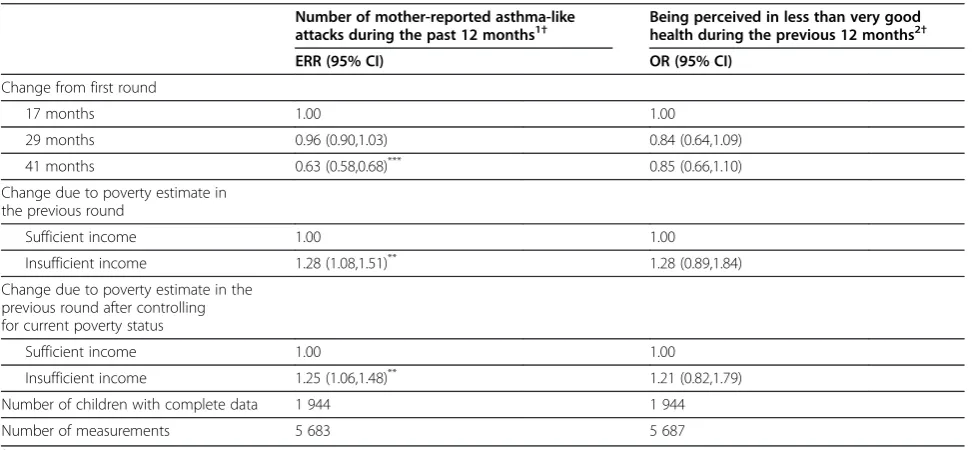
Table 4 shows that poverty assessed during the previous survey round had an effect on only one of the indicators. Holding other covariates constant, children exposed to poverty 12 months before the assessment of the health outcome had 28% increase in mother-reported asthma-like attacks (event rate ratio [ERR] = 1.28; 95% CI: 1.08, 1.51) than non-poor children. The increase in the mean number of mother-reported asthma-like attacks remained significantly associated with previous-round poverty (ERR = 1.25; 95% CI: 1.06, 1.48) even after controlling for concurrent poverty.
Effects of cumulative poverty
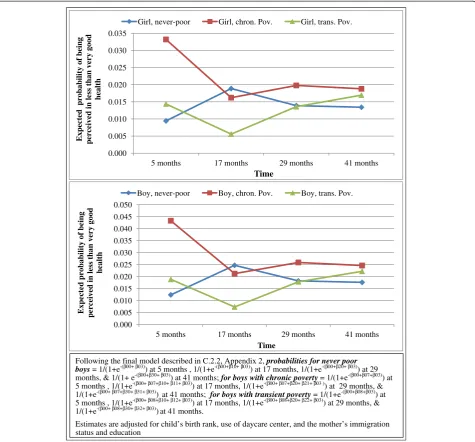
Figures 1 and 2 show estimates of the children’s health at different times related to their membership in the three la-tent classes of poverty and their sex. First-born girls who were classified in the never-poor trajectory group, who
Table 2 Child’s and mother’s characteristics as a function of reported income sufficiency at baseline (5 months) among
1 950 children followed-up to age 41 months (QLSCD, 1998–2001)
Distribution in the sample Distribution by reported income level at baseline (5 months)
Income
Sufficient Insufficient Missing data
% % % %
Child’s birth order
First 44.9 45.4 39.9 47.4
Second 39.3 40.5 37.2 36.8
Third and higher 15.8 14.0 22.9 15.8
Child’s sex
Girl 49.8 50.1 45.4 55.3
Boy 50.2 49.9 54.6 44.7
Mother’s age
<20 years 2.9 0.9 8.8 10.5
20-34 years 83.6 85.7 78.1 81.6
>=35 years 13.4 13.3 13.1 7.9
Missing data 0.0 0.1 0.0 0.0
Mother’s immigrant status
Non-immigrant or European-origin immigrant 92.8 96.2 75.7 76.3
Non-European Immigrant 7.1 3.8 24.3 21.1
Missing data 0.1 0.1 0.0 2.6
Mother’s education
College or university studies 64.0 70.4 41.3 44.7
High school, vocational or trade school diploma 20.6 20.1 22.7 34.2
No high school diploma 15.3 9.5 35.8 21.1
were born to 20–34 years old mothers with a university diploma, and who were living in a two-parent-family at 17 months of age represent the reference group. Among this reference-group, the mean number of mother-reported asthma-like attacks significantly decreased across time. In comparison, at 17 months, the number of mother-reported asthma-like attacks per year among chil-dren who experienced chronic poverty was 2.44 greater
than (from Figure 1, [Event Rate Ratio = 0.012/ 0.005] for girls, and [Event rate Ratio = 0.040/0.016] for boys) that of children who remained on a never-poor trajectory. How-ever, this association was not statistically significant at the 1% alpha level. At 29-months, the burden of mother-reported asthma-like attacks significantly (p < 0.001) increased among chronically poor children (from 0.012 to 0.013 attacks per year among girls, and 0.040 to 0.043
Table 3 Influence of concurrent poverty on child health in the first 41 months of life, adjusted event rate ratios and odds ratios (ERR & OR) from multilevel Poisson and logistic regressions, (QLSCD, 1998–2001)
Number of mother-reported asthma-like attacks during the previous 12 months1†
Being perceived in less than very good during the past 12 months2†
ERR (95% CI) OR (95% CI)
Change from first round (baseline)
5 months - 1.00
17 months 1.00 1.55 (1.18,2.03)***
29 months 0.95 (0.89,1.02) 1.32 (1.01,1.73)*
41 months 0.63 (0.58,0.68)*** 1.35 (1.03,1.77)*
Change due to concurrent poverty
Sufficient income 1.00 1.00
Insufficient income 1.39 (1.09,1.76)*** 1.51 (1.14,1.99)**
Number of children 1 944 1 945
Number of measurements 5 712 7 632
1
Adjusted for child’s sex and birth rank, type of family, and mother’s age and education. 2
Adjusted for child’s sex and birth rank, use of daycare centre, and mother’s education and immigrant status. *
p <0.05;** p <0.01;***
p <0.001. †Weighted parameter estimates.
Table 4 Influence of previous-round poverty on child health in the first 41 months of life, adjusted event rate ratios and odds ratios (ERR & OR) from multilevel Poisson and logistic regressions, (QLSCD, 1998–2001)
Number of mother-reported asthma-like
attacks during the past 12 months1† Being perceived in less than very goodhealth during the previous 12 months2†
ERR (95% CI) OR (95% CI)
Change from first round
17 months 1.00 1.00
29 months 0.96 (0.90,1.03) 0.84 (0.64,1.09)
41 months 0.63 (0.58,0.68)*** 0.85 (0.66,1.10)
Change due to poverty estimate in the previous round
Sufficient income 1.00 1.00
Insufficient income 1.28 (1.08,1.51)** 1.28 (0.89,1.84)
Change due to poverty estimate in the previous round after controlling for current poverty status
Sufficient income 1.00 1.00
Insufficient income 1.25 (1.06,1.48)** 1.21 (0.82,1.79)
Number of children with complete data 1 944 1 944
Number of measurements 5 683 5 687
1
Adjusted for child’s sex and birth rank, type of family, and mother’s age and education. 2
Adjusted for child’s sex and birth rank, use of daycare centre, and mother’s education and immigrant status. *
attacks per year among boys) while it decreased among never-poor children (from 0.005 to 0.004 attacks per year among girls, and 0.016 to 0.013 attacks per year among boys), bringing the Event Rate Ratio to 3.22. In both never-poor and chronic poverty groups, the rates of mother-reported asthma-like attacks decreased from ages 29-month to 41 months. Attacks were significantly more frequent among boys compared to girls at baseline with no significant differences in change rates at subsequent follow-ups. There were no significant difference between children belonging to the transient poverty trajectory group and those from non-poor group in terms of both level and change rates for this health indicator.
For the mother’s perception of her child’s health, the reference group included non-poor first-born girls, who used a daycare centre at five months of age, and were born to Canadian-born and University-educated mothers. In Figure 2, perceived health status at five months of age was more likely to be worse (p < 0.001) among chronically poor children (probability =3.3% for girls and 4.3 for boys) com-pared to non-poor children (probability = 0.9% for girls and 1.2% for boys). The likelihood of being perceived to be in less than very good health status subsequently tended to decrease among children in the chronic poverty class but the association was not statistically significant. Inversely, among children in the non-poor class, the 0.000
0.002 0.004 0.006 0.008 0.010 0.012 0.014
17 months 29 months 41 months
Expected number of attacks per year
Time
Girl, never-poor Girl, chron. Pov. Girl, trans. Pov.
0.000 0.005 0.010 0.015 0.020 0.025 0.030 0.035 0.040 0.045
17 months 29 months 41 months
Expected number
of attacks per
year
Time
Boy, never-poor Boy, chron. Pov. Boy, trans. Pov.
Following the final model described in C.1.2 of Appendix 2, attacks rates for never poor boys=β00+β03at 17 months , eβ00+β10+ β03at 29 months, & eβ00+β20+ β03at 41 months; Attacks rates for boys with chronic poverty= eβ00+β07+β03at 17 months , eβ00+β07+β10+β11+β03at 29 months, & eβ00+
β07+β20+β21+β03at 41 months; Attacks rates for boys with transient poverty= eβ00+β08+β03at 17
months , eβ00+ β08+β10+β12+β03at 29 months, & eβ00+ β08+β20+ β22+ β03at 41 months.
Estimates are adjusted for child’s birth rank, type of family, and the mother’s age and education.
likelihood of being perceived to be in less than very good health status tended to increase with a statistically signifi-cantly increase at 17-months of age (probability =1.9% for girls and 2.5% for boys; p < 0.001), followed by non signifi-cant associations at 29 and 41 months of age. The differ-ences between children on the transient poverty and those on the never-poor trajectory as well as differences between girls and boys were not statistically significant at the 1% alpha level.
The results for full models with all covariates are avail-able in Additional file 1: Appendix 3 (on-line Additional file 1). They show,inter alia, that irrespective of poverty status, living in a single-parent household resulted in an increase in the annual mean number of mother-reported
asthma-like attacks. Daycare centre utilization resulted in a greater likelihood of being perceived in less than very good health by the mother.
Discussion
Using data from a unique birth cohort in Québec, we explored the influence of poverty, its timing, and its ac-cumulation on the number of mother-reported asthma-like attacks and the mother’s perception of her child’s health from birth to 41 months. In summary, results suggest that different dynamics of poverty contribute to the observed negative health outcomes among children living in poverty: Concurrent poverty is associated with more mother-reported asthma-like attacks and with a 0.000
0.005 0.010 0.015 0.020 0.025 0.030 0.035
5 months 17 months 29 months 41 months
Expected probability of being perceived in less than very good
health
Time
Girl, never-poor Girl, chron. Pov. Girl, trans. Pov.
0.000 0.005 0.010 0.015 0.020 0.025 0.030 0.035 0.040 0.045 0.050
5 months 17 months 29 months 41 months
Expected probability of being perceived in less than very good
health
Time
Boy, never-poor Boy, chron. Pov. Boy, trans. Pov.
Following the final model described in C.2.2, Appendix 2, probabilities for never poor boys= 1/(1+e-(β00+ β03)) at 5 months , 1/(1+e-(β00+β10+ β03)) at 17 months, 1/(1+e-(β00+β20+ β03)) at 29 months, & 1/(1+ e-(β00+β30+ β03)) at 41 months; for boys with chronic poverty= 1/(1+e-(β00+β07+β03)) at 5 months , 1/(1+e-(β00+ β07+β10+β11+ β03)) at 17 months, 1/(1+e-(β00+ β07+β20+ β21+ β03 )) at 29 months, & 1/(1+e-(β00+ β07+β30+ β31+ β03)) at 41 months; for boys with transient poverty= 1/(1+e-(β00+β08+β03)) at 5 months , 1/(1+e-(β00+ β08+β10+β12+ β03)) at 17 months, 1/(1+e-(β00+ β08+β20+ β22+ β03)) at 29 months, & 1/(1+e-(β00+ β08+β30+ β32+ β03)) at 41 months.
Estimates are adjusted for child’s birth rank, use of daycare center, and the mother’s immigration status and education
higher risk of being perceived in poorer health status. One-period-lagged poverty is associated with more mother-reported asthma-like attacks and this remained consistent after controlling for concurrent poverty. The number of mother-reported asthma-like attacks is sig-nificantly higher among children in the chronic poverty class compared to those in the never-poor class, particu-larly at 17 and 29 months. Perceived health status at 5 months was more likely to be less than very good among chronically poor children compared to never-poor children. For both outcomes, the magnitude of the difference between the never poor and the chronically poor children tend to decline over time. Below, we first discuss children’s experience of poverty and their experi-ence of ill-health across time before discussing results on the longitudinal poverty-health relations.
More than one quarter of the children (27.6%) were born into households with insufficient income. The proportion of poor children decreased to about 20% at 41 months of age. At that age, 15% had experienced transient poverty and 17% had spent their entire first 3.5 years of life in a household with insufficient in-come. Strictly considered, the LICO provides a means of assessing relative rather than absolute poverty. It provides a means of identifying “those who are sub-stantially worse off than the average” [46](p 56). The LICO is currently the most widely accepted measure of deprivation in Canada, and is often cited in research and public policy discussions. The rates of poverty among young children observed here were similar to those for households with children under 18 years of age reported by the Canadian Council on Social Devel-opment [47].
The results showed that on average, experience of ill health among QLSCD children varied across time. Taking into account children’s sex and birth order, ma-ternal age, education and immigration status, day-care utilization, single parenthood, and birth order variability, the number of mother-reported asthma-like attacks decreased over time. The decrease in the mean number of mother-reported asthma-like attacks is consistent with the normal history of asthma symptoms in that the majority of symptoms likely develop in the preschool years and decrease later towards remission. Sears [48] reviewed studies suggesting that the highest incidence of asthma occurs during early childhood, followed by a de-crease in later childhood. A longitudinal study con-ducted in Tucson showed that 59.2% of children who developed wheezing before their 3rd birthday were symptom-free when followed up at 6 years of age [31]. Our results suggest that decrease in symptom frequency may be observed at earlier ages.
The likelihood of being perceived in less than very good health by the mother tended to increase across
time, but this increase was statistically significant only at 17 months. We are unaware of any study that has longi-tudinally analyzed how the mother’s perception of her child’s health evolves as the child ages. Studies among adults show that self-rated health declines slowly across time [24,27,49], but we have no reason to expect similar patterns among young children. However, research on inequalities in child health shows that socioeconomic differences in health risks significantly narrow in adoles-cence, suggesting that we would expect young children’s health to improve as they approach adolescence [50-53].
Turning to the poverty-health relationship, our study confirmed with different analytic strategies the deleteri-ous impact of poverty on aspects of child physical health. In particular, the study showed that living in a household with insufficient income, compared to the ab-sence of poverty, results in more frequent mother-reported asthma-like attacks and a higher likelihood of being perceived in less than very good health. The added value of our study resides in showing that the timing of exposure to poverty potentially affects children’s health in terms of these two health indicators during early childhood.
Contemporaneous poverty predicted worse overall health status as measured by maternal perception of health being less than very good. These results support the hypothesis of“immediate”effects which is suggested in the literature as a possible explanation of the path-ways from poverty to ill-health [22,24].
Irrespective of other covariates, insufficient income reported during the previous survey round was signifi-cantly associated with the number of mother-reported asthma-like attacks. This influence remained statistically significant even after controlling for concurrent poverty status. As shown in Table 4, the effect of previous-round poverty on the number of mother-reported asthma-like attacks suggests an effect in addition to an immediate ef-fect (i.e. critical period) but could also suggest a cumula-tive effect of the previous time period. These findings are consistent with those of previous studies which link early childhood poverty to aspects of poor health in adoles-cence [22] and adulthood [25,27,54], consistent with the hypothesis that poverty can have a delayed or cumulative effect for this outcome.
among children in the chronically poor group in com-parison to a statistically significant decrease in the non-poor group. Previous studies have reported conflicting results on the relationship between poverty and asthma among children [55]. Some studies have reported a higher prevalence of asthma among less privileged chil-dren compared to privileged chilchil-dren [56,57] while others have reported no association between poverty and childhood asthma [58,59]. The use of different mea-sures of poverty from one study to another may explain in part this incongruence. Interestingly, the effects of poverty on the severity of asthma attacks seem less con-troversial. Poverty seems to be associated with more se-vere cases of asthma attacks [56,57,60]. In our study, chronic exposure to poverty was associated with mater-nal perception of less than very good child health, but the effect of poverty was evident during the first 17 months of life.
Care was taken to mitigate the effect of measurement errors associated with an income-driven poverty measure on the accuracy of our estimates. Use of instrumental variables is an accepted means of correcting for this type of measurement error. We verified that the household in-come rank satisfied the main conditions of representing a good instrumental variable for the relationship between poverty and health in childhood. Multilevel procedures for repeated measures accounted for autocorrelation while latent class analysis helped in isolating chronic poverty from transient poverty so that potential residual measurement errors in the former could be captured. However, it is possible that the transient poverty class represents such a heterogeneous group of children that the meaning of any patterns would be difficult to inter-pret. The lack of a significant association between transi-ent poverty and the two health indicators under study may therefore reflect this measurement shortcoming.
Given this limitation and the fact that we had only three to four measurement occasions depending on the indicator, we were unable to adequately verify the four hypotheses underlying the poverty-health relationship in early childhood. Nevertheless, this limitation does not jeopardize the conclusion that the timing of poverty and chronic poverty matter to children’s physical health in the first few years of life and that the patterns of these effects may differ depending on the outcome. Another limitation of the study is that we did not correct for the QLSCD's design effect, which increases the risk of falsely rejecting the null hypothesis at 5%. However, in keeping with methodological suggestions, we used a conservative alpha level of 1% [61]. At this significance level, the effects of previous round poverty status and cumulative poverty on number of mother-reported asthma-like attacks was still statistically significant as was the associ-ation between concurrent poverty and maternal
perception of the child’s health status. Finally, the mea-sures are based on parents’reporting which may include subjectivity and/or memory errors. In particular, one may question the validity of maternal perception of the child’s health. However, we showed in a previous study that when children were 17 months old, the mother’s perception of the child’s health was significantly asso-ciated with the presence of acute and chronic health problems and specifically with the occurrence of mother-reported asthma-like attacks [62]. This suggests that maternal perception of the child’s health in the QLSCD is a measure with acceptable validity.
Sample attrition is common in longitudinal studies like the QLSCD. With 92% of the initial sample still partici-pating at the third annual round, the low attrition of the QLSCD is quite exceptional. Nevertheless, children from poor households are over-represented among children lost to follow-up. It is thus possible that we are under-estimating the magnitude of poverty effects when detected and we may be unable to detect any effects when in fact they do exist.
Conclusion
The aforementioned limitations do not offset the strengths of the present contribution to knowledge. In-fant and toddler exposure to poverty is associated not only with lower baseline health status but also influences two important indicators of child health during the first four years of life. Indeed, exposure to and timing of pov-erty appear to be associated with maternal perception of child health as being less than “very good” and an increased risk of asthma attacks in early childhood. In addition, the effects of insufficient income on certain child health indicators seem more marked in the first year and a half of life. Although further longitudinal investigations are required to disentangle time-specific from cumulative effects of exposure to poverty, our find-ings provide additional impetus to search for effective means to substantially reduce or even eradicate early child poverty in rich countries.
Additional file
Additional file 1:This additional file is organized in three parts: Appendix 1.presents details on the modelling steps as well as a summary of variables tested, excluded, and included by health indicator Equations for baseline and final models are given inAppendix 2.The results for full models with all covariates and level 2 variances are presented inAppendix 3.
Abbreviations
LICO: Low-income cut-off; QLSCD: Quebec Longitudinal Study of Child Development.
Competing interests
Authors’contributions
BN analyzed the data and prepared the first draft. LG provided methodological guidance. LG, MVZ, and LS contributed to discussions on analyses and interpretation of results, and revised the manuscript. All authors approved the final version of the manuscript.
Acknowledgements
We would like to thank James Lawler for his invaluable contribution in terms of English-language revision and editing of the final manuscript.
The study received funding from the Canadian Institutes of Health Research, Grant #200309MOP-123079.
TheInstitut de la Statistique du Québec,Direction des enquêtes longitudinales et sociales,collected the QLSCD data and provided much-appreciated technical support.
LG holds a CIHR/CRPO (Canadian Institutes of Health Research/Centre de recherche en prévention de l’obésité) Applied Public Health Chair on Neighbourhoods, Lifestyle, and Healthy Body Weight.
Received: 3 June 2011 Accepted: 27 August 2012 Published: 4 September 2012
References
1. Duncan GJ, Boisjoly J, Smeeding T:Economic mobility of young workers in the 1970s and 1980s.Demography1996,33(4):497–509.
2. Aber JL, Bennett NG, Conley DC, Li J:The effects of poverty on child health and development.Annu Rev Public Health1997,18(1):463–483. 3. Chen E, Martin AD, Matthews KA:Trajectories of socioeconomic status
across children's lifetime predict health.Pediatrics2007,120(2):e297–e303. 4. Ehounoux NZ, Zunzunegui MV, Séguin L, Nikiema B, Gauvin L:Duration of
lack of money for basic needs and growth delay in the Quebec Longitudinal Study of Child Development birth cohort.J Epidemiol Community Health2009,63(1):45–49.
5. Nikièma B, Zunzunegui M, Séguin L, Gauvin L, Potvin L:Poverty and cumulative hospitalization in infancy and early childhood in the Quebec birth cohort: A puzzling pattern of association.Matern Child Health J2008,
12(4):534–544.
6. Séguin L, Nikiema B, Gauvin L, Zunzunegui M-V, Xu Q:Duration of poverty and child health in the Quebec Longitudinal Study of Child
Development: Longitudinal analysis of a birth cohort.Pediatrics2007,119
(5):e1063–e1070.
7. Dearing E:Psychological costs of growing up poor.Ann N Y Acad Sci2008,
1136:324–332.
8. Duncan GJ, Yeung WJ, Brooks-Gunn J, Smith JR:How much does childhood poverty affect the life chances of children?Am Sociol Rev1998,
63(3):406–423.
9. Giskes K, van Lenthe FJ, Turrell G, Kamphuis CBM, Brug J, Mackenbach JP:
Socioeconomic position at different stages of the life course and its influence on body weight and weight gain in adulthood: A longitudinal study with 13-year follow-up.Obesity2008,16(6):1377–1381.
10. Kaplan GA, Turrell G, Lynch JW, Everson SA, Helkala E-L, Salonen JT:
Childhood socioeconomic position and cognitive function in adulthood.
Int J Epidemiol2001,30(2):256–263.
11. Kuh D, Hardy R, Langenberg C, Richards M, Wadsworth MEJ:Mortality in adults aged 26–54 years related to socioeconomic conditions in childhood and adulthood: post war birth cohort study.BMJ2002,325(7372):1076–1080. 12. Pollitt RA, Kaufman JS, Rose KM, Diez-Roux AV, Zeng D, Heiss G:Cumulative life course and adult socioeconomic status and markers of inflammation in adulthood.J Epidemiol Community Health2008,62(6):484–491. 13. Tiikkaja S, Hemstrom O:Does intergenerational social mobility among
men affect cardiovascular mortality? A population-based register study from Sweden.Scand J Public Health2008,36(6):619–628.
14. Wadsworth M, Kuh D:Childhood influences on adult health: a review of recent work from the British 1946 national birth cohort study, the MRC National Survey of Health and Development.Paediatr Perinat Epidemiol
1997,11(1):2–20.
15. McLeod JD, Shanahan MJ:Trajectories of poverty and children's mental health.J Health Soc Behav1996,37(3):207–220.
16. Macmillan R, McMorris BJ, Kruttschnitt C:Linked Lives: Stability and change in maternal circumstances and trajectories of antisocial behavior in children.Child Dev2004,75(1):205–220.
17. Strohschein L:Household income histories and child mental health trajectories.J Health Soc Behav2005,46(4):359–375.
18. Arshad SH, Kurukulaaratchy RJ, Fenn M, Matthews S:Early life risk factors for current wheeze, asthma, and bronchial hyperresponsiveness at 10 years of age.Chest2005,127(2):502–508.
19. Kurukulaaratchy RJ, Matthews S, Arshad SH:Does environment mediate earlier onset of the persistent childhood asthma phenotype?Pediatrics
2004,113(2):345–350.
20. Kozyrskyj AL, Kendall GE, Jacoby P, Sly PD, Zubrick SR:Association between socioeconomic status and the development of asthma: Analyses of income trajectories.Am J Public Health2010,100(3):540–546. 21. Kozyrskyj AL, Mai X-M, McGrath P, HayGlass KT, Becker AB, MacNeil B:
Continued exposure to maternal distress in early life is associated with an increased risk of childhood asthma.Am J Respir Crit Care Med2008,
177(2):142–147.
22. Marin TJ, Chen E, Miller GE:What do trajectories of childhood socioeconomic status tell us about markers of cardiovascular health in adolescence?Psychosom Med2008,70(2):152–159.
23. Laaksonen M, Rahkonen O, Martikainen P, Lahelma E:Socioeconomic position and self-rated health: the contribution of childhood
socioeconomic circumstances, adult socioeconomic status, and material resources.Am J Public Health2005,95(8):1403–1409.
24. McDonough P, Sacker A, Wiggins RD:Time on my side? Life course trajectories of poverty and health.Soc Sci Med2005,61(8):1795–1808. 25. Khang Y-H:Relationship between childhood socio-economic position
and mortality risk in adult males of the Korea Labour and Income Panel Study (KLIPS).Public Health2006,120(8):724–731.
26. Pensola T, Martikainen P:Life-course experiences and mortality by adult social class among young men.Soc Sci Med2004,
58(11):2149–2170.
27. McDonough P, Berglund P:Histories of poverty and self-rated health trajectories.J Health Soc Behav2003,44(2):198–214.
28. Singh-Manoux A, Ferrie JE, Chandola T, Marmot M:Socioeconomic trajectories across the life course and health outcomes in midlife: evidence for the accumulation hypothesis?Int J Epidemiol2004,33
(5):1072–1079.
29. Nikiéma B, Spencer N, Séguin L:Poverty and chronic illness in early childhood: a comparison between the United Kingdom and Quebec.
Pediatrics2010,125(3):e499–e507.
30. Matthews KA, Kiefe CI, Lewis CE, Liu K, Sidney S, Yunis C:Socioeconomic trajectories and incident hypertension in a biracial cohort of young adults.Hypertension2002,39(3):772–776.
31. Martinez FD, Wright AL, Taussig LM, Holberg CJ, Halonen M, Morgan WJ, The Group Health Medical A:Asthma and wheezing in the first six years of life.N Engl J Med1995,332(3):133–138.
32. Delacourt C, Benoist MR, Waernessickle S, Rufin P, Brouard JJ, Le Bourgeois M, de Blic J, Scheinmann P:Devenir des nourrissons asthmatiques: résultats de la cohorte des enfants malades à neuf ans.Revue française d’allergologie et d’immunologie clinique2005,2005(45):530–532.
33. Morgan WJ, Stern DA, Sherrill DL, Guerra S, Holberg CJ, Guilbert TW, Taussig LM, Wright AL, Martinez FD:Outcome of asthma and wheezing in the first 6 years of life: follow-up through adolescence.Am J Respir Crit Care Med
2005,172(10):1253–1258.
34. Santé Québec:In 2002 I’ll be 5-years old! Interviewer Completed Computerized Questionnaire (ICCQ); 1999. Available at http://www.jesuisjeserai.stat.gouv.qc. ca/pdf/questionnaires/E01_QIRI.pdf.
35. Giles P:Low Income Measurement in Canada. Ottawa: Statistics Canada, Income Statistics Division, Minister of Industry; 2004.
36. Statistics C:Low income cut-offs from 1994–2003 and low income measures 1992–2001. Ottawa: Statistics Canada, Income Statistics Division, Minister of Industry; 2004.
37. Lee N:Measurement Error and its impact on estimates of income and consumption dynamics; 2009. IEPR Working Paper 08.11. Online edition accessed at: http://ssrn.com/abstract=1299330.
38. Stock JH:Instrumental variables in statistics and econometrics. In
International Encyclopedia of the Social and Behavioral Sciences. Edited by Smelser NJ, Baltes PB. New York: Elsevier Science Ltd; 2001:7577–7582. 39. Bond S:Dynamic panel data models: a guide to micro data methods and
practice.Port Econ J2002,1(2):141–162.
41. Ravallion M:Decentralizing eligibility for a federal antipoverty program: a case study for china.The World Bank Economic Review2009,23(1):1–30. 42. Godoy R, Reyes-García V, Vadez V, Leonard WR, Tanner S, Huanca T, Wilkie
D:The relation between forest clearance and household income among native Amazonians: Results from the Tsimane' Amazonian panel study, Bolivia.Ecol Econ2009,68(6):1864–1871.
43. Muthén LK, Muthén BO:Mplus User’s Guide.. Fifthth editionLos Angeles, CA: Muthén & Munthén; 1998–2007:1998–2007.
44. Joe H:Accuracy of Laplace approximation for discrete response mixed models.Computational Statistics & Data Analysis2008,52(12):5066–5074. 45. Raudenbush SW, Yang M-L, Yosef M:Maximum Likelihood for Generalized
Linear Models with Nested Random Effects via High-Order, Multivariate Laplace Approximation.J Comput Graph Stat2000,9(1):141–157. 46. Raphael D:Poverty and Policy in Canada: Implications for Health and Quality
of Life. Toronto: Canadian Scholars' Press; 2007.
47. Canadian Council on Social Development (n.d.):Economic Security Fact Sheet #2: Poverty.: ; Available at http://www.ccsd.ca/factsheets/economic_security/ poverty/index.htm.
48. Sears M:Evolution of asthma through childhood.Clin Exp Allergy1998,
28(s5):82–89.
49. Sacker A, Clarke P, Wiggins RD, Bartley M:Social dynamics of health inequalities: a growth curve analysis of aging and self assessed health in the British household panel survey 1991–2001.J Epidemiol Community Health2005,59(6):495–501.
50. West P, Sweeting H:Evidence on equalisation in health in youth from the West of Scotland.Social Science & Medicine2004,59(1):13–27. 51. West P:Health inequalities in the early years: Is there equalisation in
youth?Social Science & Medicine1997,44(6):833–858.
52. Dolores Montoya Diaz M:Socio-economic health inequalities in Brazil: gender and age effects.Health Econ2002,11(2):141–154.
53. Chen E, Matthews KA, Boyce WT:Socioeconomic differences in children's health: How and why do these relationships change with age?Psychol Bull2002,128(2):295–329.
54. Lawlor DA, Ebrahim S, Davey Smith G:Association between self-reported childhood socioeconomic position and adult lung function: findings from the British Women's Heart and Health Study.Thorax2004,
59(3):199–203.
55. Rona RJ:Asthma and poverty.Thorax2000,55(3):239–244.
56. Ng Man Kwong G, Das C, Proctor AR, Whyte MKB, Primhak RA:Diagnostic and treatment behaviour in children with chronic respiratory symptoms: relationship with socioeconomic factors.Thorax2002,57(8):701–704. 57. Cesaroni G, Farchi S, Davoli M, Forastiere F, Perucci CA:Individual and
area-based indicators of socioeconomic status and childhood asthma.Eur Respir J2003,22(4):619–624.
58. Britto MC, Freire EF, Bezerra PG, Brito Rde C, Rego Jda C:Baixa renda como fator de proteção contra asma em crianças e adolescentes usuários do Sistema Único de Saúde/ Low income as a protective factor against asthma in children and adolescents treated via the Brazilian Unified Health System.J Bras Pneumol2008,34(5):251–255.
59. Hancox RJ, Milne BJ, Taylor DR, Greene JM, Cowan JO, Flannery EM, Herbison GP, McLachlan CR, Poulton R, Sears MR:Relationship between socioeconomic status and asthma: a longitudinal cohort study.Thorax
2004,59(5):376–380.
60. Mielck A, Reitmeir P, Wjst M:Severity of Childhood Asthma by Socioeconomic Status.Int J Epidemiol1996,25(2):388–393.
61. Fontaine C, Belleau L, Plante N, Courtemanche R:Pondération des données du volet 2008. Institut de la statistique du Québec: Direction de la méthodologie et de la qualité; 2009.
62. Monette S, Séguin L, Gauvin L, Nikiéma B:Validation of a measure of maternal perception of the child's health status.Child Care Health Dev
2007,33(4):472–481.
doi:10.1186/1471-2431-12-141
Cite this article as:Béatriceet al.:Longitudinal patterns of poverty and health in early childhood: exploring the influence of concurrent, previous, and cumulative poverty on child health outcomes.BMC Pediatrics201212:141.
Submit your next manuscript to BioMed Central and take full advantage of:
• Convenient online submission
• Thorough peer review
• No space constraints or color figure charges
• Immediate publication on acceptance
• Inclusion in PubMed, CAS, Scopus and Google Scholar
• Research which is freely available for redistribution