* Corresponding author
IN VITRO SELECTION AND CHARACTERIZATION OF WATER STRESS TOLERANT
CULTURES OF BELL PEPPER
AMARJIT K. NATH*, SUMAN KUMARI AND D.R. SHARMA
Department of Biotechnology, Dr. Y.S. Parmar University of Horticulture and Forestry, Solan –173230, India Received on 19 July, 2004, Revised 15 Dec., 2004
SUMMARY
Callus of bell pepper (Capsicum annuum L.) was initiated from hypocoty1 on MS medium supplemented with NAA (0.5mg\1) and BAP (0.2mg\1). For proliferation of callus the hormone concentrations were reduced to half. Cell clumps of about 1mm diameter were exposed to increasing concentration of polyethylene glycol (PEG) ranging from 10 g\1 to 100 g\1 for water stress tolerance. Upon incubation for 30 days, the cells, which could tolerate this concentration of PEG, grew to form calli. Selected calli were further subcultured on to the selective medium (100 g\1) PEG for 8 weeks and then transferred to normal MS medium for proliferation. The selected calli when transferred from the normal to the selective medium , were capable of growing on it. Although, there were difference in their growth, the pattern was sigmoidal in both the cell lines. Compared to the control, selected cells contained significantly higher levels of soluble proteins, total sugars, reducing sugar, and free amino acids. The water stress tolerant cells also revealed enhanced activities of enzymes, malate dehydrogenase, alkaline invertase, NADP+ -isocitrate dehydrogenase, aspartate amino transferase, glutamate pyruvate transaminase and acid phosphatase.
Key wards: callus culture, enzymes, water stress.
INTRODUCTION
Water stress is the major problem in agriculture and the ability to withstand such stress is of immense economic importance. Water stress tolerance involves subtle changes in cellular biochemistry. It appears to be the result of accumulation of compatible solutes and of specific proteins that can be rapidly induced by osmotic stress (Rhodes 1987). Many workers like
Sabbah and Tal (1990), Srivastava et al. (1995)
reported different approaches to select cells with relaxed feedback mechanism under in vitro conditions. A potential application of such studies is the subsequent regeneration of tolerant plants (Siddeswar and Kavikishore 1989).
The present study deals with in vitro selection of water stress tolerant callus cultures of bell pepper using PEG in the medium. The selected cells have been characterised for growth behaviour, level of free amino acids, free proline, soluble protein, total sugar, reducing sugars, activities of malate dehydrogenase, alkaline invertase, NADP+ isocitrate dehydrogenase, aspartate amino transferase, glutamate pyruvate transaminase and acid phosphatase.
MATERIALS AND METHODS
Callus cultures of bell pepper (capsicum annuum
0.5-1.0 cm were cultured on the MS medium (Murashige & Skoog 1962) supplemented with NAA (0.5 mg\1) and BAP (0.2 mg\1). All the cultures were incubated under 5000 lux at 25±2ºC with 16 h photoperiod. For subculturing, concentrations of the hormone were reduced to half. The calli were subcultured at an interval of 4 weeks.
Cell clumps of about 1 mm in diameter were exposed to different concentration of polyethylene glycol (PEG-6000) ranging from 10 g\1 to 120 g\1. The cells were selected at a concentration of 100 g\1 PEG. They were subcultured on the same selective medium for 6 weeks to check their stability and then transferred on to normal MS medium (0.25 mg\1 NAA and 0.1 mg\1 BAP) without PEG for further proliferation. Selected and non- selected callus were characterized for their growth behaviour, contents of soluble proteins, proline, total free amino acids, total sugars, reducing sugars and activities of malate dehydrogenase, alkaline invertase, NADP+ -isocitrate dehydrogenase, aspartate amino transferase, glutamate pyruvate transminase and acid phosphatase.
The growth of in vitro selected and non-selected cell lines (control) were studied on MS medium supplemented with NAA (0.25 mg\1) and BAP (0.1 mg\1) and selective MS medium containing 100 g\1 PEG in addition to NAA (0.25 mg\1) and BAP (0.1 mg\1). The callus was cut into small pieces. Three pieces of callus each weighing approximately 159± 0.2 mg were cultured in each flask. Subsequently at 10 days interval the callus from the flasks was removed and its fresh weight was determined. It was then oven dried at 80ºC for 48 hours till constant dry weight. This procedure was repeated till 40 days after inoculation.
For biochemical studies samples used were of selected and non-selected callus growing on normal medium. Free proline was estimated as described by Bates et al. (1973). Free amino acids and soluble sugars were extracted from 1 g of dried selected and non-selected callus with hot 80% ethanol on a boiling water bath. The extraction was repeated thrice and the supernatants were pooled. After evaporation to dryness on a water bath, the residue was dissolved in 20% ethanol to a known volume and centrifuged. The clear supernatant was used for estimations. Total sugars were estimated using phenol
sulphuric method (Dubois et al. 1956). Reducing sugars was estimated as described by Nelson (1944). Total free amino acids were determined using ninhydrin (Lee and Takhahashi 1966).
Enzymes were extracted by homogenising the fresh tissue in a chilled pestle and mortar with phosphate buffer (100 mM, pH 7.5) containing 10 mM KCl, 1 mM MgCl2, 10mM EDTA and 10 mM 2-mercaptoethanol. The extract for acid phosphatase was prepared in Tris HCl buffer (100 mM, pH 7.5) containing 10 mM 2-mercaptoethanol. The homogenate was centrifuged at 10,000 g for 20 minutes and the resulting supernatant was used for the estimation of total soluble protein and for the assay of enzyme activities.
The proteins in the above extracts were precipitated with equal volume of 20% TCA. The samples were placed at 4ºC for 30 minutes and centrifuged at 5000g for 15 minutes. The precipitates were washed with acetone thrice and dissolved in 0.1N NaOH. Estimations of soluble proteins were done as described by Lowry et al. (1951). Acid phosphatase was assayed using p-nitrophenylphosphate as substrate (Jones 1969). The enzyme activity was expressed as EU g-1 callus dry weight . One enzyme unit was defined as the change in absorbance at 540 nm in 0.01 min.
Alkaline invertase was assayed as described by Morell and Copeland (1984). The enzyme activity was expressed µmol of reducing sugars formed min-1 g-1 dry weight.
expressed as nmol\µmol of NADH oxidisde min-1 g-1 dry weight.
RESULTS AND DISCUSSION
The cells were selected at 100 g\1 polyethylene glycol (PEG-6000). Upon incubation for 30 days, most of the callus died but only a few cells, which could tolerate this concentration of PEG, grew to form cell clones. Selected clones were subcultured on the selective medium for 8 weeks and then transferred to the normal MS medium. To check the stability of tolerance at cellular level selected calli were transferred from the normal to the selective medium (with the same concentration of PEG ). The selected clones were capable of growing on it.
The non-selected callus showed a higher growth rate on normal medium than the selected callus and the growth curve showed a sigmoid pattern (Table 1). This may be
attributed to the fact that the selected callus was under stress condition and so when it was transferred to the normal medium, the growth reduced as a results of time taken for acclimatization to the normal medium. However, selected callus grew better on selective medium than non-selected callus which showed a continuous decrease in fresh weight. This may be due to stress condition that enabled selected callus to adapt better.
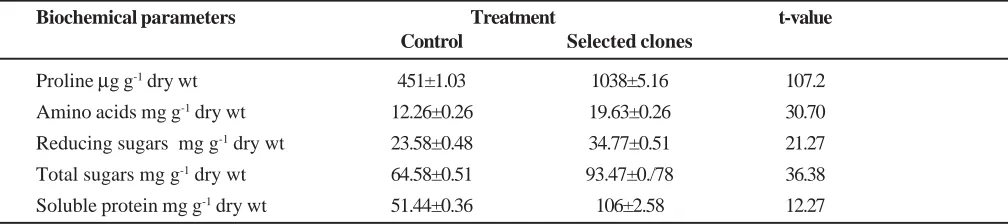
Compared to control, the selected cells showed higher content of total soluble and reducing sugars (Table 2). Accumulation of sugars in response to PEG induced stress has been shown earlier (Srivastava et al. 1995, Purushotham et al. 1998, Narang et al. 1998). The sugars might contribute to water stress tolerance either by serving as osmotica or as respiratory substrates.
The selected clones contained nearly twice the soluble protein as compared to control (Table 1). Increase in soluble protein in response to PEG induced stress has
Table 1. Comparison of fresh weight (mg) of non-selected (control) and selected callus on normal MS medium and selected callus on selective medium containing 100 g/1 PEG*.
Days Treatment
Normal MS medium Selective MS medium
Selected clones Control Selected clones
0 159±2.0 159±2.0 159±2.0
10 258±3.1 330±3.5 249±4.51
20 451±3.5 610±5.0 410±3.10
30 710±4.0 992±6.6 791±5.90
40 982±6.6 1680±7.6 909±2.50
* Each value is mean of six replications
Table 2. Comparison of levels of biochemical constituents in control and in vitro selected clones of bell pepper*.
Biochemical parameters Treatment t-value
Control Selected clones
Proline µg g-1 dry wt 451±1.03 1038±5.16 107.2
Amino acids mg g-1 dry wt 12.26±0.26 19.63±0.26 30.70
Reducing sugars mg g-1 dry wt 23.58±0.48 34.77±0.51 21.27
Total sugars mg g-1 dry wt 64.58±0.51 93.47±0./78 36.38
Soluble protein mg g-1 dry wt 51.44±0.36 106±2.58 12.27
* Each value is mean of six replications
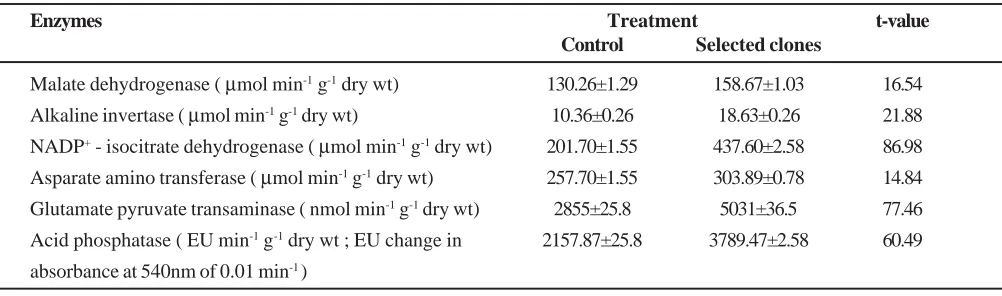
Table 3. Comparison of enzyme of activities in control and in vitro selected clones of bell pepper*.
Enzymes Treatment t-value
Control Selected clones
Malate dehydrogenase ( µmol min-1 g-1 dry wt) 130.26±1.29 158.67±1.03 16.54
Alkaline invertase ( µmol min-1 g-1 dry wt) 10.36±0.26 18.63±0.26 21.88
NADP+ - isocitrate dehydrogenase ( µmol min-1 g-1 dry wt) 201.70±1.55 437.60±2.58 86.98
Asparate amino transferase ( µmol min-1 g-1 dry wt) 257.70±1.55 303.89±0.78 14.84
Glutamate pyruvate transaminase ( nmol min-1 g-1 dry wt) 2855±25.8 5031±36.5 77.46
Acid phosphatase ( EU min-1 g-1 dry wt ; EU change in 2157.87±25.8 3789.47±2.58 60.49
absorbance at 540nm of 0.01 min-1 )
* Each value is mean of six replications
t table value at 10 degree of freedom and at 1% level of significance is 3.17 and 5/5 level of significance is 2.23
been shown earlier in crops like tomato, tobacco and chilli (Srivastava et al. 1995, Quintero- Higuera-Fernanada et al. 1997). Stress adapted cell lines of tomato showed a decline in protein levels (Handa et al.1983). It was suggested that a small portion of protein released by the stressed cells are involved in nutrient transport and other proteins are important component of the membrance structure, providing cells the ability to withstand high degree of stress (Handa et al. 1982).
There was significantly higher accumulation of free amino acids including proline in the selected cells. The levels of free amino acids and proline were 1.6 and 2.3 fold higher in selected cells as compared to the control (Table 2). The increase in the level of proline was higher than the free amino acids. This suggested that the mechanism of generation of free proline in the selected cells may be independent of that regulating the level of other amino acids. Enhanced level of free amino acids and proline in water stress tolerant cells have been reported earlier in other crops also (Purushotham et al.
1998). The increase in the level of proline could be due to
de novo synthesis or protein hydrolysis. De novo
synthesis could account for an increase in free proline as soluble proteins did not decrease in water stress tolerant cells. Ability to accumulate proline has been used as a basis for selection of drought tolerance in several species (Stajner et al. 1995, Van Heerden et al. 1996). Proline could be involved in protection of plant tissue against stress by acting as N-storage compound, osmosolute and hydrophobic protectant for enzymes and subcellular
organelles (Handa et al. 1986, Lerudulier et al. 1984). In the present studies amino acid content increase because of the continued synthesis. Higher amino content enables the plant to sustain better growth possibly by maintaining the water of the plant or by supplying essential amino acid protein synthesizing machinery drought (Bewley 1973). Increase in the free amino acid did not occur at the expense of soluble proteins in the present studies. Enhanced level of free amino acids has been reported in response to PEG induced water stress in other crops like tomato, groundnut etc. (Srivastava et al. 1995, Purushotham et al. 1998).
There was a 1.22 fold increase in activity of malate dehydrogenase in water stress tolerant cell lines of bell pepper (Table 3). Sudhakar et al. (1991) and Srivastava
et al. (1995) reported increase in activity during stress in horse gram seedling and tomato. In the selected lines higher level of malate dehydrogenase is necessary for the biosynthesis of osmotic solutes and for processes such as ion transport, which contributes to the survival of cells under water stress (Srivastava et al. 1995). Handa et al. (1983) reported increase in malate organic anion as cells became adapted to increasing level of water stress. The activity of alkaline invertase was 1.80 fold higher in water stress tolerant cell lines of bell pepper. In contrast low activity of alkaline invertase has been reported by in both leaves and roots of stressed wheat plants (Narang
in the organic anions such as citrate , as the cells become adapted to the increasing levels of the water stress (Handa et al. 1983). Sudhakar et al. (1991) reported increase in isocitrate dehydrogenase activity during stress in horse gram seedlings. Aspartate amino transferase activity was found to be 1.18 fold higher in water stress tolerant clones of bell pepper. The activity of glutamate pyruvate tranaminase was 1.76 fold higher in the water stress selected clones of bell pepper. The increase in amination and transamination visualize significance of amino acids under water stress conditions (Sharma and Garg 1985). The increase in aspartate amino transferase activity with the increasing stress has been reported in crops such as soyabean nodules, wheat etc (Sharma and Garg 1985, Boland et al. 1982). Kaur et al. (1985) reported low activity of this enzyme in mungbean nodules. The activity of acid phosphatase was 1.75 fold higher in water stress tolerant clones of bell pepper. Acid phosphatase is an important enzyme in the metabolism of phosphate compounds in plants. Acid phosphatase activity increased with increasing the stress in Dodonia viscose, tomato etc. (Srivastava et al. 1995, Thakur 1991).
REFRENCES
Bates, L.S., Waldern, R.P. and Teare, I.D. (1973). Rapid determination of free proline for water stress studies,
Plant soil 39: 205- 207.
Bergmeyer, H.U. and Bernt, E. (1974). GOT, GPT UV assay. In: H.U. Bergmeyer (ed). Methods of Enzymatic Analysis, p. 727, Academic press, New York.
Bewley, J.D. (1973). Desiccation and protein synthesis in the mass Tortula ruralis. Can. J. Bot. 51: 203-206.
Boland, M.J., Hands, J.F., Reynolds, P.H.S., Blevins, D.G., Tolbert, N.E. and Schubert, K.R. (1982). Subcellular organization of ureide biogenesis from glycolytic intermediate and ammonium in nitrogen fixing soybean nodules. Planta
155: 45-51.
Dubois, M., Gilles, K.A., Namilon, J.K., Rebers, P.A. and Smith, F. (1956). Colorimetric method for the determination of sugars and related substances. Anal. Chem. 28: 350-356.
Gupta, V.K. and Singh, R. (1988). Partial purification and characterisition of NADP+ isocitrate dehydrogenase from immature pod walls of chickpea (Cicer arietinum). Plant Physiol. 87: 741-744.
Handa, A.K., Bressan, R.A., Handa, S. and Hasegawa, P.M. (1982). Characteristics of cultured tomato cells after prolonged exposure to medium containing polyethylene glycol. Plant Physiol. 69: 514-521.
Handa, A.K., Bressan, R.A., Handa, S. Hasegawa, P.M. (1983). Clonal variation for tolerance to polyethylene glycol induced water stress in cultured tomato cells. Plant Phystol. 72: 645-653.
Handa, S., Bressan, R.A., Handa, A.K., Carpita, N.C. and Hasegawa, P.M. (1983). Solutes contributing to osmotic adjustment in cultured plant cells adapted to water stress.
Plant Physiol. 73: 834-843.
Handa, S., Handa, A.K., Hasegawa, P.M. and Bressan, R.A. (1986). Proline accumulation and the adaptation of cultured plant cell to water stress. Plant Physiol. 80: 938-945.
Jones, K.C. (1969). Similarities between Gibberellins and related compounds in inducing acid phosphatase and reducing sugar release from barely endosperm. Plant Physiol. 44: 1695-1700.
Kaur, A., Sheoran, I.S. and Singh, R. (1985). Effect of water stress on the enzymes of nitrogen metabolism in mungbean (Vigna radiata Wilczek) nodules. Plant Cell Environ. 8: 195-200.
Lee, Y.P. and Takhahashi, T. (1966). An improved calorimetric determination of amino acid with the use of ninhydrin.
Anal. Biochem.14: 71-77.
Lerudulier, D., Strom, A.M., Dandekar, A.M., Smith, L.T. and Valentine, R.C. (1984). Molecular biology of osmoregulation. Science. 224: 1064-1068.
Lowy, O.H., Rosebrough, N.J., Farr, A.L. and Randell, R.J. (1951). Protein measurement with Folin phenol reagent. J. Biol. Chem. 193: 265-275.
Morell, M. and Copeland, L. (1984). Enzymes of sucrose breakdown in soybean nodules. Plant Physiol. 74: 1030-1034.
Murashige, T. and Skoog, F. (1962). A revised medium for rapid growth and bioassay with tobacco tissue culture. Physiol. Plant.15: 473-497.
Narang, R., Malhotra, S.P. and Singh, R. (1998). Fructan metabolism in wheat (Triticum aestivum L.) as affected by water deficit. Plant Physiol. Biochem. 25: 122-129.
Purushotham, M.G., Patil, V., Raddey, P.C., Prasad, T.G. and Vajranabhaiah, S.N. (1998). Development of in vitro
PEG stress tolerant cell lines in two groundnut (Arachis hypogeae L.) genotypes. Indian J. Plant Physiol. 3: 49-51.
Quintero-Higuera-Fernanda-M., Santos-Diaz-del-Socorro-M. and Carcia-de-la-Gruz Fernando-R. (1997). Cell wall proteins of in vitro cultured chilli pepper lines differing in water stress tolerance. Plant Science Limerick. 128: 217-223.
Rhodes, D. (1987). Metabolic response to stress. In: D.D. Davis (ed.) Biochemistry of Plants, pp. 201-241. Academic Press, New York.
Sabbah, S. and Tal, M. (1990). Development of callus and suspension cultures of potato resistant to NaCl and mannitol and their response to stress. Plant Cell Tiss. Org. Cul. 21: 119-128.
Sharma, S.K. and Garg, O.P. (1985). Salinity induced changes in plant growth and activities of glutamate dehydrogenase, aspartate and alanine amino transferase in wheat. Indian J. Plant Physiol. 28: 407-412.
Siddeswar, G. and Kavikishore, P.B. (1989). Plant regeneration from polyethylene glycol adapted callus of rice. Curr. Sci. 58: 926-928.
Srivastava, D.K., Gupta, V.K. and Sharma, D.R. (1995). In vitro
selection and characterization of water stress tolerant callus cultures of tomato (Lycopersicon esculentum Mill cv. Ktl.) Indian J. Plant Physiol. 38: 99-104.
Stajner, D., Mimica-Dukie, N. and Gasic, O. (1995). Adaptability to drought in sugar beet cultivars, Biol. Plant. 37: 107-112.
Sudhakar, C., Reddy, P.S. and Verrnajaneyulu, K. (1991). Changes in respiration, its allied enzymes, pigment composition, chlorophyllase and hill reaction activity of horse gram seedlings under salt stress. Indian J. Plant Physiol. 34: 171-177.
Thakur, P.S. (1991). Effect of tricontanol and mixtalol on amino acids, chlorophyll contents and acid phosphatase activity during water deficit in Dodonia viscose. Indian J. Exp. Biol. 29: 985-987.