R E S E A R C H A R T I C L E
Open Access
Developmental outcomes and physical
activity behaviour in children post major
surgery: an observational study
Genevieve Mary Dwyer
1*, Karen Walker
2,3,4, Louise Baur
3and Nadia Badawi
2,3,4Abstract
Background:Infants may be at neurodevelopmental risk from adverse events arising in the neonatal period. This study aimed to investigate the developmental outcomes and physical activity behaviours of term infants after neonatal major surgery, at age three years.
Methods:This prospective study enrolled infants who underwent major surgery in their first 90 days, between August 2006 and December 2008. Developmental status was assessed using the Bayley Scales of Infant and Toddler Development, Third Edition (BSID-III). Physical activity and sedentary behaviour (i.e. small screen recreation) (SSR) were assessed using the Preschool-Age Physical Activity Questionnaire (Pre-PAQ). Activity (moving between slow to fast pace) and SSR were reported for a 3-day period.
Results:One hundred and thirty five children (68 major surgery, 67 control) were assessed, using both measures, at age three years. Both groups were within the average range across all domains of the BSID-III although the surgical group was significantly below the controls for cognition (t=−3.162,p= 0.002) receptive language (t=−3.790,p< 0. 001) and fine motor skills (t=−2.153,p= 0.03). Mean activity time for the surgical group was 191 mins.day−1, and 185 mins.day-1 for controls. Mean SSR time was 77 mins.day−1, and 83 mins.day−1for the respective groups. There was no significant difference between groups for either physical activity (p= 0.71) or SSR time (p= 0.49).
Conclusions:By age three, children who had major surgery in infancy are developmentally normal but have not quite caught up with their peer group in cognitive, receptive language and fine motor skill domains. Both groups met recommended 3 h of daily physical activity but exceeded 60-min SSR time recommended for preschool-age children.
Keywords:Infant, Child, Early childhood, Neonatal surgery, Developmental outcomes, Neurodevelopment, Cognitive, Motor, Language development, Physical activity behaviour, Sedentary behaviour, Small screen recreation, Bayley Scale of Infant and Toddler Development, Third edition, Preschool-Age Physical Activity Questionnaire, Follow-up
Background
Infants may be at neurodevelopmental risk from adverse events arising in the neonatal period. These events include the consequences of prematurity or the presence of congenital anomalies, requiring surgical correction during the early period of life. While the developmental sequelae due to prematurity have been well documented for over 25 years [1–4], the developmental outcomes of term infants who have undergone major surgery in the
early stage of life have not been as well investigated. Gischler et al. [5] noted survival alone is no longer a suf-ficient parameter for successful treatment in newborns requiring surgical intervention. The short and longer-term developmental outcomes of infants who have undergone cardiac surgery have gained increasing inter-est in the last decade but research is still comparatively limited despite improved survival rates [6–9]. Even less is known about the developmental outcomes of infants who have undergone non-cardiac major surgery [10–12]. The present study is part of an ongoing multicentre project undertaken to ascertain the long term outcomes of a cohort of infants who underwent cardiac or other
* Correspondence:[email protected]
1Physiotherapy Program, School of Science and Health, The University of
Western Sydney, Locked Bag 1797, Penrith, NSW 2751 Sydney, Australia Full list of author information is available at the end of the article
non-cardiac major surgery in the first 90 days of life, and to compare the outcomes with a healthy born peer cohort recruited at the same time. At age one year major surgery was found to be significantly associated with developmental delay. Delay was found in all areas (cog-nition, receptive language, expressive language, and fine and gross motor development) but was greatest in the area of gross motor development and particularly in infants who underwent cardiac surgery [13]. Fifty per cent of infants post cardiac surgery demonstrated delayed gross motor development at age one year [13].
Here we report the developmental outcomes of a sub-group of this cohort of children at age three years. Of particular interest was whether there was a continued disparity in development between the two groups (surgi-cal vs healthy term-birth control), especially in relation to gross motor development. In addition we aimed to investigate the habitual physical activity and sedentary behaviour of this preschool-age group and to ascertain whether potentially delayed gross motor development was associated with decreased activity and/or increased sedentary behaviour.
Methods
The study methods have been previously reported in de-tail [13]. Briefly, infants were sequentially recruited from each of the three paediatric tertiary hospitals in NSW, Australia between August 1 2006 and December 31 2008. Infants of any gestational age, who required sur-gery in their first 90 days, were eligible for enrolment. Healthy control infants were recruited from co-located tertiary maternity units. Ethics approval for the study was obtained from each heath service agency and paren-tal/guardian informed consent was also given prior to study entry.
Infants enrolled in the surgical group included those who underwent open or closed cardiac surgery, or non-cardiac major surgery that required opening of a truncal body cavity (e.g. thoracotomy or laparotomy). Infants who required concurrent neurosurgery were excluded as this type of procedure is more likely to be associated with increased incidence of delayed or abnormal infant development. Infants of families who resided overseas (due to difficulty of follow-up) and/or whose parents lacked adequate English written and verbal proficiency to complete the questionnaires, were also excluded. While infants who were born premature and/or who had a known chromosomal anomaly (e.g. Down syn-drome) were enrolled in the study, their results were ex-cluded from analyses reported here as these underlying conditions are associated with developmental delay and therefore would create potential confounding factors for the current investigation.
Children were assessed at age three years using the Bayley Scales of Infant and Toddler Development, Third Edition (BSID-III) [14]. The BSID-III consists of five subscale domains: Cognition, Expressive Language, Receptive Language, Fine Motor and Gross Motor. The five subscale scores were assessed so as to identify specific differences in language and motor areas that are not identified in composite scores. The children were also assessed using this tool at age one year, enabling comparison in developmental status in all subscale areas over time for study participants. On both occasions the BSID-III was administered by one of two developmental clinicians who had undertaken BSID-III training prior to the commencement of data collection.
The BSID-III is widely used internationally to assess developmental status in infants and young children. It has been validated in the United States and is used in all the neonatal follow-up clinics in New South Wales, Australia. Some have queried whether it may underesti-mate developmental delay in Australian infants who are
‘at risk’of developmental problems [15] and others have queried its validity for Australian infants or its predictive value in regards to later motor development [16, 17]. However, despite these potential issues its use in moni-toring of developmental status is still supported [18]. Further, this study was a comparative study between two groups rather than a predictive study. Any potential sociocultural bias within the tool was felt to be equiva-lent for both the surgical and healthy peer cohort groups, enabling confidence in comparison of results between these two groups.
Data analysis
The five subscale domains of the BSID-III were analysed separately for the whole cohort. Individual scores from surgical group and healthy control peer cohort were compared against standardised norms of the BSID-III. Delay was defined as a negative deviation from norma-tive data. The BSID-III is age-normed and has a mean of 10 and a standard deviation (SD) of 3. Mild delay was defined as a SD between >−2 to−1 SD below the mean. Moderate delay was defined as a SD >−3 to−2 SD, and severe delay as≤3 SD below the mean respectively.
Data were analysed using Statistical Package for the Social Sciences for Windows (SPSS) (Version 21 SPSS Inc. Chicago, Illinois). Tests of normality were per-formed on all variables in accordance with procedure advocated by Peat and Barton [20] (p43), including Q-Q plot and Kolmogorov-Smirnov Test. Difference between the surgical and control group means of each subscale domain of the BSID-III were assessed using 2-sample independentt-tests. Level of significance was set at 0.05.
Physical activity and sedentary data from Pre-PAQ were grouped to ascertain the 3-day mean of the time each child spent (a) being active (Pre-PAQ Levels 3–5) and (b) watching/using small screen recreation devices (i.e. TV/DVD, using computers or other small screen devices). Similar to analysis of BSID-III subscale domain data, difference between group means in (1) level of activity (mins per day) and (2) time spent watching TV/ DVD or other small screen devices (mins per day) was assessed using 2-sample independentt-tests with level of significance was set at 0.05.
Results
A total of 417 term infants were assessed at age 3 years, of whom 378 had complete assessments. This represents 70 % of the cohort assessed at age 1 year. Twenty per cent of children were lost to follow-up (principally due to change of home location) and four children withdrew from the study (three for family reasons and one child was subsequently diagnosed with autism). The mixture of children lost to attrition or withdrawal was from both surgical and control groups. A sub-sample of 135 children (74 male; 61 female) was assessed for both
developmental status and physical activity behaviour. There was no significant difference in mean age at time of assessment between the surgical and healthy control groups. Participant numbers and characteristics are summarised in Fig. 1 and Table 1. The characteristics of the sub-sample group were similar to those of the total group of participants assessed at age three years [12].
The BSID-III mean scores, indicative of developmental status of each group, are summarised in Table 2. A score above seven is considered as being in the aver-age range. While both groups were within averaver-age range, children who had undergone major surgery performed significantly below their healthy peer group in the areas of cognition (t=−3.162, p= 0.002), receptive language (t=−3.790, p< 0.001) and fine motor skills (t=−2.153, p= 0.03).
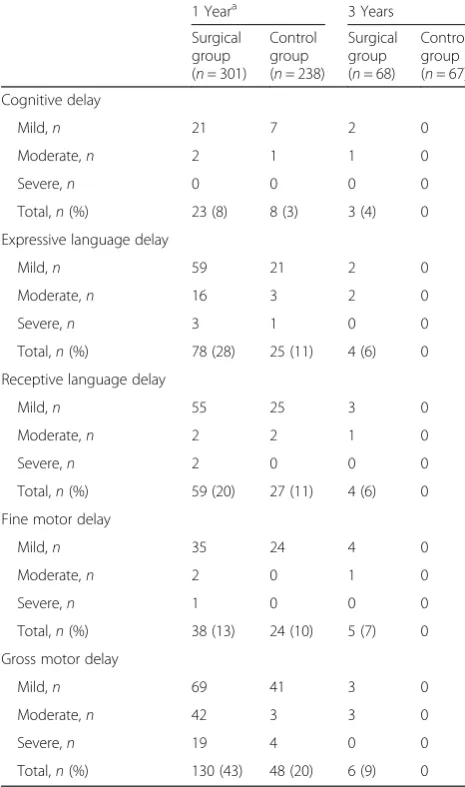
Most children at three years of age scored within the average range. However between 4–9 % of children in the surgical group demonstrated mild-moderate delay in one or more domains of cognition, expressive lan-guage, receptive lanlan-guage, fine motor and/or gross motor skills. No child in the healthy control peer group demonstrated any developmental delay (see Table 3).
Mean activity time for the surgical group was 191 mins.day−1, and 185 mins.day−1 for controls. Mean SSR time was 77 mins.day−1, and 83 mins.day−1 for the respective groups. There was no significant difference between groups for either physical activity (p= 0.71) or SSR time (p= 0.49). There was no association found between gross motor score on BSID-III and level of physical activity or SSR time.
Discussion
The results of this study indicate that the majority of children who undergo major surgery in early infancy have satisfactory longer term developmental outcomes, despite initial delay evident in the first 12 months of life. The number of children demonstrating delay improves considerably between the ages of one and three years suggestive of“developmental catch-up”over this period.
At age one year 8–43 % of children post major surgery demonstrated developmental delay in one or more of the domains of cognition, receptive language, expressive
539 infants
128 cardiac 173 surgical 238 control
124 cardiac 92 surgical 162 control
68 combined surgical 67 control 1 Year
3 Years BSID-III
BSID-III and Pre-PAQ
Age at follow-up Assessment
BSID-III
language, fine and/or gross motor development, with delay most prevalent in gross motor development. By age 3 years only 4–9 % of children demonstrated delay in an area of their development. The domain of greatest
‘catch-up’ was in gross motor development. Forty-three percent of children who had undergone major surgery were noted to be delayed at age 12 months, whereas only 9 % children were found to be delayed at age three years.
The impact of surgery may be particularly evident on gross motor development in the first 12 months because of post-operative limitations (as a result of sternal or abdominal surgery) leading to a lack of early experience, or tolerance, of the prone position. This diminished or delayed experience could potentially delay acquisition of motor skills such as balancing in prone and crawling, and in turn delay acquisition of higher order skills of standing and walking [21]. This explanation would seem supported by our previously reported finding that infants who had undergone cardiac surgery were generally able to sit unsupported and crawl at age one year but were not yet standing and walking [13]. Of note is that these children demonstrated gross motor delay rather than movement dysfunction (i.e. abnormal movement). In other words, they displayed typical movement quality but delayed or immature gross motor skill acquisition. By age three years, children who have undergone major surgery appear to demonstrate‘developmental recovery’.
However, while children who have undergone surgery demonstrate ‘developmental recovery’, they have not yet caught up to their peers by age 3 years. This difference was particularly evident in the areas of cognition, recep-tive language and fine motor development. This pattern of a generally favourable outcome but some persisting delays at age 2–3 years has also been noted in other longer-term follow-up studies of specific surgical groups
including infants who survive congenital diaphragmatic hernia [22], and those who underwent cardiac surgery in their infancy [9]. Our study suggests that this pattern of developmental lag in comparison with healthy term peers exists for infants who have also undergone major surgery for other types of conditions, including infantile hypertrophic pyloric stenosis, intestinal atresia, tra-cheoesophageal fistula and abdominal wall defects. A similar pattern of developmental lag in comparison to term peers, at preschool age, in areas such as cognition, language and motor development has also been noted in ‘healthy’ preterm survivors (i.e. preterm children without disability such as cerebral palsy or intellectual disability) [4, 23–27].
The reasons for potential subtle vulnerability in neuro-development, across the range of underlying congenital
Table 1Participant characteristics
Surgical group Healthy control
Number/sex 39 M: 29 F 35 M: 32 F
Mean age (SD) (months) 37 (2) 37 (1)
Table 2Mean scores on the five BSID-III subscales
Surgical group compared controls
Variable Surgical group
mean (SD)
Control group
mean (SD) p
-value
Cognition 9.7 (1.7) 10.7 (1.9) 0.002 **
Receptive language 10.7 (2.1) 12.0 (1.7) <0.001 **
Expressive language 10.5 (2.3) 11.6 (2.4) 0.09 NS
Fine motor 10.7 (2.6) 11.6 (2.2) 0.03 *
Gross motor 9.5 (2.3) 10.2 (1.8) 0.06 NS
**p< 0.01, *p< 0.05,NSnot significant
Table 3Rates of developmental delay in surgical and control
groups at ages 1 year and 3 years, according to BSID-III criteria
1 Yeara 3 Years
Surgical group (n= 301)
Control group (n= 238)
Surgical group (n= 68)
Control group (n= 67)
Cognitive delay
Mild,n 21 7 2 0
Moderate,n 2 1 1 0
Severe,n 0 0 0 0
Total,n(%) 23 (8) 8 (3) 3 (4) 0
Expressive language delay
Mild,n 59 21 2 0
Moderate,n 16 3 2 0
Severe,n 3 1 0 0
Total,n(%) 78 (28) 25 (11) 4 (6) 0
Receptive language delay
Mild,n 55 25 3 0
Moderate,n 2 2 1 0
Severe,n 2 0 0 0
Total,n(%) 59 (20) 27 (11) 4 (6) 0
Fine motor delay
Mild,n 35 24 4 0
Moderate,n 2 0 1 0
Severe,n 1 0 0 0
Total,n(%) 38 (13) 24 (10) 5 (7) 0
Gross motor delay
Mild,n 69 41 3 0
Moderate,n 42 3 3 0
Severe,n 19 4 0 0
Total,n(%) 130 (43) 48 (20) 6 (9) 0
a
anomalies noted above, have not yet been identified. However, in preterm survivors without major brain lesions, a reduction in corticomotor excitability has been noted and felt to be associated with poorer motor control in relation to fine motor skills [25]. Other influ-ences such as adiposity, sex and socio-economic factors regarding the child’s home environment were also found to influence development in these ‘healthy’ preterm survivors [25]. Similar mechanisms/influences may also exist for children born with congenital anomalies requir-ing major surgery in infancy.
Cognitive capacity, language proficiency and fine motor (manual) dexterity are very relevant to school academic performance (e.g. communication, learning, and writing or keyboard skills) and socialisation. How-ever it has yet to be determined whether the differences in abilities in these areas noted at age three years (surgi-cal vs control) will have an impact on later comparative school performance, as has been noted in preterm infants [1, 24, 28]. Ongoing monitoring appears war-ranted to establish potential longer term outcomes post major surgery in infancy.
A history of major surgery did not appear to influence physical activity or sedentary behaviour (i.e. TV/DVD viewing or other small screen recreation). In this study both the surgical and healthy control peer groups met the recommended level of three hours of activity per day. However, both groups exceeded the recommended limit of 60 min of small screen recreation and engaged in an extra 16 or 22 min small screen recreation, respectively, per day. Limiting small screen recreation should be encouraged in order to meet national health recommendations. Developing positive behaviours early is important as sedentary behaviour increases with age and is independently associated with poorer health out-comes such as obesity [29, 30], type 2 diabetes [31] and cardiovascular disease [32]. Health professionals are in a position to promote healthy lifestyle habits from early infancy and childhood though anticipatory guidance management [33].
Some limitations of this phase of the study were the lower retention rate at age three years (70 %) compared with age one year (90 %). However, while the partici-pant numbers were lower at age three years, the reten-tion rate is comparable to similar longitudinal studies [9, 22, 34, 35]. Further, the demographic and develop-mental characteristics of those who remained in the study (at age three years) and those who were lost to follow-up were similar at age one year [12, 13]. Another limitation was that only a subsample of children (135 children) was assessed for both their developmental status and level of physical activity, although the demographic characteristics of the subsample were similar to the larger participant group. A strength of this longitudinal
study has been the recruitment of a healthy birth co-hort at the commencement of the study. The retention rate pattern for both the surgical and healthy birth co-hort groups has been similar strengthening confidence in the study findings despite the loss of participants between age one and three years.
Conclusion
In conclusion, developmental outcomes for children who undergo major surgery in early infancy are generally satisfactory. Most children who have undergone surgery are developmentally normal by age three years but they have not yet caught up to their healthy term peers, particularly in the areas of cognition, receptive language and fine motor development. This pattern of mild delay in comparison to healthy term peers, at preschool age, is similar to that seen in ‘healthy’ preterm survivors. As cognition, language and fine motor skills are very rele-vant to school academic performance and peer social-isation then ongoing monitoring of children, who underwent major surgery in early infancy, is warranted to determine whether the differences in developmental skills may impact upon later school performance and social behaviour as has been noted in older preterm survivors.
Physical activity and sedentary behaviour appears to be independent of developmental status. At three years children who had a history of major surgery were simi-larly active to their healthy control peer group and both groups were meeting national health recommendations. However, both groups exceeded recommended levels of small screen recreation. The impact of increased seden-tary behaviour has yet to be determined but health professionals who deal with these families are in a position to promote positive health behaviours from early childhood and should be encouraged to do so.
Abbreviations
BSID-III, Bayley scales of infant and toddler development, third edition; Pre-PAQ, preschool-age physical activity questionnaire; SSR, small screen recreation
Funding
Funding support for this project was received from the March of Dimes Birth Defects Foundation (grant 12-FY06-232).
Availability of data and materials
The datasets generated and analysed during the current study are not publically available due to the ethics requirements of the project, but the corresponding author can be contacted for further information.
Authors’contributions
and designed the initial phase of the project, reviewed the design of this phase of the project, reviewed the manuscript and approved the final manuscript as submitted.
Authors’information
GMD: MAppSc (Phty), PhD Senior Lecturer Physiotherapy Program, School of Science and Health, University of Western Sydney, Australia; Titled Member of the National Paediatric Group, Australian Physiotherapy Association. KW: RGN, RSCN, BAppSc, MNurs, PhD Clinical Associate Professor, University of Sydney; Clinical Research Fellow, Grace Centre for Newborn Care, The Children’s Hospital at Westmead; Senior Research Fellow Cerebral Palsy Alliance Research Institute, The University of Sydney, Australia; President, Australian College of Neonatal Nurses; Vice-President, Council of International Neonatal Nurses.
LB: PhD, FRACP Professor Paediatrics and Child Health, The University of Sydney; Associate Dean and Head, The Children’s Hospital at Westmead Clinical School, The University of Sydney; Professor, Sydney School of Public Health; Consultant Paediatrician, Weight Management Services, The Children’s Hospital at Westmead, Australia.
NB: PhD, FRACP Clinical Professor Paediatrics and Child Health, The University of Sydney; Medical Director Co-Head, Grace Centre for Newborn Care, The Children’s Hospital at Westmead; Macquarie Group Professor and Chair of Cerebral Palsy, Cerebral Palsy Alliance Research Institute, The University of Sydney, Australia.
Competing interests
The authors declare they have no competing interests.
Consent for publication Not applicable.
Ethics approval and consent to participate
Ethics approval for the study was obtained from The Human Research Ethics Committees of the following institutions: The Children’s Hospital at Westmead, The Hunter New England Local Health District, The Royal Hospital for Women, and Westmead Hospital. Parental/guardian informed consent was also attained prior to participant entry into the study.
Author details
1Physiotherapy Program, School of Science and Health, The University of
Western Sydney, Locked Bag 1797, Penrith, NSW 2751 Sydney, Australia.
2
Grace Centre for Newborn Care, The Children’s Hospital at Westmead, Sydney, Australia.3Discipline of Paediatrics and Child Health, Sydney Medical
School, The University of Sydney, Sydney, Australia.4Cerebral Palsy Alliance
Research Institute, The University of Sydney, Sydney, Australia.
Received: 17 July 2015 Accepted: 29 July 2016
References
1. Hack M, Klein NK, Taylor HG. Long-term developmental outcomes of low birth weight infants. Future children. 1995;5:176–96.
2. Hack M, Klein NK, Taylor HG. Predictors of developmental outcomes for medically fragile early intervention participants. J Pediatr Psychol. 1996;21: 869–87.
3. Singer L, Yamashita T, Lilien L, Collin M, Baley J. A longitudinal study of developmental outcome of infants with bronchopulmonary dysplasia and very low birth weight. Pediatrics. 1997;100:987–93.
4. Aylward GP. Neurodevelopmental outcomes of infants born prematurely. J Dev Behav Pediatr. 2014;35:394–407.
5. Gischler SJ, Mazer P, Duivenvoorden HJ, van Dijk M, Bax NMA, Hazebroek FWJ, et al. Interdisciplinary structural follow-up of surgical newborns: a prospective evaluation. J Pediatr Surg. 2009;44:1382–9.
6. McGrath E, Wypij D, Rappaport LA, Newburger JW, Bellinger DC. Prediction of IQ and achievement at age 8 years from neurodevelopmental status at age 1 year in children with D-transposition of the great arteries. Pediatrics. 2004;114:e572–6.
7. Majnemer A, Limperopoulos C, Shevell MI, Rohlicek C, Rosenblatt B, Tchervenkov C. A new look at outcomes of infants with congenital heart disease. Pediatr Neurol. 2009;40:197–204.
8. Snookes SH, Gunn JK, Eldridge BJ, Donath SM, Hunt RW, Galea MP, et al. A systematic review of motor and cognitive outcomes after early surgery for congenital heart disease. Pediatrics. 2010;125:e818–27.
9. Long SH, Galea MP, Eldridge BJ, Harris SR. Performance of 2-year-old children after early surgery for congenital heart disease on the Bayley Scales of Infant and Toddler Development, Third Edition. Early Hum Dev. 2012;88:603–7.
10. Walker K, Holland AJA, Winlaw D, Sherwood M, Badawi N. Neurodevelopmental outcomes and surgery in neonates. J Paediatr Child Health. 2006;42:749–51. 11. Walker K, Badawi N, Holland AJ, Halliday R. Developmental outcomes
following major surgery: what does the literature say? J Paediatr Child Health. 2011;47:766–70.
12. Walker K, Loughran-Fowlds A, Halliday R, Holland AJA, Stewart J, Sholler GF, et al. Developmental outcomes at three years of age following major non-cardiac and non-cardiac surgery in term infants: a population-based study Journal of Pediatrics and Child Health. 2015; In press.
13. Walker K, Badawi N, Halliday R, Stewart J, Sholler GF, Winlaw DS, et al. Early developmental outcomes following major noncardiac and cardiac surgery in term infants: a population-based study. J Pediatr. 2012;161:748–52. e1. 14. Bayley N. Bayley’s Scales of Infant and Toddler Development. 3rd ed. San
Antonio, Tx: The Psychological Corporation; 2006.
15. Spittle AJ, Spencer-Smith MM, Eeles AL, Lee KJ, Lorefice LE, Anderson PJ, et al. Does the Bayley-III Motor Scale at 2 years predict motor outcome at 4 years in very preterm children? Dev Med Child Neurol. 2013;55:448–52. 16. Walker K, Badawi N, Halliday R, Laing S. Brief Report: Performance of Australian
Children at One Year of Age on the Bayley Scales of Infant and Toddler Development (Version III). Australian Educ Dev Psychol. 2010;27:54–8. 17. Luttikhuizen dos Santos ES L d, de Kieviet JF, Konigs M, van Elburg RM,
Oosterlaan J. Predictive value of the Bayley Scales of Infant Development on development of very preterm/very low birth weight children: A meta-analysis. Early Hum Dev. 2013;89:487–96.
18. Milne S, McDonald J, Comino EJ. The use of the Bayley Scales of Infant and Toddler Development III with clinical populations: A preliminary exploration. Phys Occup Ther Pediatr. 2012;32:24–33.
19. Dwyer GM, Hardy LL, Peat JK, Baur LA. The validity and reliability of a home environment preschool-age physical activity questionnaire (Pre-PAQ). Int J Behav Nutr Phys Act. 2011;8:86.
20. Peat J, Barton B. Medical Statistics: A Guide to Data Analysis and Critical Appraisal. Chichester, GBR: Wiley; 2008.
21. Kuo YL, Liao HF, Chen PC, Hsieh WS, Hwang HW. The influence of wakeful prone positioning on motor development during the early life. J Dev Behav Pediatr. 2008;29:367–76.
22. Danzer E, Gerdes M, D’Agostino JA, Partridge EA, Hoffman-Craven CH, Bernbaum J, et al. Preschool neurological assessment in congenital diaphragmatic hernia survivors: outcome and perinatal factors associated with neurodevelopmental impairment. Early Hum Dev. 2013;89:393–400. 23. Serenius F, Kallen K, Blennow M, Ewald U, Fellman V, Holmstrom G, et al. Neurodevelopmental outcome in extremely preterm infants at 2.5 years after active perinatal care in Sweden. Jama. 2013;309:1810–20. 24. Johnson S, Hennessy E, Smith R, Trikic R, Wolke D, Marlow N. Academic
attainment and special educational needs in extremely preterm children at 11 years of age: the EPICure study. Arch Dis Child Fetal Neonatal Ed. 2009;94:F283–9.
25. Pitcher JB, Schneider LA, Burns NR, Drysdale JL, Higgins RD, Ridding MC, et al. Reduced corticomotor excitability and motor skills development in children born preterm. J Physiol Lond. 2012;590:5827–44.
26. Tanis JC, Van Braeckel KN, Kerstjens JM, Bocca-Tjeertes IF, Reijneveld SA, Bos AF. Functional outcomes at age 7 years of moderate preterm and full term children born small for gestational age. J Pediatr. 2015;166:552–8. e1. 27. Aylward GP. Update on neurodevelopmental outcomes of infants born
prematurely. J Dev Behav Pediatr. 2014;35:392–3.
28. Quigley MA, Poulsen G, Boyle E, Wolke D, Field D, Alfirevic Z, et al. Early term and late preterm birth are associated with poorer school performance at age 5 years: a cohort study. Arch Dis Child Fetal Neonatal Ed. 2012;97:F167–73. 29. Tremblay MS, LeBlanc AG, Kho ME, Saunders TJ, Larouche R, Colley RC, et al.
Systematic review of sedentary behaviour and health indicators in school-aged children and youth. Int. 2011;8:98.
31. Oude Luttikhuis H, Baur L, Jansen H, Shrewsbury VA, O’Malley C, Stolk RP, et al. Interventions for treating obesity in children. Cochrane Database Syst Rev. 2009;21:CD001872.
32. Saavalainen PM, Luoma L, Laukkanen E, M Bowler D, Maatta S, Kiviniemi V, et al. School performance of adolescents born preterm: neuropsychological and background correlates. Europ J Paediatr Neurol. 2008;12:246–52. 33. Dwyer GM, Baur LA, Higgs J, Hardy LL. Promoting children’s health and
wellbeing: broadening the therapy perspective. Phys Occup Ther Pediatr. 2009;29:27–43.
34. Danzer E, Hedrick HL. Neurodevelopmental and neurofunctional outcomes in children with congenital diaphragmatic hernia. Early Hum Dev. 2011;87: 625–32.
35. McGowan JE, Alderdice FA, Doran J, Holmes VA, Jenkins J, Craig S, et al. Impact of neonatal intensive care on late preterm infants: developmental outcomes at 3 years. Pediatrics. 2012;130:e1105–12.
• We accept pre-submission inquiries
• Our selector tool helps you to find the most relevant journal
• We provide round the clock customer support
• Convenient online submission
• Thorough peer review
• Inclusion in PubMed and all major indexing services
• Maximum visibility for your research
Submit your manuscript at www.biomedcentral.com/submit