S T U D Y P R O T O C O L
Open Access
Effect of delayed CNI-based immunosuppression
with Advagraf® on liver function after MELD-based
liver transplantation [IMUTECT]
Susanne Richter
1, Georg Polychronidis
1, Daniel N Gotthardt
2, Philipp Houben
1, Thomas Giese
3, Anja Sander
4,
Colette Dörr-Harim
5, Markus K Diener
1and Peter Schemmer
1*Abstract
Background:MELD-based allocation for liver transplantation follows the“sickest-patient-first”strategy. The latter patients present with both, decreased immune competence and poor kidney function which is further impaired by immunosuppressants.
Methods/Design:In this prospective observational study, 50 patients with de novo low-dose standard Advagraf®-based immunosuppression consisting of Advagraf®, Mycophenolat-mofetil and Corticosteroids after liver transplantation will be evaluated. Advagraf® trough levels of 7-10μg/l will be reached at the end of the first postoperative week. Immunostatus, infectious complications, graft and kidney function are compared between patients with a pretransplant calculated MELD-score of≤20 and >20. Each group comprises of 25 consecutive patients. Prior to liver transplantation and on the postoperative days 1, 3 and 7, the patients’graft function (LiMAx test) will be evaluated. On the postoperative days 3, 5 and 7 the patients’immune status will be evaluated by the measurement of their monocytic HLA-DR status.
Infectious complications (CMV-reactivation, wound infection, urinary tract infection, and pneumonia), graft- and kidney function will be analysed on day 0, within the first week, and 1, 3, 6, 9 and 12 months after liver transplantation. Discussion:This study was designed to assess the effect of a standard low-dose Calcineurin inhibitor-based immunosuppression regime with Advagraf® on the rate of infectious complications, graft and renal function after liver transplantation.
Trial registration:The trial is registered at“Clinical Trials”(www.clinicaltrials.gov), NCT01781195.
Keywords:Advagraf®, Prospective observational study, MELD-score, Liver function, LiMAx test, Infection rate, HLA-DR status, Immunostatus
Background
Liver transplantation (LT) is the only curative treatment for patients with decompensated liver cirrhosis. The model for end-stage liver disease score (MELD-score) is used for the prioritization of patients awaiting LT [1].
The MELD-score was initially developed to evaluate the prognosis after transjugular intrahepatic porto-systemic shunt (TIPS). The laboratory parameters creatinine, biliru-bin, and international normalized ratio (INR) are needed for calculation of this score [1]. Nowadays, the
MELD-score is also used to allocate grafts for LT. The calculated MELD-scores of patients waiting for LT usually range be-tween 6 and 40 [2].
Sawitzkiet al.described markers that could be used to determine a patient’s immune status. This would make it possible to tailor the extent of the individual’s immuno-suppression therapy after LT. However, the lowest possible dose of immunosuppressant needs to be determined indi-vidually in order to minimize side effects of immunosup-pression while also avoiding an increase in the rejection rate [3]. The patient’s immune status can be evaluated by the measurement of B-cell sensitization and soluble bio-markers like CD30 [4,5]. In addition, the immune status after LT, sepsis, injuries, and surgery can be evaluated by * Correspondence:[email protected]
1
Department of General, Visceral and Transplant Surgery, Heidelberg, Germany Full list of author information is available at the end of the article
the monocytic HLA-DR status. A decreased monocytic HLA-DR status is indicative of an impaired immune com-petence [6].
In this context, it would be interesting to investigate to what degree a patient’s HLA-DR status corresponds to the labMELD-/Na-MELD-score and to measure the liver function with the LiMAx test. Furthermore, this trial aims to assess whether or not high-MELD patients (MELD-score >20) can benefit from a low-dose, prolonged-release immunosuppression with Advagraf®.
HLA-DR belongs to the major histocompatibility com-plex (MHC)-II family and is important for antigen pres-entation to CD4 + -T-cells [6,7]. Monocytes express HLA-DR on their surface, which can easily be detected by flow cytometry [6]. As mentioned above, the monocytic HLA-DR status has been used to evaluate the immune status after surgery, trauma, or during sepsis [6]. More-over, the decreased monocytic function found during sep-sis may be due to a diminished HLA-DR expression [8].
Granulocyte-Macrophage Colony-Stimulating-Factor (GM-CSF) activates monocytes and prevents apoptosis, in addition, GM-CSF increases monocytic HLA-DR ex-pression [8]. Havemann et al.measured the monocytic HLA-DR status after LT in 20 patients and reported that a decreased monocytic HLA-DR status was associ-ated with the risk of sepsis after LT. The risk of sepsis increases with the administration of an elevated Pred-nisolone dosage [7,9]. Administering reduced doses of Prednisolone may prevent patients with decreased monocytic HLA-DR statuses from becoming septic [7].
In order to allow for multi-center trials on the mono-cytic HLA-DR status and in an effort to index a patient’s immune status, a standardized BD Quantibrite™ HLA-DR/monocyte reagent was developed by Döckeet al.[6]. For consistent results, the blood should be stored on ice in EDTA tubes and must be analyzed within 4 hours after extraction [6].
The LiMAx test is useful for pre- and postoperative examinations of patients undergoing extensive liver re-sections to determine both, the risk of postoperative liver failure and liver function. The same applies to pa-tients after LT [10]. The LiMAx test is usually done at the patient’s bedside. Patients are required to lay in bed and avoid eating or smoking within 3 hours prior to being given 13C-Methacetin infusion. The enzyme CYP1A2 is exclusive for hepatocytes and metabolizes13C-Methacetin to Paracetamol and13CO2. Thus the13CO2/12CO2ratio in
the exhaled air correlates with liver function [11].
Unlike the LiMAX test, the sole use of laboratory pa-rameters (e.g. bilirubin, ammonia, INR, and glutamatde-hydrogenase) is not optimal for analyzing patients’graft function, since bilirubin levels are dependent on pre-operative levels and indicate transplant failure with a delay of a few days. An increased INR can also be found
as a consequence of bleeding, disseminated intravascular coagulation (DIC) or as a side effect of several medica-tions [10]. Early recognition of graft dysfunction is ne-cessary as hepatic dysfunction affects metabolism and elimination of Tacrolimus with the need of future dose adjustments [12].
Since the MELD-score is often used for graft allocation before LT and the underlying laboratory values are dependent on the methods used at the time of measure-ment, it is possible for the MELD-scores to vary signifi-cantly among the different laboratories [13,14]. It would be interesting to investigate the correlation between the pre-operative MELD-score and the LiMAx results, and deter-mine whether or not this correlation has any influence on the patient’s preoperative immunostatus (HLA-DR status).
At our institution, a Tacrolimus-based immunosup-pression (Advagraf®, Prograf®) belongs to the standard immunosuppression for patients undergoing LT.
Negative side effects of Calcineurin inhibitors (CNI) are, among others, renal impairment and infectious complications [15]. High-MELD patients often present with a limited renal function as creatinine is one compo-nent of the MELD-score [1]. The combination of CNI application and higher MELD-scores increases the risk of renal impairment [15]. Furthermore it has been hy-pothesized that high-MELD recipients have decreased immune competence [16] and can therefore benefit from the lowest possible doses of immunosuppressant drugs after LT. Low-dose Advagraf® with aimed trough levels of Tacrolimus at the end of the first week after LT should protect patients, especially high-MELD patients, from negative side effects of CNI, especially with regard to renal function and infection rate, while simultan-eously promoting no increase in the rate of rejection. Furthermore, it is assumed that patients with a MELD-score ≤20 also benefit from this immunosuppressive regime.
The aim of this study is to evaluate the effectiveness of a low-dose Calcineurin inhibitor-based immunosuppres-sive regime with Advagraf® where aimed trough levels of Tacrolimus are reached at the end of the first week after liver transplantation, in regard to infectious complica-tions and both, graft and renal function.
Methods/Design
Study population
Exclusion criteria are missing written consent, re-transplantation, and the presence of acute infections (CMV-reactivation, pneumonia, urinary tract infection, wound infection, and reactivation of hepatitis B/C). The individual criterion for discontinuation is the patient’s withdrawal of written consent.
The study protocol has been approved by the ethics committee, University of Heidelberg (S-577/2012).
Study objectives
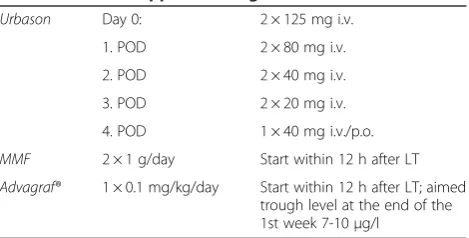
The primary objective is to evaluate the rate of infec-tious complications in the surrounding of pre-existing reduced immune competence in patients after LT under standard CNI-based immunosuppression with Advagraf®, MMF and Urbason (Table 1).
Patients with grafts from CMV- positive donors re-ceive standard CMV-prophylaxis (Table 2).
As secondary parameters the correlation between the patients’ preoperative HLA-DR statuses, MELD-scores and liver functions measured by the LiMAx-Test and the correlation between the patients’ postoperative HLA-DR statuses and liver function measured by the LiMAx-Test will be assessed. Furthermore infection rate, graft- and kidney function over time will be analysed and compared between the two groups.
Clinically relevant measures of liver function (serum bilirubin, INR, serum transaminase peaks) and kidney function (creatinine, glomerular filtration rate (GFR)) as well as episodes of rejection will be documented.
Design and trial flow
For participation in this prospective, mono-centric obser-vational study, informed written consent is mandatory. We will evaluate 50 patients, including 25 consecutive pa-tients with a calculated pretransplant MELD-score of >20 and 25 consecutive patients with a calculated pretransplant MELD-score of≤20. Infectious complications (CMV-reacti-vation, wound infection, urinary tract infection, and pneu-monia), graft- and kidney function will be analysed on day 0, within the first week after LT, and 1, 3, 6, 9 and 12 months after LT.
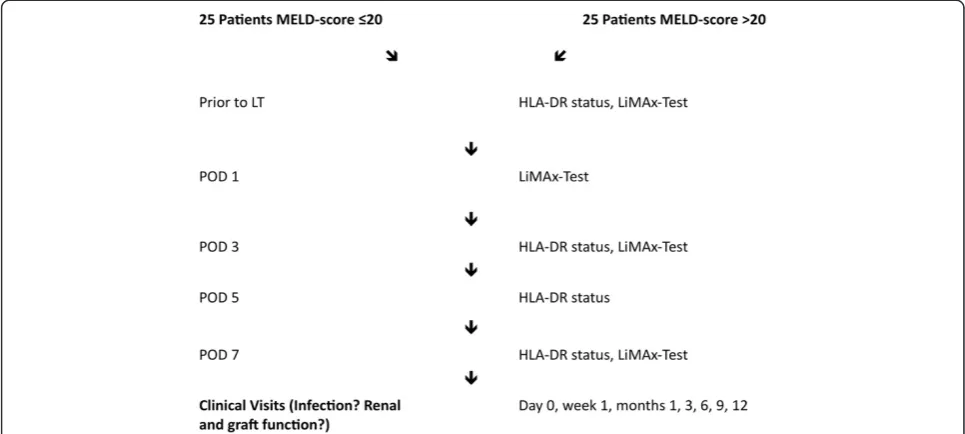
Immediately before LT and on postoperative day (POD) 3, 5, and 7, the patients’immune status will be determined by the measurement of their HLA-DR status with the BD Quantibrite™ HLA-DR/monocyte test. The patients’ liver functions will be evaluated with the LiMAx test prior to LT and on POD 1, 3, and 7 (Figure 1).
Sample size calculation
This is an observational pilot study. Therefore, no sam-ple size calculation was performed. The samsam-ple size of 50 patients is resulting of the feasibility of patient re-cruitment within one year.
Documentation and data handling
Protocol-required information will be documented in the case report form and reviewed and signed by the in-vestigator or by a designated sub-inin-vestigator.
Statistical methods
This exploratory data analysis will be performed calcu-lating appropriate summary measures for the empirical distribution of the parameters. Correlation coefficients, such as the Spearman Coefficient, will be determined in connection with the MELD-score and all other correla-tions will be expressed using the Pearson Correlation Coefficient. The comparison of infection rates between the two groups will be analyzed using the chi-squared test. Continuous parameters will be analyzed using thet -test. Resulting p-values will be interpreted descriptively. Table 1 Immunosuppression regime
Urbason Day 0: 2 × 125 mg i.v.
1. POD 2 × 80 mg i.v.
2. POD 2 × 40 mg i.v.
3. POD 2 × 20 mg i.v.
4. POD 1 × 40 mg i.v./p.o.
MMF 2 × 1 g/day Start within 12 h after LT
Advagraf® 1 × 0.1 mg/kg/day Start within 12 h after LT; aimed trough level at the end of the 1st week 7-10μg/l
i.v. = intra-venous, MMF = Mycophenolat-mofetil, p.o. = per os, POD = Postoperative day.
Table 2 CMV-Prophylaxis
CMV- positive donor Valganciclovir for 3 months:
- 2 × 450 mg/d per os during the 1st and 2nd week after LT
- 1 × 450 mg/d per os thereafter
- Reduced dosages in case of renal dysfunction creatinine clearance (ml/min):
- 40-59: 1 × 450 mg/d
- 25-39: 450 mg every 2ndday
- 10-24: 450 mg 2x/week
- Patients under dialysis: 450 mg 2x/week
Ganciclovir i.v.:
- 2x/d 5 mg/kg
- Reduced dosages in case of renal dysfunction creatinine clearance (ml/min):
- 49-10: 1x/d 2,5 mg/kg
- <10: 1,25 mg/kg 2x/week
Ethical issues
The trial will be performed according to the Declaration of Helsinki. Before starting the trial, the study protocol was approved by the ethics committee, University of Heidelberg. Participation is voluntary and patients can quit the trial at anytime without fear of subsequently re-ceiving poor medical care or the need to disclose motives for withdrawal. In case of a patient’s withdrawal, the rele-vant data will be deleted or the patient may be asked to give consent for the analysis of the data. Patient names and all other confidential information are subject to med-ical confidentiality at the appointment of the German Data Protection Act. Transmission of data will be done in an encrypted format. Third party persons have no access to original documents.
Informed consent will be obtained and validated using both the physician’s and the patient’s signature.
Discussion
The MELD-score was initially designed to estimate the prognosis of survival after TIPS [1]. Nowadays, it is one of the key scores used for assessing patients’suitability for a liver graft by focusing on the patient’s serum creatinine, bilirubin, and the INR ratios. The MELD-score values usu-ally range between 6 and 40. Liver allocation follows the
“sickest-patient-first” strategy, which has significantly de-creased outcome after LT in Germany [17] and inde-creased total costs associated with transplantation [18].
Advagraf® is a Tacrolimus derivate that must be taken once daily (in contrast to Prograf® which has to be admin-istered twice per day). Blood levels of Advagraf® are usually
increasing during the first week until the aimed Tacroli-mus trough levels are reached.
There is evidence that the immune systems of high-MELD patients are compromised per se, which in turn, may lead to an increased risk of early infectious complica-tions. Almost 85% of patients become afflicted with early infections, which is the most common cause of death soon after LT [15].
Additionally, poor renal function often occurs in high-MELD patients in the surrounding of multi-morbidity and as creatinine levels became a key parameter in the allocation of liver grafts. Early renal dysfunction after transplantation has been reported in up to 50% of patients [19,20]. CNI are well documented as major risk factors for early renal impairment and are believed to be responsible for chronic renal failure after LT [15]. Renal function seems to play a key role in the long-term survival of pa-tients with higher MELD-scores, therefore, new immuno-suppression strategies are necessary in order to avoid CNI-related impairment of the kidney function after LT.
There are several reported strategies aimed at fore-stalling renal impairment. One investigated method, the
“Bottom-up” immunosuppression regime as described by Schnitzbaueret al.,documented the use of low dos-ages of immunosuppressants immediately after LT. The drug dosages were then increased in case of organ rejec-tion or when patients were stable beyond day 30 [15].
In the context of the“ReSpECT”study, patients received standard doses of Tacrolimus (trough levels >10 ng/mL) and Corticosteroids, or MMF and reduced dosages of Tacrolimus (trough levels≤8 ng/mL) and Corticosteroids, or Daclizumab induction and MMF and reduced dosages Figure 1Flow chart of the IMUTECT study.HLA-DR= Human leukocyte antigen DR, LiMAx= Maximal liver function capacity based
of Tacrolimus with delayed administration until the fifth day post-transplantation along with Corticosteroids. Re-duced dosages of Tacrolimus have been associated with less nephrotoxicity and do not increase the risk of rejec-tion [21]. Thus, a low-dose Advagraf®-based immunosup-pression regime would decrease both the infection rate (CMV-reactivation, wound infection, urinary tract infec-tions, and pneumonia) and associated negative side effects of a CNI-based immunosuppression strategy, especially in patients with renal impairment. Moreover, the administra-tion of a “once-daily” formulation of Advagraf® is more
“patient friendly” [22] and has similar efficacy and safety results as the“twice-daily”formulation of Tacrolimus [23]. In summary, prolonged-release, low-dose Advagraf® is predicted to better protect patients from CNI side ef-fects when compared to standard immunosuppression regimes, while simultaneously maintaining graft func-tion and not elevating the rate of organ rejecfunc-tion. It has been hypothesized that especially high-MELD recipients (MELD-score >20) who have decreased immune compe-tence and a reduced renal function benefit from low-dose Advagraf® regime in regard to infectious complications and renal function. Furthermore, it can be assumed that every patient would benefit from the clinical application of this strategy after LT.
We have chosen a prospective observational study de-sign with a minor sample size as randomization is not possible in regard to our study objectives. Depending on the results of this study, a randomized controlled trial with adjusted study objectives and a major sample size might be useful in following study protocols.
Trial status
Recruiting
Enrolment of the first patient was performed in June 2013.
Abbreviations
CMV:Cytomegalie virus; CNI: Calcineurin inhibitor; CYP: Cytochrome P450; DIC: Disseminated intravascular coagulation; EDTA: Ethylene diaminetetraacetic acid; GFR: Glomerular filtration rate; GM-CSF: Granulocyte-Macrophage Colony-Stimulating Factor; HLA: Human leukocyte antigen; INR: International normalized ratio; LiMAx: Maximal liver function capacity based on
13C-Methacetin kinetics; LT: Liver transplantation; MELD: Model for end-stage liver
disease; MHC: Major histocompatibility complex; MMF: Mycophenolat-mofetil; POD: Postoperative day; TIPS: Transjugular intrahepatic porto-systemic shunt.
Competing interests
This study was supported by an unrestricted grant from Astellas Pharma, Munich, Germany. Astellas was not involved in the design of the study, in the decision to submit the manuscript for publication or in the writing of the manuscript.
Authors’contributions
SR and PS designed the study and drafted the manuscript. MD, PH, GP, DG, CDH and TG conceptualized the study and participated in its design and coordination. AS participated in the design of the study and the statistical analysis. These authors also assisted in drafting the manuscript. All authors read and approved the final manuscript.
Acknowledgements
We thank Nadya-Kaye Phillips-Houben for revising the manuscript.
Disclosure
The authors declare no other conflict of interest.
Author details
1Department of General, Visceral and Transplant Surgery, Heidelberg, Germany. 2
Department of Internal Medicine IV, University of Heidelberg, Heidelberg, Germany.3Immunology, University of Heidelberg, Heidelberg, Germany. 4
Institute of Medical Biometry and Informatics, University of Heidelberg, Heidelberg, Germany.5Study Centre of the German Surgical Society (SDGC), Heidelberg, Germany.
Received: 11 November 2013 Accepted: 20 August 2014 Published: 1 September 2014
References
1. Gotthardt D, Weiss KH, Baumgärtner M, Zahn A, Stremmel W, Schmidt J, Bruckner T, Sauer P:Limitations of the MELD score in predicting mortality or need for removal from waiting list in patients awaiting liver transplantation.BMC Gastroenterol2009,9:72.
2. Coombes JM, Trotter JF:Development of the allocation system for deceased donor liver transplantation.Clinical Med Res2005,3(2):87–92. 3. Sawitzki B, Pascher A, Babel N, Reinke P, Volk HD:Can we use biomarkers
and functional assays to implement personalized therapies in transplantation?Transpl2009,87(11):1595–1601.
4. Sawitzki B, Schlickeiser S, Reinke P, Volk HD:Pretransplant immune risk assessment.Curr Opin Organ Transpl2009,14(6):650–655.
5. Sawitzki B, Schlickeiser S, Reinke P, Volk HD:Monitoring tolerance and rejection in organ transplant recipients.Biomarkers2011,16(Suppl 1):42–50. 6. Döcke WD, Höflich C, Davis KA, Röttgers K, Meisel C, Kiefer P, Weber SU,
Hedwig-Geissing M, Kreuzfelder E, Tschentscher P, Nebe T, Engel A, Monneret G, Spittler A, Schmolke K, Reincke P, Volk HD, Kunz D:Monitoring temporary immunodepression by flow cytometric measurement of monocytic HLA-DR expression: a multicenter standardized study.
Clin Chem2005,51(12):2341–2347.
7. Haveman JW, van den Berg AP, van den Berk JM, Mesander G, Slooff MJ, de Leij LH, The TH:Low HLA-DR expression on peripheral blood monocytes predicts bacterial sepsis after liver transplantation: relation with prednisolone intake.Transpl Infect Dis1999,1(3):146–152.
8. Perry SE, Mostafa SM, Wenstone R, Shenkin A, McLaughlin PJ:HLA-DR regulation and the influence of GM-CSF on transcription, surface expression and shedding.Int J Med Sci2004,1(3):126–136.
9. van den Berk JM, Oldenburger RH, van den Berg AP, Klompmaker IJ, Mesander G, van Son WJ, van der Bij W, Sloof MJ, The TH:Low HLA-DR expression on monocytes as a prognostic marker for bacterial sepsis after liver transplantation.Transplantation1997,63(12):1846–1848. 10. Lock JF, Schwabauer E, Martus P, Videv N, Pratschke J, Malinowski M,
Neuhaus P, Stockmann M:Early diagnosis of primary nonfunction and indication for reoperation after liver transplantation.Liver Transpl2010,
16(2):172–180.
11. Stockmann M, Lock JF, Riecke B, Heyne K, Martus P, Fricke M, Lehmann S, Niehues SM, Schwabe M, Lemke AJ, Neuhaus P:Prediction of
postoperative outcome after hepatectomy with a new bedside test for maximal liver function capacity.Ann Surg2009,250(1):119–125. 12. Jain AB, Venkataramanan R, Cadoff E, Fung JJ, Todo S, Krajack A, Starzl TE:Effect
of hepatic dysfunction and T-tube clamping on FK 506 Pharmacokinetics and trough concentrations.Transpl Proc1990,22(1):57–59.
13. Trotter JF, Olson J, Lefkowitz J, Smith AD, Arjal R, Kenison J:Changes in international normalized ratio (INR) and model for endstage liver disease (MELD) based on selection of clinical laboratory.Am J Transpl2007,
7(6):1624–1628.
14. Trotter JF, Brimhall B, Arjal R, Phillips C:Specific laboratory methodologies achieve higher model for endstage liver disease (MELD) scores for patients listed for liver transplantation.Liver Transpl2004,10(8):995–1000. 15. Schnitzbauer AA, Doenecke A, Sothmann JL, Loss M, Farkas SA, Hartl J, Tsui TY, Baier L, Kirchner G, Obed A, Bein T, Geissler EK, Scherer MN, Schlitt HJ:
16. Lichtenstern C, Hochreiter M, Zehnter VD, Brenner T, Hofer S, Mieth M, Büchler MW, Martin E, Weigand MA, Schemmer P, Busch CJ:Pretransplant model for end stage liver disease score predicts posttransplant incidence of fungal infections after liver transplantation.Mycoses2013,
56(3):350–357.
17. Weismüller TJ, Negm A, Becker T, Barg-Hock H, Klempnauer J, Manns MP, Strassburg CP:The introduction of MELD-based organ allocation impacts 3-month survival after liver transplantation by influencing pretransplant patient characteristics.Transpl Int2009,22(10):970–978.
18. Bruns H, Hillebrand N, Schneider T, Hinz U, Fischer L, Schmidt J,
Goldschmidt AJ, Schemmer P:LabMELD-based organ allocation increases total costs of liver transplantation: a single-center experience.Clin Transpl 2011,25(5):558–565.
19. Paramesh AS, Roayaie S, Doan Y, Schwartz ME, Emre S, Fishbein T, Florman S, Gondolesi GE, Krieger N, Ames S, Bromberg JS, Akalin E:Post-liver transplant acute renal failure: factors predicting development of end-stage renal disease.Clin Transplant2004,18:94–99. 20. Sharma P, Welch K, Eikstadt R, Marrero JA, Fontana RJ, Lok AS:Renal
outcomes after liver transplantation in the model for endstage liver disease era.Liver Transpl2009,15:1142–1148.
21. Neuberger JM, Memelok RD, Neuhaus P, Pirenne J, Samuel D, Isoniemi H, Rostaing L, Rimola A, Marshall S, Mayer AD, ReSpECT Study Group:Delayed introduction of reduced-dose tacrolimus, and renal function in liver transplantation: the‘ReSpECT’study.Am J Transpl2009,9(2):327–336. 22. Wente MN, Sauer P, Mehrabi A, Weitz J, Büchler MW, Schmidt J, Schemmer P:
Review of the clinical experience with a modified release form of tacrolimus [FK506E (MR4)]in transplantation.Clin Transpl2006,20(17):80–84. 23. Trunečka P, Boillot O, Seehofer D, Pinna AD, Fischer L, Ericzon BG, Troisi RI,
Baccarani U, Ortiz de Urbina J, Wall W, Tacrolimus Prolonged Release Liver Study Group:Once-daily prolonged-release tacrolimus (ADVAGRAF) versus twice.daily tacrolimus (PROGRAF) in liver transplantation.Am J Transpl2010,10(10):2313–2323.
doi:10.1186/1471-2482-14-64
Cite this article as:Richteret al.:Effect of delayed CNI-based immunosuppression with Advagraf® on liver function after MELD-based liver transplantation [IMUTECT].BMC Surgery201414:64.
Submit your next manuscript to BioMed Central and take full advantage of:
• Convenient online submission
• Thorough peer review
• No space constraints or color figure charges
• Immediate publication on acceptance
• Inclusion in PubMed, CAS, Scopus and Google Scholar
• Research which is freely available for redistribution