Open Access
Report
Dementia / Alzheimer's Disease
Joan Lindsay*
1and Lori Anderson
2Address: 1Department of Epidemiology and Community Medicine, University of Ottawa, 451 Smyth Road, Ottawa, Canada and Surveillance and Risk Assessment Division, Health Canada and 2Private Consultant, Ottawa, Canada
Email: Joan Lindsay* - [email protected] * Corresponding author
Abstract
Health Issues: Dementia, including Alzheimer's disease (AD) increases exponentially with age from the age of 65. The number of people with dementia will increase significantly over the next three decades as the population ages. While prevalence and incidence rates do not differ markedly in women, compared to men, women live longer on average, so the number of women with dementia is greater than for men. Also, women are more frequently caregivers for people with dementia. Thus, dementia is an important health problem for women.
Key Findings: The Canadian Study of Health and Aging showed an increase in prevalence of dementia with age for both sexes, approximately doubling every five years of age. Rates of AD were higher in women whereas rates of vascular dementia were higher in men. The risk of AD increased with increasing age, lower education, and apolipoprotein E ε4. Regular physical activity was clearly protective in women; this was less clear for men. Use of non-steroidal anti-inflammatory drugs, wine consumption, and past exposure to vaccines decreased the risk of AD. Estrogen replacement therapy did not reduce the risk of AD. About three quarters of caregivers for dementia patients were women.
Data Gaps and Recommendations: The protective effect of regular physical activity for AD provides an additional reason to promote regular physical activity at all ages. Ongoing surveillance of the incidence, prevalence and risks for dementia is needed to monitor the impact of treatments as well as the aging of the population on the burden of dementia.
Background
Dementia involves "a chronic deterioration of intellectual function and other cognitive skills severe enough to inter-fere with the ability to perform activities of daily liv-ing."[1] Dementia mainly affects seniors and also greatly affects their families and caregivers. It includes Alzhe-imer's disease (AD), the most common form of dementia, vascular dementia, and other, rarer, conditions. AD has been defined as "a progressive, inexorable loss of cogni-tive function associated with an excessive number of senile plaques in the cerebral cortex and subcortical gray
matter, which also contains β-amyloid and neurofibrillary tangles consisting of tau protein."[1]
Two factors combine to make dementia an important issue for women: first, the Canadian population is aging, and the proportion of older people will increase rapidly over the next few decades as the baby boomers become seniors. The most rapid increase in the population is in the "oldest old," aged 85 and over, and this is the age group with the highest risk of dementia. Second, the aver-age life expectancy is longer for women than men (81.1 from Women's Health Surveillance Report
Published: 25 August 2004
BMC Women's Health 2004, 4(Suppl 1):S20 doi:10.1186/1472-6874-4-S1-S20 This article is available from: http://www.biomedcentral.com/1472-6874/4/S1/S20
BMC Women's Health 2004, 4:S20 http://www.biomedcentral.com/1472-6874/4/S1/S20
years for women and 75.1 years for men),[2] which means that in older age groups the proportion of women increases. Thus more women than men develop and live with AD and other dementias.
With the aging of the Canadian population, it becomes increasingly important to understand the effects of dementia and AD on individuals, families, friends, car-egivers, community health services and long-term care facilities. This review offers a brief summary of the magni-tude of dementia in Canada, research on risk factors and preventive factors, caregiving issues, and health policy implications.
Methods
Data SourceThe Canadian Study of Health and Aging (CSHA) is a lon-gitudinal, multi-centre, population-based study that pro-vides a great deal of detailed data on dementia in Canada. As the largest study of its kind, it is the only national, pop-ulation-based study of dementia in the world. It was designed to focus on the prevalence, incidence, risk factors and caregiving patterns related to dementia in elderly Canadians. The study methods have been more thor-oughly described elsewhere. [3-6]
During the first phase of the study (CSHA1), conducted in 1991–1992, representative samples of people aged 65 or older were randomly chosen from 36 urban and sur-rounding rural areas in the 10 Canadian provinces. The total sample was 10,263 people, including 9,008 commu-nity residents and 1,255 residents of institutions. There were 4,008 men and 6,255 women, providing a large sam-ple that could be weighted to the population for popula-tion estimates of prevalence and incidence.
Community subjects were interviewed at home and screened for cognitive impairment using standardized, validated instruments. Those who were deemed to be impaired, a random sample of those who were not, and all participants in institutions were offered an extensive clinical evaluation involving a nurse, a physician, a psy-chometrist and a neuropsychologist. Consensus diag-noses classified subjects into one of the following categories: no cognitive impairment, cognitive impair-ment no deimpair-mentia (CIND), AD (probable or possible), vascular dementia, other specific dementia, and unclassi-fiable dementia.
Subjects found to have AD for less than three years or to have vascular dementia became part of case-control stud-ies of risk factors. [5-7] Control subjects were selected from those who screened negative and who were clinically diagnosed as cognitively normal. In addition, those deemed cognitively normal completed a questionnaire for
prospective studies of risk factors. Risk factor data were obtained from proxies for both cases and controls for the initial retrospective analyses.
The caregiver study involved interviews with primary car-egivers of subjects with dementia and carcar-egivers of a sam-ple group of subjects who were cognitively normal.
In the 1996–1997 study (CSHA2), the participants were followed up to measure changes in health status and func-tioning an average of five years after CSHA-1. Subjects went through the same diagnostic process as in CSHA-1. For participants who died before CSHA-2, the date and cause of death were obtained, and a relative or other informant was interviewed.
Data Quality
The quality of the CSHA data is high. The initial commu-nity screening test was chosen in part because of its relia-bility and validity, and a high cut-point was used to increase sensitivity. Diagnosis of dementia, including sub-types, was made using carefully standardized, in-depth clinical examinations following a multi-stage protocol, and the latest criteria were applied. Response rates were high. All questionnaires were thoroughly checked and coded; data were double-entered until an error rate of less than 1 per 1,000 variables was reached.
Results
PrevalenceFrom the CSHA-1 it was estimated that over a quarter of a million (252,600) seniors in Canada suffered from dementia in 1991, representing 8% of the population aged 65 or older (Figure 1).[3] More women than men had dementia (171,400 versus 81,200), although there was less difference in the prevalence rate (86 versus 69 per 1,000 population, respectively). This included 118,300 women and 42,700 men with AD, with rates of 58 and 38 per 1,000 population respectively.
Half (51%) of those with dementia were living in institu-tions. Of those with dementia living in the community, almost two thirds (63%) were women, whereas in institu-tions almost three quarters (72%) of those with dementia were women.
AD was the most common form of dementia in women; it was diagnosed in 69% of women with dementia versus 53% of men with dementia. In contrast, only 14% of women with dementia had vascular dementia, compared with 30% of men.
women aged 75 to 84, and 371 per 1,000 for those aged 85 and over. The corresponding rates for men were 19, 104 and 287 per 1,000. Thus there was relatively little dif-ference in the rates among men and women except in the 85+ age group. In contrast, the proportions of women in the two older age groups were substantially higher: 63% of those aged 75 to 84 with dementia were women, and 75% of those aged over 85.
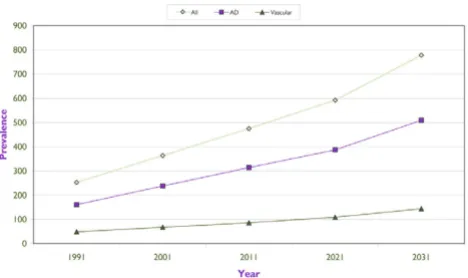
Projections of prevalent cases of dementia were calculated on the basis of the changing age composition of the Cana-dian population up to 2031 and are presented in Figure 2.[3] They are based entirely on the projected increases in the population aged 65 and over and assume no changes in prevalence due to changes in risk factors, treatment or survival.
Incidence
Based on the 1991 population, the CSHA-2 follow-up study provided estimates of 60,150 incident (new) cases
of dementia in Canada's population aged 65 and over each year.[6] The majority (60%) of new cases were women (36,320), and the overall age-standardized rate was 21.8 women per 1,000 non-demented population. The incidence rate among men was very similar (19.1 per 1,000 non-demented population). More than one fifth (22%) of new cases occurred in institutions. The approxi-mate doubling of incidence rates with every five years of age has been seen in many studies.[8]
The CSHA prevalence and incidence rates of dementia seem to generally fall within the range of other commu-nity-based European and U.S. studies,[6,9-13] although towards the upper end of the distribution.[14] This may reflect the fact that the CSHA included both institutional and community samples as well as milder cases of dementia. The larger number of women with dementia, despite the comparatively small difference in prevalence and incidence rates, reflects the larger number of women
Prevalence of dementia in Canada, 1991, by type of dementia, sex and age group – numbers and rates per 1,000 population Figure 1
BMC Women's Health 2004, 4:S20 http://www.biomedcentral.com/1472-6874/4/S1/S20
in the population due to their longer life expectancy as well as their longer survival with dementia.
Mortality
Dementia is a major risk factor for mortality. A follow-up investigation two years after the CSHA baseline study revealed that the greatest mortality risk was among women with dementia in institutions, whose risk of dying was six times as great as cognitively normal women in the community.[15] Five-year follow-up confirmed that eld-erly people with dementia had clearly increased mortality rates in all age-sex categories as compared with those who were cognitively normal.[16] Mortality increased strongly with age for people with all dementia subtypes.
Among women, those with vascular dementia experi-enced the worst prognosis, the five-year mortality ranging from 60% in the 65 to 74 age group to 83% in the over 85 group.[16] Among women with AD the prognosis was only slightly better, with a corresponding mortality range of 58% to 82%. Although the proportion of women dying within five years of CSHA-1 diagnosis was lower than among men in most of the dementia subgroups, the mor-tality rate ratios (mormor-tality relative to the general popula-tion) were higher among women in most groups.
CSHA five-year follow-up data were also analyzed to esti-mate duration of survival from the onset of dementia symptoms, adjusting for length bias (failure to include people with rapidly progressive illness who died before
being included in the study).[17] The unadjusted median survival among subjects with probable AD, possible AD and vascular dementia was 6.6 years, whereas the adjusted estimate was only 3.3 years. The median survival was 3.1 years for subjects with probable AD, 3.5 for possible AD and 3.3 for vascular dementia. Age at onset was the strong-est predictor of survival: survival decreased as age at onset of dementia increased. Women survived for slightly longer with dementia than men (3.4 versus 3.2 years).
Risk Factors for AD
The CSHA published data on risk factors for AD from a retrospective analysis of CSHA-1 data[5] and from a pro-spective analysis of incident cases.[18] We will focus on the longitudinal results, given the methodological advan-tage of this type of study design.
Briefly, the CSHA-1 analysis showed that age, family his-tory of dementia, and lower educational level were signif-icantly associated with an increased risk of AD.[5] Head injury slightly increased the risk, with borderline statisti-cal significance. Study participants who had arthritis or who used non-steroidal anti-inflammatory drugs (NSAIDs) showed a significantly reduced risk of AD.
Analysis of CSHA-2 prospective incidence data revealed a slightly different picture of risk factors for AD. Increasing age, low educational level and apolipoprotein E-ε4 (apoE-4) were significantly associated with increased risk of AD.[18] Regular physical activity, use of NSAIDs, wine consumption, past exposure to vaccines, and pre-existing arthritis were significantly associated with decreased risk of AD. [18-20] No statistically significant association was found for family history of dementia, sex, estrogen ther-apy, history of depression, head trauma, use of antiperspi-rant or antacid (containing aluminum), smoking, high blood pressure, heart disease or stroke (Figures 3 and 4).
Increasing age and the presence of the apoE-4 allele are solidly established risk factors for AD.[14,21] Although a positive family history of dementia is generally consid-ered to be the only other definite risk factor, the CSHA-2 study did not find it to be significantly related to AD (con-trary to the CSHA-1 prevalence study). However, these results are consistent with findings from the EURODEM pooled analysis of four European incidence studies.[22] It has been suggested that increased risk in first-degree rela-tives of AD patients may be related to relatively early onset of AD.[23]
The association of higher educational level with a reduced risk of AD is supported by several other prospective inci-dence studies in Europe and the United States.[22,24-27] Some of these studies found this association to exist for women only[27]or to be stronger for women.[26]
Projected Prevalence of Dementia (× 1,000) Canada, 1991– 2031
Figure 2
Notably, the CSHA-2 incidence study did not find sex to be a significant risk factor for AD.[18] A prospective study
in East Boston also found that age-specific incidence of AD did not differ significantly by sex.[28] Prospective
Association of family history of dementia, APOE ε4 status, coexisting or antecedent selected diseases, and prior use of medica-tion with risk of AD
Figure 3
Association of family history of dementia, APOE ε4 status, coexisting or antecedent selected diseases, and prior use of medication with risk of AD, Canadian Study of Health and Aging, women, 1996.
APOE = apolipoprotein E;
NSAIDs = Non-steroidal anti-inflammatory drugs. OR = odds ratio;
BMC Women's Health 2004, 4:S20 http://www.biomedcentral.com/1472-6874/4/S1/S20
studies in Europe have identified female sex as a risk factor for incidence of AD, but only after age 85 or 90.[19,29]
Several protective factors for AD were identified in the CSHA-2 that have implications for preventive strategies. Arguably the most important was regular physical activity, a modifiable lifestyle habit that reduced the risk of AD by up to 50%.[20] Significant trends of increased protection with higher levels of physical activity were observed for AD and dementia of any type as well as for cognitive impairment with no dementia. The associations between physical activity and risk of CIND, dementia or AD were strongest in women, with a reduction in risk of AD of approximately 60% among women with high levels of physical activity, as compared with no physical activity. Although the literature is not entirely consistent, this find-ing has been supported by other studies.[18]
Regular use of NSAIDs was significantly related to a 35% reduction in the risk of AD in the CSHA-2 results.[18] This protective effect was observed in several population-based case-control studies, including the CSHA-1. [30-32] At least two other longitudinal studies have supported the CSHA-2 finding,[33,34] but others reported inconclusive results.[35,36] Although it is encouraging that use of NSAIDs may help to protect against AD, it also raises
con-cern about potential side effects, particularly gastrointesti-nal bleeding.
Regular wine consumption was also significantly associ-ated with reduced risk of AD (Odds Ratio [OR] 0.49) in CSHA-2 analyses,[18] and the protective effect appeared to be even stronger in women (OR 0.38). This protective relation is consistent with findings from a longitudinal study in France.[37] It has been suggested that specific substances in wine (not alcohol) have a positive effect on nerve cells.[38] Recently, however, a longitudinal study in the Netherlands found a significant association between light to moderate drinking and lower risk of dementia, but with no evidence of any variation by type of alcoholic bev-erage.[39] There are also the detrimental effects of alcohol to be considered.
Another possible protective factor for AD identified in CSHA-2 analyses was past exposure to vaccines against diphtheria or tetanus, poliomyelitis, and influenza.[19] After adjustment for age, sex and education, vaccines against diphtheria or tetanus and against poliomyelitis were significantly associated with lower risks of AD (60% and 40% lower respectively). Influenza vaccine was also related to a lower risk of AD, but the association did not reach statistical significance. Further adjustments for other
Association of specific lifestyle variables with risk of AD Figure 4
lifestyle-related characteristics produced similar results. These findings are consistent with the hypothesis that changes in the immune system may be involved in aging and AD, but this remains to be verified in further epidemi-ologic and clinical studies.
Estrogen therapy in the past was thought to reduce the risk of AD. The CSHA did not see a protective effect,[18] and other studies have yielded inconsistent findings.[40,41] A longitudinal study in the United States found that estro-gen use was not protective against cognitive decline related to aging, although the authors noted that their study included few women who used estrogen for two years or longer.[42] In contrast, a prospective study found that women who formerly used hormone therapy had a reduced risk of AD, as did current users whose treatment exceeded 10 years.[43] More recently, a redundant publi-cation of the Women's Health Initiative has shown an increased risk of AD among women in the estrogen/pro-gesterone arm of the study.[44]
Informal Care
As dementia progresses in individuals, it affects not only them but also their caregivers. The CSHA-1 confirmed the presence of an extensive informal network of Canadians providing care to seniors with dementia.[4] Over 98% of the estimated 123,900 seniors with dementia in the com-munity had a caregiver. Of these caregivers, 94% were informal caregivers, namely, unpaid family members or friends. Of the dementia patients in the community, 94% had two or more relatives or friends besides their primary caregiver who assisted them.
Women's strong caregiving role was clearly demonstrated in the CSHA data. Three quarters of the primary caregivers of those with dementia in the community were women, as were 71% of primary caregivers of dementia patients in institutions.[4] In the community, almost one quarter (24%) of these primary caregivers were wives, and 29% were daughters. Daughters represented 45% of the infor-mal caregivers of institutionalized dementia patients.
Other characteristics of the informal primary caregivers of elderly dementia patients were notable. More than 70% were married, whether the senior lived in the community or an institution.[4] Friends and other family (i.e. neither spouses nor children) made up over one fifth of these car-egivers in both residential settings. Carcar-egivers in the com-munity were less likely to be employed (29%) than caregivers of dementia patients in institutions (41%). The average age of community caregivers was 62, but 32% of them were aged 70 to 90;[45] 60% of the community car-egivers lived with the dementia patient.
Caring for someone with dementia tends to negatively affect the well-being of the caregiver. Informal caregivers of seniors with dementia experienced more chronic health problems and depressive symptoms than those caring for a senior without dementia.[4] Caregivers of dementia patients in institutions were less likely to feel burdened and experienced less depression than the community car-egivers, even though the severity of dementia was higher. After five years, caregivers of dementia patients who remained in the community reported significantly more burden than did caregivers of patients who moved into or remained in an institution.[46] A higher frequency of disturbing behaviours, community residence of the patient, and low informal support were associated with greater caregiver burden, which in turn led to more depression in the caregiver.[47] Furthermore, caregivers of dementia patients with more disturbing behaviours and greater functional disabilities received less help from fam-ily and friends than did caregivers of dementia patients in institutions.
Use of community care services in the CSHA-1 (in 1991) seemed low, although data were not collected on the availability of services.[4] Except for home physiotherapy, use of community services was higher among those caring for seniors with dementia than among those caring for seniors without dementia. However, when patients were matched for level of disability (measured by problems with activities of daily living), except for moderate disabil-ity, caregivers of dementia patients received fewer services than those of non-dementia patients.
Possible factors affecting access to community care serv-ices related to both care recipients and caregivers in the CSHA analyses. Having greater functional disabilities, liv-ing alone, livliv-ing in a less urban environment and beliv-ing older were identified as predictors of use of community care services by seniors with dementia.[48,49] Caregivers who were children of dementia patients used more serv-ices than those who were spouses.[4] In addition, caregiv-ers who perceived their own health more poorly were more likely to use community services to help in caring for dementia patients.[48]
Institutionalization
In 1991, it was estimated from CSHA-1 data that 51% of Canada's elderly population with dementia lived in insti-tutions.[3] Five years later, CSHA-2 follow-up revealed that 51% of the dementia patients in the community-dwelling CSHA-1 caregiver study sample had been admit-ted to an institution.[50] The median time to admission was 41 months.
BMC Women's Health 2004, 4:S20 http://www.biomedcentral.com/1472-6874/4/S1/S20
involved characteristics of both dementia patients and their caregivers.[50] The patient's type of dementia, namely possible or probable AD, and the severity of disa-bility in activities of daily living were significant predictors of admission to an institution. The caregiver's age over 60, not being a spouse or child of the patient, and severe car-egiver burden were significantly associated with the care recipient's placement in an institution. Caregiver burden was strongly correlated with the patient's behavioural problems and the caregiver's depressive mood. The car-egiver's desire to have the dementia patient admitted to an institution was related to the severity of the dementia, being unable to leave the patient alone, living with the patient, using two or more home care services, and level of caregiver burden.
In addition, the risk of being admitted to an institution was significantly higher among dementia patients living in Quebec, the Prairies or British Columbia than for those living in Ontario or the Atlantic provinces.[50]
Recent analyses of the CSHA data show that there was a significant relation between service use and the functional abilities (activities of daily living) of subjects, and that their physical limitations predicted use of services whereas cognitive problems did not.
Discussion
LimitationsThe CSHA is internationally recognized as one of the best studies of the epidemiology of dementia; in addition it covered many other topics related to aging. It was well designed and conducted. More frequent follow-ups would have strengthened the study and reduced the uncertainties in calculating incidence that arose because of the larger number of people who died between phases of the study. Collection of risk factor data for the case-con-trol analyses was limited by the abilities of proxies to respond for the study participants and provide the amount of detail that was requested. The same questions were asked of those who were cognitively normal, who completed risk factor information for the prospective analyses. This had the advantage of making the retrospec-tive and prospecretrospec-tive analyses comparable, but the disad-vantage that there was not more detailed information for the prospective analyses. The caregiving data, with hind-sight, might have benefited from the collection of addi-tional information – for example, about the availability of services; however, this was not possible given time and resource constraints.
Policy Implications and Recommendations
• Further study is needed to confirm some of the protec-tive factors found in the CSHA and in other studies (coffee
drinking, vaccinations, use of estrogen therapy) before policy recommendations can be made.
• The protective effect of regular physical activity for AD provides an additional reason for the promotion of regu-lar physical activity at all ages. Education and ongoing mental activity are likely equally important.[51]
• Although the CSHA covers the years 1991 to 2001, ongoing surveillance of the incidence and prevalence of dementia is needed to monitor the impact of preventive strategies and treatments as well as the aging of the popu-lation. This is not feasible using the usual sources of data (hospitalizations, mortality, physicians' visits) since in only a fairly small fraction of dementia cases would dementia be listed as a diagnosis.
Note
The views expressed in this report do not necessarily rep-resent the views of the Canadian Population Health Initi-ative, the Canadian Institute for Health Information or Health Canada.
References
1. Beers MH, Berkow R, eds: The Merck manual of diagnosis and therapy Whitehouse Station, NJ: Merck Research Laboratories; 1999.
2. Federal, Provincial, and Territorial Advisory Committee on Population HealthReport on the health of Canadians. Appendix D: Indicator data and sources. Health Canada, 1996 [http://www.hc-sc.gc.ca/hppb/phdd/report/1996/app-d-e.htm]. Accessed March 11, 2002
3. Canadian Study of Health and Aging Working Group: Canadian Study of Health and Aging: study methods and prevalence of dementia.Can Med Assoc J 1994, 150:899-913.
4. Canadian Study of Health and Aging: Patterns of caring for people with dementia in Canada.Can J Aging 1994, 13:470-487. 5. Canadian Study of Health and Aging: The Canadian Study of
Health and Aging: risk factors for Alzheimer's disease in Canada.Neurology 1994, 44:2073-2080.
6. Canadian Study of Health and Aging Working Group: The incidence of dementia in Canada.Neurology 2000, 55:66-73.
7. Lindsay J, Hébert R, Rockwood K: The Canadian Study of Health and Aging risk factors for vascular dementia. Stroke 1997,
28:526-530.
8. Gao S, Hendrie HC, Hall KS, Hui S: The relationship between age, sex, and the incidence of dementia and Alzheimer dis-ease: a meta-analysis.Arch Gen Psychiatry 1998, 55:809-815. 9. Bachman DL, Wolf PA, Linn RT, et al.: Incidence of dementia and
probable Alzheimer's disease in a general population: the Framingham Study.Neurology 1993, 43:515-519.
10. Andersen K, Launer LJ, Dewey ME, et al.: Gender differences in the incidence of AD and vascular dementia: the EURODEM studies.Neurology 1999, 53:1992-1997.
11. Letenneur L, Commenges D, Dartigues JF, et al.: Incidence of dementia and Alzheimer's disease in elderly community res-idents of south-western France. Int J Epidemiol 1994,
23:1256-1261.
12. Ott A, Breteler MMB, van Harskamp F, et al.: Incidence and risk of dementia: the Rotterdam Study. Am J Epidemiol 1998,
147:574-580.
13. Hebert LE, Scherr PA, Beckett LA, et al.: Age-specific incidence of Alzheimer's disease in a community population.JAMA 1995,
273:1354-1359.
14. McDowell I: Alzheimer's disease: insights from epidemiology.
Aging Clin Exp Res 2001, 13:143-162.
Publish with BioMed Central and every scientist can read your work free of charge
"BioMed Central will be the most significant development for disseminating the results of biomedical researc h in our lifetime."
Sir Paul Nurse, Cancer Research UK
Your research papers will be:
available free of charge to the entire biomedical community
peer reviewed and published immediately upon acceptance
cited in PubMed and archived on PubMed Central
yours — you keep the copyright
Submit your manuscript here:
http://www.biomedcentral.com/info/publishing_adv.asp
BioMedcentral
institutions: the Canadian Study of Health and Aging.Can J Public Health 1997, 88:303-304.
16. Østbye T, Hill G, Steenhuis R: Mortality in elderly Canadians with and without dementia: a 5-year follow-up.Neurology 1999,
53:521-526.
17. Wolfson C, Wolfson DB, Asgharian M, et al.: A re-evaluation of the duration of survival after the onset of dementia.N Engl J Med
2001, 344:1111-1116.
18. Lindsay J, Laurin D, Verreault R, et al.: Risk factors for Alzheimer's disease: a prospective analysis from the Canadian Study of Health and Aging.Am J Epidemiol 2002, 156:445-453.
19. Verreault R, Laurin D, Lindsay D, De Serres G: Past exposure to vaccines and subsequent risk of Alzheimer's disease.Can Med Assoc J 2001, 165:1495-1498.
20. Laurin D, Verreault R, Lindsay J, et al.: Physical activity and risk of cognitive impairment and dementia in elderly persons.Arch Neurol 2001, 58:498-504.
21. Fratiglioni L: Epidemiology of Alzheimer's disease and current possibilities for prevention. Acta Neurol Scand Suppl 1996,
165:33-40.
22. Launer LJ, Andersen K, Dewey ME, Letenneur L, Ott A, Amaducci LA,
et al.: Rates and risk factors for dementia and Alzheimer's dis-ease: results from EURODEM pooled analyses.Neurology 1999,
52:78-84.
23. Mayeux R, Ottman R, Tang M-X, et al.: Genetic susceptibility and head injury as risk factors for Alzheimer's disease among community-dwelling elderly persons and their first-degree relatives.Ann Neurol 1993, 33:494-501.
24. Letenneur L, Gilleron V, Commenges D, et al.: Are sex and educa-tional level independent predictors of dementia and Alzhe-imer's disease? Incidence data from the PAQUID project.J Neurol Neurosurg Psychiatry 1999, 66:177-183.
25. Stern Y, Gurland B, Tatemichi TK, et al.: Influence of education and occupation on the incidence of Alzheimer's disease.JAMA
1994, 271:1004-1010.
26. Qiu C, Backman L, Winblad B, et al.: The influence of education on clinically diagnosed dementia incidence and mortality data from the Kungsholmen Project. Arch Neurol 2001,
58:2034-2039.
27. Letenneur L, Launer LJ, Andersen K, et al.: Education and the risk for Alzheimer's disease: sex makes a difference. EURODEM pooled analyses.Am J Epidemiol 2000, 151:1064-1071.
28. Hebert LE, Scherr PA, McCann JJ, et al.: Is the risk of developing Alzheimer's disease greater for women than for men?Am J Epidemiol 2001, 153:132-136.
29. Ruitenberg A, Ott A, van Swieten JC, et al.: Incidence of dementia: Does gender make a difference? Neurobiol Aging 2001,
22:575-580.
30. McGeer PL, Schulzer M, McGeer EG: Arthritis and anti-inflam-matory agents as possible protective factors for Alzheimer's disease: a review of 17 epidemiologic studies.Neurology 1996,
47:425-432.
31. Anthony JC, Breitner JCS, Zandi PP, et al.: Reduced prevalence of AD in users of NSAIDs and H2 receptor antagonists: the Cache County Study.Neurology 2000, 54:2066-2071.
32. Broe GA, Grayson DA, Creasey HM, et al.: Anti-inflammatory drugs protect against Alzheimer disease at low doses.Arch Neurol 2000, 57:1586-1591.
33. Stewart WF, Kawas C, Corrada M, Metter EJ: Risk of Alzheimer's disease and duration of NSAID use.Neurology 1997, 48:626-632. 34. in't Veld BA, Ruitenberg A, Hofman A, et al.: Nonsteroidal antiin-flammatory drugs and the risk of Alzheimer's disease.N Engl J Med 2001, 345:1515-1521.
35. in't Veld BA, Launer LJ, Hoes AW, et al.: NSAIDs and incident Alzheimer's disease. The Rotterdam Study. Neurobiol Aging
1998, 19:607-611.
36. Fourrier A, Letenneur L, Bégaud B, Dartigues JF: Nonsteroidal anti-inflammatory drug use and cognitive function in the elderly: inconclusive results from a population-based cohort study.J Clin Epidemiol 1996, 49:1201.
37. Orgogozo J-M, Dartigues J-F, Lafont S, et al.: Wine consumption and dementia in the elderly: a prospective community study in the Bordeaux area.Rev Neurol (Paris) 1997, 153:185-192. 38. Tredici G, Miloso M, Nicolini G, et al.: Resveratrol, map kinases
and neuronal cells: Might wine be a neuroprotectant?Drugs Exp Clin Res 1999, 25:99-103.
39. Ruitenberg A, van Swieten JC, Witteman JC, et al.: Alcohol con-sumption and risk of dementia: the Rotterdam Study.Lancet
2002, 359:281-286.
40. Paganini-Hill A, Henderson VW: Estrogen replacement therapy and risk of Alzheimer disease. Arch Intern Med 1996,
156:2213-2217.
41. Seshadri S, Zornberg GL, Derby LE, et al.: Postmenopausal estro-gen replacement therapy and the risk of Alzheimer disease.
Arch Neurol 2001, 58:435-440.
42. Fillenbaum GG, Hanlon JT, Landerman LR, et al.: Impact of estro-gen use on decline in cognitive function in a representative sample of older community-resident women.Am J Epidemiol
2001, 153:137-144.
43. Zandi PP, Carlson MC, Plassman BL, et al.: Hormone replacement therapy and incidence of Alzheimer disease in older women: The Cache County Study.JAMA 2002, 288:2123-2129.
44. Shumaker SA, Legault C, Rapp SR, Thal L, Wallace RB, Ockene JK, et al.: Estrogen plus progestin and the incidence of dementia and mild cognitive impairment in postmenopausal women: the Women's Health Initiative Memory Study: a rand-omized controlled trial.JAMA 2003, 289:2651-2662.
45. Meshefedjian G, McCusker J, Bellavance F, Baumgarten M: Factors associated with symptoms of depression among informal caregivers of demented elders in the community.Gerontologist
1998, 38:247-253.
46. Canadian Study of Health and Aging Working Group: Patterns and health effects of caring for people with dementia: the impact of changing cognitive and residential status.Gerontologist 2002,
42:643-652.
47. Clyburn LD, Stones MJ, Hadjistavropoulos T, Tuokko H: Predicting caregiver burden and depression in Alzheimer's disease.J Gerontol 2000, 55B:S2-S13.
48. Penning MJ: Cognitive impairment, caregiver burden, and the utilization of home health services.Journal of Aging and Health
1995, 7:233-253.
49. Tuokko H, MacCourt P, Heath Y: Home alone with dementia.
Aging and Mental Health 1999, 3:21-27.
50. Hébert R, Dubois MF, Wolfson C, et al.: Factors associated with long-term institutionalization of older people with demen-tia: data from the Canadian Study of Health and Aging.J Ger-ontol Med Sci 2001, 56A:M693-M699.
51. Friedland RP, Fritsch T, Smyth KA, et al.: Patients with Alzhe-imer's disease have reduced activities in midlife compared with healthy control-group members.Proc Natl Acad Sci USA