R E S E A R C H
Open Access
Automatic extraction of protein-protein
interactions using grammatical relationship
graph
Kaixian Yu
1,2*, Pei-Yau Lung
1, Tingting Zhao
3, Peixiang Zhao
4, Yan-Yuan Tseng
5and Jinfeng Zhang
1*From
The 2nd International Workshop on Semantics-Powered Data Analytics
Kansas City, MO, USA. 13 November 2017
Abstract
Background:
Relationships between bio-entities (genes, proteins, diseases, etc.) constitute a significant part of our
knowledge. Most of this information is documented as unstructured text in different forms, such as books, articles
and on-line pages. Automatic extraction of such information and storing it in structured form could help
researchers more easily access such information and also make it possible to incorporate it in advanced
integrative analysis. In this study, we developed a novel approach to extract bio-entity relationships
information using Nature Language Processing (NLP) and a graph-theoretic algorithm.
Methods:
Our method, called GRGT (Grammatical Relationship Graph for Triplets), not only extracts the pairs of terms
that have certain relationships, but also extracts the type of relationship (the word describing the relationships). In
addition, the directionality of the relationship can also be extracted. Our method is based on the assumption that a
triplet exists for a pair of interactions. A triplet is defined as two terms (entities) and an interaction word describing the
relationship of the two terms in a sentence. We first use a sentence parsing tool to obtain the sentence structure
represented as a dependency graph where words are nodes and edges are typed dependencies. The shortest paths
among the pairs of words in the triplet are then extracted, which form the basis for our information extraction method.
Flexible pattern matching scheme was then used to match a triplet graph with unknown relationship to those triplet
graphs with labels (True or False) in the database.
Results:
We applied the method on three benchmark datasets to extract the protein-protein-interactions (PPIs), and
obtained better precision than the top performing methods in literature.
Conclusions:
We have developed a method to extract the protein-protein interactions from biomedical literature. PPIs
extracted by our method have higher precision among other methods, suggesting that our method can be used to
effectively extract PPIs and deposit them into databases. Beyond extracting PPIs, our method could be easily extended
to extracting relationship information between other bio-entities.
Keywords:
Information extraction, Relationship extraction, Protein-protein-interactions, Nature language processing,
Graph-theoretic algorithm
* Correspondence:[email protected];[email protected]
1Department of Statistics, Florida State University, Tallahassee, FL 32306, USA
Full list of author information is available at the end of the article
deposited into various databases [
2
–
21
].
However, human annotation can be very time and
re-source consuming, and keeping pace with the ever
in-creasing amount of biomedical publications has become
more and more difficult. As a result, computational
methods have been designed to extract bio-entity
rela-tionships automatically from the literature, and used to
assist scientists in their efforts to build databases using
manual annotation approach [
22
–
48
]. Most
computa-tional studies attempted to extract PPIs from PubMed
abstracts due to the easy accessibility of deposited
arti-cles [
49
,
50
]. Most of the PPI extraction methods are
based on one of the two ways: (1) specify some rules (or
patterns, templates etc.) manually [
34
,
50
–
66
]; or (2)
infer/learn the rules computationally from manually
la-beled sentences [
67
–
69
].
Simple rules, such as co-occurrence, were used in the
early efforts of PPI extraction. Co-occurrence assumes
that two proteins likely interact with each other if they
co-occurred in the same sentence/abstract [
70
,
71
]. The
drawback of these approaches is that the false positive
rate of the methods tends to be quite high. Later studies
used manually-specified rules, which can sometimes
achieve much lower false positive rate, but often suffered
from low recall rate [
34
,
50
–
66
].
Recently, machine learning solutions have been
pro-posed to extract PPI information automatically. By
learn-ing the language rules from annotated texts, machine
learning techniques can perform better than other
methods in terms of both decreasing the false-positive
rate and increasing the coverage [
67
–
69
]. Huang et al.
...
[
67
] used a dynamic programming algorithm, similar to
that used for sequence alignment, to extract patterns
from sentences tagged by part-of-speech taggers. Kim et
al.
.
[
69
] and Murugesan et al [
72
] used a kernel-based
approach for learning genetic and protein-protein
inter-action patterns.
Although extensive studies have by far been carried
out, existing methods only achieved partial success
in small datasets [
55
,
58
–
60
,
67
,
73
] [
54
]. Kim et al
[
74
] developed a web server: PIE, and tested their
method on BioCreative dataset [
38
,
39
,
75
],
achiev-ing a reasonably good performance for a PPI article
filtering task.
the distance between the first and second triplet word,
the distance betwenn the second and third triplets
words, existence of comma between triplet words, the
distance of the comma to one of the triplet word,
exist-ence of the negative words such as
“
but
”
,
“
not
”
,
“
no
”
etc., existence of
“
which
”
, and number of interaction
words in the sentence, in addition to other features. The
method achieved an overall accuracy of 87% on a
cross-validation test using manually annotated dataset
with 2550 triplets. It was also showed, through
extract-ing PPI triplets from a large number of PubMed
ab-stracts, that the method was able to complement human
annotations to extract large number of new PPIs from
literature. Through manual validation of some of the
predictions, they concluded that the current databases
likely missed at least 130,000 PPIs [
45
]. The method was
later applied to a large scale PPI extraction task for
auto-matic
knowledge
discovery
using
an
integrated
bio-entity network made using heterogeneous types of
bio-entities, including proteins, genes, diseases, gene
on-cology terms, pathways etc. [
45
]. A variation of the
method that allows the extraction of directionality was
also developed later using a mixture logistic model and
ensemble approach [
76
]. A new PPI corpus, called
PICAD (Protein Interaction Corpus with Annotated
Di-rections), was manually curated with more than 1500
sentences and more than 10,000 triplet cases.
Thus far, there have been few methods that extract
both the protein names and the interaction words at the
same time. However, only the protein names are
insuffi-cient to understand PPIs. As a result, there is an urgent
need to extract the PPI triplet (two different protein
names and one interact word) in order to reveal how the
proteins are interacted [
77
].
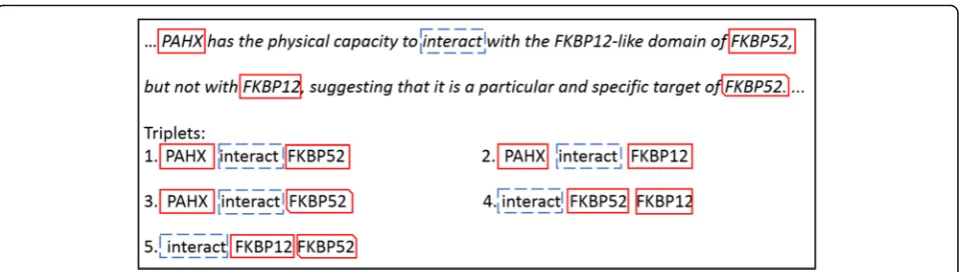
protein name) PAHX, FKBP52, FKBP12, and FKBP52 (the
second occurrence of FKBP52 in the sentence) and one
interaction word
interacts
. There are five PPI triplets
(Fig.
1
), only one of the triplets correctly describes
this specific PPI (triplet 1 in Fig.
1
).
Recently Natural Language Processing (NLP)
tech-niques have been utilized in many machine learning
ap-proaches [
63
–
66
] to parse sentences into dependency
trees or constituent trees, which could further be used
in pattern matching or rule-based search. However, to
our best knowledge, all the methods have to adopt some
given rules/patterns. The given rules are typically rather
general; therefore, they fail to represent all the patterns
in the training sentences.
Bui et al. has developed a hybrid approach for
extract-ing PPIs [
78
]. The method consists of two phases. First,
the data were automatically categorized into subsets
based on its semantic properties and candidate PPI pairs
were extracted from these subsets. Second, support
vec-tor machines (SVMs) were applied to classify candidate
PPI pairs using features specific for each subset. They
obtained promising results on five benchmark datasets:
AIMed, BioInfer, HPRD50, IEPA and LLL with F-scores
ranging from 60 to 84%.
A comprehensive benchmark was developed for Kernel
based PPI extraction methods by Tikk et al. [
43
]. In the
work, the authors study whether the reported
perform-ance metrics are robust across different corpora and
learn-ing settlearn-ings and whether the use of deep parslearn-ing actually
leads to an increase in extraction quality. They concluded
that for most kernels no sensible estimation of PPI
extrac-tion performance on new text is possible, given the
current heterogeneity in evaluation data [
43
].
In this paper, we propose a method based on NLP and
automatically learn rules/patterns to extract the PPI
trip-lets from sentences. We then classify them as true or
false with probabilities based on whether the interaction
words correctly describe the interaction relationship
be-tween the two participant protein names.
Methods
Our method, GRGT, utilized the grammatical
relation-ship among each Protein-Protein-Interaction triplet
ex-tracted by natural language processing (NLP) techniques
and a graph theorem algorithm (shortest path algorithm)
as feature to build a classifier. A dictionary of protein
names and interaction words with their morphemes
were built based on our previous study [
28
]. All
inter-action words in our dictionary were a single word, and
were grouped manually into 22 categories by the
similar-ity of their grammatical properties to reflect the fact that
some interaction word can be used interchangeably
without altering the sematic of the sentence.
Preprocessing
The sentence harboring the PPI triple was first
toke-nized, so that each word took their own tag as an
inde-pendent component. The tokenized sentence was then
parsed using Stanford Sentence Parser to obtain the
grammatical relationships among all the words. For
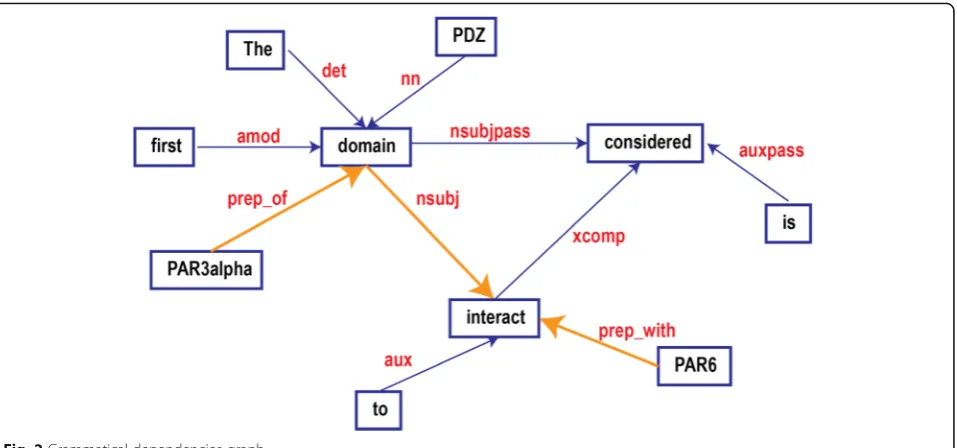
ex-ample, the sentence,
“
The first PDZ domain of
PAR3a-lpha is considered to interact with PAR6.,
”
was parsed to
have a relationship graph showing in Fig.
2
representing
the grammatical relationships between the words in the
sentence. The words in red, such as
nn, nsubj
, etc. are
typed dependencies defined in [
79
].
The typed dependencies have a hierarchical structure
themselves. Here we only introduce some necessary
facts. The top level of the hierarchical structure is
dependent (
dep
), which has the following types: auxiliary
(
aux
), argument (
arg
), coordination (
cc
), conjunct (
conj
),
expletive (
expl
), modifier (
mod
), parataxis (
parataxis
),
punctuation
(
punct
),
referent
(
ref
)
and
semantic
dependent (
sdep
). Each of the above types may have
sub-types themselves. For example,
arg
has subtypes: agent
(agent), complement (
comp
) and subject (
subj
), where
subj
has nominal subject (
nsubj
) and clausal subject
(
csubj
) as its subtypes. For example,
“
domain
”
is
nsubj
of
“
interact
”
(Fig.
2
).
Feature extraction
We designed the direct feature of each triplet (two protein
names and the interaction word) as the minimal sub-graph
containing the triplet. Dijkstra
’
s shortest paths algorithm
was adopted to find the shortest path (highlighted path in
Fig.
2
) in the grammatical graph between pairs of the triplet
elements. The obtained sub-graph is the Grammatical
Rela-tionship Graph for Triplets (GRGT) (Fig.
3a
).
The GRGT of Fig.
3a
describes the meaning
“
domain
of P1 (PAR3alpha) interact with P2 (PAR6).
”
The
infor-mation in this graph is all the inforinfor-mation we need to
know to infer the interaction between PAR3alpha and
PAR6. In fact, for two triplets with only altered protein
names but exactly the same GRGT, these two triples are
equivalent in the sense of grammatical relations; thus,
they shall be classified as the same category. Although
the direct feature, exact GRGT, is quite specific and the
classification based on only these exact GRGTs are of
very high precision. It sacrifices the generalizability a lot:
the pattern of a new GRGT of PPI triplet has to match
the training true patterns exactly to be considered as a
true PPI. To introduce more general GRGTs, we could
relax the subgraph. For example, in the subgraph above,
we allowed the
domain
to vary from annotated samples
(Fig.
3b
). Furthermore, it is also possible to alternating
the interaction word to replace the interaction word in
GRGT with other members in its group (notice we
grouped interaction words into 22 categories).
Training
We adopted a probabilistic way to train the model. Each
feature, GRGT, will be assigned a probability of being
corresponding to a true PPI as the proportion of true
PPI triplets in the training data having such a feature
Fig. 2Grammatical dependencies graph
(either a direct or generalized one) in all triplets that
have this feature.
The directions of the sub-graph can also be inferred at
the same time, since the information of the direction of
the true patterns can also be annotated.
Prediction
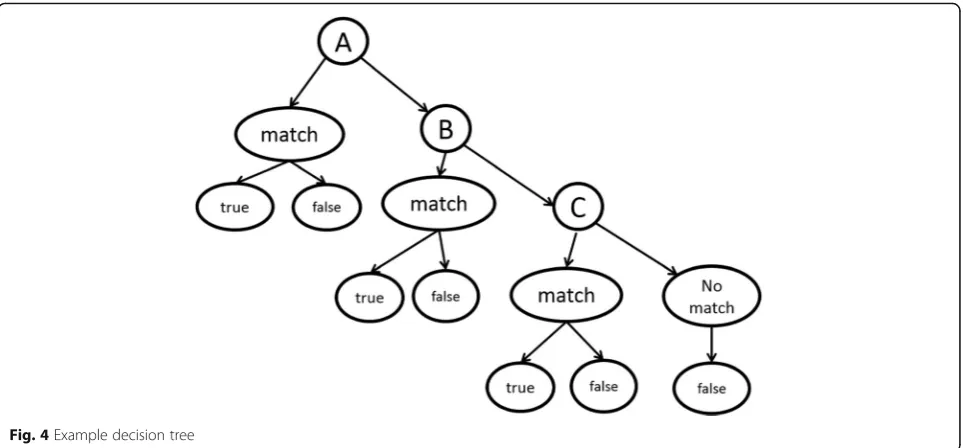
A simple decision tree (Fig.
4
) was used to cast the
pre-diction. The decision tree has one decision node at each
level representing the GRGT at different levels of
gener-alizations. For simplicity, we use the above interaction
sentence
“
domain of P1 interact with P2
”
as the
anno-tated training sample to demonstrate how the decision
tree works. The procedure is shown below:
The first level of the decision tree will be the exact
feature in Fig.
3a
. If the new sentence does not match
the pattern exactly, send this sentence to the second
level. Therefore,
“
domain of P1 interact with P2
”
is a
match, and the probability of triplet
“
P1-interact-P2
”
being true is assigned as the probability of this feature
being associated with true PPIs. However,
“
motif of P1
interact with P2
”
does not match the feature, thus
should be passed to the next level.
The second level is the relaxed graph as shown in
Fig.
3b
. At this level, the previous example,
“
motif of
P1 interact with P2
”
is a match; therefore, the
probability of this triplet
P1-interact-P2
classified as
true triplet is the associated probability of the
feature. However, the sentence
“
motif of P1
associates with P2
”
does not have a feature in this
level since the interaction word is different.
Therefore, it is passed to the next level.
The third level, as described in Fig.
3c
, is the most
relaxed version. In this level we allow the interaction
words to differ from the annotated example as long
as they belong to the same group. For example, the
above sentence
“
motif of P1 associates with P2
”
is a
match in level 3, although it is not a match in level
1 or 2. Therefore the triplet
P1-associates-P2
is given
the probability being true as the probability of the
feature being true. If a sentence fails to match the
pattern in this level (in practice there may be much
more levels), we mark the triplet contained in this
sentence as a false triplet.
Results
Table
1
summarizes the datasets we used for testing the
performance of our method (GRGT), including three
benchmark datasets: HPRD50, IEPA, LLL, and a corpus
we constructed: PICAD (protein interaction corpus with
annotated directions). PICAD contains not only the
in-teractions of protein pairs, but the directionality of
inter-actions, which is important for analyzing biological
network.
Table
2
shows the experiment results based on
leave-one-out
classification.
The
performance
of
top-performing methods in literature [
23
,
47
,
48
,
72
]
was also included for comparison. Compared with
Fig. 4Example decision tree
Table 1
Dataset information
Corpus No. of sentences No. of Triplets No. of true PPI
HPRD50 145 954 126
IEPA 374 1341 164
LLL 79 977 106
other methods, GRGT largely improved precision while
maintaining comparable F-score, especially on IEPA
and LLL. High precision is very important when the
discovered (classified) results are going to be used as
prior knowledge to guide experiment design. If one
model has low precision, the results could be doubtful,
and the researchers would receive incorrect
informa-tion, which may provide false guidance for downstream
studies. On the other hand, the lower recall rate of
GRGT resulted from that most misclassified cases were
false negatives, where true triplets cannot be matched
to any known patterns. This would be acceptable since
most true interactions (PPI triplets) tend to occur more
than once in literature. The interaction will be
ex-tracted as long as one of PPI triplets is classified as
true. A system with high precision can thus be used to
more effectively extract PPIs from biomedical literature
and deposit them into databases. In such task, the value
Performance comparison of our method (GRGT) with top-performing methods on four benchmark datasets.FF1-score,Pprecision,Rrecall. The measurement is
out of 100.a
deep learning method.b
Values are not available because of the unavailability of executable program or source code
a
b
c
d
of precision would be more important than the value of
recall, and the tradeoff that decreases F-score with
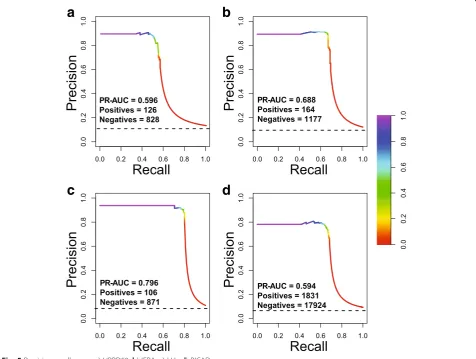
im-proving precision significantly is worthy. Figure
5
shows
the precision-recall curves of our system on different
datasets.
Recently, several studies introduced deep learning
methods for PPI extraction [
80
–
83
]. We also compare
the performance of our method with Zhao et al. [
83
],
which uses the same benchmark datasets. Our method
again had better precision for the benchmark datasets
compared with [
83
], while they get improvement in
recall.
Discussion
To further improve the performance of GRGT, the
pat-terns can be simplified further so that more true triplets
can be matched if they are similar to true patterns, but
not exactly the same. The hierarchical structure of the
typed dependencies can be used for this purpose. For
ex-ample,
nsubj
(nominal subject) can be reduced to
subj
(subject) or even further to
arg
(argument). We need to
balance recall and precision rate while doing this, as
simplification would improve the recall rate, but with a
cost of lowered precision rate. Some more experiments
can be performed on various ways of reducing the exact
patterns, and on how to combine the new relaxed
pat-terns with our existing patpat-terns by designing different
decision trees to achieve better performance.
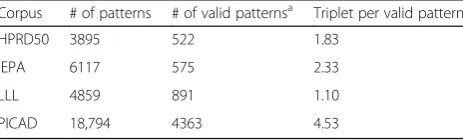
We further analyzed the extracted patterns
(sub-graphs), and in Table
3
we can see that not a lot of
patterns appeared more than once, only about 10
–
20%
of the extracted subgraphs appeared at least twice in the
entire dataset, which leaves the coverage of triplets per
sample relatively low, so that there is not much
informa-tion can be borrowed from other triplets in the dataset.
To further improve the performance, one can annotate
more interaction cases to increase the size of the
train-ing set, which should significantly improve the recall rate
of our method since we will have more coverage per
pattern.
This method can be used to extract other relationships
as well, as long as the triplet is well defined and the
library for terms and interaction words are given.
Consistent with literature, Table
2
showed that deep
learning approaches cannot beat traditional kernel-based
or machine-learning methods all the time in PPI
extrac-tion task. The reasons would be 1) deep neural networks
would not be beneficial without effectively large amount
of training data and 2) deep neural networks are
rela-tively difficult to train because of the large number of
parameters. For a well-trained deep neural networks
from large amount of training data, the performance
may still get improved by combining with traditional
feature-based machine learning methods [
84
]. The
fea-tures we designed in this study can be applied to other
machine learning methods, as well as be incorporated
into deep learning methods. The current work is an
ex-panded version of a previous study [
82
].
Conclusions
In this work, we developed a new NLP-based method,
GRGT, for extracting the protein-protein interactions
from biomedical literature. The performance of GRGT
was demonstrated by comparing with top performing
methods using benchmark datasets. GRGT obtained
bet-ter precision, indicating that researchers can use PPIs
extracted by GRGT as prior knowledge to guide
experi-ment design with high confidence. We believe that
GRGT will be a very useful tool for PPI-extraction task.
Abbreviations
GRGT:Grammatical Relationship Graph for Triplets; NLP: Natural language processing; PICAD: Protein interaction corpus with annotated directions; PPI: Protein-protein interaction
Acknowledgements
We would like to thank the anonymous reviewers for the valuable insights.
Funding
This study was partially supported by a grant from NIGMS of National Institute of Health under award number R01GM126558. YYT is supported by a grant from NCI of National Institute of Health under award number R01CA204962.
The publication cost of the article will be covered by the open access fund from Florida State University.
Availability of data and materials
PICAD is available on author’s website. Other data are all publicly available.
About this supplement
This article has been published as part ofBMC Medical Informatics and Decision MakingVolume 18 Supplement 2, 2018: Selected extended articles from the 2nd International Workshop on Semantics-Powered Data Analytics. The full contents of the supplement are available online athttps://bmcmedinformdecismak.biomed central.com/articles/supplements/volume-18-supplement-2.
Authors’contributions
KY implemented the original algorithm and wrote the first draft of the paper. PL improved the method and worked on the revisions. JZ designed the original algorithm. All the authors involved in the research design. All the authors have revised and proofread the paper. All authors read and approved the final manuscript.
Ethics approval and consent to participate Not applicable.
Table 3
Summary of the extracted subgraphs and their
generalizations
Corpus # of patterns # of valid patternsa Triplet per valid pattern
HPRD50 3895 522 1.83
IEPA 6117 575 2.33
LLL 4859 891 1.10
PICAD 18,794 4363 4.53
a
Genetics, School of Medicine, Wayne State University, Detroit, MI 48201, USA.
Published: 23 July 2018
References
1. Kann MG. Protein interactions and disease: computational approaches to uncover the etiology of diseases. Brief Bioinform. 2007;8:333–46. 2. Alfarano C, Andrade CE, Anthony K, Bahroos N, Bajec M, Bantoft K, Betel D,
Bobechko B, Boutilier K, Burgess E, et al. The biomolecular interaction network database and related tools 2005 update. Nucleic Acids Res. 2005; 33:D418–24.
3. Aranda B, Achuthan P, Alam-Faruque Y, Armean I, Bridge A, Derow C, Feuermann M, Ghanbarian AT, Kerrien S, Khadake J, et al. The IntAct molecular interaction database in 2010. Nucleic Acids Res. 2010;38:D525–31. 4. Beuming T, Skrabanek L, Niv MY, Mukherjee P, Weinstein H. PDZBase: a
protein-protein interaction database for PDZ-domains. Bioinformatics (Oxford, England). 2005;21:827–8.
5. Chatr-Aryamontri A, Breitkreutz B-J, Heinicke S, Boucher L, Winter A, Stark C, Nixon J, Ramage L, Kolas N, O'Donnell L, et al. The BioGRID interaction database: 2013 update. Nucleic Acids Res. 2013;41:D816–23.
6. Chatr-aryamontri A, Ceol A, Palazzi LM, Nardelli G, Schneider MV, Castagnoli L, Cesareni G. MINT: the molecular INTeraction database. Nucleic Acids Res. 2007;35:D572–4.
7. Gama-Castro S, Jiménez-Jacinto V, Peralta-Gil M, Santos-Zavaleta A, Peñaloza-Spinola MI, Contreras-Moreira B, Segura-Salazar J, Muñiz-Rascado L, Martínez-Flores I, Salgado H, et al. RegulonDB (version 6.0): gene regulation model of Escherichia coli K-12 beyond transcription, active (experimental) annotated promoters and Textpresso navigation. Nucleic Acids Res. 2008;36: D120–4.
8. Griffith OL, Montgomery SB, Bernier B, Chu B, Kasaian K, Aerts S, Mahony S, Sleumer MC, Bilenky M, Haeussler M, et al. ORegAnno: an open-access community-driven resource for regulatory annotation. Nucleic Acids Res. 2008;36:D107–13.
9. Grote A, Klein J, Retter I, Haddad I, Behling S, Bunk B, Biegler I, Yarmolinetz S, Jahn D, Münch R. PRODORIC (release 2009): a database and tool platform for the analysis of gene regulation in prokaryotes. Nucleic Acids Res. 2009; 37:D61–5.
10. Han K, Park B, Kim H, Hong J, Park J. HPID: the human protein interaction database. Bioinformatics (Oxford, England). 2004;20:2466–70.
11. Keshava Prasad TS, Goel R, Kandasamy K, Keerthikumar S, Kumar S, Mathivanan S, Telikicherla D, Raju R, Shafreen B, Venugopal A, et al. Human protein reference database–2009 update. Nucleic Acids Res. 2009;37: D767–72.
12. Kuhn M, von Mering C, Campillos M, Jensen LJ, Bork P. STITCH: interaction networks of chemicals and proteins. Nucleic Acids Res. 2008;36:D684–8. 13. Mathivanan S, Periaswamy B, Gandhi TKB, Kandasamy K, Suresh S,
Mohmood R, Ramachandra YL, Pandey A. An evaluation of human protein-protein interaction data in the public domain. BMC bioinformatics. 2006; 7(Suppl 5):S19.
14. Matys V, Fricke E, Geffers R, Gössling E, Haubrock M, Hehl R, Hornischer K, Karas D, Kel AE, Kel-Margoulis OV, et al. TRANSFAC: transcriptional regulation, from patterns to profiles. Nucleic Acids Res. 2003;31:374–8. 15. Mishra GR, Suresh M, Kumaran K, Kannabiran N, Suresh S, Bala P, Shivakumar
K, Anuradha N, Reddy R, Raghavan TM, et al. Human protein reference database–2006 update. Nucleic Acids Res. 2006;34:D411–4.
16. Pagel P, Kovac S, Oesterheld M, Brauner B, Dunger-Kaltenbach I, Frishman G, Montrone C, Mark P, Stümpflen V, Mewes H-W, et al. The MIPS mammalian
21. Stark C, Breitkreutz B-J, Reguly T, Boucher L, Breitkreutz A, Tyers M. BioGRID: a general repository for interaction datasets. Nucleic Acids Res. 2006;34: D535–9.
22. Barrell D, Dimmer E, Huntley RP, Binns D, O'Donovan C, Apweiler R. The GOA database in 2009–an integrated gene ontology annotation resource. Nucleic Acids Res. 2009;37:D396–403.
23. Bui Q-C, Katrenko S, Sloot PMA. A hybrid approach to extract protein-protein interactions. Bioinformatics (Oxford, England). 2011;27:259–65. 24. Bui Q-C, Nualláin BO, Boucher CA, Sloot PMA. Extracting causal relations on
HIV drug resistance from literature. BMC Bioinformatics. 2010;11:101. 25. Ceol A, Chatr Aryamontri A, Licata L, Peluso D, Briganti L, Perfetto L,
Castagnoli L, Cesareni G. MINT, the molecular interaction database: 2009 update. Nucleic Acids Res. 2010;38:D532–9.
26. Ceol A, Chatr-Aryamontri A, Licata L, Cesareni G. Linking entries in protein interaction database to structured text: the FEBS letters experiment. FEBS Lett. 2008;582:1171–7.
27. Chowdhary R, Zhang J, Liu JS. Bayesian inference of protein-protein interactions from biological literature. Bioinformatics (Oxford, England). 2009;25:1536–42.
28. Giles CB, Wren JD. Large-scale directional relationship extraction and resolution. BMC bioinformatics. 2008;9(Suppl 9):S11.
29. Gonzalez G, Uribe JC, Tari L, Brophy C, Baral C. Mining gene-disease relationships from biomedical literature: weighting protein-protein interactions and connectivity measures. Pac Symp Biocomput. 2007:28–39. 30. Hu X, Wu DD. Data mining and predictive modeling of biomolecular
network from biomedical literature databases. IEEE/ACM Trans Comput Biol Bioinform. 2007;4:251–63.
31. Hu X, Zhang X, Yoo I, Wang X, Feng J. Mining hidden connections among biomedical concepts from disjoint biomedical literature sets through semantic-based association rule. Int J Intell Syst. 2010;25:207–23. 32. Huang M, Ding S, Wang H, Zhu X. Mining physical protein-protein
interactions from the literature. Genome Biol. 2008;9(Suppl 2):S12. 33. Iossifov I, Rodriguez-Esteban R, Mayzus I, Millen KJ, Rzhetsky A. Looking at
cerebellar malformations through text-mined interactomes of mice and humans. PLoS Comput Biol. 2009;5:e1000559.
34. Jensen LJ, Saric J, Bork P. Literature mining for the biologist: from information retrieval to biological discovery. Nat Rev Genet. 2006;7:119–29. 35. Kano Y, Nguyen N, Saetre R, Yoshida K, Miyao Y, Tsuruoka Y, Matsubayashi
Y, Ananiadou S, Tsujii J: Filling the gaps between tools and users: a tool comparator, using protein-protein interaction as an example. Pac Symp Biocomput 2008:616–627.
36. Koike A, Niwa Y, Takagi T. Automatic extraction of gene/protein biological functions from biomedical text. Bioinformatics (Oxford, England). 2005;21: 1227–36.
37. Korbel JO, Doerks T, Jensen LJ, Perez-Iratxeta C, Kaczanowski S, Hooper SD, Andrade MA, Bork P. Systematic association of genes to phenotypes by genome and literature mining. PLoS Biol. 2005;3:e134.
38. Krallinger M, Leitner F, Rodriguez-Penagos C, Valencia A. Overview of the protein-protein interaction annotation extraction task of BioCreative II. Genome Biol. 2008;9(Suppl 2):S4.
39. Krallinger M, Leitner F, Valencia A: Assessment of the {S}econd {B}io{C}reative {PPI} task: {a}utomatic extraction of protein-protein interactions. In: Proceedings of the Second BioCreative Challenge Evaluation Workshop:2007 2007; 2007.
41. Pyysalo S, Airola A, Heimonen J, Björne J, Ginter F, Salakoski T. Comparative analysis of five protein-protein interaction corpora. BMC Bioinformatics. 2008;9(Suppl 3):S6.
42. Rzhetsky A, Seringhaus M, Gerstein M. Seeking a new biology through text mining. Cell. 2008;134:9–13.
43. Tikk D, Thomas P, Palaga P, Hakenberg J, Leser U. A comprehensive benchmark of kernel methods to extract protein-protein interactions from literature. PLoS Comput Biol. 2010;6(7):e1000837.
44. Wong L, Liu G. Protein Interactome analysis for countering pathogen drug resistance. J Comput Sci Technol. 2010;25:124–30.
45. Bell L, Chowdhary R, Liu JS, Niu X, Zhang J. Integrated bio-entity network: a system for biological knowledge discovery. PLoS One. 2011;6(6):e21474. 46. Airola A, Pyysalo S, Björne J, Pahikkala T, Ginter F, Salakoski T. All-paths
graph kernel for protein-protein interaction extraction with evaluation of cross-corpus learning. BMC bioinformatics. 2008;9(11):S2.
47. Chang Y-C, Chu C-H, Su Y-C, Chen CC, Hsu W-L. PIPE: a protein–protein interaction passage extraction module for BioCreative challenge. Database. 2016:2016.
48. Miwa M, Sætre R, Miyao Y, Tsujii J. Protein–protein interaction extraction by leveraging multiple kernels and parsers. Int J Med Inform. 2009;78(12):e39–46. 49. Skusa A, Rüegg A, Köhler J. Extraction of biological interaction networks
from scientific literature. Brief Bioinform. 2005;6:263–76.
50. Blaschke C, Andrade MA, Ouzounis C, Valencia A. Automatic extraction of biological information from scientific text: protein-protein interactions. Proc Int Conf Intell Syst Mol Biol. 1999:60–7.
51. Ng, Wong: Toward routine automatic pathway discovery from on-line scientific text abstracts. Genome Inform Ser Workshop Genome Informa 1999, 10:104–112.
52. Thomas J, Milward D, Ouzounis C, Pulman S, Carroll M. Automatic extraction of protein interactions from scientific abstracts. Pac Symp Biocomput. 2000: 541–52.
53. Friedman C, Kra P, Yu H, Krauthammer M, Rzhetsky A. GENIES: a natural-language processing system for the extraction of molecular pathways from journal articles. Bioinformatics (Oxford, England). 2001;17(Suppl 1):S74–82. 54. Ono T, Hishigaki H, Tanigami A, Takagi T. Automated extraction of
information on protein-protein interactions from the biological literature. Bioinformatics (Oxford, England). 2001;17:155–61.
55. Park JC, Kim HS, Kim JJ. Bidirectional incremental parsing for automatic pathway identification with combinatory categorial grammar. Pac Symp Biocomput. 2001:396–407.
56. Wong L. PIES, a protein interaction extraction system. Pac Symp Biocomput. 2001:520–31.
57. Yakushiji A, Tateisi Y, Miyao Y, Tsujii J. Event extraction from biomedical papers using a full parser. Pac Symp Biocomput. 2001:408–19.
58. Leroy G, Chen H. Filling preposition-based templates to capture information from medical abstracts. Pac Symp Biocomput. 2002:350–61.
59. Pustejovsky J, Castaño J, Zhang J, Kotecki M, Cochran B. Robust relational parsing over biomedical literature: extracting inhibit relations. Pac Symp Biocomput. 2002: 362–73.
60. Temkin JM, Gilder MR. Extraction of protein interaction information from unstructured text using a context-free grammar. Bioinformatics (Oxford, England). 2003;19:2046–53.
61. Narayanaswamy M, Ravikumar KE, Vijay-Shanker K. Beyond the clause: extraction of phosphorylation information from medline abstracts. Bioinformatics (Oxford, England). 2005;21(Suppl 1):i319–27.
62. Saric J, Jensen LJ, Ouzounova R, Rojas I, Bork P. Extraction of regulatory gene/protein networks from Medline. Bioinformatics (Oxford, England). 2006;22:645–50.
63. Miyao Y, Sagae K, Saetre R, Matsuzaki T, Tsujii J. Evaluating contributions of natural language parsers to protein-protein interaction extraction. Bioinformatics. 2009;25(3):394–400.
64. Zhang HT, Huang ML, Zhu XY. A unified active learning framework for biomedical relation extraction. J Comput Sci Technol. 2012;27(6):1302–13. 65. Lee J, Kim S, Lee S, Lee K, Kang J. On the efficacy of per-relation basis
performance evaluation for PPI extraction and a high-precision rule-based approachBMC Med Inform Decis Mak. 13;2013(Suppl 1):S7.
66. Raja K, Subramani S, Natarajan J. PPInterFinder–a mining tool for extracting causal relations on human proteins from literature. Database. 2013;2013:bas052. 67. Huang M, Zhu X, Hao Y, Payan DG, Qu K, Li M. Discovering patterns to
extract protein-protein interactions from full texts. Bioinformatics (Oxford, England). 2004;20:3604–12.
68. Malik R, Franke L, Siebes A. Combination of text-mining algorithms increases the performance. Bioinformatics (Oxford, England). 2006;22:2151–7. 69. Kim S, Yoon J, Yang J. Kernel approaches for genic interaction extraction.
Bioinformatics (Oxford, England). 2008;24:118–26.
70. Stapley BJ, Benoit G. Biobibliometrics: information retrieval and visualization from co-occurrences of gene names in Medline abstracts. Pac Symp Biocomp. 2000:529–40.
71. Jenssen TK, Laegreid A, Komorowski J, Hovig E. A literature network of human genes for high-throughput analysis of gene expression. Nat Genet. 2001;28:21–8.
72. Murugesan G, Abdulkadhar S, Natarajan J. Distributed smoothed tree kernel for protein-protein interaction extraction from the biomedical literature. PLoS One. 2017;12(11):e0187379.
73. Chowdhary R, Zhang J, Liu JS. Bayesian inference of protein-protein interactions from biological literature. Bioinformatics. 2009;25(12):1536–42. 74. Kim S, Shin S-Y, Lee I-H, Kim S-J, Sriram R, Zhang B-T. PIE: an online
prediction system for protein-protein interactions from text. Nucleic Acids Res. 2008;36:W411–5.
75. Krallinger M, Morgan A, Smith L, Leitner F, Tanabe L, Wilbur J, Hirschman L, Valencia A. Evaluation of text-mining systems for biology: overview of the second BioCreative community challenge. Genome Biol. 2008;9(Suppl 2):S1. 76. Bell L, Zhang J, Niu X. Mixture of logistic models and an ensemble
approach for extracting protein-protein interactions. ACM-BCB. 2011:371–5. 77. Hatzivassiloglou V, Weng W. Learning anchor verbs for biological interaction
patterns from published text articles. Int J Med Inform. 2002;67:19–32. 78. Bui QC, Katrenko S, Sloot PM. A hybrid approach to extract protein-protein
interactions. Bioinformatics. 2011;27(2):259–65.
79. Marneffe M-Cd, MacCartney B, Manning CD: Generating typed dependency parses from phrase structure parses. In:LREC:2006; 2006.
80. Hsieh Y-L, Chang Y-C, Chang N-W, Hsu W-L. Identifying protein-protein interactions in biomedical literature using recurrent neural networks with long short-term memory. In: Proceedings of the eighth international joint conference on natural language processing (volume 2: short papers), vol. 2017; 2017. p. 240–5.
81. Peng Y, Lu Z: Deep learning for extracting protein-protein interactions from biomedical literature. arXiv preprint arXiv:170601556 2017.
82. Sun T, Zhou B, Lai L, Pei J. Sequence-based prediction of protein protein interaction using a deep-learning algorithm. BMC bioinformatics. 2017; 18(1):277.
83. Zhao Z, Yang Z, Lin H, Wang J, Gao S. A protein-protein interaction extraction approach based on deep neural network. Int J Data Min Bioinform. 2016;15(2):145–64.