Sci
O p e n H U B f o r S c i e n t i f i c R e s e a r c hForschen
Journal of Clinical and Cosmetic Dermatology
Open Access
Volume:1.3
Research Article
Blepharoplasty with External Mini-Incisions
Angelo Rebelo*
Plastic, Reconstructive and Aesthetic Surgery, Clínica Milénio, Rua Manuel Silva Leal, Lisboa, Portugal
Received date: 17 Aug 2017; Accepted date: 13 Sep 2017; Published date: 19 Sep 2017.
Citation: Rebelo A (2017) Blepharoplasty with External Mini-Incisions. J Clin Cosmet Dermatol 1(3): http://dx.doi.org/10.16966/2576-2826.118
Copyright: © 2017 Rebelo A. This is an open-access article distributed under the terms of the Creative Commons Attribution License, which permits unrestricted use, distribution, and reproduction in any medium, provided the original author and source are credited.
*Corresponding author: Angelo Rebelo, Plastic, Reconstructive and Aesthetic Surgery, Clínica Milenio, Rua Manuel Silva Leal, Lisboa, Portugal, Tel: + 351 21 7277265; E-mail: [email protected]
Abstract
Background: This is a simple and almost risks free technique. Very efficient, improving the appearance of people with herniation of fat pad
bags of the lower lids.
Objective: The author reports a series of 3239 blepharoplasty with external mini-incisions from September 1990 through July 2017.
Methods: All patients have a complete clinical history, preoperative routine examinations and photos pre and post-operative. Local anaesthesia is used.
Results: Fat pad bags of the lower lids were removed without major complications or recidive.
Conclusions: This is a simple and quick technique with minimal scars almost invisible, with very good results, quick recovery, few risks and complications.
Keywords:
Blepharoplasty; Mini-incisions; Plastic SurgeryIntroduction
It was Fontana, a Plastic Surgeon from Valenca, Spain, who invented this technique to remove the fat pad bags of the lower lids, through minimal transcutaneous incisions of 2-3 mm. It’s a very simple technique, easy to perform, with indication in cases with excess or herniation of the fat pad bags. We also perform this procedure in patients with skin excess and/or wrinkles, [1-3] with good results. It’s a good alternative to the conjuntival approach [4,5] because it’s more comfortable and with fewer risks to the patients. We verified that the removal of the simple fat pad gives a much better appearance to patients with a good skin retraction and if necessary can be complemented with peeling’s or laser procedures.
Methods
Patients
Since September of 1990, 3239 blepharoplasty were performed with external mini-incisions. Local anaesthesia was used. Patient ages ranged from 23 to 80 years old.
Patient selection
In our experience the age is not an important factor. We have concluded that the operated patients are very satisfied and with a good result. This technique is excellent in patients with herniation without excess of skin. However we have been performing it, with good results, in patient with certain excess of skin and some wrinkles.
Contraindications
Like other surgical procedures it has the same contraindications. It is contraindicated when certain ocular diseases occur.
Anesthesia
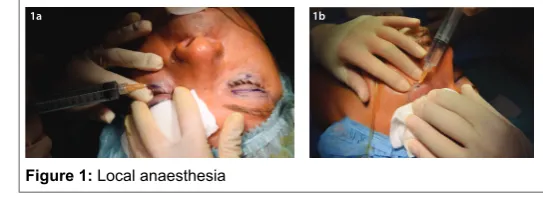
Local anaesthesia, Lydocaine 2% with Adrenaline was used, 4-8 cc (Figures 1a and 1b).
Technique
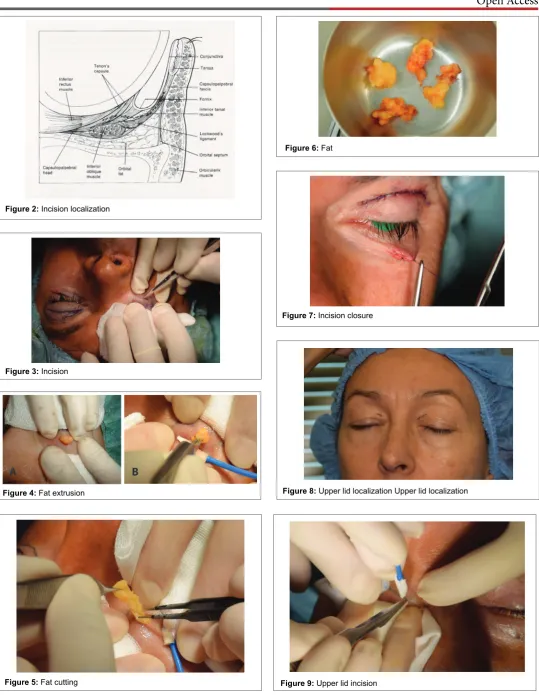
It is performed under local anaesthesia, through a small 2-3 mm incision made with an 11 blade, in the lower lid at pupil level. It should be cut at once, downwards, skin, muscle and septum until the central bag (Figures 2 and 3); pressing, at the same time, the eye to facilitate the extrusion of the fat with the removal of the blade (Figure 4a).
With the help of forceps the fat is gently pushed and cut with a cautery high Temperature Loop Tip (Aaron Medical Industries, St. Petersburg, FL) (Figures 4b and 5). We can use electrocautery low intensity, radio surgery or laser.
Through the same small incision we have access to the internal and external fat pad bags. With gentle and directioned movements we should remove sufficient fat, never in excess (Figure 6). Incision closure is carried out with a 6/0 nylon, one or two stitches (Figure 7).
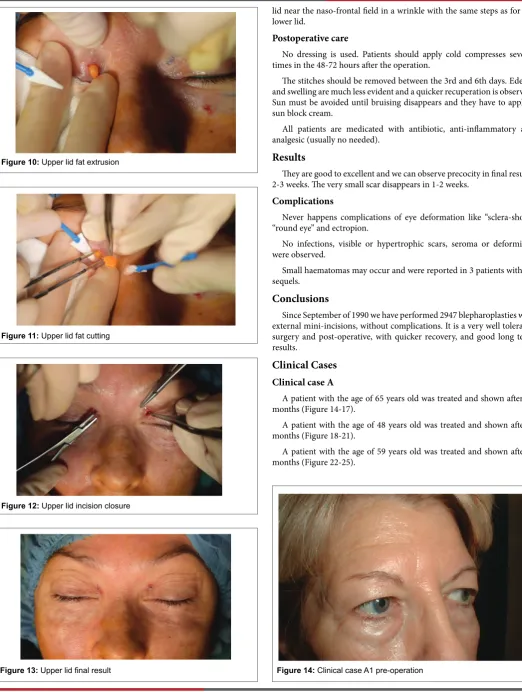
We also performed a similar procedure on the upper lid (Figures 8-13), but with very specific indications of herniation of the medial and internal fat pad bags, through a 2-3 mm incision in the inner portion of the upper
1a 1b
Figure 1: Local anaesthesia
Sci
O p e n H U B f o r S c i e n t i f i c R e s e a r c hForschen
Open Access
Figure 2: Incision localization
Figure 3: Incision
A
B
Figure 4: Fat extrusion
Figure 5: Fat cutting
Figure 6: Fat
Figure 7: Incision closure
Figure 8: Upper lid localization Upper lid localization
Sci
O p e n H U B f o r S c i e n t i f i c R e s e a r c hForschen
Open Access
Figure 10: Upper lid fat extrusion
Figure 11: Upper lid fat cutting
Figure 12: Upper lid incision closure
Figure 13: Upper lid final result Figure 14: Clinical case A1 pre-operation
lid near the naso-frontal field in a wrinkle with the same steps as for the lower lid.
Postoperative care
No dressing is used. Patients should apply cold compresses several times in the 48-72 hours after the operation.
The stitches should be removed between the 3rd and 6th days. Edema and swelling are much less evident and a quicker recuperation is observed. Sun must be avoided until bruising disappears and they have to apply a sun block cream.
All patients are medicated with antibiotic, anti-inflammatory and analgesic (usually no needed).
Results
They are good to excellent and we can observe precocity in final results, 2-3 weeks. The very small scar disappears in 1-2 weeks.
Complications
Never happens complications of eye deformation like “sclera-show”, “round eye” and ectropion.
No infections, visible or hypertrophic scars, seroma or deformities were observed.
Small haematomas may occur and were reported in 3 patients without sequels.
Conclusions
Since September of 1990 we have performed 2947 blepharoplasties with external mini-incisions, without complications. It is a very well tolerated surgery and post-operative, with quicker recovery, and good long term results.
Clinical Cases
Clinical case A
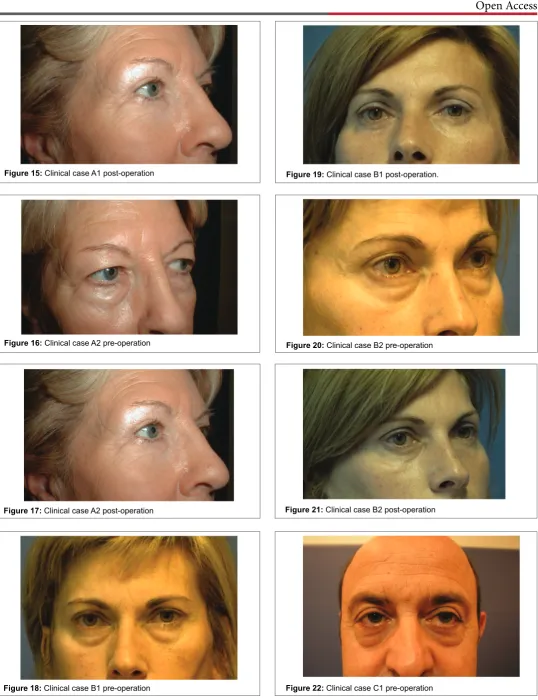
A patient with the age of 65 years old was treated and shown after 36 months (Figure 14-17).
A patient with the age of 48 years old was treated and shown after 6 months (Figure 18-21).
Sci
O p e n H U B f o r S c i e n t i f i c R e s e a r c hForschen
Open Access
Figure 15: Clinical case A1 post-operation
Figure 16: Clinical case A2 pre-operation
Figure 17: Clinical case A2 post-operation
Figure 18: Clinical case B1 pre-operation
Figure 19: Clinical case B1 post-operation.
Figure 20: Clinical case B2 pre-operation
Figure 21: Clinical case B2 post-operation
Sci
O p e n H U B f o r S c i e n t i f i c R e s e a r c hForschen
Open Access
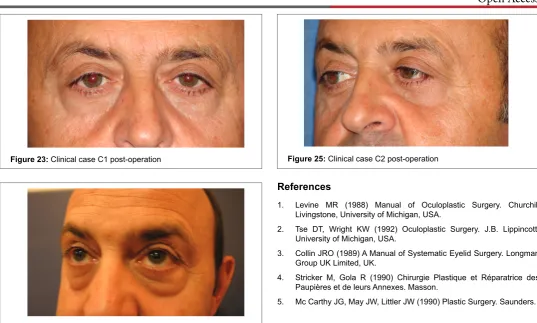
Figure 23: Clinical case C1 post-operation
Figure 24: Clinical case C2 pre-operation
Figure 25: Clinical case C2 post-operation
References
1. Levine MR (1988) Manual of Oculoplastic Surgery. Churchill Livingstone, University of Michigan, USA.
2. Tse DT, Wright KW (1992) Oculoplastic Surgery. J.B. Lippincott, University of Michigan, USA.
3. Collin JRO (1989) A Manual of Systematic Eyelid Surgery. Longman Group UK Limited, UK.
4. Stricker M, Gola R (1990) Chirurgie Plastique et Réparatrice des Paupières et de leurs Annexes. Masson.