SocialCloudShare: a Facebook Application for a
Relationship-based Information Sharing in the
Cloud
Davide Alberto Albertini
1, Barbara Carminati
1, Elena Ferrari
11DISTA, Università degli Studi dell’Insubria, Via Mazzini 5, Varese, Italy. {davide.albertini, barbara.carminati, elena.ferrari}@uninsubria.it
Abstract
Inlastfewyears, OnlineSocialNetworks(OSNs) havebecomeoneof themost usedplatformsforsharing data(e.g.,pictures,shorttexts)ontheInternet.NowadaysFacebookandTwitterarethemostpopularOSN providers,thoughtheyimplementdifferentsocialmodels.However,independentlyfromthesocialmodelthey implement,OSNplatformshavebecomeawidespreadrepositoryofpersonalinformation.Allthesedata(e.g., profileinformation,sharedelements,users’likes)arestoredinacentralizedrepositorythatcanbeexploited fordataminingandmarketing analysis.Withthisdatacollectionprocess,lotsof sensitiveinformationare gatheredbyOSNprovidersthat,intime,havebecomemoreandmoretargetedbymaliciousattackers. Toovercomethisproblem, inthispaper wepresentan architecturalframeworkthat,by meansofa Social ApplicationregisteredinFacebook,allowsuserstomovetheirdata(e.g.,relationships,resources)outsidethe OSNrealm andtostorethem inthepublic Cloud.Given thatthepublic Cloudisnota secureandprivate environment,ourproposalprovidesuserssecurityandprivacyguaranteesovertheirdatabyencryptingthe resources and by anonymizing their social graphs. The presented framework enforces Relationship-Based Access Control (ReBAC) rules over the anonymized social graph, providing OSN users the possibility to selectivelyshareinformationandresourcesastheyareusedtodoinFacebook.
Keywords: Online Social Networks; Collaborative graph anonymization; Controlled information sharing; Privacy-preserving path finding.
1. Introduction
In last years Online Social Networks (OSNs) have become one of the most common platforms for sharing data (e.g., pictures, short texts) on the Internet. Nowadays Facebook and Twitter are the most common OSN providers, though they implement different social models (e.g., supporting symmetric or asymmetric relationships). However, independently from the model they implement, OSN platforms have become a widespread repository of personal information. All these data (e.g., profile information, shared elements, users’ likes) are stored in a centralized repository, not only to offer users a more customized experience on the OSN, but also to exploit them for data mining and marketing analysis. With this data collection process, lots of sensitive information are gathered by OSN providers that, in time, have become more and more targeted by malicious attackers.
Even though OSN providers give users’ the ability to control how their information is shared over the platforms, this does not prevent them from
collecting and profilingd ata.L iteraturepresents several proposals aiming to prevent these marketing analysis. In general, these solutions imply to hide resources to OSN providers, e.g.,by encrypting or by movingthemtoanexternalplatform(seeSection7for a moredetaileddiscussion).All these proposals,thus, giveuserstheabilitytohidetheirresourcesfromOSN providers, but do not avoid that OSN providers may infer users’s personal information by analyzing, for example,thesocialgraph.
This problem is further exacerbated by the fact that some well known OSN provider have not been always honest with respect to users privacy (see, for instance, [11] for a survey on these privacy concerns). Moreover, it occurred that OSN weaknesses brought to release as public some users’ private data (e.g., the Google cyber attack in 2009 [13] or Google glitches [25]).
To overcome this problem, in this paper we present an architectural framework that, by means of a Social Application registered in Facebook, allows users to move their data (e.g., resources, relationships) outside
1
Research Article
Received on 19 July 2014, accepted on 23 July 2014, published on 20 October 2014
Copyright © 2014 Davide Alberto Albertiniet al., licensed to ICST. This is an open access article distributed under the terms of
the Creative Commons Attribution licence (http://creativecommons.org/licenses/by/3.0/), which permits unlimited use, distribution and reproduction in any medium so long as the original work is properly cited.
doi: 10.4108/ cc.1.2.e6
EAI Endorsed Transactions on Collaborative Computing 06 -10 2014 | Volume 01 | Issue 2 | e6
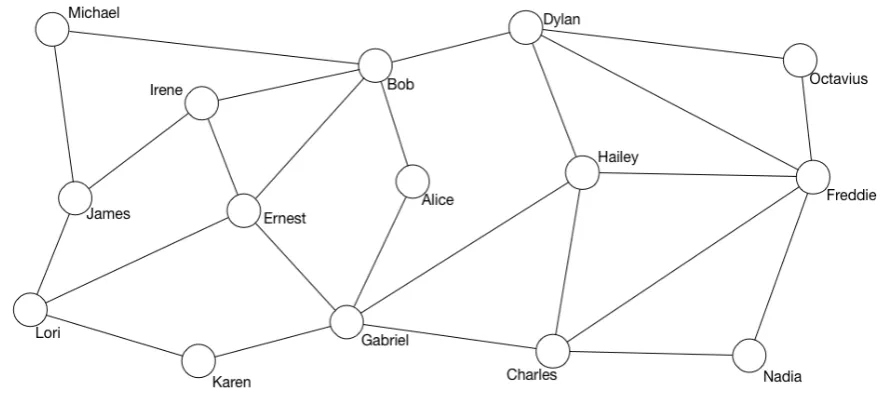
Figure 1. An example of social graph
the OSN realm and to store them in the public Cloud. Given that the public Cloud is not a secure and private environment, our proposal provides users security and privacy guarantees over their data by encrypting the resources and anonymizing their social graphs.
The presented framework enforces Relationship-Based Access Control (ReBAC) (see [5, 8]) rules over the anonymized social graph, granting OSN users the possibility to selectively share resources as they are used to do in Facebook. More precisely, the owner of a certain resourcersccan define relationship-based access control conditions that have to be verified in order to releaserscto the requestors. A relationship-based access control condition acc specifies type and depth of the relationship that must exist between the resource owner and the requestor to release rsc to the latter. More formally, an access control condition has the formacc= (RelT ype, MaxDepth), where RelType is taken from a finite set of relationship type (e.g., friend, relative, sibling, colleague) andMaxDepthspecifies the maximum number of hops that the shortest path connecting the owner and the requestor may be composed of. In this paper, we allow users to define access control conditions on their resources according to the ReBAC paradygm.
The proposed framework is based on the architecture described in [1], where anonymization and encryption techniques are accurately described. The work in [1], however, was tailored for a Decentralized Social Network (DSN) and, then, it suffers of all the limitations coming from a decentralized management of users data. In this paper, we present aproof-of-conceptof such model, by implementing it inside Facebook.
The remainder of the paper is organized as follows. Section 2 presents an overall description of the
proposal, while Section 3 illustrates the details of the architecture, along with a disussion describing how ReBAC is enforced over an anonymized social graph. Section 4 describes communication protocols, whereas Section 5 provides technical details of the current framework implementation. Section 6 deals with experimental evaluations. Finally, Section7gives an overview of the state of art, whereas Section 8 concludes the paper.
2. Overall Description
In order to highlight limitations of current proposals, we introduce a motivating example that reflects a real case of use of OSN functionalities.
Example. Let consider the simple social network represented in Figure1, where where nodes represent users and edges represent “friend” relationships. Let assume that an OSN user, say Ernest, is willing to publish on his Facebook wallboard some pictures regarding a Christmas company party. As such, Ernest wishes to share those pictures only with the people working in his company, that is, with Gabriel, James, Karen, and Lori.
In a Facebook-style scenario, Ernest would not be able to keep track of the real-life relationships that he has with his colleagues. Then, in order to distinguish his colleagues from other contacts, Ernest would have to create agroupor aneventincluding all the people who take part in the party and then share the pictures with them. A simple relationship-based sharing, like the one offered by Facebook (e.g., friends or friends-of-friends), in fact, would not reach all the users of the network that attended the party. Indeed, with an “only friends” (OF)
2 EAI Endorsed Transactions on
Collaborative Computing 06 -10 2014 | Volume 01 | Issue 2 | e6
privacy setting, James and Karen, who are not directly connected with Ernest, would not be able to see the pictures. On the other hand, with a “friend of friends” (FoF) privacy setting, a larger set of users would be able to see them, including other people such as, e.g., Ernest’s friends and relatives and their contacts.
Moreover, users who can see Ernest’s pictures are granted the ability to share the pictures on their own wall, diclosing to the OSN community that there exists a connection between them and Ernest. Let assume, then, that pictures are uploaded with an OF privacy setting and Lori shares them on her wall. As such, even James and Karen would be able to see those photos, discovering there exists a connection between Ernest and Lori. This side effect may not be appreciated by Ernest, who may desire to keep this relationship private. Finally, Ernest may have concerns publishing his pictures, in that he knows that all the published pictures are stored in an OSN repository that could be attacked by malicious users without any possibility for Ernest to prevent this event. The Social Network provider, actually, may try to infer data about Ernest for marketing purposes too and, still, Ernest would have no chances to prevent this profiling.
As highlighted by the example above, we identify three main issues underlying every OSN user expe-rience: a limited set of privacy settings available in today OSNs for sharing resources, the possibility for both users and OSN provider to infer existence of relationships, and the lack of tools for users to control how their data are stored in the social network provider realm. To cope with these issues, we propose to export users’ data (i.e., relationships and resources) from the OSN to an external platform, such as, the public Cloud, by, at the same time, enforcing a relationship-based access control more flexible than the one offered by OSN providers. Moreover, since the Cloud itself could act as a malicious party or, simply, it could be targeted by malicious attackers, data stored in the public Cloud have to be protected.
To achieve these requirements, in this paper, we present an implementation of the solutions proposed in [1] having the most popular social network, i.e., Facebook, as target. The framework presented in [1] allows users to share encrypted resources stored on the public Cloud, releasing decryption keys only to users that satisfy the corresponding ReBAC rule. The key management presented in [1] assures that resources can be encrypted/decrypted only at client-side, without disclosing any other information to the framework components. More details on the encryption scheme will be provided in Section6.
Relationships data have to be processed in a different way with respect to users’ resources. Indeed, in order to implement ReBAC, the framework needs
to search for path existence in the social graph. Thus, in order to preserve users’ privacy, this path discovering is performed on anonoymized structures, calledAnonymized Contact Lists (ACL)s. More precisely, given a user u and the list of contacts, denoted as
CLd(u), that are at a maximum distance ofd-hops from
u, the correspondingAnonymized Contact List,ACLd(u),
is defined as the coefficients of the polynomial Pd u(x)
whose roots are all and only the identifiers of users in
CLd(u).1
By exploiting the ACLs, it is possible to verify the existance of a path of a given distance between two users. As example, if the identifier of a uservis a root for the polynomial whose coefficients are in ACL1(u) (i.e., Pu1(x=idv) = 0), it means that between u and v
there exists direct relationship. However, since users have only a local view of the social graph (i.e., only their direct contacts), they are only able to compute their
ACL1. Indeed, they cannot retrieve enough information in order to compute anyACLns, wheren >1, on his/her own. Thus, in order to enforce a ReBAC model, a more complete view of the social graph is necessary, rather than the one offered byACL1s.
To overcome this problem, in [1] we propose a method to combine ACL1s so as to compute such a global view of the social graph. This method is based on the consideration that, given a certain useru, his/her list of contactsCL2(u) contains all and only those userst
such that there exists a uservcontained inCL1(u), such thatt is inCL1(t). Then, with an abuse of notation, we can denoteCL2(u) =S
v∈CL1(u)CL1(v). Thus, by means
ofACL1s of all the direct contacts ofu, it is possible to computeACL2(u).
In particular, to compute the union, we exploit the polynomials property that, given two polynomialsp(x) andq(x), the roots of the polynomial which results from their multiplication, that is,r(x) =p(x)·q(x), are all and only the roots in the union set between the roots of
p(x) and the roots ofq(x). Thus, to privately compute
ACL2(u), it is possible to compute the multiplication of all the polynomials Pv1(x), where v is a direct contact
ofu, that is,Pu1(x=idv) = 0, in order to obtainPu2(x). By
means of this procedure, at last, it is possible not only to computeACL2s, but also to obtainACLns, wheren≥2. As such, in order to compute ACLns, where n≥2, no user interaction is required.
With reference to the social graph depicted in Figure 1, the proposed collaborative graph reconstruction procedure is executed as follows. Let assume that Karen makes use ofSocialCloudShare before any other user in her community. At registration time, Karen fetches
1This relies on the assumption that, for each user u of the social network, the OSN provider assigns him/her an unique identifieridu,
at registration time, which is true for any popular OSN.
3 EAI Endorsed Transactions on
Collaborative Computing 06 -10 2014 | Volume 01 | Issue 2 | e6
her direct contact list CL1(Karen) and anonymizes it locally, in order to composeACL1(Karen). Let assume, for instance, that CL1(Karen) = [Lori,Gabriel]; then
ACL1(Karen) is given by a polynomialPKaren1 (x), whose only possible roots are the the values of identifiers of users inCL1Karen. Then, thisACL1(Karen) is sent to the SocialCloudShareframework (see Figure2).
Figure 2. Example of the propagation procedure - phase 1
Assume now that, in a second time, Ernest makes use ofSocialCloudShare. Similarly to Karen, Ernest fetches
CL1(Ernest) and anonymizes it, obtainingPErnest1 (x). By having ACL1(Karen) andACL1(Ernest) (see Figure 3), the framework2 can combine them together so as to reconstruct the graph. More precisely, it has to discover if Karen and Ernest are friends. This can be done by evaluating PKaren1 (x=idErnest), which will return a
number,0, since Ernest is not a Karen’s contact. Then,
no information propagation is necessary, in that no new relationship has been discovered.
Figure 3. Example of the propagation procedure - phase 2
Finally, assume that Lori makes use of
SocialCloudShare. Figure 1 depicts that Lori is both a direct contact of Karen and Ernest; as such, when the framework comes to evaluate PKaren1 (x=idLori)
2In Section3it will be explained which entity of the framework is in charge of this activity.
the result will be 0. Then, the framework is able to determine
PLori2 (x) =PLori2 (x)·P1
Karen(x),
PKaren2 (x) =PKaren2 (x)·P1
Lori(x).
Then, the propagation procedure evaluates PErnest1 (x=
idLori) and, again, the given result is 0; as such
the information represented by ACL1(Ernest) and
ACL1(Karen) has to be cross-propagated, resulting in
PLori2 (x) =PLori2 (x)·P1
Ernest(x),
PErnest2 (x) =PErnest2 (x)·P1
Lori(x).
Figure4 illustrates the impact of these evaluations on the framework current state.
Figure 4. Example of the propagation procedure - phase 3
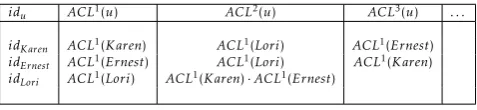
The procedure, then, continues in propagating users information in deeper levels until no futher computation is possible, that is, when the ACL1(Lori) has been propagated to each of Lori’s contacts and theirACLs have been propagated too (see Figure5). As such, by exploiting the presented collaborative graph reconstruction, the framework is able to computeACLn, where n≥2, obtaining a social graph representation much wider than the one represented by onlyACL1.
idu ACL1(u) ACL2(u) ACL3(u) . . .
idKaren ACL1(Karen) ACL1(Lori) ACL1(Ernest)
idErnest ACL1(Ernest) ACL1(Lori) ACL1(Karen)
idLori ACL1(Lori) ACL1(Karen)·ACL1(Ernest)
Figure 5. Example of the propagation procedure - end phase
A more detailed description of the adopted tech-niques, along with a security analysis of the framework, can be found in [1].
4 EAI Endorsed Transactions on
Collaborative Computing 06 -10 2014 | Volume 01 | Issue 2 | e6
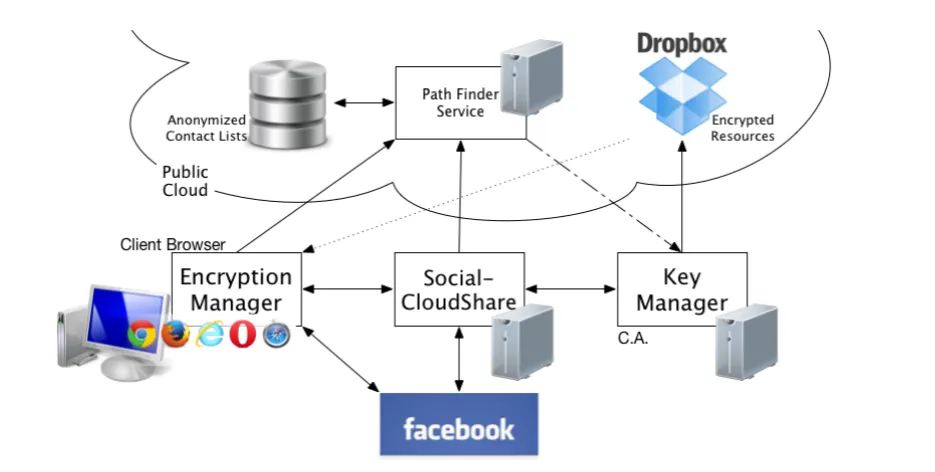
Figure 6. Framework architecture
3. Framework Architecture
According to the proposed architecture (see Figure 6), users’ resources to be shared are locally encrypted by owners and stored into a Cloud storage (i.e., Dropbox). In support of this, we assume that the user is provided with theEncryption Manager (EM), a browser plugin that is mainly in charge of owner’s resources encryption and of generation of the Anonymized Contact Listof user’s direct contacts, that is,ACL1. As described in Section 2, these structures are computed by anonymizing the information of CL1, which is gathered directly from the OSN (i.e., Facebook). The channel between Facebook and the browser plugin is handled by the JavaScript Facebook SDK,3 that allows the user to fetch structured data about the social graph (e.g., a contact list) directly from the OSN, without relying on any thirdy-party application.
ReBAC enforcement is carried out by releasing encryption keys only to those requestors that satisfy at least one of the owner’s access rules. This enforcement requires the presence in the framework of two more entities. The first entity is a Social Application, namedSocialCloudShare (SCS), that provides users the possibility to manage access control rules and to share resources directly from the Facebook web page. The second is an entity, calledKey Manager (KM), in charge of the management of encryption keys.
Encryption keys are generated by exploiting two secret parameters: the first parameter, denoted with
3https://developers.facebook.com/docs/javascript .
secretowner, is unique per user and it is generated by
SocialCloudShare; the second parameter, denoted with
secretrsc, is unique per resource and it is generated by
KM. As such, this results in an encryption key unique per resource, that can be obtained only by combining the two corresponding secrets. As it will be discussed in Section 4, protocols regulating resources release have been designed so that neither SocialCloudShare
norKMcan decrypt owner’s resources, as well as infer any information on owner’s relationships. In particular, these are designed such that onlyEMis able to combine the encryption secrets; as such, SocialCloudShare is not able to discover secretrsc values, while KM is not
able to unveil secretowner values. This holds under the
assumption that SocialCloudShare and KM do not collude together. In support of this assumption, we assume that SocialCloudShare is implemented on a tailored server and acts only inside the OSN realm, whereas the KM is an external trusted entity, whose role could be played by a Certificate Authority.
Moreover, to determine if a relationship-based access control rule is satisfied, it is required to find those paths in the social graph that connect the owner to therequestor. To protect relationships privacy, this path finding is carried out on ACLs stored in the public Cloud. This task is performed by thePath Finder Service (P FS) at Cloud side. As described in Section2,ACLs are combined together to convey a deeper view of the social graph, with respect to the simple user local view that is represented withACL1. More precisely, for each useru P FS computesACLd(u) representing the list of all the contacts thatucan reach with a d-hop path.
5 EAI Endorsed Transactions on
Collaborative Computing 06 -10 2014 | Volume 01 | Issue 2 | e6
4. Communication Protocols
Let us now introduce how the proposed framework enforces relationship-based information sharing, by illustrating the messages exchanged in each step. In doing that, we assume that the communication between entities is transmitted over secure channels.4
In this section, we will denote with K a symmetric encryption key, with K+ and K−
a public and private key, and with Ksession a session key valid only for the current comunication session. For any key, we report as subscript the framework component for which the key has been generated (e.g.,KSCS+ denotes a public key generated for SocialCloudShare). Moreover, we denote withKrsca resource encryption key, whereassecretowner
andsecretrsc denote the secret tokens that are used for
the generation of the resource encryption keys. Finally, with such defined keys, we denote with {message}K a message that is encrypted exploiting K as encryption key.
1. FB.api{ ‘me/friends’, {fields: ‘id’} } 2. JSON-formattedCL1
3. ACL1:= anonymize(CL1) 4. {iduser, ACL1}K+
P FS
5. storeAndPropagate(iduser, ACL1)
6. { “ACK” }K−
P FS
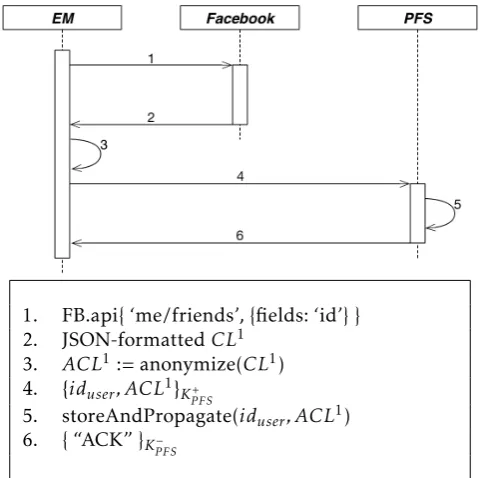
Figure 7. Registration phase: messages Exchange
User Registration. Figure 7 depicts the messages exchange when users access SocialCloudShare for the first time. Exploiting Facebook JavaScript SDK, the user’s contact list is requested (message 1) and gathered directly from the OSN (message 2) with no need to rely on any intermediate service. The anonymization process (message 3 in Figure 7) produces ACL1 at user side, taking as input the direct contact listCL1; as such, no
4Beyond encryption primitives present in messages schemas, we assume that HTTPS connections can be instantiated before communicating, so that an additional security layer can be granted.
relationship data are sent to the provider before being anonymized. The anonymized contact list is then sent to theP FS, which stores it and propagates in all theACLs (see message 5 in Figure7).
The messages exchange is ended with a response message produced by theP FS, i.e. message 6, to notify theEMthat the protocol has been properly executed by both parties and the sent data have been successfully handled.
Login Phase. Since we assume that EM is not aware of SocialCloudShare and KM public keys, the communication is initalized by requestingKSCS+ ,KKM+ , where KSCS+ and KKM+ respectively denote the public keys of SocialCloudShare and of the Key Manager (see messages 1-4 in Figure8).
1. {iduser,“PUBLIC_KEYS_REQ”}
2. {iduser,“PUBLIC_KEYS_REQ”}
3. {iduser, K+ KM}
4. {iduser, K+ KM, KSCS+ }
5. {iduser, Ksession
SCS ,{iduser, KKMsession}KKM+ }KSCS+
6. {iduser, Ksession KM }KKM+
7. {iduser,“SESSION_KEY_RECEIVED”}K−
KM
8. {iduser,“SESSION_KEY_RECEIVED”, . . .
. . .{iduser,“SESSION_KEY_RECEIVED”}K−
KM}K
−
SCS
Figure 8. Login phase: messages exchange
Once the user has received these keys, the EM
generates a pair of 128 bit random keys, denoted as
KSCSsession and KKMsession, that will be exploited as session keys for the user current session. Note that, as depicted by the architecture in Figure 6, EM communicates withKMrelying only onSocialCloudShare, since there exist no direct communication channel between the
EM and the KM. Indeed, we adapted the structure of Needham-Schroeder protocol (see [23]). As such, when theEM has to communicate with theKM, it creates a message forSocialCloudShareand encapsulates inside this the message directed to KM. SocialCloudShare, when receives such message, forwards to KM the encapsulated chunk (e.g., messages 5,6 in Figure 8). Assuming that only KM knows his private key KKM− ,
SocialCloudShare cannot decrypt the encapsulated
6 EAI Endorsed Transactions on
Collaborative Computing 06 -10 2014 | Volume 01 | Issue 2 | e6
message,butithasjusttoforwardittotheKM.5Once both SocialCloudShare and KM correctly receive the sessionkey,theyreplytotheuserwithmessages7-8in Figure8.
1. {´id’: ´user_id’, ´changed_fields’: ´friends’ } 2. storeUpdate(user_id, “CL_OUT_OF_DATE”) 3. { “CL_OUT_OF_DATE” }
4. FB.api{ ´me/friends’, {fields: ´id’} } 5. JSON-formattedCL1
6. ACL1−new:= anonymize(CL1−new)
ACL1−removed:= anonymize(CL1−removed) 7. {iduser, ACL1−new, ACL1−removed}
KP FS+
8. updateAndPropagate(iduser, ACL1−new, ACL1−removed)
9. { “ACK” }K−P FS
10. { “CL_UPDATE_DONE” }Ksession SCS
11. { “ACK” }Ksession SCS
Figure 9. Contact list update: messages exchange
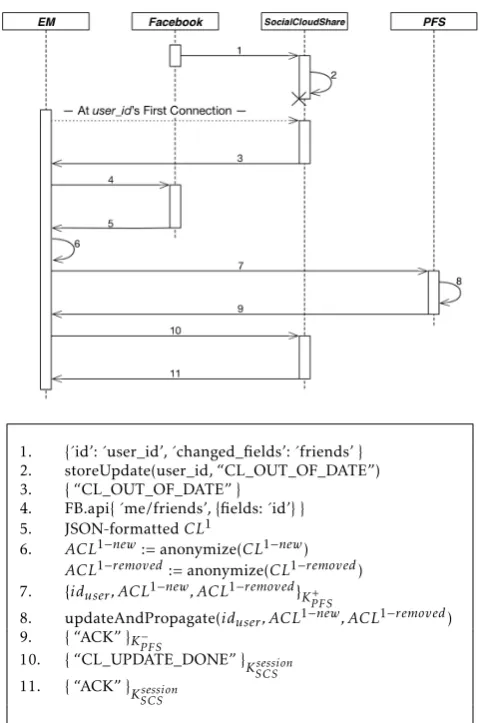
Contact List Update. Figure9summarizes the messages exchange when the users’ contact lists are modified (i.e., by adding or removing relationships). In the current implementation, we exploit FacebookReal Time Updates (RTU).6 RTU is a feature of Facebook Graph API7 which allows Facebook thirdy-party Social Apps to be informed, directly from the OSN provider, when certain pieces of data change (e.g., new profile pictures, new friendship requests). With this functionality,
SocialCloudShare does not need to continuously keep synchronized with the social graph, because a callback function is called, by means of an HTTP POST request,
5This still relies on the assumption thatSocialCloudShareandKM do not collude.
6 https://developers.facebook.com/docs/graph-api/real-time-updates/v2.0 .
7https://developers.facebook.com/docs/graph-api/ .
every time a user changes his/her own contact list (see message 1 in Figure9).
Unfortunately, the OSN only notifies
SocialCloudShare about the changed fields, without revealing any other information. As such, it is then necessary to fetch from the OSN social graph all the data about new or removed friends. For this reason, we designed SocialCloudShare to keep track of all those users whose contact lists are not synchronized with the
ACLs stored at Cloud side. Then, when each of those users makes use ofSocialCloudShare, he/she receives a message that informs the EM that the contact list has to be synchronized (see messages 2,3 in Figure9). Exploiting JavaScript functions, the current contact list is fetched from the social graph and new users (or, equivalently, removed users) are detected.CL1−new
andCL1−removed denote the two contact lists computed by the EM representing the lists of the new and the removed contacts. By exploiting theanonymizefunction in message 6 of Figure7,CL1−new andCL1−removed are anonymized.
Then, the user sends to the P FS these two separate
ACLs (or just one of them, in case the other one results in an empty list) (see message 7 in Figure 9). The P FS runs again the process of ACL propagation, adding the new information whenever these data are missing, or removing old information in case of relationship removal (i.e., by dividing polynomials instead of multiplying them). The messages flow is concluded with a special flag (see messages 9-11), in order to inform both the P FS and SocialCloudShare
that the protocol has been properly executed.
Resource Upload. The messages exchange for the resource upload phase follows the same schema as the one depicted in Figure8, whereas the messages content is depicted in Figure10.
1. {iduser, idrsc,“RSC_UPLOAD_REQ”, . . .
. . .{iduser, idrsc,“RSC_UPLOAD_REQ”}
KKMsession}KSCSsession
2. {iduser, idrsc,“RSC_UPLOAD_REQ”} KsessionKM
3. {iduser, idrsc, secretrsc} KKMsession
4. {iduser, secretuser,{iduser, idrsc, secretrsc}
KsessionKM }KsessionSCS
5. {iduser, idrsc,Rrsc,{iduser, idrsc,{rsc}K
rsc}KKMsession}KSCSsession
6. {iduser, idrsc,{rsc}K
rsc}KsessionKM
7. {iduser, idrsc,“RSC_STORED”} KKMsession
8. {iduser, idrsc,“ACR_STORED”, . . .
. . .{iduser, idrsc“RSC_STORED”}
KKMsession}KSCSsession
Figure 10. Resource upload phase: messages exchange
Before uploading a certain resource rscin Dropbox, its owner, say useru, has to encrypt it using a symmetric key, that is,Krsc. This key is computed as combination
of two secrets, i.e.Krsc=F(secretowner,secretrsc), which
7 EAI Endorsed Transactions on
Collaborative Computing 06 -10 2014 | Volume 01 | Issue 2 | e6
EAI
for InnovationEuropean Allianceare separately generated by SocialCloudShare and the KM.8 In the given implementation, we choose to encrypt resources exploiting AES-256 algorithm [22], operatingin CipherBlockChaining (CBC) mode[10], where the plaintext is padded according to PKCS#7 [17]; forthisreason we designedthe twosecrets with length of 256 bit. As it will be discussed later, these secretsarereleasedtoarequestorbySocialCloudShare
and KM if and only if he/she satisfiesa tl eastone accessruleconditionassociatedwithrsc.
Thus, before any upload, resource owner has to interact with bothSocialCloudShareand theKMso as to retrieve the corresponding secretowner and secretrsc.
Assuming the user shares a symmetric session key only with KM, negotiated during the login phase,
SocialCloudShare cannot decrypt the encapsulated message and thus cannot discover secretrsc. Once the
secrets have been generated by SocialCloudShare and the KM, they are received by u encrypted with pre-shared session key (see message 4 in Figure 10); as such, the user is able to compute Krsc. Hence, u
composes a message including the encrypted resource (to be transmitted to KM) and the set of access control rulesRrsc that SocialCloudShare has to store. In our implementation Rrsc is a 1 byte value; the 5 more significant bits translate the relationship type (with a maximum of possible relationship types equal to 32) and the 3 less significant bits translate the maximum depth value of the access control condition. Even though our implementation currently supports only“friend”relationships, this implementative choice leaves the framework ready to further improvements.
As depicted in Figure10, theEMsends all messages to SocialCloudShare, which then forwards nested encrypted messages to the KM. After the execution of the protocol illustrated in Figure 10, the Cloud data storage service contains the encrypted resource, whereas SocialCloudShare and the KM contain only resource metadata. In particular, the KM stores idrsc
and secretrsc, whereas SocialCloudShare saves idrsc
along with the resource access control rulesRrsc, where
idrscdenotes a unique identifier for the resource.
Resource Download. In order to enforce a relationship-based resource sharing, the framework has to release encryption keys only to requestors satisfying at least an access control rule associated with the requested resources. To determine if an access rule is satisfied, the
P FS service is inquired. To protect the communication between SocialCloudShare, the KM, and the P FS
we assume there exists a symmetric encryption key, denoted asKP FS, shared between those three entities. By
8Several F functions can be adopted. In our implementation, we
make use ofXOR.
using this key, the communication encrypted withKP FS
cannot be decrypted by anyone unless the components of the framework.
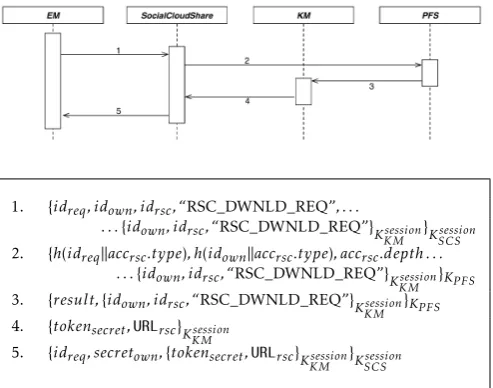
If a requestorreqwishes to download and decryptrsc, it has to send a message toSocialCloudShare with the related ids (message 1 in Figure11).SocialCloudShare
retrieves the corresponding access rulesRrsc and the id ofrsc’s owner (i.e.,idown). Then, assuming for simplicity
Rrsc contains only one access control condition acc= (t, d), it inquires theP FSto search for a path connecting the requestor to the owner, with all edges labeled with
t and length less than d (i.e., message 2 in Figure11). It is important to note that if theP FS sends the yes/no answer back directly to SocialCloudShare, this might bring to some information leakage. Indeed, for some particular access rules, knowing whether the rule is satisfied gives exact information on existing paths. As such, the answer produced by theP FSis sent to theKM
(see message 3 in Figure11).
1. {idreq, idown, idrsc,“RSC_DWNLD_REQ”, . . .
. . .{idown, idrsc,“RSC_DWNLD_REQ”}
KsessionKM }KsessionSCS
2. {h(idreq||accrsc.type), h(idown||accrsc.type), accrsc.depth . . .
. . .{idown, idrsc,“RSC_DWNLD_REQ”}
KKMsession}KP FS
3. {result,{idown, idrsc,“RSC_DWNLD_REQ”}
KKMsession}KP FS
4. {tokensecret,URLrsc} KKMsession
5. {idreq, secretown,{tokensecret,URLrsc}
KKMsession}KSCSsession
Figure 11. Resource download phase: messages exchange
The URL sent from the KM (see message 4 in Figure 11) is a temporarily valid URL provided by the Cloud storage service upon KM requests. The rsc
to be downloaded is reachable at this URL only for a small and fixed interval of time, afterwards rsc is moved back to the private realm of the storage service, without any public access.9 Message 4 (see Figure 11) contains, along with the above mentioned URL, the value of tokensecret, which is tokensecret =secretrsc in
case the P FS sent a positive answer, or a random value otherwise. SocialCloudShare inserts secretown
into the received message, encrypts it with pre-shared session key and forwards it to the user (i.e., message
9Moving resources on temporaryURLis a common approach used by several Cloud storage services (e.g., Dropbox, in this implementation) to limit access of requested resources.
8 EAI Endorsed Transactions on
Collaborative Computing 06 -10 2014 | Volume 01 | Issue 2 | e6
EAI
for InnovationEuropean Alliance5 in Figure11). Then, the user decryptssecretown and
tokensecretvalues and generatesF(secretown, tokensecret),
which returns the correct encryption key Krsc only if
tokensecret =secretrsc, that is, only if theKMreceives a
positive answer from theP FS, confirming the existence of a path satisfying the rule.
5. Implementation
In this section, we provide some details concerning the implementation ofSocialCloudShare.
5.1. Encryption Manager - Browser Plugin
The Encryption Manager (EM) is the component in charge of client-side resource encryption and of anonymized contact lists generation. We choose to implement the aboved-mentioned functionalities with a set of JavaScript functions, in order to achieve a better usability than a customized software and to give users the possibility to make use of it with no restriction given by his/her operative system.
By exploiting jQuery library10 and AJAX-like11 tech-niques,EMis able to process user actions (e.g., mouse clicks, page requests, upload/download requests) inside
SocialCloudShare. The most important functionali-ties offered by EM are the encryption primitives for resources/messages encryption/decryption. For what concerns the resource encryption/decryption phase, the
EM can be seen as a cipher black box. Thus, plaintext resource is taken as input and coded into a ciphertext resource and vice versa. As such, no entity except the EM takes part in these processes. At this pur-pose, we decided to exploit an existing library, named Crypto-JS,12 available under BSD-3 License on Google Code, offering several encryption primitives ready to be used. In particular, for resources encryption, we exploit AES-256 algorithm applied according to Cipher Block Chaining (CBC) mode, where the plaintext is padded according to PKCS#7.
In order to exploit CBC mode, an Initialization Vector iv is necessary during the encryption and decryption phases. For this reason, the EM generates each time a random value as initalization vector (by exploiting CryptoJS.lib.WordArray.random(128/8)), which is added prior to the ciphertext, such that the iv itself can be securely stored along with the encrypted resource.
Figures 12 and 13 depict the functions used in the
EMimplementation.
10http://jquery.com/ .
11http://www.w3schools.com/ajax/default.ASP . 12https://code.google.com/p/crypto-js/ .
CryptoJS.AES.encrypt( ’Resource-Stream’, ’Resource-Secret-Key’, { iv: ’iv’,
mode: CryptoJS.mode.CBC, padding: CryptoJS.pad.Pkcs7 }
);
Figure 12. Javascript AES encipher
CryptoJS.AES.decrypt(
’Encrypted-Resource-Stream’, ’Resource-Secret-Key’, { iv: ’iv’,
mode: CryptoJS.mode.CBC, padding: CryptoJS.pad.Pkcs7 }
);
Figure 13. Javascript AES decipher
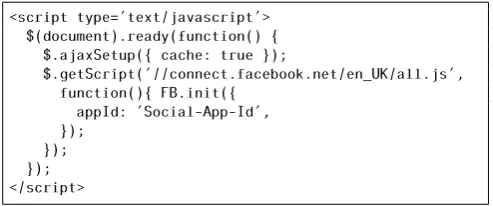
Another important feature handled by EM is the generation of ACL1. To compute such ACL1, the JavaScript library contains functions implementing the polynomial multiplication, i.e., computing the discrete convolution bewteen number sequences. As first step, the direct contacts list is fetched from Facebook social graph, by means of Facebook JavaScript SDK. As depicted in Figure 14, the JavaScript SDK needs to be initalized with a valid Social-App-Id, which is the identifier assigned by Facebook when registering a Social App inside its realm.
<script type=’text/javascript’> $(document).ready(function() {
$.ajaxSetup({ cache: true });
$.getScript(’//connect.facebook.net/en_UK/all.js’, function(){ FB.init({
appId: ’Social-App-Id’, });
}); }); </script>
Figure 14. Facebook JS-SDK load phase
The EM can request to Facebook, by means of the JavascriptFB Object, the logged user’s friend list (e.g., see messages 1,2 in Figure 7) so that it can receive the current user’s direct contacts identifiers. By having these identifiers, theEMcan generate the user’sACL1. Once this ACL1 is fully computed, it is sent to the Path Finder Service, which is the component in charge of handling the anonymized social graph.
9 EAI Endorsed Transactions on
Collaborative Computing 06 -10 2014 | Volume 01 | Issue 2 | e6
5.2. Path Finder Service
As outlined above, the Path Finder Service (PFS) is the component of SocialCloudShare that handles the anonymized social graph. All theACLs are stored into the ACL Repository table, where the record is in the form [idu, ACL1(u), ACL2(u), . . . , ACLMaxDepth(u)], that
is, it contains the user identifier and all his/herACLs of different path length (see example ofACL Repository in Figures2,3,4,5).
TheP FS is implemented as a web service, by means of a Java servlets that handles HTTP requests. The request received fromEMinstances are encrypted with the P FS public key, i.e., KP FS+ . On the other hand, requests received from SocialCloudShare entity are encrypted with a pre-shared session key, denoted as
KP FS, that grants a lower overhead than an
asymmetric-key encryption.
Such component, like SocialCloudShare and the
KM entities presented in the following sections, has been developed inside the Spring framework13 and exploiting STS14, an eclipse-based IDE.15
Algorithm5.1describes the procedure executed each time a newACL1 is received from aSocialCloudShare
user. This algorithm makes use of the ACL Repository, denoted withR, and of a boolean matrix,updates, that keeps track of theACLs that have been modified during the propagation procedure.
Each time a newACL1is received, along with the user
id, theP FS stores inside theACL Repositorythose new information (see Line 3 in Algorithm 5.1) and sets as true the corresponding cell of the updatesmatrix (see Line 4). Once the data have been stored, the procedure analyzes, from the shallowest level to the deepest, the ACL Repositoryrecord (see Lines 5,7). We denote with
e.id the user identifier stored in the repository entry
e, and with e.ACLd, the ACLd stored in the same reporitory entry.
For each recorde, the procedure performs a second iteration over all different recorde0 (see Line 8). If the updatesmatrix containstruein the cell corresponding toe0, the procedure performs a polynomial evaluation, where the polynomial is theACLtaken frome0 and the user identifier is taken frome(see Line 9). In case the polynomial evalutation results 0, and each polynomial evaluation for smallest path length (see Lines 10, 11)
13http://projects.spring.io/spring-framework/ . 14http://spring.io/tools .
15Spring is an application framework with built-in modules that facilitate Java application development, in which code dependecies are directly handled by Apache Maven (http://maven.apache.org/) and Gradle (http://www.gradle.org/) at build-time, generating a .jar archive that can run under, for example, an Apache Tomcat (http://tomcat.apache.org/) web server.
result in a value different from 0, the information carried by e.ACL1 and e0.ACL1 is cross-propagated to level d+ 1, where d is the variable iterated over the path depth values (see Lines 12, 13). Along with this cross-propagation, the procedure updates the values of the updates matrix, that is, it keeps track of the above modified entries. Finally, a boolean variablestop, initally set withtrue(see Line 6), is set withfalse(see Line 16).
The above described procedure terminates when, given a path depth d, ACLds are no more modified throughout the whole iteration over the repository records, that is, the boolean value of the variablestop is true when the loop cycle at Line 7 ends, and the procedure is forced to terminate (see Line 18).
Algorithm 5.1: ACL propagation procedure
Input:idu, ACL1(u), ACL Repository R
begin 1
boolean[][]updates;
2
R.push({idu, ACL1(u),1,1, . . .}); 3
updates[1][u] =true; 4
foreachd∈ {1,2, . . . , MaxDepth}do 5
booleanstop =true;
6
foreachentrye∈Rdo
7
foreachentrye0> edo 8
if(updates[d][e0.id])AND 9
(e0.ACLd(x=e.id) == 0)then foreachd0< ddo 10
ife0.ACLd0(x=e.id),0then 11
e.ACLd+1=e.ACLd+1·e0.ACL1; 12
e0.ACLd+1=e0.ACLd+1·e.ACL1; 13
updates[d+1][e.id]=true; 14
updates[d+1][e’id]=true; 15
stop =false; 16
ifstopthen
17
exit; 18
end 19
5.3. SocialCloudShare
Differently from the P FS and the KM,
SocialCloudShare has been developed with both a back-end system and a graphical interface, which is displayed when users access SocialCloudShare inside Facebook.
SocialCloudShareback-end is implemented as a web application, designed according to the Model-View-Controller architectural pattern, such that a precise HTTP request on a given URL calls a certain method of the underlying servlet. The most relevant methods offered by SocialCloudShare are called by handling HTTP requests incoming on the following URLs:
10 EAI Endorsed Transactions on
Collaborative Computing 06 -10 2014 | Volume 01 | Issue 2 | e6
SCS/ : A request to the baseURLof the web application generates and returns SocialCloudShare home-page. The underlying controller, when necessary, fetches and stores some of the users’ data (e.g., full name, profile picture). These data are col-lected interacting directly with the OSN provider, exploiting Facebook Graph API in order to receive users’ profile information.
SCS/key/broadcast : This URL is requested
automati-cally when the EM detects that the public keys of SocialCloudShare and the KM are not stored at client-side. It represents the arrival point of message 1 in Figure 8. The controller forwards the received parameters to the KM on its URL KM/key/broadcast.
SCS/key/negotiate : This URL is requested
automati-cally when the EM detects that the session keys for communicating with SocialCloudShare and
KMare not stored at client-side. It represents the arrival point of message 5 in Figure 8. The con-troller forwards the message that is encapsulated in the received one, that is the message fromEM
to theKM, on the URLKM/key/negotiate.
SCS/fb_updates : This URL is reachable both with
HTTP GET and HTTP POST requests, but it is supposed to be requested only from Facebook provider. The application listens to information from the OSN, waiting for Real Time Updates (RTU). Once an HTTP GET request has been received, the application communicates with Facebook in order to control and regulate the subscription for RTU. HTTP POST requests, on the other hand, are assumed to include information about the user activity in the OSN (e.g., a new profile picture, a new friendship in the social graph). The controller underlying these requests keeps track of those users that have a contact list that is not synchronyzed with the
ACLs stored in the P FS (e.g., see message 1 in Figure9).
SCS/upload : The controller that handles HTTP
requests to this URL is the one responsible of starting the resource upload procedure (see message 1 in Figure 10). The received message is decrypted with the corresponding session key, and the encapsulated message (that cannot be decrypted by SocialCloudShare) is forwarded to theKMon its URLKM/upload. Once the message is forwarded, the controller holds and waits for a response from theKM.
SCS/upload/finalize : A request done to this URL
finalizes an upload procedure already started. As such, the underlying controller waits messages
such as message 5 in Figure 10. Once received, the message is decrypted and the encapsulated part is forwarded to the KM. The remainder of the message, thus, includes the access control rule Rrsc of the uploaded resource. As such, Rrsc is stored by SocialCloudShare along with the resource owner identifier and the resource identifier.
SCS/download : The controller that handles the
incoming requests to thisURLis the one in charge of listening to download requests (e.g., message 1 in Figure 11), representing the initialization of a download process. As such, this message gathers information about the requestor, the owner, and theresourceinvolved in the download process. These data are sent to theP FS that, after checking the existence of a path onACLs, sends the corresponding result to the KM on its URL KM/download.
5.4. Key Manager
Similar to SocialCloudShare, the KM has been developed as a web application, exploiting the STS IDE. On the other hand, the KM is sligthly different from the previously presentedSocialCloudShare. TheKMis designed to listen to communication exclusively coming fromSocialCloudShare, theP FS, and Dropbox; as such the application performs an IP filtering prior to accept incoming data. In case some data are received by a peer that is not regognized as belonging to one of those three parties, its requests are rejected and the communication channel closed. Then, the KM is designed without any front-end interface; any incoming message that is identified as valid brings theKMto perform some data processing and the output is directly sent as response to the message sender. The main methods offered by the
KMare called by handling HTTP requests incoming on the following URLs:
KM/key/broadcast : This URL can only be requested
bySocialCloudShare (e.g., via IP filtering) and it is requested only whenEMdetects that the public keys of SocialCloudShare and the KM are not stored at client-side. It represents the arrival point of message 2 in Figure8.
KM/key/negotiate : This URL is requested
automati-cally when theEM detects that the session keys for communicating with SocialCloudShare and
KMare not present at client-side. It represents the arrival point of message 5 in Figure8.
KM/upload : With reference to Figure 10, the
con-troller handling these requests listens to messages such as message 2. The underlying methods are the ones responsible of generating and storing
11 EAI Endorsed Transactions on
Collaborative Computing 06 -10 2014 | Volume 01 | Issue 2 | e6
the resource secretsecretrsc, whererscrepresents
the identifier of the resource that is going to be uploaded .
KM/upload/finalize : The underlying controller
includes the methods for resources upload to the Cloud Storage Service (e.g., Dropbox). Once a resource is stored into Dropbox, the KM locally stores certain resource metadata, such as the name, the filetype, and the last modification date. Those data are then displayed to users, through theSocialCloudShareGUI.
KM/download : This URL is listening only to requests
coming from P FS. Indeed, the underlying con-troller is listening to messages resulting from a path search on the anonymized graph (message 3 in Figure 11). Messages received at this URL not only contain the result of the path search performed by P FS, but they include pieces of data that were included in the dowload request sent from the requestor. With these informa-tion, the KM is able to ask Dropbox to gener-ate URLrsc, that is a temporary valid URLfor the encrypted resource download. URLrsc is included in the response along with tokensecret, that may
be a randomly generated value, in case the path finding returns a negative answer, or the value of
secretrsc otherwise, wherersc is the downloaded
resource.
6. Experimental Evaluations
To evaluate the framework performance, we carried out several tests. In doing that, we kept into account that theP FSefficiency has been studied in [1]. In particular, [1] presents the time needed by the P FS to perform polynomial evaluation and multiplication, that is, to verify a relationship-based access control rule and propagate anACL throughout the ACL Repository. As such, in this section, we focus more on the overhead introduced by resource management, such as messages encryption size, messages encryption average time, and resource encryption average time. The workstation used for these experiments is an Intel Core 2 Quad Q6600 @ 2.40 GHz×4, with 8GB RAM. In the current implementation SocialCloudShare, the KM, and the
P FSare instantiated in the same instance of an Apache Tomcat servlet container and they run under different namespaces.
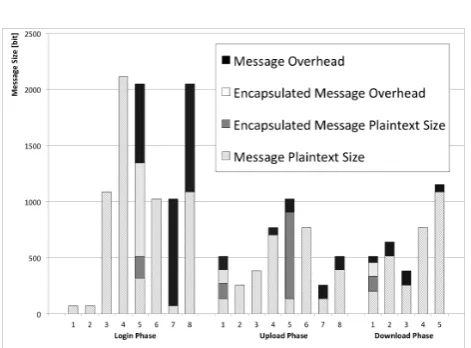
Message Encryption Size. Figure 15 depicts the over-head, in terms of length of messages, implied by mes-sages encryption. The considered mesmes-sages are those exchanged during the login, upload, and download phases (see Figures8,10,11).
Figure 15. Messages encryption size overhead
Each bar in Figure 15 represents a single message, in term of message size. Each message is denoted by a message plaintext size, that is, the size of the message before encryption and a message overhead, that is, the size of the message once encrypted. Some message includes an encapsulated message (see message 5 in Figure8, messages 1,2 in Figure 10, and message 1 in Figure 11) that requires a further encryption phase prior to message encryption. For those messages, Figure 15 reports the encapsulated message plaintext size as well as theencapsulated message overhead. As such, the message plaintext sizefor those messages is composed of the message plaintext size, the encapsulated message plaintext size, and the encapsulated message overhead.
Finally, it is important to note that messages in the login phase (see Figure 8) are encrypted using an asymmetric key encryption scheme.16 This motivates
the higher overhead introduced by messages encryption in such phase. Messages exchanged during upload and download phases, on the other hand, are encrypted exploitingAES-128algorithm.
Message Encryption/Decryption Average Time. Tables 1 and2report the time consumption given by messages encryption. This experiment has been carried out monitoring the time required by encryption primitives to encrypt/decrypt the corresponding messages; for each message the encryption/decryption phase has been repeated 10 times. As such Tables 1, 2 report the minimum and the maximum time obtained in this experiment, along with the time average and the standard deviation.
With the exception of message 5 of the upload phase (Figure 10), the encryption/decryption primitives
16In particular, we exploitRSA-1024for this phase .
12 EAI Endorsed Transactions on
Collaborative Computing 06 -10 2014 | Volume 01 | Issue 2 | e6
Protocol Msg Time [ms] Standard
Min Avg Max Deviation
Login
5 3.0 6.0 9.0 1.89
7 1.0 2.2 3.0 0.6
8 2.0 3.0 6.0 1.61
Upload
1 6.0 14.4 24.0 7.68
3 3.0 8.1 12.0 3.01
4 6.0 15.0 24.0 8.16
5 14.0 28.0 56.0 16.57
7 2.0 5.2 8.0 2.4
8 4.0 8.0 16.0 4.0
Download
1 6.0 16.2 24.0 7.61
2 5.0 8.0 20.0 4.58
3 3.0 8.1 12.0 3.01
4 6.0 13.2 24.0 7.96
5 9.0 26.1 36.0 10.22
Table 1. Time required for message encryption
Protocol Msg Time [ms] Standard
Min Avg Max Deviation
Login 6 4.0 4.8 6.0 0.98
Upload 2 4.0 10.0 16.0 4.1
6 8.0 21.6 32.0 8.8
Download
2 4.0 9.2 16.0 4.02
3 5.0 11.0 20.0 6.63
4 5.0 10.8 20.0 6.38
Table 2. Time required for message decryption
completed the execution in less than 40 milliseconds. In this experiment, we used a 64byte text file as uploaded resource to keep the simulation as light as possible. The average time for all messages encryption/decryption, thus, never reached a value higher than 30 milliseconds; as such this result let us state that the protocols may run with no impact on the user experience over the OSN.
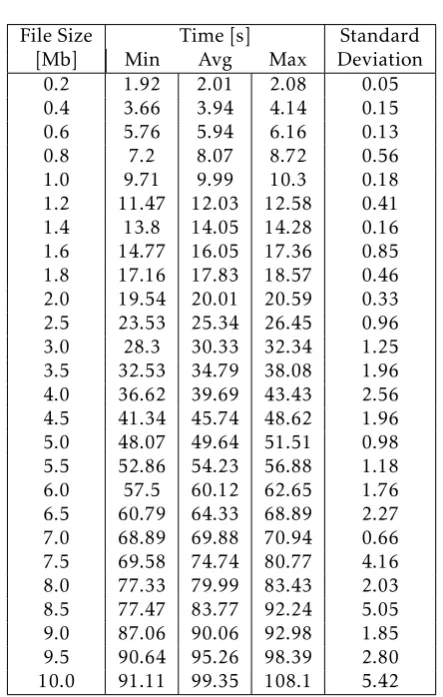
Resource Encryption Average Time. Finally, Table 3 reports the results of the experiment to estimate the encryption time necessary to prepare a resource to be uploaded. Unlike messages, which are encrypted exploitingAES-128algorithm, resources are encrypted exploiting AES-256 algorithm, in order to achieve a better security for resources, that have to be stored in the public Cloud. The first column in Table3 reports the size (in Mbytes) of the resource to be encrypted, while the other columns gather the time interval, in seconds, necessary to perform the encryption. In this experiment, we used random-generatedASCIIstrings, with pre-determined lengths. The encryption phase has been repeated 10 times for each resource; as such Table3 reports the minimum and the maximum time
File Size Time [s] Standard
[Mb] Min Avg Max Deviation
0.2 1.92 2.01 2.08 0.05
0.4 3.66 3.94 4.14 0.15
0.6 5.76 5.94 6.16 0.13
0.8 7.2 8.07 8.72 0.56
1.0 9.71 9.99 10.3 0.18
1.2 11.47 12.03 12.58 0.41
1.4 13.8 14.05 14.28 0.16
1.6 14.77 16.05 17.36 0.85
1.8 17.16 17.83 18.57 0.46
2.0 19.54 20.01 20.59 0.33
2.5 23.53 25.34 26.45 0.96
3.0 28.3 30.33 32.34 1.25
3.5 32.53 34.79 38.08 1.96
4.0 36.62 39.69 43.43 2.56
4.5 41.34 45.74 48.62 1.96
5.0 48.07 49.64 51.51 0.98
5.5 52.86 54.23 56.88 1.18
6.0 57.5 60.12 62.65 1.76
6.5 60.79 64.33 68.89 2.27
7.0 68.89 69.88 70.94 0.66
7.5 69.58 74.74 80.77 4.16
8.0 77.33 79.99 83.43 2.03
8.5 77.47 83.77 92.24 5.05
9.0 87.06 90.06 92.98 1.85
9.5 90.64 95.26 98.39 2.80
10.0 91.11 99.35 108.1 5.42
Table 3. Time required for resource encryption
recorded during the experiment, along with the time consumption average and the standard deviation.
With those experiments, and the ones previously reported in [1] about the Path Finder Service perfor-mances, we can thus state that SocialCloudShare causes a slight overhead over users experience in the Social Network. As such, we believe that protocols and tech-niques proposed in this paper would give a remarkable improval to OSN privacy measures.
7. Related Work
The presented work is mainly related to the following research topics: path-preserving graph anonymization, crypto-based access control, and privacy preserving in Online Social Networks.
Present literature includes many work proposing graph anonymization techniques. Most of these works can be grouped into two separate categories: those which propose node clusterization tecnhiques (e.g., [3, 6,15]), and those which flatten the graph topology by modifying it (e.g., [16,18]). However, these works, make the common assumption that the graph topology can be
13 EAI Endorsed Transactions on
Collaborative Computing 06 -10 2014 | Volume 01 | Issue 2 | e6
entirely read by a centralized party that anonymizes the graph.
A slightly different approach is described by Terzi et al. in [12]. In this work, authors present a collaborative anonymization procedure that exploits only nodes’ neighborhood information. However, even this work, likely the works mentioned before, presents a technique that anonymize the graph by modifying its topology. Unfortunately, an anonymization techniques that contemplates a topology modification is not suitable for ReBAC enforcement. Indeed, introducing new edges in the graph may bring to harmful data release, whereas removing edges may cause not to release resource that should be released according to access control rules in place.
The only work presenting a path-preserving anonymization technique is, to the best of our knowledge, [4]. Authors in [4] present algorithms that allow to compute privacy-preserving operations without editing the graph structure. However, the path finding procedure presented in [4] can handle only paths whose lenght is≤2. As such, none of these works propose a path-preserving collaborative anonymization procedure like the one presented in this paper.
Literature offers several proposals of crypto-based access control for cloud-centric platforms. Many recent proposals exploit attribute-based encryption (see [14, 21, 26]). Authors in [9] propose a solution for regulating access to outsourced data by means of a proper distribution of encryption keys. In recent works have been proposed OSN plugins (e.g., see Scramble! [2], FaceCloak [19]) that prevent OSN providers to performa data mining by analyzing users’ data by encrypting them. As such, resources can be shared as encrypted data and decrypted only by those users who exploit the same platform that has been used for encryption phase. None of these works, however, target the enforcement of ReBAC.
A different approach, that can be exploited to prevent OSN analysis over shared data, is to move users’ resources to a data repository separate from the OSN (e.g., see Lockr [24] or Trust&Share [7]), where the social network provider has no access. Still, those proposals treat only aspects related to shared resources, and do not take into account to hide relationship data from OSN managers.
8. Conclusions
In this paper, we present an implementation of the architecture presented in [1], where users’ personal data are securely stored in public Cloud data storage and shared according to relationship-based access control rules defined by owners, tailored for the most popular of today OSNs, that is, Facebook. We
plan to extend the work reported in this paper along several directions. First, we plan to extend the proposed privacy-preserving path finding to support more expressive access control rules. For instance, we intend to enforce also constraints on the trust of the required relationships. Moreover, we plan to improve the framework by implementing it in a distributed system, where the Path Finder Service is instantiated inside a Cloud provider realm (e.g., Amazon EC2).
9. Acknowledgements
The research presented in this paper was partially funded by the European Office of Aerospace Research and Development (EOARD) and the Air Force for Scientific Research (ASFOR). The authors would like to thank the anonymous reviewers for their valuable comments and suggestions to improve the quality of the paper.
References
[1] D.A. Albertini, B. Carminati. Relationship-based Infor-mation Sharing in Cloud-based Decentralized Social Networks. In Proc.ACM CODASPY, 2014.
[2] F. Beato, I. Ion, S. ˇCapkun, B. Preneel, M. Langheinrich. For Some Eyes Only: Protecting Online Information Sharing.In Proc.ACM CODASPY, 2013.
[3] S. Bhagat, G. Cormode, B. Krishnamurthy, D. Srivas-tava. Class-based graph anonymization for social net-work data. In Proc.VLDB Endowment, 2009.
[4] J. Brickell, V. Shmatikov. Privacy-Preserving graph algorithms in the semi-honest model. In Proc. ASI-ACRYPT, 2005.
[5] G. Bruns, P. W. L. Fong, I. Siahaan, M. Huth. Relationship-Based Access Control: Its Expression and Enforcement Through Hybrid Logic. In Proc. ACM CODASPY, 2012.
[6] A. Campan, T. M. Truta. A clustering approach for data and structural anonymity in social networks. In Proc.
ACM PinKDD, 2008.
[7] B. Carminati, E. Ferrari, J. Girardi. Trust&Share: Trusted Information Sharing in Online Social Net-works. In Proc.IEEE ICDE, 2012.
[8] B. Carminati, E. Ferrari, A. Perego. Enforcing Access Control in Web-based Social Networks. In Proc.ACM TISSEC, 2009.
[9] S. De Capitani Di Vimercati, S. Foresti, S. Jajodia, S. Paraboschi, P. Samarati. Encryption policies for regulating access to outsourced data. ACM Trans. Database Systems, 2010.
[10] W. F. Ehrsam, C. H. W. Meyer, J. L. Smith, W. L. Tuchman. message verification and transmission error detection by block chaining. US Patent 4074066, 1976. [11] Electronic Privacy Information Center, Facebook
Pri-vacy. online:http://epic.org/privacy/facebook/
[12] D. Erdös, R. Germulla, E. Terzi. Reconstructing Graphs from Neighborhood Data. In Proc.IEEE ICDM, 2012.
14 EAI Endorsed Transactions on
Collaborative Computing 06 -10 2014 | Volume 01 | Issue 2 | e6
[13] Google official blog, A new approach to China. online:
http://googleblog.blogspot.com/2010/01/new-approach-to-china.html. January 12, 2010.
[14] V. Goyal, O. Pandey, A. Sahai, B. Waters. Attribute-based encryption for fine-grained access control of encrypted data. In Proc.ACM CCS, 2006.
[15] M. Hay, G. Miklau, D. Jensen, D. Towsley, P. Weis. Resisting structural re-identification in anonymized social networks. In Proc.VLDB, 2008.
[16] M. Hay, G. Miklau, D. Jensen, P. Weis, S. Srivastava. Anonymizing Social Networks.Technical Report, 2007.
[17] B. Kaliski. RFC 2315. online:
http://tools.ietf.org/html/rfc2315, 1998.
[18] K. Liu, E. Terzi. Towards identity anonymization on graphs. In Proc.ACM SIGMOD, 2008.
[19] W. Luo, Q. Xie, U. Hengartner. FaceCloak: An architecture for user privacy on social networking sites. In Proc.ICCSE, 2009.
[20] M. Naor, B. Pinkas. Oblivious transfer and polynomial evaluation. In Proc.ACM STOC, 1999.
[21] S. Narayan, M. Gagné,R. Safavi-Naini. Privacy preserv-ing EHR system uspreserv-ing attribute-based infrastructure. In Proc.ACM CCSW, 2010.
[22] National Institute of Standards and Technology. Announcing the Advanced Encryption Standard (AES). online: http://csrc.nist.gov/publications/fips/fips197/fips-197.pdf, 2001.
[23] R. Needham, M. Schroeder. Using encryption for authenticating in large networks of computers. Commu-nication of the ACM 21, 1978
[24] A. Tootoonchian, S. Saroiu, Y. Ganjali, A. Wolman. Lockr: better privacy for social networks. In Proc.ACM CoNEXT, 2009.
[25] J. E. Vascellaro. Google discloses Privacy Glitch. online:
http://blogs.wsj.com/digits/2009/03/08/1214/.
[26] J. Zhang, Z. Zhang, A. Ge. Ciphertext policy attribute-based encryption from lattices. In Proc.ACM ASIACCS, 2012.
15 EAI Endorsed Transactions onCollaborative Computing 06 -10 2014 | Volume 01 | Issue 2 | e6