1.
© Global Society of Scientific Research and Researchers
http://ijcjournal.org/
An Architecture for Misconfiguration Patching of Web
Services: A Case Study of Apache Server
Franklin Tchakounté
a*, Jean Marie Kuate Fotso
b, Vivient Corneille Kamla
ca,b
Department of Mathematics and Computer Science, Faculty of Science, University of Ngaoundéré, Cameroon
cDepartment of Mathematics and Computer Science, National School of Agro-Industrial Sciences, University of
Ngaoundéré, Cameroon
aEmail: [email protected]
bEmail: [email protected]
cEmail: [email protected]
Abstract
Services are usually left configured by default and therefore subjects to vulnerabilities because they are not
security enforced. Web services are so popular that they are targets of attacks to intrusions related to
vulnerabilities discovered by attackers. This work proposes an architecture for patching Web service
misconfigurations related to existing vulnerabilities. The approach underlying this architecture first retrieves and
structures anti-vulnerability measures published by the official service manufacturers. Second, it evaluates the
risk level using Common Vulnerability Scoring System (CVSS) on the current state of configurations. The
proposed approach has been applied on Apache server on four vulnerabilities: version discovery, XSS, SQL
injection and deny of service. Experimental results on a vulnerable environment demonstrate that the proposed
approach considerably reduces vulnerabilities compared to similar solutions.
Keywords: CVSS; misconfiguration; patching; risk; vulnerabilities; Web Received on DD MM YYYY;
accepted on DD MM YYYY; published on DD MM YYYY.
1. Introduction
The service Web is the most popular on Internet. It has revolutionized how people communicate and how
companies operate [1]. It allows exchange of information but e-services such as e-commerce, e-learning etc [2].
Its popularity attracts malicious people who take advantage of various vulnerabilities to infiltrate. According to
Marconato [3], vulnerabilities related to misconfiguration remain a serious problem since administrators mainly
take default parameters. Existing works to that problem have two orientations [4].
---
The first one consists to passively scan for the presence of vulnerabilities to inform users [7], the second one
consists to check some subsidiary files according to pre-defined security directives and to make
recommendations according to the actual status of configuration [4]. Existing solutions are more informative
than curative. Moreover, security directives are not related to known vulnerabilities for the assessment of risk
levels. This work proposes an architecture to identify vulnerabilities in main configuration files, to structure
security directives according to the rules retrieved from official editor sites, to compute risk levels associated to
the status of service configuration, and to automatically apply security directives on behalf of the user. Unlike
existing work which only consider the status of service configuration at the installation, this work consider that
this status can evolve over the time. A simulation of this architecture on the service Apache has provided
satisfying results. It is able to reduce considerably vulnerabilities. The document is organized in four sections.
The first section reviews existing solutions against misconfiguration vulnerabilities. The second section presents
concepts about service and management of vulnerabilities. The third section describes the architecture to reduce
misconfiguration vulnerabilities. The fourth section is dedicated to the implementation of the solution for
Apache and the tests on vulnerable environments. The document ends with conclusion and perspectives.
2. Solutions against misconfiguration vulnerabilities
2.1. Motivation
The default configuration is mainly chosen during installation of services. This method is not controlled by
administrators who do not enforced the service with security guards. We aim to propose a solution which
automatically fetches and structures security rules from official service manufacturers, then compute the risk
level based on the current configuration of security enforcement and takes decision accordingly. This work is
the first step which proposes and simulates an architecture to achieve these goals. Simulations is made on
Apache server. Authors have proposed some works related to misconfiguring services. They operate on the
client side (application and browser) and on the server side.
2.2. Client-side patching
Zoummouri and his colleagues [17] proposed a model of prevention against browser settings configuration
attacks to facilitate access to the user's machine. Their system aimed to improve the level of browser prevention
against Web attacks. OWASP describes several scanners against Web vulnerabilities [18]. Those which are
open source and freeware include OWASP Zed Attack Proxy, OWASP Xenotix XSS Exploit Framework, Vega,
Wapiti, Grendel-Scan, and Grabber. They essentially perform a static analysis of the application code and a
dynamic analysis during execution of the application, to detect vulnerabilities such as cross-site scripting,
remote file inclusion, local file inclusion, HTTP response splitting, SQL injection, command execution and
injection XML External Entity (XXE).
2.3. Server-side patching
Some works have been realized to analyze server-side configurations for the detection of hidden vulnerabilities.
server-side configurations. In the second case activity, it goes through various configuration directories looking
for obsolete version files (indexes), and malicious scripts. In addition, it derives potentially harmful elements
based on its default path rule base. SCAAMP [4] is a system built to detect vulnerabilities related to the default
configurations of AMP (Apache, MySql and PHP) in terms of security in general. It lets the readjustment the
configuration parameters of the Web server. This system evaluates the level of risk specific to the current state
of configuration to propose recommendations to the user.
2.4. Limitations
Nikto and SCAAMP are found closer to this work. However, they face some limitations. Nikto aims to statically
scan vulnerabilities and inform users. It does not deal with core configuration files and does not propose rules
against vulnerabilities but relies on information on obsolete versions, access paths, and malicious scripts. It
could be subject to false positive because it relies on a priori signature. SCAAMP deals with specific services
only during the first installation. The generation of rules is independent of known vulnerability impacts. It
computes the risk level for the actual configuration files states and recommend measures based on fixed rules.
Nikto is more informative and SCAAMP‘s evaluation is not related to known vulnerabilities. This work
complements Nikto but identifies vulnerabilities in central configuration files to design directives according to
the rules retrieved from official editor sites. This work proposes evaluation of risk levels based on status of
service configurations and applies directives on behalf of users.
3. Preliminaries
3.1. Services
In the client server architecture, the client is an application requesting resources held by the server application,
through messages called requests. These queries are sent from a random source port on the client machine to a
known destination port on the server machine [6]. The latter serves these resources through a service that
represents the instance in the background of the running application. Some services are file sharing (FTP,
SFTP), Web (HTTP), name resolution (DNS). To better ensure the security of these services they must be
correctly configured. Configuring a service consists to technically manage its various components, as well as all
updates made during its evolution. This configuration is deployed in the form of files and data in three steps:
Identification of configuration items: Activities here include organization of information, type of
information (file formats), naming rules, and identification of relationships between data.
Control of the configuration: It includes activities confirming the consistency of all the configuration
data of the service.
Storing configuration status: To manage a configuration, it is necessary to be able to control its
evolution over time. The evolution concerns the modification of the physical, functional and
performance characteristics of the service. This work deals with Web services and consistency of
3.2. Vulnerabilities
According to Avizienis and his colleagues [7], a vulnerability is an internal fault that allows an external fault to
damage the system. This definition can be supplemented by the one elaborated in the framework of the
MAFTIA project ([8] according to [7]): a vulnerability is an accidental, or intentional, malicious or not, fault in
the specifications, the design or the configuration of the system, or in the way it is used, which can be exploited
to create an intrusion. Exploitations of vulnerabilities can cause significant losses. They are:
Direct financial loss: destruction of crucial data, decommissioning of the entire computer system; Loss of repudiation: questioning of credibility in the case of disclosure of highly confidential
information;
Loss of time: detection of security vulnerabilities, installation of security patches, efforts to restore
destroyed data.
OWASP maintains the TOP 10 list of vulnerabilities [9, 10]. Four vulnerabilities such as version discovery,
XSS, SQL injection and deny of service are within the scope of this work.
3.3. Management of vulnerabilities
As shown in Figure 1, the management of vulnerabilities starts with risk analysis, followed by the detection of
malicious traces and ending with the application of corrective measures [11]. The analysis of vulnerability
identifies risk factors to target and monitor. Considering sophisticated attacker techniques, it is important to first
analyzing critical processes especially those that require high levels of compliance and confidentiality. Once
critical processes are targeted, an inventory of computer hardware can be made to obtain an overview of the
network. It is also important to identify security measures already in place to protect important equipment:
internal policies, firewalls, intrusion detection and prevention systems, virtual private networks and information
leak prevention systems. The detection of vulnerabilities is usually done by tools called scanners. These tools
indicate potential flaws of the scanned network equipment. They list open ports, type and version of operating
system and applications running on the server. Other scanners test the presence of the various known faults on
services. Some examples are OpenVAS [12] and Nmap [13]. Vulnerabilities can be published to the general
public as soon as they are detected by
International organizations. Open Web Application Security Project (OWASP), National Vulnerability
Database (NVD), Common Vulnerabilities and Exposures (CVE), and Forum of Incident Response and
Security Teams (FIRST),
individuals specialized in finding solutions for the detection of vulnerabilities (researchers) and interested individuals devoted to fight against attackers.
Application publishers are responsible for continually improving the quality of their product. Once they detect a
defect, they put together an anti-defect called patch. A patch is a section of code that is added to software, to
regularly install patches released by the publishers to correct vulnerabilities of host operating systems, products
and applications [14]. The integration of these patches can be done using tools such as Microsoft Baseline
Security Analyzer (MBSA) or Windows Server Update Services (WSUS) [15]. This patch management is based
on a process that goes through several steps [16].
Figure 1: Patch management
4. Architecture for misconfiguration of services
This work proposes an architecture to assist an administrator to reliably apply security rules of the service to be
installed. This section starts by making some assumptions, then defines the risk assessment model and describes
components of the overall architecture.
4.1. Considerations
We assume that
The current state of the system in terms of security is correct;
The proposed approach applies to one service at a time and on a server independently; The proposed approach applies to a service that has been successfully started.
We define some concepts for this work.
Si is the service running on the process i;
( ) {
( ) is the primitive to reload the service
4.2. Risk assessment
Let be,
* +: the set of possible vulnerabilities on a service
* + : the set of rules to apply to reduce the impact of a vulnerability
Let consider the event "Apply rule r for vulnerabilities in V". The contribution of each rule rj on the impact αi of
the vulnerability i is defined in Equation 1.
( )
where :
, -, the impact of vulnerability i;
, the number of security rules for the vulnerability i;
It is assumed that rules have the same probability of apparition. is the probability that the rule is
not applied and 0 otherwise;
{
;
, the level of risk for all the rules of r;
∑
( )
Equation 2 represents the model of assessment of the level of risk generated according to the degree of
application of anti-vulnerability rules. In this equation, .is unknown. Its determination is made in the
following part.
Evaluation of
It is adopted the model known Common Vulnerability Scoring System (CVSS) [2] to evaluate . The choice is
justified by the fact that it is used by outstanding organizations governing the domain vulnerabilities such as
CVE, NVD, and FIRST. Its risk level classification has also been exploited. The assessment of risk level with
( ) ( )
( ( ) ( ) ( ))
( )
ComfImpact: the impact of the vulnerability on confidentiality; InteImpact: the impact of vulnerability on integrity;
AvailImpact: the impact of vulnerability on availability; AccessComplexity: defines the complexity of access; Authentication: defines complexity on authentication; AccessVector: defines the access vector;
CVSS evaluates the risk level of the system according to the numerical scores defined by range to which it is
added corresponding flags.
Figure 2: Risk levels
4.3. Architecture
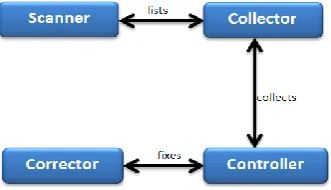
The final system is structured in four modules as shown in Figure 3.
Figure 3: Architecture of the system
First, we monitor characteristics of the service (scanner). Second, we retrieve and structure security rules over
service to see whether some rules have been already applied (controller). Fourth, we evaluate the security risk
based on security rules appliance. The system patches according to this risk level (corrector).
Scanner
This module is responsible for scanning the active Web services (Si) of the system to determine for each service,
its name, its version, its active port, its manipulated files, its user owner (u), and its rights AC (Si, u). To
optimize operations, the scanner has a database which includes the list of Web services on the host system
associated with characteristics. However, there will be a situation of additive (installation) of applications. In
this vision, the refresher module is added. The refresher helps the scanner to:
a) take into account newly installed applications;
b) check the identifier (example: version) of the installed application with that of the database to limit the
scan. This activity has a big impact on the availability of the entire system.
Collector
As the name suggests, it collects vulnerabilities and rules. It retrieves a report (Web services detected) from the
scanner and performs a search for vulnerabilities and fix information on official publisher sites and other
credible sources such as CVE. Vulnerabilities on applications are generally known to the public. Publishers
sometimes leave in comment in the code of the application the various limits indicating vulnerable functions,
updates to apply after installation, configurations to avoid, files to be renamed to adapt with the current
configurations. This information is usually more detailed in the user manual submitted by the publishers. The
CVE provides in this direction vulnerabilities related to application versions.
After this search, the collector transforms the unstructured information into rules while checking the syntax. It
then groups these rules by category of vulnerabilities among which: version disclosure, Injection vulnerability,
XSS, and Deny of service.
The rules are in the form of vector R with R = (L, A, O) where,
L is the location. It gives the exact information about the file and the corresponding directory. In short,
it defines the path for the rule to be made.
A defines the action. An action could be to apply a modification on a specific line in configuration files
or to enable or disable an option on configuration files.
O denotes operands. In the modification modes, it refers to the instruction on the indicated line. It is
usually in the form (x, y) where x is the variable and y is its state ((x, on) means that x is enabled).
The controller of the system marks the rules. This module allows avoiding configuration repetitions. The user (u)
applies only once a configuration rule for the service (Si). To mark the rules, this module negotiates with the
host system for the acquisition of AC ( , u). The controller completes reports on the state of the rules. These
rules are labelled with a Boolean function (0, 1). The meaning of these two values is as follows:
0: The rule is not applied yet. However, it may be present but poorly applied; 1: The rule is correctly applied by the user.
Corrector
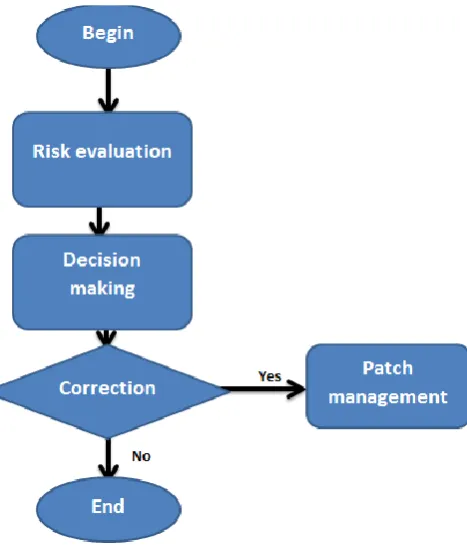
The corrector performs two specific tasks, risk assessment and adequate application of configuration patches.
The risk assessment allows the user (u) to decide for the application of the service configuration patch (Si). The
higher the level of risk, the more the user will have to patch. The corrector negotiates with the system for the
acquisition of AC ( , u) before applying patches. Reload(Si) is performed to take in account changes on the
configuration files. The configuration test is done by restarting the system to obtain a security report later
reassuring or not the actual presence of the configuration patch. Figure 4 summarizes activities of this module.
Figure 4: Corrector diagram
System interactions
communications are carried out sequentially, each of them, labeled with a message stereotype.
The message <<Lists>>
This message allows the collector to retrieve the application report from the scanner. The message is structured
as shown in Figure 5.
Figure 5: Message‘s structure of scanner
The transmission is done sequentially and by blocks. For a service, it is sent the name (e.g. Apache), then the
version (e.g. 2.4.7).
The message <<Collects>>
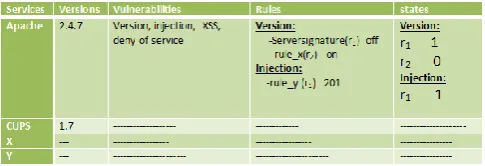
The collector in turn encapsulates information on the vulnerability and rules to the previous message. It
associates with each service, all the collected vulnerabilities and the set of rules as provided by publishers. The
message is transmitted to the verifier. It follows the structure shown in Figure 6.
Figure 6: Message‘s structure of the collector
The message <<Fixes>>
The controller marks all the rules of the message sent by the collector. Only rules labeled with 0 will be applied.
Those marked with 1 mean that security rules are already effective on the system. Information passing from the
verifier to the corrector is shown in Figure 7. They encapsulate the information regarding the state of applying
Figure 7: Message‘s structure of the Controller
5. Implementation of modules
5.1. Environment of tests
We have used a computer with the following characteristics
Constructor: COMPAQ;
Operating system: Ubuntu version 14.01 LTS 64-bits Processor: Genuine Intel (R) processor 575 @ 2.00GHz; Memory: 2.00 GB;
Hard disk : 50GB.
Apache version 2.4.7 is the Web service to be enforced which is the most popular according to Netcraft report
[19].
5.2. Definitions
A chatty service is a service that provides to the client more information than is needed.
An open service is a service opened to any client requests.
An injectable service is a service that is vulnerable to injection vulnerabilities.
We consider a service as vulnerable if it is chatty, open or injectable.
5.3. Implementation
The implementation is summarized in three major steps as shown in Figure 8. The first phase consists to protect
against version disclosure. The second one consists to configure the security module against injection attacks
Figure 8: Implementation steps
The different artefacts developed with Bash and Zenity (for graphical aspects), are available in the Githubpage
dedicated to this project [20].
5.4. Module interfaces
The home screen is illustrated in Figure 9.
Figure 9: Home screen
Version protection
This option makes a service less chatty while responding to requests. Typically, attackers use scanner tools such
as Nikto to detect service versions, and once the version is obtained, they consult editor or CVE sites to check
its corresponding vulnerability information. Another scenario comes from the fact that Apache may not be
available when it is solicited by the client. But instead of just returning an error message, the service displays
service is open thus responding to several requests.
Protection of XSS and injection
XSS and Injection attacks can occur when the appropriate protection module is not correctly configured on
Apache or injectable. The proposed system relies on the module Modsecurity and checks that it is considered
by other packages of the Web server. Modsecurity is the application firewall (WAF) that protects Web services
such as Apache from application attacks. This module is responsible to filter requests and responses generated
between the clients (visitors) and the Web server. It verifies that they comply with the established security
policies. It is based on signatures of Web attacks, compliance with Web standards and protocols (HTTP, HTML,
XML) as well as understanding of Web application.
Protection of deny of service
Deny of service aims to overload resources such as memory, processor and disk. Apache suffers greatly from
this attack and sometimes becomes temporarily out of service because it is open. The service is present but
cannot answer because the solicitation is huge. Behind that, it is possible to have an attacker but not always. It is
due to the default configuration. The number of requests to receive (MaxClients), at a given moment, must be
set according to the RAM size on the host system.
Risk calculation
Rules concerning version disclosure and deny of service vulnerabilities come from official Apache Web site [21]
whereas those of injection vulnerabilities include steps for deploying Modsecurity.
a) Injection vulnerabilities
This vulnerability is planned to be banned with seven security rules
Install the ModSecurity module ( );
Restart apache ( );
Rename the file modsecurity.conf-recommended ( );
Install git-hub( );
Download the rules OWASP ( );
Include the rules of OWASP in Apache2 ( );
Enable the modsecurity module ( ).
The values of known variables of risk levels are as follows:
{
According to CVSS, it is a high level of risk.
b) Deny of service
This vulnerability is planned to be banned five security rules
Calculation of the Maxclients according to RAM ( );
Calculation of Startservers which is equal to
MaxClients ( );
Calculation of the MinSpareserver which is equal to
MaxClients ( );
Calculation of MaxSpareserver which is equal to
MaxClients ( );
Calculation of ServerLimit which is equal to MaxClients( ).
Calculation
Values:
According to CVSS, the level of risk for this vulnerability is average.
c) Version disclosure attack
Its security rules are
Activate the ServerSignature option. The server no longer displays any information on the error pages
( );
Set the ServerTokens to ―prod‖. It allows to modify the contents of the field "Server" which is in the header of
each answer sent by the server. It will
only contain the name of the Web server used ( ).
Calculation
Values:
According to CVSS, the level of risk for this vulnerability is high.
d) XSS attack
This vulnerability has the same security rules as the injection vulnerability. Thus, and since the test
environment does not have any of these rules, its evaluation gives the same risk level result as that of injection.
6. Evaluation and discussions
This section evaluates the application of the system on a vulnerable Apache. The approach includes two steps: it
presents first the security status before the application of the approach (pre-test) and secondly shows the
improvement brought after the application of the approach (post-test).
6.1. Version Disclosure
The system works as follows concerning this vulnerability: The scanner module detects and presents a report
mentioning Apache vulnerable to version attacks. Once this report is received by the collector module, it
conducts a search of publishers and official sites for the collection of security rules. After checking the syntax of
these rules, it sends to the controller two protection signatures in the structure of rules (ServerSignature and
ServerTokens). At the same time, it indicates the apache2.conf file to apply these two security rules. The vector
sent is the following: ('apache2.conf, write, ServerSignature on', 'apache2.conf, write, ServerTokens prod').
The controller first checks for the presence of these rules on the apache2.conf file. In the actual case, the two
rules are missing in this file at start. Thus, they are all numbered to 0 to be considered by the corrector as rules
to be applied. This report is sent to corrector to assess the risk, required to apply configuration patches.
Scenario
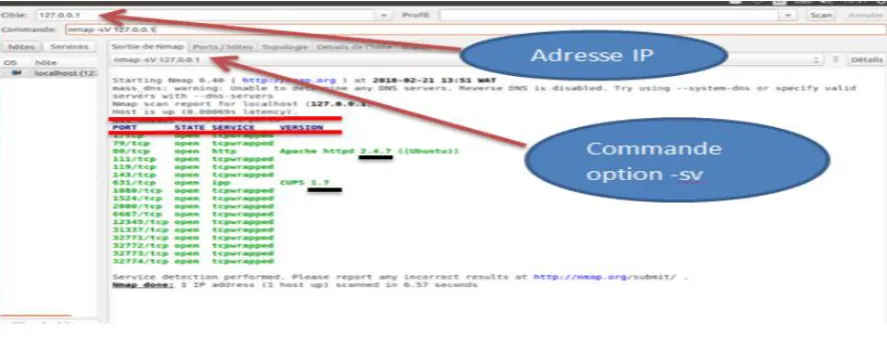
The command ―Nmap -sV IP_address‖ is launched on Zenmap [22] by specifying the IP address of the target.
Zenmap is the graphical version of nmap. The command is performed locally on a machine where Apache is
vulnerable. The output is illustrated in Figure 10
Figure 10: Vulnerable Apache
It is observed underlined in black, Apache and printing services with their versions. The box in red gives other
information. These are: response port, service status, service name, and service version. The attacker can
therefore consult the CVE Website, for the list of vulnerabilities for this version of Apache. Once the system is
launched and the protection option chosen, rules are applied to hide the version of Apache as shown in Figure
Figure 11: Secure Apache
It should be noted that the protection has been carried out and considered by the system. Thus, during a next
scan, the system informs that it is protected. The improvement is verifiable with Nikto.
6.2. Injection and XSS attack
The collector detected these two types of vulnerabilities. Correction information was retrieved by the Collector
from the Apache official Web site. The system automatically installs the security module called Modsecurity.
The Collector retrieves security rules defined by OWASP on Github [23] concerning the deployment of
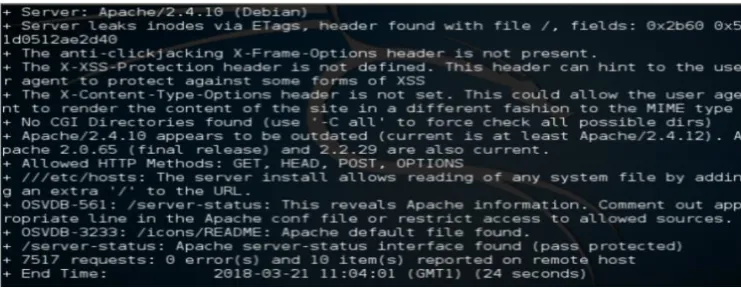
Modsecurity. In this test case, the Controller notices the absence of Modsecurity. The test of Nikto on unsecure
Apache is shown on Figure 12.
Figure 12: Nikto test on vulnerable Apache
It is observed thatNikto listed eleven vulnerabilities on the Apache Web service in 24 seconds. Among them,
the XSS flaw, version disclosure and many more. The Corrector includes some rules recommended by OWASP.
The well integration of rules is confirmed after performing the Bash script ―curl localhost/index.html?
Figure 13: Attack‘s test
The system is applied to reduce vulnerabilities identified by Nikto.
Figure 14: Post-test of Nikto
The vulnerability detection has been significantly reduced by 8 seconds. The number of vulnerabilities in this
progression has been reduced to 2. It reveals the efficiency of the system.
6.3. Deny of service
Vulnerabilities detected by the Collector in this category of attacks are collected from official Apache editors.
The correction solutions are transformed by the Collector into rules structured as follows:
R1= (apache2, writes, MaxClient 1288), and so on. The controller marks all these rules to 0 because Apache is at
the default configuration stage
It is defined the MaxClients based on the size of current RAM and the average size of Apache processes. It
implies that the heavier the process, the less the Maxclient is. The part of code dealing with this part is also
available to the Github page of this project.
Due to the limited number of processes during the test, it has not been easy to check improvements.
6.4. Comparison with SCAAMP
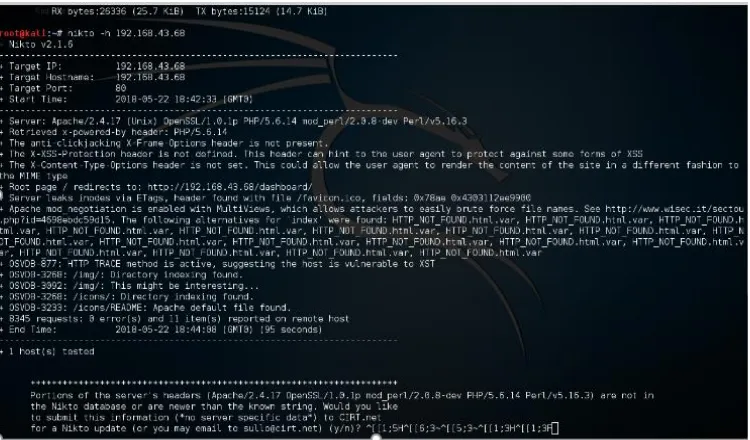
This section compares the proposed system to SCAAMP. Nikto reveals several vulnerabilities on the unsecure
Figure 15: Test of SCAAMP
After the application of SCAAMP on the same unsecure Apache, the security level is estimated to 33% as
shown in Figure 16. Therefore, the risk level is 77%. Within the same conditions, the proposed system reduces
the longer list of vulnerabilities to only two as shown in Figure 14. SCAAMP does not inform about risk level
on vulnerabilities, to which users are exposed. The determination of rules in this work is based on up-to-date
retrieved recommendations from official editors; making the system flexible and scalable. SCAAMP works
unlike with fixed rules.
Figure 16: Summary of SCAAMP configuration
6.5. Limitations and recommendations
The proposed solution includes Nikto tools for static scanning and evaluates risk level and efficiently reduce
vulnerabilities. However, this work builds the system only for Apache. It is recommended to make it generic to
all services. The computation of risk level supposes that each rule has the same contribution to a vulnerability
type. However, in real cases it cannot be the case. It is recommended to consider that rules have different
impacts on the computation of misconfiguration risk level. The system should also integrate automatic retrieval
and mining of rules and Nikto part to make the scanning fully complete.
7. Conclusion
This work proposes an architecture to identify vulnerabilities in core configuration files, to design directives
service configuration, and to automatically apply directives on behalf of the user. Unlike SCAAMP, the status
of service configuration is not the one at the installation but can evolve over the time. Experimentations on real
environments demonstrate that the system reduce considerably vulnerabilities.
Future works will be oriented to
consider of several services at once with possibilities of local or remote intercommunication (via a
network);
automate information retrieval and mining by the collector;
assign different weights to the rules for the assessment of risk levels; automate update of CVSS values for risk level assessment in the corrector.
References
[1] R. Newmana, V. Chang, J. W. Walters, G. B. Wills. ―Web 2.0—The past and the future‖. International
Journal of Information Management, 36, pp. 591–598, 2016.
[2] G. Harry. Principales failles de sécurité des applications Web : principes, parades et bonnes pratiques de
développement. CNRS, 2012
[3] G. V. Marconato. ―Evaluation quantitative de la sécurité informatique : approche par les vulnérabilités‖.
Ph.D thesis, INSA, 2009
[4] B. Eshete, A. Villafiorita, K. Weldemariam. ―Early Detection of Security Misconfiguration Vulnerabilities
in Web Applications,‖ in Proc. Int. on Availability, Reliability and Security, 2011, pp. 169-174.
[5] ‗Nikto2‘, https://cirt.net/Nikto2, accessed 05 January 2018
[6] M. van Steen, A. S. Tanenbaum: Distributed Systems: Principles and Paradigms. CreateSpace Independent
Publishing Platform, 3rd edn, 2017
[7] A. Avizienis, J-C. Laprie, B. Randell, C. Landwehr. ―Basic Concepts and Taxonomy of Dependable and
Secure Computing‖. IEEE Transactions on Dependable and Secure Computing, 1(1), pp. 11-34, 2004.
[8] A. Adelsbach, D. Alessandri, C. Cachin. ―Conceptual Model and Architecture of MAFTIA‖. University of
Newcastle upon Tyne, pp 30-31, 2003.
[9] Vaadata. ―Comprendre les vulnérabilités web en 5 min – episode #1 : Injections!‖. Internet:
https://www.vaadata.com/blog/fr/comprendre-les-vulnerabilites-Web, March. 21, 2014 [Jul. 29, 2019].
[10] OWASP. ―Top 10-2017 Top 10‖. Internet: https://www.owasp.org/index.php/Top_10-2017_Top_10,
[11] A. Viardin. ―Un petit guide pour la sécurité‖. Internet : https://www.inetdoc.net/guides/tutoriel-secu/,
2003, [Jul. 29, 2019].
[12] OpenVAS. ―The world's most advanced Open Source vulnerability scanner and manager‖. Internet:
http://www.openvas.org/, [Jul. 29, 2019].
[13] Nmap. ―Chapter 2. Obtaining, Compiling, Installing, and Removing Nmap‖. Internet:
https://nmap.org/book/install.html, [Jul. 29, 2019].
[14] P. Chambet. ―La gestion des correctifs de sécurité dans un parc Windows : des solutions techniques à la
mise en œuvre pratique en entreprise‖. Internet :
http://www.chambet.com/publications/Correctifs_securite.pdf , [Jul. 29, 2019].
[15] A. Taylor. ―Guide détaillé pour Microsoft Windows Server Update Services 3.0 SP2‖. Internet :
http://www.labreux.fr/tssi/ms/10%20-%20WSUS30SP2StepbyStep.pdf , [Jul. 29, 2019].
[16] S. Murugiah, S. Karen. Guide to Enterprise Patch Management Technologies. National Institute of
Standards and Technology (NIST), 2013
[17] A. Zammouri, A. A. Moussa. ―SafeBrowse: a New Tool for Strengthening and Monitoring the Security Configuration of Web Browsers‘. in Proc. Int. Conf. Information Technology for Organizations
Development (IT4OD), Fez, Morocco, May 2016, pp. 1-5.
[18] OWASP. ―Category:Vulnerability Scanning Tools‖. Internet:
https://www.owasp.org/index.php/Category:Vulnerability_Scanning_Tools, Apr. 26, 2018 [Jul. 29, 2019].
[19] Netcraft. ―February 2018 Web Server Survey‖, Internet:
https://news.netcraft.com/archives/2018/02/13/february-2018-web-server-survey.html, Feb. 13, 2018
[Jul. 29, 2019].
[20] Tchafros. ―Misconfiguration Patching of Web Services‖. Internet: https://github.com/tchafros/PatchConf,
Jun. 12, 2018 [Jul. 29, 2019].
[21] Apache. ―Apache HTTP Server Project‖.Internet:
https://httpd.apache.org/security/vulnerabilities_24.html, [Jul. 29, 2019].
[22] Nmap. ―Chapter 12. Zenmap GUI Users‘ Guide‖. Internet : https://nmap.org/book/zenmap.html, [Jul. 29,
2019].
[23] SpiderLabs. ―Modsecurity rules‖. Internet: