1
Coupling of the synchronization stations of an Extended
Kanban system
Leandros A. Maglaras
1,*
1University of Surrey, Department of Computing, Guildford, UK
Abstract
In this paper, an approximate method for estimating the performance of the synchronization stations of an Extended Kanban production system is developed. The correct treatment of an Extended Kanban system requires the decomposition of the system into a set of subsystems and the coupling of the synchronization stations of each of these. Unlike other Kanban type systems, the analysis in isolation of each synchronization station gives inaccurate results due to the simultaneous arrival of requests at all stations. The method of coupling of the synchronization stations of each production stage which is proposed, gives a good approximation of the performance of the production system, and makes the process quite accurate. This method provides a good basis for the comprehensive analysis and solution of a system of Extended Kanban.
Keywords: Industrial production system, Kanban, approximation method
Received on 1RYHPEHU, accepted on -DQXDU\, published on 04-XQH
Copyright © 2015 L. A. Maglaras, licensed to ICST. This is an open access article distributed under the terms of the Creative Commons Attribution Licence (http://creativecommons.org/licenses/by/3.0/), which permits unlimited use, distribution and reproduction in any medium so long as the original work is properly cited.
doi: 10.4108/inis.2.4.e5
*Corresponding author. Email: [email protected]
1. Introduction
In this work, an approximate method to estimate the performance of the synchronization stations of an Extended Kanban production system is developed [7], which could be used to assess overall performance of a production system in a multistep sequence. The Extended Kanban system is used to coordinate production systems - stocks in multistage series. The basic operation of an Extended Kanban system can be summarized as two basic principles. a) When a request reaches the system it is immediately transferred to all stages of the system and b) In order to release a component from one stage to the next there must be a free Kanban in the next step.
The Extended Kanban system combines the systems Basestock and Kanban which are included as special cases. The extended Kanban system differs from simple system Kanban owing to the fact that the requests are transferred simultaneously to all stages. This feature of the system makes it necessary to create a special method for solving
synchronization stations. Any attempt to resolve the channels in isolation, as in other production systems, which may lead to miscalculation as it does not take into account the simultaneous arrival of demands at the stations of the system.
The Extended Kanban system, thanks to its specificity, can respond quickly to changes in demand while maintaining a high level of customer service, since the function of each stage depends not only on local data, but also on the demand for final products. The disadvantage of the extended Kanban system is the complexity introduced by the resolution of the main stations regarding synchronization.
Solving an Extended Kanban system can be achieved similarly to other production control systems [1]. The system is modeled as an open network of queues with synchronization stations. By changing the roles between the components and Kanban a closed queuing network is obtained. Next, the network is decomposed into subsystems, each of which includes a single stage of the production process and the neighbouring subsystems communicate with each other since they share common synchronization
Research Article
2 stations. Each subsystem is analyzed and the service rates of each is calculated. Then, an iterative procedure is used to solve the overall system.
There are several studies on Kanban type systems. The Baynat and Dallery [3] use the method of assembly of classes for resolving synchronization stations where the exact solution is time consuming and sometimes impossible. The Mascolo and Frein [1] give an analytical solution of a Kanban system . The literature assessing the performance of Kanban systems, includes works dealing with simple systems [1,2], research focused on resolving synchronization stations [3] and that regarding extended Kanban systems [6,7,10]. Moreover, there are studies introducing some approximation methods that have tried to analyze queuing systems [4, 5, 8, 9].
In this work, an approximate method is devised in order to estimate the performance of the synchronization stations of an extended Kanban production system along with a simulation program based on the method Monte Carlo, for comparing the results. The analysis of the performance of the synchronization station produced by the proposed method is based on the aggregation technique of classes [3].
Initially, a method called "Coupling of Synchronization stations" is developed, which approximates the operation of a synchronization station of the Extended Kanban system by producing an equivalent synchronization station for each stage of the production process. Then, the algorithm developed in [3] is implemented in order to analyse the produced synchronization station. Finally, the results are compared with those obtained from a simulation method based on Monte Carlo. The numerical results show that there is a good approximation of the rates of output for each channel of a synchronization station of an extended Kanban system. The method of coupling synchronization stations could be used as a basis for an overall solution for an extended Kanban production system.
The rest of the paper is organized as follows. In Section 2, the operation and modeling of an extended Kanban system is presented. In Section 3, the method relying on aggregation to resolve the synchronization stations is explained. Section 4 presents the application of the Monte Carlo method in a system of synchronization stations. In Section 5, the numerical results for both the approximate and Monte Carlo methods for simple synchronization stations (systems Kanban) and cases of coupling stations (Extended Kanban System) are given. Section 6 reviews similar work in the field. The final conclusions of the article and suggestions for further research are covered in Section 7.
Table 1 summarizes the basic notation used in the article.
Symbol Definition
Mi Stage i
nk Number of customers of queue k Nk Maximum number of customers of queue k
λ(nk) Rate of queue k with nk customers of the original station
λ’(n’k) Rate of queue k with n’k customers of the equivalent station
RND[0..1] Random number with a range from 0 to 1
2.
Extended Kanban Systems
2.1.
System description
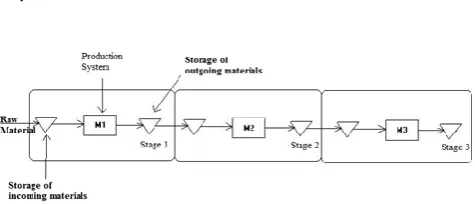
To describe the operation of an Extended Kanban system, a simple example is used involving a production system consisting of M = 3 machines in series, each of which has a random processing time. The production system is divided into N = 3 stages, with stage consisting of a store for incoming materials, a production system and an area that holds the finished parts of the production stage. The production system of each stage comprises a subset of the machines of the original system and in this example, each stage has one machine as shown in Figure 1.
Each stage has a specific number of Kanbans that determine the maximum number of components in the process, with this number at stage i being ki. OK? To enter a new part in stage i from the previous stage, there should be at least one free Kanban in stage i. If one is free, it adheres to the part and follows it throughout the stage. Once the component arrives at the next stage of production, the Kanban is released and can be reused. The number of Kanbans for each stage determines the maximum number of components present either in the production system (Mi) or in the storage areas. The components stored as the outgoing materials of the last stage are the final outputs of the production system. If a final product reaches the storage of the outgoing materials from the final stage it is given directly to the customer and the Kanban of stage 3 that was attached to it is removed for further use.
.
Figure 1.Serial production system divided into subsystems
2.2.
Modeling of an Extended Kanban System
To solve an Extended Kanban system, it must first be modeled as an open network of queues with synchronization stations.
3
Figure 2. Extended Kanban modeled as a queue type system
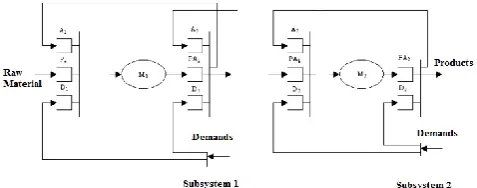
Figure 2 shows an Extended Kanban system with two stages in series, where the production system of each stage is represented by a station with exponential service rate. The warehouses of incoming and outgoing materials of each stage are represented by synchronization stations at the input and output locations.
A synchronization station is a tool that is often used for modeling the composition functions in networks. When at least one customer exists in each queue, then the server generates output. In the current case, the station synchronization queues contain components, Kanban and demands for products. The number of Kanbans of stage i is Ki. When the system is in its initial state, the queue Po contains an initial stock of raw materials, the queue PAi contains Si finished parts of step i (original stock), where each component has an attached Kanban, queue Ai contains Ki - Si free Kanbans of stage i and all other queues are empty.
The behaviour of the Extended Kanban system is a combination of those of the Basestock and Kanban systems. When a demand for a product reaches the Extended Kanban, it is inserted in the queue D3requesting delivery of a finished product from the queue PA2 to the customer. Simultaneously, generated in each queue Di is a demand for the introduction of a component from the queue PAi-1 to the queue Ii, where i = (1, 2, ..), as is the case in the Basestock system. However, in contrast to what happens in that system, under Extended Kanban a member is not authorized to pass immediately from the queue PAi -1 to the queue Ii, unless there is a free Kanban in queue Ai, which is the same as with the Kanban system.
Initially, there are Ki - Si free Kanbans in queue Ai, which may authorize the entry of an equal number of new components at stage i. In the limiting case where Ki = for all I, this is equivalent to the Basestock system, which is why when there is an infinite number of Kanban at each stage, the Ai queues can be deleted from the system shown in Figure 2. In the special case where Si = Ki for all i, this is equivalent to the simple Kanban system. This is because when the number of Kanbans is equal to the level of the base stock at each stage, the queues that contain requests for the production of new components can be deleted from the system illustrated in Figure 2.
As explained above, the concept of the Extended Kanban system is as follows:
When one demand reaches the system it is immediately transferred to each stage of the system as with the Basestock system.
A part may be released from one stage to the next only when a Kanban is free, as is the case in the Kanban system.
The Extended Kanban system is a fairly simple system, because the roles of the parameters Ki, and Si, are discrete. One consequence of the latter circumstance, is that the capacity of the Extended Kanban system, ie the maximum average rate of demand that can it satisfy, does not depend on Si, but rather, only on Ki.
2.3.
System analysis
Figure 3 shows the decomposition of the Extended Kanban system of Figure 2 into two subsystems.
Figure 3. Decomposition of an Extended Kanban system
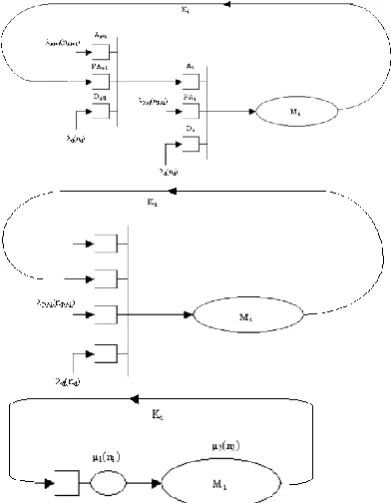
Each subsystem in the above figure is connected to its neighbour by the synchronization station. The rate of external arrivals to each is described by an exponential function and depends on the number of elements that each queue has. In the queue PAi of each subsystem i the arrival rate depends also on the number of elements of the queue Ai+1, as these two queues contain the total number of Kanbans in the subsystem. Any subsystem (stage) resulting from the decomposition of the original system is treated as a closed network. The Kanbans in this network are considered as the clients, with the original materials and demands being the external sources. The system now consists of a module Mi and two synchronization stations (Figure 4).
Figure 4. Model of a closed network for a single stage of the Extended Kanban system
4 Such a closed network can be approximated if each of the stations is in synchronization, where each service station Mi of subsystem Ri has an exponential service rate, which depends on the number of customers in the subsystem. In the case of the Extended Kanban, such an approach would lead to quite inaccurate results because both stations have interdependence owing to the simultaneous receipt of demands in queues Di and Di-1, respectively. For this reason, both stations are treated as one, and this system is approximated, as above, by a station with an exponential service rate dependent on the number of customers in it. To calculate this supply rate, the system of the two synchronization stations is replaced by an equivalent station by the proposed method of coupling as explained in the following section. This subsystem is now composed of the subsystem R and one synchronization station (see Figure 5).
This network can be solved approximately, if the synchronization station and each of the service stations of subsystem R, are approximated by independent stations each with an exponential service rate dependent on the number of customers in station. Let μk(nk) be the service rate of station k when it has nk customers and the current state of the system is expressed by the vector n = (n1, …, nk). The probability that the system is in state n, is given by the formula:
)
)
(
(
)
(
1
)
(
)
( 1
k S k
n
k k
k
n
V
k
G
n
p
where, G(k) is a normalization constant and V(k) is the average visit rate for station k. To determine the unknown parameters μk(nk), each subsystem R is analyzed in isolation as an exponential station and the outputs are given by:
)
(
)
(
)
(
)
(
11
k k
k k k k k k
n
p
n
p
n
n
v
Then an iterative process is followed based on the equation Vk(nk)= μk(nk) until the values converge. For the analysis of a subsystem such as that in Figure 5, it is obvious that the equivalent synchronization station needs to be approximated. In the case where the number of the queues of a synchronization station is more than two, the exact analysis of a Markov chain is laborious and time-consuming (and sometimes impossible), which has led to the development of approximate methods, such as the aggregation of classes as discussed in the next section.
Figure 5. Equivalent scheme of a one stage Extended Kanban system
3.
Synchronization station
Analysis of a synchronization station is necessary for the overall analysis of the closed network as mentioned in the previous section. However, the exact solution to one is sometimes impossible. For this reason, several methods have been developed that can approximate the performance of a synchronization station quite accurately. Nevertheless, analysis in isolation of the synchronization stations for an Extended Kanban system does not give accurate results as it does not take into account the simultaneous arrival of the demands at all stations. For this reason, the Coupling Method presented in Subsection 3.2 is developed. To approximate the behaviour of the equivalent synchronization station that is produced by the proposed, the method of aggregation of classes technique as developed by Baynat - Dallery [3] is used (see Section 3.1).
3.1. A
ggregation algorithm
When the number of queues of a synchronization station is large, the calculation of the probabilities of the Markov chain corresponding to the station can prove to be extremely difficult and so the technique of aggregation can be used instead. Let r be a class of service (queue) of the synchronization station and the customers of other queues are considered resources required for the release of a customer of class r from this particular station. The only restriction on this is the existence of authorization to class r, ie the existence of at least one client from each of the other
EAI Endorsed Transactions on Industrial Networks and Intelligent Systems
5 classes. Let na be the number of available authorizations of
class r, then:
na = min {ns}, where s≠r
The authorizations of class r can be represented as a union of R - 1 customers, one from each class s, where s≠r. At least one of the quantities nr and na is zero at any time. In the
case where nr> 0 (when na = 0), each customer of class r
has to wait until a new authorization exists and hence, the effect of the remaining customer classes on class r can be represented in a comprehensive manner. So, during the process of aggregation of classes for each class r, the initial synchronization station of several classes is converted into a station with two classes, where the influence of other classes is represented in a comprehensive way with a class ar. The resulting synchronization station with two classes is shown in Figure 6 and it is called a total synchronization station. This transformation should be performed R times, one for each queue of the station.
Figure 6. An aggregated synchronization station.
3.2. Coupling of synchronization stations
As pointed out above, analysis in isolation of the synchronization stations in an Extended Kanban system leads to errors, which thus requires the use of various approximation methods. One such method propose here is the coupling of the synchronization stations of each stage of the system, thereby creating an equivalent station. The method is developed in this subsection, based on which and that of aggregation, a comprehensive solution (algorithm) for solving any production system that uses synchronization stations is developed.
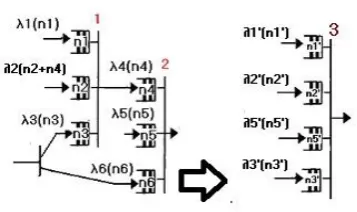
Figure 7. Coupling of synchronization stations
The equivalent station that is produced from the coupling of stations 1 and 2 is called 3 (Figure 7). For this station, the following equations apply.
Queue P1 : n1΄= n1 + n4 (1),
λ1΄(n1΄,n2΄,n3΄)= λ1(n1΄-min(n1΄,n2΄,n3΄)) (5)
Queue P2 : n2΄= n2 + n4 (2), λ2΄(n2΄)= λ2(n2+n4) (6)
Queue P3 : n3΄= n3 + n4 = n6 (3) , λ3΄(n3΄)=λ6(n6) (7)
Queue P4 : n5΄= n5 (4), λ5΄(n5΄)=λ5(n5) (8)
where, ni is the current number of customers of queue i of
the original station and ni΄ is the current number of customers of queue i of the equivalent station. In order to calculate the rate λ1΄(n1΄,n2΄,n3΄) equations (1),(2),(3) are
used, which gives:
λ1΄(n1΄,n2΄,n3΄) = λ1(n1΄-min(n1΄,n2΄,n3΄)) =
λ1(n1-min(n1,n2,n3)) (9)
If n
1΄=0 then n
1=0
λ
1΄(n
1΄,n
2΄,n
3΄) = λ
1(0)
≡
λ
1(n
1)
If n
1΄>0 then:
λ
1(n
1΄) = λ
1(n
1)
n
1΄ (10)
n
1= 0
λ
1(0)
≡
λ
1(n
1)
n
2=0
λ
1(n
1)
λ
1(n
1΄)= λ
1(n
1)
n
3=0
λ
1(n
1)
EAI Endorsed Transactions on Industrial Networks and Intelligent Systems
6 Using the above equations (1-10) gives:
) 11 ( , ) ( ) ' / ( a) ' (n ' ) , ( θετικό} εφόσον{0ή(n'-N )
1 1 1 1 1 1 4 1
MinaN
k k a n k n P
The limits of the sum of equation 11 result from the fact that for each value of n1, say a, the range of n1 is from
zero or (a-N4) to the minimum of a and N1. Equation 10
gives the sum of the probabilities of n1, given n1’,
multiplied by the input rate to queue one of station one for the condition n1
In order to calculate the value of P(n1 k/n1'a) the
following steps are taken. We assume that originally queues n1, n4 have s1, s4 customers respectively. We also
assume that at some time instance n4 = (n1’-n1) = m. the
probability P depends on the ratio of the number of outputs from station 1, s1-k, and the number of outputs
from station 2, s4-m. This probability can be
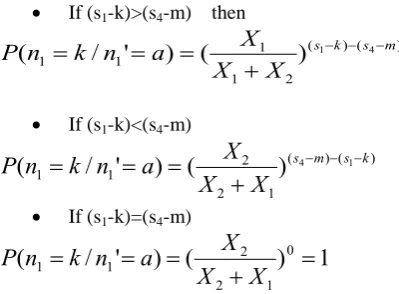
approximated by assuming that the average throughputs of the stations are independent of each other. Specifically there are three cases:
If (s1-k)>(s4-m) then
) ( ) ( 2 1 1 1
1
/
'
)
(
)
1 4(
s k s mX
X
X
a
n
k
n
P
If (s1-k)<(s4-m)
) ( ) ( 1 2 2 1
1
/
'
)
(
)
4 1(
s m s kX
X
X
a
n
k
n
P
If (s1-k)=(s4-m)
1
)
(
)
'
/
(
0 1 2 2 11
X
X
X
a
n
k
n
P
Since the average throughputs of the two synchronization stations after some time, when the system is in balance,
are equal, the ratio
1 2 2
X
X
X
is equal to 1/2.The steps of the coupling algorithm are:
Create equivalent station 3 from the two initial stations
Calculate the rates λ1'(n1') based on the
above equations
Apply the aggregation technique to equivalent station 3 and find the throughput of each n2’ queue.
Since there is no available literature on the numerical results in order to compare those of the proposed coupling method, the method of Monte Carlo is applied. The results of the analysis with this method are compared with those of the coupling method, which involves comparing the
long-terms probabilities for each possible state of the P2
queue of the equivalent synchronization station.
4.
Monte Carlo algorithm
The Monte Carlo method has no known origin, but it was used as far back as 1944 by Voi Neumann and Fermi for calculations of neutron decay. Since then it has been used in many scientific areas including reliability systems. Under this method, a large number of experiments can be carried out and the probabilities for each state at both synchronization stations recorded. In each experiment random numbers are generated for all inputs of the system, such that they are compatible with the distribution of arrivals to the system (exponential). Moreover, the period of the sequence of random numbers should be large enough to obtain satisfactory results. The Monte Carlo method, although simple, is quite costly in terms of time, for as explained earlier it requires a large number of experiments (tests) to produce a statistically significant number of arrivals to the system.
Figure 8. The two synchronization stations of a stage of an Extended Kanban system
]) 1 ... 0 [ ln( ) ( 1 1 1
1 n RND
t
,
])
1
...
0
[
ln(
)
(
1
2 2 2RND
n
t
,
6 3 ]) 1 ... 0 [ ln( 1 t t RND t dd
,
]) 1 ... 0 [ ln( ) ( 1 5 55 n RND
t
The steps of the algorithm are:
Production of arrival times for the queues, based on the above equations
Find the smallest ti
Update the appropriate table showing the arrival series in order of time (shortest first)
Update the total experiment time T = T + min (ti)
EAI Endorsed Transactions on Industrial Networks and Intelligent Systems
7
Check if all the values in Table A are > 0, so that station 1 produces an output
New Update of Tables A and B
Update the probability matrix Pr
Check if all the values in Table B are> 0, so that station 2 produces an output
New update of Table B, Pr.
Check if T> tol (Maximum run time), if: a. YES: go to Step 11
b. NO: Resume from step 1. (Based on the fact that arrivals follow an exponential distribution and therefore do not have a memory)
Find the probability for each state of the queues at stations 1, 2 from table pr from the equation:
tol
n
i
n
i
p
ii
)
,
Pr(
)
,
(
,
where i is the queue ofinterest and ni the state in the queue
In the program are the following variables and tables: A: Status table for each queue of the first station synchronization with initial conditions (S1, 0, 0)
B: Status table for each queue of the second station synchronization with initial conditions (S4, 0, 0)
Pr: Table where the time that each queue remains in each state is stored
C: Table where the time that the system of queues 2 and 4 remain in each state is stored in order to derive the probability P (n2 + n4)
5.
Evaluation
In order to evaluate the proposed method experiments are conducted for a synchronization station in isolation and for both the synchronization stations of a single stage of an extended Kanban system.
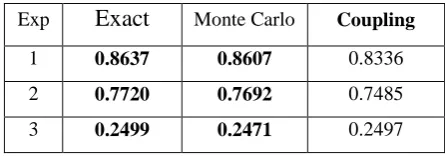
Table 1.Average outputs for a station in isolation.
Exp
Exact
Monte Carlo Coupling1 0.8637 0.8607 0.8336
2 0.7720 0.7692 0.7485
3 0.2499 0.2471 0.2497
Table 2. Average outputs for the equivalent station for an Extended Kanban system
Exp Monte Carlo Coupling
Error %
1 0.8383 0.8306 0,93
2 0.7054 0.687 2,68
3 0.1256 0.1248 0,64
Table 3. Comparison of the second queue of the equivalent synchronization station
Error % for the station [P2]
Exp State
0 1 2 3 4 5
1 13.63 15.80 14.48 12.82 6.36 4.60
2 6.16 10.26 10.58 8,29 1.70 8.96
3 0.00 13.79 3.42 2.35 0.53 0.01
From the above tables, it is obvious that the coupling method used in the aggregated synchronization station provides a very good approximation to the average output rate when compared to the single synchronization station.
Besides the above, a plurality of experiments were performed with different Ni [maximum number of items in each queue] and various arrival rates for each queue. All experiments showed a similar behaviour of the proposed coupling method regarding the outputs of the equivalent sychronization station when compared to those of the uncoupled stations (those resulting from the method of Monte Carlo). Hence, the method can be used as a basis for a comprehensive solution for an Extended Kanban system, which offers quick and fairly reliable estimates of synchronization stations.
6.
Related work
Approximation techniques are applied in [11] for comparing Basestock, Kanban and generalized Kanban production systems containing one to four stages. A similar comparison for a two-stage system is made in [12]. In [13] authors conduct an assessment of the behaviour of extended Kanban systems and results are used in [14] in order to develop an approximate method for evaluating the performance of the synchronization channels of an Extended Kanban system.
Some of the most common methods for assessing the performance of Kanban type production systems are approximate assessment methods of queuing networks, with particular emphasis on closed networks. However, accurate solutions exist only for a small class of such networks, known as separable ones. In an early work, Jackson [15] showed that an open network with Poisson distributed arrivals, exponential service times as well as probabilistic routing and discipline (FCFS) can be solved if each station is represented as an M / M / 1 queue. In the
EAI Endorsed Transactions on Industrial Networks and Intelligent Systems
8 case of closed networks that keep the conditions of the Jackson type, it is proved in [16] that same solution works. A summary of these results and some extensions to the methods are included in the BCMP theorem in [17]. The performance parameters of inseparable networks can be obtained by the use of efficient algorithms, such as the convolution algorithm [18].
The restrictions regarding severable networks make their application difficult in real systems. For this reason, attempts have been made to develop approximate methods for solving inseparable networks, i.e. general networks in general service times and discipline FCFS. Most of these methods are based on decomposition. For medium sized networks various approximate methods have been developed. Among the different approaches that have been proposed, of particular interest is the Marie method based on the idea of replacing the initial network with an equivalent network, which has service rates that depend on the load of the synchronization station. This particular approximation technique is proposed in [19].
For the Extended Kanban systems where the requests arrive at all stages simultaneously, new approximate methods are needed. The present article proposes a novel approximation method that avoids the aforementioned shortcomings and tries to incorporate the best features of the Extended Kanban system. It is believed that this is the first time that coupling of synchronization stations has been used in order to approximate a Kanban type production system.
6.
Conclusions
In this article, the behaviour of synchronization stations in a production system has been studied. At first, the algorithm proposed by Baynat - Dallety (aggregation method) to approximate the behaviour of a synchronization station was implemented. Next, an approximation method for the analysis of the behaviour of a synchronization station of an Extended Kanban system, where most stations are not treated separately, but as a system for each stage of the production system, was introduced. More specifically, the method of coupling of synchronization stations was proposed involving the creation of an equivalent synchronization station for each stage. Due to lack of real data, the outputs of the set of the synchronization stations were simulated using the Monte Carlo method. Subsequently, the values of the Monte Carlo program and the proposed coupling method for an Extended Kanban system were compared and it was found that the latter gives a good approximation of the systems behaviour. Consequently, it is contended that the proposed coupling method could be used as part of a comprehensive program for the analysis of any Kanban type production system. Moreover, the coupling method could be used as a basis in order to solve other Kanban
type systems, where the synchronization stations of each stage are connected in such a way that their analysis in isolation is prohibitive.
Acknowledgement.The author would like to thank
Max Harris for his help in editing and proofreading this paper.References
[1] Di Mascolo Μ and Yannick Frein Υ (1994) “An analytical method for performance evaluation of Kanban controlled production systems”, Operations Research, vol 44, 50-64. [2] Baynat B and Dallery Y (1996) “A product-form
approximation method for general closed queueing networks with several classes of customers” Performance Evaluation, vol 24, 165-168.
[3] Baynat B and Dallery Y (1995) “Approximate analysis of Multi-class Synchronized Closed Queueing Networks”. Technical Report MASI.
[4] Dallery Y (1990) “Approximate analysis of General Open Queueing Networks with restricted Capacity”, Performance Evaluation, vol 11, 209-222.
[5] Baynat B and Dallery Y (1993) “A unified view of product-form approximation techniques for general closed queueing systems”, Performance E valuation, vol 18, 205-224.
[6] Chiaouiya C, Liberopoulos G and Dallery Y (2000) “The Extended Kanban control system for production coordination of assembly manufacturing systems”, IIE Transactions vol 32, 999-1012.
[7] Liberopoulos G and Dallery Y (1998) “Extended Kanban control system: combining Kanban and Basestock”, IIE Transactions vol 32, 369-386.
[8] Baynat B, Dallery Y, Di Mascolo M and Frein Y (2001) “A multi-class approximation technique for the analysis of Kanban-like control systems”, International Journal of Production Research vol 39, 307 – 328.
[9] Baynat B and Dallery Y (1993) “Approximate techniques for several closed queueing networks with subnetworks having population constraints”, Operations Research vol. 69, 250-264.
[10] Kageshima, Rumiko, and Atsushi Inoie. "Simulation-Based Optimization Approach for an Extended-Kanban Control System." Computational Science and Computational Intelligence (CSCI), 2014 International Conference on. Vol. 2. IEEE, 2014.
[11] Duri, C., Y. Frein and M. Di Mascolo (2000) “Comparison among Three Pull Control Policies: Kanban, Base Stock and Generalized Kanban,” Annals of Operations Research, 93, 41-69
[12] Zipkin, P. (2000) Foundations of Inventory Management, McGraw Hill: Management & Organization Series, Boston, MA.
[13] Dachtaris Ι., “Conduct Evaluation of Extended Kanban systems”, Masters Thesis, Department of Mechanical and Industrial Engineering, University of Thessaly, Volos, 2000
[14] Maglaras A. Leandros, “Approximate Method for the Performance Evaluation of Synchronization Stations of an
EAI Endorsed Transactions on Industrial Networks and Intelligent Systems
9 Extended Kanban System”, masters thesis, Department of Mechanical and Industrial Engineering, University of Thessaly, Volos. 2004
[15] Jackson, J.R. (1963) “Jobshop-Like Queuing Systems,” Management Science, 10 (1), 131-142.
[16] Gordon, W.J. and G.F. Newell (1967) “Closed Queuing Networks with Exponential Servers”, Operations Research, 15, 252-267.
[17] Baskett, F., K.M. Chandy, R.R. Muntz and F. Palacios-Gomez (1975) “Open, Closed and Mixed Networks of Queues with Different Classes of Customers”, Journal of ACM,22 , 248-260
[18] Buzen, J.P. (1973) “Computational Algorithms for Closed Queuing Networks with Exponential Servers”, Comm. ACM, 16 (9), 527-531.
[19] Marie, R. (1979) “An Approximate Analytical Method for General Queuing Networks”, IEEE Transactions on Software Engineering, 5(5), 530-538.
EAI Endorsed Transactions on Industrial Networks and Intelligent Systems