A Survey of Internet of Things Services Provision by
Telecom Operators
Manal A. Alareqi
1
Fahd N.Al-Wesabi
2, Ammar T. Zahary
3, Mansoor N.Ali
41Faculty of Computing and IT, Sana’a University, Sana’a, Yemen; [email protected] 2Faculty of Computer and IT, Sana’a University, Sana’a, Yemen; [email protected] 3Faculty of Computer and IT, Sana'a University, Sana'a, Yemen; [email protected]
4Faculty of Education, Arts and Sciences-Marib, Sana'a University, Sana'a, Yemen; [email protected]
Abstract
Telecom industry will play a vital role in delivering Internet of Things (IoT) solutions and services. Researchers trust that IoT services deployment by Telecom is inevitable during the next few years. Nowadays, digital development overgrows, thus Telecom operators should consider IoT as the next evolution in their business plans. If an operator’s services confined to traditional services such as calling, they will lose a lot of added values and opportunities. In the end, they will find themselves out of the competition. Recently, the research community has addressed this topic and enriched it by highlighting related issues to help operators and researchers to move forward in this field. This paper presents a sound review for this topic covering the most significant related issues such as success elements, strategies and Low-Power Wide-Area (LPWA) standards provided by Telecom operators for IoT provision.
Keywords: Telecom, Internet of Things, Telecom Operators for IoT, Success Elements, Telecom IoT Topics, IoT Strategies, LPWA. Received on 23 December 2017, accepted on 11 February 2018, published on 20 March 2018
Copyright © 2018 Manal A. Alareqi et al., licensed to EAI. This is an open access article distributed under the terms of the Creative Commons Attribution licence (http://creativecommons.org/licenses/by/3.0/), which permits unlimited use, distribution and reproduction in any medium so long as the original work is properly cited.
doi: 10.4108/eai.13-7-2018.155571
Corresponding author. [email protected]
1. Introduction
Telecom players a vital role in IoT. There are a lot of synergies that Telecom can derive out of IoT. Telecom can provide IoT services through the reliable, adaptable, safe and secure way [1].Telecom operators reinvent themselves in the digital age by utilizing IoT to upgrade and optimize their network performance [2]. Also, IoT creates new revenue streams. Operators have many success factors to make revenue from this
environment, will be explained later [3]. IoT basic architecture consists of three layers [4] [5] [6]: (I) the perception layer, (ii) the network layer, and (iii) the application layer.
Also, Telecom network can give clear benefits over IoT that use existing network infrastructure. The researchers look that if Telecom operators don't keep pace with the rapid digital development, they will find themselves outside the squadron. As noted, social networking such as Facebook, WhatsApp, Twitter, and others have become better and cheaper than Phone calls or messages, and this is one of the most reasons that
Telecom operators considering IoT as the next evolution plans without creating security gaps or loss of information.
This paper describes how these technologies impact the Telecom world by introducing a sound review for the most important topics and issues related to Telecom IoT provision trying to help both researchers and operators alike.
The paper first addresses the success elements of Telecom IoT. Additionally, it discusses in details five essential strategies to offer IoT by Telecom operators. For operators, it is possible to adopt more than one strategy according to their infrastructure, their growth plans as well as country and region.
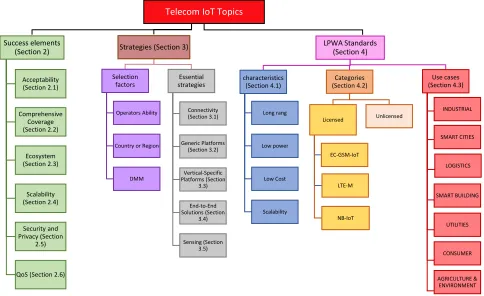
The rest of this paper summarised in Figure 2, and organized as follows: Section 2 outlines the success elements and the essential aspects that make Telecom the best technology to for IoT. This topic will answer one question: why Telecom? Section 3 shows IoT strategies. Strategy topic contains two points. First, factors to choose the suitable strategy. Second, the five essential strategies with benefits, challenges and use cases for each one. These strategies are Connectivity, Generic platforms, Vertical-specific platforms, End-to-End solutions, and Sensing. Finally, section 4 presents the IoT standards for Telecom. It explains LPWA standards used to help Telecom operators to merge and optimize IoT solution by their existing
Figure 1: Telecom infrastructure used as a network
layer, (a) used as a bearer network. (b) used as an access network
Figure 2: Topics of Telecom IoT
Telecom IoT Topics
Success elements (Section 2)
Acceptability (Section 2.1)
Comprehensive Coverage (Section 2.2)
Ecosystem (Section 2.3)
Scalability (Section 2.4)
Security and Privacy (Section
2.5)
QoS (Section 2.6)
Strategies (Section 3)
Selection factors
Operators Ability
Country or Region
DMM
Essential strategies
Connectivity (Section 3.1)
Generic Platforms (Section 3.2)
Vertical-Specific Platforms (Section
3.3)
End-to-End Solutions (Section
3.4)
Sensing (Section 3.5)
LPWA Standards (Section 4)
characteristics (Section 4.1)
Long rang
Low power
Low Cost
Scalability
Categories (Section 4.2)
Licensed
NB-IoT EC-GSM-IoT
LTE-M
Unlicensed
Use cases (Section 4.3)
INDUSTRIAL
SMART CITIES
LOGISTICS
SMART BUILDING
UTILITIES
CONSUMER
network. This section offers more details about three points of LPWA standards: the first point is LPWA characteristics with explaining techniques that exploited to meet these characteristics. The second point is LPWA categories (licensed and unlicensed) with a comparison between them. For solutions in the licensed spectrum, the paper shows the solutions published by the 3rd Generation Partnership Project (3GPP) to develop standards for reuse of existing Telecom networks to address IoT. These standards are extended coverage GSM IoT (EC-GSM-IoT), Long Term Evolution for Machines (LTE-M) and Narrowband IoT (NB-IoT). These standards allow the gradual transformation of IoT on the legacy network with a power saving feature. The third point is a summary of the main categories of LPWA with the main factors to choose suitable applications by operators.
2. Success Elements Provided by Telecom
Operators for IoT
Operators are in a vital place to capture a share of the added value created by the emerging IoT market since they are responsible for connectivity on a global scale [8]. This domain starting with being a direct connectivity provider (monetizing connectivity in new ways), all the way to providing of turnkey solutions to IoT markets [9].
The important aspect that makes Telecom networks as the preferred technology for IoT is maturity [10]. Operators have accumulated many years of experience in the construction and operation of networks, they perfectly know the details of the organization of safe and reliable information transfer and potentially can offer the most protected fault-tolerant IoT solutions. The maturity can translate by reviewing evident success elements provided by Telecom operators across a variety of applications using existing network infrastructure [8]. The researchers see these elements are operators' strengths points and must be exploited.
2.1 Acceptability
The researchers believe that Telecom provides high reliability by leveraging the vast existing customer base. It is estimated at millions and using proven billing mechanisms. Where the researchers think that acceptance and trust to offer IoT services by known and reliable companies better than providing these services by new companies especially in developing countries. Recognition of society [11], privacy and security [4] are the most prominent challenges facing IoT services deployment.
2.2 . Comprehensive Coverage
Telecom operators offer excellent coverage area in mature markets. In the first quarter of 2018, the number of mobile
subscriptions grew at 4 percent annually, reaching 7.9 billion. The most of the additions were in China (+ 53 million), followed by India (+16 million), Indonesia (+ 6 million), Nigeria (+3 million), and Bangladesh (+2 million) [12]. Figure 3 shows that the number of mobile subscriptions overrides the population in many countries, this is due to the ownership of multiple devices or inactive subscriptions, it means the number of subscribers is less than the number of subscriptions. Now, there are around 7.9 billion subscriptions worldwide compared to 5.3 billion subscribers.
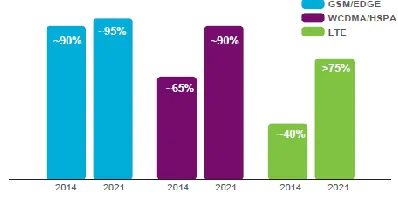
In Figure 4 Ericsson offered that Wideband Code Division Multiple Access (WCDMA) and Long-Term Evolution (LTE) are catching up, but Global System for Mobile Communications (GSM) will offer excellent coverage in many markets for a considerable length of time to come. Also, in this scope AT&T provide worldwide coverage crosswise over more than 200 countries and territories and over 500 wireless networks with Global Subscriber identity module (SIM) technology. LTE coverage is now available in 85 countries and growing [13].
As a result, applications offer through continuous service delivery mechanisms implemented by operators which makes the Telecom ecosystem quite appealing for specific IoT use cases [10] [14], the researchers see this element as helping to
Figure 3: No of subscribers Vs. No of subscriptions
Figure 4: World population coverage by cellular 3GPP
reduce the cost of providing this use cases by Telecom.
2.3 . Ecosystem
The Telecom operators achieved a vast and mature ecosystem, incorporating chipset, device and network equipment vendors, operators, application providers, and many others.
Operators have invested billions of dollars on their existing 2G, 3G, and 4G infrastructures. So they should enter into the IoT market with their traditional areas of strength [15]. For example, these networks have stable identity mechanisms that could be successfully reused, similar to the SIM card that will end up being double use components, equipped for securing application communications and the application itself.
2.4 . Scalability
For the Telecom industry, scalability is among the most critical properties that Telecom offered. Scalability enables to react all the rapidly and flexibility to changes in the market allowing it to process a significant amount of data [13]. The researchers observe that this is what the IoT market needs, where its applications evolve rapidly, and the world seeks a smart life.
2.5 . Security and Privacy
Security and privacy are the significant worries in the world at the all-time, particularly considering the secret data that be stored [4]. Conventional Telecom environments designed as a safe and reliable ecosystem for specific services that have a critical need for secure, and as a result, customer data always ensured by encryption and stored it in safe conditions [10] such as:
Various encryption algorithms used for protecting data
sent over the air algorithms.
Encrypting the core network is used for secure user level
and data.
In case of disaster and unintentional attacks such as
signaling storms due to massive roaming, the protecting do
by denial of service.
Security mechanisms based on a physical SIM related to a
Universal Integrated Circuit Card (UICC).
Packet inspection techniques can detect anomalies in
traffic flow and can trigger packet isolation.
Hence, the researchers believe that the Telecom system will cover a good level of security and privacy concerns for IoT
services. In addition to the new security requirements that emerge as a result of the deployment of widespread IoT services in any aspect of the life [16].
2.6 . QoS
Quality of Service (QoS) defined in [17] is "A set of specific requirements provided by a network to users, which are necessary to meet the required functionality of a service." The users specify their performance requirements in the form of parameters such as delay or packet loss. The QoS is one of the essential elements which the Telecom system built, and thus IoT services will inherit it. In addition to QoS requirements for its services, and Telecom will be able to meet them because of long experience and maturity.
3. IoT Strategies for Telecom Operators
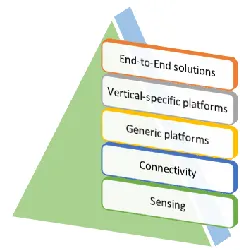
IoT helps operators to deliver innovative, value-added products and services if it designed and executed in the right way. Some customers will need connectivity, and others will need complete solutions. The strategies choice according to several factors: First, the operators’ abilities such as infrastructure and available resources. Second, a digital evolution of the country or region such as a platforms strategy is unsuitable for countries that don't have software evolution [18]. Third: the existence of digital maturity model (DMM) [19]. There are five strategies for the IoT [20], Figure 5 shows these strategies.
3.1. Connectivity
Whereas connectivity plays a vital role in the complete IoT and there are more business opportunities in connectivity [18]. It will form the basis of all Telecom IoT solutions. In connectivity strategy, Telecom operators provide an economical cellular connectivity package of pricing & services and providing high-quality & reliable communication by
leveraging the potential in existing space, existing customer base and use mechanisms for billing.
3.2. Generic Platforms
It is a broader solution that an operator can offer a hosting environment for applications to multiple industrial sectors by providing necessary capabilities to help developers meet IoT requirements of storage, processing, management, and sharing of data across these verticals that offer a range of services. This strategy needs advanced capabilities in software development with in-depth knowledge of the verticals field [21].
3.3. Vertical-Specific Platforms
An operator can offer capabilities and building solutions to solve small use cases that tailored to a specific vertical market, but without providing all components of these solutions. An operator should have industry knowledge and experience domain to select the vertical markets that intend to address carefully.
3.4. End-to-End solutions
An operator can offer all components of a solution including sensors, actuators, devices, middleware, gateways, analytics, user applications and other benefits (e.g., connectivity, support, and billing). This strategy brings more revenues and gives more control, but it needs careful planning, technology and business partnerships with players in the industry such as chip and device manufacturers [18].
3.5. Sensing
Analysys Mason [22] and An IoT-Ignite [21] mention the above four strategies, but the researchers believe that sensing should be added as a strategy. In this strategy, buying and selling IoT data becomes a new value of revenue for operators, by using the existing infrastructure to deliver environmental data and then operators offer data to their customer in enterprises as an option to enable IoT solutions [23]. This strategy is useful for more efficient asset management of operator networks also brings new reliable opportunities, and it improves operational expenditure through the exploitation of resources such as environmental analysis data which updated continuously by operators (for best coverage). It's possible to deploy the sensors for ecological monitoring near the base stations to solve the power problem, which is one of the most prominent challenges of deployment IoT solutions [11] and also one of the challenges of sensing as a service [24] [25] [26]. In this context, at the Mobile World Congress which held in early 2018, Nokia declared its solutions for sensing as a service and these solutions target Telecom operators [23].
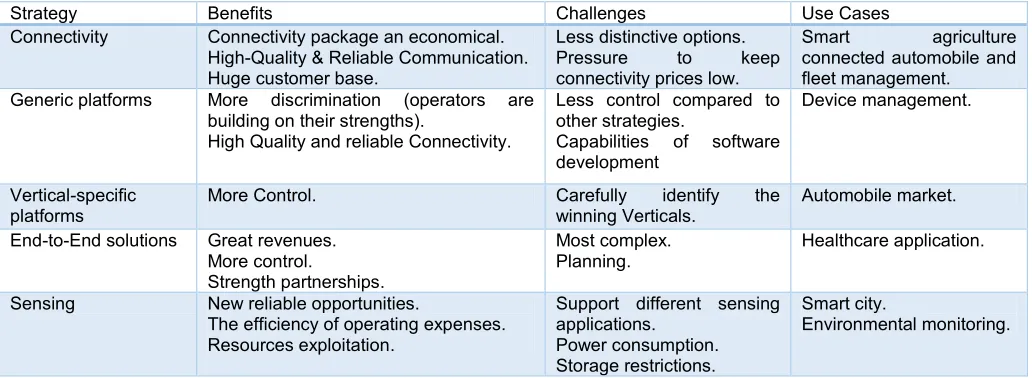
Table 1 shows the most important benefits and challenges of each strategy with some use cases for each one.
These strategies aren't exclusive, and the researchers believe that it is possible to summarise these strategies as follows: everything as a service (XaaS). Where it’s possible to offer services at any level such as connectivity as a service, platform as a service, solutions as a service and sense as a service. Also, operators should be flexible to choose one strategy or more to meet revenue.
TABLE 1 COMPARISON OF STRATEGIES
Strategy Benefits Challenges Use Cases
Connectivity Connectivity package an economical. High-Quality & Reliable Communication. Huge customer base.
Less distinctive options. Pressure to keep connectivity prices low.
Smart agriculture connected automobile and fleet management. Generic platforms More discrimination (operators are
building on their strengths).
High Quality and reliable Connectivity.
Less control compared to other strategies.
Capabilities of software development
Device management.
Vertical-specific
platforms More Control. Carefully winning Verticals. identify the Automobile market. End-to-End solutions Great revenues.
More control.
Strength partnerships.
Most complex.
Planning. Healthcare application.
Sensing New reliable opportunities.
The efficiency of operating expenses. Resources exploitation.
Support different sensing applications.
Power consumption. Storage restrictions.
Smart city.
4. Telecom IoT Standards
There have many efforts that study Telecom IoT opportunities. This section reviews the efforts to offer IoT services by the Telecom operators. The researchers will discuss the standards according to the Figure 6 as an attempt to summarise the techniques and standards and give the flexibility that operators need to help optimize their IoT solution.
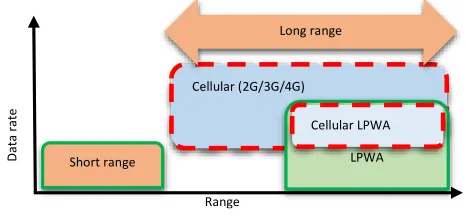
LPWA network is a type of wireless telecommunication wide area network designed to allow long-range communications at low-power connectivity to a massive number of devices distributed over large geographical areas at an unprecedented low-cost which requires long battery lives [13] and work in remote and hard to reach locations (buildings and underground). The main characteristic of LPWA is power saving. LPWA operated on small and inexpensive batteries for years. The battery life almost 10+ years [27], and it provides long-range communication up to 10–40 km in rural zones and 1–5 km in urban zones [28]. It only transfers tiny amounts of data (a few hundred to a thousand bits/sec) to support this long-range communication as shown in Figure 7.
4.1. LPWA Characteristics and their Techniques
This part reviews the LPWA characteristics and techniques that exploited to meet these characteristics [29].
4.1.1. Long Range
LPWA designed to cover a wide area with the ability to penetrate the indoor places, most LPWA technologies use a Sub-GHz band to meet this goal.It operates at a low frequency, less congested than 2.4 GHz, and the Sub 1 GHz spectrum can handle interference better than 2.4 GHz. LPWA technologies also work around 140-160 decibels (dB) which add many miles of range [30].
4.1.2. Low Power
Low power consumption makes a very long battery life, often between 5 and 10 years or more. It is achieved by:
Topology
LPWA technologies associate end devices directly to base stations. Furthermore, it always bases station provides comfortable and quick access when required by the end-devices, and this achieved by a star topology used broadly in cellular networks and brings huge energy-saving advantages. The devices need not dissipate energy to listen to other devices that want to relay their traffic to them such as mesh topology. Which drains their batteries quickly, limiting overall network lifetime to a few months or few years [31] [32].
Duty Cycling (Power Management Techniques) The most effective save energy operation is putting the data transceiver in the sleep (low-power) mode when communication is not required [33] [34]. Ideally, the transceivers should turn off when there is no data to send/receive and should resume when a new data becomes ready. Along of these ways, a node periodically placed into the sleep mode.
Simplify the Design of End Devices
To keep the transceiver design for end devices simple and low-cost, the base stations or backend system become complex. The end devices reach the base station without the need for expensive signalling to start communication. Base stations use multiple channels or orthogonal signals to detect multiple data streams in the same channel, and at the same time, these allow end devices to send data using any available channel or orthogonal signal efficiently.
4.1.3. Low Cost
LPWA hardware's cost underneath $5 [18], and the connectivity subscription per unit as low as $1, whereas connecting a large number of end devices in a single LPWA base station distributed over several kilometers, significantly LPWA
licensed
Cellular technologies
EC-GSM LTE-M NB-IoT
Standalone (GSM<E)
Guard band (LTE)
In-band (LTE)
Unlicensed
such as LoRa
Figure 6: LPWA technologies
D
at
a ra
te
Short range
Cellular (2G/3G/4G)
LPWA Long range
Cellular LPWA
Range
reducing the costs for network operators. The low-cost designs of end devices are possible by several techniques such as star type (instead of mesh) connectivity, and techniques to offload complexity from end devices that enables manufacturers to design simple end devices with low-cost [8]. Additionally, most LPWA technologies prefer deployment in exempted license domains already owned by operators to avoid additional license costs.
4.1.4. Scalability
LPWA supports a massive number of devices and these technologies should work well with increasing number of these devices. To meet this characteristic, it uses multichannel and multi-antenna communication to parallelize transmissions to/from the connected devices.
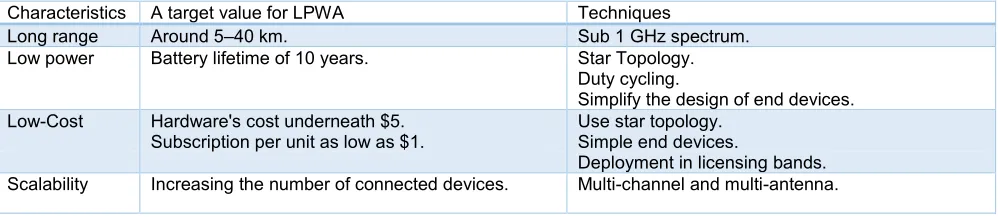
Table 2 shows LPWA characteristics with their target value and techniques that exploited to meet each one.
Table 2: LPWA techniques and characteristics
Characteristics A target value for LPWA Techniques
Long range Around 5–40 km. Sub 1 GHz spectrum. Low power Battery lifetime of 10 years. Star Topology.
Duty cycling.
Simplify the design of end devices. Low-Cost Hardware's cost underneath $5.
Subscription per unit as low as $1. Use star topology. Simple end devices.
Deployment in licensing bands. Scalability Increasing the number of connected devices. Multi-channel and multi-antenna.
4.2. LPWA Categories
As early 2013, the term "LPWA" didn't even occur [30]. According to the rapid growth of the IoT market, LPWA technologies becoming popular now [35]. LPWA deploys into licensed and unlicensed solutions.
4.2.1. Unlicensed
The current unlicensed LPWA solutions developed for commercial use as proprietary technologies by companies such as Sigfox, or the LoRa technology developed by Semtech [36]. Proprietary technologies aren’t globally successful. The significant part of global connectivity today is open standards such as cellular, Wi-Fi and Bluetooth. One reason is that those providing the network equipment might differ from those supplying the devices. A variance of supply is critical, particularly in IoT, where competition leads to the best design with the lowest cost. Moreover, proprietary technologies aren’t compatible with legacy networks [28]. To work in the legacy network requires a new installation of a base station (as big as a WiFi) and a small antenna. On the other hand, because proprietary technologies use unlicensed bands, the interference is inevitable, there will be other networks operating on the same unlicensed frequencies, and this cause QoS degradation [37]. According to AT&T [13], it is unclear which proprietary technologies will survive in the long run.
4.2.2. Licensed
Licensed solutions are those deployed by 3GPP to evolve the standards for reusing existing cellular networks to offer IoT services. Nowadays the term cellular IoT (CIoT) is used to denote the networks of IoT that operate in the licensed spectrum [38]. In September 2015, 3GPP made a significant effort in Release 13 to meet this market. The new technologies in a licensed spectrum which 3GPP operators can achieve their different market requirements are EC-GSM-IoT, LTE-M, and NB-IoT [35]. Due to the success elements of Telecom IoT presented in section 3, the researchers see operators prefer to add these technologies through modifying their networks to bring an economical long-term global IoT market.
LTE-M is expanding work that began in Release-12 [30], LTE-M submits more LTE improvements for Machine Type Communications (MTC). In traditional LTE, several MTC use cases aren’t acceptable because end devices offer high data rate with high cost and more power consumption, and to solve this problem 3GPP reduces the peak data rate to decrease the cost. It provides likewise more improvements from Category 0 to Category M [29]. It minimizes the receive bandwidth from 20 MHz to 1.4 MHz with a decreased transmission power to save cost as well as power.
Furthermore, Cat-M permits an extended battery life (more than 10 years) through use power saving mode (PSM) that enables the user equipment (UE) to sleep mode for hours or even days when there is no data to send, without missing their network register [39]. It allows extended Discontinuous Reception (eDRx) that prevents end devices from monitoring the control channel for a long time to save energy [40].
NB-IoTsuch as others LPWA License technology that uses PSM and eDRX to save battery. Moreover, the main feature of NB is to realize superb co-existence performance with legacy GSM, General Packet Radio Service (GPRS) and LTE technologies [41]. Other features that offered by NB are [18] [42]:
Keep low power performance with a battery capacity of 5 Watt-hours empowers devices to work for up to 10 years on a single charging cycle.
Enhancement outdoor and indoor coverage by 20 dB on traditional networks.
Every cell site sector supports connection no less than 52547 low throughput devices.
Figure 8 shows three modes to deploy NB-IoT which can work in 200 kHz carrier [43]:
Stand-alone: as a dedicated carrier, NB-IoT use as a re-farmed at least one GSM carriers to carry NB-IoT traffic and it deploys by using existing idle spectrum resources [44].
In-band: deploys inside the occupied bandwidth of an LTE carrier, it can deploy by flexible and adaptable way inside a common LTE carrier, also efficiently uses spectrum resources for LTE or NB-IoT. NB-IoT carrier shares the time resource with an existing LTE carrier, so it doesn't need any hardware change, and it doesn't affect to LTE or NB-IoT performance [43].
Guard-band: it deploys inside an existing LTE carrier, and it
uses the unused resource within LTE carrier's guard-band, without influencing of LTE carrier capacity. It is less interference compared to in-band operation as the LTE interfere just on one side of the NB-IoT carrier [45]. Table 3 provides some comparison of the three licensed LPWA solutions.
TABLE 3 COMPARISON OF 3GPP IOT PROPOSALS
Although, Universal Mobile Telecommunications System (UMTS) isn't within the scope of these standards, the most features presented by LTE also supported by UMTS, so it uses the same LTE standards for IoT [46]. Because of device manufacturers inclination for low-cost, operators prefer 2G compared to 3G for different applications classified as loT/M2M (such as geolocation tracking). But they are now facing a problem with a large number of IoT/M2M customers still utilizing legacy 2G shows that Figure 4, which operators try to end and replace with the latest 4G mobile network technology [35] without passing through the 3G, the researchers think that is why specific standards for UMTS are not added to meet IoT.
4.3. LPWA Use Cases
Ericsson presented LPWA use cases as Massive IoT Applications [8]. Massive IoT applications requirements are low-cost devices with low energy consumption and good coverage with small data volumes [39].
Many efforts had done to classify the LPWA applications, the paper reviews seven categories of LPWA applications [20]. As shown in Figure 9.
These seven categories are reviewed and summarized as follows: Industrial could offer applications for cases that need
EC-GSM LTE-M NB-IoT Deployment In-band
GSM. In-band LTE. Standalone GSM. In-band LTE. Guard-band LTE. Bandwidth 200kHzper
channel. 180 KHz 180 KHz Power
saving PSM, ext.I-DRX PSM, ext.I-DRX, C-DRX
PSM, ext. I-DRX, C-DRX
Range < 15 km < 11 km < 15 km Spectrum 8-900 MHz 7-900
MHz (NB – GSM) 8-900 MHz (NB –LTE) 7-900 MHz Battery Life >10 years >10
years >10 years
LTE In-band LTE guard band GSM Standalone LTE Standalone
short-range coverage, where any downtime would be Expensive like in manufacturing and heavy industries [20]. The applications in this category such as Factory control, Vending machines, and Energy Infrastructure. Smart cities contain a broad range of various possibility services, It contained a wide array of assets dispersed across suburban and urban areas as parking sensors, smart lighting, and waste management. Logistics applications need limited and straightforward data with lower value items, and data is not required in real-time, once an hour or even once a day regularly is enough, such as parcels, luggage, crates, and packages. Smart building, the possible market in this use case is still exceptionally extensive, where both consumers and businesses are increasingly deploying technology to make homes less energy intensive and more secure [47], for instance: Alarm systems and Home automation. Utilities services, LPWA technologies are particularly well suited to metering and monitoring applications that need the periodic transmission of small amounts of data because LPWA is solving absence of the main power supply.
Consumer services, consumers can track any item with high financial or emotional value that might be vulnerable to theft or loss, such as Expensive equipment, Wearables, and VIP/Pet tracking. Agriculture & Environment, LPWA can monitor and optimize irrigation and water levels, it deploys sensors crosswise over vast zones of land, helping farmers to decide when compost or pest control treatments are needed and automatically activating irrigation systems.
Additionally the operators' existing infrastructure, the researchers think that there are other important factors to choose suitable applications such as:
Propagation, it refers if the current network infrastructure is suitable for an application, or it needs devices to support coverage in places beyond the infrastructure (e.g., basements).
Power supply, if devices need the main power supply or rechargeable batteries, or it works with its batteries. Coverage type, some applications need stationary coverage (e.g., smart building), and others need to deploy across a mobile and wide area (e.g., tracing). The cost must also be taken into consideration, as we
are always looking for the shortest way to get the best results at the lowest cost.
In this paper, the researchers will be classified the services by two factors are propagation and type of coverage.
4.3.1 Proposal for classification of use cases
A. Based on propagation
Depending on the propagation, the services divide into two categories. The first is the services provided at the places where the operator's coverage is, and do not need additional equipment to support the coverage, where the operator's coverage is sufficient to provide the services. Such as city lighting and environmental monitoring. The second, the services that extend beyond the infrastructure, i.e., places that do not reach the coverage of the operator and therefore require support equipment for coverage, such as smoke detection and city parking.
B. Based on Coverage type
Depending on the type of coverage, and the movement of the things, the services divide into two categories. The first is stationary things that the operator focus on a concentrated certain space; it may be possible to perform local processing and then send the results through the operator's network, such as smart home services and machinery control. The second, moving things, where the operator focus on the entire area where the thing is supposed to move, such as the tracking services.
5. Conclusion
This paper introduced a sound review for the most important topics and issues related to Telecom IoT provision trying to help both researchers and operators alike.
The paper first addressed the success elements of Telecom IoT. As a conclusion, provision of IoT services by Telecom operators sounds better than the entry of new service providers to the industry especially, in developing societies in which the essential issues emerge the rapid and required improvement of the IoT. The most critical issues are reliability, security, and privacy, while the most crucial success elements are a huge subscriber base, comprehensive coverage, ecosystem, scalability, and QoS.
The paper also argued in details the essential strategies to offer IoT by Telecom operators. We saw the need to add sensing as a strategy because of its benefits, mainly it is easy to offer by Telecom operators. For operators, it is possible to adopt more than one strategy according to their capabilities and growth plans as well as their country and region.
The paper then tackled the LPWA standards for Telecom IoT. Despite there are two categories of LPWA solutions, the paper focused on the licensed solution, because it achieves a
long-Figure 9: LPWA applications categories
INDUSTRIAL SMART CITIES LOGISTICS
SMART BUILDING UTILITIES CONSUMER
term global economic market. Unlike the unlicensed solutions, it doesn’t need to support equipment to deploy on the legacy networks. Additionally, the paper presented 3GPP efforts to develop standards for Telecom IoT. These standards allow the gradual transformation of IoT on the legacy network with a power saving feature. As noted, 3G standards haven’t been defined, because 3G offers almost the same LTE features. It uses the same LTE standards for IoT. The IoT services implementation in legacy 2G networks is increasing rapidly, so most operators prefer to upgrade directly to 4G. 5G will also achieve a bigger leap in IoT, where 5G will be built specifically to increase the data speed and the response time is very low and supports a large number of devices.
As a future work further study on factors of choosing the suitable strategies by operators, explain sensing as a strategy with a review of its advantages and challenges, also, add more classifications to the seven usage cases according to main characteristics such as data rate and the devices supporting to help operators for selection suitable services. As well as 5G standards for IoT.
References
[1] D. SJÖSTRÖM . (2017) "Unlicensed and licensed low-power wide area networks Exploring the candidates for massive IoT," Master’s Thesis, KTH Royal Institute of Technology , School of Information and Communication Technology (ICT), Stockholm, Sweden.
[2] N. Villa and R. Savage. (2016) "white paper: What can telecom operators do to capture the value of the IoT," IBM Global Business Services.
[3] V. Douin, A. Sachdeva and A. Baschnonga. (2017) "Global digital telecom playbook Telcos reinvent themselves in the digital age," ey-global-digital-telecom-playbook-flyer.
[4] R. Khan, S. U. Khan and R. Zaheer. (2012) "Future Internet: The Internet of Things architecture, possible applications and key challenges," in Frontiers of Information Technology (FIT), Islamabad.
[5] M. Yun and B. Yuxin. (2010) "Research on the Architecture and Key Technology of Internet of Things (loT) Applied on Smart Grid," in International Conference on Advances in Energy Engineering ICAEE, Beijing.
[6] K. Hwang, J. Dongarra and G. C. Fox. (2012) Distributed and Cloud Computing: From Parallel Processing to the Internet, Elsevier Science, p. 672.
[7] X. Jia, J. Wang and Q. He. (2011) "IoT business models and extended technical requirements," in Communication Technology and Application (ICCTA), Beijing, China.
[8] Ericsson. (2016) "White Paper: Ericsson Cellular networks for Massive IoT – enabling low power wide area applications,".
[Online]. Available:
https://www.ericsson.com/res/docs/whitepapers/wp_iot.pdf. [Accessed 2017 Apr 12].
[9] L. Militano, G. Araniti, M. Condoluci, I. Farris and A. Iera. (2015) "Device-to-Device Communications for 5G Internet of Things," EAI Endorsed Transactions on Internet of Things, vol. 1, no. 1.
[10] S. Zamfir, T. Balan, F. Sandu and C. Costache. (2016) "Mobile Communication Solutions for the Services in the Internet of Things," in Exploring Services Science (IESS), Bucharest, Romania.
[11] M. N. M. Ali and A. A. Al-Khulaidi. (2018) "Development Challenges Of The Internet Of Things In Yemen," S.J.I.T.N, vol. 6, no. 1, pp. 30-37.
[12] Ericsson. (June 2018) "Ericsson Mobility Report," Stockholm, Sweden.
[13] AT&T Intellectual Property. (2016)"What you need to know about IoT wide area networks How to choose the right WAN technology for the Internet of Things," [Online]. Available: https://www.business.att.com/content/whitepaper/what_need_ know_iot_networks.pdf. [Accessed 25 Apr 2017].
[14] G. d. Boer, P. Engel and W. Praefcke. (2005) "Generic remote software update for vehicle ECUs using a telematics device as a gateway," in Advanced Microsystems for Automotive Applications, Springer, Berlin, Heidelberg, p. 371–380.
[15] K. Herron. (2016) "Critical Success Factors for IoT," unifiedinbox, 14 October. [Online]. Available: https://unifiedinbox.com/critical-success-factors-iot/.
[Accessed 23 Apr 2017].
[16] C. Pielli, D. Zucchetto, A. Zanella, L. Vangelista and M. Zorzi. (2015) "Platforms and Protocols for the Internet of Things," EAI Endorsed Transactions on the Internet of Things, vol. 1, no. 1.
[17] F. C. Gouveia and T. Magedanz, "Quality of Service in Telecommunication Networks," [Online]. Available: http://www.eolss.net/sample-chapters/c05/e6-108-14-00.pdf. [Accessed 2 Jan 2018].
[18] Huawei. (2015) "NB-IoT-Enabling New Business Opportunities," Huawei.
[19] M. Newman. (2017) "White Paper: Digital Maturity Model (DMM): blueprint for digital transformation,". [Online].
Available:
https://www.tmforum.org/wp-content/uploads/2017/05/DMM-WP-2017-Web.pdf. [Accessed 1 Jan 2018].
[20] T. Rebbeck, M. Mackenzie and N. Afonso. (2014) "Low-powered wireless solutions have the potential to increase the M2M market by over 3 billion connections," Analysys Mason Limited, London.
[21] An IoT-Ignite. (2017) "White Paper: Role of Telcos Internet of Things,".
[23] C. Wong. (2018) "Is sensing-as-a-service the answer to IoT complexity?," expertIP. [Online]. Available: https://blog.allstream.com/is-sensing-as-a-service-the-key-to-iot-complexity/. [Accessed 28 Apr 2018].
[24] Nokia, "Nokia Sensing as a Service," Nokia , [Online]. Available: https://networks.nokia.com/services/sensing-as-a-service. [Accessed 28 Apr 2018].
[25] X. Sheng, J. Tang, X. Xiao and G. Xue. (2013) "Sensing as a Service: Challenges, Solutions and Future Directions," IEEE Sensors Journal, vol. 13, no. 10, p. 3733 – 3741.
[26] R. Mizouni and M. El Barachi. (2013) "Mobile Phone Sensing as a Service: Business Model and Use Cases," in Next Generation Mobile Apps, Services and Technologies (NGMAST), Prague, Czech.
[27] D. Patel and M. Won. (2017) "Experimental Study on Low Power Wide Area Networks for Mobile Internet of Things," in Vehicular Technology Conference (VTC Spring), Sydney, NSW, Australia.
[28] M. Centenaro, L. Vangelista, A. Zanella and M. Zorzi. (2016) "Longrange communications in unlicensed bands: The rising stars in the IoT and smart city scenarios,," IEEE Wireless Communications, vol. 23, no. 5, pp. 60-67.
[29] U. Raza, P. Kulkarni and M. Sooriyabandara. (2017) "Low Power Wide Area Networks: An Overview," IEEE Communications Surveys & Tutorials, vol. 19, no. 2, pp. 855 - 873.
[30] K. Mekki, E. Bajic, F. Chaxel and F. Meyer. (2017) "A comparative study of LPWAN technologies for large-scale IoT deployment," ICT Express.
[31] G. Strazdins , A. Elsts , K. Nesenbergs and L. Selavo . (2013) "Wireless sensor network operating system design rules based on real-world deployment survey," Journal of Sensor and Actuator Networks(JSAN), vol. 2, no. 3, p. 509–556.
[32] F. J. Oppermann, C. A. Boano and K. Römer. (2013) "A Decade of Wireless Sensing Applications: Survey and Taxonomy.," in The Art of Wireless Sensor Networks, Springer, Berlin, Heidelberg, pp. 11-50.
[33] I. Demirkol, C. Ersoy and F. Alagoz. (2006) "Mac protocols for wireless," IEEE Communications Magazine, vol. 44, no. 4, p. 115–121.
[34] G. Anastasia, M. Contib, M. D. Francescoa and A. Passarellab, "Energy," Ad hoc networks, vol. 7, no. 3, p. 537–568, 2009.
[35] R. S. Sinha, Y. Wei and S.-H. Hwang. (2017) "A survey on LPWA technology: LoRa and NB-IoT," ICT Express, vol. 3, no. 1, pp. 14-21.
[36] H. Wang and A. Fapojuwo. (2017) "A Survey of Enabling Technologies of Low Power and Long Range Machine-to-Machine Communications," IEEE Communications Surveys & Tutorials, vol. 19, no. 4, pp. 2621 - 2639.
[37] S. Glassman. (2016) "IoT and the four reasons why licensed spectrum technologies have been worth the wait," u-blox. [Online]. Available:
https://www.u-blox.com/en/iot-and-four- reasons-why-licensed-spectrum-technologies-have-been-worth-wait. [Accessed 18 Jan 2018].
[38] A. Laya1, A. Ghanbari and J. Markendahl. (2015) "Tele-Economics in MTC: what numbers would not show," EAIEndorsed Transactions on Internet of Things, vol. 1, no. 1.
[39] GSMA. (2016) "White Paper: 3GPP Low Power Wide Area Technologies," GSMA Mobile IoT Industry Alignment group.
[40] A. Rico-Alvarino, M. Vajapeyam, H. Xu, X. Wang, Y. Blankenship, J. Bergman, T. Tirronen and E. Yavuz. (2016) "An Overview of 3GPP Enhancements on Machine to Machine Communications," IEEE Communications Magazine, vol. 54, no. 6, pp. 14-21.
[41] V. Spajic. (2017) "Narrowband Internet of Things," INFOTEH-JAHORINA, vol. 16.
[42] Y.-P. E. Wang, X. Lin, A. Adhikary, A. Grovlen, Y. Sui, Y. Blankenship, J. Bergman and H. S. Razaghi. (2017) "A Primer on 3GPP Narrowband Internet of Things (NB-IoT)," IEEE Communication Magazine, vol. 55, no. 3, pp. 117 - 123, 13.
[43] Birla Institute of Technology & Science. (2015) "White Paper: Cellular Technologies Enabling the Internet of Things," p. 65.
[44] Y. Li , X. Cheng, Y. Cao, D. Wang and L. Yang. (2018) "Smart Choice for the Smart Grid: Narrowband Internet of Things (NB-IoT)," IEEE Internet of Things Journal, vol. 5, no. 3, pp. 1505 - 1515.
[45] Y. D. Beyene, R. Jäntti, O. Tirkkonen, K. Ruttik, S. Iraji, A. Larmo, T. Tirronen and J. Torsner. (2017) "NB-IoT Technology Overview and Experience from Cloud-RAN Implementation," IEEE Wireless Communications, vol. 24, no. 3, pp. 26 - 32, 22.
[46] O. Liberg, M. Sundberg, E. Wang, J. Bergman and J. Sachs. (2017) Cellular Internet of Things Technologies, Standards and Performance, Elsevier Science, p. 398.