HYPERION UNIVERSITY www.hyperion.ro
37
DIFFERENCES BETWEEN THE SELF-ASSESSED AND
OBSERVED LEVEL OF AGGRESSIVITY OF YOUNG DRIVERS
IN TRAFFIC – A PILOT STUDY
EMIL RAZVAN GÂTEJ a,
STELIANA RIZEANU
a,GEORGE URSACHI
ba Hyperion University, Faculty of Psychology and Educational Sciences,
Department of Psychology; b Road Safety Analysis, Banbury, UK
Abstract
The aim of this research is to show that the level of self-reported aggressive behavior may differ significantly from the real level of the aggressive behavior in traffic. After developing this pilot study we agreed that a much more complex research should be conducted. After considering previous research we decided to explore the gender variable to identify the differences between what the subjects reported and the real level observed in the experimental group. The hypothesis that implies gender differences was denied, confirming the null hypothesis. The results of this pilot study lead to the conclusion that statistically there are significant differences between what is reported and the more severe than that, perceived, and the real level of risk that drivers generate in the social environment of road traffic. We are proposing a broader exploration of these hypotheses in a study that encompasses a more varied context and whose results can be more prominent.
Keywords: fake good, aggressiveness, driver behavior, empathy, road safety
1.
THEORETHICAL FRAMEWORK
1.1.
BRIEF DESCRIPTION OF AGGRESSIVE DRIVING
Aggressive driving is one of the most severe problems of modern traffic (Foundation AAA for Traffic Safety, 1997; NHTSA, 1998). The Omnibus study provided by the Statistics Office for Transportation in August 2000 shows that aggressive driving was considered the highest concern regarding safety behind the steering wheel (Shinar & Compton, 2004).
Corresponding author: Emil Razvan Gatej
38
NHTSA (2000) offers a different definition which sees aggressive driving as the use of a motor vehicle in a manner which jeopardizes or can jeopardize people and goods. Tasca (2000) too considers that aggressive driving means that the act is intended, that it can increase the risk of collision and that it is motivated by lack of patience, frustration, hostility or wish to save time.
Aggressive driving refers to behaviors such as flashing the headlights (Diekmann et al., 1996; Ellison-Potter et al., 2001), raising the voice to other drivers (Hennessy & Wiesenthal, 1999), obscene gestures (Ellison-Potter et al., 2001). There are authors who underline that beside aggressive behaviors could appear as well certain behaviors called trans aggressive (Ellison-Potter et al., 2001).Trans aggressive behaviors are speeding above the legal limit (James & Nahl, 2000), crossing on the red light (James & Nahl, 2000; Tasca, 2000) and not observing the required distance from the vehicle ahead (Diekmann et al., 1996; Ellison-Potter et al., 2001).
Shinar (2007) makes the distinction between “hostile aggression” and “instrumental aggression”. The first category comprises hostile reactions aimed at other participants in the traffic without having a good reason, such as verbal abuse, physical attack and obscene gestures. Instrumental aggression on the other hand comprises behaviors focused on the purpose of finishing the journey sooner, for example changing the lanes too many times, not keeping the distance from the vehicle ahead, excessive speed and not observing the red lights.
Galovski și Blanchard (2005) consider that intention is the key element to differentiate between aggressive driving and driving mistakes. Overall, the majority of researchers can`t make the distinction between these two behaviors, those which are clearly motivated by the intention of harming others and those which are not. It is possible for the drivers to look at the observed behavior, if it looks or not as an aggressive manoeuvre (Vanlaar, Simpson, Mayhew & Robertson, 2008; Rizeanu, Gatej, Ciolacu, 2017), especially taking into account the idea that driving is more than just operating a motor vehicle and is seen as a factor that contributes to self-respect, independence and quality of life, especially in the developed countries where driving is the main means of mobility (Liddle, Turpin, Carlson & McKenna, 2008; Mezuk & Rebok, 2008).
The research done by Parker, Lajunen și Stradling (1998) show that 89% of 270 drivers admit they are occasionally behaving aggressively and underlines the magnitude of aggressive driving.
1.2 AGGRESSIVE DRIVING AT YOUNG DRIVERS
39
period of youth but they are as well personality traits which appear in the normal population. People of all ages that possess a high degree of these characteristics can be aggressive drivers. Among young male drivers, those who have particular emphasized traits of personality have as well an increased risk to commit traffic accidents (Tsuang et al., 1985). Such traits include: aggressiveness, impulsiveness and quest for strong sensations (Rimmö & Åberg, 1999).
Young drivers, especially males, have a higher risk to be involved in a traffic accident compared to other categories of age (Massie et al., 1995, Panayiotou et al., 2008). This is a significant social problem as traffic accidents are the main cause of youth death and invalidity in many parts of the world, Europe included (Cvijanovich et al., 2001).
1.3 GENDER DIFFERENCES IN AGGRESSIVE DRIVING
Perhaps the reason behind the lack of studies focused on female driving is due to the increased driving behaviors, accidents and deaths among men. Despite all these, there are more women driving today than anytime (NHTSA, 2005).
On gender differences, majority of evidence indicate that men are more aggressive than women (Hyde, 1984). Men register higher scores when it comes about the search for strong sensations (Jonah, 1997) as well as about committing unsafe acts of driving such as excessive speed (Harre et al., 1996). That is men underestimate the danger of such actions and consider themselves better drivers than women (Dejoy, 1992).
Evidence suggests as well that women feel stronger about observing the law and have the tendency to evaluate positively the lows regulating traffic while men tend to overestimate their driving capacity and underestimate the risks associated to not complying with the rules (Yagil, 1998).
However, a study conducted by the Medicine and Public Health School in John Hopking, Baltimore, showed that female drivers are involved in more traffic accidents than men (Lennon &Watson, 2011).
2.
OBJECTIVE AND HYPOTHESIS
The main objective of this study is to reveal a significant difference between the level of traffic aggressiveness showed by a self-report instrument and the level of traffic aggressiveness observed with a special safety device and evaluated by a road safety specialist.
40
The aim of this research is to analyses to what extent young drivers perceive the real level of their own aggressive behavior behind the steering wheel.
2.2.
HYPOTHESIS
We assume there are statistically significant differences between the level of aggressiveness measured by self-report and the one observed in the traffic among young drivers. We assume there are statistically significant differences between the level of aggressiveness measured by self-report and the one observed in the traffic among young drivers according to gender.
3.
METHOD
3.1.
PARTICIPANTS/SUBJECTS
60 participants of Romanian nationality were tested, 30 males and 30 females, ranging between 18 and 35, students at two universities in Romania.
3.2.
INSTRUMENTS/APPARATUS/STIMULI/MATERIALS
We used the AVIS Test (Vienna Tests System, 2012) to measure the level of self-reported level of aggressiveness. The standard form of this questionnaire contains 36 items. This instrument contains six factors as follows: instrumental aggression, anger, enjoyment of violence, negativism, actting out, social desirability. Each item has eight response options (1-very often, 8- frequently). The Cronbach Alpha coefficient reported by author is .96. The measurement of the real behaviors in traffic was conducted by a road traffic safety evaluator aided by a context test and an observation sheet.
To observe the driver behavior in traffic situations we used DVM 750 ally device produced by Digital. Video sequences were analyzed by a road safety specialist. The observation scale was based on four concepts: hostile attitude, aggressive behavior generating dangerous situations (acting with no politeness in traffic situations, flashlights, tailgating) verbal aggressiveness.
3.3.
PROCEDURE
41
across which the digital observation was done was 10 km in urban traffic. The analyzed images were transcribed on the same sheet as the self-reporting instrument.
Previous studies regarding the aggressive driving and the use of AVIS questionnaire were conducted by Chraif, Aniței, Burtăverde & Mihăilă (2015) regarding the link between personality, aggressive driving, and risky driving outcomes and Chraif, Aniței, Dumitru, Burtăverde & Mihăilă (2015) regarding the development of an English version of the aggressive driving behavior test.
4.
RESULTS
In order to observe significant differences, the T test for dependent samples was used.
Table 1. Description of values for averages of the two sets of data collected from the experimental sample in which the parameter “driving aggressiveness” is regarded
Average N SD*
Standard deviation of the average
Pair 1 Gr1 150.430 60 .23015 .03721
Gr2 80.031 60 .24012 .04515
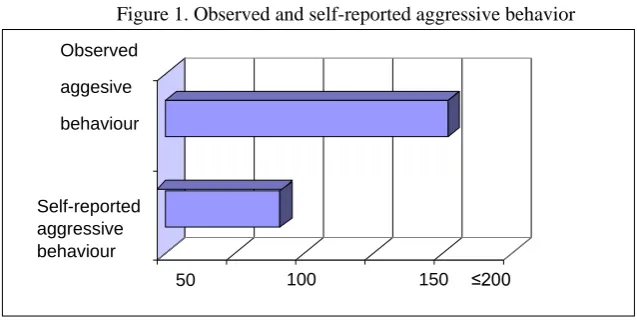
According to the T-test for pairwise samples, the average level of the first group (m = 150, N = 60, standard deviation = 0.03) is higher than the median level of the second group (m = 60, Standard deviation = 0.04), thus demonstrating that the level of aggressiveness at the wheel is visibly different between the two assessed samples, namely, the level of observable aggression is much higher than the aggressive behavior self-reported by the participants.
42
Figure 1. Observed and self-reported aggressive behavior
To see to what extent these results are statistically significant, we used T Test for independent samples.
Table 2. Independent Samples Test
t-test for Equality of mens
F Sig. t df Sig.
(2 –
tailed)
Mean Diferen ce
Std. Error Differen ce
95% Confidence
interval of the Diference
Lower Upper
Scor Equal
variance s assumed
12.70 1
.000 3.701 58 .000 5.359 .384 .573 5.951
Equal variance not assumed
3.471 27.227 .001 5.359 .387 .573 5.004
Given that p = 0.001 <α = 0.05, the rejection of the null hypothesis can be stated.
These results lead to the conclusion that there is a significant difference between the level of self-reported level of aggressive behavior and the observed in-traffic behavior as the participants rated their level of aggressive behavior in in-traffic lower than the observed behavior.
Regarding the hypothesis of gender differences, this is invalidated in this first part of the pilot study, confirming the null hypothesis according to which there are no significant gender differences in self-reported aggression and the observed level of aggressiveness.
50 100 150 ≤200
Observed
aggesive
behaviour
43
Table 3. Gender differences in self-reported aggression and the observed level of aggressiveness.
Levene Test T test
F Sig. t df Sig. (2
tailed) Dif. mean
Std. Error Dif.
95% Confidence interval
Gen der
Equal variances assumed
.731 .394
.549 58
,772 ,05467 ,12733
Inferior
Supe rior
.7285 7.83
54
The results showed that both female and male drivers have deficits in recognizing their own aggressive behavior, being more aggressive in driving than perceived, but there were no differences at the level of aggressiveness between genres.
5.
CONCLUSIONS
Young drivers declare a much lower level of aggressiveness compared to the level indicated by their real behavior. The perception of the level of aggression is a challenge in the context of a traffic that shows 5 deaths a day as in Romania. As seen in previous studies (Gatej, Rizeanu, Ciolacu, 2016) young drivers in Romania consider that the most important thing in traffic is to have distributed attention and be able to drive doing more things at the same time. The limits of perceiving aggressive behavior reside in the lack of road education as well as in a low level of personal development, whose presence would lead to empathy and full awareness of the consequences of aggressive conduct.
A limit of this research is that subjects were analyzed just in urban traffic situations. Also in this pilot experiment we used a procedure for observing DVM -750 recording that will be standardized in future research.
44
This research was made with the technical support of Academia Titi Aur research facility, the technical support of Safety Camera Systems and in cooperation with Road Safety Analysis Ltd. – UK.
Received at: 15.09.2017, Accepted for publication on: 25.09.2017
REFERENCES
AAA Foundation for Safety. (2009). Aggressive Driving Research Update.Washington D.C.
AAA Foundation for Traffic Safety. (1997). Aggressive Driving: Three Studies. AAA Foundation for Traffic Safety. Washington, DC.
Aberg, L., & Rimmo, P. A. (1998). Dimensions of aberrant driver behaviour.
Ergonomics, 41(1), 39-56.
Chraif, M., Aniței, M., Burtăverde, V., Mihăilă, T. (2015). The link between personality, aggressive driving, and risky driving outcomes - testing a theoretical model.
Journal of Risk Research, DOI: 10.1080/13669877.2015.1042500,
Chraif, M., Aniței, M., Dumitru, D., Burtăverde, V., & Mihăilă, T. (2015). Developing of an English Version of the Aggressive Driving Behavior Test (Avis) Improving the Construct Validity of Aggressive Driving. Current Psychology, DOI: 10.1007/s12144-015- 9353-7.
Cvijanovich, N. Z., Cook, L. J., Mann, N. C., & Dean, J. M. (2001). A population-based study of crashes involving 16-and 17-year-old drivers: the potential benefit of graduated driver licensing restrictions. Pediatrics, 107(4), 632-637.
Diekmann, A., Jungbauer-Gans, M., Krassnig, H., & Lorenz, S. (1996). Social status and aggression: a field study analyzed by survival analysis. Journal of Social Psychology
136, 761-768.
Ellison-Potter, P., Deffenbacher, P.B., & Deffenbacher, J. (2001). The effects of trait driving anger, anonymity, and aggressive stimuli on aggressive driving behaviour. Journal
of Applied Social Psychology 31, 431-443.
Galovski, T. E., & Blanchard, E. B. (2005). Understanding and treating the aggressive driver. In D.A Hennessy & D.L Wiesenthal (Eds.), Contemporary Issues in Road User
Behavior and Traffic Safety (pp. 47-60). New York, Ny: Nova Science Publishers, Inc.
Gatej, E.R., Rizeanu, S., Ciolacu, M.V. (2016). Effects of aggresiveness on performance in handling of a swerve vehicle. Romanian Journal of Experimental Applied Psychology, vol. 7, issue 4, p 16-22.
Harré, N., Field, J., & Kirkwood, B. (1996). Gender differences and areas of common concern in the driving behaviors and attitudes of adolescents. Journal of Safety Research, 27(3), 163-173.
Hyde, J. S. (1984). How large are gender differences in aggression? A developmental meta-analysis. Developmental psychology, 20(4), 722.
James, D. L., & Nahl, D. (2000). Road Rage and Aggressive Driving: Steering Clear of
45
Jonah, B. A. (1997). Sensation seeking and risky driving: a review and synthesis of the literature. Accident Analysis & Prevention, 29(5), 651-665.
Lajunen, T., Parker, D., & Stradling, S. G. (1998). Dimensions of driver anger, aggressive and highway code violations and their mediation by safety orientation in UK drivers. Transportation Research Part F: Traffic Psychology and Behaviour, 1(2), 107-121.
Lennon, A., & Watson, B. (2011). “Teaching them a lesson?” A qualitative exploration of underlying motivations for driver aggression. Accident Analysis & Prevention, 43(6), 2200-2208.
Levy, D. T. (1990). Youth and traffic safety: the effects of driving age, experience, and education. Accident Analysis & Prevention, 22(4), 327-334.
Liddle, J., Turpin, M., Carlson, G., & McKenna, K. (2008). The needs and experiences related to driving cessation for older people. British Journal of Occupational Therapy, 71(9), 379-388.
Marsh, P. E., & Collett, P. (1986). Driving passion: The psychology of the car. Boston: National Academy of Sciences.
Massie, D. L., Campbell, K. L., & Williams, A. F. (1995). Traffic accident involvement rates by driver age and gender. Accident Analysis & Prevention, 27(1), 73-87.
Mezuk, B., & Rebok, G. W. (2008). Social integration and social support among older adults following driving cessation. The Journals of Gerontology Series B: Psychological
Sciences and Social Sciences, 63(5), 298-303.
NHTSA. (1998). Aggressive drivers view traffic differently Capital Beltway focus groups find. US Departament of Transportation Traffic Tech. no 175, April.
NHTSA. (2000). Aggressive Driver Enforcement: Strategies for Aggressive Driver Enforcement.
NHTSA (2005). Turning the Corner and Still Driving: A Review of Law Enforcement Programs Involving Older Driver Safety. South Deerfield: Channing L. Bete Co.
Panayiotou, G., Constantinou, E., Loutsiou-Ladd, A., Kapardis, A., & Konstantinou, N. (2008). Personality Factors as Predictors of Driving Outcomes. Poster Presented at the European Personality Conference, Tartu, Estonia.
Parker, D., Lajunen, T., Stradling, S. (1998). Attitudinal Predictors of Interpersonally Aggressive Violations on the Road. Transportation Research Part F Traffic Psychology
and Behaviour 1(1):11-24. DOI: 10.1016/S1369-8478(98)00002-3.
Rimmö, P. A., & Åberg, L. (1999). On the distinction between violations and errors: sensation seeking associations. Transportation Research Part F: Traffic Psychology and Behaviour, 2(3), 151-166.
Rizeanu, S., Gatej, E.R., Ciolacu, M.V. (2017). Personal Development Through Defensive Driving Techniques: Implications in the Field of Emotional Intelligence Regarding the Age Factor. American Research Journal of Geriatrics and Aging; V1, I1; pp: 1-7.
Sagberg, F., Selpi, Bianchi Piccinini, G. F., & Engström, J. (2015). A review of research on driving styles and road safety. Human factors, 57(7), 1248-1275.
Shinar, D. (2007). Traffic safety and human behavior. Amsterdam, Netherlands: Elsevier.
46
Tasca, L. (2000). A review of the literature on aggressive driving research. Ontario, Canada: Ontario Advisory Group on Safe Driving Secretariat, Road User Safety Branch, Ontario Ministry of Transportation.
Tsuang, M. T., Boor, M., & Fleming, J. A. (1985). Psychiatric aspects of traffic accidents. Am J Psychiatry, 142(5), 538-546.