GSJ: Volume 7, Issue 7, July 2019, Online: ISSN 2320-9186
www.globalscientificjournal.com
THE
EFFECT
OF
HUMAN
RESOURCE
COMPETENCE
AND
LEADERSHIP
STYLE
ON
BUDGET
ABSORPTION
WITH
ORGANIZATIONAL
COMMITMENTS
AS
A
MODERATION
VARIABLE
Andri Machmury
1, Haliah
2, Amiruddin
2,
1
Polytechnic Tourism Makassar Departement of Accounting, Hasanuddin University,
2Departement
of Accounting, Makassar 90241, South Sulawesi, Indonesia,
1E-mail:[email protected]
Abstrack
This study aims to examine and analyze the influence of human resource competencies and leadership style on the absorption of the budget, as well as testing and analyzing organizational commitment as moderating the relationship of these variables. The research design is non-experimental and the type of research is explanatory research or hypothesis testing that explains the effect of independent variables on the dependent variable. Data obtained through questionnaires involved 44 respondents ... at Makassar Polytechnic and analyzed using multiple regression (moderated regression) and moderated regression analysis (MRA) with IBM packages for social sciences (SPSS). The results of the study show that the competence of human resources affects the absorption of the budget, while the leadership style does not affect the absorption of the budget. Organizational commitment variables can strengthen the relationship between human resource competency and leadership style towards budget absorption. This finding shows that factors such as resource competency, leadership style and organizational commitment can provide useful understanding and framework to government agencies in increasing the effectiveness of budget absorption. The results of this study can also have implications both theoretically and implementation for policy making to increase the effectiveness of government budget management, especially Makassar Tourism Polytechnic.
Keywords
Human resource competencies, leadership style, organizational commitment, budget absorption
1. Introduction
exercise its authority in government. The budget in government functions as a contract or document of agreement on the use of public funds for certain interests that have been made by the government (Mardiasmo, 2002).
One of the government institutions that have provided a budget in order to move the country's economy is the Ministry of Tourism, especially the Ministry of Tourism of the Makassar State Polytechnic. The legal basis of the Makassar State Polytechnic is regulated in a copy of the Republic of Indonesia Minister of Tourism Regulation Number 15 of 2015 concerning the Organization and Work Procedure of the Makassar Tourism Polytechnic. In 2018 from the beginning of January to June (Semester I) of the fiscal year, the ministry of tourism includes 5 (five) ministries that have the lowest absorption capacity. Changes in organizational structure that are very dynamic in one budget year have had a lot of impact on the implementation of activities that have led to the absorption of the budget. This results in low performance indicators of the Ministry of Tourism, so that many factors influence the situation.
The failure of the target in absorbing the budget of the Ministry of Institution did result in the loss of the value of shopping benefits, because the funds allocated were apparently not maximally utilized, which meant that there was iddle money. Limited sources of state revenues require the government to prioritize effective and efficient activities and budget allocations. Failure to target the absorption of the budget indicates an inefficiency and ineffectiveness in budget allocation (Carsidiawan, 2008).
The low achievement of budget absorption, is very contrary to economic principles, efficient, effective in public sector budget theory (Jones and Pendlebury, 1998). In addition, this will also have an impact on the national economy in general. First, the non-functioning of fiscal policy in order to increase economic growth effectively. Second, the loss of benefits due to the allocated budget turns out not all can be utilized, which means there is idle money. Third, the delay in implementing government programs related to poverty reduction. Fourth, the accumulation of bills at the end of the fiscal year is very unhealthy for government cash management (Seftianova 2013). Especially for the type of goods expenditure and capital expenditure.
Based on the phenomena that occur, there are several behavioral factors that can affect the low absorption of the budget, such as human resource competencies, leadership style and organizational commitment. Various studies have been conducted that are related to factors that influence the absorption of the budget. By that, the focus of this research is to examine the factors of human resource competence, leadership style, and organizational commitment to the absorption of the budget
2. Theoretical review & Hypotheses 2.1. Public Finance Theory
Public finance theory is an aspect of economics that explains the government's financial activities (Richard A, 1959). Public finance is a form of statement of a plan and also those policies concerning management that are used in a certain period, namely instructions in that period (Welsch, et. Al., 2000).
Suparmoko (1992) says that public finance is a science of the effects of the state's (public) budget on revenues and expenditures on the economy, especially the influence on achieving economic activity goals such as economic growth, price stability, more equitable income distribution, increasing efficiency and job creation. Thus, public finance is a study of the impact of the budget on the economy, especially its influence on the achievement of major economic objects such as growth, stability, justice and efficiency (Otto Eckstein, 1990).
Public finance basically explains public spending and the techniques used by the government to finance the expenditure. Public finance also analyzes public expenditure which aims to understand why certain services must be provided by the state and why the government relies on certain types of taxes.
expenditures and analyzing the implications of income and expenditure activities on resource allocation, income distribution, and economic stability.
2.2. Contigency Theory
Contingency theory is often called situational theory because this theory suggests leadership that depends on the situation. This theory is also often called Fiedler's leadership theory. Contingency theory Fiedler (1967) sees that effective groups depend on a match between the style of the leader who interacts with the subordinates (subordinates) so that the situation is controlling and influencing the leader. The leadership model will not occur in a social or environmental vacuum. Leaders try to influence group members in relation to specific situations.
The situation can vary greatly along different dimensions, therefore it makes sense to estimate that there is not one style or model of leadership that will always be the best. However, it can be understood that the most effective strategies will probably vary from one situation to another. The acceptance of this basic reality underlies the theory of leader effectiveness developed by Fiedler (1967), which explains his theory as a Contingency Approach. The main assumption of this theory is that a leader's contribution to group success is determined by both the characteristics of the leader and by a variety of conditions and situations. To be able to fully understand the effectiveness of leaders, both of these things must be considered.
For a leader in dealing with a situation that demands his leadership application model, in adapting to the situation can take a process: (1) understanding leadership style, (2) diagnosing a situation, and (3) applying leadership styles that are relevant to the demands of the situation or with change the situation to fit his leadership style (Fiedler, 1967).
2.3. Theory of Organizational Behavior
A scientific discipline that explains the behavior of individuals and the level of groups in the organization and the impact on performance, both organizational performance, group performance or individual performance is the theory of organizational behavior. Organizational behavior is known as the study of organizations. The study is a special field of academic study that studies organizations, utilizing methods from sociology, economics, science, politics, anthropology, and psychology.
According to Robbins and Judge (2008), organizational behavior is a field of study that investigates the influence of individuals, groups and structures on behavior in organizations, which aims to implement science to improve the effectiveness of an organization. Meanwhile, Thoha (2014) argues that organizational behavior is a system of study of the nature of organizations such as how organizations begin, grow and develop, and how to influence members as individuals, voter groups, other organizations and institutions that greater than.
Based on these explanations, it can be argued that organizational behavior is the fundamental nature of behavioral studies themselves that are developed with the focus of attention on human behavior in an organization. In addition, organizational behavior is also directly related to understanding, forecasting and controlling the behavior of individuals in the organization, and how the behavior of these individuals influences efforts to achieve organizational goals. The basic framework of organizational behavior is supported by a minimum of two elements, namely individuals who behave and formal organizations as a forum for such behavior
2.5 Hypothesis
In a public finance theory that requires the management of the budget to be handled by skilled personnel, it is one of the professional principles. Therefore, the government as a unit of organization in organizing it effectively and efficiently requires quality human resources to support the government in carrying out its functions, and in managing regional finance that must be done properly. Competent human resources are one of the important elements in the organization. The quality of human resources possessed by an organization will determine the success of the organization towards achieving its objectives.
An organization that has a noble goal, government organizations need quality human resources to achieve and optimize income and realize it in the form of maximum expenditure for the sake of prosperity (Richard and Peggy, 1991). However, if an organization has less competent human resources, it will reduce the achievement of organizational goals. Government organizations that have human resources below capacity or are inadequate have an effect on the performance of the government itself, such as not achieving revenue targets and absorbing planned budgets (Sutiono, 1997).
Based on the explanation of the relationship between the competence of human resources and the absorption of the budget stated above, the following hypothesis can be formulated.
H1: Human resource competency affect on budget absorption
Contingency theory can explain how leaders' models in helping their members achieve their goals and to give direction and support or both, are needed to ensure their goals are consistent with the overall goals of the organization. Robins (2002) states that leader behavior will provide motivation as long as making subordinates feel the need for satisfaction in achieving effective performance, and providing the teachings, direction, support and rewards needed in effective performance. This theory also implies that leaders are able to carry out some or all behaviors that depend on the situation (Robins and Coluter, 2002).
There are two categories, namely task-oriented leadership (structure) and relationship-oriented leadership (consideration). The characteristics of task-oriented leaders include providing many explanations, making members know what the organization expects, designing tasks in detail, asking members to follow the rules, and so on. While the characteristics of relationship-oriented leaders include approaching members, making it easier to understand by members, accepting ideas and suggestions from members, seeking welfare of members, and so forth. Differences in leadership styles can cause differences in patterns in executing performance-based budgets.
Based on the explanation of the relationship between leadership style and the absorption of budget that has been stated above, the hypothesis can be formulated as follows.
H2: Leadership style affect on budget absorption
In the theory of organizational behavior, explore the behavior of individuals and group levels in the organization and the impact on performance, both organizational performance, group performance or individual performance. Different behaviors of a person are influenced by their abilities (Wexley and Gary, 2005).
Individuals who have more ability towards the goals set by the organization will increasingly demonstrate their ability to achieve these goals. Conversely, if someone does not have a capable ability to show different behavior. Allen and Meyer (1991) say that basically every human being in an organization wants to contribute to achieving organizational goals, where to achieve these goals is influenced by different commitments.
Commitments held make individuals able to identify themselves with the organization and organizational goals, so that the expectations of individuals to become part of the organization become higher (Robbins and Judge, 2008). Furthermore, Porter et al. (1974) said that organizational members who have organizational commitment will work to do their best by exerting maximum effort for the benefit of the organization, and assume that the important thing to achieve is the achievement of tasks in the organization and the desire to maintain membership in the organization.
Based on the results of the research stated above, this research is again carried out with the aim to examine the interaction of organizational commitment with the competence of human resources on the absorption of the budget, the following hypothesis can be formulated.
H3: Organizational commitment has a moderaing human resource competencies on budget absorption
The basic principle of organizational behavior theory states that, individuals who know the condition of the surrounding environment and know the needs that exist in the environment, the person will try to do what will benefit the environment. The contingency approach in the theory of organizational behavior implies that the existence of different environments requires different behavioral practices to achieve their effectiveness.
According to Chong and Chong (2002) commitment is a psychological aid in carrying out an organization to achieve predetermined performance. Strong organizational commitment in the individual will cause individuals to strive to achieve the goals and interests of the organization and the willingness to exert effort on behalf of the organization so that it will improve organizational performance (Nouri and Parker, 1998). Malhotra and Mukherjee (2004) and Chong and Chong (2002) state that organizational commitment has a positive influence on the quality of good service, which will achieve the stated goals.
Based on several research results that have been put forward, then this research is carried out again with the aim of testing the interaction of
organizational commitment with leadership style towards budget absorption, the hypothesis can be formulated as follows.
H4: Organizational commitment has a moderating leadership style on budget absorption. 3. Research Model
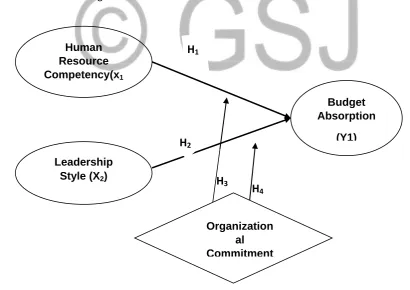
The research hypothesis explains the influence of human resource competencies and leadership style on budget absorption with organizational commitment as a moderating variable in the Makassar Tourism Polytechnic. Conceptual framework is a chart that describes the relationship between the dependent variable, the independent variable and the modern variable in the study. Conceptual framework for developing hypotheses can be seen in Figure 1.
Figure 1. Conceptual Framework
Human Resource Competency(x1
)
Leadership Style (X2)
Budget Absorption
(Y1)
H
2 UJIH
1H
4H
34. Methodology
This type of research is explanatory research which aims to find out the causal relationship between variables through a hypothesis testing (Jogiyanto, 2013). Testing the hypothesis with causal research and drawing conclusions based on inference statistics. The time dimension of this study involves one particular time (cross section). The method of primary data collection by giving questions to individual respondents (Jogiyanto, 2013). And, the research environment is a real environment (field setting) with the unit of analysis are individuals, namely officials of the Politeknik Pariwasata (POLTEKPAR) Makassar who are involved in the drafting process, implementation and budget accountability.
The researcher used the design of this study to find out whether human resource competence and leadership style as independent variables had an influence on budget absorption as the dependent variable. And whether organizational commitment moderates the influence of human resource competencies and leadership style on budget absorption.
The population in this study were all structural and functional officials of the Politeknik Pariwasata (POLTEKPAR) Makassar who were involved in the use of the budget at the Makassar Tourism Polytechnic. The total population is 50 people. Determination of the number of samples in this study using a purposive sampling method, which sets or determines the sample carried out in accordance with the research objectives set. The minimum sample in this study was 44 respondents who were determined using the Slovin formula.
The type of data used in this study is subject data. Subject data is a type of research data in the form of opinions, attitudes, experiences or characteristics of a person or group of people who are the subject of research. The data sources used in this study are primary data. Primary data (primary data) is data obtained from survey results by distributing questionnaires to respondents who match the characteristics of the population.
Data analysis techniques used in this study to examine the effect of each independent variable, then used the analysis of Multiple Regression and Moderated Regression Analysis (MRA) with SPSS tools (Statistical Package for the Social Sciences). Moderated Regression Analysis (MRA) is a special application of multiple linear regression, in which the regression equation contains an element of interaction (multiplying two or more independent variables). The reason for using the Moderated Regression Analysis (MRA) analysis tool is because there are moderating variables in this study. And, regression analysis aims to determine the magnitude of the influence of human resource competencies and leadership style on budget absorption with organizational commitment as a moderating variable. The data analysis used in this study is descriptive statistics, data quality test, classic assumption test, and hypothesis testing.
5. Result and Discussion 5.1. Descriptive Statistics
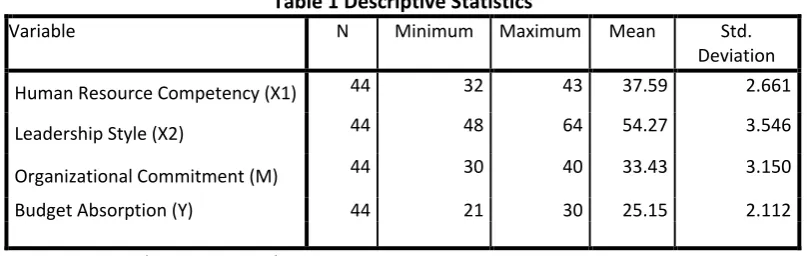
Descriptive statistics are intended to analyze data based on results obtained from respondents' answers to each variable measuring indicator. Based on the data that has been collected, the results of respondents' answers can be seen in table 1.
Table 1 Descriptive Statistics
Variable N Minimum Maximum Mean Std.
Deviation
Human Resource Competency (X1) 44 32 43 37.59 2.661
Leadership Style (X2) 44 48 64 54.27 3.546
Organizational Commitment (M) 44 30 40 33.43 3.150
Budget Absorption (Y) 44 21 30 25.15 2.112
Source: Primary data is processed, 2019.
shows a deviation of 2.661 from the average value (mean) of the respondent's answer to the item statement regarding the competence of human resources (HR). Human resource competency variable (X1) which is measured using a questionnaire that consists of 9 items statement with a Likert scale consisting of 5 alternative answers. Where the score is 5 (strongly agree) for the highest score and score 1 (strongly disagree) for the lowest score. From the points of the statement, obtained the highest total score (maximum) of 43 and the lowest score (minimum) of 32. While the leadership style variable (X2) has a standard deviation value of 3.456 and the average value of 54.27. This shows a deviation of 3.456 from the average value (mean) of the respondent's answer to the statement item regarding leadership style. The variable leadership style variable (X2) was measured using a questionnaire that consisted of 13 items with a Likert scale consisting of 5 alternative answers. Where the score is 5 (strongly agree) for the highest score and score 1 (strongly disagree) for the lowest score. From the item statement, the highest total score (maximum) is 64 and the lowest score (minimum) is 48.
Furthermore, for the moderating variable (M) namely organizational commitment has a standard deviation value of 3.150 and an average value of 33.43. This shows there is a deviation of 3.150 from the average value (mean) of respondents' answers to questions / statements regarding organizational commitment. Organizational commitment variables measured using a questionnaire that consists of 8 items with a Likert scale statement consisting of 5 alternative answers. Where the score is 5 (strongly agree) for the highest score and score 1 (strongly disagree) for the lowest score. From the statement, the highest total score (maximum) is 40 and the lowest score (minimum) is 30. And, the dependent variable is budget absorption (Y) has a standard deviation value of 2.112 and the mean value is 25 , 15. This shows a deviation of 2.112 from the average value (mean) of respondents' answers to statements regarding the absorption of the budget. The budget absorption variable (Y) is measured using a questionnaire that consists of 6 items with a Likert scale consisting of 5 alternative answers. Where the score is 5 (strongly agree) for the highest score and score 1 (strongly disagree) for the lowest score. From the item statement, the highest total score (maximum) is 30 and the lowest score (minimum) is 21.
Based on the results of the descriptive statistics, it shows that the mean value is greater than the standard deviation (SD) value for each variable, which indicates that the value of the data deviation is small. Therefore, the mean can be used as a representation of the entire data. This is because the standard deviation (SD) is a reflection of a very high deviation so that the spread of data shows normal and unbiased results. And, if the average value (mean) is smaller than the standard deviation value (SD), indicating poor results, then the spread of data is considered abnormal and causes bias.
5.2 Reliability and Validity 5.2.1 Reliability
Reliability testing using Cronbach Alpha with a cut-off value of at least 0.60 (Ghazali, 2013). A variable construct is said to be realible if it shows the cronbach alpha value of each variable greater than 0.60 (≥0.6). The results of the reliability test can be seen in Table 2.
Tabel 2 Test Resutls of Research Instrument Reliability
Variable Cronbach Alpha Statemnet
Human Resource Competency (X1) 0,602 Reliable
Leadership Style (X2) 0,786 Reliable
Organizational Commitment (M) 0,784 Reliable
Budget Absorption (Y) 0,699 Reliable
Source: Primary data is processed, 2019.
5.2.2 Validity
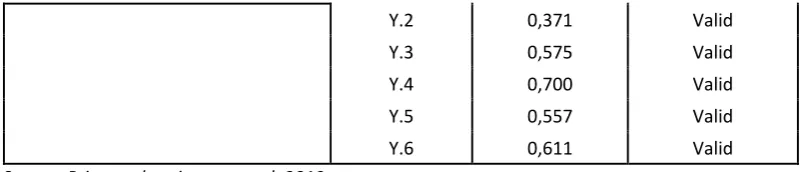
Research carried out using a questionnaire as a research instrument using a Likert scale with points 1 to 5, the choice of answers from strongly disagree (STS) to strongly agree (SS). Before the answer to the questionnaire statement can be used for further analysis, the research data that has been obtained in advance is necessary to test the validity of the research instrument. According to Ghozali (2013), testing validity with Pearson correlation, the instrument is declared valid if the correlation value (r) ≥ 0.3. The results of the validity test of each variable can be seen in Table 3.
Table 3 shows that the correlation value of all statement items of all variables in the questionnaire has a value above or greater than 0.03 (≥0.3). Thus it can be said that all questions or statements have met the validity requirements.
Tabel 3 Test Results of Validity
Variable Item Correlation Statement
Human Resource Competency (X1)
X1.1 0,503 Valid
X1.2 0,468 Valid
X1.3 0,366 Valid
X1.4 0,524 Valid
X1.5 0,420 Valid
X1.6 0,378 Valid
X1.7 0,756 Valid
X1.8 0,430 Valid
X1.9 0,503 Valid
Leadership Style (X2)
X2.1 0,427 Valid
X2.2 0,589 Valid
X2.3 0,566 Valid
X2.4 0,517 Valid
X2.5 0,647 Valid
X2.6 0,620 Valid
X2.7 0,630 Valid
X2.8 0,447 Valid
X2.9 0,764 Valid
X2.10 0,551 Valid
X2.11 0,384 Valid
X2.12 0,375 Valid
X2.13 0,589 Valid
Organizational Commitment (M)
M.1 0,707 Valid
M.2 0,689 Valid
M.3 0,755 Valid
M.4 0,729 Valid
M.5 0,639 Valid
M.6 0,391 Valid
M.7 0,729 Valid
M.8 0,766 Valid
Y.2 0,371 Valid
Y.3 0,575 Valid
Y.4 0,700 Valid
Y.5 0,557 Valid
Y.6 0,611 Valid
Source: Primary data is processed, 2019.
5.3 Data Quality Test Normality Normality Test Result
Normality testing uses the Kolmogorov Smirnov test. If the test results show the value (asymp.sig) is greater than 0.05 (sig> 0.05), then the assumption of normality is fulfilled. Conversely, if the value is smaller than 0.05 (sig <0.05), then the assumption of normality is not fulfilled. The Kolmogorov-Smirnov test results can be seen in Table 4. Table 4 Kolmogorov-Smirnov One-Sample Test Results.
Tabel 4 Kolmogorov-Smirnov One-Sample Test Result
Variabel Asymp. Sig Statement
Human Resource Competency (X1) 0,339 Normal
Leadership Style (X2) 0,072 Normal
Organizational Commitment (M) 0,180 Normal
Budget Absorption (Y) 0,118 Normal
Source: Primary data is processed, 2019.
From Table 4 it can be seen that the asymp.sig kolmogorov smirnov value is all greater than 0.05 (sig> 0.05), then the assumption of normality is fulfilled.
Test for Multicolinearity
To see the presence or absence of multicolonity in a regression model, it can be seen from the tolerance value or variance inflation factor (VIF). According to Ghazali (2013), the cut-off value commonly used to indicate multicollinearity is if the Tolenrance value is <0.10 or equal to the VIF value> 10. The test results of the assumption of multicollinearity can be seen in Table 5.
Tabel 5 Non-Multicolinierity Assumption Test Results
Variabel Tolerance VIF Statement
Hypothesis 1 1.000 1.000 Non-Multikolinieritas
Hypothesis 2 1.000 1.000 Non-Multikolinieritas
Hypothesis 3 0.356 2.808 Non-Multikolinieritas
Hypothesis 4 0,356 2.808 Non-Multikolinieritas
Source: Primary data is processed, 2019.
Tabel 5 menunjukkan bahwa bahwa nilai tolerance pada keseluruhan model bernilai di atas 0,10
(>0,10) dan nilai VIF masing-masing model di bawah 10 (<10). Dengan demikian, hasil tersebut menunjukkan
bahwa tidak terdapatmultikolinearitas antar variabel dalam model regresi.
Test of Heterocedasticity
again, there is no clear pattern of data spreading, and the points spread above and below the number 0 on the Y axis, there is no heteroscedasticity.
If seen in the attachment to the classic assumption test, the existing plot graph shows that the equations that have been tested do not occur heteroscedasticity. That is, there is no correlation between the amount of data with residuals, so that if the data is enlarged it does not cause a greater residual (error).
5.4 Hypothesis and Discussion Results
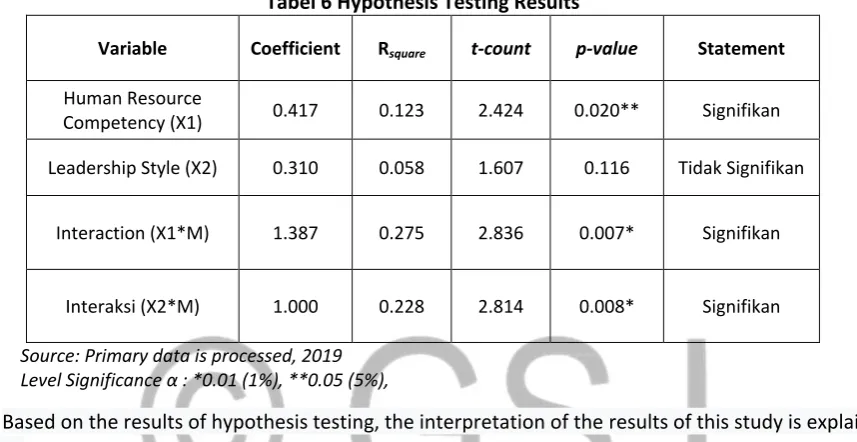
The basis used in testing the hypothesis is to look at the value of p and the value of t, if the value of p is smaller than 0.05 then the relationship between variables is significant or see the value of t, if count > t-table then there is a significant effect. Table 6 can provide an overview of the results of hypothesis testing.
Tabel 6 Hypothesis Testing Results
Variable Coefficient Rsquare t-count p-value Statement
Human Resource
Competency (X1) 0.417 0.123 2.424 0.020** Signifikan
Leadership Style (X2) 0.310 0.058 1.607 0.116 Tidak Signifikan
Interaction (X1*M) 1.387 0.275 2.836 0.007* Signifikan
Interaksi (X2*M) 1.000 0.228 2.814 0.008* Signifikan
Source: Primary data is processed, 2019 Level Significance α : *0.01 (1%), **0.05 (5%),
Based on the results of hypothesis testing, the interpretation of the results of this study is explained as follows.
5.4.1 Effect of Human Resource Competence on Budget Absorption
Based on Table 6, obtained the determination coefficient value of R square is 0.123 or 12.3%. This means that the budget absorption variable is influenced by 12.3% by HR competencies, while the remaining 87.7% is influenced by other variables which are outside the variables studied in this study.
The HR competency variable obtained t-count value ≥ t-table (2,424> 1,684) and probability value below 0.05 (0.02 <0.05), then partially HR competency variable (X1) has a significant effect on budget absorption (Y). Based on the regression coefficient value (0.417) which is positive, which means that the more HR competency variable (X1) increases, the budget absorption will increase (Y). Conversely, the lower the competency (X1), the lower the level of absorption of the budget (Y). These results indicate that the competence of human resources has a positive and significant effect on budget absorption.
This research supports the professional principle which is regulated in a public finance theory that requires the management of the budget to be handled by skilled personnel. The government as a unit of organization in managing its organization effectively and efficiently requires quality human resources to support the government in carrying out its functions, and in managing regional finance that must be done properly and correctly.
Biana (2016) who suggest that human resource competency factors have no influence on budget absorption, caused by several problems, such as in managing the budget of employees is still given other responsibilities or multiple tasks and excessive workload.
The implications of the results of this test show that human resource competency is an important predictor for the effectiveness of budget absorption, the competence of human resources will affect the absorption of the budget. When human resources in this case are employees or government officials who are authorized to have higher competence, then it will be more effective in managing the budget, it will be more efficient and more appropriate in managing and using the budget in accordance with the objectives and plan of the program. Employees or authorized officials will use various methods in carrying out the tasks assigned. Employees or authorities who have higher competence will carry out government functions by developing economic techniques in order to optimize revenues and realize expenditure allocations quickly and evenly in order to maintain economic stability specifically and ensure the availability of basic services to the community.
5.4.2 Effect of Leadership Style on Budget Absorption
Based on Table 6, obtained the determination coefficient value of R square is 0.058 or 5.8%. This means that the budget absorption variable is influenced by 5.8% by the leadership style while the remaining 94.2% is influenced by other variables which are outside the variables studied in this study.
In the leadership style variable, the t-count value <t-table (1,607> 1,684) and probability values above 0.05 (0.116> 0.05), then the leadership style variable (X2) partially does not significantly influence budget absorption ( Y). Thus, these results indicate that the leadership style does not have a positive and significant effect on budget absorption.
This study does not support contingency theory which explains how leaders' models in helping their members achieve their goals and to give direction and support or both, are needed to ensure their goals are consistent with the overall goals of the organization.
This study concludes with Khikmah et al. (2015) which suggests that leadership styles do not influence the absorption of performance-based budgets. This finding is in line with the research conducted by Pradana et al (2014) and Ayu (2017). However, this study does not support the results of research by Izzaty and Rohman (2011) and Setiawan (2013) investigating the influence of leadership style and quality of human resources on the absorption of performance budget-based Public Service Agencies, which suggests that leadership styles influence the absorption of organizations, the better and more acceptable style leadership in the organizational environment, it will also increase the effectiveness of budget management.
Leadership can determine whether an organization is able to achieve the stated goals (Robbins, 1990). Leadership behavior will directly influence the achievement of organizational goals. Leadership style is a crucial factor in an organization both public and private. A leader is able to allocate time well, able to influence subordinates with various characteristics of leadership, and be able to motivate employees or subordinates wisely in accordance with their respective duties. But in this study, leadership style does not have a direct influence on the absorption of the budget, this may be due to the tendency of employees to be influenced by other factors that are more dominant.
5.4.3 Effect of Organizational Commitments as Moderating The Relationship of Human Resources Competence with Budget Absorption
Based on Table 6, is the result of the calculation of the organizational commitment test (M) obtained by the determination coefficient value R Square of 0.228 or 22.8%. This means that the budget absorption variable is influenced by 22.8% by the interaction of leadership style with organizational commitment, while 77.2% is influenced by other variables outside of the variables studied in this study.
budget. Thus, this result shows that organizational commitment strengthens the relationship between human resource (HR) competencies and budget absorption.
This study supports one of the basic principles of human behavior described in the theory of organizational behavior, namely that every human being behaves in accordance with the understanding of their environment. Individuals who have more knowledge and understand the goals set by the organization environment will always highlight the advantages and increase the capacity and capabilities possessed for the achievement of organizational goals. Conversely, if individuals do not have sufficient understanding of what and how the organization's environment works, it will show different capacities, such as the tendency to ignore the goals set by the organization. Therefore, the position of a strong commitment to the organization that exists in everyone, will stimulate these people to strive to achieve organizational goals and have a positive outlook and more trying to do the best for the benefit of the organization. Conversely, individuals who have low organizational commitment will have low attention to achieving organizational goals and tend to try to fulfill their personal interests.
The results of this study support the research conducted by Sardjito and Osmad (2007), suggesting that organizational commitment has a positive influence on the performance of local government officials. The results of this study are also supported by research by Alumbida et al. (2016), Nouri and Parker (1996), and Juliani (2014).
The implications of the results of this study indicate that organizational commitment is an important factor for the effectiveness of budget absorption, organizational commitment can be a strong link between human resource competencies and budget absorption. When an authorized employee or government official has a strong organizational commitment coupled with high human resource competencies, he will be more effective in managing the budget, will be more efficient and more appropriate in managing and using the budget in accordance with the objectives and plan of the program.
Employees or authorities who have organizational members who are strong in carrying out government functions realize expenditure allocations quickly and evenly in order to maintain economic stability specifically and ensure the availability of basic services to the community. With strong commitment, employees or authorities are able to identify themselves with the organization and organizational goals, so that the expectations and willingness of individuals to optimize their potential to become part of the organization become higher.
5.4.4 Effect of Organizational Commitment as Moderating The Relationship of Leadership Styles with Budget Absorption
Based on Table 6, is the result of the calculation of the organizational commitment test (M), the determination coefficient value of R Square is 0.275 or 27.5%. This means that the budget absorption variable is influenced by 27.5% by the interaction of leadership style with organizational commitment, while 72.25% is influenced by other variables outside of the variables studied in this study.
The results of testing the third hypothesis indicate that the t-count value is greater than t-table (2.814> 1.684) with a probability value below 0.05 (0.008 <0.05). These results indicate that organizational commitment significantly moderates the relationship between leadership style and budget absorption. Positive regression coefficient (1,000) means, if organizational commitment increases (high), it will increase and have a positive impact on the relationship of leadership style with the absorption of the budget. Thus, these results indicate that organizational commitment strengthens the relationship between leadership style and budget absorption.
what will benefit the environment. The contingency approach in organizational behavior theory implies that the existence of different environments requires different behavioral practices to achieve their effectiveness.
Relationship-oriented leadership style makes managers interact with their subordinates openly and creates high social relations between subordinates and superiors, this will make subordinates feel more important and responsible in carrying out their duties. Conversely, task-oriented leaders view that they will feel satisfied if they are able to complete the tasks that are there, demands for subordinates in the form of tasks that must be completed. However, the orientation of the leadership style is not necessarily able to encourage individuals to work effectively against budget management. This is evident in the results of hypothesis 2 research that leadership style does not affect the absorption of the budget. Therefore, in this study and several previous studies used organizational commitment as a link between leadership style and budget absorption.
The results of this study support the study of Pradana et al. (2014), which deals with the effect of reward effects, availability of resources, leadership style, remuneration and punishments that influence the implementation of performance-based budgets with organizational commitment as a moderating variable. The results of his research suggest that organizational commitment strengthens the relationship between leadership style and the implementation of BLU performance-based budgets. This research was strengthened by Ayu (2017), Setiawan (2013), Izzaty and Rohman (2011).
The implications of this study indicate that organizational commitment is an important predictor of the effectiveness of budget absorption, organizational commitment can be a strong link between leadership style and budget absorption. When an authorized employee or government official has a strong organizational commitment coupled with the acceptance of a high leadership style, he will be more effective and appropriate in managing the budget, and able to use the budget in accordance with the time set.
6. Conclussion
Based on the results and discussion that have been presented, conclusions are obtained: (a) the competence of human resources affects the absorption of the budget. That is, increasing the competence of human resources has a positive impact on the performance of budget management in this case is the absorption of the budget. (b) The leadership style does not affect the absorption of the budget. That is, the level of leadership style orientation does not have a positive influence on budget absorption. (c) Organizational commitment moderates the relationship between human resource competencies and budget absorption. That is, the higher the organization's commitment, the budget management efforts (government) in an effort to increase budget absorption will also increase. (d) Organizational commitment moderates the relationship between leadership style and budget absorption. That is, the higher the organizational commitment, the orientation of the relationship-based leadership style or the task for the budget manager (government) in an effort to increase budget absorption will also increase.
7. Implication & limitations of research
The results of this study have implications both theoretically and implementation for policy making to increase the effectiveness of government budget management, especially Makassar Tourism Polytechnic. Based on the results of the analysis, the implications of this study are as follows.
a. The results of this study indicate that the competency factor of human resources affects the absorption of the budget. Thus, the results of this study support public finance theory. Public finance theory that requires budget management to be handled by skilled personnel. The government as a unit of organization in managing its organization effectively and efficiently requires quality human resources to support the government in carrying out its functions, and in managing regional finance that must be done properly and correctly. This is indicated by the positive influence of human resource competence on budget absorption.
supporting the implementation of duties and functions of employees because strong support from a leader can provide high accessibility for employees in carrying out their duties. The results of this study indicate that there is no influence of both relationship-based and task-based leadership styles on budget absorption.
c. The results of this study support the theory of organizational behavior, that is, every human being behaves according to their understanding of the environment. Individuals who have more knowledge and understand the goals set by the organization environment will always highlight the advantages and increase the capacity and capabilities possessed for the achievement of organizational goals. Conversely, if individuals do not have sufficient understanding of what and how the organization's environment works, it will show different capacities, such as the tendency to ignore the goals set by the organization. In addition, the contingency approach in organizational behavior theory implies that the existence of different environments requires different behavioral practices to achieve their effectiveness. This is indicated by the ability of organizational commitment to moderate the relationship between human resource competencies and budget absorption, and leadership style with budget absorption.
This research was carried out due to the limitations that could reduce the quality of research data. The limitations of this study are as follows.
a. This research only focuses on human resource competency, leadership style and organizational commitment in increasing the effectiveness of budget absorption. It does not rule out the possibility of other factors, both internal and external factors or intrinsic and extrinsic factors that can influence the effectiveness of budget absorption but have not been tested in this study.
b. The study only took place at the Pariwasata Polytechnic (POLTEKPAR) Makassar, so that for different government agencies, different conclusions were possible.
7.4 Suggestions
Based on the conclusions of the study, it is recommended that some suggestions for the next study be as follows.
1. The factor of organizational commitment has the biggest influence in moderating the competence of human resources towards the absorption of the budget. Future studies can consider testing any indicator of the variable organizational commitment.
2. Further research can consider the addition of independent variables, internal and external factors or intrinsic or extrinsic factors.
3. Further research can use other behavioral theories, such as Attribution Theory, Path-Goal Theory, and other motivational theories that are relevant to the research variable.
4. It is hoped that further research can consider the respondents and the broader research locations related to government budget management agencies.
References
1. Allen, J. N., dan Meyer, J. P. 1991. The Measurement and Antecedents of Affective, Continuance, and Normative Commitment to the Organization. Journal of Occupational Psychology, 63, 1-18.
2. Alumbida, D.I., Saerang, David. P.E., Ilat, Ventje. 2016. Pengaruh Perencanaan, Kapasitas Sumber Daya Manusia danKomitmen Organisasi Terhadap Penyerapan Anggaran BelanjaDaerah pada Pemerintah Kabupaten Kepulauan Talaud. Jurnal Accountability. Vol. 5 No. 2.
3. Ayu, M. 2017. Pengaruh Gaya Kepemimpinan, Kualitas SDM, BudayaOrganisasi dan Komitmen Organisasi terhadap Penerapan Anggaran Berbasis Kinerja (Study Empiris di Universitas Sang Bumi Ruwa Jurai Bandar Lampung). Jurnal EKOMBIS Sains – Vol. 02 No. 02.
4. Carsidiawan.D, 2009. Mengungkap Penyebab Lambatnya Penyerapan Anggaran Belanja Pemerintah. Buletin Anggaran dan Perbendaharaan [Buletin "A&P"].
5. Chong, V. K. dan K. M. Chong. 2002. Budget Goal Commitment and Informational Effect of Budget
Participation on Performance: A Structural Equation Modeling Approach. Behavioral Research In Accounting.
Vol 14.
7. Ghozali, I. 2013. Aplikasi Analisis Multivariate dengan Program SPSS. Semarang: Badan Penerbit Universitas Diponegoro.
8. Gregorius, N.M., Fitriany, N., dan Suwarti T. 2015 Eksploring The Factors That Impact The Accumulation of Budget Absorption In The End of The Fiscal Year. Proceeding-Kuala Lumpur International Business, Economic and Law Conference 7, Vol. 3. August 15-16.
9. Herriyanto, H. 2012. Faktor-faktor yang Mempengaruhi KeterlambatanPenyerapan Anggaran Belanja pada Satuan Kerja Kementrian di WilayahJakarta. Jurnal Prosiding, Fakultas Ekonomi dan Bisnis: Universitas Indonesia.
10. Izzaty, K.N., dan Rohman, A. 2011. Pengaruh Gaya Kepemimpinan Dan Kualitas Sumber Daya Manusia Terhadap Penyerapan Anggaran Berbasis Kinerja Badan Layanan Umum (Studi pada BLU Universitas Diponegoro Semarang). Jurnal Prosiding, Fakultas Ekonomi dan Bisnis Universitas Diponegoro.
11.Juliani. D. 2014. Pengaruh Faktor-faktor Konstektual Terhadap Persepsian Penyerapan Anggaran Terkait Pengadaan Barang/Jasa. Jurnal Akuntansi dan Keuangan Indonesia, Desember 2014, Vol. 11, No. 2. hal 177 – 199.
12. Khikmah SN. R MM, dan Farida. 2015. Pengaruh Gaya Kepemimpinan, kualitas SDM, Budaya Organisasi dan Komitmen Organisasi Terhadap Penerapan Anggaran Berbasis Kinerja (Studi kasus di Universitas Muhammadiyah Magelang). Jurnal prosiding, Portal Garuda.
13. Malahayati, C. 2015. Pengaruh Kapasitas SDM, Perencanaan Anggaran dan Pelaksanaan Anggaran
terhadap Serapan Anggaran Satuan Kerja Perangkat Daerah (SKPD) pada Pemkot Banda Aceh. Jurnal prosiding
Banda Aceh: Universitas Syiah Kuala.
14.Mardiasmo. 2002. Otonomi dan ManajemenKeuangan Daerah. Yogyakarta: ANDI.
15. Nina, S. Karamoy, H., dan Pontoh, W. 2016. Identifikasi Faktor-Faktor Penumpukan Realisasi Anggaran Belanja di Akhir Tahun (Studi Kasus pada Balai Penelitian dan Pengembangan Lingkungan Hidup danKehutanan Manado). Jurnal Prosiding Magister Akutansi, Universitas Sam Ratulangi.
16. Porter, L.W., Steers, R.M., Mowday, R.T., & Boulin, P.V. 1974. Organizational Commitment, Job Satisfaction, and Turnover Among Psychiatric Technicians. Journal of Applied Psychology, 59, 603-609.
17. Pradana, B.A., Handayani, B.D., dan Murtini.H. 2014. Determinan Impelementasi Anggaran Berbasis Kinerja Badan Layanan Umum (Pada Universitas Negeri Semarang). Accounting Analysis Journal 3 (1) (2014).
18.Priatno, P.A. 2013. Analisis Faktor-Faktor yang Mempengaruhi Penyerapan Anggaran Pada Satuan
Kerja Lingkup Pembayaran KPPNBlitar. Malang: Fakultas Ekonomi dan Bisnis Universitas Brawijaya. Jurnal Ilmiah. 1(2).
19. Putri, K.M.R., Yuniarta, Gede A., dan Prayudi, M.A. 2017. Pengaruh Perencanaan Anggaran, Kualitas Sumber Daya Manusia Dan Komitmen Organisasi Terhadap Penyerapan Anggaran (Survei Pada Skpd Di Wilayah Pemerintah Daerah Provinsi Bali). Jimat (Jurnal Ilmiah Mahasiswa Akuntansi) Undiksha 8.2.
20. Rerung, E.D., Karamoy.H., Pontoh.W. 2017. Faktor-Faktor Yang Mempengaruhi Penyerapan Anggaran Belanja Pemerintah Daerah: Proses Pengadaan Barang/Jasa Di Kabupaten Bolaang Mongondow Selatan. Jurnal Prosiding, Fakultas Ekonomi dan Bisnis Universitas Sam Ratulang.
21. Rifai, A dan Biana, I.A. 2016. Analisis Faktor-Faktor yang Memengaruhi Keterlambatan Daya Serap
Anggaran (Studi Empiris pada SKPD Pemprov NTB).Jurnal Ilmiah Akuntansi dan Bisnis.
22. Robbins dan Coulter. 2002. Management, 7th edition. New Jersey: Prentice Hall, Inc.
23. Robbins, S. 1990. Perilaku Organisasi. Jakarta: Prehalindo.
24. Robbins, S.P., dan Judge, T.A. 2008. Perilaku Organisasi Edisi ke-12. Jakarta: Salemba Empat. 25. Sardjito, B., dan Osmad, M. 2007. Pengaruh Partisipasi Penyusunan Anggaran Terhadap Kinerja Aparat Pemerintah Daerah: Budaya Organisasi dan Komitmen Organisasi Sebagai Variabel Moderating. Jurnal Simposium Nasional Akuntansi (SNA) X. Makasar, 26-28 Juli.
26. Setiawan, B.F. 2013. Pengaruh Gaya Kepemimpinan Sebagai Variabel Moderating dalam Hubungan Antara Partisipasi Penyusunan Anggaran terhadap Kinerja Instansi Pemerintah (Studi Empiris Satuan Kerja Perangkat Daerah Kota Padang). Jurnal Prosiding, Fakultas Ekonomi dan Bisnis Universitas Negeri Padang.
27. Sutiono. 1997. Faktor-Faktor yang Memengaruhi Lambatnya Realisasi Daya Serap Anggaran Keuangan Program Inpres Dati II Di Kabupaten Dati Bandung dan Kabupaten Bekasi.