Research Article
Influence of zeatin, glutamin and auxins
on root and shoot organogenesis of Guava
(Psidium guajava L.) cv. safeda seedling
explants
Roshan Zamir
1, Abdur Rab
2, Muhamad Sajid
2and Izhar Ahmad
3*1. Nuclear Institute for Food & Agriculture (NIFA), Peshawar-Pakistan
2. Department of Horticulture, The University of Agriculture, Peshawar-Pakistan 3. Department of Botany, Islamia College Peshawar-Pakistan
*Corresponding author’s email: [email protected]
Citation
Roshan Zamir, Abdur Rab, Muhamad Sajid and Izhar Ahmad. Influence of zeatin, glutamin and auxins on root and shoot organogenesis of Guava (Psidium guajava L.) cv. safeda seedling explants. Pure and Applied Biology. Vol. 6, Issue 1, pp197-206. http://dx.doi.org/10.19045/bspab.2017.60014
Received: 07/01/2017 Revised: 02/02/2017 Accepted: 05/02/2017 Online First: 07/02/2017
Abstract
An experiment was conducted to develop a regeneration protocol from seedling explants of higher yield Psidium guajava cv. safeda. Initially surface sterilized guava seeds were germinated inside the conical flasks. Explants taken from 49-day old seedlings were cultured on MS-medium modified with different concentration of plant growth regulators. Maximum explants showing shoot response (48%) was observed on MS-medium supplemented with 6-benzyladanin (BA) 1.0 mgl-1combined with 0.5 mgl-1ziatin. On the same media after 38-days of culturing, maximum number of 3.6 shoots per explant, 2.6 cm long was also recorded. On MS containing combination
of BA (2.0 mgl-1) and zeatin (1.0 mgl-1), 37% explants responded which produced 2.3 shoot per
explant after 42 days of culturing. Whereas on MS containing glutamin 250 mgl-1, 25% explants
responded and gave 2.2 shoots per explants after 46-days. However, when the concentration of glutamin alone was increased from 250 to 500 mgl-1 the shoot formation potential of explant decreased to 10%. Addition of BA, glutamin and zeatin alone to MS medium was less effective. However, combination of BA with zeatin was effective in shooting response, number of shoot/explants and shoot length. Maximum number of explants (76.6%) responded to rooting with 1.5 mgl-1 IAA in combination with 1.0 mgl-1 NAA. On average, maximum of (2.5) roots were also recorded per explants in 42 days. In vitro plantlets were acclimatized and shifted to soil successfully.
Keywords:Psidium guajava L; Micropropagation; Zeatin; Glutamin and auxins Introduction
Guava (Psidium guajava L.) is one of the most common fruit crops of Pakistan which ranks third after citrus and mango in area
and production wise [1]. Guava was
originated in tropical America stretching
guava is increasing due to its nutritional value, biannual bearing and affordable prices [4]. It is a well-known fruit of tropical and subtropical regions, where it is consumed fresh or processed into different products [5]. Guava is usually propagated by seeds and natural cross pollination is responsible for diversity in seedlings plants
[4]. Guava propagation by layering,
inarching, and budding is achievable but
cumbersome and time consuming [6].
During the past three decades, several
techniques have been practiced for
propagation of guava but no one could be perfected. Guava is recalcitrant specie for tissue culture when the explants are taken from mature part of the plant [7]. It is difficult to establish aseptic cultures from field grown mature woody plants due to endophytic microorganisms [8].
Clonal propagation of guava through micropropagation has been demonstrated using seedling explants, shoot tips and nodal segments [9-11]. Micropropagation of guava has been achieved by single node cuttings from seedlings raised in green house and in vitro raised seedlings [12]. A regeneration protocol from hypocotyl seedling explants of guava was also carried out by [9]. Micropropagation can be exploited to produce guaranteed quality, reliable and true to type plants for farmer community. It is
rapid, efficient and cost effective
technology, which will help in germplasm preservation and genetic improvement of the crop. Moreover, true to type plants can be produced throughout the year for the growers through micropropagation. The present studies were carried out to investigate rapid production of true-to-type plants in vitro from seedling explants of elite
Guava cv. safeda.
Materials and methods
Seed extraction and sterilization
Seeds from well ripen fruits of Guava cv.
safeda were extracted. After thoroughly
washing, seeds were surface sterilized with 0.1% Mercuric Chloride for 5 minutes followed by four rinsing with autoclaved sterile distilled water according to [4]. These were cultured in 500 ml conical flasks inside laminar flow bench on sterilized filter paper laid on cotton below. The flasks were kept in the dark for the first three weeks and then shifted to16 hour photoperiod produced by white fluorescent lamps. Forty-nine-day old contamination free in vitro seedlings were used as explants source.
Explants sterilization, culturing and media composition
The explants (0.5 - 1cm) were aseptically excised from the seedlings and given a quick rinse with 70% ethanol followed by two rinses with sterile distilled water. The excised explants were cultured according to
[13] containing 6- benzyladanine (BA) (1.0 and 2.0 mgl-1) and zeatin (0.5 and 1.0 mgl-1) alone and in combinations. One combination of MS media was also supplemented with glutamin 250 and 500 mgl-1. Solidification of media was done with 0.8% agar. The media was also supplemented with 30 g l-1 sucrose. The pH of the medium was adjusted with pH meter (Inolab Germany) to 5.80 before autoclaving at (1.02 kg/cm2 for 15 min). Cultures were kept in dark on (25 + 2 °C) for initial 24 hours and then shifted to light from cool white fluorescent lamps (3000 Lux) maintained at 16 hours photoperiod.
Shoot organogenesis
The cultures were observed for regeneration of shoot and shoot multiplication. The parameters on days to shooting, % shooting, number of shoot/explants and length of microshoot were recorded on regeneration media after 8-9 weeks of culturing.
Root organogenesis
concentrations and combinations of Indol-3-butyric acid (IBA), Indole-3-acetic acid (IAA) and Naphthalene acetic acid (NAA). The parameters on % rooting, days to rooting, number of roots/shoot and root length was recorded after 7-8 weeks of culturing.
Acclimatization of plantlets
When the micro shoot rooted successfully they were thoroughly washed with sterile doubled distilled water and transplanted in to small pots containing mixture of sterile soil of sand, silt and clay at (1:1:1). They were covered with transparent polythene sheet to arrest humidity. The hardened plantlets (35-45 days) with 2-4 fully expanded leaves were again shifted to 7.5cm diameter plastic pots containing sand, silt and clay. They were then transferred to the glasshouse. The plants were covered with polyethylene bags for 15-20 days. These pots were kept at 25°C in 16 hour
photoperiod for 3-4 weeks before
transferring to lathe house. Experimental design
The experiment was laid out in Completely Randomized Design with three replications. The data were statistically analyzed by using the software Stat. 8.1 USA analysis of variance. Duncan's Multiple Range test was used to compare the treatments among themselves.
Results and discussion Percent shooting
The data presented in figure-1 revealed that different PGRs have significantly affected percent shootings in seedling explants of guava. Explants cultured on MS with 1.0 mgl-1 BA in combination with 0.5 mgl-1 zeatin gave maximum (48%) shooting. With
the same combinations when the
concentration of cytokinin was doubled the shooting frequency reduced to 37%. Twenty two percent explants on MS medium
with1.0 mgl-1 BA responded to shoot
regeneration after seven weeks of culturing.
However, an increase in BA from 1.0 mgl-1
to 2.0 mgl-1 decreased shoot regeneration potential of explants. Compared to 22% explants regeneration, only 15% explants responded. Only 25% explants responded to
shoot regeneration when glutamin 250 mgl-1
was added to MS medium. All concentration of zeatin and BA alone gave less shooting
frequency as compared to their
combinations. On the other hand, lower concentration of glutamin (250 mgl-1) gave higher response in shoot regeneration as compared to the higher concentration (500
mgl-1) which gave only 10% shooting
response (Fig.1). When cytokinins alone were used, the shooting frequency of explants decreases. However, combination of BA with zeatin was effective in shooing response, number of shoot/explants and shoot length.
Most of the literature on micro propagation indicates that cytokinin and other hormone play a key role in shoot organogenesis in guava [14-16]. The present study reveals
that combination of cytokinins had
encouraged regeneration and it was almost doubled as compared to their use alone. Lower concentrations of BA combined with zeatin have proved to be the best one in the regeneration and shoot induction of guava. In contrast to [10], maximum number of shoot per explant in seedling tip of guava was reported when the medium was supplemented with 2.0 mgl-1 BA. Similar results were recorded by [9, 11] of seedling
explants regeneration on Ms-medium
supplemented with lower concentration of
BA (0.0l-1.0 mgl-1). Many researchers
suggested low level of cytokinins in regeneration of guava for proper growth of leaves and uniform growth in micro-shoots
[11, 17, 18]. It was reported that prolonged
17, 19]. glutamin and tryptophan had no positive effect on the tissue culture system of upland rice cultivars (except cultivar Lamsan) regarding callus induction [20].
These results strongly support the findings of our results that higher concentration of glutamin gave lower response (10%) only.
Figure 1. Effect of PGRs on % shooting. Means with same letters are not significantly different at P<0.05 using DMR test
Days to shoot induction
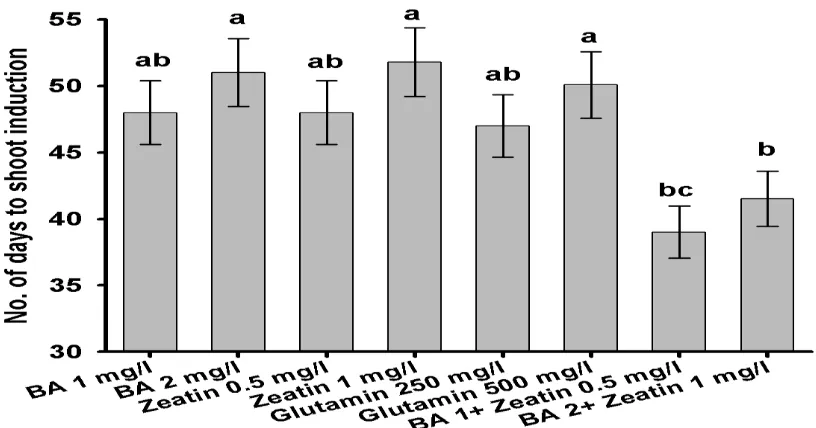
The data presented in figure-2 revealed that the lowest number of days (39) was recorded when MS media was augmented with 1.0 mgl-1 BA combined with 0.5 mgl-1 zeatin followed by 41.5 days on the medium containing 2.0 mgl-1 BA combined with 1.0 mgl-1 zeatin. The highest number of days (51.8) to shooting was recorded when MS
medium was supplemented with 1.0 mgl-1
zeatin. It followed with 51 days on media with 2.0 mgl-1 BA and 50 days on media with 500 mgl-1 glutamin. The present studies reveal that combination of BA and zeatin has encouraged early shooting. Higher concentrations of BA and zeatin alone have delayed soot induction. In earlier studies on guava shoot tips and nodal explants, it was recorded 4-6 weeks for shoot induction on MS medium supplemented with 4.5 µM BA
[21]. In contrast, [11] recorded the
maximum number of days (52.5) and the minimum days to shoot induction (35.8) in seedling explant of guava on 2.22 µM BAP and TDZ + NAA. The earliness in shooting in this study might be due to different media formulation (incorporation of NAA and TDZ) or could be due to explants difference.
However, single shoot formation per
explants was recorded on medium
Figure 2. Effect of PGRs on days to shoot formation. Means with same letters are not significantly different at P<0.05 using DMR test
Number of shoot per explant
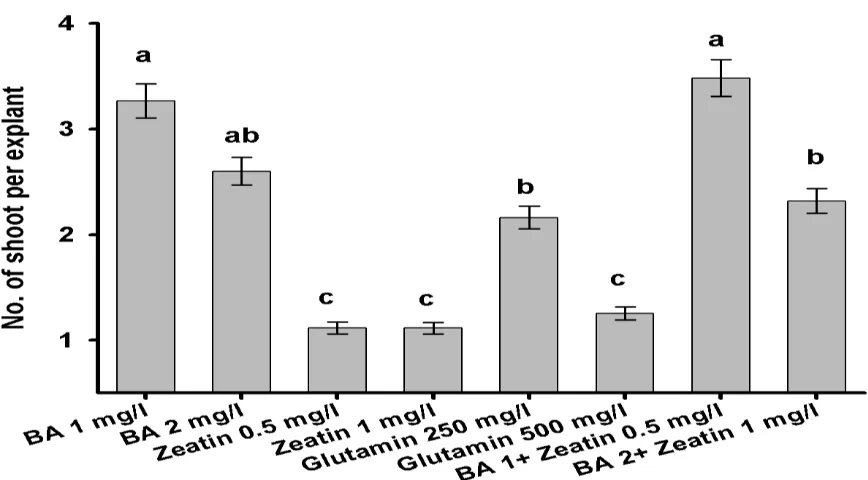
Maximum average number of shoots (3.6) per explants was recorded on medium
supplemented with 1.0 mgl-1 BA in
combination with 0.5 mgl-1 zeatin (Fig-3).
This was followed by BA alone at 1.0 mgl-1
with 3.3 shoots per explants. This parameter once again confirms the effectiveness of BA irrespective of its combination with other cytokinin. The findings of our results is confirmed from the earlier studies of [9, 10, 19] who reported that multiple shoots were induced to form by enhancement of axillary branching with BA (1.0-2.0 mgl-1) without addition of any auxin and gibberellins. In
contrast, [11] reported maximum of 5.2
shoot per explants when BAP and kinetin were incorporated in MS medium at 2.2 and 2.32 µM respectively. They further observed that BAP was effective alone in lower
concentrations for producing shoots. The high shooting frequency in this study may be due to incorporation of Kinitin or likely due to varietal difference. In our studies, glutamin at 500 mgl-1 and zeatin at both concentrations (0.5 and 1.0 mgl-1) produced single shoot on average. However, the average number of shoot per explants was doubled when the concentration of glutamin was decreased from 500 to 250 mgl-1. These results are in line with those reported [22]
who investigated the effect of glutamin and asparagine on the growth and metabolic
changes in French bean under in vitro
Figure 3. Effect of PGRs on number of shoots/explant. Means with same letters are not significantly different at P<0.05 using DMR test
Shoot length (cm)
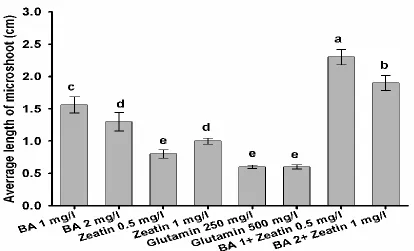
The data in figure-4 revealed that on average, all concentrations of BA produced 1.5 cm long shoot in seven weeks. However, the longest shoot of 2.3 cm was produced when 1.0 mgl-1 BA was combined with 0.5
mgl-1 zeatin. This was followed by
combination of BA (2.0 mgl-1) and zeatin
(1.0 mgl-1). zeatin alone at both
concentrations (0.5 and 1.0 mgl-1) produced 0.8 and 1.0 cm long shoots. The most inferior results in case of shoot length was
recorded when the medium was
supplemented with glutamin 250 and 500 mgl-1 with maximum of 0.6 cm long shoot. The longest shoots were also recorded in
guava from green house grown explants by the application of lower concentrations (0.25 mgl-1) of BAP [17] while the longest shoot of 2.5 cm on medium containing BAP 2.2 µM+kinitin 0.93 µM was achieved by
Figure 4. Effect of PGRs on average length of microshoot. Means with same letters are not significantly different at P<0.05 using DMR test
Percent rooting
The percent rooting among all the treatments
tried, maximum number of plantlets
showing roots (76.6%) was observed on
MS-medium containing 1.5 mgl-1 IAA and
1.0 mgl-1 NAA after 42 days. This was followed by 1.0 mgl-1 IAA and 0.5 mgl-1 NAA with 76% rooting. However, when the concentration of IBA increased to 1.5 mgl-1 with 1.0 mgl-1 NAA, reduced rooting to 73.3% of micro shoots. Again when the concentration of IBA decreased from 1.5 to 1.0 mgl-1 and NAA from 1.0 to 0.5 mgl-1, rooting response decreased to 70 %. Most of the relevant literature reported on the application of auxin indicates that IAA is very effective in various species of tropical trees [14], [30- 33]. In our studies at both concentrations of IAA or IBA, rooting response increases when NAA increase from 0.5 to 1.0 mgl-1. These results are confirmed by those reported by [11, 32] on the rooting of guava in vitro. In contrast, the highest
rooting response of 95.9% on medium
containing IBA 4.90 µM + 100 mgl-1
activated charcoal was reported by [11]. The high response of rooting in this case may be due the addition of activated charcoal in the medium. Addition of 100 mgl-1 activated charcoal had adsorbed toxins and phenolic compounds resulting in high rooting frequency.
Days to rooting
The data presented in table-1 revealed that among all the combinations, the lowest numbers of days (42) were taken to roots when the medium was supplemented with either 1.0 or 1.5 mgl-1 IAA or 0.5 or 1.0 mgl -1 NAA. It was followed by 1.5 mgl-1 IBA +
of guava on medium containing IBA 4.90 µM combined with activated charcoal 100 mgl-1 was reported by [11]. However, the highest number of days taken to rooting was 38.9 on the medium that containing 2.46 µM
IBA. The lowest days to rooting than our studies may be due to the addition of activated charcoal in the medium.
Table 1. Response of micro shoot from seedling explants of guava to rooting using various concentrations and combinations of auxin
Auxins (mgl-1) Days to root induction % root response No. of roots/shoot
IBA 1.0 +NAA 0.5 49 a 70.0 c 1.9 d
IBA 1.5+NAA 1.0 45 b 73.3 b 2.2 b
IAA 1.0 + NAA0.5 42 c 76.0 a 2.0 c
IAA 1.5 + NAA1.0 42 c 76.6 a 2.5 a
LSD 2.2 1.2 0.15
Means not followed by same letters are significantly different at P<0.05 using LSD test
Number of roots per shoot
Maximum number of roots per shoot (2.5)
was recorded on medium containing1.5 mgl
-1 IAA + 1.0 mgl-1 NAA followed by 2.2
roots per shoot on the medium contained 1.5
mgl-1 IBA + 1.0 mgl-1 NAA (Table-1).
Lower concentrations of NAA irrespective of combination with IBA or IAA have decreased the number of roots per explants. The number of roots per shoots was 2.0 on
the medium containing IAA 1.0 mgl-1 +
NAA 0.5 mgl-1. However, it was decreased to 1.9 with the same concentration of NAA when the combination was with 1.0 mgl -1IBA
. Maximum 4.3 numbers of roots per shoot in seedling explants of guava on medium containing IBA 4.90 µM combined
with activated charcoal 100 mgl-1.was
achieved by [11]. The highest number of roots per shoot may due to the combination of activated charcoal as activated charcoal acts as adsorbents to toxins, excess phytohormones and other phenolics.
Conclusions
It can be concluded from results that combination of BA 1.0 mgl-1 with 0.5 mgl-1 zeatin proved to be the best one in case of in vitro regeneration from seedlings explants of cv. safed (48 % shoot organogenesis). On the same medium maximum of 3.6 shoots
per explant was produced followed by BA 1.0 mgl-1 that produced 3.3 shoots per explant. In case of root organogenesis the best medium was IAA 1.5 mgl-1 combined
with 1.0 mgl-1 NAA which induced root
organogenesis in (76.6 %) micro shoots in 42-days. On the average, it gave 2.5 roots per explants.
Authors’ contributions
Conceived and designed the experiments: A Rab, Performed the experiments: R Zamir, M Sajid & I Ahmad, Analyzed the data: R Zamir, A Rab & I Ahmad, Contributed reagents/materials/analysis tools: A Rab & I Ahmad, Wrote the paper: R Zamir, M Sajid & I Ahmad
References
1. Khushak A, Memon MA & Lashari MI
(2009). Factors affecting guava
production in Pakistan. J Agric Res 47(2): 201-209.
2. Amin MN & Jaiswal VS (1988).
Micropropagation as an aid to rapid cloning of a guava cultivar. Sci Hort 36: 89-95.
4. Zamir R, Khattak GSS, Mohammad T, Shah SA, Khan AJ & Ali N (2003). In vitro mutagenesis in guava (Psidium guajava L.). Pak J Bot 35(5):825-828.
5. Martin FW, Campbell CW & Roberte RM
(1987). Perennial edible fruits of the tropics: An inventory, U.S. Deptt Agri Res Ser Agr Hand book 642.
6. Amin MN & Jaiswal VS (1993). In vitro
response of apical bud explants from mature trees of jack fruit (Artocarpus heterophyllus). Plant cell tiss & organ cult 33: 59-65.
7. Pence VC & Sandoval JA (2002).
Controlling contamination during in vitro
collecting. A review of methods and
chemicals used for controlling
contamination in collected tissues. IPGRI
tech bulletin 7: 30–40.
8. Loh CS & Rao AN (1989). Clonal
propagation of guava (Psidium guajava
L.) from seedling and grafted plants and adventitious shoot formation in vitro. Scie Hort 39: 31-39.
9. Papadatou P, Pontikis C, Ephtimiadou E & Lydaki M (1990). Rapid multiplication of guava seedlings by in vitro shoot culture. Scie Hort 45: 99-103.
10. Yasseen M, Barringer SA, Schnell RJ & Splittoesser WE (1995). In vitro shoot proliferation of guava (Psidium guajava L.) from germinated seedlings. Plant Cell Rep 14: 525-528.
11. Goyal Y & Arya HC (1985). Tissue culture of desert tree- II. Clonal multiplication of Ziziphusin vitro. J plant physiol 199: 399-404.
12. Murashige T & Skoog FA (1962).
Revised medium for rapid growth and bioassays with tobacco tissue cultures.
Phys Plant 15: 473–497.
13. Chandra R, Mishra M & Bajpai A
(2005). Biotechnological interventions
for improvement of guava (Psidum
guajava L.). Proceeding of 1st Int guava
symp, CISH, Lucknow, India. pp. 19-25.
14. Mishra AK (2005). Important diseases of
guava in India with special reference to wilt. In: Proc of 1st international guava symposium, CISH, Lucknow, India. pp.75-90.
15. Rai MK, Jaiswal VS & Jaiswal U
(2009). Shoot multiplication and plant regeneration of guava (Psidium guajava
L.) from nodal explants of in vitro raised plantlets. J fruit and ornamental plant Res 17(1): 29-38.
16. Ali N, Mulwa RMS, Norton MA &
Skirvin RM (2003). Micropropagation of guava (Psidium guajava L.). J Hort Sci & Biotech 78: 739–741.
17. Kouidar M, Korban SS, Skirvin RM &
Chu MC (1984). Influence of
embryogenic dominance and polarity on adventitious shoot formation from apple cotyledons in vitro. J Amer Soc Hort Sci
109: 381-385.
18. Shahsavari E (2011). Impact of
tryptophan and glutamin on the tissue culture of upland rice. Plant soil envir.
57(1): 7–10.
19. Jaiswal VS & Amin MN (1987). In vitro
propagation of guava from shoot cultures of mature tree. J Plant Physiol 130: 7-12. 20. Haroun SA, Shukry WM & El-Sawy O
(2010). Effect of asparagine or glutamin
growth and metabolic changes in
phaseolus vulgaris under in vitro
conditions. Biosci Res. 7(1): 01-21.
21. Chandra R, Bajpai A, Gupta S & Tiwari RK (2004). Embryogenesis and plant
regeneration from mesocarp of Psidium
guajava L. Indian J Biotech 3(531): 246-248.
22. Das DK, Prakash NS & Balla-Sarin N (1999). Multiple shoot induction and
plant regeneration in litchi (litchi
chinensis Son). Plant cell Rep 18: 691-665.
23. Fuenmayor MED & Montero NJM
guava (Psidium guajava L.) from stem
shoots of cv. Mara-7. Acta Hort 452: 47–
51.
24. Malik SK, Chaudhury R & Kalia RK (2005). Rapid in vitro multiplication and
conservation of Garcinia indica: A
tropical medicinal tree species. Sci Hort
106: 539-553.
25. Meghwal PR, Singh SK & Sharma HC (2003). Micropropagation of Aneuploid guava. Indian J Hort 60: 29-33.
26. Mishra DS, Tiwari JP & Lal S (2005). In vitro cloning of guava (Psidium guajava L.) cv. Pant Prabahat. In: Proc of 1st International guava symposium, CISH, Lucknow, India; pp. 32-33.
27. Singh SK, Meghwal PR, Sharma HC &
Singh SP (2002). Direct shoot
organogenesis on explants from
germinated seedlings of Psidium guajava
L. cv. Allahabad Safeda. Sci Hort 95: 213-221.
28. Amin MN & Jaiswal VS (1987). Rapid clonal propagation of guava through in vitro shoot proliferation on nodal explants of mature trees. Plant Cell Tiss & Organ Cult 9: 235-243.
29. Roy SK, Islam MS, Sen J &
Hadiuzzaman S (1992). Effects of auxins, sucrose and agar on in vitro rooting of callus induced micro shoots of jackfruit (Artocarpus heterophyllus). Bangladesh J Bot 21: 93:98.
30. Amin MN, Razzaque MA & Akhtar S (1992). Axillary shoot proliferation and adventitious rooting in vitro of response of carambula (Averhoa carambola L.).
Plant Tiss Cult 2: 7-13.
31. Amin MN, Islam MN & Azad AK
(1999). Regeneration of plantlets in vitro
from the seedling explants of
pomegranate (Punica granatum). Plant
Tiss Cult 9(1): 53-61.
32. MacRae S, Van J & Den (1990). In vitro
culture of Eucalyptus grandis: Effect of gelling agents on propagation. J Plant Physiol 137: 249-251.
33. Singh D, Mohammed S & Shukla AK (2005). Micropropagation of guava as
influenced by season, source and