Research Article
1
Research on the Pre-coding Technology of Broadcast
Stage in Multi-user MIMO System
Guoqiang Wang
1,*, Shangfu Li
21 Key Lab of Electronic and Communication Engineering, Heilongjiang University, Harbin, P. R. China 2 Key Lab of Electronic and Communication Engineering, Heilongjiang University, Harbin, P. R. China
Abstract
For the poor transmission reliability of data, this paper focuses on the precoding techniques of the multi-user MIMO system in the broadcast phase in, and the single-user MIMO and multi-user MIMO precoding techniques have been studied. In the multi-user MIMO system, BD-MMSE-VP coding algorithm is proposed to improve the BER performance of the system by using the MMSE criterion to optimize the perturbation vector, and the system uses QR technique to decompose BD channel matrix. Simulation results verify the effective of the proposed precoding algorithm.
Keywords: Multi-user, MIMO system, precoding, block diagonalization.
Received on 12 August 2017, accepted on 02 December 2017, published on 8 December 2017
Copyright © 2017 Guoqiang Wang et al., licensed to EAI. This is an open access article distributed under the terms of the Creative
Commons Attribution licence (http://creativecommons.org/licenses/by/3.0/), which permits unlimited use, distribution and
reproduction in any medium so long as the original work is properly cited.
doi: 10.4108/eai.8-12-2017.153461
*Corresponding author. Email: [email protected]
1. Introduction
With advent of the era of "Internet +", the mobile Internet has been seen everywhere and played an important role in the development of human society. People enjoy the convenience of mobile communications at the same time, but also put forward higher requirements on the mobile communication technology, which promoted the rapid development of mobile communications [1]. It has developed from the first generation mobile communication (1st-generation, 1G) based on analog cellular technology to the fourth generation mobile communication (4th-generation, 4G) mainly based on MIMO systems through 30 years’ development. 1G only provided high quality speech services, but now mobile communication has to meet all aspects of the demand, including work, leisure and entertainment. Mobile communication brings people endless convenience and well-being [2]. However, 4G cannot meet the current requirements of achieving interconnectedness of all things. Therefore, the next generation of communication technology - the fifth generation mobile communication (5th-generation, 5G) has also started to be studied.
In this paper, we focus on the preprogramming in the multi-user MIMO system broadcast phase. The inter-user interference can be eliminated by precoding the signals sent to the multiuser at the base station.
2. The precoding technique of multi-user
MIMO system
2.1. Traditional precoding technology
Multi-user MIMO system can achieve the communication between base station and multiple users in the same frequency domain or time domain, increasing the spectrum efficiency and the reliability of communication system [3]. Multi-user MIMO as the 5G core technology has attracted many researchers’ attention. In the broadcast link, the base station needs to send multiple data streams to multiple users. The signals obtained by each user contain not only the signals sent by the base station to them, but also the interference signals of other users. In addition, the users cannot cooperate among each other. The multi-user interference (MUI) occurs. Therefore, it is necessary to encode the transmitted signal before the signal is transmitted
on
Ambient Systems
EAI Endorsed Transactions on
or to performing the detection operation at the receiving end, in order to eliminate the interference between the users and separate the information required by each user.
The precoding in Multi-user MIMO system is classified into linear and non-linear precoding. The linear precoding mainly includes channel inversion (CI) and block diagonalization (BD). The nonlinear precoding includes Dirty Paper Coding (DPC) and Tomlinson-Harashima Precoding (THP) [4].
CI precoding can be divided into the following two types: channel inversion precoding (ZF-CI) based on zero forcing and channel inversion precoding (MMSE-CI) based on minimum mean square error. Similar to the linear precoding of single-user MIMO, CI preprogramming is simple, with low computational complexity and thus easy to be implemented in communication systems, but weak at the anti-jamming. Block diagonalization precoding uses singular value decomposition of the channel matrix and is more suitable for the case of multi-antenna users. The computational complexity of Block diagonalization precoding is much smaller than other precoding algorithms, but it increases significantly as the number of users and receiving antennas increases. Therefore, it is important to find a new precoding algorithm that can reduce the block diagonalization precoding complexity and improve the system performance.
For non-linear dirty paper coding, the key idea is to treat other user signals as interference in addition to the effective user. Dirty paper coding can achieve close to the total channel capacity of multiple users, but is too complicated in computation to be applied to real communication system. Nonlinear THP precoding is formed on the basis of dirty paper coding. Although it does a compromise in terms of computational complexity and performance, it is still necessary to perform multiple iterations to eliminate user interference. THP is not suitable to the real communication system due its computational complexity. Therefore, in this section, we go into more detail on BD precoding and propose an optimization scheme.
2.2. An Optimal Coding Scheme Based on
Block Diagonalization
The traditional block diagonalization coding (BD) uses the singular value decomposition (SVD) to decompose the channel matrix and obtains the zero matrix of the unitary matrix as the coding matrix. However, computational complexity of the singular value decomposition increases sharply as the number of transmitting and receiving antennas increases [5]. The study on precoding with low complexity and ideal performance is very important. In this paper, a block diagonalization scheme based on Perturbation Vector (VP) is proposed. The optimization of the perturbation vector is based on the MMSE criterion. Therefore, we name the proposed code scheme as BD-MMSE-VP.
In this paper, we use the multiuser MIMO system as a
base station transmits the perturbation signal vector, and for the optimization of the perturbation vector, the MMSE is used as the criterion. The client needs to carry out simple modulo operation on the received signal to restore the signal. Unlike traditional BD precoding, BD-MMSE-VP encoding uses QR decomposition channel matrix, while traditional BD precoding uses SVD.
H
is the channel matrix between the base station and all users, 1T 2T T TK
H H H H ,
H
ˆ
isH
’s pseudo inversematrix, ˆ H
H
1H H HH , and Hˆ H Hˆ ˆ1 2 HˆK, so
,1
,
1 1 1 1
1 1
1
ˆ ˆ
ˆ ˆ ˆ
ˆ ˆ
R
R R K
N K
K
N
K K K
I
I I
H H H H H
HH H H
H H H H H
(1) From the above can be seen when
j
k
,H Hj ˆk 0. Thechannel matrix of all other users except the user j is constructed as follows:
1 1 1
T
T T T T
j j j K
H H H H H (2)
If you want to avoid other users on the user j caused by user interference, then the user j pseudo inverse matrix must fall in the matrix of zero space, so
ˆ 0, j1, 2...,K j j
H H (3) Now, QR decomposition of the pseudo inverse matrix of user j is performed
ˆ
ˆ ˆ j1,...,K j j j
H Q R (4)
According to QR decomposition properties, Rˆj is the
upper triangular matrix, andQˆjcolumn vector can form the
standard orthogonal basis of the matrix Hˆj. In order to
eliminate inter-user interference, H Hj ˆjH Q Rjˆjˆj 0 ,
because Rˆj is reversible matrix, so H Qjˆj0 . Qˆj is
removing the orthogonal base forming the zero space. LetWjQˆj, construct a valid matrixHeff j, W Hj ,
BD-MMSE-VP coding principle is shown in Fig. 1:
The original signal
Spherical encoders
Modulo
Base station
j
F H
j
x n
j d n
,
Heff j
j
W
1,0,1
j
z n
j s n
BH j j
g
ˆ
j
d n s nˆj
j
p n
User j
Figure 1. BD-MMSE-VP precoding diagram
The optimal perturbation vector and power constraint
factor are found by using MMSE criterion, d nj
is the userj wants to get the signal, d nˆj
is the user j actually receives the signal, The minimum homogeneous error of the two signals is expressed by the formula (4), while BHj is the3 ,
eff j
H , d nj
, tr R
n . So the problem to be solved is when
j
p n ,xj[n] , gj are what values, the d nj
and d nˆj
mean square error is minimal, and power constraint is
1 B N H j j nx n x n P
, P is the base station total transmit power.
, , , , 2 1 2 , 1 , 1 , 2 2 ˆ , [n], gB
B
B
eff j eff j eff j
eff j
N
j j j j j
n N
H
j j eff j j j j
n
N H
H
j j eff j j j j
n
H
j j eff j j j j
H H H H
j j j j j j j
H H H
j n j j j j j j
p n x E d n d n
E g B H x n z n d n
E g B H x n z n d n
g B H x n z n d n
g x n H H x n g d n B H x n
E
g tr R g x n H B d n d n d n
1 B N n
(5) Firstly, the Lagrangian function is constructed by using the Lagrangian algorithm:
1 , , , , , B N Hj j j j j j j j
n
f p n x n g p n x n g x n x n P
(6)
And thenp nj
, xj[n], were partial guide:
, ,
,
2
0
eff j eff j eff j
H H H H H
j j j j j j
j f
g x n H H g d n B H x n
x n
(7)
, , , , 1 2 2 =0 Beff j eff j eff j
eff j
N
H H H H
j j j j j j
n j
H H
j n j j j
f
g x n H H x n d n B H x n g
g tr R x n H B d n
(8)
1 = =0 B N H j j n fx n x n P
(9)Let N tr RB
n P , finally we can obtain
,
, ,
1
eff j eff j eff j
H H
j j j j j
j
x n F d n H H H I B d n
g
1 (10)
, ,
,
2
, 1
1 B
eff j eff j eff j
N
H H H H
j j j eff j j j
n
g d n B H H H I H B d n
P
(11)
Relative to the perturbation vector signal d nj
codingmatrix is
, , ,
1
eff j eff j eff j
H H
j j
j
F H H H I B
g
1 , and the
perturbation vector p nj
can be formed by a sphericalencoder.
arg min
j j j j
p n B s n p n (12) The user j receive signal can be expressed as
, 1 , , , ,j eff j j j
H H
eff j eff j eff j eff j j j j j
j
j j j j
j
y n H x n z n
H H H H I B s n p n z n
g
B s n p n z n g 1 1 (13)
The equation z nj
contains the Gaussian redundantinterference noise, which is multiplied by the power of the user j to remove the power scaling, and the user j knows the value of the spherical encoder , so the receiver can
eliminate
p nj
influence by modulo operation.3. Implementation and Performance
Analysis
In this section, the performance of the proposed algorithm and system will be evaluated and analyzed in terms of the optimized coding sum rate and complexity of optimized coding.
3.1. Optimized coding sum rate analysis
The sum of the rates of the multiuser MIMO systems is the sum of all single user rates. Through the use of BD-MMSE-VP precoding in multi-user MIMO systems, Heff j, is the
equivalent matrix of base station and user j, transmit a signal is
H,
, H,
1
j eff j eff j eff j j j j
x n H H H I B d n
g
1 , the receiving
signal where in the user is y nj
Heff j, x nj
z nj
. According to feature decomposition, we can easily obtain,
H H
eff j eff j
H H Q Q , Heff j, x nj
is decomposed:
,
1
eff j j j j
j
H x n B d n g
Q Q
Φ
(14)While
Q
is the unit matrix, is the diagonal matrix,and the value on the diagonal is j j
,
j is
matrix’s diagonal elements. According to (14), and it can be seen that the user j input signal can be expressed as: R, R, R, R,
R, R, R, R,
1,1 N ,1 ,1
N 1
, ,1 ,N
1 N
1,N N ,N ,N
1 j j
j j
j j j j
H H
j
eff j j k k k
H j
j
q q c n
H x n q q
g
q q c n
(15) So the user j's k-th received signal is represented by the following equation:
,
2
, , , ,
1
1 NR j
l
j k k l j k j k
l l j
y n q c n z n
g
(16)EAI Endorsed Transactions on
While
, ,
, , , ,k ,k
1, 1
1 R j NR j
H l
j k k l m l j j
m m k l l j
z n q q c n z n
g
,including internal data stream interference and signal noise
,k
j
z n , so the user j SINR is:
2
,
, 2 2
1
,m ,
B
N
j k j k
n
j j k
sc n SINR
tc n z n
(17)While
,
2
, 1
1 NR j
l k l l j
s q
g
,, ,
, ,
1, 1
1 NR j R j
H l
k l m l m m k l l
j
t q q
g
, so the BD-MMSE-VPcoding sum rate is:
,
2 ,
1 1
log 1
R j
N K
BD MMSE VP j k
j k
R SINR
(18)3.2. Complexity Analysis of Optimized Coding
For multiuser MIMO precoding complexity analysis, this section considers only the complexity of the base station precoding algorithm and measures the computational complexity using floating-point arithmetic. Traditional BD precoding uses the SVD decomposition, its complexity:
2 3
,
4 13
SVD B R R R j
C K N N N N (19)
The BD-MMSE-VP coding uses QR decomposition and perturbation vector optimization, QR decomposition complexity is
3 2 2
,
11 5 1
3 3 3
QR B B R j B R j
C N N KN N N
(20)
It can be seen that the QR operation is much smaller than the SVD by comparing the SVD and QR operations, because the QR is decomposedNBNR j, , and the matrix of
the traditional BD precoding SVD is
NR NR j,
NB.3.3. Simulation results
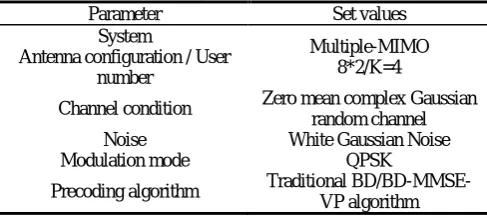
In this paper, BD-MMSE-VP precoding and traditional BD precoding algorithm is simulated by Matlab. In the multi-user MIMO system broadcast stage, QPSK is used for modulation and demodulation. The number of base stations is 8, and each user adopts two receiving antennas, the number of users is 4. The simulation compares the system and the rate and BER performance, the specific simulation parameters are shown in table 1 below:
It can be seen from Fig. 2 and Fig. 3 that the BD-MMSE-VP precoding proposed in this paper has a great advantage over traditional BD precoding, both BER performance and
the case of no more than 10dB, BD-MMSE-VP pre-coding performance advantage is more obvious. When the signal-to-noise ratio is 5dB, the BD-MMSE-VP precoding is improved by 5bps / Hz compared with the traditional BD precoding algorithm. When the SNR is 15dB, the BD-MMSE-VP precoding is better than the traditional BD precoding The algorithm improves the rate of 2bps/Hz. This is because the BD-MMSE-VP uses the Lagrangian algorithm to allocate the transmit power, allocates more transmit power for subchannels with good channel states, and the channel subcarriers are allocated less or do not allocate transmit power. Noise ratio is maximized, but with the increase of the signal-to-noise ratio, the BD-MMSE-VP precoding is almost evenly distributed to all subchannels, so its rate performance is high Noise ratio is similar to the traditional BD precoding. BD-MMSE-VP precoding BER performance is better than traditional BD precoding. At BER = 10-2, BD-MMSE-VP precoding obtains a gain of 2.7dB
relative to traditional BD algorithm.
Figure 2. The contrast of Multi-User MIMO precoding
sum rate
Figure 3. The contrast of Multi-User MIMO precoding
BER performance
0
5
10
15
20
0
10
20
30
40
50
SNR
(
dB
)
S
um
r
a
te
(
bps
\H
z
)
BD Precoding
BD-MMSE-VP Precoding
0 5 10 15 20
10-3 10-2 10-1 100
SNR(dB)
B
E
R
BD Precoding
5
Table 1. Multi-User MIMO precoding simulation
parameter
Parameter Set values
System
Antenna configuration / User number
Multiple-MIMO 8*2/K=4
Channel condition Zero mean complex Gaussian
random channel
Noise White Gaussian Noise
Modulation mode QPSK
Precoding algorithm Traditional
BD/BD-MMSE-VP algorithm
4. Conclusion
In the multiuser MIMO system, two kinds of linear precoding of CI and BD are preliminarily studied, and two kinds of nonlinear codes such as DPC and THP coding are difficult to be applied because of the high complexity of non-linear coding DPC and THP coding. The performance of BD pre-coding is better than that of the CI pre-coding, and the BD-MMSE-VP precoding is proposed at the same time, which is combined with the BD algorithm of QR decomposition, and the MMSE criterion is used to optimize the perturbation vector. Simulation results show that the performance of sum rate and BER has been greatly improved by comparison.
References
[1] Zheng, K., Zhao, L., Mei, J., Shao, B., Xiang, W., &
Hanzo, L.: Survey of large-scale MIMO systems. IEEE Communications Surveys & Tutorials, 17(3), 1738—1760 (2015).
[2] X. Gao, L. Dai, Y. Ma, et al. Low-complexity near-optimal
signal detection for uplink large-scale MIMO systems. Electronics Letters, 50(18): 1326—1328(2015).
[3] L. Lu, G. Li, A. Swindlehurst, A. Ashikhmin, and R.
Zhang. An overview of massive MIMO: Benefits and challenges. IEEE J. Sel. Topics Signal Process, 8(5): 742—758(2014).
[4] W. Feng, Y. M. Wang, N. Ge, J. H. Lu, and J. S. Zhang.
Virtual MIMO in Multi Cell distributed antenna systems: Coordinated transmissions with large-scale CSIT. IEEE J. Sel. Areas Commun, 31(10): 2067—2081(2013).
[5] V. Stankovic, Haardt M. Generalized Design of Multi-User
MIMO Precoding Matrices. IEEE Transactions on Wireless Communications, 7(3): 953—2961(2008).
EAI Endorsed Transactions on