SPIRALLY FLUTED COLUMNS IN GREECE
(PLATES
45-53)
INTRODUCTION 1
{NE of the most neglected creations of the ancient stone-cutter is the spirally
fluted column. That will be evident from the examples presented here. Although
nearly all are from well-known sites or near-by areas, they have seldom attracted
enough attention even to be mentioned in excavation reports. Victor Chapot, enumer-
ating examples in 1907, was unable to mention a single example from Greece,2
although at least some of those listed below must have been known at that time. It is
true that they are more often than not sporadic, or even completely isolated, finds
which cannot be connected with specific building complexes. Taken as a whole group,
however, they are far from being devoid of interest in themselves. Their mere
existence is important for the larger question of the origin, meaning and widespread
use of the twisted column in the ancient world; one has only to think of the so-called
Asiatic sarcophagi.3 These larger connections appear to be complicated and must be
dealt with eventually on a broader scale;
4when the question is re-opened, however, it
must take into account monuments and evidence of the sort to be discussed below.
It is a pleasure to thank many organizations and persons-too numerous for all to be
named individually- for their assistance in the preparation of this study. It was written during a sojourn at the American School of Classical Studies in Athens where I held Fulbright and Gug- genheim grants. I am indebted to the Ephors of the districts concerned in the catalogue for per- mission to study and publish various pieces, to Dr. Ohly of the German Institute and Professor Homer A. Thompson of the Agora Excavations for permission to publish the Kerameikos and Agora examples respectively. Dr. P. Topping of the Gennadeion gave me bibliographical assistance; Professor Orlandos of the University of Athens and Mr. A. H. S. Megaw, Director of Antiquities, Cyprus, read the manuscript and offered many valuable suggestions. The majority of the photo- graphs were taken by Linda Benson, who also gave invaluable assistance in preparing the manu- script, but in addition I wish gratefully to acknowledge the contributions of Miss Alison Frantz (Agora photographs), Miss Virginia Grace (P1. 45, f), Prof. D. A. Amyx (Pl. 45, e), Dr. G. Rizza (P1. 49, b-d) and Dr. H. W. Catling (Pl. 51, a).
2 La colonne torse et le d;ecor en helice dans l'art antique, Paris, 1907. He mentions (pp. 119-
120), however, coin representations which point to the existence in Samos and Thrace of temples with this type of column.
B Cf. C. R. Morey, Thie Sarcophagus of Claudia Antonia Sabina and the Asiatic Sarcophagi:
Sardis V, Pt. I, Princeton, 1924; M. Lawrence, "Additional Asiatic Sarcophagi," M.A.A.R., XX, 1951, pp. 115 ff.; " Season Sarcophagi of Architectural Type," A.J.A., LXII, 1958, pp. 273 ff.
4 I am dealing with the background of the spiral column in Mycenaean and Early Greek art
in another place. K. Schefold has kindly called my attention to a note by C. Picard on conches and columns in Rev. Arch., XIV, 1939, p. 79 (cf. also Orient, Hellas und Rom, Bern, 1949, p. 202).
Hesperia, XXVIII, 4
American School of Classical Studies at Athens is collaborating with JSTOR to digitize, preserve, and extend access to
Hesperia
254
J.
L. BENSONGENERAL CHRONOLOGICAL CONSIDERATIONS
The first and thorniest problem in dealing with our examples is that of chron-
ology. Many of them are too worn and fragmentary to offer much basis for
classification. Chronological departure points are at best few and hard to come by.
The present terminus ante quem is the destruction of Pompeii as regards actual monu-
ments,5 but excavations will some day surely push this back considerably;
6in fact, it
may prove that there was never really any interruption in the existence of such
columns from prehistoric tiies. In any case, it is unthinkable that there was ever any
interruption in the knowledge that they had existed.
The lower limit is more difficult to define. No indications seem to lead necessarily
beyond about the seventh or eighth century of the present era as the date by association
of any of our fragments. This is rather surprising as one might expect on the general
basis of ecclesiastical conservatism to find the practice of placing this type of column
in new churches to continue almost indefinitely. At the very least we know that already
existing columns were long visible; the sixth century Silver Ciborium of Santa Sophia
in Constantinople continued in use until the thirteenth century and the ciborium of
San Apollinare Classe (P1. 52, f) still exists. However, it cannot be claimed that all
the evidence has been collected; the present collection of material, though undoubtedly
representative, does not pretend to exhaust the resources even of Greece in this type
of monument. The northern provinces, particularly Thrace and Macedonia, and
certain islands are not represented, owing to the fact that it has not been possible for
me to look there, but other examples (some of which might be of interest to the
chronological problem) must be awaiting discovery in these places. Also a full con-
See A.J.A., LX, 1956, p. 387, note 18. The column referred to is actually in Stabiae which
was destroyed in the same eruption as Pompeii, A.D. 79. It has been published by L. d'Orsi in
Gli Scavi di Stabia (A Cura del Comitato per gli Scavi di Stabia) Naples, no date, pl. 5.
f Cf. Chapot, op. cit., pp. 85 ff. They are represented in the fanciful constructions of Pompeian
wall-painting, Fourth Style (cf. K. Schefold, Pampejanische Malerei, Basel, 1952, p. 176, pl. 37; H. G. Beyen, Die Pawpejanische Wanddekoation, Haag, 1938, fig. 44). It is most interesting that plain columns appearing to be garlanded and sometimes flanking a doorway also occur in Roman painting (cf. Beyen, figs. 22, a-b; 58; 60). Cf. also the relief from the Haterii Tomb, best illustration, G. M. A. Hanfmann, The Season Sarcophagus in Dumbarton Oaks, II, Cambridge, Mass., 1951, fig. 130. I point out the connection of garlanded and spiral columns in earlier times in the paper referred to above. Apparently garlanded columns occur on a black-figured lekythos by the Amasis Painter described by D. von Bothmer in Gnomon, XXIX, 1957, p. 538; photograph and mention of same (not showing columns) in Bul. Met. Mus., XV, 1956, p. 54. A representation which must undoubtedly be considered a spirally fluted column appears on an Apulian krater (De'lcs, XVIII, Mobilier Delien, p. 54, fig. 77, 1 from C.V.A., Lecce, 1, IVd r, pl. 8:2, 3, 5). Moreover, the existence of Hellenistic copies of Minoan seals is supplementary evidence that the subjects of Minoan seals (which include spirally fluted columns) were directly known and admired in the classical world.
SPIRALLY FLUTED COLUMNS IN GREECE 255
sideration of the monumental evidence from the Latin world is wanting but cannot
be undertaken here. The following remarks are not therefore intended to be definitive
but rather to illuminate as much as possible at the present stage the monuments actually
known to be in Greece.
COMPOSITE SPIRALLY FLUTED COLUMNS
Perhaps the most interesting and certainly the best-documented type of column
is a composite of vertical linear fluting on its lower part and spiral fluting on its upper
part. The vertical " channels " have slightly arched upper and lower terminations in
a manner obviously derived from the Ionic column, but the actual channels, instead
of being hollowed out are left convex or flat, giving a distinctly linear surface effect
as opposed to the usual effect of alternating volume and space.8
The earliest known example of this occurs at Stabiae ' (P1. 52, b). I take the
column from the fountain house of the Sultan Moustapha Mosque in Rhodes (P1.
45 e, f) to be the latest specimen of those collected here (I shall discuss its date in
some detail below). Somewhere between the Stabiae and the Rhodes columns, un-
doubtedly closer to the latter, will lie Athens A, B, K (P1. 45, a-d) and Corinth A.
Athens A and K are sufficiently similar in design to suggest contemporaneity and
they may even have belonged to the same building complex, for which the near-by
basilicas of the Asklepieion or the Olympieion-both belonging roughly to about the
mid-fifth century A.D.-might be considered as candidates.1" In any case it seems
quite certain that both columns were used in Christian buildings because of the
cuttings and holes for a railing or balustrade such as one finds in early Christian
churches
11(P1. 53, e). The same feature occurs on the mosque column. Such cuttings
and holes probably were made after the column was installed in place and cannot be
considered per se as a sign of re-use of non-Christian elements. A contemporary
column can be as easily mutilated as an old one.
There is, moreover, a certain unpretentious simplicity about all these examples
8 Cf. e. g., fluting of P1. 52, d with examples of conventional Ionic: W. B. Dinsmoor, The
Architecture of Ancient Greece, London, 1950, pl. XLIX; A. W. Lawrence, Greek Architecture, 1957, pl. 96, B. The latter author refers to the type of fluting under discussion here as " cannela- tions, separated by fillets" (cf. p. 224, pl. 112, B). "Cannelated" is described by the Shorter Oxford English Dictionary as archaic, meaning " fluted." I use the term " filled fluting " suggested by A. H. S. Megaw.
9 Illustrated London News, Nov. 6, 1954, p.= 802, fig. 2 (from which our P1. 52, b). Reproduced with permission of Professor D'Orsi.
10 Cf. J. N. Travlos, 'ApX. 'EP., 1939-1941, p. 64; idem, HpaKTvKa, 1949, pp. 36 ff.; cf. J.H.S.,
LXXI, 1951, p. 235. There is, of course, always the possibility of the basilica in the Parthenon itself! Cf. Ath. Mitt., XLIII-XLIV, 1938-1939, pp. 127 ff., esp. 134 ff.
'ApX. 'E+., 1939-1941, p. 43, fig. 6 (from which our P1. 53, e); Sir Bannister Fletcher,
256
J. L. BENSON
which sets them off considerably from the more sophisticated articulation of the
Stabiae column and brings them into the Early Christian sphere. The quite Baroque
contrast between the elegant linear stylization of the vertical fluting and the deep-cut
shadow-catching spiral fluting of the Roman example has been eliminated on the
surface of Athens A and the elements of design merely engraved. Athens B goes
perhaps even farther in this direction and the mosque column adds a certain plump
provinciality to it.
Before turning to a closer inspection of the last-mentioned piece, I should like to
draw attention to another type of composite column represented in the propylon
12of the Olympieion in Athens. The one remaining bit of evidence for the reconstruction
is a handsome pedestal (P1. 52, d) supporting a beautifully moulded column base
1and the lower part of a column displaying exactly the filled fluting which has been
discussed above. It is worth noting that such fluting, as a lower element, was combined
with ordinary concave fluting
14as an upper element no doubt more frequently than
with spiral fluting. Although the Olympieion columns, in harmony with the porch
columns of the Library of Hadrian (P1. 52, e), no doubt should be restored with the
former type, it cannot be maintained that spiral fluting of itself is entirely unsuitable
for a propylon, since the propylon of the possibly contemporary Temple of Aphrodite
(P1. 53, d) at Aphrodisias in Caria is characterized by spiral fluting."5 In any case,
the Olympieion fragment provides a local Greek example of filled fluting in Hadrianic
times
16and by its appearance a confirmation of the assumption that the composite
(spiral) columns mentioned above as Christian are not re-used classical columns.
They are far in conception from the elegant monumentality of the propylon fragment.
12 For plan cf. J.H.S., VIII, 1887, p. 272; F. Versakis, 'O HEpi/3oXos To) 'OXv7rtdov ( C 'A8ptavov'
Athens, 1910, p. 13, fig. 7, where a matching propylon to the west is postulated; HpaKunKa, 1949, p. 27,
fig. 2. The existing pedestal is that farthest to the west. I have noted the following indications for the propylon column. Pres. H. 130 cm., with moulded base 152 cm., Distance between centers of arrisses 7.5 cm., D. ca. 70 cm., H. of pedestal 62 cm., 24 flutes. Pentelic marble.
13 This is literally a duplicate of the pedestal, base and lower column from the Library of
Hadrian as shown by Stuart and Revett, The Antiquities of Athens, London, 1762, I, Ch. 5, pl. VII (from which our P1. 52, e). It is an easy assumption that the same architect or architectural firm was involved in both structures. Cf. also Versakis, op. cit., p. 4. Notice that the library columns have Corinthian capitals.
14 Lawrence, loc. cit.; Fletcher, op. cit., p. 225, A, S. Sabina, Rome; obviously re-used columns
(cf. also p. 228).
15 Antiquities of Ionia published by the Society of Dilettanti, III, London, 1840, Ch. 2, pl. 23
(from which our P1. 53, d). For dating cf. Dinsmoor, op. cit., p. 277. For general views of Aphro- disias see Freya Stark, Ionia: A Quest, New York, 1954, pp. 209 ff. (reference from A. H. S. Megaw).
6 The propylon is a purely Hadrianic structure; cf. W. Judeich, Topographie von A then2,
Munich, 1931, p. 384. Date of consecration of the Zeus Temple is A.D. 131/2; P. Graindor, AthWnes
SPIRALLY FLUTED COLUMNS IN GREECE
257
Returning now to the column in Rhodes which seems to be the latest of the series,
we must consider its dating more closely. I became convinced on inspecting the
fountain house
17that all its six columns, with their capitals and bases, originated in
one building, presumably a Christian church. The capitals and bases, then, should
yield some chronological connections. Although the capital (PI. 45, e) looks and
undoubtedly is Early Byzantine,"8
really close architectural parallels are difficult if not
impossible to find. I assume that the double hooked U's on each face of the block are
to be explained as extremely stylized versions of the acanthus motif of the Corinthian
capital in the same sense that this process can be seen to have taken place on certain
capitals in Salona.& The closest example (Kautzsch no. 26) is not doubled and
does not have the hooked terminations. Nevertheless, the fact that it is dated more
or less securely in the sixth century after Christ may have some indicative value
for the date of our example. A silver bowl
(paten),"2perhaps of the fifth century after
Christ, from Riha in Syria, with a representation of the communion of the Apostles,
shows two spirally fluted columns in the background with highly stylized double U
ornaments ( ?) which are very much run together. It is, of course, doubtful that much
weight should be given to such a schematic representation in interpreting real
architectural forms. In the same category as evidence belongs the representation of
a capital occurring in a wall-painting in a Macedonian church
21of the eleventh
century (P1. 53, a). Nevertheless, it may be noted that in both these cases the capitals
are represented with spiral columns.
A somewhat similar U motif (never doubled, as far as I know) also occurs fairly
frequently, for example in the ikonostasis of Ayios Stratagos in Boularioi, dated
according to R. Traquair
22to the eleventh or twelfth centuries. I should not like to
suggest, however, that this is by any means the earliest occurrence of the ornament.
The fact that it has volutes relates it to the motif on the Rhodes capital.2" The
17 See A. Gabriel, La cite de Rhodes 1310-1522 architecture civile et religieuse, Paris, 1923,
fig. 112, e (Sultan Moustapha Djami) and pp. 210 ff. where modern mosques, but not this one specifically, are discussed. The general statement is made that the cupola of the fountain house of all these rests on ancient columns. I do not suppose that there is any hope of associating such columns with any specific ancient (or Byzantine) monument.
18 For the shape of the block, cf. llpaKtKaK, 1914, p. 237, fig. 9, y in a group dated fifth to seventh centuries.
19 R. Kautzsch, Kapitellstudien, Berlin, 1936, pl. 3, 23-26. See pp. 18 ff. for the date.
20 W. Neuss, Die Kunst der AlIten Christen, Augsberg, 1926, p. 110, fig. 138. See also H. Pierce and R. Tylor, L'art byzantin, Paris, 1934, II, No. 144. This has some resemblance to the grapevine capital of St. Mark's (A. Orlandos, "H 'vXo'ayo- llaAato ptrnavauc BaXtXtK Athens, 1952, p. 333, fig. 291)
21 D. E. Evangelidi, "H 'Havaytza rwv XaXKicEv ("EK8o07 tE'atpe1pas Tw'v 4A(t'v r BvCavrtv's MaxK- 8ovtas), ?EOcraaXovtbKr,, 1954, pl. 12 (from which our P1. 53, a); cf. p. 10.
22 " The Churches of Western Mani," B.S.A., XV, 1908-1909, pp. 177 if., esp. 211, pl. 16.
258
J. L. BENSON
tendency for it to enclose rosettes or other floral motifs
24may show a lingering recol-
lection of the origin of the motif in the acanthus foliage of the Corinthian capital.
If the capital of the mosque column defies close placement because of its originality,
so also does the base. A comparison with the convenient collection of profiles prepared
by Orlandos
25would suggest that it be ranged with those Early Christian examples
which have most departed from the classical norm (his fig. 219), or even beyond
these in time, depending on what role pure provincialism played in its formation. On
the whole, if it is justifiable to date the Rhodes column on the basis of the capital and
base associated with it, one can state that it could belong to the fifth or sixth century
but that it would be safer to allow for a somewhat wider range upward in time.
A number of monuments furnish evidence that the composite column was popular
in the fifth and sixth centuries. The most spectacular of these was the Silver Ciborium
of Santa Sophia in Constantinople;
26in addition there are several minor monuments
to be mentioned below. Sarn Apollinare in Classe, which is contemporary with Santa
Sophia, also has an impressive ciborium
27of which, however, at least the canopy
must be dated not many years before
A.D.810, on the basis of an inscription. The
possibility has to be weighed, nevertheless, that the actual columns may have belonged
to an earlier ciborium
28in San Apollinare or some other church. In these columns the
proportion of convex fluting to spiral fluting is unequal, the latter being taller. This
agrees with Athens A and probably the mosque column (discounting its truncation)
and bears out Orlandos' restoration of the Santa Sophia ciborium columns.29 If this
arrangement seems to be the rule for ciborium columns, there is nevertheless evidence
that an equal distribution of upper and lower portions prevailed in other contexts. An
ivory diptych of Monza (P1. 52, a) assigned to the fifth century
8shows a Muse
35-36, etc.; strictly speaking, not capitals but tops of posts which presumably appeared below the
capitals. Scranton calls this ornanment an inverted omega. A. Orlandos ('H OtopO4- 'EKKXClU,
Athens, 1921, p. 13) more cautiously refers to it as lyre-shaped.
24 Cf. 'ApXetoV, II, 1936, p. 26, fig. 21; Mo ' BXaXEpviWv, second half of thirteenth century. 25 5vXvo'Eyos BaatLXIC, pp. 226 if., figs. 212-221.
26 See note 7. It is clear, of course, that this type of ciborium existed before the one in Santa
Sophia; G. Soteriou, XptaTtavtKL Kat Bvtavrtv 'ApxatoXoy(a, I, Athens, 1942, p. 179, fig. 101.
27 H. Holtzinger, Die Baustile: 3. Band, Heft 1: Altchristliche und; Byzantinische Baukunst,
Leipzig, 1909, p. 75, fig. 77; M. Mazzotti, La Basilica di Sant'Apollinare in Classe, Citt'a del Vaticano, 1954, pp. 215 if., fig. 78. Date of San Apollinare in Classe, A.D. 549 (cf. W. Lowrie,
Art in the Early Church, New York, 1947, p. 266).
28 Mazzotti, op. cit., p. 217, mentions a tradition of an " argenteo " ciborium (in connection with Pope John V) in San Apollinare in Classe. He thinks that the present ciborium was actually made
for San Eleucadio and transferred to San Apollinare in Classe around A.D. 1000. If my suggestion
about the columns is right then this might refer only to the canopy.
P0av rVyos BacrtALK7, p. 476, fig. 437; cf. also p. 473, fig. 434 (not identified in the text). For another restoration of the silver ciborium cf. Antoniadou, op. cit., p. 114, fig. 259.
'0 K. Schefold, Die Bildnisse der antiken Dichter, Redner und Denker, Basel, 1943, pp. 184-185
SPIRALLY FLUTED COLUMNS IN GREECE
259
playing a lyre which is resting on a projecting low column of this type, hardly higher
than a table leg. This is presumably inspired by the familiar ancient motif of a figure
leaning on a column.3" Again, a relief from Baouit (P1. 52, c) assigned to the sixth
century has a very similar column in company with another composite column of more
bizarre type.82 It is perhaps too much to postulate a conscious distinction in propor-
tions between strictly sacral and more decorative applications of the composite column.
More likely it was a matter of convenience. A mausoleum 3 at Souma Djazzia in
Algeria, built probably in the fourth to sixth centuries of our era,34 provides a proto-
type in stone for the equal composite column. Rather fanciful variations of this
scheme, not to be taken seriously as imitations of real architecture, occur in manu-
script illuminations.35
ORDINARY SPIRALLY FLUTED COLUMNS
There are a few points of reference for the use and dating of ordinary spirally
fluted columns. They were used for pulpits, as evidenced by the basilica of Nea
Anchialos,"6
between Almiros and Volos, the sculpture of which has been specifically
dated to about the mid-fifth century. One might expect them to have been used for
ciboria as well, but I know of no actual example of this, and fragments of spiral fluting
found in connection with Christian buildings may in some cases be the upper portions
of composite columns (as those in Preveza from Nikopolis which I have not been able
to control, and perhaps many in the miscellaneous groups of the catalogue appended to
this article). They were employed in balusters
(m'epurXa).Their use in supporting
the galleries, perhaps even the lower arcades, of basilicas is suggested by the balu-
strades of Al Mafjar.3
*1 Cf. e.g., Chapot, figs. 127, 150.
32 Pierce and Tylor, op. cit., pp. 103 ff., pl. 100, b (from which our P1. 52, c). Notice that the
upper portion of the lefthand column displays the so-called Treasury of Atreus pattern. Cf. also pl. 155, ivory, Aix-la-Chapelle. There is a similar example in Thasos, 'ApXeZov, VII, 1951, p. 25, of pre-Justinian date.
83 S. Gsell, Monuments antiques de l'Alg'rie, II, Paris, 1901, p. 94 and inscription C.I.L., VIII, 17654.
34 Chapot, p. 133. There is no reason why the magistrate apparently referred to in the inscrip-
tion could not have been a Christian.
35 K. Weitzmann, Illustrations in Roll and Codex (Studies in Manuscript Illumination, II)
Princeton, 1947, fig. 95. For date (ninth to twelfth centuries) cf. p. 73. Also J. Warb. Inst., XVIII, 1955, pls. 2, e, f; 3, d.
36 'E. 'Apx., 1929, p. 24, fig. 26; reconstruction, p. 87, fig. 107, pl. A. Cf. also Sotiriou, op. cit., p. 211 and Orlandos, 'vAoXEreyog BactktXw, p. 551.
37 Q.D.A.P., XIII, 1947-1948, p. 32; for eighth century date cf. Q.D.A.P., X-XI, 1940, p. 47,
260
J. L. BENSON
In connection with the architectural use of the ordinary columns I wish to discuss
a few technical matters. The specimen from Nea Anchialos exhibits a curious feature
which I have noticed occasionally elsewhere (Group 2), viz., a kind of pared-away
head. A possible explanation for this might be that such a head was intended to be
inserted in a socket prepared in the capital. A considerable number of other specimens
(Group 3) have a small square or rounded sinking in the worked end which is simply
a continuation of the classical usage in connection with drums.88 All the spirally fluted
and composite examples I have examined are, or appear to have belonged to, monolithic
columns (except, of course, the archaic poros fragments from the Acropolis of
Athens).
Ordinary spirally fluted columns, unless they are found with a capital, are very
difficult to date. The only general criterion I am prepared to offer is that most monu-
mental columns were probably connected with Roman theatres, as illustrated by a
group I have isolated in Cyprus.89 I therefore consider Group 7-pieces with a
diameter of thirty centimeters or more-to belong to the Roman period. Even this is
not an infallible criterion, as is shown by the fact that a column with a diameter of
about fifty centimeters was employed to support the apse arch of St. Phokas in Syria,40
dated
A.D.491/2 (P1. 53, f). This could, of course, be a re-used Roman column (a
point which only a local investigation of the matter could decide), but there can at
least be little doubt that its windblown capital is contemporary with the construction
of the church.4' On the whole, however, it seems fair enough to conclude that a sense
for the monumental possibilities of spirally fluted columns was strongest in the early
imperial period, as is evident in Roman theatre fagades,42 in temple fa?ades, of which
an example (P1. 53, g) confirming the many coin illustrations has been found at Lagon
in Pamphylia,j and in propyla, such as that of Aphrodisias (P1. 53, d). In Christian
architecture, the type occurs seldom in a fagade44 (the only example I know is
P1. 53, h) but frequently in subordinate structures in the interiors of churches, less
frequently as interior structural supports, and then one is inclined to suspect a re-use
of ancient columns.
88 Cf. Dinsmoor, op. cit., pp. 171 if.
39 A.J.A., LX, 1956, pp. 385-387.
40 H. C. Butler Early Churches in Syria, Princeton, 1929, Pt. I, pp. 69, 239, fig. 263 (from
which our P1. 53, f).
41Cf. Kautzsch, op. cit., pp. 140-142 for a characterization of the earlier classical type of
windblown capital.
42 Cf. A.J.A., LX, 1956, p. 386.
43 Annuaria, III, 1921, pp. 135-141, fig. 69 (from which our P1. 53, g). Third century (?).
For coin illustrations cf. Chapot, figs. 129-149.
44A representation of S. Lorenzo shows four spirally fluted columns in a faqade of six; A.
SPIRALLY FLUTED COLUMNS IN GREECE 261
The foregoing remarks seem especially applicable to our Group 6, possibly also
to Group 5. Group 4, however, stands somewhat apart from the others. These
columns generally have an elaborately moulded base and taper strongly. They are
certainly to be explained as columnar supports for lustral basins, lamps or something
similar, as Deonna supposed in the case of the examples found at Delos. The other
specimens lack an upper termination but presumably, on the analogy of the Delian
complete example, they did not have real capitals. For this reason, I have excluded the
attractive colonnette Eleusis A (P1. 47, e, f) from this catagory. It -may be a little
later than a capital from Latomou monastery assigned to the end of the fifth century.45
The acanthus leaves of Eleusis A cling more rigidly to the central cylinder, but I take
this to be the result of the fact that capital and column were carved from a single block,
a not uncommon practice in subordinate Byzantine structures. It might be well to
remark here that the spirally fluted column type seldom escaped being combined with
the universally popular Corinthian capital (or some derivative of it)." The already
untectonic spiral column was thus heightened by combination with a stylized symbol
of the plant world into a particularly exotic creation which satisfied a human need for
fantasy in a world which was becoming increasingly hieratical in government and
religlon.
CONCLUSION
The attempt has been made, on the basis of factors which necessarily remain
somewhat tentative, to place in the light of historical consideration the numerous
examples collected and described irn the appendices. The use of spirally fluted columns
and a composite variety related to composite Ionic columns is attested in Greece from
Roman imperial times to the sixth century after Christ and possibly later. In the
majority of cases association with ecclesiastical architecture or appointments is indi-
cated or can reasonably be resumed. Regional studies like the present provide a basis
for investigating iconographical and symbolic aspects of the spirally fluted column.
APPENDIX
A description, and in some cases a brief discussion, of each piece is presented in Section A on the basis of geographical distribution, with find-spots arranged alphabetically. This is followed in Section B by a grouping undertaken on the basis of types or, when this is not possible, by any available characteristics, including size. This is not the sort of categorization which can be called
45 EX'T., 1929, p. 154, fig. 14, p. 178. Cf. also Fletcher, op. cit., p. 231, D, for a similar but
unidentified Early Christian capital.
262
J.
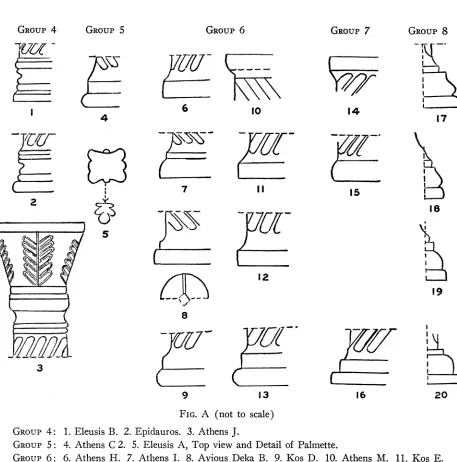
L. BENSONGROUP 4 GROUP 5 GROUP 6 GROUP 7 GROUP 8
6
4 17
~~~~~~~~~~~~~~~~~~Is
11 15
2 8 18
? S X ~~~~~~~~~12 1
3
-
~
~~~9~
13 16 20FIG. A (not to scale)
GROUP 4: 1. Eleusis B. 2. Epidauros. 3. Athens
J.
GROUP 5: 4. Athens C 2. 5. Eleusis A, Top view and Detail of Palmette.
GROUP 6: 6. Athens H. 7. Athens I. 8. Ayious Deka B. 9. Kos D. 10. Athens M. 11. Kos E. 12. Kos F. 13. Samos.
GRouP 7: 14. Corinth F. 15. Kos C. 16. Naxos.
SPIRALLY FLUTED COLUMNS IN GREECE 263
ideal; I cannot, however, at the present time offer anything better, for it seems the only basis on which to make a few general observations on possible chronology and use, as can be seen from the text. Some pieces are listed more than once under this system. A supplement on columns in Cyprus is offered in Section C.
Abbreviations used: L.-length; D.-diameter (of actual column, not worked end unless
otherwise stated) ; Dist.-distance between centers of arrisses; Depth-depth of fluting measured
from arrisses; H.-height of worked end measured to fluting; Rht.-righthand twists; Lht.-
Lefthand twists. All measurements given in centimeters unless otherwise noted.
SECTION A: CATALOGUE OF MONUMENTS
ATHENS A 1-2 (Acropolis). Outside museum
on north revetment. Two fragments, one seem- ingly broken at both ends (see below) with spiral fluting only (P1. 45, c), the other cer- tainly broken at both ends, with spiral and vertical fluting separated by a band of lightly incised continuous horizontal chevrons 5 cm. wide (P1. 45, d). The two fragments, which have a diameter of 26.5 cm. throughout and are of the same marble, are obviously from the same monument, if not column. It was not feasible to test for joins. The marble is very light, almost white, but with gray streaks and weathers to a dark gray; in general, reminiscent of the coarser variety of Parian.
A 1: L. 88, Dist. 4.5, Depth ca. 0.3. One end may possibly represent a badly mutilated worked end but D. still normal. Rht. 10.
A 2: L. 73, Dist. 8.5 (filled fluting). Small hole 3.5 (D.), 4 cm. deep, bored in spiral flut- ing. Rht. 10.
One or both of these must be the column referred to by Belger, Arch. Anz., 1895, cols. 15-16.
ATHENS B (Acropolis). Outside walls, on left side of path leading up to new entrance. Entire lower portion (filled fluting) preserved plus a small portion of spiral fluting (P1. 45, b). Coarse white micaceous marble weathering to dark gray. Small hole bored in spiral fluting. Very flat arrisses in spiral fluting apparently influenced by extremely linear treatment of vertical fluting.
L. 108 (vertical fluting alone, 73), D. 30, Dist. 4.5 (spiral), 9 (vertical), H. 6, Lht. 12
(?), 10(?) vertical flutes (both estimated be- cause piece could not be moved).
ATHENS C 1-2 (Acropolis). On terrace inside new entrance. Two fragments of dark gray limestone of which one preserves a worked end (Fig. A, 4; Pl. 47, a). It is quite possible that both belonged to the same monument.
C 1: L. 28, D. 16, Dist. 2.5, Depth ca. 0.3, Lht. 16.
C 2: L. 42, D. 14.5, Dist. 2, Depth ca. 0.3, H. 8, Rht. 16.
ATHENS D (Agora A 2718). Part(?) of column buried upright in ground on first terrace below Church of the Holy Apostles. 58 cm. ex- posed. Extremely battered and weathered. Rather coarse-grained light gray stone with dark gray mottling and much mica. An ap- proximate diameter obtainable in only one spot because of extensive damage to one side, 21.4. Dist. 3.5. Arrisses extremely eroded. Number of flutes could only be estimated at 10 or 12
(Lht).
ATHENS E (Agora A 2707). Fragment in very bad condition, fluting nearly obliterated; traces of a worked end approximately 6 cm. high which seems to have been chipped away (Pl. 46, b). Light to dark gray flaky stone with some mica, in consistency between marble and limestone.
L. 37, D. 15 (may have tapered slightly), Dist. 2.5, Lht. 16.
264 J. L. BENSON
architectural fragments in the Agora. F 1-2 (A 2708 a-b) are badly eroded fragments of a very coarse granular marble, crumbly and with conspicuous quartz, weathering to a slight- ly yellowish gray. Very possibly from the same monument.
F 1 (P1. 47, b): L. 20, D. 10.5 and 12 resp., Dist. 2.5, Depth (est.) 0.3, Lht. 7.
F 2 (P1. 47, c): L. 27, D. 15 and 16 resp., Dist. ca. 3, Depth (est.) 0.2, Lht. 12.
F 3-4 are slightly better preserved, though jaggedly broken, fragments of dark gray mica- ceous stone in consistency between limestone and marble, and exhibiting large lumps of car- bonized material. Probably from the same monument.
F 3 (P1. 47, d): L. 36, D. 16.5 and 18 resp., Dist. ca. 3, Depth ca. 0.2, Lht. 18.
F 4 (Pl. 48, a): L. 26.8, D. 22, Depth ca. 0.2, Lht. 20.
In general, cf. Annuaria, IV-V, 1921-1922,
p. 35, fig. 2, in which an unidentified fragment of spirally fluted column from Ayia Pyriotissa is visible.
ATHENS G (Agora A 2710). Lower part of
well-head with vertical wavy fluting and mould- ed base (Fig. A, 17; P1. 51, f). Dead-white, fine-grained micaceous marble.
L. 21.5, Pres. circumference of base 26, Dist. 3.5, H. 9.8, Width of wall (to arrisses) 4.5.
ATHENS H (Kerameikos). Outside apotheke at corner of Kerameikos. Fragment preserving one worked end (Fig. A, 6; P1. 48, b). Very coarse-grained gray to blue-gray marble weath- ering to a rather light gray-blue; in fair con- dition.
L. 88, D. 26.5 (apparently no taper), Dist. 3, Depth 0.5, H. 9, Lht. 20.
ATHENS I (Kerameikos). Location as fore- going. Fragment with one worked end (Fig. A, 7; Pl. 48, b). Blue-gray stone of rather poor, coarse quality, in consistency between limestone and marble, weathering to a bitumin- ous appearance. Badly eroded on one side.
L. 58, D. 22.5 (apparently no taper), Dist. 2.5, Depth 0.3, H. 6, Rht. 20.
ATHENS J (Naos MeTauop+4Wroeo, Plaka, at foot of Acropolis). In a kind of alcove built onto the righthand side of the church, in which there are also other small Byzantine architec- tural fragments, one sees a small part of a taper- ing column with a moulded base (Fig. A, 3) buried upright in an earthen floor. The column appears to be of Pentelic marble and is subject to the depredations of continual moisture. On top of the base rests a capital of the same marble 27 cm. in height and flaring from a circular base to a 30 cm. square face at top. A simply stylized leaf pattern adorns the block. The question of the relation of capital to column and of both to the church is obscure to me (cf.
'ApX. 'E+., 1913, pp. 137-143 for a discussion
of the history of the church, which is assigned to the thirteenth or fourteenth century). The capital must surely be dated centuries before the construction of the church (cf. its similarity to a capital from the Asklepieion, 'ApX. 'E+., 1915, p. 39, fig. 10) and may possibly have been used with the column on which it now rests. Professor Orlandos suggests a date in the eighth or ninth century for the capital, and in this case it is surely later than the column.
L. (above ground) 40, D. 19, Dist. 4.2, Depth 0.5, H. 18, Lht. 12.
SPIRALLY FLUTED COLUMNS IN GREECE 265
L. 224.5, L. (of spiral section) 146, D. 30 and 32 resp. giving a slight upward taper, Dist. 4, Depth 0.5, Rht. 16.
ATHENS L (Stoa of Hadrian). Fragment of flint-gray limestone in bad condition (PI. 46, a). One end chipped away to less than di- ameter of column. This end is flat and has a roughly circular sinking 7 cm. in diameter and 5.5 cm. deep. Opposite end broken. Arrisses quite wide and blunt (not entirely due to weathering).
L. 55, D. 28.5 (no taper), Dist. 4.3, Depth 0.6, Rht. 20.
ATHENS M 1-2 (Theatre of Dionysos). Lying just behind the raised stage of the latest period are two fragments obviously belonging to the same column but not joining (Fig. A, 10; P1. 48, d). Dark blue-gray fine-grained limestone now badly weat-hered. M 1 has a worked end from which there is a distinct flare to the largest part of M 2.
M 1: L. 71, D. 25, Dist. 3, Depth 0.2, H. 8.5, Rht. 22.
M 2: L. 67.5, D. 25 and 27.5, otherwise like M 1.
AYious DEKA, CRETE A 1-2 (Main street) .7
Two fragments of gray(?) marble now com- pletely whitewashed and used as pillars of a small porch (P1. 49, b-d). Dr. Rizza was of the opinion that they belonged to the same column. I am puzzled by the supplementary fragments used to raise the spiral columns to the desired height. One of these has apparently vertical fluting, similar to, but not identical with, filled fluting (see P1. 49, d). The other looks like, but may not be, a crude square capi- tal (or cement base?).
L. of both given as 115, D. ca. 27 with a very slight taper in each column, Lht. 20.
AYious DEKA, CRETE B (Museum). Fragment
with worked end, split laterally, half remaining (Fig. A, 8; P1. 49, a). Rather fine-grained, yellowish marble with blue-gray veins (local?) There is a 5 cm. square sinking in the worked end with a channel ca. 0.5 cm. deep diagonally to perimeter (cf. Corinth D 2).
L. 21, D. ca. 20, Dist. 3, Depth 0.7, flat, well- cut arrisses 0.4 wide, H. 5.5, Rht. 20 (est.).
CHIos. Column probably from the colonnade of the Basilica of St. Isidore; A. C. Orlandos, Monuments byzantins de Chios, II (planches), Athens, 1930, pl. 2'c. Two columns are illu- strated: one with concave fluting above, filled fluting below; the other has spiral fluting which becomes almost vertical in the lower portion and is left unfluted in the upper portion. If these belong to the sixteenth or seventeenth century period of the basilica, as seems indi- cated by the plan on pl. 1, then they must have been re-used or have remained from an earlier period.
CORINTH A (R. L. Scranton, Corinth, XVI, Mediaeval Architecture, Princeton, 1957, p. 108, pl. 24, 43, AM 425). Fragment of Pen- telic marble. " Treated at bottom with fluting resembling an Ionic shaft, above this with spiral fluting. Excellent work." As the author seems to imply, this is obviously Early Christian rather than mediaeval.
L. 104, D. at bottom 31, at top 26.
CORINTH B (Julian Basilica). In a pile of architectural fragments. Small piece of rather dark gray limestone with much mica. Very jagged breaks which have resulted in the virtual destruction of the piece. It can be stated with certainty that there were more than 17 twists.
L. 45, D. (est.) 28, Dist. 3.5, Depth 0.8.
CORINTH C (between Babbius monument and West Shops). Large fragment with simply worked end (P1. 51, d). Coarse-grained white
266 J. L. BENSON
marble weathering to a light blue-gray and the appearance of limestone. A large sliver is broken free from the side of the column but still rests on it.
L. 107, D. 30, Dist. 4.3, Depth 0.4, Lht. 15.
CORINTH D 1-5 (Peirene Fountain). Various fragments obviously deriving from one monu- ment (P1. 51, b, c). All are of the same ma- terial, a white, somewhat coarse-grained marble with gray mottle, and same cut: Dist. 3.5, Depth 1, 24 twists, some righthand, some left- hand.
D 1: L. 150, D. 34 (possibly tapering), Rht. D 2: L. 80, D. 30 and 32 resp. Remains of a sinking about 7 cm. square with a small channel 2.5 cm. wide, 1 cm. deep running off at right angles to side of square. Lht. Cf. Ayious Deka B.
D 3: L. 45, D. 33 and 34 resp., Rht.
D 4 (P1. 51, b): L. 65, D. 33, H. 6. Simply worked end; very much battered. Lht.
D 5: L. 20. Sliver of same type as D 4.
CORINTH E (Lechaion Road, near city gate). Small badly damaged fragment of grayish coarse-grained marble. The worked end, pared down and badly destroyed, has remains of sink- ing at least 8 cm. square.
L. 22, D. 32, Depth 0.5, 24 twists.
CORINTH F (near Fountain of Glauke). Frag- ment with simply worked cut end (Fig. A, 14; P1. 50, c). Coarse gray marble with consider- able mica. Part of worked end missing. This has a roughly circular sinking 7 cm. in diameter. There is another sinking 6 cm. square, 5 cm. deep on the column itself.
L. 176, D. 38 (with possible taper), Dist. 4, Depth 0.9. Arrisses broad and flat. Lht.
CORINTH G (Acrocorinth). Large fragment standing upright on wall inside third gate of fortress. No details available. For possible provenance see buildings described in Corinth, III, i, pp. 21 ff.
DELOS A (W. Deonna, Delos, XVIII, Le Mo-
bilier De'lien, Paris, 1938, p. 55, pl. XXV, 174). " White marble." No exact provenance given. Curious, apparently complete, column with spiral flutes in a very nearly vertical position, rising from a large tuft of acanthus. The low height (65 cm.) makes the purpose of the object uncertain but it must be a stand of some sort unless hollowed out (which is neither stated nor implied in the text). The fluting is terminated against a plain moulding at the top.
DELOS B (Delos, XVIII, p. 56, fig. 80). Frag-
ment of white marble ( ?) representing the lower part of a column like pl. XXV, 176 of same publication. L. 57. Found in the ruins of a house between the Hypostyle Hall and the sea. The very schematic drawing makes it appear that the column is hollow.
DELOS C (Delos, XVIII, p. 56, pl. XXV, 176).
"White marble." Complete colonnette from north of the Agora of the Competaliastes. L. 64. Elaborately moulded termination at each end. Placed on a high square plinth. The sketch (op. cit., p. 55, fig. 79) is poor and mis- leading; the flutes are cut, not moulded. The piece appears to be eroded.
DELPHI A-B. Among numerous architectural fragments on the first terrace parallel to the motor road between the museum and the sanctu- ary are two fragments of dark blue-gray, rather fine-grained limestone with some mica. Very probably from the same monument. I am grateful to Monsieur P. Courbin for procuring me the following information: " Elles ont ete trouvees pendant la ' grande fouille ' (1890- 1904!) 'avec' beaucoup d'autres vestiges de date chretienne. Elles ne figurent pas dans les croquis du carnet de fouilles."
A: L. 74, D. 22 (with slight taper), Dist. 3, Depth 0.3, Lht. 17. Very jagged break at each end.
SPIRALLY FLUTED COLUMNS IN GREECE 267
ELEUSIS A (outside Museum). Fragment of a small column with simply stylized Corinthian capital carved from the same block (Fig. A, 5; P1. 47, e, f). The marble is dark gray, fairly coarse-grained and does not appear to have weathered much although there is a cer- tain hard, golden-colored incrustation over much of the surface, which is otherwise light- colored.
L. 35 (including capital which is 18.5), Width of capital block 15.5, D. 13, Dist. 2.5, Depth 0.25, Lht. 16.
ELEUSIS B (outside Museum). In a heap of architectural fragments at the side of the mu- seum is a fragment of column with an elabo- rate moulded base (Fig. A, 1; P1. 46, c). Dark gray coarse-grained marble similar to that of Eleusis A but not weathered nor encrusted. Professor Orlandos tells me that this was al- most certainly part of a baluster.
L. 39, D. 17.3, Dist. 2.8, Depth 0.6, H. 10, H. (of plinth) 4, plinth ca. 22 square, Lht. 12. Barely visible in the photograph behind this column is a sliver of another much larger frag- ment with fluting only slightly deviate from the vertical, something like Delos A.
EPIDAUROS (in front of Museum, near care- taker's house). Fragment with an elaborate worked end (Fig. A, 2; P1. 46, d). Material is white coarse-grained marble, probably Nax- ian, with some gray imperfections, badly weath- ered on one side. The worked end consists of two narrow rings set on a concave, then a convex, element; below this, a plinth.
L. 66, D. 17.6 and 21.6 resp., Dist. 2.9, Depth 0.6, H. 8.3 (not including plinth), plinth 23 square, Lht. 12.
GORTYN, CRETE (opposite Ayios Titos). On river bank opposite Ayios Titos (on other side of river) is a large column (fragment?) buried upright in the ground (P1. 50, e). Near by is another similarly placed column (exposed end ca. 117 cm. in height) with completely eroded surface (P1. 50, d). Both stand only several
hundred meters distant from the cavea of the theatre, a circumstance which, taken together with their large size, lends credence to the natural assumption that they originated there (on theatre, cf. A.J.A., VI, 1902, pp. 105-112; Arch. Anz., 1937, cols. 178ff.). The material of the spirally fluted column is a dark gray, coarse-grained limestone(?) with white spots. The exposed end has been chipped away to less than the diameter of the column and has a sinking 4 cm. square and deep. The arrisses are wide (0.8 cm.) and carefully cut, though now badly chipped.
L. 116, D. 43 and 45 resp., Dist. 4.5, Depth 1, Rht. 24.
Kos A (Casa Romana). In front of house en- closure. Large column fragment of dark gray, close-grained stone, basalt or something similar to basalt (P1. 50, b). Cf. Kos C. Both ends appear to be roughly cut and one has a circular sinking 5 cm. in diameter and 7 cm. deep.
L. 153, D. 42 and 44 resp., Dist. 4, Depth 0.5, Lht. 24.
Kos B (Casa Romana). Fragment of column broken at both ends which have been evened up with cement (P1. 47, g). Dark gray close- grained stone like Kos A. Only known proven- ance: courtyard of Catholic church formerly opposite Akteon Hotel.
L. 90, D. 18.5 and 20 resp., Dist. 3, Depth 0.4, Lht. 18.
Kos C (Kastro). On spit of land before Kastro at harbor entrance. I am indebted to Mr. Niko- laides for the information that this piece and others in the same location were probably col- lected from various places after the 1933 earth- quake and that they had been built into build- ings. Drum with simply worked end (Fig. A,
15; P1. 50, a). Cut of unworked end quite rough. Material and cut same as that of Kos A. Considerable traces of a whitish incrustation which looks like stucco.
268 J. L. BENSON
Kos D (Kastro, as C). Fragment of column with simply worked end (Fig. A, 9; P1. 50, a). Stone similar to Kos A. Piece badly cracked and chipped.
L. 68, D. 24.5, Dist. 3, Depth 0.3, Lht. 20.
Kos E (Kastro, as C). Fragment of column with simply worked end (Fig. A, 11; P1. 50, a). Small sinking at center of both ends roughly 4 cm. square. Stone similar to Kos A but lighter and more like marble in consistency. Numerous traces of incrustation.
L. 90, D. 27.5, Dist. 3, Depth 0.5, H. 8, Lht. 22.
Kos F (Kastro, as C). Fragment of column with simply worked end (Fig. A, 12; P1. 48, f). Broken jaggedly and much encrusted (not stucco). Workmanship in general quite inexact, giving an asymmetrical appearance to the column, although the individual flutings are cut cleanly and sharply. Coarse-grained white mar- ble (Naxian?).
L. 59, D. 25, Dist. 4, Depth 0.4, H. 11, Lht. 16.
LINDOS (Acropolis). In Commandant's Quar- ters, upstairs. Fragment of dark blue-gray marble, undoubtedly hewn on the Acropolis it- self, roughly broken at both ends (P1. 48, e). Arrisses cut squarely. I should not postulate any direct connection with the adjoining Ayios Ioannis tou Kastrou of the thirteenth century
('ApXEdov, VI, 1948, pp. 80-83, figs. 64-65), unless it was re-used there, but possibly with a predecessor.
L. 68.5, D. 19.7 and 21.5 resp., Dist. 3.5, Depth 1.2, Rht.
There is. also a tiny fragment of a much smaller spirally fluted column in the Com- mandant's Quarters.
MAVROMATI-ITHOME (Museum). On doorstep
outside museum, a fairly well preserved frag- ment with an elaborate worked end on a plinth (P1. 46, e). Light gray marble showing rust- colored stains.
L. 68.5, D. 12.7 and 19.7 (notice pronounced taper), Rht. 13.
NAXOS (Museum). Fragment with worked
end from church in ruins of temple ' Sto Palati ' (Fig. A, 16). Very dark stone, blue- gray in hue, which weathers to a volcanic- looking, completely honeycombed surface. Bad- ly weathered.
L. 76, D. 33, Dist. 3.2.
Also in the museum are two fragments of a small column of a type suitable for stand or ciborium. Naxian marble. D. 10.2.
NEA ANCHIALOS A-B (Basilica). (G. Soti-
riou 'At Xpun-ttavtKa't @,r/at Trys 0Eco-oaXia%, 'E+. 'Apx., 1929, pp. 1-158). Soteriou, p. 24, fig. 26 shows a large fragment of fluted column with pared-down end. Apparently resting on it is a fragment of capital. Another column fragment of the same kind is mentioned on p. 95 (no. 4). A reconstruction of the pulpit to which this belonged is presented in fig. 107 (p. 87) and plate A.
NIKOPOLIS (Mosque). (IlpaKTtKa', 1914, p. 237,
fig. 9, a). Rough sketch of a spirally fluted column with a moulded termination and above this a six( ?)-sided capital. No dimensions nor other details are given. All the architectural pieces of fig. 9 are designated as Byzantine.
IIpaKTtKa, 1915, p. 61, fig. 1, apse of the Chris-
tian basilica with a fairly large fragment of spirally fluted column (unfortunately in sha- dow) lying in a mass of debris. Perhaps 60- 70 cm. in length.
PATMOS (Church inside Monastery of Ayios
Ioannis Theologos). Casually illustrated in
Clara Rhodos, VI-VII, 3, pp. 707-801, figs. 4, 5.
PATRAS (Odeion). Between modern street and
SPIRALLY FLUTED COLUMNS IN GREECE 269
L. 101, D. 16 and 19 resp., Dist. 4, Depth 1, Rht. 12.
Cf. also A. Lenoir, Architecture monastique,
II and III, p. 186, no. 417.
PIRAEUs A-C (Theatre). Numerous small fragments among the architectural debris with nearly vertical wavy fluting. Among these I noted three separate types of moulded base. Presumably the other fragments without bases belong to one of these types. Since in all cases the columns seem to have been hollowed out, they must be well-heads.
A: Close-grained light gray limestone (Fig. A, 18). L. 33, Pres. D. 53 (est. total D. 56),
Dist. 4, Depth 0.6, Width of wall 5.5.
B: Close-grained light gray limestone with schist( ?) (Fig. A, 19). Pres. D. 62 (est. total D. 70), H. 8, Width of wall 5.2.
C: Close-grained dead-white marble with mica (Fig. A, 20; P1. 51, e). L. 55, Pres. D. 29, Dist. 4.5, Depth 0.5, H. 10, Width of wall
7.5.
RHODES A (Fountaln house of Sultan Monu-
stapha Mosque). The fountain house is an octagonal structure supported by eight Byzan- tine columns with separate capitals, all broken off about 3 cm. below the " abacus " ring (P1. 45, e, f). Likewise bases are all separate, hav- ing been broken off just above moulding. The plinths were all originally tetragonal. It appears from material, cut, proportions and general effect that all members of the present peristyle (capitals, columns and bases, now rejoined arti- ficially with cement) were originally created for one architectural complex. The only explana- tion which occurs to me for such a procedure is that the builders of the fountain house needed to reduce the height of the columns to suit their own specifications.
One of the eight columns is of the composite type with the two types of fluting separated by an undecorated ring. There is a roundish hole several centimeters wide at the upper end of the vertical fluting with a lump of iron in it. The marble (like that of all the other columns, capitals and bases) is rather coarse-grained with much mica and irregular pockets of dark gray osseous-looking material. Flakes and weathers to dark gray.
L. (without capital and base) 145.5, upper fluting 8.5, lower fluting (with ring) 60.5, D. 29.6 and 32 resp. (notice upward taper), Dist. (spiral fluting) 4, Depth 0.8, Dist. (filled flut- ing) 6.4, Capital 18.2 (height), Base 40.7, Rht. 16.
RHODES B (Museum). Fragment of a baluster;, 'ApXeZotj VI, 1948, p. 18, fig. 13. Evidently serving as a division between two plaques of the orthostate, to one of which it is attached, is a small spirally fluted column with simplified Corinthian capital.
RHODES C (Ialysos). Fragment of a sarcopha-
gus of the Asia Minor type; 'ApXEtov, VI, 1948,
pp. 51-53, figs. 44-46. Spirally fluted columns with capitals very similar in appearance to Eleusis A.
SAMOS (Pythagoreion). Fragment built into garden wall of house on main street leading west out of Pythagoreion (Tigani) towards the Heraion; near edge of town. Worked end turned up and visible, lower end plastered into wall (Fig. A, 13; P1. 48, g). Mottled dark gray close-grained limestone containing veins of coarse-grained white marble; said to come from Kouphia Spelia near Tigani.
270 J. L. BENSON
SECTION B: SUMMARY BY TYPES
1. Composite columns. It need hardly be pointed out that, in addition to the examples listed under this category, various other frag- ments of spirally fluted columns listed under other categories could be the upper portions of composite columns:
Athens A 1-2, B, K Corinth A
Rhodes A
Cf. also Ayious Deka A 1-2
2. Columns with pared ends: Athens E, L
Corinth E Gortyn
Nea Anchialos A
3. Columns with a small sinking in the worked end (or cut end):
Athens K, L Ayious Deka B Corinth D 2, E, F Gortyn
Kos A, E
4. Small columns of type suitable for stands, lampholders, etc. (Fig. A, 1-3):
Athens j (?)
Delos B, C Eleusis B Epidauros
Mavromati-Ithome Patras
Cf. also notes on Lindos and Naxos
5. Miscellaneous columns of small size,48 under 20 cm. in diameter. This group is obviously related to the foregoing with which its pieces
may in some cases be interchangeable (Fig. A,
4-5):
Athens C 1-2, E, F 1-3 Eleusis A
Kos B
6. Miscellaneous columns of medium size, be- tween 20 and 29 cm. in diameter (Fig. A, 6- 13):
Athens D, F 4, H, I, L, M 1-2 Ayious Deka A 1-2, B
Corinth B Delphi A-B Kos D-F Lindos Samos
7. Miscellaneous columns of large size, 30 cm. or more in diameter (Fig. A, 14-16):
Corinth C, D 1-5, E, F Gortyn
Kos A, C Naxos
8. Objects with vertical wavy fluting (Fig. A, 17-20). These are noted here as being related to the theme of spirally fluted columns. They are almost certainly well-heads with the ex- ception of Delos A. I have also noted a large hollowed-out drum (of vertical fluting) on the Athens Acropolis between the Erechtheion and the Parthenon (East side) which must cer- tainly have been a well-head.
Athens G Delos A Piraeus A-C
Cf. also note on Eleusis B
48 It should be noted that no dimensions are available for Corinth G, Nea Anchialos and
U)
ANALYSIS OF SPIRALLY FLUTED COLUMNS AT KOURION
(measurements in meters)
iii v vi
ii PRES. iv NO. OF ARRISS Vii Viii ix X xi
COLUMN MATERIAL LENGTH DIAMETERS CHANNELS WIDTH CHANNEL PITCH TWIST c
(a) (b) (c) (d) Width Depth L. F. H
A. Demeter ?Basalt, dk. gray 2.00 0.59 22 0.015 0.044 0.018 2.40 (?) 4.06 R
B. " . " . 2.32 0.58 22 0.012 0.042 0.019 2.024 3.86 R
o
C. Basilica Marble, gray 0.93 0.31 0.26 0.26 20 0.008 0.025 0.005 0.97 3.73 L
D. Theater " " 1.86 0.45 0.43 0.37 24 0.008 0.034 0.015 R
E. Curium House " " 1.64 0.40 24 0.009 0.033 0.012 R
F. Turk. House " " 1.57 0.446 0.39 24 0.007 0.030 0.010 R Z
G. Ay. Erm. " " 0.40 0.39 24 0.009 0.028 0.010 L
272 J. L. BENSON
SECTION C: ADDITIONAL COLUMNS IN CYPRUS
There are two complete columns lying outside the church of Kyra (Nicosia District), alleged to have come from the ruined church of Ayios Stephanos (Cyprus Survey Serial No. 207) in Kyra village. I wish to thank Dr. H. W. Catling of the Cyprus Survey for information and photographs
(P1. 51, a) of these columns as well as for permission to publish them. A: L. 233.8, D. 26.7 and 30.5, H. 6.3, Lht. 16.
B: L. 241.5, otherwise as A.
Base: 42 cm. square at bottom, 35.6 cm. in diameter at top, 12.7 cm. in height.
These columns, being complete and of good workmanship, illustrate very well category 6 of Section B and were no doubt used in an interior colonnade of the church from which they came. There is in this case, however, no reason to suspect that they are re-used ancient columns; they must be contemporary with the church.
Mr. J. S. Last of Episkopi, Cyprus has kindly furnished me with an enlarged table of data concerning spirally fluted columns from Kourion, set up in a form which has possibilities for use in a corpus of such columns. It seems desirable to publish this here in order to facilitate comparison with the categories established for columns in Greece. I am responsible for an error which occurred in the transcription of a heading in his original table (A.J.A., LX, 1956, p. 386), which is, of course, superseded by the present table.
J.
L.
BENSON
PLATE 45
a. Athens K b. Athens B e. Rhodes A
L
~ ~
~
c. Athens A 1
d. Athens A 2 f. Rhodes A