R E V I E W
Open Access
HIV-associated synaptic degeneration
Wenjuan Ru and Shao-Jun Tang
*Abstract
Human immunodeficiency virus (HIV) infection induces neuronal injuries, with almost 50% of infected individuals
developing HIV-associated neurocognitive disorders (HAND). Although highly activate antiretroviral therapy (HAART)
has significantly reduced the incidence of severe dementia, the overall prevalence of HAND remains high. Synaptic
degeneration is emerging as one of the most relevant neuropathologies associate with HAND. Previous studies
have reported critical roles of viral proteins and inflammatory responses in this pathogenesis. Infected cells, including
macrophages, microglia and astrocytes, may release viral proteins and other neurotoxins to stimulate neurons and cause
excessive calcium influx, overproduction of free radicals and disruption of neurotransmitter hemostasis. The dysregulation
of neural circuits likely leads to synaptic damage and loss. Identification of the specific mechanism of the synaptic
degeneration may facilitate the development of effective therapeutic approaches to treat HAND.
Introduction
There are almost 37 million HIV-infected people
world-wide, with over 1 million in U.S in 2015 (https://
www.hiv.gov/hiv-basics/overview/data-and-trends/statis-tics). No cure is currently available. HIV attacks the
im-mune system, especially CD4 T cells, leading to imim-mune
dysfunction. Soon after the infection, HIV enters the
central nervous system (CNS) and causes neurological
dysfunction. Even with the effective anti-retroviral
ther-apy that suppresses viral replication and transmission,
about 70% of HIV patients still develop neurological
complications [1]. Multiple neurological disorders are
manifested in HIV patients.
HIV-associated neurocognitive disorder (HAND) is a
common primary neurological disorder associated with
HIV infection of the CNS. Patients with HAND often
develop cognitive impairment, motor dysfunction and
speech problems. Clinical severity of HAND ranges from
asymptomatic neurocognitive impairment and mild
neu-rocognitive disorder to HIV-associated dementia (HAD)
[2]. Due to the success of HAART, HAD has declined,
with a prevalence of less than 5% of HIV patient who
are on the treatment [3]. However, the mild forms of
HAND are still common and significantly affect a
pa-tient
’
s quality of life.
Neuropathy of the peripheral nerves often develops in
HIV patients. With the improved survival of HIV
pa-tients on HAART, the prevalence of HIV-associated
neuropathy has increased, with about 42% of HIV
pa-tients showing neuropathy symptoms [4]. The clinical
symptoms include unusual sensation, numbness and
se-vere pain. However, pathological analysis of autopsies
in-dicate that almost all patients with AIDS develop
peripheral neuropathy, including those who did not
show clinical symptoms [5].
HIV-associated vacuolar myelopathy (VM) is
com-monly associated with late stages of HIV infection. Of
AIDS patients, 20
–
55% exhibit symptoms of VM [6].
Vacuolization in dorsal and lateral tracts in the thoracic
spinal cord is a common pathological characteristic.
Pa-tients with VM manifest progressive weakness of legs
and sensory abnormalities, and VM may ultimately lead
to paralysis of lower limbs [6].
In addition to HIV infection, anti-retroviral therapy may
also contribute to neurological disorders. HAART is the
current standard treatment for HIV infection. It is a
cus-tomized combination of different classes of antiretroviral
agents, including nucleoside reverse transcriptase
tors (NRTIs), non-nucleoside reverse transcriptase
inhibi-tors, protease inhibiinhibi-tors, integrase inhibitors and entry
inhibitors. For example, patients treated with NRTIs are
prone to develop neuropathy and/or myopathy in a
dose-dependent manner [7
–
9]. A major side effect of protease
inhibitors on the CNS is lipodystrophy syndrome, which
is characterized by peripheral fat wasting and central
* Correspondence:[email protected]Department of Neuroscience and Cell Biology, University of Texas Medical Branch, Galveston, TX 77555, USA
adiposity [10]. NRTIs have also been linked to
lipodystro-phy [11]. HAART was also reported to increase the
inci-dence of encephalitis [12] and induce neuropathy [13].
In this review, we will focus on HAND. In particular,
we will critically consider the current understanding of
HAND neuropathogenesis from three related aspects:
the neuropathogenic underpinnings, the model systems
for mechanistic studies, and potential mechanisms of
HAND-associated synapse degeneration.
Neuropathology of HAND
Early stages
Although 70% of people with HIV have
neuropatho-logical abnormalities in the era of HAART [1], only a
few studies have reported neuropathology in
HIV-infected individuals before the onset of AIDS due to the
limited availability of postmortem brains. Most HIV-1
patients remain neurologically unimpaired during early
pre-AIDS stages. It generally takes 3 to 6 weeks to
be-come seropositive after HIV infection, and this period is
known as seroconversion. During seroconversion, 50–
70% of HIV-infected people experience transient
“acute
HIV syndrome”, such as symptomatic meningitis [14],
encephalopathy [15, 16] or myelopathy [17]. Some
clini-copathological studies revealed that the CNS entry of
HIV-1 might also induce demyelination in the white
matter during seroconversion [18, 19].
Asymptomatic period
After the seroconversion period, HIV infection enters a
latency phase called the asymptomatic period, which
usually lasts for 8–10 years. Neurological pathologies are
noted during this stage, especially in the white matter,
although the pathological changes are not consistent.
Vascular inflammation is frequently observed in the
white matter and basal ganglia, and microglial activation,
astrocytosis and myelin pallor are observed in the white
matter during this stage [20–22]. Although microglial
activation is observed in the cerebral cortex [23], neuronal
loss and astrocyte proliferation are rarely seen there [22].
AIDS stage
Autopsies found that 80–100% of AIDS patients had
neuropathological changes in the CNS [24–27]. HIV-
as-sociated encephalitis (HIVE) was also observed in some
patients at this stage. The neuropathological
characteris-tics of HIVE include microglial nodules, multinucleated
giant cells, reactive astrocytosis, microglial proliferation,
myelin pallor, and infiltration of peripheral monocytes
[28–31]. In contrast to the pre-AIDS stages, when
neuronal loss is not seen, neuronal death is frequently
observed in AIDS patients [32]. Significant neuronal
loss has been reported in the frontal cortex [32–34].
Neuronal death via apoptosis occurs in AIDS patients
[35, 36]. Non-apoptotic neuronal injuries, including
re-traction of dendritic spines, dendritic pruning or aberrant
sprouting, axonal disruption and synaptic degeneration,
were also observed. Immunostaining analysis of
postmor-tem brain tissues using synaptic and dendritic markers
re-vealed dendritic beading, synaptic degeneration and
dendritic spine loss in the brain of HIV patients [37–39].
Axonal injury indicated by elevated neurofilament protein
in CSF is also detected in HIV patients [39–41]. Loss of
synaptodendritic structures in HIV patients is
corre-lated with reduced volume of neuropil and white
matter [41, 42].
Synaptic degeneration and HAND
Multiple studies have been carried out to identify the
neuropathological underpinnings of HAND. Both HIV
encephalitis and neuronal loss are observed in the brain
after HIV infection, and they appear to associate with
se-vere dementia. However, they do not correlate well with
milder forms of cognitive impairment [43]. HIV
en-cephalitis occurs in some but not all HIV-infected
indi-viduals. Its presence and severity do not correspond to
the degree of cognitive deficits [44–46]. In addition,
dif-ferent from other neurocognitive conditions such as
Alzheimer’s or Parkinson’
s diseases, the early dementing
process in HIV patients is not associated with substantial
neuronal apoptosis. Weis et al. reported that AIDS
pa-tients with clinical signs of progressive dementia showed
no significant difference in neuronal densities compared
to patients lacking dementia, indicating that neuronal loss
was not causally linked to the development of dementia
[33]. Nonetheless, synaptic alteration and degeneration in
the brains of HIV patients appear to correlate well
with the presence and severity of cognitive impairment
[38, 47, 48]. Inhibition of synaptic degeneration may
provide an attractive therapeutic target to prevent
HAND pathogenesis.
Animal models of HAND
To investigate the neuropathogenic mechanism of
HAND-related pathologies observed in human patients,
relevant animal models are essential. Several animal
models develop specific aspects of cognitive defects and
neuropathological key features of HAND.
Non-human primate models
For example, pre-synaptic damage was reported in
SIV-infected macaques, as indicated by elevated levels of
neuronal damage marker 14-3-3 protein in the CSF
[54, 55]. SIV-infected macaques developed various
types of behavioral impairments, similar to those
observed in HIV patients, as shown by a number of
be-havioral and neurophysiological testing modalities
[56–60]. This model is particularly useful to study the
pathogenesis of HAND in the era of HAART, because
the infected macaque can be treated with HAART
reg-imens to mimic the clinical settings [61]. It is also very
helpful for the investigation of the synergized effects of
drug abuse and HIV infection during
neuropathogen-esis [62–65]. In addition, because of the multi-time
ac-cessibility of CSF, plasma and CNS samples during the
progression of infection, this model allows the
investi-gation of the development of HAND through the
pro-gressive stages.
Although studies with SIV-infected macaques provide
valuable insights into the pathogenesis of HIV infection,
it is important to keep in mind that SIV and HIV are not
the same. For example, CCR5-preferred HIV can gain
the ability to use CXCR4 to enter into monocyte-derived
macrophages [66, 67], while CCR5-preferred SIV uses
other co-receptors such as CXCR6, GPR15 and GPR but
not CXCR4 to enter host cells [68]. To address these
limitations,
simian-human
immunodeficiency
virus
(SHIV) was constructed, in which the env gene of SIV
was replaced by HIV-1 env. Therefore, the hybrid viruses
are biologically more similar to HIV than SIV.
Macaques infected with SHIV89.6P (CXCR4/CCR5
virus) developed encephalitis characterized by
multinu-cleated giant cells, astrogliosis, microglial nodules,
acti-vated macrophages and astrocytes, and perivascular
cuffing with mononuclear cells in the white matter
[69]. CCR5 (R5)-tropic SHIVSF162P3N virus caused
giant cell SIV encephalitis in approximately 30% of
in-fected rhesus macaques that developed AIDS [70].
Giant cell SIV encephalitis lesions included white
matter damage, necrosis, and astroglial and microglial
activation [70]. SHIVKU, a CXCR4 virus, also could
productively replicate in the CNS of rhesus macaques
and caused pathological changes [71
–
73]. Despite the
significant contributions of non-human primate models
to understanding HIV-1-associated neuropathogenesis,
these models are limited by their availability and high
cost of maintenance.
Rodent models
For reasons that are not completely defined, rodents
can-not be productively infected by HIV-1. To circumvent this
drawback, transgenic mice are generated to express HIV-1
proteins such as the envelope protein gp120 and the
trans-activator of transcription (Tat), both of which are
neurotoxic. In a gp120 transgenic mouse (gp120Tg) model,
the gp120 transgene is controlled by the glial fibrillary
acidic protein promoter, and thus gp120 is restricted to
as-trocytes [74]. The release of astrocytically expressed gp120
protein can affect nearby neurons. Confocal imaging of
brain sections labeled with dendritic and synaptic markers
revealed the dendritic vacuolization, loss of dendritic
spines and presynaptic termini in the neocortex and the
hippocampus [74]. This gp120Tg mouse also showed
reaction of glial cells [74] and impaired proliferation and
differentiation of neuronal progenitor cells [75, 76].
Addi-tionally, aging (12 months) gp120Tg mice developed
defi-cits in motor and cognitive performance [74, 77].
In another transgenic mouse model, the Tat transgene
is expressed in astrocytes in a Dox-regulated manner
[78]. The inducible expression of Tat provides the ability
to study the temporal effect of Tat released from
astro-cytes. This transgenic mouse displays degeneration of
neuronal dendrites, neuron death, astrocytosis and
en-hanced infiltration of activated monocytes and T
lym-phocytes, and these alterations are largely observed in
the cerebellum and cortex [78]. Other studies described
more subtle neuronal injuries such as spine loss and
syn-aptic degeneration in hippocampal pyramidal CA1
neu-rons and striatal neuneu-rons [79–81]. The Tat transgenic
mice develop impairments in spatial memory and novel
object recognition memory [78, 81, 82].
Transgenic mice with full-length [83, 84] or
gag-pol
-deleted HIV-1 genomic DNA [85] have been reported.
The integrated HIV-1 genome in the transgenic mouse
somewhat resembles HIV-1 provirus. In addition, the
transgenic HIV-1 genome has the potential to express
multiple HIV-1 proteins. These strengths of this
trans-genic strategy, however, also complicate the result
interpretation for determining the causal relationship
be-tween specific HIV-1 proteins and observed phenotypes.
Despite low levels of viral protein expression, the
full-length transgenic mouse model shows impaired nerve
conduction, axonal degeneration and decreased nerve
fiber density in the peripheral nervous system. They are
also impaired in motor function [83], and show
hyper-reaction of microglia and astrocytes [84, 86].
The HIV-1 transgenic rat has been studied by multiple
groups as a model of HIV-associated neurological
diseases. It contains a
gag
-
pol
-deleted HIV-1 genome
that is controlled by the viral promoter. Since without
individuals on HAART [88]. The 7-to-9-month-old
ani-mals show up-regulated expression of neuroinflammation
markers such as interleukin-1
β
(IL-1
β
), tumor necrosis
factor
α
(TNF-
α
) and microglial/macrophage marker
CD11b [89], which may contribute to the observed
synapto-dendritic injury [89]. The transgenic rats develop
spatial learning deficits [90, 91] and are impaired in motor
performance [92].
The HIV-1 transgenic rodent models described above
provide useful tools to study the contribution of viral
proteins to the pathogenesis of HAND. However, they
have significant limitations. Foremost, they do not
ac-quire HIV-1 infection and thus cannot faithfully model
the initial infection stages or the AIDS progression,
which are key events associating with HAND
develop-ment. Understandably, efforts continue to create
add-itional rodent models to mimic HIV infection. One
strategy is to introduce human HIV-1 receptors and
co-receptors in transgenic rodents [93]. However, it appears
that HIV-1 replication was defective in CD4 or CCR5
transgenic rodents [94, 95].
Potash et al. designed a creative approach to generate
a novel mouse model of HIV-1 infection. They
con-structed a chimeric 1 virus by replacing the
HIV-gp120 coding region with the gp80 envelope gene from
the ectotropic murine leukemia virus. This chimeric
virus, called EcoHIV, can enter to the host cells by
bind-ing to cationic amino acid transpoter-1 (mCAT) [96].
Despite the widespread expression of mCAT in the
mouse tissues, persistent infection seems to be restricted
to splenic lymphocytes, peritoneal macrophages and
brain [96, 97]. EcoHIV infection by stereotactic
inocula-tion into the mouse basal ganglia caused pre-clinical
brain pathology such as microglia and astrocyte
activa-tion [96, 98]. However, the lack of gp120 in the chimeric
virus presents specific limitations in this model. First, it
is unclear to what degree the chimeric virus mimics the
HIV-1 infection. For example, it may not target the same
populations of cells as HIV-1. In addition, because
gp120 is a major HIV-1 neurotoxic protein, this model
may not recapitulate some of the neuropathological
phe-notypes related to HAND.
HIV-infected humanized mice are the exciting new
ro-dent models. One strategy is to generate humanized
mice with CNS HIV infection by direct injection of
in-fected human cells. HIV-inin-fected human
monocyte-derived macrophages or HIV-infected human microglia
cells are injected into the brain of severe combined
im-munodeficiency deficient (SCID) mice [99, 100] or
reconstituted SCID mice with human peripheral blood
leukocytes (PBLs) (huPBL/SCID) [101, 102]. SCID and
huPBL/SCID mice with the infected human cells
recap-itulate the several neurological pathologies observed in
HIV patients with HIVE, including multinucleated giant
cells, astrogliosis, microglial activation and neuronal
damage [99–102]. The SCID-HIVE mouse model also
develops cognitive deficits. Morris water maze tests
re-vealed their learning and memory impairments,
regard-less of HAART treatment [103]. Using these models,
isolate-specific cognitive deficits and neuropathology
were reported. Intracranial injection of macrophages
in-fected with a clade B HIV-1 isolate (HIV-1(ADA)) into
SCID mice caused worse performance in cognitive tests
and more severe pathological changes than a clade C
HIV-1 isolate (HIV-1(Indie-C1)) [104].
Another strategy to generate humanized mice is
sys-temic transplantation of human hematopoietic stem cells
(CD34
+cells) or adult human peripheral blood
mono-nuclear cells into various immunodeficient mice so that
the mice host the human target cells for HIV-1 infection
[105–110]. Various neuropathologies were reported in
HIV-infected humanized mouse models. For example,
NOD/SCID-IL-2R
γ
cnul(NSG) mice with engrafted
hu-man CD34+ stem cells (NSG-hCD34+) developed a
functional human immune system containing T
lympho-cytes, monocytes and macrophages could be efficiently
infected with HIV [111–114]. Neuronal and synaptic
damages were detected by immunohistochemical
stain-ing of various neuronal and synaptic markers such as
microtubule associated protein-2, neurofilament and
synaptophysin. The neuropathologies appeared to
cor-relate with glial cell activation [112, 113]. The animals
also showed memory deficits and persistent anxiety
[112, 113]. Although less used for CNS infection, other
humanized mouse models (e.g. humanized bone
mar-row/liver/thymus mouse models) have been used for
studies on HIV pathogenesis, transmission, replication
and prevention.
In vitro models
Primary neuron cultures are useful for studying the
neurotoxicity of HIV-1 proteins such as gp120 and Tat.
Confocal imaging of cultured rat hippocampal neurons
revealed that gp120 application caused a dramatic
de-crease in the number of synapses [115]. Similarly, Tat
treatment also induced synaptic loss [116–118]. In
addition, gp120 was shown to cause dendritic damage in
human primary neurons [115, 119]. Mixed primary
cul-tures that have neurons and glia cells provide an in vitro
experimental setting for investigating the interaction
between neurons and other cell types (e.g. microglia and
astrocytes) during the HIV-induced neuropathogenesis.
Mechanisms of synaptic degeneration induced by
HIV-1 infection
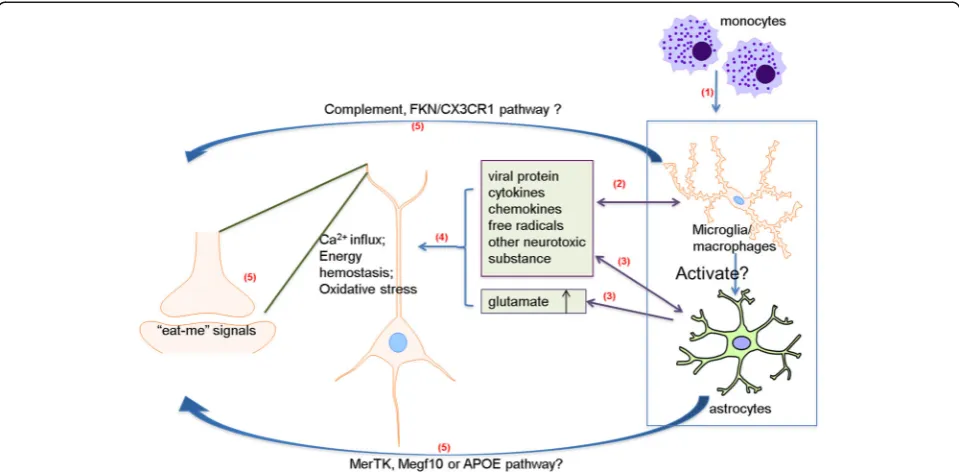
microglia and astrocytes. The infected cells may elicit
neurodegenerative responses by releasing viral
pro-teins and other toxic factors such as chemokines and
cytokines. The neurotoxins may induce arrays of
cel-lular and molecular cascades that eventually lead to
synaptic loss, including Ca
2+overload, energy hemostasis
disturbance, neurotransmitter (e.g. glutamate) metabolism
perturbation, oxidative stresses and excitatory toxicity. In
the following sections, we discuss potential
mecha-nisms regulating HIV-induced synaptic degeneration
(Fig. 1).
Neurotoxicity of viral proteins
Viral proteins, particularly gp120 and Tat, are released
from infected microglia/macrophages and astrocytes.
Gp120 is thought to induce synaptic degeneration via
multiple mechanisms. One suggested pathway is
glutam-ate receptor activation-mediglutam-ated excitotoxicity such as
the hyperactivation of N-methyl-D-aspartate receptor
(NMDAR) and its associated excessive Ca
2+influx [120].
Gp120 can activate NMDARs by binding to their glycine
binding sites [121]. Gp120 may also enhance synaptic
activity by potentiating the phosphorylation and synaptic
trafficking of NMDARs [122]. In addition to stimulating
NMDARs, gp120 can bind to its chemokine co-receptor
CXCR4 or CCR5 on the neurons to mediate neuronal
damage [123, 124]. M-tropic HIV-1 strains preferably
bind to CCR5 [125–127], and T-tropic strains use
CXCR4 to gain entry into the cells [128]. After binding
to its co-receptor, gp120 may facilitate NMDAR
activa-tion and intracellular Ca
2+increase to induce neuronal
damage [129–134] and/or activate signaling cascacades
(e.g. ERK and p38 MAPK signaling pathways) that are
asssociated with cell damage and death [135–137].
Alter-natively, gp120 might cause neurotoxicity via indirect
mechanisms. Gp120 can potentiate NMDAR activity
by inducing release of proinflammatory cytokines from
glial cells [138, 139]. For instance, after binding to the
interleukin-1 receptor, IL-1
β
can stimulate the
phos-phorylation of NR2B at tyrosine 1472 to potentiate
NMDAR activation [138]. In addition, gp120 may
cause glial dysfunction and impair extracellular
glu-tamate reuptake. Accumulated extracellular gluglu-tamate
and NMDAR hyperactivation will induce synaptic
damage [140–143]. Furthermore, the neurotoxicity of
gp120 may be mediated by down-regulating release of
neurotrophic factors (such as BDNF) from activated
glia cells [144–148].
Fig. 1Potential mechanisms of HIV-induced synaptic degeneration. (1) HIV-1 infection of the CNS initiates from transmigration of HIV-1-infected peripheral blood monocytic cells/macrophages across the blood-brain barrier (BBB). Subsequently, microglia and astrocytes become infected and reactivated. (2) The immune-activated and HIV-1-infected microglia/macrophages release viral proteins (e.g. gp120, Tat, Vpr), cytokines (e.g. IL-1β, IL-6, TNF-α), chemokines (e.g. CXCL12, MCP1) and other neurotoxic factors. (3) Infected/reactivated astrocytes can also release neurotoxic substances and pathogenically enhance synaptic activity with increased transmitter release and impaired glutamate re-uptake. (4) The released neurotoxins and extracellular glutamate can cause excessive Ca2+influx, disturbance of energy metabolism and production of reactive oxidative species, which then
By binding to the low-density lipoprotein
receptor-related protein (LRP), Tat protein can cause NMDAR
activation, excessive Ca
2+influx [118, 149–151] and
mitochondrial dysfunction [152, 153]. These Tat effects
trigger downstream events that contribute to synaptic
loss, including the activation of the
ubiquitin–prote-asome pathway [116, 117], the disturbance of energy
metabolism [154] and the production of reactive
oxida-tive species [152, 155]. Tat also stimulates glial cells and
macrophages to release cytokines, chemokines and other
neurotoxic factors that cause neuronal injury [156–158].
Neuroinflammation
HIV-1 enter the CNS soon after peripheral infection of
blood monocytes and circulating T cells, mainly through
a
“Trojan horse”
mechanism [159] as well as other
routes such as
“transcytosis”
or infection of BBB
endo-thelial cells [160–164]. The viral proteins, inflammatory
cytokines and chemokines released from infected and/or
activated cells can lead to disruption of BBB integrity
and hence exacerbation of the entry of infected cells
[165]. As a key component in the BBB structure,
astro-cytes that become infected can directly cause the
in-crease of BBB permeability [166].
Microglia and perivascular macrophages are
CNS-resident immunocompetent cells that can be
product-ively infected by HIV-1. After HIV infection, substantial
pro-inflammatory cytokines (e.g. TNF-
α
, IL-6 and IL-1
β
)
are released from infected/reactivated microglial cells/
macrophages [138, 139, 167, 168]. Cytokines in
periph-eral circulation may also traffic to the CNS [169–171].
The cytokines are elevated in the CSF of HIV patients
with cognitive impairments [172, 173]. They may
con-tribute to the pathogenesis of synaptic degeneration via
multiple pathways, including NMDAR hyperactivation.
For instance, TNF-
α
and IL-1
β
can stimulate L-cysteine
release
from
macrophages,
which
then
activates
NMDARs to cause neuronal damage [174]. In addition,
cytokines may also induce synaptic abnormalities by
ab-errantly activating cytokine receptors [175–177]. After
binding to its receptors on neurons, TNF-
α
activates
multiple pathways that are implicated in neuronal
dam-age, including the nuclear factor-kappa B (NF-
κ
B), ERK,
p38 MAPK, the c-Jun N-terminal kinase, and caspase
pathways [133, 178].
HIV-infected microglia and macrophages may also
re-lease chemokines, which can stimulate neurons via
che-mokine receptors to induce synaptic degeneration. For
example, CXCL12/SDF-1
α
is elevated in the brain and
CSF of HIV patients with HAD [179, 180]. By binding to
its receptors, CXCL12 can function as either
neuropro-tective or neurotoxic mediator [148, 181, 182]. When
CXCL12 is cleaved, it switches its preferred receptor
from CXCR4 to CXCR3, leading to enhanced neurotoxic
effects [183]. Another chemokine, CXCL10, promotes
neuron injury by stimulating Ca
2+flux [184–186].
Chemo-kines may also cause neuronal damage by inducing
mono-cyte infiltration. For instance, monomono-cyte chemoattractant
protein-1 (MCP1, a.k.a. CCL2) increases in the CSF of HIV
patients with cognitive impairment [187], and the MCP-1
increase is implicated in neuronal injury by promoting
migration and infiltration of monocytes/macrophages
[188–191]. The neuron-released chemokine fractalkine
(FKN; a.k.a. CX3CL1), which is also up-regulated in HIV
patients [192–195] and has been implicated in
HIV-associated dementia [196–198], may also modulate
mono-cyte migration and neuron damage [195, 199–201].
Besides cytokines and chemokines, reactive microglia
can also release other neurotoxic substances such as
ex-citatory amino acids, platelet-activating factor and free
radicals [202–206].
These neurotoxins
may
cause
NMDAR-mediated excitotoxicity by excessive Ca
2+in-flux and oxidative stress.
Reactive microglia assume diverse phenotypes, which
are roughly categorized into the
“classical”
activation
(M1) and
“alternative”
activation (M2) phenotypes. M1
microglia secrete pro-inflammatory cytokines (e.g.
TNF-α
, IL-1
β
, interleukin-6 (IL-6)) and reactive oxygen
spe-cies [207–209], which are implicated in synaptic damage.
On the other hand, M2 microglia play a role in repairing
neuronal injuries and clearing debris, and they produce
anti-inflammatory cytokines and substances such as IL-10,
arginase-1 (Arg-1), chitinase 3-like 3 (Chi3l3) and
trans-forming growth factor-
β
(TGF-
β
) to facilitate the repair
processes [207–209]. Therefore, M1-M2 polarization may
play a crucial role in determining the potential neurotoxic
or neuroprotective activity of microglia in
neurodegenera-tion disorders [210]. It is currently unknown if
dysregula-tion of M1/M2 polarizadysregula-tion of microglia is involved in the
pathogenesis of HIV-associated synaptic degeneration.
may contribute to the dysregulation of the integrity of
the BBB as well as defects in monocyte recruitment
and immune responses in the CNS [166, 223]. In
addition, HIV-infected and/or reactivated astrocytes are
probably impaired for glutamate re-uptake, resulting in
increased extracellular glutamate and
excitotoxicity-induced synaptic degeneration [224–226].
A role of glia-mediated phagocytosis of synapses?
The discovery of microglial phagocytosis in
developmen-tal synaptic pruning [227–229] presents an intriguing
possibility of similar mechanisms in synaptic degeneration
induced by HIV-1 infection. Microglial phagocytosis is
mediated by the classical complement system [229, 230].
More recent work indicates that this microglia-based
mechanism is implicated in synaptic loss in Alzheimer’s
disease [229, 231] and West Nile virus-induced synaptic
loss [232]. Although a role of the complement system was
suggested in the immune defense for HIV infection
[233, 234], little is known about its involvement in
HIV-associated neurodegeneration in the CNS.
Com-plement proteins C1q and C3 are significantly increased
in the brains and CSF of HIV patients, and the increase
is associated with the up-regulation of the neuronal
in-jury marker neurofilament protein in the CSF and with
cognitive impairments [235]. It will be interesting to
inves-tigate if complement-mediated microglial phagocytosis
contributes to HIV-associated synaptic degeneration.
Moreover, the FKN/CX3CR1 pathway also regulates the
phagocytosis of microglia [236–238], but its potential
con-tribution to HIV-induced synaptic degeneration has not
been tested.
Astrocytes have numerous processes that intimately
interact with synapses and monitor synaptic activity.
Recent studies indicate that astrocytes can eliminate
synapses by phagocytosis [239–241]. Astrocytes express
critical regulators of phagocytotic pathways, including
Megf10 and MerTK, which play important roles during
elimination of synapses in the developing and adult
brain [239]. In addtion, the synaptic phagocytic capacity
of astrocytes is highly controlled by an APOE isoform in
Alzheimer’s disease brains. APOE2 enhances the
phago-cytic activity of astrocytes; whereas APO4 decreases the
rate of synaptic phagocytosis by astrocytes [242]. It is
in-triguing to conceive that astrocyte dysfunction might
contribute to pathogenic synaptic degeneration in the
neuropathogenesis of HAND.
Conclusion
It is clear that HIV-associated synaptic degeneration is a
result of cascades of neuropathogenic processes initiated
by HIV-1 infection (and often in combination with
re-lated comorbidities). The progression of the pathogenesis
is determined by the interaction between HIV-1 and the
host. The high prevalence of HAND in patients with
HAART, which successfully suppresses HIV-1 replication,
indicates that intact virions are probably not the major
pathogenic agent. Instead, individual HIV-1 toxic proteins
such as gp120 and Tat released from infected cells in the
CNS may play a major role in inducing the synaptic
de-generation. This view posits an interesting and relevant
possibility that infected cells that do not productively
as-semble infective virions, thanks to HAART, may still
synthesize pathogenic HIV-1 proteins. The scenario of
replication-independent production of HIV-1 protein is
superficially counterintuitive, and the underlying
mechan-ism is still poorly understood. Mounting evidence is
docu-menting the neurotoxic effects of individual HIV-1
proteins. Published studies have mainly focused on
spe-cific HIV-1 proteins such as gp120 and Tat in different
ex-perimental systems, and they have found that more than
one HIV-1 protein may elicit complicated molecular
path-ways that potentially contribute to synaptic degeneration.
When these proteins are co-released from the infected
cells in the CNS, they likely act in conjunction to cause
synaptotoxicity. The conceived interaction of multiple
HIV-1 proteins would dramatically increase the
com-plexity of the pathogenic cascades. At the cellular level,
in addition to the excitotoxicity from direct stimulation
of neurons, reactive microglia and astrocytes likely also
attack the neurons at synaptic regions to contribute to
the concerted processes of synaptic degeneration.
These intrinsically complicating interactions at the
mo-lecular and cellular levels in vivo indicate a potential
heterogeneity of the pathogenesis among HIV patients,
and synaptic degeneration may result from different
molecular and cellular pathways elicited by HIV
infec-tion in different patients. These conceived complexities
and heterogeneity present a daunting task for defining
the relevant pathogenic mechanisms in patients for
years to come.
Acknowledgements Not applicable.
Funding
SJT was supported by NIH grants R01NS079166, R01NS095747 and R01DA036165.
Availability of data and materials Not applicable.
Authors’contributions
WR and SJT wrote the manuscript. Both authors read and approved the final manuscript.
Ethics approval and consent to participate Not applicable.
Competing interests
The authors declare that they have no competing interests.
Publisher
’
s Note
Springer Nature remains neutral with regard to jurisdictional claims in published maps and institutional affiliations.
Received: 20 March 2017 Accepted: 18 August 2017
References
1. Sacktor N. The epidemiology of human immunodeficiency virus-associated neurological disease in the era of highly active antiretroviral therapy. J Neuro-Oncol. 2002;8(Suppl 2):115–21.
2. Antinori A, Arendt G, Becker JT, Brew BJ, Byrd DA, Cherner M, Clifford DB, Cinque P, Epstein LG, Goodkin K, et al. Updated research nosology for HIV-associated neurocognitive disorders. Neurology. 2007;69:1789–99. 3. Saylor D, Dickens AM, Sacktor N, Haughey N, Slusher B, Pletnikov M,
Mankowski JL, Brown A, Volsky DJ, McArthur JC. HIV-associated neurocognitive disorder - pathogenesis and prospects for treatment. Nat Rev Neurol. 2016;12:309.
4. Smyth K, Affandi JS, McArthur JC, Bowtell-Harris C, Mijch AM, Watson K, Costello K, Woolley IJ, Price P, Wesselingh SL, Cherry CL. Prevalence of and risk factors for HIV-associated neuropathy in Melbourne, Australia 1993-2006. HIV Med. 2007;8:367–73.
5. Cornblath DR, McArthur JC. Predominantly sensory neuropathy in patients with AIDS and AIDS-related complex. Neurology. 1988;38:794–6. 6. Di Rocco A, Simpson DM. AIDS-associated vacuolar myelopathy. AIDS
Patient Care STDs. 1998;12:457–61.
7. Bozzette SA, Santangelo J, Villasana D, Fraser A, Wright B, Jacobsen C, Hayden E, Schnack J, Spector SA, Richman DD. Peripheral nerve function in persons with asymptomatic or minimally symptomatic HIV disease: absence of zidovudine neurotoxicity. J Acquir Immune Defic Syndr. 1991;4:851–5. 8. Dalakas MC, Illa I, Pezeshkpour GH, Laukaitis JP, Cohen B, Griffin JL.
Mitochondrial myopathy caused by long-term zidovudine therapy. N Engl J Med. 1990;322:1098–105.
9. Jay C, Ropka M, Dalakas MC. The drugs 2′,3′-dideoxyinosine (ddI) and 2′,3′ -dideoxycytidine (ddC) are safe alternatives in people with AIDS with zidovudine-induced myopathy. J Acquir Immune Defic Syndr. 1994;7:630–1. 10. Carr A, Samaras K, Burton S, Law M, Freund J, Chisholm DJ, Cooper DA. A
syndrome of peripheral lipodystrophy, hyperlipidaemia and insulin resistance in patients receiving HIV protease inhibitors. AIDS. 1998;12:F51–8. 11. Carr A, Miller J, Law M, Cooper DA. A syndrome of lipoatrophy, lactic
acidaemia and liver dysfunction associated with HIV nucleoside analogue therapy: contribution to protease inhibitor-related lipodystrophy syndrome. AIDS. 2000;14:F25–32.
12. Langford TD, Letendre SL, Larrea GJ, Masliah E. Changing patterns in the neuropathogenesis of HIV during the HAART era. Brain Pathol. 2003;13:195–210. 13. Maschke M, Kastrup O, Esser S, Ross B, Hengge U, Hufnagel A. Incidence
and prevalence of neurological disorders associated with HIV since the introduction of highly active antiretroviral therapy (HAART). J Neurol Neurosurg Psychiatry. 2000;69:376–80.
14. Ho DD, Sarngadharan MG, Resnick L, Dimarzoveronese F, Rota TR, Hirsch MS. Primary human T-lymphotropic virus type III infection. Ann Intern Med. 1985;103:880–3.
15. Carne CA, Tedder RS, Smith A, Sutherland S, Elkington SG, Daly HM, Preston FE, Craske J. Acute encephalopathy coincident with seroconversion for anti-HTLV-III. Lancet. 1985;2:1206–8.
16. Nzwalo H, Añón RP, Àguas MJ. Acute encephalitis as initial presentation of primary HIV infection. BMJ Case Rep. 2012;2012
17. Denning DW, Anderson J, Rudge P, Smith H. Acute myelopathy associated with primary infection with human immunodeficiency virus. Br Med J (Clin Res Ed). 1987;294:143–4.
18. Jones HR, Ho DD, Forgacs P, Adelman LS, Silverman ML, Baker RA, Locuratolo P. Acute fulminating fatal leukoencephalopathy as the only manifestation of human immunodeficiency virus infection. Ann Neurol. 1988;23:519–22.
19. Gray F, Chimelli L, Mohr M, Clavelou P, Scaravilli F, Poirier J. Fulminating multiple sclerosis-like leukoencephalopathy revealing human immunodeficiency virus infection. Neurology. 1991;41:105–9.
20. Gray F, Lescs MC, Keohane C, Paraire F, Marc B, Durigon M, Gherardi R. Early brain changes in HIV infection: neuropathological study of 11 HIV seropositive, non-AIDS cases. J Neuropathol Exp Neurol. 1992;51:177–85. 21. An SF, Ciardi A, Giometto B, Scaravilli T, Gray F, Scaravilli F. Investigation on
the expression of major histocompatibility complex class II and cytokines and detection of HIV-1 DNA within brains of asymptomatic and symptomatic HIV-1-positive patients. Acta Neuropathol. 1996;91:494–503. 22. Gray F, Scaravilli F, Everall I, Chretien F, An S, Boche D, Adle-Biassette H,
Wingertsmann L, Durigon M, Hurtrel B, et al. Neuropathology of early HIV-1 infection. Brain Pathol. 1996;6:1–15.
23. Sinclair E, Gray F, Ciardi A, Scaravilli F. Immunohistochemical changes and PCR detection of HIV provirus DNA in brains of asymptomatic HIV-positive patients. J Neuropathol Exp Neurol. 1994;53:43–50.
24. Kanzer MD. Neuropathology of AIDS. Crit Rev Neurobiol. 1990;5:313–62. 25. Anders KH, Guerra WF, Tomiyasu U, Verity MA, Vinters HV. The neuropathology
of AIDS. UCLA experience and review. Am J Pathol. 1986;124:537–58. 26. Gray F, Geny C, Lionnet F, Dournon E, Fenelon G, Gherardi R, Poirier J.
Neuropathologic study of 135 adult cases of acquired immunodeficiency syndrome (AIDS). Ann Pathol. 1991;11:236–47.
27. Navia BA, Cho ES, Petito CK, Price RW. The AIDS dementia complex: II. Neuropathology. Ann Neurol. 1986;19:525–35.
28. Tauber SC, Staszewski O, Prinz M, Weis J, Nolte K, Bunkowski S, Brück W, Nau R. HIV encephalopathy: glial activation and hippocampal neuronal apoptosis, but limited neural repair. HIV Med. 2016;17:143–51. 29. Gelman BB. Diffuse microgliosis associated with cerebral atrophy in the
acquired immunodeficiency syndrome. Ann Neurol. 1993;34:65–70. 30. Budka H. Multinucleated giant cells in brain: a hallmark of the acquired
immune deficiency syndrome (AIDS). Acta Neuropathol. 1986;69:253–8. 31. Budka H. Neuropathology of human immunodeficiency virus infection. Brain
Pathol. 1991;1:163–75.
32. Adle-Biassette H, Levy Y, Colombel M, Poron F, Natchev S, Keohane C, Gray F. Neuronal apoptosis in HIV infection in adults. Neuropathol Appl Neurobiol. 1995;21:218–27.
33. Weis S, Haug H, Budka H. Neuronal damage in the cerebral cortex of AIDS brains: a morphometric study. Acta Neuropathol. 1993;85:185–9. 34. Ketzler S, Weis S, Haug H, Budka H. Loss of neurons in the frontal cortex in
AIDS brains. Acta Neuropathol. 1990;80:92–4.
35. Garden GA, Budd SL, Tsai E, Hanson L, Kaul M, D'Emilia DM, Friedlander RM, Yuan J, Masliah E, Lipton SA. Caspase cascades in human immunodeficiency virus-associated neurodegeneration. J Neurosci. 2002;22:4015–24. 36. Shi B, De Girolami U, He J, Wang S, Lorenzo A, Busciglio J, Gabuzda D.
Apoptosis induced by HIV-1 infection of the central nervous system. J Clin Invest. 1996;98:1979–90.
37. Masliah E, Heaton RK, Marcotte TD, Ellis RJ, Wiley CA, Mallory M, Achim CL, McCutchan JA, Nelson JA, Atkinson JH, Grant I. Dendritic injury is a pathological substrate for human immunodeficiency virus-related cognitive disorders. HNRC Group. The HIV Neurobehavioral Research Center. Ann Neurol. 1997;42:963–72.
38. Everall IP, Heaton RK, Marcotte TD, Ellis RJ, McCutchan JA, Atkinson JH, Grant I, Mallory M, Masliah E. Cortical synaptic density is reduced in mild to moderate human immunodeficiency virus neurocognitive disorder. HNRC Group. HIV Neurobehavioral Research Center. Brain Pathol. 1999;9:209–17. 39. Gisslén M, Rosengren L, Hagberg L, Deeks SG, Price RW. Cerebrospinal fluid
signs of neuronal damage after antiretroviral treatment interruption in HIV-1 infection. AIDS Res Ther. 2005;2:6.
40. Hagberg L, Fuchs D, Rosengren L, Gisslén M. Intrathecal immune activation is associated with cerebrospinal fluid markers of neuronal destruction in AIDS patients. J Neuroimmunol. 2000;102:51–5.
41. Norgren N, Rosengren L, Stigbrand T. Elevated neurofilament levels in neurological diseases. Brain Res. 2003;987:25–31.
42. Grant I, Atkinson JH, Hesselink JR, Kennedy CJ, Richman DD, Spector SA, McCutchan JA. Evidence for early central nervous system involvement in the acquired immunodeficiency syndrome (AIDS) and other human immunodeficiency virus (HIV) infections. Studies with neuropsychologic testing and magnetic resonance imaging. Ann Intern Med. 1987;107:828–36. 43. Adle-Biassette H, Chrétien F, Wingertsmann L, Héry C, Ereau T, Scaravilli F,
Tardieu M, Gray F. Neuronal apoptosis does not correlate with dementia in HIV infection but is related to microglial activation and axonal damage. Neuropathol Appl Neurobiol. 1999;25:123–33.
45. Brew BJ, Rosenblum M, Cronin K, Price RW. AIDS dementia complex and HIV-1 brain infection: clinical-virological correlations. Ann Neurol. 1995;38:563–70. 46. Cherner M, Masliah E, Ellis RJ, Marcotte TD, Moore DJ, Grant I, Heaton RK.
Neurocognitive dysfunction predicts postmortem findings of HIV encephalitis. Neurology. 2002;59:1563–7.
47. Ellis R, Langford D, Masliah E. HIV and antiretroviral therapy in the brain: neuronal injury and repair. Nat Rev Neurosci. 2007;8:33–44.
48. Sá MJ, Madeira MD, Ruela C, Volk B, Mota-Miranda A, Paula-Barbosa MM. Dendritic changes in the hippocampal formation of AIDS patients: a quantitative Golgi study. Acta Neuropathol. 2004;107:97–110.
49. Roberts ES, Zandonatti MA, Watry DD, Madden LJ, Henriksen SJ, Taffe MA, Fox HS. Induction of pathogenic sets of genes in macrophages and neurons in NeuroAIDS. Am J Pathol. 2003;162:2041–57.
50. Roberts ES, Masliah E, Fox HS. CD163 identifies a unique population of ramified microglia in HIV encephalitis (HIVE). J Neuropathol Exp Neurol. 2004;63:1255–64.
51. Roberts ES, Huitron-Resendiz S, Taffe MA, Marcondes MC, Flynn CT, Lanigan CM, Hammond JA, Head SR, Henriksen SJ, Fox HS. Host response and dysfunction in the CNS during chronic simian immunodeficiency virus infection. J Neurosci. 2006;26:4577–85.
52. Fox HS. Virus-host interaction in the simian immunodeficiency virus-infected brain. J Neuro-Oncol. 2008;14:286–91.
53. Marcondes MC, Burdo TH, Sopper S, Huitron-Resendiz S, Lanigan C, Watry D, Flynn C, Zandonatti M, Fox HS. Enrichment and persistence of virus-specific CTL in the brain of simian immunodeficiency virus-infected monkeys is associated with a unique cytokine environment. J Immunol. 2007;178:5812–9. 54. Sharer LR, Baskin GB, Cho ES, Murphey-Corb M, Blumberg BM, Epstein LG.
Comparison of simian immunodeficiency virus and human
immunodeficiency virus encephalitides in the immature host. Ann Neurol. 1988;23(Suppl):S108–12.
55. Helke KL, Queen SE, Mankowski JL. 14-3-3 protein in CSF reflects SIV-mediated pre-synaptic damage. Curr HIV Res. 2013;11:281–7.
56. Weed MR, Gold LH, Polis I, Koob GF, Fox HS, Taffe MA. Impaired performance on a rhesus monkey neuropsychological testing battery following simian immunodeficiency virus infection. AIDS Res Hum Retrovir. 2004;20:77–89. 57. Gold LH, Fox HS, Henriksen SJ, Buchmeier MJ, Weed MR, Taffe MA,
Huitrón-Resendiz S, Horn TF, Bloom FE. Longitudinal analysis of behavioral, neurophysiological, viral and immunological effects of SIV infection in rhesus monkeys. J Med Primatol. 1998;27:104–12.
58. Marcondes MC, Flynn C, Huitron-Rezendiz S, Watry DD, Zandonatti M, Fox HS. Early antiretroviral treatment prevents the development of central nervous system abnormalities in simian immunodeficiency virus-infected rhesus monkeys. AIDS. 2009;23:1187–95.
59. Horn TF, Huitron-Resendiz S, Weed MR, Henriksen SJ, Fox HS. Early physiological abnormalities after simian immunodeficiency virus infection. Proc Natl Acad Sci U S A. 1998;95:15072–7.
60. Weed MR, Hienz RD, Brady JV, Adams RJ, Mankowski JL, Clements JE, Zink MC. Central nervous system correlates of behavioral deficits following simian immunodeficiency virus infection. J Neuro-Oncol. 2003;9:452–64. 61. Zink MC, Brice AK, Kelly KM, Queen SE, Gama L, Li M, Adams RJ, Bartizal C,
Varrone J, Rabi SA, et al. Simian immunodeficiency virus-infected macaques treated with highly active antiretroviral therapy have reduced central nervous system viral replication and inflammation but persistence of viral DNA. J Infect Dis. 2010;202:161–70.
62. Hollenbach R, Sagar D, Khan ZK, Callen S, Yao H, Shirazi J, Buch S, Jain P. Effect of morphine and SIV on dendritic cell trafficking into the central nervous system of rhesus macaques. J Neuro-Oncol. 2014;20:175–83. 63. Bokhari SM, Hegde R, Callen S, Yao H, Adany I, Li Q, Li Z, Pinson D, Yeh HW,
Cheney PD, Buch S. Morphine potentiates neuropathogenesis of SIV infection in rhesus macaques. J NeuroImmune Pharmacol. 2011;6:626–39. 64. Marcario JK, Pendyala G, Riazi M, Fleming K, Marquis J, Callen S, Lisco SJ,
Fowler SC, Cheney PD, Buch SJ. Effects of morphine on behavioral task performance in SIV-infected rhesus macaques. J NeuroImmune Pharmacol. 2016;11:348–57.
65. Marcondes MC, Flynn C, Watry DD, Zandonatti M, Fox HS. Methamphetamine increases brain viral load and activates natural killer cells in simian immunodeficiency virus-infected monkeys. Am J Pathol. 2010;177:355–61. 66. Gorry PR, Bristol G, Zack JA, Ritola K, Swanstrom R, Birch CJ, Bell JE, Bannert N,
Crawford K, Wang H, et al. Macrophage tropism of human immunodeficiency virus type 1 isolates from brain and lymphoid tissues predicts neurotropism independent of coreceptor specificity. J Virol. 2001;75:10073–89.
67. Gray L, Roche M, Churchill MJ, Sterjovski J, Ellett A, Poumbourios P, Sherieff S, Sheffief S, Wang B, Saksena N, et al. Tissue-specific sequence alterations in the human immunodeficiency virus type 1 envelope favoring CCR5 usage contribute to persistence of dual-tropic virus in the brain. J Virol. 2009;83:5430–41. 68. Riddick NE, Hermann EA, Loftin LM, Elliott ST, Wey WC, Cervasi B, Taaffe J,
Engram JC, Li B, Else JG, et al. A novel CCR5 mutation common in sooty mangabeys reveals SIVsmm infection of CCR5-null natural hosts and efficient alternative coreceptor use in vivo. PLoS Pathog. 2010;6:e1001064. 69. Buch S, Pinson D, Hou Y, Adany I, Li Z, Mukherjee S, Jia F, Mackay G,
Silverstein P, Kumar A, Narayan O. Neuropathogenesis of chimeric simian human immunodeficiency virus infection in rhesus macaques. J Med Primatol. 2000;29:96–106.
70. Harbison C, Zhuang K, Gettie A, Blanchard J, Knight H, Didier P, Cheng-Mayer C, Westmoreland S. Giant cell encephalitis and microglial infection with mucosally transmitted simian-human immunodeficiency virus SHIVSF162P3N in rhesus macaques. J Neuro-Oncol. 2014;20:62–72. 71. Raghavan R, Stephens EB, Joag SV, Adany I, Pinson DM, Li Z, Jia F, Sahni M,
Wang C, Leung K, et al. Neuropathogenesis of chimeric simian/human immunodeficiency virus infection in pig-tailed and rhesus macaques. Brain Pathol. 1997;7:851–61.
72. Li JL, Zhuang K, Wu GY, Ho WZ. Magnetic resonance imaging study of a simian/human immunodeficiency virus-infected Chinese rhesus macaque with HIV-associated dementia. AIDS Res Hum Retrovir. 2015;31:272–3. 73. Buch SJ, Villinger F, Pinson D, Hou Y, Adany I, Li Z, Dalal R, Raghavan R,
Kumar A, Narayan O. Innate differences between simian-human immunodeficiency virus (SHIV)(KU-2)-infected rhesus and pig-tailed macaques in development of neurological disease. Virology. 2002;295:54–62. 74. Toggas SM, Masliah E, Rockenstein EM, Rall GF, Abraham CR, Mucke L.
Central nervous system damage produced by expression of the HIV-1 coat protein gp120 in transgenic mice. Nature. 1994;367:188–93.
75. Okamoto S, Kang YJ, Brechtel CW, Siviglia E, Russo R, Clemente A, Harrop A, McKercher S, Kaul M, Lipton SA. HIV/gp120 decreases adult neural progenitor cell proliferation via checkpoint kinase-mediated cell-cycle withdrawal and G1 arrest. Cell Stem Cell. 2007;1:230–6.
76. Lee MH, Wang T, Jang MH, Steiner J, Haughey N, Ming GL, Song H, Nath A, Venkatesan A. Rescue of adult hippocampal neurogenesis in a mouse model of HIV neurologic disease. Neurobiol Dis. 2011;41:678–87. 77. D'hooge R, Franck F, Mucke L, De Deyn PP. Age-related behavioural deficits
in transgenic mice expressing the HIV-1 coat protein gp120. Eur J Neurosci. 1999;11:4398–402.
78. Kim BO, Liu Y, Ruan Y, Xu ZC, Schantz L, He JJ. Neuropathologies in transgenic mice expressing human immunodeficiency virus type 1 Tat protein under the regulation of the astrocyte-specific glial fibrillary acidic protein promoter and doxycycline. Am J Pathol. 2003;162:1693–707. 79. Bruce-Keller AJ, Turchan-Cholewo J, Smart EJ, Geurin T, Chauhan A, Reid R,
Xu R, Nath A, Knapp PE, Hauser KF. Morphine causes rapid increases in glial activation and neuronal injury in the striatum of inducible HIV-1 Tat transgenic mice. Glia. 2008;56:1414–27.
80. Fitting S, Xu R, Bull C, Buch SK, El-Hage N, Nath A, Knapp PE, Hauser KF. Interactive comorbidity between opioid drug abuse and HIV-1 Tat: chronic exposure augments spine loss and sublethal dendritic pathology in striatal neurons. Am J Pathol. 2010;177:1397–410.
81. Fitting S, Ignatowska-Jankowska BM, Bull C, Skoff RP, Lichtman AH, Wise LE, Fox MA, Su J, Medina AE, Krahe TE, et al. Synaptic dysfunction in the hippocampus accompanies learning and memory deficits in human immunodeficiency virus type-1 Tat transgenic mice. Biol Psychiatry. 2013;73:443–53.
82. Carey AN, Sypek EI, Singh HD, Kaufman MJ, McLaughlin JP. Expression of HIV-Tat protein is associated with learning and memory deficits in the mouse. Behav Brain Res. 2012;229:48–56.
83. Thomas FP, Chalk C, Lalonde R, Robitaille Y, Jolicoeur P. Expression of human immunodeficiency virus type 1 in the nervous system of transgenic mice leads to neurological disease. J Virol. 1994;68:7099–107.
84. Wang EJ, Sun J, Pettoello-Mantovani M, Anderson CM, Osiecki K, Zhao ML, Lopez L, Lee SC, Berman JW, Goldstein H. Microglia from mice transgenic for a provirus encoding a monocyte-tropic HIV type 1 isolate produce infectious virus and display in vitro and in vivo upregulation of lipopolysaccharide-induced chemokine gene expression. AIDS Res Hum Retrovir. 2003;19:755–65.
86. Sun J, Zheng JH, Zhao M, Lee S, Goldstein H. Increased in vivo activation of microglia and astrocytes in the brains of mice transgenic for an infectious R5 human immunodeficiency virus type 1 provirus and for CD4-specific expression of human cyclin T1 in response to stimulation by lipopolysaccharides. J Virol. 2008;82:5562–72.
87. Reid W, Sadowska M, Denaro F, Rao S, Foulke J, Hayes N, Jones O, Doodnauth D, Davis H, Sill A, et al. An HIV-1 transgenic rat that develops HIV-related pathology and immunologic dysfunction. Proc Natl Acad Sci U S A. 2001;98:9271–6.
88. Peng J, Vigorito M, Liu X, Zhou D, Wu X, Chang SL. The HIV-1 transgenic rat as a model for HIV-1 infected individuals on HAART. J Neuroimmunol. 2010; 218:94–101.
89. Rao JS, Kim HW, Kellom M, Greenstein D, Chen M, Kraft AD, Harry GJ, Rapoport SI, Basselin M. Increased neuroinflammatory and arachidonic acid cascade markers, and reduced synaptic proteins, in brain of HIV-1 transgenic rats. J Neuroinflammation. 2011;8:101.
90. Lashomb AL, Vigorito M, Chang SL. Further characterization of the spatial learning deficit in the human immunodeficiency virus-1 transgenic rat. J Neuro-Oncol. 2009;15:14–24.
91. Vigorito M, LaShomb AL, Chang SL. Spatial learning and memory in HIV-1 transgenic rats. J NeuroImmune Pharmacol. 2007;2:319–28.
92. Reid WC, Casas R, Papadakis GZ, Muthusamy S, Lee DE, Ibrahim WG, Nair A, Koziol D, Maric D, Hammoud DA. Neurobehavioral abnormalities in the HIV-1 transgenic rat do not correspond to neuronal Hypometabolism on HIV- 18F-FDG-PET. PLoS One. 2016;11:e0152265.
93. Seay K, Qi X, Zheng JH, Zhang C, Chen K, Dutta M, Deneroff K, Ochsenbauer C, Kappes JC, Littman DR, Goldstein H. Mice transgenic for CD4-specific human CD4, CCR5 and cyclin T1 expression: a new model for investigating HIV-1 transmission and treatment efficacy. PLoS One. 2013;8:e63537. 94. Goffinet C, Allespach I, Keppler OT. HIV-susceptible transgenic rats allow
rapid preclinical testing of antiviral compounds targeting virus entry or reverse transcription. Proc Natl Acad Sci U S A. 2007;104:1015–20. 95. Tervo HM, Goffinet C, Keppler OT. Mouse T-cells restrict replication of
human immunodeficiency virus at the level of integration. Retrovirology. 2008;5:58.
96. Potash MJ, Chao W, Bentsman G, Paris N, Saini M, Nitkiewicz J, Belem P, Sharer L, Brooks AI, Volsky DJ. A mouse model for study of systemic HIV-1 infection, antiviral immune responses, and neuroinvasiveness. Proc Natl Acad Sci U S A. 2005;102:3760–5.
97. Hadas E, Chao W, He H, Saini M, Daley E, Saifuddin M, Bentsman G, Ganz E, Volsky DJ, Potash MJ. Transmission of chimeric HIV by mating in conventional mice: prevention by pre-exposure antiretroviral therapy and reduced susceptibility during estrus. Dis Model Mech.
2013;6:1292–8.
98. Kelschenbach JL, Saini M, Hadas E, Gu CJ, Chao W, Bentsman G, Hong JP, Hanke T, Sharer LR, Potash MJ, Volsky DJ. Mice chronically infected with chimeric HIV resist peripheral and brain superinfection: a model of protective immunity to HIV. J NeuroImmune Pharmacol. 2012;7:380–7. 99. Persidsky Y, Buttini M, Limoges J, Bock P, Gendelman HE. An analysis of
HIV-1-associated inflammatory products in brain tissue of humans and SCID mice with HIV-1 encephalitis. J Neuro-Oncol. 1997;3:401–16.
100. Persidsky Y, Limoges J, McComb R, Bock P, Baldwin T, Tyor W, Patil A, Nottet HS, Epstein L, Gelbard H, et al. Human immunodeficiency virus encephalitis in SCID mice. Am J Pathol. 1996;149:1027–53.
101. Poluektova LY, Munn DH, Persidsky Y, Gendelman HE. Generation of cytotoxic T cells against virus-infected human brain macrophages in a murine model of HIV-1 encephalitis. J Immunol. 2002;168:3941–9. 102. Poluektova L, Gorantla S, Faraci J, Birusingh K, Dou H, Gendelman HE.
Neuroregulatory events follow adaptive immune-mediated elimination of HIV-1-infected macrophages: studies in a murine model of viral encephalitis. J Immunol. 2004;172:7610–7.
103. Cook-Easterwood J, Middaugh LD, Griffin WC, Khan I, Tyor WR. Highly active antiretroviral therapy of cognitive dysfunction and neuronal abnormalities in SCID mice with HIV encephalitis. Exp Neurol. 2007;205: 506–12.
104. Rao VR, Sas AR, Eugenin EA, Siddappa NB, Bimonte-Nelson H, Berman JW, Ranga U, Tyor WR, Prasad VR. HIV-1 clade-specific differences in the induction of neuropathogenesis. J Neurosci. 2008;28:10010–6. 105. Traggiai E, Chicha L, Mazzucchelli L, Bronz L, Piffaretti JC, Lanzavecchia A,
Manz MG. Development of a human adaptive immune system in cord blood cell-transplanted mice. Science. 2004;304:104–7.
106. Shultz LD, Lyons BL, Burzenski LM, Gott B, Chen X, Chaleff S, Kotb M, Gillies SD, King M, Mangada J, et al. Human lymphoid and myeloid cell development in NOD/LtSz-scid IL2R gamma null mice engrafted with mobilized human hemopoietic stem cells. J Immunol. 2005;174:6477–89.
107. Ito M, Hiramatsu H, Kobayashi K, Suzue K, Kawahata M, Hioki K, Ueyama Y, Koyanagi Y, Sugamura K, Tsuji K, et al. NOD/SCID/gamma(c)(null) mouse: an excellent recipient mouse model for engraftment of human cells. Blood. 2002;100:3175–82.
108. Mosier DE, Gulizia RJ, Baird SM, Wilson DB. Transfer of a functional human immune system to mice with severe combined immunodeficiency. Nature. 1988;335:256–9.
109. Melkus MW, Estes JD, Padgett-Thomas A, Gatlin J, Denton PW, Othieno FA, Wege AK, Haase AT, Garcia JV. Humanized mice mount specific adaptive and innate immune responses to EBV and TSST-1. Nat Med. 2006;12:1316–22.
110. Hatziioannou T, Evans DT. Animal models for HIV/AIDS research. Nat Rev Microbiol. 2012;10:852–67.
111. Marsden MD, Zack JA. Studies of retroviral infection in humanized mice. Virology. 2015;479-480:297–309.
112. Dash PK, Gorantla S, Gendelman HE, Knibbe J, Casale GP, Makarov E, Epstein AA, Gelbard HA, Boska MD, Poluektova LY. Loss of neuronal integrity during progressive HIV-1 infection of humanized mice. J Neurosci. 2011;31:3148–57. 113. Boska MD, Dash PK, Knibbe J, Epstein AA, Akhter SP, Fields N, High R,
Makarov E, Bonasera S, Gelbard HA, et al. Associations between brain microstructures, metabolites, and cognitive deficits during chronic HIV-1 infection of humanized mice. Mol Neurodegener. 2014;9:58.
114. Gorantla S, Makarov E, Finke-Dwyer J, Castanedo A, Holguin A, Gebhart CL, Gendelman HE, Poluektova L. Links between progressive HIV-1 infection of humanized mice and viral neuropathogenesis. Am J Pathol. 2010;177: 2938–49.
115. Kim HJ, Shin AH, Thayer SA. Activation of Cannabinoid type 2 receptors inhibits HIV-1 envelope glycoprotein gp120-induced synapse loss. Mol Pharmacol. 2011;80:357–66.
116. Kim HJ, Martemyanov KA, Thayer SA. Human immunodeficiency virus protein Tat induces synapse loss via a reversible process that is distinct from cell death. J Neurosci. 2008;28:12604–13.
117. Shin AH, Thayer SA. Human immunodeficiency virus-1 protein Tat induces excitotoxic loss of presynaptic terminals in hippocampal cultures. Mol Cell Neurosci. 2013;54:22–9.
118. Shin AH, Kim HJ, Thayer SA. Subtype selective NMDA receptor antagonists induce recovery of synapses lost following exposure to HIV-1 Tat. Br J Pharmacol. 2012;166:1002–17.
119. Iskander S, Walsh KA, Hammond RR. Human CNS cultures exposed to HIV-1 gp120 reproduce dendritic injuries of HIV-1-associated dementia. J Neuroinflammation. 2004;1:7.
120. Choi DW. Excitotoxic cell death. J Neurobiol. 1992;23:1261–76.
121. Fontana G, Valenti L, Raiteri M. Gp120 can revert antagonism at the glycine site of NMDA receptors mediating GABA release from cultured
hippocampal neurons. J Neurosci Res. 1997;49:732–8.
122. Xu H, Bae M, Tovar-y-Romo LB, Patel N, Bandaru VV, Pomerantz D, Steiner JP, Haughey NJ. The human immunodeficiency virus coat protein gp120 promotes forward trafficking and surface clustering of NMDA receptors in membrane microdomains. J Neurosci. 2011;31:17074–90.
123. Lavi E, Strizki JM, Ulrich AM, Zhang W, Fu L, Wang Q, O'Connor M, Hoxie JA, González-Scarano F. CXCR-4 (Fusin), a co-receptor for the type 1 human immunodeficiency virus (HIV-1), is expressed in the human brain in a variety of cell types, including microglia and neurons. Am J Pathol. 1997; 151:1035–42.
124. Rottman JB, Ganley KP, Williams K, Wu L, Mackay CR, Ringler DJ. Cellular localization of the chemokine receptor CCR5. Correlation to cellular targets of HIV-1 infection. Am J Pathol. 1997;151:1341–51.
125. Alkhatib G, Combadiere C, Broder CC, Feng Y, Kennedy PE, Murphy PM, Berger EA. CC CKR5: a RANTES, MIP-1alpha, MIP-1beta receptor as a fusion cofactor for macrophage-tropic HIV-1. Science. 1996;272:1955–8.
126. Choe H, Farzan M, Sun Y, Sullivan N, Rollins B, Ponath PD, Wu L, Mackay CR, LaRosa G, Newman W, et al. The beta-chemokine receptors CCR3 and CCR5 facilitate infection by primary HIV-1 isolates. Cell. 1996;85:1135–48. 127. Dragic T, Litwin V, Allaway GP, Martin SR, Huang Y, Nagashima KA,
128. Feng Y, Broder CC, Kennedy PE, Berger EA. HIV-1 entry cofactor: functional cDNA cloning of a seven-transmembrane, G protein-coupled receptor. Science. 1996;272:872–7.
129. Marchionni I, Beaumont M, Maccaferri G. The chemokine CXCL12 and the HIV-1 envelope protein gp120 regulate spontaneous activity of Cajal-Retzius cells in opposite directions. J Physiol. 2012;590:3185–202.
130. Catani MV, Corasaniti MT, Navarra M, Nisticò G, Finazzi-Agrò A, Melino G. gp120 induces cell death in human neuroblastoma cells through the CXCR4 and CCR5 chemokine receptors. J Neurochem. 2000;74: 2373–9.
131. Ru W, Tang SJ. HIV-1 gp120Bal down-regulates Phosphorylated NMDA receptor subunit 1 in cortical neurons via activation of glutamate and chemokine receptors. J NeuroImmune Pharmacol. 2016;11:182–91. 132. Maung R, Hoefer MM, Sanchez AB, Sejbuk NE, Medders KE, Desai MK,
Catalan IC, Dowling CC, de Rozieres CM, Garden GA, et al. CCR5 knockout prevents neuronal injury and behavioral impairment induced in a transgenic mouse model by a CXCR4-using HIV-1 glycoprotein 120. J Immunol. 2014;193:1895–910.
133. Kaul M, Garden GA, Lipton SA. Pathways to neuronal injury and apoptosis in HIV-associated dementia. Nature. 2001;410:988–94.
134. Nicolai J, Burbassi S, Rubin J, Meucci O. CXCL12 inhibits expression of the NMDA receptor’s NR2B subunit through a histone deacetylase-dependent pathway contributing to neuronal survival. Cell Death Dis. 2010;1:e33.
135. Medders KE, Sejbuk NE, Maung R, Desai MK, Kaul M. Activation of p38 MAPK is required in monocytic and neuronal cells for HIV glycoprotein 120-induced neurotoxicity. J Immunol. 2010;185:4883–95.
136. Garden GA, Guo W, Jayadev S, Tun C, Balcaitis S, Choi J, Montine TJ, Möller T, Morrison RS. HIV associated neurodegeneration requires p53 in neurons and microglia. FASEB J. 2004;18:1141–3.
137. Lazarini F, Casanova P, Tham TN, De Clercq E, Arenzana-Seisdedos F, Baleux F, Dubois-Dalcq M. Differential signalling of the chemokine receptor CXCR4 by stromal cell-derived factor 1 and the HIV glycoprotein in rat neurons and astrocytes. Eur J Neurosci. 2000;12:117–25.
138. Viviani B, Gardoni F, Bartesaghi S, Corsini E, Facchi A, Galli CL, Di Luca M, Marinovich M. Interleukin-1 beta released by gp120 drives neural death through tyrosine phosphorylation and trafficking of NMDA receptors. J Biol Chem. 2006;281:30212–22.
139. Brabers NA, Nottet HS. Role of the pro-inflammatory cytokines TNF-alpha and IL-1beta in HIV-associated dementia. Eur J Clin Investig. 2006; 36:447–58.
140. Melendez RI, Roman C, Capo-Velez CM, Lasalde-Dominicci JA. Decreased glial and synaptic glutamate uptake in the striatum of HIV-1 gp120 transgenic mice. J Neuro-Oncol. 2015;22:358–65.
141. Dreyer EB, Lipton SA. The coat protein gp120 of HIV-1 inhibits astrocyte uptake of excitatory amino acids via macrophage arachidonic acid. Eur J Neurosci. 1995;7:2502–7.
142. Vázquez-Santiago FJ, Noel RJ, Porter JT, Rivera-Amill V. Glutamate metabolism and HIV-associated neurocognitive disorders. J Neuro-Oncol. 2014;20:315–31.
143. Potter MC, Figuera-Losada M, Rojas C, Slusher BS. Targeting the glutamatergic system for the treatment of HIV-associated neurocognitive disorders. J NeuroImmune Pharmacol. 2013;8:594–607.
144. Bachis A, Major EO, Mocchetti I. Brain-derived neurotrophic factor inhibits human immunodeficiency virus-1/gp120-mediated cerebellar granule cell death by preventing gp120 internalization. J Neurosci. 2003;23:5715–22. 145. Nosheny RL, Bachis A, Acquas E, Mocchetti I. Human immunodeficiency
virus type 1 glycoprotein gp120 reduces the levels of brain-derived neurotrophic factor in vivo: potential implication for neuronal cell death. Eur J Neurosci. 2004;20:2857–64.
146. Mocchetti I, Nosheny RL, Tanda G, Ren K, Meyer EM. Brain-derived neurotrophic factor prevents human immunodeficiency virus type 1 protein gp120 neurotoxicity in the rat nigrostriatal system. Ann N Y Acad Sci. 2007; 1122:144–54.
147. Viviani B, Corsini E, Binaglia M, Galli CL, Marinovich M. Reactive oxygen species generated by glia are responsible for neuron death induced by human immunodeficiency virus-glycoprotein 120 in vitro. Neuroscience. 2001;107:51–8.
148. Kaul M, Lipton SA. Chemokines and activated macrophages in HIV gp120-induced neuronal apoptosis. Proc Natl Acad Sci U S A. 1999;96: 8212–6.
149. Self RL, Mulholland PJ, Nath A, Harris BR, Prendergast MA. The human immunodeficiency virus type-1 transcription factor Tat produces elevations in intracellular Ca2+ that require function of an N-methyl-D-aspartate receptor polyamine-sensitive site. Brain Res. 2004;995:39–45.
150. Haughey NJ, Holden CP, Nath A, Geiger JD. Involvement of inositol 1,4,5-trisphosphate-regulated stores of intracellular calcium in calcium dysregulation and neuron cell death caused by HIV-1 protein Tat. J Neurochem. 1999;73:1363–74.
151. Li W, Huang Y, Reid R, Steiner J, Malpica-Llanos T, Darden TA, Shankar SK, Mahadevan A, Satishchandra P, Nath A. NMDA receptor activation by HIV-Tat protein is clade dependent. J Neurosci. 2008;28:12190–8.
152. Perry SW, Norman JP, Litzburg A, Zhang D, Dewhurst S, Gelbard HA. HIV-1 transactivator of transcription protein induces mitochondrial
hyperpolarization and synaptic stress leading to apoptosis. J Immunol. 2005; 174:4333–44.
153. Rappaport J, Joseph J, Croul S, Alexander G, Del Valle L, Amini S, Khalili K. Molecular pathway involved in HIV-1-induced CNS pathology: role of viral regulatory protein, Tat. J Leukoc Biol. 1999;65:458–65.
154. Liu Y, Jones M, Hingtgen CM, Bu G, Laribee N, Tanzi RE, Moir RD, Nath A, He JJ. Uptake of HIV-1 Tat protein mediated by low-density lipoprotein receptor-related protein disrupts the neuronal metabolic balance of the receptor ligands. Nat Med. 2000;6:1380–7.
155. Aksenov MY, Hasselrot U, Bansal AK, Wu G, Nath A, Anderson C, Mactutus CF, Booze RM. Oxidative damage induced by the injection of HIV-1 Tat protein in the rat striatum. Neurosci Lett. 2001;305:5–8.
156. Nath A, Conant K, Chen P, Scott C, Major EO. Transient exposure to HIV-1 Tat protein results in cytokine production in macrophages and astrocytes. A hit and run phenomenon. J Biol Chem. 1999;274:17098–102.
157. Jin J, Lam L, Sadic E, Fernandez F, Tan J, Giunta B. HIV-1 Tat-induced microglial activation and neuronal damage is inhibited via CD45 modulation: a potential new treatment target for HAND. Am J Transl Res. 2012;4:302–15.
158. Bokhari SM, Yao H, Bethel-Brown C, Fuwang P, Williams R, Dhillon NK, Hegde R, Kumar A, Buch SJ. Morphine enhances Tat-induced activation in murine microglia. J Neuro-Oncol. 2009;15:219–28.
159. Haase AT. Pathogenesis of lentivirus infections. Nature. 1986;322:130–6. 160. Argyris EG, Acheampong E, Nunnari G, Mukhtar M, Williams KJ, Pomerantz
RJ. Human immunodeficiency virus type 1 enters primary human brain microvascular endothelial cells by a mechanism involving cell surface proteoglycans independent of lipid rafts. J Virol. 2003;77:12140–51. 161. Mankowski JL, Spelman JP, Ressetar HG, Strandberg JD, Laterra J, Carter DL,
Clements JE, Zink MC. Neurovirulent simian immunodeficiency virus replicates productively in endothelial cells of the central nervous system in vivo and in vitro. J Virol. 1994;68:8202–8.
162. Bobardt MD, Salmon P, Wang L, Esko JD, Gabuzda D, Fiala M, Trono D, Van der Schueren B, David G, Gallay PA. Contribution of proteoglycans to human immunodeficiency virus type 1 brain invasion. J Virol. 2004; 78:6567–84.
163. Liu NQ, Lossinsky AS, Popik W, Li X, Gujuluva C, Kriederman B, Roberts J, Pushkarsky T, Bukrinsky M, Witte M, et al. Human immunodeficiency virus type 1 enters brain microvascular endothelia by macropinocytosis dependent on lipid rafts and the mitogen-activated protein kinase signaling pathway. J Virol. 2002;76:6689–700.
164. Bomsel M. Transcytosis of infectious human immunodeficiency virus across a tight human epithelial cell line barrier. Nat Med. 1997;3:42–7.
165. Strazza M, Pirrone V, Wigdahl B, Nonnemacher MR. Breaking down the barrier: the effects of HIV-1 on the blood-brain barrier. Brain Res. 2011; 1399:96–115.
166. Eugenin EA, Clements JE, Zink MC, Berman JW. Human
immunodeficiency virus infection of human astrocytes disrupts blood-brain barrier integrity by a gap junction-dependent mechanism. J Neurosci. 2011;31:9456–65.
167. Saha RN, Pahan K. Tumor necrosis factor-alpha at the crossroads of neuronal life and death during HIV-associated dementia. J Neurochem. 2003;86:1057–71.
168. Shah A, Verma AS, Patel KH, Noel R, Rivera-Amill V, Silverstein PS, Chaudhary S, Bhat HK, Stamatatos L, Singh DP, et al. HIV-1 gp120 induces expression of IL-6 through a nuclear factor-kappa B-dependent mechanism: suppression by gp120 specific small interfering RNA. PLoS One. 2011;6:e21261. 169. Ellis RJ, Calero P, Stockin MD. HIV infection and the central nervous system:
170. Orandle MS, MacLean AG, Sasseville VG, Alvarez X, Lackner AA. Enhanced expression of proinflammatory cytokines in the central nervous system is associated with neuroinvasion by simian immunodeficiency virus and the development of encephalitis. J Virol. 2002;76:5797–802.
171. Cinque P, Brew BJ, Gisslen M, Hagberg L, Price RW. Cerebrospinal fluid markers in central nervous system HIV infection and AIDS dementia complex. Handb Clin Neurol. 2007;85:261–300.
172. Bandaru VV, McArthur JC, Sacktor N, Cutler RG, Knapp EL, Mattson MP, Haughey NJ. Associative and predictive biomarkers of dementia in HIV-1-infected patients. Neurology. 2007;68:1481–7.
173. Yuan L, Qiao L, Wei F, Yin J, Liu L, Ji Y, Smith D, Li N, Chen D. Cytokines in CSF correlate with HIV-associated neurocognitive disorders in the post-HAART era in China. J Neuro-Oncol. 2013;19:144–9.
174. Yeh MW, Kaul M, Zheng J, Nottet HS, Thylin M, Gendelman HE, Lipton SA. Cytokine-stimulated, but not HIV-infected, human monocyte-derived macrophages produce neurotoxic levels of l -cysteine. J Immunol. 2000;164: 4265–70.
175. Kaul M, Zheng J, Okamoto S, Gendelman HE, Lipton SA. HIV-1 infection and AIDS: consequences for the central nervous system. Cell Death Differ. 2005; 12(Suppl 1):878–92.
176. Kovalevich J, Langford D. Neuronal toxicity in HIV CNS disease. Future Virol. 2012;7:687–98.
177. Khairova RA, Machado-Vieira R, Du J, Manji HK. A potential role for pro-inflammatory cytokines in regulating synaptic plasticity in major depressive disorder. Int J Neuropsychopharmacol. 2009;12:561–78.
178. Olmos G, Lladó J. Tumor necrosis factor alpha: a link between neuroinflammation and excitotoxicity. Mediat Inflamm. 2014;2014: 861231.
179. Peng H, Erdmann N, Whitney N, Dou H, Gorantla S, Gendelman HE, Ghorpade A, Zheng J. HIV-1-infected and/or immune activated macrophages regulate astrocyte SDF-1 production through IL-1beta. Glia. 2006;54:619–29.
180. Rostasy K, Egles C, Chauhan A, Kneissl M, Bahrani P, Yiannoutsos C, Hunter DD, Nath A, Hedreen JC, Navia BA. SDF-1alpha is expressed in astrocytes and neurons in the AIDS dementia complex: an in vivo and in vitro study. J Neuropathol Exp Neurol. 2003;62:617–26.
181. Zheng J, Thylin MR, Ghorpade A, Xiong H, Persidsky Y, Cotter R, Niemann D, Che M, Zeng YC, Gelbard HA, et al. Intracellular CXCR4 signaling, neuronal apoptosis and neuropathogenic mechanisms of HIV-1-associated dementia. J Neuroimmunol. 1999;98:185–200.
182. Khan MZ, Brandimarti R, Shimizu S, Nicolai J, Crowe E, Meucci O. The chemokine CXCL12 promotes survival of postmitotic neurons by regulating Rb protein. Cell Death Differ. 2008;15:1663�