Baghdad Science Journal
Vol.12(4)2015
Solving Two-Points Singular Boundary Value Problem
Using Hermite Interpolation
Heba A. Abd Al-Razak
Department of Mathematics, College of Science for Women, University of Baghdad.
Received 3, September, 2014 Accepted 5, February, 2015
This work is licensed under a Creative Commons Attribution-NonCommercial-NoDerivatives 4.0 International Licens
Abstract:
In this paper, we have been used the Hermite interpolation method to solve second order regular boundary value problems for singular ordinary differential equations. The suggest method applied after divided the domain into many subdomains then used Hermite interpolation on each subdomain, the solution of the equation is equal to summation of the solution in each subdomain. Finally, we gave many examples to illustrate the suggested method and its efficiency.
Keywords
:
Singular ordinary differential equations, Boundary value problems, Hermite interpolation.Introduction:
Singular boundary value problems (SBVP's) for ordinary differential equations (ODE) arise very frequently in several areas of science and engineering. For example, in analysis of heat conduction through a solid with heat generation, Thomas–Fermi model in atomic physics, electro hydrodynamics and the theory of thermal explosions. These arise in Physiology as well in the study of various tumor growth problems, in the study of the distribution of heat sources in the human head[1-3]. Singular boundary value problems are always very important, there exists many method for solving. For example, modified Homotopy perturbation method [4], differential transform method [5],
cubic trigonometric B-spline
method[6], Adomian decomposition method [7], shooting method [8], variation method[9].
Hermite interpolation method which was mooted by charts Hermite is often used in interpolation of the data points when the derivative of the function f(x) in the given points are available this technique has superiority on the other types of interpolation polynomial [10]. In this paper we will use Hermite
interpolation method for solving
singular boundary value problems of ODE after divided the interval [0,1] into many subdomains equal distance. Numerical examples show that present method is efficiency.
1. Hermite Interpolation [11]
polynomial, i.e., the interpolation problem can also be formulated in another way, viz. as the answer to the following question : How to find a good representative of a function that is not knew explicitly, but only at some points of the domain of interest. In this paper we will consider Hermite interpolation where the interpolation polynomial also matches the first
derivatives ( )( ) . This
interpolation technique is important since it has the property that gives high order of accuracy.
Theorem 1:[11] Suppose that f(x)
[a,b] , and that
are distinct, then the unique polynomial of degree (at most) 2n + 1
denoted by , and such that :
( ) ( ) ( )
( ) is given by : ( ) ∑ [ ( )(
)] ( ) ( ) ∑ (
) ( ) ( ) …(1)
( ) ∏
The error bound for Hermite interpolation is provided by the expression:
E=( ) ( ) (
) ( )( ) ( ) ,where
f(x) .
2. Singular Boundary Value Problem
The general form of the order
two point boundary value problems (TPBVP) is:
( ) ( )
( )
With the boundary conditions
(BC):y(a) = A and y(b) = B, where A, B ϵ R
There are two types of a point [0,1].Ordinary point and Singular
point.A function y(x) is analytic at if
it has a power series expansion at that converges to y(x) on an open
interval containing . A point is an
ordinary point of the ODE (2), if the functions P(x)and Q(x) are analytic at
. Otherwise is a singular point of
the ODE. On the other hand if P(x)
or Q(x) are not analytic at then is
said to be a singular point [12-13].There is at present, numerical method for solving problems with regular singular points using Hermite interpolation method with interval [0 1].
3. Description of the Method
In this section ,we apply the Hermite
interpolation method and Taylor
series to solve regular differential
equations. A general form of the
order SBVP's is:
( )
( )
Subject to the boundary condition (BC):
In the case Dirichlet BC: y(0)= A, y(1) = B, where A, B ϵ R
In the case Neumann BC: y′(0)= A, y′(1) = B, where A, B ϵ R
In the case Cauchy or mixed BC: y(0)= A, y′(1) = B, where A, B ϵ R
Or y′(0)= A, y(1) = B, where A, B ϵ R
where f is a general nonlinear function . Now, to solve the problem by the suggested method we will doing the following steps:
Step one: Evaluate Taylor series of y(x) about x = 0:
( ) ∑
∑ ( )
Where y(0)= ,y'(0)= ,
( )
= ,…,
( )( )
,i=3,4,…
Evaluate Taylor series of y(x) about x = 1/3:
( ) ∑ ( ) ( ) ∑ ( ) ( )
Where y(1/3)= ,y'(1/3)= , ( )
= ,…,
( )( )
Evaluate Taylor series of y(x) about x = 2/3:
( ) ∑ ( ) ( ) ∑ ( ) ( )
Where y(2/3)= ,y'(2/3)= ,
( )
= ,…,
( )( )
,i=3,4,…
And evaluate Taylor series of y(x) about x = 1:
( ) ∑ ( )
( ) ∑ ( ) ( )
Where y(1)= ,y'(1)= , ( )
= ,…,
( )( )
,i=3,4,…
Step two: Insert the series form (4) with derivatives into equation (3) and put x = 0, then equate the coefficients of powers of x to obtain
.Then derive equation(3) with respect to x,to get new form of equation say(8) as following:
( ) ( ) ( )
( )
Then insert the series form (4) with derivatives into equation (8) and put x=0 equate the coefficients of power of
x to obtain .Iterate this process
many times to obtain then and so
on.
Step three: Make up x=1/3 into
equation (4) to obtain y(1/3)= ,to
find derive the equation(4)and
requite x=1/3,and insert the series (5) into equation (3) and put x=1/3,then equate the coefficients of power of
(x-1/3) to obtain .to find insert the
series (5) into equation (8) and put x=1/3 and equate the coefficient of power of (x-1/3). Iterate this process
many times to obtain then and so
on.
Step four: Make up x=2/3 into
equation (5) to obtain y(2/3)= ,to
find derive the equation(5)and
requite x=2/3,and insert the series (6) into equation (3) and put x=2/3,then equate the coefficients of power of
(x-2/3) to obtain .to find insert the
series (6) into equation (8) and put x=2/3 and equate the coefficient of power of (x-2/3). Iterate this process
many times to obtain then and so
on.
Step five: Insert the series form (7) with derivatives into equation (3) and put x = 1, then equate the coefficients of powers of( x-1) to
obtain ,to find insert the
series(7) with derivatives into equation (8) and put x=1 and equate the coefficient of power of (x-1) . Iterate this process many times to obtain
then and so on.
Step six: The notation implies that the coefficients depend only on the
indicated unknowns
where dependes on the
indicated unknowns
When the substitute (BC) we get two
unknown coefficients and then
substitute for coefficients ( )
that we have obtained the previous
steps in Hermite interpolation
polynomial equation(1).
Step seven: To find the unknown
coefficients by reduction order
equation and use as a
replacement of y(x) and substitute the boundary conditions , we have only
two unknown coefficients from
and two equation, we can find this for any n by solving this system of algebraic equations. So insert the value of the unknown coefficients into equation (1),Thus equation (1) represent the solution of the problem.
4. Error Estimation for SBVP's
an estimate of the error or maximum defect is being used. If the error is being uses estimated, in this paper we modify this package to consist SBVPs, defined as :
E= (x)- (x) / ( 1 +
(x) ) ; 0
where y(x) is exact solution and
(x) is suggested solution of SBVPs . If the exact solution does not find then the component error of SBVPs is
E= ''(x) − f(x, (x),
'(x)) / ( 1 + f(x, (x), '(x) ) )
The relative estimate of both the error and the maximum defect are slightly modified from the one used in SBVP SOLVER[ 14] .
5. Numerical Examples:
In this section ,we used Hermite interpolation and Taylar series to solve singular boundary value problems (SPVBs).After the domain [0 ,1] is divided into two points with points 0,1
where you found polynomial
solution (x) and presented the
results the Variational iteration method and the exact solution, and the domain [0 ,1] is divided into four points with points 0,1 where you found
polynomial solution (x),also the
domain[0 ,1] is divided into night points with points 0,1 where you found
polynomial solution (x).Then
examples calculated maximum error in each case n=4,6,11 with figure polynomials to find a good solution.
Example1. Consider the following SBVP :
( )
, 0 ≤ x ≤ 1
with mixed BC:y'(0) = 0, y(1) = 1.
The exact solution is : y(x) =1- [15]
Using Taylor polynomials ,we have y(0)=1 ,y(1/3)= 0.8888888888888889, y(2/3)= , 0.5555555555555555
y'(1/3)= -0.6666666666666667,
y'(2/3)= 1.333333333333333, y'(1)= -2
Now, we solve this equation using these data
( )= 9.148237723 -
3.268496584 +
4.227729278 -
2.664535259 +
7.860379014 - 1.0 + 1.0
Geng [15] solved this example by (VIM) and give the following series solution:
p (x) = 0.999997 - + 1.2347
+ 1.46988 +
0.0000165329
-0.0000201421 +7.95888
-1.03072
The numerical results are given in
following Table 1 gives ( ) and
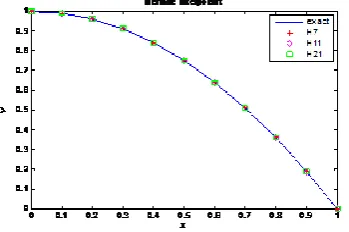
result VIM also exact solution. Table 2 gives the maximum error for number point n = 4 , 6, 11. Figure 1 gave the accuracy of the suggested method.
Table 1: Numerical results for n=4 of example 1
VIM p(x) Hermite
interpolation
( )
Exact Solution y(x) xi
0.999997000000000 1
1
0
0.989997000012525 0.990000000000000
0.990000000000000
0.1
0.959997000238787 0.960000000000000
0.960000000000000
0.2
0.909997001980789 0.910000000000001
0.910000000000000
0.3
0.839997012074748 0.840000000000001
0.840000000000000
0.4
0.749997054738341 0.750000000000002
0.750000000000000
0.5
0.639997189102191 0.640000000000003
0.640000000000000
0.6
0.509997518669322 0.510000000000004
0.510000000000000
0.7
0.359998167043863 0.360000000000005
0.360000000000000
0.8
0.189999194602654 0.190000000000007
0.190000000000000
0.9
4.57128800035456e-07
8.43769498715119e-15 0
1
Table 2: The result maximum error when n=4,6,11of example 1
Hermite interpolatio
n ( )
Hermite interpolatio
n ( )
Hermite interpolatio
n ( ) Er
ror
3.03624319 630824e-07 2.31020758
079126e-12 4.21884749
357560e-15 M.
Fig.1: Comparison between the exact and suggested solution when n= 4, 6,11
Example2
. Consider the followingSBVP : ,
0 ≤ x ≤ 1
with mixed BC:y'(0) = 0, y(1) = 5.5.
The exact solution is : y(x) =
( ) ( ) [15]
Using Taylor polynomials, we have y(0)= 3.257205700320381 ,y(1/3)=
3.466030095098947, y(2/3)=
4.1499242047031
y'(1/3)= 1.280759726616932, y'(2/3)=
2.915149400050196, y'(1)=
5.373147016441
Now, we solve this equation using these data
( )= 0.009130738291121613 +
0.01920841575611729 +
0.01361484275073988 +
0.3613904331003707 +
0.001445668149072448 +
1.838004201632197 +
3.257205700320381
Geng [15] solved this example by (VIM) and give the following series solution:
p (x) = 3.25721 + 1.83814 +
0.367628 +
0.0350121 +0.00194512 +
0.0000707316
The numerical results are given in and
Table 3 gives ( ), results VIM exact
solution. Table 4 gives the maximum error for number point n = 4, 6, 11. Figure 2 gives the accuracy of the suggested method.
Table 3: Numerical results for n=4 of example 2
VIM p(x) Hermite
interpolation
( )
Exact Solution y(x) xi
3.27562819783156 3.27562348331808
3.27562381647618
0.1
3.33132605056115 3.33132136138556
3.33132158129189
0.2
3.42564603865789 3.42564145791085
3.42564142056487
0.3
3.56086836853219 3.56086354389276
3.56086353732463
0.4
3.74027648126133 3.74027129054089
3.74027136831943
0.5
3.96825161157128 3.96824615761122
3.96824614512855
0.6
4.25039935164274 4.25039351936955
4.25039346768551
0.7
4.59371217247398 4.59370563007463
4.59370586068823
0.8
5.00677296919957 5.00676603087337
5.00676642428200
0.9
5.50000595160000 5.50000000000000
5.50000000000000
1
Table 4: The result maximum error when n=4,6,11of example 2
Hermite interpolation
( ) Hermite
interpolation ( ) Hermite
interpolation
( )
Erro r
1.9597881395255 3e-05 3.2687191368661
6e-06 6.0524403950195
8e-08 M.E
Fig.2: Comparison between the exact and suggested solution when n=4,6,11
Example 3
. consider the followingSBVP: (1- x2) y"+ x y'+ y = 0 , 0
≤ x ≤ 1
With Neumann BC : y'(0) = 0, y'(1) = - y(1) [11]
Using Taylor polynomials, we have
y(0)= 1.85779174711865 ,y(1/3)=
2.076407841859629, y(2/3)=
2.02488427571492,y(1)=
1.65096790760441614054343517637,
y'(1/3)= 0.2793960039864789,
y'(2/3)= 0.6144298559221, y'(1)= -1.650967907604
Now, we solve this equation using these data
7(x) -
0.001499602844631908737937919795
0.027426733964148297673091292381
287x5+ 0.07514319897959248x4-
0.332863322735647670924663543701
17x3 -
0.928936107025947421789169311523
44x2 + x + 1.857791747118655
The numerical results are given in
and Table 5 gives ( ), results VIM
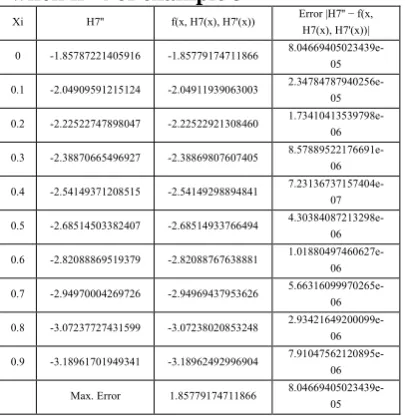
exact solution. Table 6gives the maximum error for number point n = 4, 6, 11. Figure 3 gives the accuracy of the suggested method.
Table 5: Numerical results for n=4 of example 3
Hermite interpolation ( ) P7
xi
1.85779174711866 1.857784296228232
0
1.94817677138695 1.948169418187120
0.1
2.01808339018278 2.018075735440336
0.2
2.06574825787000 2.065740050052486
0.3
2.08953495227793 2.089526555233489
0.4
2.08791430899834 2.087906467474147
0.5
2.05944879456718 2.059442143114885
0.6
2.00278016273118 2.002774819034724
0.7
1.91661963799949 1.916615117147540
0.8
1.79973987068057 1.799735452392664
0.9
1.65096790760442 1.650963483906875
1
Table 6:the results maximum error when n=4 of example 3
Error |H7'' − f(x, H7(x), H7'(x))| f(x, H7(x), H7'(x))
H7'' Xi
8.04669405023439e-05 -1.85779174711866
-1.85787221405916 0
2.34784787940256e-05 -2.04911939063003
-2.04909591215124 0.1
1.73410413539798e-06 -2.22522921308460
-2.22522747898047 0.2
8.57889522176691e-06 -2.38869807607405
-2.38870665496927 0.3
7.23136737157404e-07 -2.54149298894841
-2.54149371208515 0.4
4.30384087213298e-06 -2.68514933766494
-2.68514503382407 0.5
1.01880497460627e-06 -2.82088767638881
-2.82088869519379 0.6
5.66316099970265e-06 -2.94969437953626
-2.94970004269726 0.7
2.93421649200099e-06 -3.07238020853248
-3.07237727431599 0.8
7.91047562120895e-06 -3.18962492996904
-3.18961701949341 0.9
8.04669405023439e-05 1.85779174711866
Max. Error
Where n=4,6,10, then max. error:
‖ ( ) ( ( ) ( ))‖ (
‖ ( ( ) ( ))‖
‖ ( ) ( ( ) ( ))‖
( ‖ ( ( ) ( ) )‖
‖ ( ) ( ( ) ( ))‖ ( ‖ ( ( ) ( ) )‖ =
0.003949
Fig. 3: Comparison the suggested solution when n=4,6,11
Conclusion:
In this paper Hermite interpolation method was used to solving singular boundary value problem. The result shown that the divided the domain into a number point follow the same steps as the previous is a very powerful and efficient in finding accurate solution for a large class of regular singular point.
References:
[1] Kadalbajoo, M. K. and Kumar V. 2007. B-spline method for a class of singular two-point boundary value problems using optimal grid. Appl. Math. Computa., 188(2) : 1856-1869.
[2] Jamet, P., 1970.On the convergence of finite difference approximations
to one dimensional singular
boundary value problems. Numer. Math.,14(4): 355–378
[4] Mahmoudi, M. and Kazemi, M. V. 2013. Solving singular boundary
value problems of ordinary
differenal equation by modified homotopy perturbation method. Appl Math. Comput. Sci., (7):138-143.
[5] Ravi Kanth, A. S. V. and Aruna, K.
2008. Solution of singular two
point boundary value problems using differential transformation
method. Phys. Lett. A, 372(26):
4671–4673.
[6] Gupta, Y. and kumar, M. 2011. A Computer based numerical method
for singular boundary value
problems. Int. J. Comput. Applic. 30(1):21-25.
[7] Ebaid, A. and Aljouf, M. D. 2012. Exact solutions for a class of singular two-point boundary value
problems using adomian
decomposition Method. Appl.
Math. Sci.,6(122):
6108
-
6097
[8] Koch, O. and Weinmüller, E. B. 2003.The convergence of shooting methods for singular boundary value problems. math. Comput., 72(241): 289–305.
[9] Tripathi, B. k. 2013. Solution of a class of singular two point boundary value problems by
variational method. Math.
comput. Sci. res.,6(3):35-39.
[10] Butcher, J. C.; Corless, R. M.,
Gonzale, L. and shakoori-Vega, A. 2011. Polynomial algebra for
Birkhoff interpolants. Numer.
Algorith., 56(3) : 319-347.
[11] Burden, L. R. and Faires, J. D. 2001. Numerical analysis. Seventh Edition.
[12] Rachůnková, I.; Staněk, S. and Tvrdý, M. 2008. Solvability of Nonlinear Singular Problems for Ordinary Differential Equations. Hindawi, New York, pp279. [13] Shampine, F.; Kierzenka, J. and
Reichelt, M. W. 2000. Solving Boundary Value Problems for Ordinary Differential Equations in Matlab with bvp4c. The Math Works, Inc., 24 Prime Park Way, Natick,MA.,pp1-27.
[14] Carnahan, B.; Luther, H. and
Wilkes, J. 1990. Applied
numerical methods. Robert E.
Krieger Publishing Company,
Inc.,Florida , pp 604.
[15] Geng, F. 2010. Variational iteration method for a class of singular boundary value problems. Math. Sci., 4(4): 359-370.
جهريه جارذنلاا ماذختساب نيتطقنلا ثار ةراشلا تيدوذحلا نيقلا تلأسه لح
قازرلا ذبع داوع تبه
ثاٍضاٌشلا نسق ,ثانبلل مىلعلا تٍلك ,
داذغب تعهاج
:تصلاخلا
تٍناثلا تبحشلا نه تٍهاظنلا تٌدوذحلا نٍقلا لئاسه لحل جهشٍه جاسذنا تقٌشط انهاذخخسا,ثحبلا ازه ًف
. ةراشلا تٌداٍخعلاا تٍلضافخلا ثلاداعولل ذعب اهقٍبطح تقٌشط حشخقا
جولا نه ذٌذعلا ىلا لاجولا نٍسقح ا
لا تٍعشفلا ث
عشف لاجه لك ىلع جهشٍه جاسذنلاا ماذخخسا نث نهو . ً
.ًعشف لاجه لك ًف لحلا عوج يواسٌ تلداعولل لحلا
.هحءافكو حشخقولا بىلسلاا خضىخل تلثهلاا نه ذٌذعلا انهذق,اشٍخا
:تيحاتفولا ثاولكلا