J Wood Sci (1998) 44:142-146 © The Japan Wood Research Society 1998
M a s a h i r o M a t s u n a g a • K a z u y a M i n a t o
Physical and mechanical properties required for violin bow materials Ih
Comparison of the processing properties and durability between
pernambuco and substitutable wood species*
Received: August 22, 1997 / Accepted: November 14, 1997
A b s t r a c t Pernambuco (Guilandina echinata Spreng. syn
Caesalpinia echinata Lam.), which has been used for a ma- terial of violin bows, was compared with substitutable wood species from the viewpoint of processing properties and durability. The properties required for bow material are discussed. The shearing strength of pernambuco was higher than that of the other wood species at the same specific gravity. High shearing strength seems to be effective for preventing damage to the head (top part) of the bow. The presence of extractives affects the thermal softening of wood material, but ease of handling and permanent reten- tion of form are not particularly superior for pernambuco, although it does have a high extractives content. A pecu- liarly low loss tangent (tan 6) of pernambuco can probably be attributed to the large amount of extractives, rather than the mean microfibril angle.
K e y w o r d s P e r n a m b u c o • Violin b o w . Shearing strength • Processing property • Mean microfibril angle
Introduction
The heartwood of pernambuco (Guilandina echinata
Spreng. syn Caesalpinia echinata Lain.), a Brazilian hard- wood, has been used to make violin bows for more than 200 years. In previous studies 1'2 we compared the physical and mechanical properties of pernambuco with those of some substitutable wood species and tried to clarify why pernambuco is suitable for bows. Because the loss tangent (tan 6) of pernambuco is exceptionally low among the wood
M. Matsunaga (~3) • K. Minato
Graduate School of Agriculture, Kyoto University, Kyoto 606-8502, Japan
Tel. +81-75-753-6256; Fax +81-75-753-6300 e-mail: [email protected]
* Part of this report was presented at the 46th Annual Meeting of the Japan Wood Research Society in Kumamoto, April 1996.
species examined, it was suggested that a low tan 6 value is a necessary condition for bow material. It was also found that a low tan 6 could be attributed to a large volume of extractives in pernambuco, and that the tan 6 may be af- fected not only by the quantity of the extractives but also by their chemical structure and location in the wood structure.
Though the vibrational property is closely related to the suitability of bow material, the ease of handling during the manufacturing process and durability also seem to be im- portant. For example, a curvature, which offers tensile force to the horse hair, is created in the bow by heating. Thus the ease of handling and permanent retention of this deforma- tion may also be required. The top part of the bow (called the "head") is easy to break along a longitudinal direction when it is carelessly handled, so the strength of the head is another important factor.
In this paper the physical and mechanical properties of pernambuco and some promising wood species were inves- tigated. From a comparative study of pernambuco and other wood species, the conditions required for bow mate- rial were explored, especially from the viewpoint of their processing properties and durability. The factors control- ling vibrational properties were also examined.
Materials and methods
Materials
The specimens were cut from heartwood of the following five wood species.
Pernambuco ( Guilandina Caesalpinia echinata Lam.) Family: Leguminosae Color: yellowish to reddish
echinam Spreng. syn
Massaranduba (Manilkara bidentata Mimusops bidentata A. DC. Chev.) Family: Sapotaceae
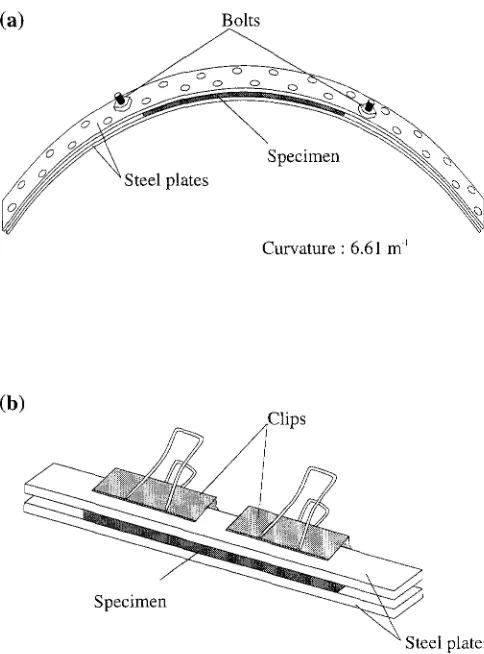
(a) Bolts
Specimen plates
Curvature : 6.61 m ~
(b)
otcel plates Fig. 1. Devices for fixation (a) and forced recovery (b) of the curvature
Growing district: Brazil
Color: light to dark reddish brown
This wood is sometimes used in bow making. Kerandji
(Dialium
spp.)Family: Leguminosae
Growing district: Malaysia, Indonesia Color: light to yellow brown
Bows made of this species are comparable to those made of pernambuco and are experimentally commercially available.
Pao rosa
(Swartzia fistuloides
Harms) Family: LeguminosaeGrowing district: West Africa Color: dark red to rose red
This species is under investigation for use as a bow. Blackbutt
(Eucalyptus piIularis
Sm.)Family: Myrtaceae
Growing district: Australia Color: whitish or pale brown
This wood is abundant but has not effectively.
yet been used
Specimens of pernambuco, massaranduba, and kerandji were cut from a lot of bar-shaped materials that were elimi- nated when manufacturing bows because of their partial
defects. The specimens of pao rosa and blackbutt were pre- pared from several pieces of board-shaped or bar-shaped timbers. The number of specimens is shown in Tables 1, 2, and 3 (see below). The specific gravity of oven-dried wood was measured for the bending and shearing tests.
Shearing test
Specimens of 35 m m (longitudinal direction, L) × 20mm (radial direction, R) × 10mm (tangential direction, T), which had a notch of 10mm (L) × 10mm (R) × 10mm (T) were used. The specimens were sheared parallel to the tan- gential plane by means of a compression test apparatus (Mori Shikenki Seisakusho, Tokyo, Japan), and the maxi- m u m load was measured. The shearing rate was about lmm/min. Shearing strength was calculated by dividing the maximum load by the shearing area. The tests were carried out in a surrounding atmosphere.
Thermal softening test
All of the wood species were ground with a Wiley mill to pass through a sieve with 355-~m apertures but not a sieve with a 150-~tm apertures. Half of the wood meal was ex- tracted with ethanol-benzene (v/v 1 : 2) for 6 h by a Soxhlet's extractor; both the extracted and unextracted wood meals were used for the thermal softening test. The wood meal was stuffed into a glass tube ( 2 m m diameter). The height of the stuffed wood meal was about 10mm. The change of the height during heating was measured as the volumetric change through a differential transformer. The temperature range and increasing rate of temperature change were 50 °. 300°C and 2K/min, respectively.
Tests for bending property and retention of the curvature A specimen measuring 150mm (L) × 12mm (R) × 2 m m (T) was heated at 280°C for 90 s in an oven, placed between curved steel plates (curvature 6.61), and fixed by bolts (Fig. la). The whole device was cooled under atmospheric condi- tions. Ten minutes later the steel plates were removed, and the curvature of the specimen was measured. The speci- mens were then placed in a desiccator maintained at 20°C and 66% relative humidity (RH). After 2 weeks the speci- men was held between flat steel plates and pinched by clips (Fig. lb), after which the change of the curvature that oc- curred with the passage of time was measured.
X-ray diffractometry
The mean microfibril angle (MMA) was evaluated by X-ray diffractometry. Specimens of l m m (L) × 0.8mm (R) × 2 m m (T) were used. It is known that Cave's method 3 and an improved Cave's method 4 are convenient for determining the M M A of a cell wall.
144
Table 1, Properties of specimens subjected to the shearing test
Specimen No. Specific gravity in oven-dried Shearing strength 0]9 (MPa) state mean _+ SD (MPa) mean + SD mean
Pernambuco 15 0.940 _+ 0.052 22.5 ± 2.4 24.0
Massaranduba 13 1.075 ± 0.032 23.9 + 1.9 22.2
Kerandji 14 1.016 ± 0.047 21.1 ± 1.9 20.8
Pao rosa 13 1.082 _+ 0.025 19.7 ± 1.2 18.2
Blackbutt 31 0.825 _+ 0.124 18.0 _+ 3.0 21.8
30
e~
20
+
().6O []
0 +
++
+
.,-
100.4 0.8 1.0 1'.2
Specific gravity in oven-dry
Fig. 2. Relation between specific gravity in the oven-dried state and
shearing strength. Open circles, pernambuco; open squares,
massaranduba; filled triangles, kerandji; filled diamonds, pao rosa;
crosses, blackbutt
each specimen. An X-ray diffraction apparatus (RINT2200V; Rigaku Denki, Tokyo, Japan) was used. An imaging plate (Fuji Film Blue IP) was set behind the speci- men to record the X-ray diffraction pattern. The MMA was calculated from a diffraction intensity distribution around (200) arc using Cave's method.
Results and discussion
Shearing strength
One of the most serious problems with bows is a broken head, which is mostly caused by careless handling. For ex- ample, if the bow collides perpendicularly with a wall or the floor, the hook-shaped head may be subjected to a shearing impact.
Figure 2 shows the relation between specific gravity in an oven-dried state and the shearing strength of tangential sections of all the wood species. It was found that the shear- ing strength is proportional to the specific gravity; the shear-
(a) Be~reextraction 1
+ + e + + ~ + + ~ + + ]
_ ' ~ + + J p } - , /
l i l l l l l l l l l l i r - r ~ b ~ t - l ] l ] l l ] l ] l l @ '
50 100 150 200 250 300
(b) A~er extraction
+ + l l l l l l l l l l l l l l l l t l l ~ b w [ l [ l l l l l I l [ l l l l [ [ [ ~ + _
Z l ~ l l l l l l l l l I ~ l i r [ ~ ] ~ l l F l ~ ] Z E [ i i ~ l l l d
. . . , l l l ~
i i i I
50 100 150 200 250 300
Temperature (°C)
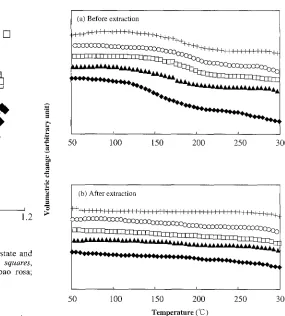
Fig. 3. Thermal softening of wood meals. Symbols are the same as in Fig. 2
ing strength of pernambuco was somewhat higher than that of the other wood species at the same specific gravity. Though the massaranduba has the highest shearing strength (Table 1), when the shearing strength is divided by the specific gravity (o]p), that of pernambuco was highest. In fact, it has been pointed out that bow heads made from kerandji, whose shearing strength is lower than that of pernambuco, easily break. Pernambuco, with its high shear- ing strength, seems to satisfy one of the requirements for bow material.
Thermal softening
Table 2. Curvature immediately after removal of bending device
Specimen No. Curvature (m 1)
Mean _+ SD
P e r n a m b u c o 8 4.12 -- 0.19
Massaranduba 5 4.87 + 0.09
Kerandji 5 4.66 _+ 0.65
Pao rosa 5 6.07 +- 0.25
ease with which the wood can be bent in the flame and permanent retention of the form must be taken into consideration.
We previously reported that pernambuco and pao rosa, which contain large amounts of extractives, showed lower softening temperatures than the other wood species) This fnding suggests that extractives affect the softening tem- perature of wood. Thus the thermal softening of extracted and unextracted wood meal were measured, and the rela- tion between the softening temperature and the extractives content was examined.
The results are shown in Fig. 3. For unextracted wood meals of all wood species, significant decreases of volume were observed between 150 ° and 200°C. Pao rosa, which has a large amount of the ethanol-benzene extractives, espe- cially showed a marked change. On the other hand, the volume changes in extracted wood meals were only slight, irrespective of the wood species.
In a previous paper 2 we proposed that the decrease of dynamic Young's modulus around 200°C was attributed to the softening of extractives, which restrained the free move- ment of the cellulose chain. The results of the thermal soft- ening test supports that proposal.
Ease of bending and retention of the curvature
As mentioned above, it was found that extractives affect the softening of wood material. Thus a curvature was made in the specimen by a method similar to that used for bow manufacturing, and the change in the curvature was mea- sured when the specimen was forcibly straightened. Blackbutt was not subjected to the test because it is so weak in terms of bending that experiments under the same condi- tions as used for the other wood species were impossible.
Table 2 shows the curvatures of each wood species im- mediately after bending in the drying oven. The curvature varied among wood species despite using the same imple- ment. Pernambuco had the lowest curvature.
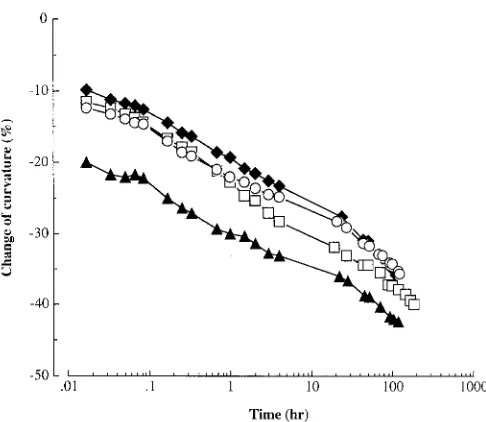
Figure 4 shows the change in the curvature over time when specimens were straightened between two flat steel plates. The line for pernambuco had a gentle slope and was located on the upper part of the graph. Thus pernambuco tends to maintain its curvature compared with other wood species, although the difference between pernambuco and other wood species is only slight. Therefore it is difficult to assert that pernambuco keeps its curved form more than the
J
v
c a
10
-20
-30
-40
- 5 0 i . . . i . . . i i T I L r l l l l , T , , , ~ , , I , r , , , , , , r
.01 .1 1 10 100 1000
Time (hr)
Fig. 4. Changes of the curvature with the passage of time. Symbols are the same as in Fig. 2
other wood species. Ultimately, the ease of bending in the flame and permanent retention of the form are not always the primary characteristics on which to base the selection of wood for bow material.
Mean microfibril angle
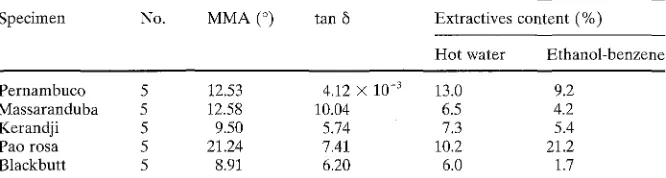
The middle layer in the secondary wall ($2 layer) comprises 80% or more of the volume of the cell wall of wood fiber, and some of the physical properties of wood depend strongly on the microfibril angle of the $2 layer. The tan 6 is also affected by the microfibril angle of the $2 layer. It has been reported that specimens with a large microfibril angle have a larger tan 6 value. 5'6 Though the high extractives content of pernambuco is responsible for a low tan 6 value, the microfibril angle must also be taken into consideration. The M M A estimated by Cave's method is shown in Table 3. The tan 6 values and extractives contents are from a previous paper, 2 where other parts of the same specimens were used. Though the wood species examined here have a high specific gravity, it is probable that the calculated values for the microfibril angle are lower than the true values because the thick cell wall may increase the diffraction in- tensity. The M M A in Table 3 is available only when high- specific-gravity species are compared.
146
Table 3. MMA, tan 6, and extractives content
Specimen No. MMA (°) tan 6 Extractives content (%)
Hot water Ethanol-benzene
Pernambuco 5 12.53 4.12 × 10 -3 13.0 9.2
Massaranduba 5 12.58 10.04 6.5 4.2
Kerandji 5 9.50 5.74 7.3 5.4
Pao rosa 5 21.24 7.41 10.2 21.2
Blackbutt 5 8.91 6.20 6.0 1.7
The values for tan 6 and coiltent of extractives are from Matsunaga et al. z where other parts of the specimens were used.
Conclusions
Physical and mechanical properties of pernambuco were compared with those of alternative wood species in terms of their use for bow material. The results obtained were as follows. The shearing strength of pernambuco was higher than that for the other wood species at the same specific gravity. A high shearing strength effectively prevents dam- age to the bow's head. Shearing strength seems to be re- quired for bow material, but it is not the most important property. The presence of extractives affects the thermal softening of wood material. However, the ease of handling and permanent retention of the curvature when per- nambuco is used are not markedly superior. Consequently, these properties are probably not the most important prop- erties when selecting bow material. The low tan 6 value of pernambuco seems to be attributable to the high extractives content rather than to the small microfibril angle.
Acknowledgments The authors thank Mr. K. Sugito, Sugito Gakkyusha & Company, and Dr. Y. Yazaki, CSIRO division of Forest Products, for supplying the materials. The authors also are grateful to
Dr. I. Iida, Faculty of Agriculture, Kyoto Prefectural University, for his kind guidance regarding the shearing strength test.
References
1. Sugiyama M, Matsunaga M, Minato K, Norimoto M (1994) Physical and mechanical properties of pernambuco (Guilandina echinata Spreng) used for violin bows (in Japanese). Mokuzai Gakkaishi 40:905-910
2. Matsunaga M, Sugiyama M, Minato K, Norimoto M (1996) Physical and mechanical properties required for violin bow materials. Holzforschung 50:511-517
3. Cave ID (1966) Theory of X-ray measurement of microfibril angle in wood. Forest Prod J 16:37-42
4. Yamamoto H, Okuyama T, Yoshida M (1993) Methods of deter- mining the mean microfibril angle of wood over a wide range by the improved Cave's method. Mokuzai Gakkaishi 39:375-381 5. Ono T, Norimoto M (1983) Study on Young's modulus and internal
friction of wood in relation to the evaluation of wood for musical instruments. Jpn J Appl Phys 22:611-614