This is an Accepted Manuscript of an article published by Taylor & Francis in International Journal of Construction Management on 26/03/2018, available online:
http://www.tandfonline.com/doi/abs/10.1080/15623599.2018.1452098
REVIEW OF APPLICATION OF ANALYTIC HIERARCHY PROCESS IN 1
CONSTRUCTION MANAGEMENT 2
ABSTRACT 3
The analytic hierarchy process (AHP) has gained increasing attention in construction 4
management (CM) science as a technique to analyze complex situations and formulate 5
appropriate decisions. However, AHP per se or its potential application on CM problems are 6
ill-defined within extant literature. Consequently, this paper reviews 77 AHP-based papers 7
published in eight selected peer-reviewed CM journals from 2004 to 2014 to better define 8
and delineate AHP application areas and typical decision-making problems solved within 9
CM. The thematic groups of ‘risk management’ and ‘sustainable construction’ were 10
identified as the most popular AHP application areas albeit, the technique may also be useful 11
in quality management and knowledge management. The findings also revealed that AHP: i) 12
is flexible and can be used either as a stand-alone tool or used in conjunction with other tools 13
to resolve decision-making problems; and ii) is widely used throughout Asian higher 14
education institutions (HEIs). Notably, the most prominent justifications for using AHP 15
include small sample size, high level of consistency, simplicity and availability of user-16
friendly software. This paper provides a useful reference for researchers and practitioners 17
interested in the application of AHP in CM. Future research is however needed to compare 18
and contrast between AHP and other multicriteria decision-making (MCDM); such work 19
could reveal which technique provides an optimized solution under various decision-making 20
scenarios. 21
22
KEYWORDS 23
Analytic hierarchy process (AHP), multicriteria decision-making, application, construction 24
INTRODUCTION 26
Decision-making is defined as the process of determining the best alternative among all 27
possible choices but in practice, achieving an optimized result can be problematic as decision 28
makers are often confronted with various decision-making problems (Angelis and Lee, 1996). 29
Multicriteria decision-making (MCDM) is one of the most important branches of decision 30
theory and is used to identify the best solution from all possible solutions available (Huang et 31
al., 2015; Işıklar and Büyüközkan, 2007). Several methods have been developed to enable 32
improvements in MCDM, including: analytic hierarchy process (AHP) (Saaty, 1980); 33
superiority and inferiority ranking (SIR) technique (Xu, 2001); Simos’ ranking method 34
(Marzouk et al., 2013); multi-attributeutility theory (MAUT) (Chan et al., 2001); elimination 35
and choice corresponding to reality (ELECTRE) (Roy, 1991); preference ranking 36
organization method for enrichment evaluations (PROMETHEE) (Brans et al., 1986); and 37
choosing by advantages (CBA) (Arroyo et al., 2014). These MCDM methods are frequently 38
used to facilitate the resolution of real-world decision-making problems. 39
40
Saaty’s (1980) AHP represents a popular MCDM method that has attracted considerable 41
attention throughout industry (including construction) over the past two decades. 42
Construction decision-making problems in particular, have been characterized as being 43
complex, ill-defined and uncertain (Chan et al., 2009). Al-Harbi (2001) further suggests that 44
elements of construction-related decision-making problems are numerous and that the 45
interrelationships between these elements are complicated and often nonlinear. In addition, 46
judgement systems and human value are integral components of construction-related 47
decisions (Lifson and Shaifer, 1982). Consequently, the ability to make sound decisions is 48
increasingly important to the success of construction activities and operations. Jato-Espino et 49
construction decisions because it allows decision makers to utilize multiple criteria in 51
supporting the decision-making process. 52
53
Because of AHP’s inherent ability to deal with various types of decisions, it has been widely 54
applied in construction management (CM) research over the past two decades (Nassar and 55
AbouRizk, 2014; Akadiri et al., 2013; Ruiz et al., 2012; Zou and Li, 2010; Chan et al., 2006). 56
However, there has been a notable dearth of comprehensive reviews of AHP applications 57
within the CM domain with Jato-Espino et al.’s (2014) study of 22 different MCDM methods 58
representing a rare exception. At present, no review has specifically focused on AHP 59
applications in CM. Therefore, this paper aims to fill this void and provide a deeper 60
understanding of the decision areas and decision problems that AHP could efficiently deal 61
with. Concomittant objectives seek to: summarize the existing literature related to AHP 62
applications in CM; identify the popular AHP application areas and problems; and provide 63
directions for future AHP application. To achieve these objectives, 77 relevant AHP-based 64
papers published in eight selected peer-reviewed CM journals from 2004 to 2014 were 65
identified through a systematic desktop search and reviewed. This paper provides a useful 66
benchmark reference for researchers and practitioners who are interested in the application of 67
AHP to analyze and model construction-related decisions. AHP decision support systems and 68
models developed for the construction industry are myriad and scattered throughout extant 69
literature. Researchers and practitioners may experience some difficulty locating these 70
systems and models hence, this paper will provide clear signposting to potentially useful 71
decision support systems and models, which in-turn may trigger greater usage in practice. 72
73
AHP was created by Saaty (1980) to deal with decision-making problems in complex and 75
multicriteria situations (c.f. Dyer and Forman, 1992; Saaty, 1990). Therefore, this research is 76
not concerned with explicating specific details about the method but rather the basic concepts 77
of it. AHP assists in making decisions that are characterized by numerous interrelated and 78
often competing factors, and establishes priorities amongst decision factors when set within 79
the context of the decision goal (Shapira and Goldenberg, 2005). An important aspect is that 80
decision factors are assessed with respect to their relative importance in order to allow trade-81
offs between them. 82
83
The AHP consists of three steps: (1) hierarchy formation - the first level of the hierarchy 84
contains the decision gooal, whereas the subsequent lower levels represent the progressive 85
breakdown of the decision criteria, sub-criteria and the alternatives for reaching the decision 86
goal.; (2) pairwise comparisons - decision makers (who are often domain experts) are asked 87
to complete pairwise comparisons of the elements at each level of the hierarchy, assuming the 88
elements are independent of each other. In this regard and considering the decision goal, 89
comparisons are made between the relative importance of every two criteria at the second 90
level of the hierarchy. Every two sub-criteria under the same criterion (at level two) are also 91
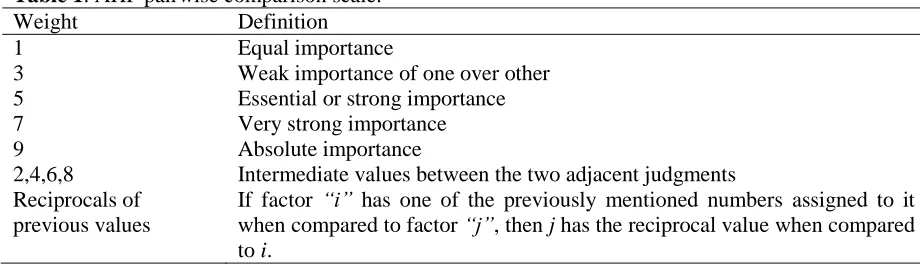
compared, and so on and so forth. These pairwise comparisons are based on a nine-point 92
scale, as shown in Table 1 (Saaty, 1980; Wind and Saaty, 1980; Dyer and Forman, 1992); 93
and (3) verification of consistency - expert judgments are necessary for determining the 94
relative importance of each criterion and any alternative to achieving the decision goal. 95
Because AHP allows subjective judgments by decision makers, consistency of the judgments 96
is not automatically guaranteed. Therefore, consistency verification is essential to ensuring 97
the optimized outcome. Saaty (2000) mentioned that to control the consistency of pairwise 98
makers are required to revise their initial judgments if the computed consistency ratio 100
exceeds the threshold of 0.1 (Saaty, 2000). After all of the necessary pairwise comparisons, 101
and revisions have been made, and the consistency ratio has also been found to be less than 102
0.1, the judgments can then be synthesized to prioritize the decision criteria together with 103
their corresponding sub-criteria. 104
105
[Insert Table 1 about here] 106
107
RESEARCH METHODOLOGY 108
This study was based upon the AHP literature published in eight selected CM journals from 109
2004 to 2014. These journals were: (1) ASCE’s Journal of Construction Engineering and
110
Management (JCEM); (2) Automation in Construction (AIC); (3) Construction Management
111
and Economics (CME); (4) ASCE’s Journal of Management in Engineering (JME); (5) 112
International Journal of Project Management (IJPM); (6) Engineering, Construction and
113
Architectural Management (ECAM); (7) Building and Environment (BE); and (8) Building
114
Research and Information (BRI). The first six journals were deemed to be high quality based 115
on Chau’s (1997) ranking of CM journals, while the last two journal are widely regarded as 116
top-quality journals in CM (Chan et al., 2009). Major search engines such as ASCE Library, 117
Science Direct, Taylor and Francis and Emerald were used to search for the keyword 118
“analytical hierarchy process” in the advanced search section of the selected journals. An 119
initial search conducted was limited to papers published from 2004 to 2014 and resulted in 120
the identification of 194 research papers. However, not all of these papers used AHP as a 121
primary or secondary decision-making tool as some simply mentioned AHP in the literature 122
review and/ or recommended its application for future research. A review of each paper’s 123
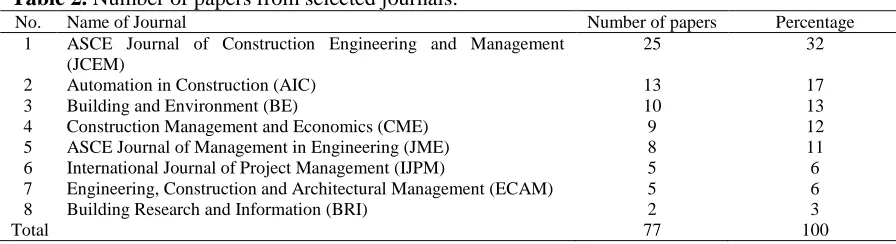
were considered valid for further analysis. Table 2 shows the number of relevant papers 125
collected from each of the selected journals. It reveals that 25 of the papers were from JCEM, 126
13 were from AIC, 10 were from BE and nine were from CME, in total representing 74% of 127
the sample. The remaining papers were distributed across the other four journals. Ernest – are 128
we using numbers or numerical numbers here – some consistency issues I sense. 129
130
[Insert Table 2 about here] 131
132
The next sections offer an overview of the benefits of applying AHP to construction-related 133
decision-making problems, identifying the specific decision areas and decision problems to 134
which AHP could be applicable or useful. Moreover, a concise review of the literature (based 135
on the top six identified decision areas) is provided to demonstrate the versatility and worth 136
of AHP in diverse construction situations. Where applicable, the application cases reviewed 137
in a certain decision area are divided into stand-alone and integrated approaches - depending 138
upon whether the AHP was used in a particular case as a sole method or in combination with 139
other notable systems or methods. This approach will help to elucidate upon the inherent 140
flexibility of AHP in terms of combining it with other methods to analyze and model 141
construction-related decisions. 142
143
REVIEW OF AHP APPLICATIONS IN CM 144
Identification of Decision Areas and Decision Problems 145
As the most commonly used method, AHP attracts the most attention from decision makers 146
because of the availability of extensive literature that defines and delineates its application 147
problems that AHP can be used to model. Such an understanding would greatly stimulate 149
interest in AHP applications within the wider areas of CM. 150
151
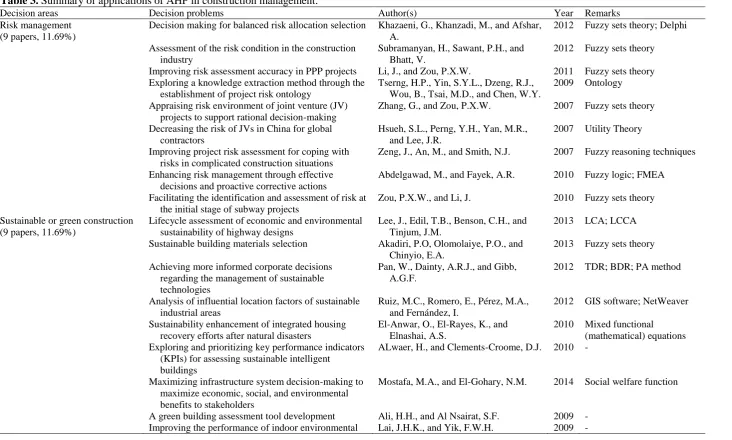
Table 3 presents all of the 77 identified papers and provides a quick reference guide and 152
meaningful information about the applications of AHP in CM. The table was created based 153
upon information provided in the papers. First, the paper’s research interests/ topics aided the 154
identification of the decision areas summarized in the first column of the table. Based upon 155
this, AHP has been found to be applicable to many different areas of CM. Second, the papers’ 156
research aims/ objectives presented the decision problems that AHP was used to address. 157
This showed that AHP has been applied to numerous construction-related decision-making 158
problems. These findings suggest that AHP is useful and helpful in enabling strategic and 159
sound decision-making in a wide range of CM areas, which is consistent with the viewpoint 160
of Jato-Espino et al. (2014). Following initial identification of the decision areas and 161
problems, the reviewed papers were then thematically grouped, based upon the decision 162
problems under the decision areas. Each paper was assigned to only one decision area, thus if 163
a paper appears to have multiple research interests and hence, qualifies for more than one 164
decision area (e.g., Lai and Yik’s (2009) paper addressed both sustainability and 165
housing/residential building issues), it was assigned to the best-fit decision area (c.f. Hong et 166
al., 2012). Although subjectively deciding on the best-fit decision area for a paper may seem 167
arbitrary, the researchers contend that any variations in views were minimalized or even 168
eradicated using tacit knowledge of individual members within the team. Lastly, the authors 169
and the papers’ years of publication, and information on other methods (denoted as remarks) 170
combined with AHP in some of the papers have also been presented in the table. This is 171
wordy and unclear – please rewrite. 172
[Insert Table 3 about here] 174
175
Descriptive Analysis 176
A descriptive analysis of the papers was also undertaken to illustrate insightful trends in the 177
application of AHP in CM (refer to Fig. 1). Of the 77 papers, 14 were published in the years 178
before 2007 and during 2007, a peak of 13 papers was evident which appeared to be a purely 179
random occurrence given a lack of any ‘special issue’ that could easily explain it. In recent 180
years (2009 to 2013), relatively stable output was achieved with an average of seven papers 181
published every year – however, in 2014 the output significantly reduced. 182
183
[Insert Fig. 1 about here] 184
185
Regards geographical origins, the US and Taiwan account for the highest number of AHP-186
based papers published with 11 and 10 papers respectively (Table 4). This finding suggests 187
that the application of AHP in CM within these two developed countries is relatively more 188
mature. Although some developing countries, such as China (6 papers) and India (4 papers), 189
have made good progress in the application of AHP in CM, there is still room for 190
improvement. 191
192
[Insert Table 4 about here] 193
194
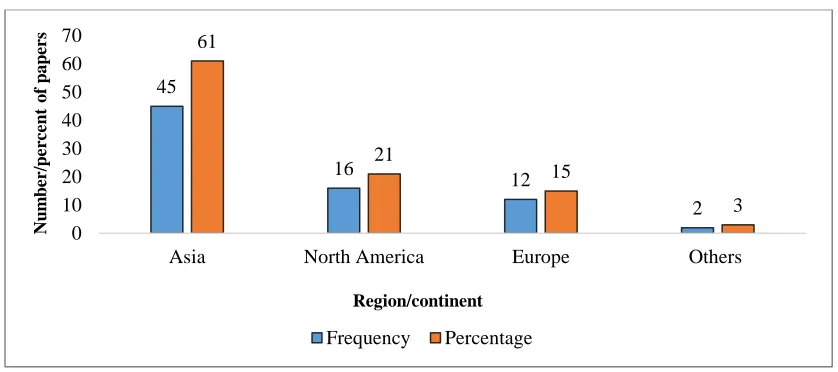
Finally, the sample papers were also viewed from a regional perspective. Fig. 2 shows that 195
there is a relatively large number of AHP applications in Asia (45 papers, 61%) – a finding 196
that concurs with the earlier research of (Jato-Espino et al., 2014). In light of the extent of 197
application of AHP in enhancing construction-related decisions has been significantly 199
helpful. This should encourage other global regions to pursue AHP application(s) in CM. 200
201
[Insert Fig. 2 about here] 202
203
Nonetheless, the results presented in Table 4 and Fig. 2 must be interpreted with caution 204
because although a variety of search engines were used to synthesize the literature, complete 205
coverage of all relevant papers cannot be claimed. Thus, future reviews using additional 206
search engines would be useful for future proofing of the results presented herein. 207
208
AHP APPLICATIONS IN IDENTIFIED CM AREAS 209
Table 3 summarizes AHP literature relating to CM and reveals that risk management, 210
sustainable construction, transportation, housing, contractor prequalification and selection, 211
and competitive advantage were the top six application areas. Papers in these areas used AHP 212
explicitly for different applications and so each area will now be discussed in further detail. 213
214
Risk management 215
Risk management is a major CM area comprising defects, misalignments and crises that can 216
lead to inflated risks and project conflicts (Zheng et al., 2016). Risk management decisions 217
are often viewed and tackled as multicriteria decisions. Interestingly, all the AHP 218
applications within the risk management area involved the integrated approach of combining 219
AHP with other techniques. 220
221
222
AHP combined with Fuzzy Sets Theory (FSs)
224
Subramanyan et al., (2012) designed a model for construction project risk assessment by 225
using a combination of FSs and AHP. During the process of designing the model, FSs was 226
used to capture both subjectivity and linguistic terms, while AHP was applied to weight and 227
prioritize various risk factors. Li and Zou (2011) also developed a FSs-AHP-based risk 228
assessment method for improving the accuracy of risk assessment. FSs-AHP was used to 229
pairwise compare between different risk factors - after which the pairwise comparisons were 230
synthesized to obtain risk priorities. Li and Zou (2011) proved the validity of this FSs-AHP 231
based method to assess the risks in public-private partnership projects, by exhibiting its 232
applicability in an actual PPP expressway project. Other applications of FSs-AHP in the risk 233
management area were presented by Zhang and Zou (2007), Zeng et al., (2007), and Zou and 234
Li (2010). 235
236
AHP combined with FSs and Delphi
237
Khazaeni et al., (2012) demonstrated an application of FSs-AHP together with the Delphi 238
method to risk management problems in construction and illustrated the usefulness of this 239
approach in resolving the problem of unbalanced allocation of risks among contracting 240
parties. Specifically, the fuzzy adaptive decision-making model presented (ibid) was used for 241
selecting the most appropriate allocation of risks among contracting parties. FSs was used in 242
the model for the quantification and reasoning of linguistic principles. A Delphi team was 243
employed to pairwise compare various risk allocation criteria using fuzzy values. FSs-AHP 244
was then used to derive priority weights for the risk allocation criteria. 245
246
AHP combined with FSs and Failure Mode and Effect Analysis (FMEA)
FMEA is a useful risk analysis technique albeit, some limitations are apparent. Abdelgawad 248
and Fayek (2010) combined FSs-AHP and FMEA with the aim to overcome the limitations 249
of the traditional FMEA-based risk management in CM. Their work (ibid) formed a model 250
for assessing the criticalities of construction risk events and recommending corrective 251
measures. A case study was presented, which confirmed the applicability and usefulness of 252
this approach in providing valid and reliable risk management results. 253
254
AHP combined with Utility Theory (UT)
255
Hsueh et al., (2007) applied a combination of AHP and UT to develop a multicriteria risk 256
assessment model for contractors to reduce risks in joint ventures. AHP was first used to 257
weight a set of risk criteria. Employing utility functions were then used and risks were 258
converted into numerical rates for ascertaining the expected utility value of various scenarios. 259
260
AHP combined with Ontology
261
Tserng et al., (2009) explored an approach for conducting knowledge extraction by the 262
establishment of an ontology-based risk assessment framework for enhancing risk 263
management in building projects. In developing the framework, risk class and subclass 264
weights were established, which was achieved by using AHP to capture experts’ assessment 265
of the risks. Subsequent application in a real project indicated that the framework greatly 266
increased the effectiveness and efficiency of project risk management. 267
268
Sustainable construction 269
Sustainable construction represents another popular area of AHP application in CM. In this 270
area, both stand-alone and integrated AHP applications were identified. 271
Stand-alone
273
Ali and Al Nsairat (2009) used AHP to develop a green building rating tool. After identifying 274
the green building assessment criteria, each criteria was weighted and prioritized using AHP. 275
Similarly, Lai and Yik (2009) implemented AHP to identify the significant indoor 276
environmental quality areas in high-rise residential buildings. Specifically, AHP was used to 277
derive importance weights for various indoor environmental quality attributes. The authors 278
(ibid) claimed that the results can assist facility managers in managing buildings within 279
constrained budgets. Alwaer et al., (2010) developed a sustainability assessment model to 280
assess the performance of intelligent building systems in a more objective manner. Model 281
performance was based upon the use of AHP to assign relative importance weights to 282
different sustainability issues; the research sought to help stakeholders choose the most 283
suitable indicators for intelligent buildings. 284
285
Integrated Approaches
286
AHP combined with Life-Cycle Assessment (LCA) and Life-Cycle Cost Analysis (LCCA)
287
Lee et al., (2013) developed a rating system for assessing the economic and environmental 288
sustainability of highways using LCA and LCCA as measurement methods for quantifying 289
environmental impact and economic impact respectively. AHP was used to weight different 290
sustainability indexes as a means of encouraging recycling of materials, which is vital for 291
sustainable development (ibid). 292
293
AHP combined with Top-Down Direct Rating (TDR), Bottom-Up Direct Rating (BDR), and
294
Point Allocation (PA)
295
Pan et al., (2012) presented construction firms with value-based decision criteria and 296
technologies. Different combinations of AHP, TDR, BDR and PA were used in different 298
cases to weight various decision criteria by pairwise comparisons. Case studies involving six 299
UK construction firms sought to examine decision criteria for sustainable building 300
technologies selected and verify the effectiveness of the method developed. 301
302
AHP combined with Geographic Information System (GIS) and NetWeaver
303
Ruiz et al., (2012) studied the problems of planning, designing and delivering a sustainable 304
industrial area and developed a multicriteria spatial decision support system that incorporated 305
a GIS platform, NetWeaver and AHP. While the GIS platform stores and manages 306
geographical data in the system, NetWeaver provides an environment for developing expert 307
systems that provide an interface for defining ‘knowledge.’ The main function of AHP in the 308
system was to obtain the variables’ structure and determine the variables’ respective weights. 309
310
AHP combined with Mathematical Models
311
El-Anwar et al., (2010) suggested a combination of AHP and mathematical functions (such as 312
sustainability index and environmental performance index) to tackle the issueof maximizing 313
the sustainability of post-disaster housing recovery and construction. To help decision makers 314
quantify and maximize the sustainability of post-natural disaster integrated housing recovery 315
efforts, sustainability metrics were computed and incorporated into an optimization model. 316
AHP was used to identify the relative importance of different sustainability metrics. Mostafa 317
(2014) also presented a stakeholder-sensitive, social welfare-oriented sustainability benefit 318
analysis model to evaluate infrastructure project alternatives. A major component of the 319
model is AHP that was used to compute stakeholder benefit preference weights. 320
321
Transportation has attracted various AHP applications while MCDM methods more 323
generally, have had major applications in roads and highways construction (Jato-Espino et 324
al., 2014). 325
326
Stand-alone
327
Wakchaure and Jha (2012) used AHP to resolve the conundrum of optimizing bridge 328
maintenance using limited resources. Specifically, AHP was used to determine the relative 329
importance weights of various bridge components as a first step towards developing a bridge 330
health index. This index can be applied by different stakeholders to rank bridges that need 331
maintenance – thereafter, ranks were utilized to allocate resources optimally. Dalal et al. 332
(2010) also used AHP in group decision-making to rank rural roads for optimal allocation of 333
funds for upgrading purposes. 334
335
Integrated Approaches
336
AHP combined with Data Envelopment Analysis (DEA)
337
Wakchaure and Jha (2011) sought to prioritize bridge maintenance planning based on 338
efficient allocation of limited funds. They utilized DEA to evaluate the efficiency scores of 339
different bridges, while the relative importance weights and condition ratings of the 340
components and sub-components of the bridges were ascertained through AHP. 341
342
AHP combined with FSs and Delphi
343
Pan (2008) proposed a FSs-AHP based model to select the most suitable bridge construction 344
method. Various bridge selection criteria were weighted through pairwise comparisons using 345
bridge shape. A case study of a new bridge construction project was presented to illustrate the 347
usefulness and capability of the model. 348
349
AHP combined with Monte Carlo Simulation (MCS)
350
Minchin et al., (2008) proposed a practical construction quality index for highway 351
construction by combining AHP with MCS. The developed index addresses quality factors 352
for the major components of pavement construction (e.g. rigid pavements, base course, 353
embankment, subgrade and flexible pavements). Weighting factors representing the relative 354
importance of construction quality metrics on pavement performance were established using 355
AHP, while MCS predicted the pavement life. 356
357
Housing 358
Similar to the risk management area, all of the application cases identified in the area of 359
housing involved the integrated AHP approach. 360
361
AHP combined with Delphi and Analysis of Variance (ANOVA)
362
Hyun et al., (2008) tackled performance evaluation of housing project delivery methods by 363
combining the AHP and Delphi methods with an ANOVA test. This approach sought to 364
devise objective standards and contents for quantitative evaluation of the impacts of delivery 365
methods on design performance in multifamily housing projects. First, AHP and a three-366
round Delphi were used to develop an evaluation standard and calculate the weights of 367
different evaluation items. Second, an ANOVA test was performed to identify the level of 368
influence of different delivery methods on design performance. 369
370
AHP combined with Sensitivity Analysis (SA)
Mahdi et al., (2006) used AHP to design a decision model for reducing the construction cost 372
and waiting time caused by conflict encountered when economic versus quality decisions 373
have to be made in selecting delivery alternatives for housing projects. The effects of 374
different criteria on the selection of proper housing delivery alternatives were analyzed using 375
AHP, after which SA was performed to investigate the sensitivity of the final decision to 376
possible changes in judgments. 377
378
AHP combined with GIS, UT, and Online Analytical Processing (OLAP)
379
Ahmad et al., (2004) created a decision support system for property developers and builders 380
to tackle the problem of selecting the most appropriate site for residential housing 381
development. The system was based upon an integration of AHP with GIS software, an 382
OLAP concept and the expected utility value theorem. The GIS software performed 383
geographical analyses of the available sites; OLAP analysis was performed using AHP; and 384
the expected utility value theorem was used to convert monetary values into equivalent utility 385
functions. An application example was presented to exhibit the worth and applicability of the 386
decision support system. 387
388
AHP combined with Mathematical Models
389
El-Anwar and Chen (2013) established a methodology for quantifying and minimizing the 390
displacement distance equivalents for families that are assigned temporary housing following 391
a natural disaster. The methodology used AHP and mathematical models (e.g. Haversine 392
formula) to compute displacement distances. 393
394
Contractor prequalification is an important activity in the field of CM, as it aims to select 396
competent contractors for the bidding process. The identification of AHP applications in the 397
contractor prequalification and selection area corroborates the viewpoint of Al-Harbi (2001) 398
that AHP is a practical and effective decision-making tool to prequalify and select 399
contractors. 400
401
Stand-alone
402
Abudayyeh et al., (2007) employed AHP to develop an effective decision-making tool for 403
contractor prequalification. Specifically, the technique was used to find the relative weights 404
of various prequalification criteria, which were subsequently used to rank contractors to 405
select the top-ranked/ best contractor for the project. Similarly, Topcu (2004) proposed an 406
AHP-based decision model to prequalify and select contractors based on preference ranking. 407
408
Integrated Approaches
409
AHP combined with Neural Network (NN), Genetic Algorithm (GA), and Delphi
410
El-Sawalhi et al., (2007) suggested a combination of AHP, NN, GA and Delphi to analyze 411
and improve the accuracy of contractor prequalification and selection. This hybrid approach 412
was proposed mainly to offset the limitations of one technique with the strengths of others, 413
and was used to collect the importance weights of prequalification criteria through Delphi. 414
415
AHP combined with SA
416
El-Sayegh (2009) developed a multicriteria decision support model to assist owners/ clients 417
in selecting the most appropriate construction firm to deliver a project through the 418
construction management at risk delivery method. AHP was used to establish the decision 419
trade-off values among different firms. A case study utilized demonstrated the model’s 421
application. 422
423
Competitive advantage 424
Stand-alone
425
Sha et al., (2008) used AHP within a bespoke system to define and measure competitiveness 426
in the construction industry. The system aspired to help construction enterprises better 427
evaluate their overall performance and improve their competence. The indicators at the 428
different levels of the system were weighted using AHP. 429
430
Integrated Approaches
431
AHP combined with Cluster Analysis (CA)
432
Shen et al., (2006) established the key competitiveness indicators for assessing contractor 433
competitiveness. After formulating a list of contractor competitiveness indicators, a 434
combination of AHP and CA was applied to determine the weights of project success criteria. 435
436
AHP combined with SA and Delphi
437
Wu et al., (2007) adopted the modified Delphi method, AHP and SA to present an AHP-438
based evaluation model for selecting the optimal location of hospitals. The modified Delphi 439
method was applied to define the evaluation criteria and sub-criteria that were used to 440
construct a hierarchy based upon which pairwise comparison matrices were established using 441
AHP. SA was performed to explore the model’s response to changes in the importance of the 442
criteria. Hsu et al., (2008) also presented an optimal model to evaluate the resource-based 443
allocation for enterprises who sought competitive advantage in the senior citizen housing 444
to devise the competitive advantage criteria before AHP was applied to determine the 446
importance weight of each competitive advantage criterion. 447
448
DISCUSSION 449
This review illustrates that risk management and sustainable construction are the two most 450
popular AHP application areas in CM. As shown in Table 3, risk management and 451
sustainable construction had the highest number of papers on AHP applications (9 papers, 452
11.69%). These results suggest that AHP enjoys widespread popularity within these two 453
areas of CM. While the risk management problems were primarily concerned with the 454
effective identification, assessment and allocation of risks, the sustainable construction 455
problems focused on improving sustainable development decisions within the construction 456
industry. It is unsurprising to find that risk management and sustainable construction 457
problems attracted the greatest attention in AHP application in CM. Risk management and 458
sustainable construction are probably the most delicate areas of CM, as their activities are 459
likely to affect the well-being of humans, the environment and the construction industry as a 460
whole. The presence of risk events within the construction industry could impede the success 461
of every construction operation, including projects. Conversely, better and sound sustainable 462
construction decisions could enhance human health as well as protect the environment. Thus, 463
the widespread application of AHP for integrated and holistic assessments toward risk 464
management- and sustainable construction-related decisions is crucial. 465
466
AHP applications were also found in other important areas of CM, such as transportation (5 467
papers, 6.49%), housing (4, 5.19%), contractor prequalification and selection (4, 5.19%), 468
competitive advantage (4, 5.19%), plant and equipment management (3, 3.90), building 469
applicable to making problems in a broad range of CM areas. Generally, decision-471
making in the identified CM areas requires thorough analysis of multiple economic, social, 472
environmental and technical factors whose knowledge could be arduous to quantify and 473
process. Moreover, a lack of objectivity is almost inevitable in these construction-related 474
decision-making problems due to the need to consider subjective criteria, resulting in 475
assessments by several stakeholders to reach consensus. These may explain the reason why 476
AHP has become popular and successful in the CM domain. The popularity of AHP in CM 477
may be explained by the fact that: “pairwise comparisons of factors and attributes come 478
naturally, and dividing a decision-making problem appears easy” (Arroyo et al., 2014, p. 2). 479
480
This review not only demonstrates the usefulness and versatility of AHP and how it fits 481
nicely into the nature of dealing with various construction-related decision-making problems, 482
but it also demonstrates AHP’s flexibility and simplicity of application. Hence, the review 483
results suggest that AHP is useful and allows construction decision makers to implement it 484
either as a stand-alone tool or integrate it with other advanced decision-making methods to 485
ensure a more reliable decision-making process. Additionally, AHP (stand-alone and 486
integrated) has frequently been used as a method to easily identify the most important aspects 487
of construction-related decision problems, affirming its appropriateness for such problems. 488
Other decision-making methods (e.g. the analytic network process (ANP) and DEA) might be 489
useful for similar purposes however, they are more stringent and time-consuming, giving 490
AHP a significant advantage (Jato-Espino et al., 2014). For example, although ANP is 491
considered a general form of AHP (Saaty, 1996), its ability to allow interdependencies among 492
decision factors is time-consuming and therefore difficult to apply amongst busy practitioners 493
or decision makers. 494
Regarding the nature of application, Table 3 reveals that AHP was mainly applied in 496
combination with other methods - with FSs being the most common method in the integrated 497
AHP approaches. This could be attributed to the popular belief that AHP is incapable of 498
handling the imprecision and uncertainty involved in construction decisions and so 499
combining it with FSs enhances its capability (Zadeh, 1965). The presence of many other 500
methods (e.g. DEA, MCS, UT, QFD, LCCA and MAUT) in the integrated AHP approaches 501
also indicates that the integration of AHP with other methods can be implemented in many 502
diverse ways to conform to the nature and environment of the construction decision problem. 503
Consequently, it would be useful if researchers and practitioners continue to apply AHP to 504
organize, analyze and model complex construction decisions to develop more useful models 505
to support decision-making in wide-ranging areas of CM. 506
507
When to, and Why Use AHP 508
AHP can help researchers and industry practitioners explore important multicriteria 509
decisions. However, because of other alternative MCDM methods, the use of AHP often 510
requires further justification as illustrated in some of the papers reviewed. Although this 511
paper does not intend to provide an in-depth review of these justifications, a brief review of 512
them could be useful and helpful for those interested in applying AHP inside and outside the 513
CM field. Thus, the three most prominent justifications given within extant literature 514
reviewed are discussed below. 515
516
Small Sample Size
517
Small sample size can adversely affect several aspects of any research, including the data 518
analysis and concomitant interpretation of results. The major advantage of AHP over other 519
achieve sound and statistically robust results (Doloi, 2008; Dias and Ioannou, 1996). Some 521
researchers argue that AHP is a subjective method for research focusing on a specific issue, 522
so it is not necessary to employ a large sample (Lam and Zhao, 1998). Others argue that 523
because AHP is based on expert judgments, judgments from even a single qualified expert 524
are usually representative (Golden et al., 1989). Moreover, it may be unhelpful to use AHP in 525
a study with a large sample size because ‘cold-called’ experts are likely to provide arbitrary 526
answers which could significantly affect the consistency of judgments formulated (Cheng and 527
Li, 2002). Much of the popularity of AHP in CM could be attributed to its ability to handle 528
small sample sizes. 529
530
The extant literature on AHP applications in CM indicates that there is no strict requirement 531
on the minimum sample size for AHP analysis. According to the literature, a sample size of 532
one qualified expert can be used (Tavares et al., 2008; Abudayyeh et al., 2007). Other 533
researchers used sample sizes ranging from four to nine (Akadiri et al., 2013; Chou et al., 534
2013; Pan et al., 2012; Li and Zou, 2011; Dalal et al., 2010; Zou and Li, 2010; Pan, 2008; 535
Lam et al., 2008; Hyun et al., 2008; Zhang and Zou, 2007). Only a few of the papers used 536
sample sizes greater than 30 (El‐Sayegh, 2009; Ali and Al Nsairat, 2009). These findings 537
suggest that AHP can be performed with few experts to achieve useful decision results and 538
models, which often makes it a more preferred method in CM research. However, it is still 539
imperative for researchers to treat the choice of AHP sample size with care, as the possible 540
impact of an optimally selected sample size on the decision outcomes cannot be undermined. 541
As such, several factor (e.g. the nature and scope of the problem under study and the number 542
of experts available) must be taken into account when choosing the AHP sample size. 543
544
High Level of Consistency
Although AHP has been criticized for its subjectivity, it also capable of eliminating 546
inconsistencies (via a consistency test) to ensure that decisions are built on consistent expert 547
judgments (Saaty, 1980; Saaty and Vargas, 1991; Wong and Li, 2008). Analysis of the 548
reviewed papers showed that this is one of the most prominent reasons why researchers 549
selected AHP (Hsu et al., 2008; Abudayyeh et al., 2007; Shapira and Goldenberg, 2005; 550
Cheung et al., 2004). AHP is capable of using both subjective and objective data for proper 551
making. This capability makes AHP important for construction-related decision-552
making, as subjective judgments from different experts form a crucial part of construction 553
decision-making (Hsu et al., 2008). This review suggests that for construction-related 554
decision-making, AHP can help ensure a high level of consistency among the judgements 555
obtained from various experts who may have different perceptions, experiences and 556
understanding of the decision factors. This paper argues that if the reliability of decision 557
results matters, then the consistency of expert judgments also matters. 558
559
Simplicity and User-Friendly Software
560
Other prominent reasons stated for using AHP relate to its simplicity of implementation and 561
the availability of user-friendly software for analyzing AHP data (El-Anwar and Chen, 2013; 562
Hsu et al., 2008; El-Sawalhi et al., 2007; Ahmad et al., 2004; Topcu, 2004; Cheung et al., 563
2004). These aforementioned researchers argue that AHP helps to easily and effectively 564
break down complex construction decision problems into a hierarchy that provides a deeper 565
understanding of all the factors involved. Using this hierarchy, decision makers are able to 566
pairwise compare the factors, rather than assess the relative importance of the large number 567
of tangible and intangible factors simultaneously. This provides a structured and analytic, yet 568
simple approach that does not require any special skills from the decision makers to 569
FUTURE AHP APPLICATIONS IN CM 571
Reviewing the literature revealed that AHP has not been extensively applied in certain areas 572
of CM and hence, warrants future research attention. In this study, any CM area where only 573
one paper on AHP application was found is considered as an area requiring additional 574
attention in the future AHP applications; albeit areas with more than one paper may also 575
require additional investigation. As shown in Table 3, CM decision areas where only one 576
paper applying AHP was found include, quality management, knowledge management, 577
planning and scheduling, pricing and bidding. This implies that more AHP applications in 578
modeling and improving different types of decisions in these areas of CMis required. 579
580
In the quality management area, for example, only one paper applying AHP to solve quality 581
problems was found (Lam et al., 2008). Yet, quality is a critical issue for almost all 582
construction stakeholders, as it remains one of the key criteria for measuring project success. 583
Therefore, more AHP applications in analyzing quality management decisions are needed. 584
For example, future research could expand on the work of Lam et al., (2008) in order to 585
develop more decision support systems to help solve quality problems in construction 586
projects. The development of such decision support systems should focus on incorporating 587
and assessing not only factors that can help achieve better quality, but also those that can help 588
attain higher client satisfaction and higher productivity. This is because quality, client 589
satisfaction and productivity are all key issues that can affect the overall project performance 590
(Lam et al., 2008). Furthermore, future AHP applications could focus on developing quality 591
performance measurement models to help assess and measure the quality performance of 592
different stakeholders within the construction industry. As Lam et al., (2008) mentioned, their 593
developed self-assessment quality management system is a “tailor-made” system for Hong 594
develop more AHP-based quality measurement models/systems for international contractors 596
and other construction stakeholders to improve their quality performance. 597
598
Knowledge management represents another promising direction for the future AHP 599
application in CM. Knowledge management is about creating value from the intangible assets 600
of an organization and facilitating knowledge sharing and integration (Alavi and Leidner, 601
1999). Over the last two decades, knowledge management has received increasing attention 602
from practitioners; consequently, many organizations and individuals have developed a 603
myriad of frameworks for knowledge management (Rubenstein-Montano et al., 2001). 604
Undoubtedly, many construction organizations lack such frameworks yet such as desperately 605
needed to identify the processes, mechanisms, cultures and technologies necessary for 606
implementing a knowledge strategy. Such frameworks can assist construction organizations 607
leverage knowledge both inside their organizations and externally amongst their shareholders 608
and customers (Rubenstein-Montano et al., 2001). Albeit future AHP application 609
opportunities exist in many other areas of CM (Table 3), it is in the interest of brevity that the 610
above discussion was limited to the quality management and knowledge management areas. 611
612
LIMITATIONS OF THIS STUDY 613
This study forms the initial phase of a literature study that has been initiated to fully review 614
the AHP application in CM from different perspectives. This research identifies the AHP 615
application areas in CM but does not present application examples to illustrate how AHP can 616
be used ‘step-by-step’ to address specific problems within the identified areas. However, the 617
papers reviewed provide a good reference point to understand how AHP was used to tackle 618
specific and complex problems. In addition, any future review will include papers published 619
bibliometric and co-occurrence networks to better understand the literature. Moreover, 621
although it was relatively straightforward to use the topic coverage of the reviewed papers to 622
identify and categorize AHP application areas in CM, the process was largely dependent 623
upon the authors’ subjective judgments. Future review may also offer insight into other 624
trends in AHP application in CM, such as the contributions of various authors. Finally, 625
research is needed to differentiate between AHP and other MCDM methods through 626
comparing their merits and demerits to determine which methods are superior to the others in 627
various CM circumstances (c.f. Arroyo et al., 2014). 628
629
CONCLUSIONS 630
AHP has become a popular method for organizing, analyzing and modeling complex 631
decisions within the CM field. This paper attempted to review AHP application in CM so as 632
to improve understanding of the decision areas and decision problems that AHP could 633
efficiently resovle. Consequently, the paper’s objectives were to summarize existing 634
literature related to AHP applications in CM, and identify the popular AHP application areas 635
and problems as well as provide directions for future AHP application. To achieve the 636
objectives, 77 relevant AHP-based papers published in eight selected peer-reviewed CM 637
journals from 2004 to 2014 were identified through a systematic desktop search and 638
reviewed. 639
640
The findings revealed that risk management and sustainable construction were the most 641
popular AHP application areas in CM. In addition, it was identified that AHP is flexible and 642
can be used as a stand-alone tool or in conjunction with other tools to rigorously tackle 643
construction-related decision-making problems. Moreover, a descriptive analysis of the 644
justifications for using AHP include small sample size, high level of consistency, simplicity 646
and availability of a user-friendly software. Based upon the findings presented, directions for 647
future AHP applications were proposed. In conclusion, the findings suggested that AHP 648
(whether stand-alone or integrated) can help construction researchers and practitioners 649
address a variety of decision-making problems that matter. As such, construction researchers, 650
practitioners and institutions are advised to consider AHP applications when the need to 651
analyze decisions in wide-ranging areas of CM arises. 652
653
This paper could be useful for researchers and practitioners interested in the application of 654
AHP to analyze and model construction-related decisions. For researchers, this paper 655
provides a comprehensive review of past AHP-based studies in CM, which is necessary for 656
conducting future studies. In addition, this paper could help practitioners better understand 657
and judge the usefulness of AHP in tackling specific decision-making problems in CM, 658
which could encourage its wider application in CM. Notably, decision support systems and 659
models developed for the construction industry are myriad as a result of AHP usage. 660
However, practitioners may not find it easy to locate these systems and models, because they 661
have remained scattered throughout the broader literature. With the help of this review paper, 662
practitioners could readily become familiar with the potentially useful decision support 663
systems and models, which in-turn, may trigger attempts to use them in practice. 664
665
DISCLOSURE STATEMENT 666
The authors report no potential conflict of interest. 667
REFERENCES 670
671
Abdelgawad, M., and Fayek, A. R. (2010). Risk management in the construction industry 672
using combined fuzzy FMEA and fuzzy AHP. Journal of Construction Engineering
673
and Management, 136(9), 1028-1036. 674
Abudayyeh, O., Zidan, S. J., Yehia, S., and Randolph, D. (2007). Hybrid prequalification-675
based, innovative contracting model using AHP. Journal of Management in
676
Engineering, 23(2), 88-96. 677
Ahmad, I., Azhar, S., and Lukauskis, P. (2004). Development of a decision support system 678
using data warehousing to assist builders/developers in site selection. Automation in
679
Construction, 13(4), 525-542. 680
Akadiri, P. O., Olomolaiye, P. O., and Chinyio, E. A. (2013). Multi-criteria evaluation model 681
for the selection of sustainable materials for building projects. Automation in
682
Construction, 30, 113-125. 683
Alavi, M., and Leidner, D. E. (1999). Knowledge management systems: issues, challenges, 684
and benefits. Communications of the Association for Information Systems, 1(7), 1-37. 685
Al-Harbi, K. M. A. S. (2001). Application of the AHP in project management. International
686
Journal of Project Management, 19(1), 19-27. 687
Ali, H. H., and Al Nsairat, S. F. (2009). Developing a green building assessment tool for 688
developing countries–Case of Jordan. Building and Environment, 44(5), 1053-1064. 689
Al-Tabtabai, H. M., and Thomas, V. P. (2004). Negotiation and resolution of conflict using 690
AHP: an application to project management. Engineering, Construction and
691
Architectural Management, 11(2), 90-100. 692
Alwaer, H., and Clements-Croome, D. J. (2010). Key performance indicators (KPIs) and 693
priority setting in using the multi-attribute approach for assessing sustainable 694
intelligent buildings. Building and Environment, 45(4), 799-807. 695
Angelis, D. I., and Lee, C. Y. (1996). Strategic investment analysis using activity based 696
costing concepts and analytical hierarchy process techniques. International Journal of
697
Production Research, 34(5), 1331-1345. 698
Arantes, A., Ferreira, L. M. D. F., and Kharlamov, A. A. (2014). Application of a purchasing 699
portfolio model in a construction company in two distinct markets. Journal of
700
Management in Engineering, 30(5), 1943-5479. 701
Arroyo, P., Tommelein, I. D., and Ballard, G. (2014). Comparing AHP and CBA as decision 702
methods to resolve the choosing problem in detailed design. Journal of Construction
703
Engineering and Management, 141(1), doi:10.1061/(ASCE)CO.1943-7862.0000915. 704
ASCE. (2016). Aim and scope [online], [cited August 3, 2016]. Available from internet: 705
http://ascelibrary.org/page/jcemd4/editorialboard 706
Brans, J. P., Vincke, P., and Mareschal, B. (1986). How to select and how to rank projects: 707
The PROMETHEE method. European Journal of Operational Research, 24(2), 228-708
238. 709
Cariaga, I., El-Diraby, T., and Osman, H. (2007). Integrating value analysis and quality 710
function deployment for evaluating design alternatives. Journal of Construction
711
Engineering and Management, 133(10), 761-770. 712
Cha, H. S., and O’Connor, J. T. (2006). Characteristics for leveraging value management 713
processes on capital facility projects. Journal of Management in Engineering, 22(3), 714
135-147. 715
Chan, A. P. C, Chan, D. W. M., and Yeung, J. F. Y. (2009). Overview of the application of 716
“fuzzy techniques” in construction management research. Journal of Construction
717
Chan, A. P., Yung, E. H., Lam, P. T., Tam, C. M., and Cheung, S. O. (2001). Application of 719
Delphi method in selection of procurement systems for construction projects. 720
Construction Management and Economics, 19(7), 699-718. 721
Chan, E. H. W., Suen, H. C. C., and Chan, C. K. L. (2006). MAUT-based dispute resolution 722
selection model prototype for international construction projects. Journal of
723
Construction Engineering and Management,132(5), 444-451. 724
Chau, K. W. (1997). The ranking of construction management journals. Construction
725
Management and Economics, 15(4), 387–398. 726
Chen, Y. Y., Chuang, Y. J., Huang, C. H., Lin, C. Y., and Chien, S. W. (2012). The adoption 727
of fire safety management for upgrading the fire safety level of existing hotel 728
buildings. Building and Environment, 51, 311-319. 729
Cheng, E. W. L., and Li, H. (2002). Construction partnering process and associated critical 730
success factors: quantitative investigation. Journal of Management in Engineering, 731
18(4), 194-202. 732
Cheng, M. Y., Tsai, M. H., and Sutan, W. (2009). Benchmarking-based process 733
reengineering for construction management. Automation in Construction, 18(5), 605-734
623. 735
Cheung, S. O., Suen, H. C. H., Ng, S. T., and Leung, M. Y. (2004). Convergent views of 736
neutrals and users about alternative dispute resolution. Journal of Management in
737
Engineering, 20(3), 88-96. 738
Chinowsky, P. S., Molenaar, K., and Bastias, A. (2007). Measuring achievement of learning 739
organizations in construction. Engineering, Construction and Architectural
740
Management, 14(3), 215-227. 741
Chou, J. S., Chen, H. M., Hou, C. C., and Lin, C. W. (2010). Visualized EVM system for 742
assessing project performance. Automation in construction, 19(5), 596-607. 743
Chou, J. S., Pham, A. D., and Wang, H. (2013). Bidding strategy to support decision-making 744
by integrating fuzzy AHP and regression-based simulation. Automation in
745
Construction, 35, 517-527. 746
Dalal, J., Mohapatra, P. K., and Chandra Mitra, G. (2010). Prioritization of rural roads: AHP 747
in group decision. Engineering, Construction and Architectural Management, 17(2), 748
135-158. 749
Das, S., Chew, M. Y. L., and Poh, K. L. (2010). Multi‐criteria decision analysis in building 750
maintainability using analytical hierarchy process. Construction Management and
751
Economics, 28(10), 1043-1056. 752
Daud, M. N., Adnan, Y. M., Mohd, I., and Aziz, A. A. (2011). Developing a model for 753
Malaysia's office classification. Building Research and Information, 39(3), 301-313. 754
Davies, M. (2001). Adaptive AHP: a review of marketing applications with extensions. 755
European Journal of Marketing, 35(7/8), 872-894. 756
Dias Jr, A., and Ioannou, P. G. (1996). Company and project evaluation model for privately 757
promoted infrastructure projects. Journal of Construction Engineering and
758
Management, 122(1), 71-82. 759
Doloi, H. (2008). Application of AHP in improving construction productivity from a 760
management perspective. Construction Management and Economics, 26(8), 841-854. 761
Dyer, R. F., and Forman, E. H. (1992). Group decision support with the analytic hierarchy 762
process. Decision Support Systems, 8(2), 99-124. 763
El-Anwar, O., and Chen, L. (2013). Computing a displacement distance equivalent to 764
optimize plans for postdisaster temporary housing projects. Journal of Construction
765
El-Anwar, O., El-Rayes, K., and Elnashai, A. S. (2010). Maximizing the sustainability of 767
integrated housing recovery efforts. Journal of Construction Engineering and
768
Management, 136(7), 794-802. 769
El-Sawalhi, N., Eaton, D., and Rustom, R. (2007). Contractor pre-qualification model: State-770
of-the-art. International Journal of Project Management, 25(5), 465-474. 771
El‐Sayegh, S. M. (2009). Multi‐criteria decision support model for selecting the appropriate 772
construction management at risk firm. Construction Management and Economics, 773
27(4), 385-398. 774
Goedert, J. D., and Sekpe, V. D. (2013). Decision support system–enhanced scheduling in 775
matrix organizations using the analytic hierarchy process. Journal of Construction
776
Engineering and Management, 139(11), 1943-7862. 777
Golden, B., Wasil, E., and Harker, P. (1989). The Analytical Hierarchy Process: Applications
778
and Studies. Springer Verlag, New York. 779
Goldenberg, M., and Shapira, A. (2007). Systematic evaluation of construction equipment 780
alternatives: case study. Journal of Construction Engineering and Management,
781
133(1), 72-85. 782
Goodrum, P. M., Haas, C. T., Caldas, C., Zhai, D., Yeiser, J., and Homm, D. (2011). Model 783
to predict the impact of a technology on construction productivity. Journal of
784
Construction Engineering and Management, 137(9), 678-688. 785
Gunhan, S., and Arditi, D. (2005). International expansion decision for construction 786
companies. Journal of Construction Engineering and Management, 131(8), 928-937. 787
Heidenberger, K., and Stummer, C. (1999). Research and development project selection and 788
resource allocation: a review of quantitative modelling approaches. International
789
Journal of Management Reviews, 1(2), 197-224. 790
Hong, Y., Chan, D. W., Chan, A. P., and Yeung, J. F. (2012). Critical analysis of partnering 791
research trend in construction journals. Journal of Management in Engineering, 28(2), 792
82-95. 793
Hopfe, C. J., Augenbroe, G. L., and Hensen, J. L. (2013). Multi-criteria decision making 794
under uncertainty in building performance assessment. Building and Environment, 69, 795
81-90. 796
Hsieh, T. Y., Lu, S. T., and Tzeng, G. H. (2004). Fuzzy MCDM approach for planning and 797
design tenders selection in public office buildings. International Journal of Project
798
Management, 22(7), 573-584. 799
Hsu, P. F., Wu, C. R., and Li, Z. R. (2008). Optimizing resource-based allocation for senior 800
citizen housing to ensure a competitive advantage using the analytic hierarchy 801
process. Building and Environment, 43(1), 90-97. 802
Hsueh, S. L., Perng, Y. H., Yan, M. R., and Lee, J. R. (2007). On-line multi-criterion risk 803
assessment model for construction joint ventures in China. Automation in
804
Construction, 16(5), 607-619. 805
Huang, T. C. K., Chen, Y. L., and Chang, T. H. (2015). A novel summarization technique for 806
the support of resolving multi-criteria decision making problems. Decision Support
807
Systems, 79, 109-124. 808
Hyun, C., Cho, K., Koo, K., Hong, T., and Moon, H. (2008). Effect of delivery methods on 809
design performance in multifamily housing projects. Journal of Construction
810
Engineering and Management, 134(7), 468-482. 811
Işıklar, G., and Büyüközkan, G. (2007). Using a multi-criteria decision making approach to 812
evaluate mobile phone alternatives. Computer Standards and Interfaces, 29(2), 265-813
Jato-Espino, D., Castillo-Lopez, E., Rodriguez-Hernandez, J., and Canteras-Jordana, J. C. 815
(2014). A review of application of multi-criteria decision making methods in 816
construction. Automation in Construction, 45, 151-162. 817
Kaka, A., Wong, C., Fortune, C., and Langford, D. (2008). Culture change through the use of 818
appropriate pricing systems. Engineering, Construction and Architectural
819
Management, 15(1), 66-77. 820
Kang, S., and Seo, J. (2013). GIS method for haul road layout planning in large earthmoving 821
projects: Framework and analysis. Journal of Construction Engineering and
822
Management, 139(2), 236-246. 823
Khazaeni, G., Khanzadi, M., and Afshar, A. (2012). Fuzzy adaptive decision making model 824
for selection balanced risk allocation. International Journal of Project Management, 825
30(4), 511-522. 826
Lai, J. H., and Yik, F. W. (2009). Perception of importance and performance of the indoor 827
environmental quality of high-rise residential buildings. Building and Environment, 828
44(2), 352-360. 829
Lai, J. H., and Yik, F. W. (2011). An analytical method to evaluate facility management 830
services for residential buildings. Building and Environment, 46(1), 165-175. 831
Lai, Y. T., Wang, W. C., and Wang, H. H. (2008). AHP-and simulation-based budget 832
determination procedure for public building construction projects. Automation in
833
Construction, 17(5), 623-632. 834
Lam, K. C., Lam, M. C. K., and Wang, D. (2008). MBNQA‐oriented self‐assessment quality 835
management system for contractors: fuzzy AHP approach. Construction Management
836
and Economics, 26(5), 447-461. 837
Lam, K., and Zhao, X. (1998). An application of quality function deployment to improve the 838
quality of teaching. International Journal of Quality and Reliability Management, 839
15(4), 389-413. 840
Lee, J., Edil, T. B., Benson, C. H., and Tinjum, J. M. (2013). Building environmentally and 841
economically sustainable transportation infrastructure: green highway rating system. 842
Journal of Construction Engineering and Management, 139(12), 1943-7862. 843
Lee, S. I., Bae, J. S., and Cho, Y. S. (2012). Efficiency analysis of Set-based Design with 844
structural building information modeling (S-BIM) on high-rise building structures. 845
Automation in Construction, 23, 20-32. 846
Le, Y., Shan, M., Chan, A. P., and Hu, Y. (2014). Overview of corruption research in 847
construction. Journal of Management in Engineering, 30(4), doi: 848
10.1061/(ASCE)ME.1943-5479.0000300. 849
Li, J., and Zou, P. X. W. (2011). Fuzzy AHP-based risk assessment methodology for PPP 850
projects. Journal of Construction Engineering and Management, 137(12), 1205-1209. 851
Liberatore, M. J., and Nydick, R. L. (2008). The analytic hierarchy process in medical and 852
health care decision making: A literature review. European Journal of Operational
853
Research, 189(1), 194-207. 854
Lifson, M. W., and Shaifer, E. F. (1982). Decision and risk analysis for construction 855
management. Wiley, New York, USA. 856
Lueke, J. S., and Ariaratnam, S. T. (2005). Surface heave mechanisms in