Flexural Behavior of Post-tensioned Lightweight Concrete
Continuous One-Way Slabs
Keun-Hyeok Yang
1), Yongjei Lee
2),* , and Dae-Bong Joo
3)(Received January 7, 2016, Accepted September 9, 2016, Published online October 14, 2016)
Abstract: In this experimental study, six post-tensioned light weight concrete (LWC) continuous one-way slabs were tested in the following manner: the flexural behaviors of the members were compared with the calculations from the existing standards. The test also examined the effect of prestressing in tendons and proper prestress conditions to reduce the deflection and crack width, and to enhance the flexural capacity and ductility of LWC members. Flexural capacity and stress increments in unbonded tendons of the specimens were compared with those of the simply supported normal and the lightweight concrete members. The suggested safety limit from the American Concrete Institute (ACI) regulation on the maximum capacity and the stress incremental in unbonded tendons were also compared with the test results under simple and continuous supporting conditions.
Keywords:post-tensioned, continuous one-way slab, lightweight concrete, flexural capacity.
1. Introduction
Due to many well-known advantageous aspects, researchers have investigated the possibility of light weight concrete (LWC) as a replacement for normal weight concrete (NWC) for structural components. A comparative study on the frac-ture properties of high-strength concrete with normal aggre-gate and lightweight aggreaggre-gate was conducted (Tang et al.
2008). Through the study, the critical stress intensity factor
and critical crack tip opening displacement for the double-parameters model and the fracture energy for a fictitious crack model were examined. Since LWC possesses thermal insu-lation capacity, it can enhance energy consumption efficiency for commercial and residential heating and cooling systems
(Chandra and Berntsson 2003; Kayali2008). For example,
using LWC as a structural material may reduce the overall
energy consumption of buildings (Yang2010). Consequently,
LWC has been gathering attention as a potential construction
material to minimize long-term carbon dioxide (CO2)
emis-sions. On one hand, LWC has shown disadvantages in struc-tural performance due to its relatively low Young’s modulus and tensile resistance capacity causing larger deformations and crack width in concrete. By the way, prestressing is highly effective in minimizing cracks and controlling deflections of
concrete flexural members (Collins and Mitchell 1991).
Introducing a prestressing force to the LWC flexural members can compensate for the reduced serviceability of the members, producing considerable synergistic advantages in structural and environmental aspects. Therefore, a prestressed concrete system with LWC is recognized as a decent solution for cre-ating a suitable structure that can decrease the consumption of the natural resources and reduction in the enormous amount of
CO2 emitted from construction and residual environments
(Chandra and Berntsson2003; Oh and Choi2004).
Most of the research using prestressed concrete flexural members has been conducted with normal weight concrete
(NWC) (Warwaruk et al. 1962; Harajli and Kanj 1990;
Campbell and Chouinard,1991; Chakrabrti1995; Mainsekar
and Senthil2006; Lou and Xiang2007; Ellobody and Bailey
2008; Cai et al. 2009). Yang and Mun (2013) initiated
experimental studies on the flexural capacity of post-ten-sioned LWC beams. They found the stress increase in the
unbonded strands (Dfps) at the ultimate strength of the
post-tensioned LWC beam was higher than that of the post-ten-sioned NWC beams under same reinforcing index values.
This indicates that the ACI 318-11 provisions forDfpswould
be unconservative for post-tensioned LWC members. Currently, most codes and recommendations, including American Concrete Institute standards (ACI Committee 318
2011), evaluate the flexural behaviors of the post-tensioned
concrete members based on studies with NWC; therefore, there could be a question about how to evaluate the flexural behavior of post-tensioned LWC members. As it is well known, LWC has lower stiffness than NWC. LWC also shows many different material properties from NWC including creep and drying shrinkage deformation. The flexural behaviors of post-tensioned LWC members are distinguished from those of NWC in bending strength, ductility and stress in unbonded strands.
1)Department of Architectural Engineering, Kyonggi
University, Suwon 16227, Korea.
2)YG Engineering & Architects, Seoul 06125, Korea.
*Corresponding Author; E-mail: [email protected]
3)
4M Engineering Co., Naju-si, Korea.
CopyrightÓThe Author(s) 2016. This article is published with open access at Springerlink.com
International Journal of Concrete Structures and Materials Vol.10, No.4, pp.425–434, December 2016
One of the most important factors in the design of post-tensioned flexural members is to evaluate the stress incre-mental in unbonded tendons to which the sectional strain compatibility condition is not applicable. The stress increase in unbonded tendons is suggested by the member compati-bility condition based upon the test results using simply
supported NWC beams (ACI Committee 318 2011; Yang
et al. 2013). However, when it comes to the LWC,
insuffi-cient data have been provided to assure the safety of the existing models and current design standards. For safe design of post-tensioned LWC beams, the effects of vari-ables on the stress incremental in unbonded tendons must be studied under both simple and continuous support condi-tions. Therefore, the bond reduction coefficients of plastic hinge length proposed to evaluate stress increase in unbon-ded tendon need to be adjusted in LWC members because the proposed equations are empirically derived using limited test data from the NWC members. However, available test results and information are very rare for LWC flexural members.
In this experimental study, six post-tensioned LWC con-tinuous one-way slabs were tested. For each test parameter, the crack developments, failure modes, load–displacement relation, and load-tendon stress relationship were measured. The ultimate stress and stress incremental of the tendons were compared to the calculation results using the existing
standards; ACI 318-11, AASHTO (1998) and
CAN3-A23-M94. The stress increments of the tendons were also com-pared to the previous NWC test data generated by Lim et al.
(1999). The flexural behaviors of the members were
com-pared using calculations derived from the existing standards (ACI, AASHTO, and CAN3). The tests also examined the effect of prestressing in tendons and proper prestress pro-cedures to reduce the deflection and crack width, and to enhance the flexural capacity and ductility of LWC mem-bers. Flexural capacity and stress increment in unbonded tendons of the specimens were compared to those of the simply supported normal and the LWC members. The sug-gested safety limit from the ACI regulation on the maximum capacity and the stress incremental in unbonded tendons
were also compared to the test results under simple and continuous supporting conditions.
1.1 Significance of Research
This research provides meaningful test results on the behaviors of the post-tensioned continuous lightweight slabs. Here, the applicability of the stress incremental equations for unbonded tendons suggested by design stan-dards was evaluated. The stress increments in unbonded tendons were also reviewed under simple and continuous support conditions. Authors believe the results can provide basic data for development of a future design manual of post-tensioned continuous lightweight concrete slabs.
2. Experimental Program
2.1 SpecimensSix LWC one-way continuous slab specimens post-ten-sioned with unbonded tendons were prepared for flexural
tests, as shown in Table1. The nomenclature for each
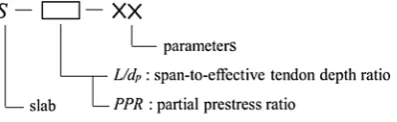
specimen is shown in Fig.1. Each specimen had three
supports with two spans. Two critical parameters affecting the stress increase in unbonded tendons were considered in
experiments: span-to-effective tendon depth ratio (L/dp) in
Group 1; and steel ratio in member section (qs) in Group 2.
As known well from the study by Mojtahedi and Gamble
(1978),L/dpof the concrete member can affect the stress in
tendons. ACI 318 equation (18-4) overestimates Dfps in
NWC members whenL/dpis greater than 35. In this study,L/
dpvaries from 25, 35, and 45 to evaluate the stress changes
in tendons. It was Warwaruk et al. (1962) who conducted an
Table 1 Specimen details (unit: mm).
Group Specimen Load Type b h L(one
span)
L/dp PPR qs qp fpe/fpu e
1 S-L/dp-25 Uniform 600 125 2400 25 0.792 0.00247 0.00206 0.6 33.1
S-L/dp-35 3400 35
S-L/dp-45 4300 45
2 S-PPR-0.5 0.884 0.00123 33.2
S-PPR-1.0 0.792 0.00247 33.1
S-PPR-1.5 0.718 0.00370 32.9
bmember width,hmember height,eeccentricity of prestressing strands,qsratio of steel,qpratio of tendon,dpeffective depth of prestressing strands.
PPR(partial prestressing ratio)=Apfpe/(Apfpe?Asfy), wherefpeeffective prestress,Apsectional area of prestressing steel,fyyield stress of steel,Assectional area of steel.
Fig. 1 Specimen nomenclature.
experiment about the loading pattern for the first time.
Harajli and Kanj (1990) found the length of the plastic
hinges of beams, as well as the stress in tendons, can be changed according to the loading patterns. When it comes to continuous slabs, a uniform loading method has been
sug-gested for ideal member behaviors (Burns et al.1978), so the
use of uniformly distributed loading was applied in this test. Group 1 consists of three continuous one-way slabs
receiving uniformly distributed load whoseL/dpranges from
25, 35 and 45. The ACI 318-11 requires at least 0.4 % reinforcement of the cross section between the flexural
ten-sion face and center of gravity of gross section (Act). Three
slabs in Group 2 receiving uniformly distributed load have
three differentqs’s with the same span and theL/dp; half of
the ACI requirement (S-PPR-0.5), same with the
require-ment (S-PPR-1.0), and 50 % more than the requirement
(SPPR-1.5). In all specimens, identical three-strand tendons
with 2050 MPa tensile strength were used. D10 and D6
(a) (b)
(c)
P/8
P/8 P/8 P/8 P/8 P/8 P/8 P/8
Load Cell 300kN Oil-Jack
Load cell Oil jack Hinge and loading plate Loading beam
Load cell LVDT
(2000kN) Hinge
(lp=100mm) Load cell(1000kN)
Roller (lp=50mm)
Load cell (1000kN)
LVDT ¥ Õ6mm Strand
tendon
L=2400,3400,4300mm
L/4
L/4 L/4 L/8
L/8
L=2400,3400,4300mm
Fig. 2 Test setupaactuator and specimenbloading points and supportcload cell and LVDT.
ࣱࣴ࣬ ࣱࣴ࣬
ࣱ࣭࣬ࣳ ࣱ࣭࣬ࣳ
ࣤएऑऌऌऋऎऐएࣥ
एकउ
एकउ
एकउ ࣤएऑऌऌऋऎऐएࣥ
ࣤएऑऌऌऋऎऐएࣥ
ࣤईऋࣽऀअऊःࣜऌऋअऊऐएࣥ
एऌँࣿअउँऊࣜएࣩई࣫ठबࣱࣩ࣮
एऌँࣿअउँऊࣜएࣩई࣫ठबࣱࣩ࣯
एऌँࣿअउँऊࣜएࣩई࣫ठबࣰࣱࣩ
ࣲ࣬࣬ ࣲ࣬࣬
࣭࣮
ࣱ
࣭࣮
ࣱ
एँࣿऐअऋऊࣩࣣࣜࣽࣽ
࣭࣮
ࣱ
ࣰࣱ࣮
ࣰ࣯࣬࣬
ࣰࣱ࣮ ࣯࣬࣬
ࣰ࣮࣬࣬
࣯࣬࣬
ࣱࣱ࣯ࣳ࣪
ࣰ࣯࣬࣬
ࣱࣱ࣯ࣳ࣪ ࣲ࣬࣬
ࣱࣴ࣬
ࣱ࣭࣬ࣳ (a)
(b)
(c)
rebars were used as reinforcing steel. The effective prestress
of tendon (fpe) was 60 % of its ultimate stress (fpu). The
concrete compressive strength was 35 MPa. See Figs.2and
3for their configurations.
The mixtures of LWC for the test are listed in Table2, and
the material properties of lightweight aggregates are listed in
Table3. Test results of lightweight concrete mixture are
shown in Table4. The designed compressive strength of the
ready-mixed concrete using lightweight aggregates was 35 MPa for all specimens. Artificially expanded clay gran-ules with maximum sizes of 20 and 5 mm were used for lightweight coarse and lightweight fine aggregates, respec-tively. The lightweight fine aggregates were replaced with local natural sand by as much as 30 % by volume in order to control the continuous grading. The average dry density of
the mixed LWC was approximately 1770 kg/m3. The
mechanical properties of the steel reinforcing bars are listed
in Table5. The tensile strength and equivalent yield strength
(fpy) of the low relaxation three-wire mono-strand were 2050
and 1852 MPa, respectively. The equivalent yield strength of the strand was calculated using measured nonlinear stress– strain curves according to ASTM A 416 (American Society
for Testing and Materials1996). The yield strengths of the
mild reinforcing bars with diameters of 10 and 6 mm were 446 and 475 MPa, respectively.
2.2 Test Procedure and Measurement
Each continuous one-way slab specimen was supported on hinges at both ends and on a roller at the center. The uniform load was applied by universal testing machine (UTM) at a
Table 2 Mixture proportions of lightweight concrete.
W/C(%) VG Unit weight (kg/m
3
)
Water Cement Light fine
aggregate
Sand Light coarse
aggregate
37 0.573 181 542 311 230 554
W/Cwater-cement ratio,VGapparent density ratio of coarse aggregate.
Table 3 Material properties of lightweight aggregates.
Aggregates Max. size (mm) Specific gravity Unit weight (kg/m3)
Fineness modulus
Absorption (%) Void ratio (%)
1 day 14 days
Coarse 19 1.80 931 3.365 11.8 14.29 48
Fine 4 1.80 1105 1.838 15.9 18.53 39
2 1.30 978 2.458 19.1 24.3 25
Table 4 Lightweight concrete mixture test results.
No. Slump
(mm)
Compressive strength (MPa) Splitting tensile
strength
Modulus of rupture Modulus of elasticity
(MPa) 1 day 3 days 7 days 28 days 56 days 92 days fsp
(MPa)
fsp ffiffiffiffi fck
p fr
(MPa)
frffiffiffiffi fck
p Ec
1 220 4.9 15.1 30.4 36.7 38.7 39.3 3.19 0.53 2.81 0.46 11,614
2 230 4.7 13.5 24.1 29.2 30.5 31.9 2.62 0.49 3.15 0.58 13,442
3 242 5.2 16.7 29.4 35.2 38.5 39.3 2.53 0.47 2.91 0.49 11,280
Table 5 Material properties of steels.
Area (mm2) Yield strain Yield strength (MPa)
Tensile strength (MPa)
Young’s modulus (MPa)
Elongation (%)
Anchoring plate – – 402 480 – –
Tendon (3 strands) 19.89 0.01000 1852 2050 201,319 5.7
Mild bar
D10 71.00 0.00279 446 639 214,976 18.4
D6 31.60 0.00282 475 500 171,121 3.9
(a)Group 1
(b)Group 2
ࣲࣩᇟࣲ ࣮ࣩऄऀ࣭࣬ ऄऀࣲ ࣮ࣵ ࣲࣵ ࣱ࣭࣮ ࣱࣲ ࣲ࣬࣬ ࣮࣬ एँࣿऐअऋऊࣩࣣࣜࣽࣽ ࣲࣩᇟࣲ ࣮ࣩऄऀ࣭࣬ ऄऀࣲ ࣮ࣵ ࣲࣵ ࣱ࣭࣮ ࣱࣲ ࣲ࣬࣬ ࣮࣬ एँࣿऐअऋऊࣩࣣࣜࣽࣽ एऌँࣿअउँऊࣜएࣩऌऌऎࣩ࣭࣪࣬ ࣲࣩᇟࣲ ࣯ࣩऄऀ࣭࣬ ऄऀࣲ ࣮ࣵ ࣲࣵ ࣲ࣬࣬ ࣮࣬ एँࣿऐअऋऊࣩࣣࣜࣽࣽ एऌँࣿअउँऊࣜएࣩऌऌऎࣱࣩ࣭࣪ ࣱ࣭࣮ ࣱࣲ ࣲࣩᇟࣲ ࣯ࣩऄऀ࣭࣬ ऄऀࣲ ࣲࣵ ࣲ࣬࣬ ࣮࣬ एँࣿऐअऋऊࣩࣣࣜࣽࣽ एऌँࣿअउँऊࣜएࣩऌऌऎࣱࣩ࣬࣪
Fig. 4 Section details and arrangement of reinforcing bars in specimens.
Specimen S-L/dp=45 is identical with S-PPR-1.0 of Group 2
(a)Group 1
(b)Group 2
S-L/dp=35
73 73 55
67 55 70 47 67 768080 43 6070
80 4760
60
76 60
64 68
68 68
4975 6060 6075
70 70 70 64 76 71 71 79
47 24453547 45
6875
S-L/dp=25
100 120 115 93 119 84 90 121 84 93 84 67 113 84 100 90 108115
108 110 121 121
121 83
75 100 108
63 80 100 S-PPR-0.5 S-PPR-1.0 S-PPR-1.5 44 44 44 44
43 43 43
43 40
48 48 48 4848
48 48 48 48 48 40 40 40 40 40 50 51 31 46 49 3640 47 3648 47 47 47 55
5555 5548 40
40 25 30 36 48 15 15 20 35 48 49 64 64 50
64 50 56 4850 48 54 48 53 4837 4258 64 53 38 53 5850
34 3450 53 54 6157
38405059594052 3459 59 61 53 52 3461 61 52 556555
56 56 64 56 52 31 52 50 26 555950 38 40 34 36 30 36 35
31 30 35
38
29 3029 293434 34 34
35 35 29 28 28 35 30 25 37
rate of 2.5 mm per minute. Linear variable differential transducers (LVDTs) were installed beneath the specimens at
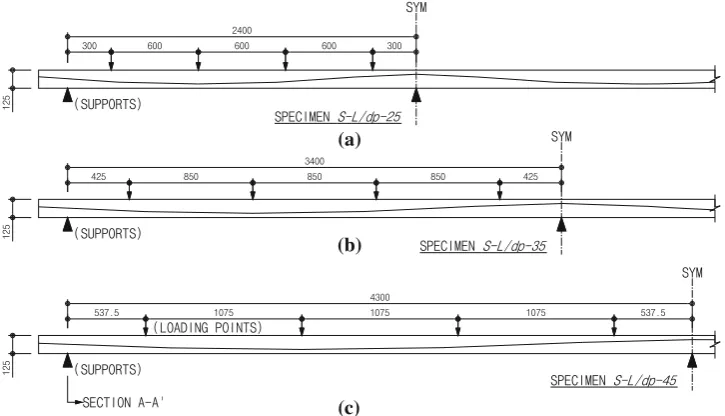
the loading points to measure the vertical deflection (Fig.2).
The 200 kN capacity load cells were installed on both ends of specimens to trace the stress incremental in unbonded tendons. The loading points and supports of each specimen
are described in Fig.3and the section details are shown in
Fig.4. The crack width was measured from where the first
cracks appeared until the reinforcing steels yielded. Electri-cal resistance strain gages were attached to the surface of the concrete and the steel to check how the strain changes, especially when concrete reached its ultimate strain (0.003). Concrete strain gages were installed on both compressive and tensile area of the center and the edges of specimens.
Wire strain gages were installed on rebars at intervals ofd/2.
All data from the UTM, load cells, and gages were collected into a data logger and saved in a computer. Through the process, the following information was obtained: crack development pattern and failure mode; load–displacement relationship; load-reaction relationship; load-tendon stress; flexural capacity; flexural ductility; and curvature-prestress loss.
3. Test Results
3.1 Crack Propagation and Failure Mode
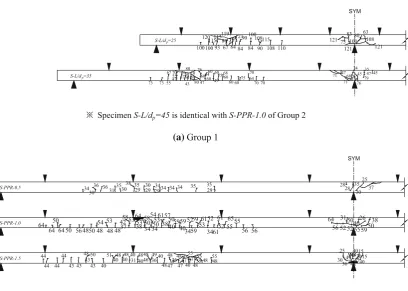
Crack propagation patterns were marked in Fig.5. No
diagonal crack was found; that means in this test, that flex-ural behavior was dominant. The maximum moment occurred at the center supports of the slabs; therefore, cracks were initiated at the upper parts of the center supports (negative moment region) and then developed at the lower parts of mid-spans (positive moment region). Due to the reinforcing steels, the cracks maintained the same intervals to each other, propagating towards the middle of the spans. Upon reaching maximum loading, cracks also achieved their maximum width at the center of the spans, while cracks at the supporting areas stopped developing prior to that stage. When the simultaneous compressive fracture and dramatic flexural strength reduction was achieved the test was ter-minated. The crack happened at the same position of the
members regardless of the L/dp. The major cracks
propa-gated until the peak loading was reached and then
com-pressive fractures were triggered. With the higher L/dp, the
cracks distributed more broadly. In all specimens, only a little more crack propagations were observed after the peak
loading. In Group 2, specimen S-PPR-0.5 reinforced less
than S-PPR-1.5 showed fewer number of cracks although
their width were bigger. That means specimens with more reinforcing steels are advantageous in control of crack width, although more fine cracks are expected.
3.2 Load–Deflection Relationship
In Group 1, as theL/dpincreased from 25 to 45, the ultimate
load was reduced by 44 %, while the deflection at the ultimate
loads was increased (Table6). Initial crack strength (Pcr) and
yield strength (Py) also dropped as the L/dp increased. As
T able 6 T est results. Specimen Pcr (kN) Py (kN) Pn (kN) Vn (kN) Dcr (mm) Dy (mm) Dn (mm) fps (MPa) D fps (MPa) D fps -ACI (MPa) D
fps
-EXP / D fps -ACI Pn -ACI (kN m) Pn -EXP / Pn -ACI Mcr (kN m) gcr x Mn (kN m) gn M n -EXP / Mn -ACI Mid Edge Mid Edge Mid Edge Group 1 S -L / dp -25 61.7 65.7 80.9 89.8 254.5 77.2 50.1 5.6 13.0 48.8 1613 358 256 1.40 214.5 1.19 14.77 0.0401 0.1 14 26.98 0.0732 1.35 S -L / dp -35 23.5 46.1 37.8 64.2 155.5 48.3 29.4 1 1.8 31.1 85.3 1788 505 256 1.97 155.9 1.00 14.68 0.0398 0.123 26.29 0.0713 1.32 S -L / dp -45 14.7 30.4 46.6 43.3 1 1 1.1 33.2 22.3 1 1.6 36.8 165.8 1669 430 132 3.25 120.7 0.92 12.25 0.0332 0.1 16 21.68 0.0588 1.22 Group 2 S -PPR -0.5 14.7 28.4 25.7 24.4 75.9 23.9 14.1 29.1 14.0 95.8 1540 285 132 2.16 97.5 0.78 1 1.46 0.031 1 0.095 14.68 0.0398 0.97 S -PPR -1.0 14.7 30.4 46.6 43.3 1 1 1.1 33.2 22.3 1 1.6 36.8 165.8 1669 430 132 3.25 120.7 0.92 12.25 0.0332 0.1 16 21.68 0.0588 1.22 S -PPR -1.5 25.5 33.3 34.1 55.0 129.9 40.9 24.0 16.7 57.5 1 13.6 1655 400 132 3.03 131.8 0.99 13.43 0.0365 0.130 26.82 0.0728 1.32 Pcr cracking load, Py yielding load, Pn ultimate load, Vn force at failed span, Dcr , Dy , Dn deflection at the first flexural crack, at yielding of mild longitudinal tensile reinforcement, and at the ultimate state, respectively , fps , D fps stress of prestressing strands and its increase, Pn -ACI ultimate load predicted by ACI, Pn(ExP) ultimate load by experiment, gcr cracking moment capcity (= M cr / f
0c bw h 2), gn ultimate moment capcity (= M n / f
0bc
shown in Fig.6a, as L/dpincreased, the maximum flexural
strength of the slabs decreased and the ductility increased. In
Group 2, as shown in Fig.6b, specimenS-PPR-1.0showed
excellent ductility while specimenS-PPR-0.5reinforced with
the least number of reinforcement among Group 2 specimens showed compressive fracture after the reinforcement yielding.
Specimen S-PPR-1.5 which is reinforced with 50 % more
steel than required was less ductile thanS-PPR-1.0with 17 %
higher ultimate load.
3.3 Stress of Unbonded Prestressing Tendons
The relationship of the load and the unbonded prestressing tendon stress was almost identical to that of the load–de-flection. Even after reaching the ultimate loading, the tendon stresses increased continuously to bear the tension stress
until the member failure. Figure7a shows the effect of theL/
dp on the load-tendon stress relationship. As the L/dp
increased, the ultimate stress in tendons decreased.
Fig-ure7b shows the effects of theqson the load-tendon stress
Fig. 6 Load-deflection relationship for each group.
Fig. 7 Load-tendon stress relationship for each group.
Table 7 Comparison of experiments and standards for ultimate stress increment of unbonded tendons.
Specimen Experimental Df
ps
exp .
Dfps
pre
fps(MPa) Dfps(MPa) ACI AASHTO CAN3
S-L/dp=25 1613 358 1.38 1.14 0.66
S-L/dp=35 1760 505 3.79 2.28 1.32
S-L/dp=45 1669 430 3.22 2.45 1.42
S-PPR-0.5 1540 285 2.14 1.58 0.92
S-PPR-1.0 1669 430 3.22 2.45 1.42
relationship. All specimens in Group 2 showed similar stress increments until the initial crack happened. The maximum
stress ofS-PPR-1.0was higher thanS-PPR-0.5, even higher
thanS-PPR-1.5. The measured stress increase in unbonded
tendons was higher than that from ACI and AASHTO
(Table7).
3.4 Cracking and Ultimate Moment Capacities
The normalized cracking capacities, gcr =Mcr/(f0cbwh2)
and the ultimate moment capacities,gn=Mn/(f0cbwh2) of the
specimens are listed in Table6. Thegcrdecreased as theL/dp
ratio increased in Group 1, and a higher gn was developed
with anL/dpratio of 25 than those with anL/dpratio of 35 or
45. In Group 2,gn increased in proportion to theqs.
In Fig.7, the ultimate moment of the specimens, (Mn)Exp
is compared with the corresponding value predicted by the
ACI 318-11 design procedure, (Mn)Pre. The safety of the
ACI 318-11 provision is significantly dependent on the
reinforcing index (x) and the loading type, but it is
inde-pendent of the L/dp ratio. However, a moment capacity
reduction was observed in the S-L/dp-45 of Group 1
(Fig.8a). When qs is half of the requirement, the (Mn)Exp/
(Mn)Preis less than unit (Fig.8b).
4. Comparison with Standards
In Table7, the stress in prestressing steel (fps) and its
increment (Dfps) of each specimen are listed. Also, the
experimental results were compared to the standards. The mean and standard deviation of the ratios of the measured and predicted moment capacities of the post-ten-sioned NWC beams are 1.05 and 0.22, respectively (Yang
et al.2013). Hence, the ACI 318-11 procedure for predicting
the Mn value of post-tensioned flexural members can be
considered conservative for LWC. In other words, the ACI
318 design equations generally underestimated Dfps. The
Dfps predictions from ACI 318 are as conservative as in
NWC. In addition the predictions obtained from the
AASHTO1998were in better agreement with the test results
than ACI 318-11, showing that the mean, standard deviation, and coefficient of variation of the ratios between measured
and predicted stress increases (Dfps) are 1.70, 0.53, and 0.31,
respectively. The predictions obtained from CAN 3 were the least conservative among three standards showing that the mean, standard deviation, and coefficient of variation of the
ratios between measured and predicted stress increases (Dfps)
are 1.10, 0.23, and 0.21, respectively. The ratios of measured
to predicted incremental stresses are plotted against x
accompanying with the NWC test results by Lim et al.
(1999) in Fig.9.
In all cases, Dfps
exp
.
Dfps
prefor LWC is less than that
for NWC. Note that Dfpsexp
.
Dfps
pre of specimen S-L/
dp=25, S-L/dp=45, and S-PPR-0.5 in CAN 3 are less
than one, while all NWC data are more than one.
5. Conclusions
To evaluate the flexural capacity and the ductility of post-tensioned LWC continuous slabs, six specimens were tested and compared with the design standards. Through the test the followings have been found: (1) The initial crack hap-pened at the center of negative moment and then developed at the positive moment areas on both sides simultaneously;
(2) As the steel ratio in member section (qs) increased, the
width of the crack decreased while the number of micro cracks increased. Also the maximum capacity increased while the ductility decreased; (3) As the span-to-effective
tendon depth ratio (L/dp) increased, the maximum strength
(Pu) decreased. The initial crack load (Pcr) and the yielding
capacity (Py) also decreased while the deflection increased
withL/dpgrowth; (4) As the quantity of minimum required
rebars increased, the initial crack load, yielding capacity, and maximum strength increased; (5) Even after reaching the ultimate stress of flexural members, the stress in the tendons continuously increased sharing the tensile stresses. The stress increases stopped when the flexural member finally
Fig. 8 Comparisons of measured and ACI318-11 predicted ultimate moment capacities.
ruptured; (6) As the L/dpincreased, the stresses in tendons
decreased. That means L/dpis a critical factor affecting the
tendon stresses; (7) In all specimens, before the initial crack, no stress change was observed in the tendons. After initial crack happened, the tendon stresses increased gradually as the applied load was increased; (8) With fewer rebars, the stress-increasing rate in the tendons was relatively high. The ACI standard evaluated the stress increment conservatively. The expected stress increase in unbonded tendon espe-cially by ACI and AASHTO were less than the test results in all specimens. In other words, the normalized flexural capacity of the post-tensioned LWC slabs was higher than the predictions based on the ACI code provision. The
differences were not negligible quantity so it may cause overdesign.
Open Access
This article is distributed under the terms of the Creative Commons Attribution 4.0 International License (http://creativecommons.org/licenses/by/4.0/), which per-mits unrestricted use, distribution, and reproduction in any medium, provided you give appropriate credit to the original author(s) and the source, provide a link to the Creative Commons license, and indicate if changes were made.
References
AASHTO. (1998). AASHTO LRFD Bridge Design
Specifica-tions. Washington D.C: American Association of State
Highway and Transportation officials.
ACI Committee 318. (2011). Building code requirements for
structural concrete (ACI 318-11) and commentary (ACI
318R-11). Farmington Hills, MI: American Concrete
Institute.
ASTM A 416. (1996). Standard specification for steel strand, uncoated seven-wire for prestressed concrete. West Con-shohocken: American Society for Testing and Materials. Au, F. T. K., & Du, J. S. (2004). Prediction of ultimate stress in
unbonded prestressed tendons. Magazine of Concrete
Research, 56(1), 1–11.
Burns, N. H., Charney, F. A., & Vine, W. R. (1978). Tests of
one-way post-tensioned slabs with unbonded tendons.PCI
Journal, pp. 66–81.
Cai, J., Li, G., Yang, C., & Lin, F. (2009). Tests on unbonded posttensioned concrete flat plate with T-shaped column
connections. Advances in Structural Engineering, 9(5),
671–685.
Campbell, T. I., & Chouinard, K. L. (1991). Influence of non-prestressed reinforcement on the strength of unbonded
partially prestressed concrete members. ACI Structural
Journal, 88(5), 546–551.
Canadian Standards Association (Can3-A23-M94) (1994) De-sign of Concrete Structures for Buildings.
Chakrabarti, P. R. (1995). Ultimate stress for unbonded
post-tensioning tendons in partially prestressed beams. ACI
Structural Journal, 92(6), 689–697.
Chandra, S., & Berntsson, L. (2003). Lightweight aggregate
concrete: Science, technology and applications. Norwich,
NY: Noyes Publications.
Collins, M. P., & Mitchell, D. (1991). Prestressed concrete
structures. Upper Saddle River, NJ: Prentice-Hall.
Ellobody, E., & Bailey, C. G. (2008). Behavior of unbonded
posttensioned one-way concrete slabs.Advances in
Struc-tural Engineering, 11(1), 107–120.
Harajli, M. H. (2006). On the stress in unbonded tendons at
ultimate: Critical assessment and proposed changes. ACI
Structural Journal, 103(6), 803–812.
Harajli, M. H. & Kanj, M. (1990).Experimental and analytical study of the behavior of concrete beams prestressed with
unbonded tendons, Report No. CE/FSEL 90-02, University
of Oklahoma, Norman, OK.
Kayali, O. (2008). Fly ash lightweight aggregates in high
per-formance concrete. Construction and Building Materials,
22(12), 2393–2399.
Lim, J. H., Moon, J. H., & Lee, L. H. (1999). Experimental examination of influential variables on unbonded tendon
stresses. Journal of Korea Concrete Instititute, 11(1),
209–219.
Lou, T. J., & Xiang, Y. Q. (2007). Effects of ordinary tension reinforcement on the response of beams with unbonded
tendons. Advances in Structural Engineering, 10(1),
95–109.
Manisekar, R., & Senthil, R. (2006). Stress at ultimate in unbonded post tensioning tendons for simply supported
beams: A state-of-the-art review. Advances in Structural
Engineering, 9(3), 321–335.
Mojtahedi, S., & Gamble, W. (1978). Ultimate steel stress in
unbonded prestressed concrete. Journal of Structural
Division, ASCE, 104(ST7), 1159–1165.
Naaman, A. E., & Alkhairi, F. M. (1991). Stress at ultimate
unbonded post-tensioned tendons.ACI Structural Journal,
88(6), 683–692.
Oh, B. H., & Choi, Y. C. (2004). State-of-the-arts of prestressed
concrete structures. Magazine of the Korea Concrete
Institute, 16(1), 12–21.
Ozkul, O., Nassif, H., Tanchan, P., & Haraili, M. (2008). Actional approach for predicting stress in beams with
unbonded tendons. ACI Structural Journal, 105(3),
338–347.
Tang, W. C., Lo, T. Y., & Chan, W. K. (2008). Fracture prop-erties of normal and lightweight high-strength concrete.
Magazine of Concrete Research, 60(4), 237–244.
Warwaruk, J., Sozen, M. A., & Siess, C. P. (1962).Investigation
of prestressed reinforced concrete for highway bridges, part III: Strength and behavior in flexure of prestressed
concrete beams, Bulletin No. 464, Engineering Experiment
Station, University of Illinois, Urbana, IL.
Yang, K. H. (2010). Tests on lightweight concrete deep beams.
ACI Structural Journal, 107(6), 663–670.
Yang, K. H., & Mun, J. H. (2013). Flexural capacity and stress in unbonded tendons of post-tensioned lightweight concrete
beams. Advances in Structural Engineering, 16(7),
1297–1310.
Yang, K. H., Mun, J. H., & Kim, G. H. (2013). Flexural behavior of post-tensioned normal-strength lightweight concrete
one-way slabs.Engineering Structures, 56, 1295–1307.