O R I G I N A L A R T I C L E
Vibrational properties of harp soundboard with respect to its
multi-layered structure
Takuya Gunji•Eiichi Obataya •Kenzo Aoyama
Received: 11 October 2011 / Accepted: 6 February 2012 / Published online: 23 February 2012
ÓThe Japan Wood Research Society 2012
Abstract The vibrational properties of a harp soundboard were investigated with respect to its multi-layered struc-ture. The surfaces of harp soundboards are usually rein-forced with veneer; however, this reduces the specific dynamic Young’s modulus (E0/q) and significantly increases the internal friction (Q-1) of soundboards. Since smaller E0/q and greater Q-1 values impart a smaller acoustic conversion efficiency, the attachment of veneer is predicted to reduce the amplitude of the sound produced, as suggested by harp makers. The vibrational properties of veneer-reinforced wood are elucidated using a multi-lay-ered model comprising base wood, a glue layer, veneer and a varnish layer. The results of calculations suggest that a thinner veneer attached with minimal glue would increase the sound amplitude.
Keywords HarpSoundboard Vibrational properties
VeneerMulti-layered model
Introduction
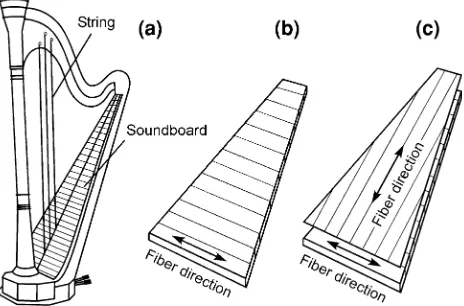
A harp is a popular string instrument used in various genres of music. There are many types of harps; the modern ‘‘grand harp’’ illustrated in Fig.1a is the biggest one. A harp comprises about 48 strings connected to a wooden soundboard, which converts the vibration of the strings into
audible sound by its flexural vibration. Many acousticians have dealt with the vibration of string and soundboard, and sound radiation from the soundbox of the harp [1–5]. In addition, the vibrational properties of solid wood have been well investigated by wood scientists [6,7]. However, little attention has been paid on the unique ‘‘plywood-like’’ structure of harp soundboard.
In general, the sound radiated from a wooden board is dominated by its vibrational properties along the grain, because the acoustic conversion efficiency (ACE) of wood is maximized in its fiber direction [6]. The ACE is usually defined as pffiffiffiffiffiffiffiffiffiffiffiffiE0=q3=Q1; where q, E0, and Q-1 are the
density, dynamic Young’s modulus, and internal friction of the material, respectively. It has been experimentally [6] and theoretically [7] proved that a higher ACE correlates with a greater overall power level of sound from wooden boards. The harp soundboard is usually made of spruce wood with its fiber direction aligned perpendicular to the length of the harp, as shown in Fig. 1b. In this case, the sound of harp is primarily determined by the flexural vibration of its soundboard in the width direction.
In small harps, a single wooden board is strong enough to support the tensile force of the strings. However, in grand harps, the strong force of the strings (12–20 kN) [4] can cause serious cracks of the soundboard along its width,i.e., in the fiber direction. Therefore, the longitudinal direction of the soundboard,i.e., the radial direction of the wood, is usually reinforced with a thin veneer, as shown in Fig.1c.
Although the veneer overlay provides effective rein-forcement to prevent the failure of the base wood, it causes another problem: many harp makers claim that the veneer significantly reduces the amplitude of sound. This problem may be caused by a reduction in the ACE of the sound-board in its width direction. Since the ACE in the radial direction is much smaller than that along the fiber direction T. GunjiE. Obataya (&)
Graduate School of Life and Environmental Sciences, Tsukuba University, Tsukuba, Ibaraki 305-8572, Japan e-mail: [email protected]
K. Aoyama
Aoyama Harp Company, Fukui 910-1127, Japan e-mail: [email protected]
[6], it is possible that the veneer dampens the flexural vibration of the soundboard in its width direction. How-ever, few studies have focused on the vibrational properties of these plywood-like soundboards, probably because the plywood is not a usual material for the soundboard of traditional string instruments.
In this paper, we describe the vibrational properties of a harp soundboard with respect to its multi-layered or plywood-like structure. The results are analyzed using a multi-layered model in which the viscoelastic properties of the adhesive and varnish are taken into consideration.
Materials and methods
Wood samples
Sitka spruce (Picea sitchensis) wood selected for the harp soundboard was used as the base material. It was cut into strips with dimensions of 200 mm (L longitudinal direction)915 mm (R radial direction)92.9–10.0 mm (T tangential direction). On the other hand, sliced veneer of Sitka spruce with dimensions of 200 mm (R)915 mm (L)90.8–1.0 mm (T) was used for surface reinforcement. The thickness of those specimens was chosen by consid-ering the structure of real soundboards. All specimens were conditioned at 25°C and 60% relative humidity (RH) for at least 1 month prior to the experiments.
Veneer attachment
Sliced veneers were attached to the edge grain (LR) surface of the strips using a honeymoon-type adhesive (Konishi Co. HB10). The curing agent was first applied to the sur-face of the strips and maintained at 25°C and 60% RH for
1 day until the solvent evaporated. Meanwhile, the base resin was applied to the surface of the veneer using a hand roller. The amount of applied resin, being based on its uncured weight, was controlled to be 100, 200, 300 and 400 g/m2. The veneers were then attached to the strips, and pressed at room temperature for 1 h under a pressure of 0.1 MPa. Five specimens were employed for each testing condition.
Sample varnishing
A polyurethane lacquer (PU, Otani Paint Manufacturing Co. High-gross type) that is typically used for harp soundboards was applied to the LR surface of the wood specimens with a paintbrush. This varnishing process was repeated 1–4 times to vary the amount of applied lacquer from 100 to 400 g/m2. Five specimens were employed for each testing condition.
Resin plates
To determine the vibrational properties of the adhesive and lacquer resins, they were spread onto a flat polytetrafluo-roethylene plate and cured at room temperature. The pro-cess was repeated until a sufficient thickness of 1 mm for the adhesive resin and 3 mm for the PU resin was achieved. The resin plates were then cut into strips with dimensions of 10 980 mm.
Vibrational measurements
After conditioning at 25°C and 60% RH for 1 month, the dynamic Young’s modulus (E0) and internal friction (Q-1) of the wood specimens were determined via the free–free flexural vibration method [8]. A thin piece of 3910 mm iron was attached to the end of a specimen, and the spec-imen hung by silk threads was vibrated by a magnetic driver. The amplitude of vibration was detected using an eddy-current sensor, and the signal passed through a band-pass filter (NF Electronic instruments, Type 3611) was observed by a FFT analyzer (Ono Sokki Co., CF-4220A). TheE0andQ-1values were calculated from the resonance frequency of the first mode vibration and the width of the resonance curve, respectively. The resonance frequency ranged between 300 and 1500 Hz.
TheE0andQ-1values of the resin plates were measured using cantilever flexural vibration method at 25°C and 60% RH. A thin iron piece of 3910 mm was attached to the end of a specimen, and the other end was fixed by a metal clamp. The free end of the specimen was then tapped lightly by a finger, and the excited vibration was detected by an eddy-current sensor. TheE0value was determined by Fig. 1 aAppearance of a grand harp,bfiber alignment of the base
the resonance frequency of the free vibration, and Q-1 from the decrement curve. The resonance frequency ranged from 50 to 300 Hz.
Results and discussion
Effect of reinforcement with veneer
Table1lists the averageE0/qandQ-1values of materials tested. In this paper, the vibrational properties of reinforced and/or varnished specimens are always normalized by those of base wood determined before the attachment of veneer and varnishing to eliminate the natural variations in the vibrational properties of wood.
As in real harp soundboards, the thickness of the base wood (t0) varied between 2.9 and 10.0 mm while that of
the overlaid veneer (t1) remained almost constant at
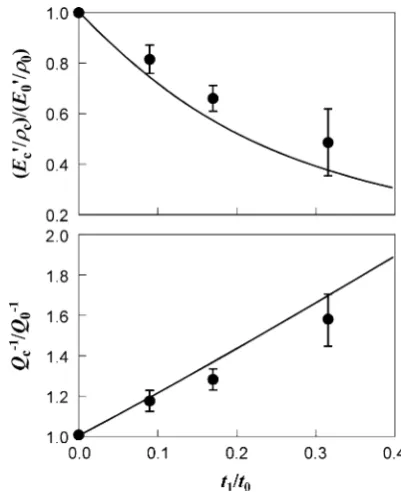
0.8–0.9 mm. Figure2shows the relative values ofE0/qand Q-1as a function of the relative thickness of the veneer (t1/ t0). A thicker veneer resulted in smaller E0/q and greater Q-1values. Those changes include the effects of adhesive, but it should be noted that the amount of adhesive was constant (200 g/m2) in this case. Therefore, it is evident that the veneer significantly reduces the ACE of the soundboard. These data provide empirical support for harp makers’ intuitive knowledge that the application of a veneer reduces the amplitude of sound. This adverse effect must be greater at higher frequencies because thinner base wood is usually used in the upper position of the sound-board, which covers the higher frequency range. Essen-tially, the overlaid veneer may act as a high-cut damper in soundboards. To maintain higher ACE, it is advisable to use a thinner veneer for the reinforcement of soundboards. The effect of adhesive
In soundboards reinforced with veneers, a continuous layer of adhesive (glue layer) is present between the base wood and veneer. Even a very thin glue layer significantly affects the flexural vibration of the soundboard because it is located near the surface of the soundboard and its
viscoelastic properties completely differ from those of wood. Figure3exhibits the relative values ofE0/qandQ-1 for veneer-reinforced wood plotted against the amount of adhesive applied. In this case, the amount of adhesive varied from 100 to 400 g/m2 while the thickness of base wood and veneer remained constant. The E0/q value was significantly reduced by the attachment of veneer, but it did not depend on the amount of adhesive. For the E0/q of soundboard, the effect of adhesive is much slighter than that of veneer. On the other hand, theQ-1value increased linearly with increasing amount of adhesive,i.e., increasing thickness of the glue layer. This suggests that the amount of glue should be minimized to maintain a higher ACE for veneer-reinforced soundboards.
The effect of varnishing
Varnishing is an effective method of stabilizing the per-formance of wooden instruments because it impairs the moisture sorption and desorption of wood. However, arti-sans suggest that the varnish layer should be as thin as possible because it degrades the sonority of the sound. This adverse effect can be explained by the reduction in ACE due to varnishing, as described in a previous paper [9,10]. Varnish resin is usually an amorphous polymer and has lowerE0/q and higherQ-1values than wood; therefore, it reduces theE0/qand increases theQ-1of wood in the fiber
Table 1 Average experimental values of density (q), dynamic Young’s modulus (E0) and internal friction (Q-1) of materials tested
q(kg/m3) E0(GPa) Q-1
Wood
L direction 420 14.3 0.0068
R direction 0.936 0.0206
Adhesive 1200 2.6 0.189
Varnish 1200 2.5 0.050
Fig. 2 Relative values ofE0/qandQ-1of veneer-reinforced wood as
a function of the relative thickness of veneer (t1/t0). Filled plots
direction. Figure4 shows the relative values of E0/q and Q-1 for varnished wood plotted against the amount of lacquer applied. Again, the vibrational properties of the varnished specimens are normalized by those of ‘‘naked’’ specimens. Therefore, the results in Fig.4 include the effects of veneer and adhesive as well as those of var-nishing. In both the unreinforced and veneer-reinforced wood, thicker varnishing resulted in lowerE0/qand higher Q-1 values. As suggested by artisans, the varnish layer should be minimized to increase the amplitude of sound. Analysis using a multi-layered model
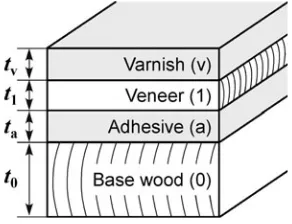
To elucidate the vibrational properties of plywood-like harp soundboard, we analyzed the experimental results using the multi-layered model illustrated in Fig.5. The harp soundboard is approximated by a multi-layered composite (c) consisting of base wood (0), an adhesive layer (a), overlaid veneer (1), and a varnish layer (v). In reality, some of the lacquer and adhesive penetrates into the porous wood surface to form additional layers [9]. However, this effect is considered to be negligible in the present calculation and it is assumed that the adhesive and lacquer resins form flat and continuous layers without penetration into the wood. The q and flexural Young’s modulus (E) of the composite are expressed by the fol-lowing equations:
qc¼
Pn j¼1qjAj
Ac
ð1Þ
Ec¼
Pn j¼1EjIj
Ic
; ð2Þ
whereAandIrepresent the cross-sectional area and second moment of inertia of each layer, respectively. The Ivalue of thenth layer (In) is given by
In¼In0þa2nAn; ð3Þ
whereI0nis the second moment of inertia of thenth layer, andanis the shift of the neutral plane by the combination Fig. 3 Relative values ofE0/qandQ-1for veneer-reinforced wood
plotted against the amount of adhesive. Filled plots experimental values, solid lines calculated values. The bars indicate standard deviation. Some plots without bars indicate that the standard deviation was smaller than the size of plot. All samples were unvarnished and the relative thickness of veneer (t1/t0) was 0.27
Fig. 4 Relative values ofE0/qandQ-1for unreinforced and veneer-reinforced wood plotted against the amount of lacquer applied.Open
plots unreinforced specimens, filled plots veneer-reinforced
speci-mens, broken lines calculated values for unreinforced specimens,
solid lines calculated values for veneer-reinforced specimens. The
bars indicate standard deviation. Some plots without bars indicate that the standard deviation was smaller than the size of plot. The amount of glue for the attachment of veneer was 100 g/m2and the relative thickness of veneer (t1/t0) was 0.27
of different materials. When Eq. (2) is expanded to represent complex Young’s modulus (E*=E0?iE00), the dynamic Young’s modulus (Ec0) and internal friction
(Qc-1) of the composite can respectively be described by
E0c¼ Pn
j¼1E
0 jIj Ic
and ð4Þ
Qc1 ¼E 00
c E0
c
¼ Pn
j¼1Ej0IjQj1 Pn
j¼1E0jIj
ð5Þ
The experimental values listed in Table1 were used as basic parameters of local components, and the thickness of glue and varnish layers was calculated from the amount of adhesive and lacquer, their resin contents, and their den-sities in dry state. The calculated values are compared to the experimental values in Figs.2, 3,4 via lines. Despite the simplicity of the model and the natural variations in wood properties, agreement with the experimental data was fairly good.
It was inferred from the calculations that the lowerE0 and greaterQ-1values of veneer in the R direction are the major reasons for the reduced ACE of veneer-rein-forced soundboard. An additional factor was the amount of adhesive, i.e., the thickness of glue layer, which contributes to the reduction in ACE especially when the Q-1of the glue layer is much greater than that of wood. For more effective sound radiation, it is advisable to minimize the thickness of veneer and amount of adhe-sive. Additionally, the use of epoxy or similar cross-linking resins will give better results because theirQ-1 values are lower than that of honeymoon-type glue currently used. The adverse effects of varnishing were less significant than those of veneer and adhesive because the Q-1 value of the PU lacquer was smaller than that of the adhesive resin and comparable to that of wood in the R direction.
In any cases, the ACE of harp soundboard is more or less reduced by the conventional veneer reinforcement. For further development of harp soundboard, it is worth reconsidering its designing from the very beginning. As one of many options, carbon fiber-reinforced structure will be proposed in a following article.
Conclusions
The attachment of veneer resulted in a significant reduction in E0/q and a marked increase in Q-1 of wooden sound-board in its width direction,i.e., the direction of the fiber of the base wood. These adverse effects were mainly due to the smaller E0/q and greater Q-1 values of the overlaid veneer. In addition, larger amounts of glue and varnish induced a greater reduction in E0/q and increase in Q-1. These results all correlate with artisans’ knowledge that veneer-reinforcement and varnishing reduce the sonority of harps. The experimental results were clarified via calcula-tions on a multi-layered model consisting of base wood, a glue layer, veneer, and a varnish layer.
References
1. Bell AJ (1997) The Helmholtz resonance and higher air modes of the harp soundbox. J Catgut Acoust Soc 3:2–8
2. Gautier F, Dauchez N (2004) Acoustic intensity measurement of the sound field radiated by a concert harp. Appl Acoust 65:1221–1231
3. Le Carrou JL, Gautier F, Folteˆt E (2007) Experimental studies of the A0 and T1 modes of the concert harp. J Acoust Soc Am
121:559–567
4. Waltham C, Kotlicki A (2008) Vibrational characteristics of harp soundboards. J Acoust Soc Am 124:1774–1780
5. Daltrop S, Kotlicki A, Waltham C (2010) Vibro-acoustic char-acteristics of an Aoyama Amphion concert harp. J Acoust Soc Am 128:466–473
6. Ono T (1996) Frequency responses of wood for musical instru-ments in relation to the vibrational properties. J Acoust Soc Jpn (E) 17:183–193
7. Yano H, Matsuhisa H (1991) Study on the timber of wood II, analysis of the sound spectrum of wood using viscoelastic Tim-oshenko equation. Sci Rep Kyoto Prefect Univ 43:24–31 8. Hearmon RFS (1958) The influence of shear and rotary inertia on
the free flexural vibration of wooden beams. J Appl Phys 9:381–388
9. Obataya E, Ohno Y, Norimoto M, Tomita B (2001) Effects of oriental lacquer (urushi) coating on the vibrational properties of wood used for the soundboards of musical instruments. Acoust Sci Tech 22:27–34