R E V I E W
Open Access
Septic cardiomyopathy
Antoine Vieillard-Baron
1,2Abstract
Depression of left ventricular (LV) intrinsic contractility is constant in patients with septic shock. Because most parameters of cardiac function are strongly dependent on afterload, especially in this context, the cardiac performance evaluated at the bedside reflects intrinsic contractility, but also the degree of vasoplegia. Recent advances in echocardiography have allowed better characterization of septic cardiomyopathy. It is always reversible providing the patient’s recovery. Unlike classic cardiomyopathy, it is not associated with high filling pressures, for two reasons: improvement in LV compliance and associated right ventricular dysfunction. Although, it is unclear to which extent it affects prognosis, a hyperkinetic state is indicative of a profound and persistent vasoplegia
associated with a high mortality rate. Preliminary data suggest that the hemodynamic response to a dobutamine challenge has a prognostic value, but large studies are required to establish whether inotropic drugs should be used to treat this septic cardiac dysfunction.
Introduction
Reversible myocardial depression in patients with septic shock was first described in 1984 by Parker et al. using radionuclide cineangiography [1]. In a series of 20 patients, they reported a 65% incidence of left ventricu-lar (LV) systolic dysfunction, defined by an ejection
frac-tion <45% [1]. In 1990, using transthoracic
echocardiography, Jardin et al. reported the same results [2]. In a canine model simulating human septic shock, Natanson et al. demonstrated that intrinsic LV perfor-mance was actually depressed in all animals and not corrected by volume expansion [3]. Finally, more recently, Barraud et al. confirmed the presence of severe depressed intrinsic LV contractility using LV pressure/ volume loops in lipopolysaccharide-treated rabbits [4]. All of these studies, and many others not cited in this introduction, demonstrate the reality of the impairment of intrinsic LV contractility in septic shock. For many years, septic cardiac dysfunction was largely underesti-mated because the hemodynamic device used, i.e., the pulmonary artery catheter, was not appropriate for establishing such a diagnosis. Development of new hemodynamic tools at the bedside, such as echocardio-graphy, allowed better characterization of the septic car-diomyopathy [5]. The following review explains the
mechanisms of such a depression, its characteristics, incidence, and finally its impact on treatment and prog-nosis. We decided not to deal with the place and the role of biomarkers, which will be presented in a future review of the journal.
Mechanisms
Many factors may contribute to cardiac depression dur-ing sepsis. Studies performed in humans have ruled out coronary hypoperfusion requiring coronary intervention as a cause of LV systolic dysfunction in sepsis [6,7]. Of course, patients with coronary disease may behave differently.
On the other hand, the role of cytokines has been strongly advocated in the genesis of septic cardiomyopa-thy. In 1985, Parrillo et al. demonstrated in vitro that myocardial cell shortening is reduced by exposure to the serum of septic patients [8]. Later, the same team showed that the circulating factor responsible for this
was tumor necrosis factor a (TNF-a) [9,10], even
though later studies have implicated other cytokines, such as interleukin-1b[11]. Kumar et al. suggested that the effect of cytokines on cardiac myocytes results from an increase in intracellular cGMP and in nitric oxide [12]. In addition, direct alteration in cellular respiration with mitochondrial dysfunction also was advocated [13], and, finally, Tavernier et al. suggested that increased phosphorylation of troponin I was involved by reducing myofilament response to Ca2+ [14].
Correspondence: [email protected] 1
Service de Réanimation, Hôpital Ambroise Paré, Assistance Publique des Hôpitaux de Paris, 9 avenue Charles de Gaulle, 92104 Boulogne, France Full list of author information is available at the end of the article
Main characteristics of septic cardiomyopathy
The first characteristic of septic cardiomyopathy is that it is acute and reversible, providing the patient recovers. In 90 patients during a 5-year period, Jardin et al. reported that LV ejection fraction is normalized in a few days [15], as also reported more recently by Bouhemad et al. [16].
The second characteristic, which is crucial to full understanding, is that depressed LV systolic function is associated with normal or low LV filling pressure, unlike
the “classic” pattern of cardiogenic shock where LV
pressures are elevated (Figure 1). This may explain why the pulmonary artery catheter has for many years under-estimated the incidence of LV systolic dysfunction. Jar-din et al. and Bouhemad et al. reported an average pulmonary capillary wedge pressure close to 11 mmHg in patients with decreased LV ejection fraction, which is
not significantly different from that found in patients with a preserved ejection fraction [2,16]. In the study by Parker et al., the pulmonary capillary wedge pressure was 14 mmHg on average in patients with LV ejection fraction <45% [1].
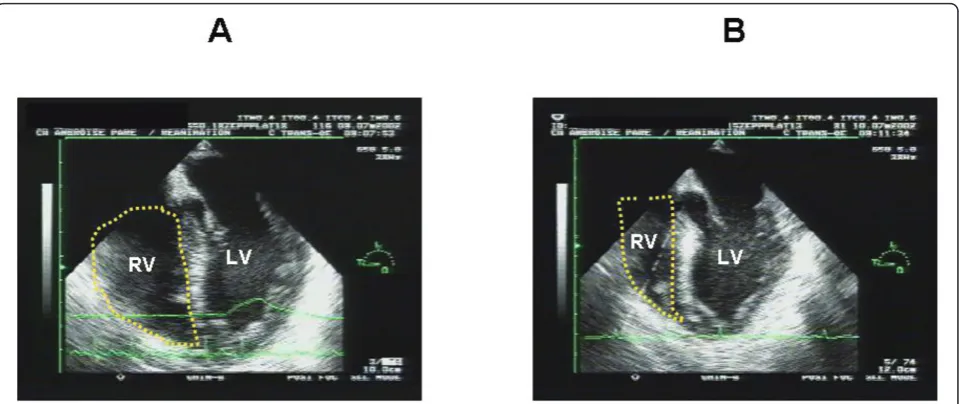
Two mechanisms may explain this absence of elevated LV pressures. The first relates to the frequent associa-tion with right ventricular (RV) dysfuncassocia-tion. Vincent et al. in a group of 93 patients with septic shock reported a decreased RV ejection fraction compared with a “ con-trol” group [17]. Similar results were found by Kimchi et al. and Parker et al. [18,19]. Using transesophageal echocardiography, we reported that almost 30% of patients have RV dilatation, which is highly suggestive of significant RV dysfunction (Figure 2) [20]. RV dys-function is related to acute pulmonary hypertension, which is frequently associated in this situation because
of the acute lung injury, or depressed intrinsic contracti-lity due to circulating cytokines [18]. It protects the pul-monary circulation [21] and avoids significant elevation of LV pressures.
The second mechanism relates to LV compliance alteration, which usually occurs. In their original work, Parker et al. suggested a huge increase in LV compli-ance; they found a dilatation of the left ventricle of
more than 100% [1]. This very impressive LV “preload
adaptation”was actually never confirmed and was prob-ably explained in part by technical errors related to the use of the pulmonary artery catheter. Most studies using echocardiography only report a slight increase in LV size in patients with decreased LV ejection fraction compared with patients with preserved ejection fraction, suggesting a true but slight increase in LV compliance in these patients (Table 1) [16,20,22]. In 12 normal healthy volunteers, Suffredini et al. demonstrated that injection of endotoxin induces a depression of LV systo-lic function associated with a significant decrease in the ratio of pulmonary capillary wedge pressure to LV end-diastolic volume index [23]. A limited but significant increase in LV end-diastolic volume (+15%) was reported after volume loading with a pulmonary capil-lary wedge pressure less augmented than in the control group [23].
Incidence
The reported incidence of LV systolic dysfunction varies significantly (Table 2). This is easy to understand, because the LV afterload plays a crucial role in the eva-luation of cardiac function. As well illustrated by Robot-ham et al. [24], the same value of LV ejection fraction
may correspond to very different levels of intrinsic LV contractility: for instance, an ejection fraction of 60% may correspond to a severe impairment of LV contracti-lity, if the afterload is very low, as it is in septic shock before resuscitation. As shown by all animal studies, we must consider that the presence of depressed LV intrin-sic performance is constant in septic shock. Accordingly, LV ejection fraction actually reflects the LV afterload rather than the intrinsic contractility. During the 6 first hours of resuscitation, we found an 18% incidence of a hypokinetic profile, associating low cardiac index and decreased LV ejection fraction [20]. In another study, where echocardiography was performed later, we reported a 40% incidence of LV systolic dysfunction Figure 2Long-axis view of the left ventricle by a transesophageal approach in a patient ventilated for septic shock. At day 1 (panel A), the patient had right ventricular dysfunction illustrated by major dilatation of the right ventricle. At day 2 (panel B), this was corrected. RV, right ventricle; LV, left ventricle.
Table 1 End-diastolic size of the left ventricle according to the ejection fraction
LV end-diastolic size
Decreased LVEF Preserved LVEF
Parker et al. [1] 20 patients,PAC
LVEDV159 ± 29 mL/m2 81 ± 9 mL/m2*
Jardin et al. [2] 21 patients,TTE
LVEDV76 ± 18 mL/m2 70 ± 20 mL/m2
Jardin et al. [15] 90 patients,TTE
LVEDV80 ± 21 mL/m2 62 ± 15 mL/m2*
Vieillard-Baron et al. [25] 67 patients,TEE
LVEDV76 ± 24 mL/m2 68 ± 24 mL/m2
Bouhemad et al. [16] 45 patients,TEE
LVEDA13 ± 3 cm2/m2 11 ± 2 cm2/m2*
PAC, pulmonary artery catheter; TTE, transthoracic echocardiography; TEE, transesophageal echocardiography; LVEF, left ventricular ejection fraction; LVEDV, left ventricular diastolic volume; LVEDA, left ventricular end-diastolic area.
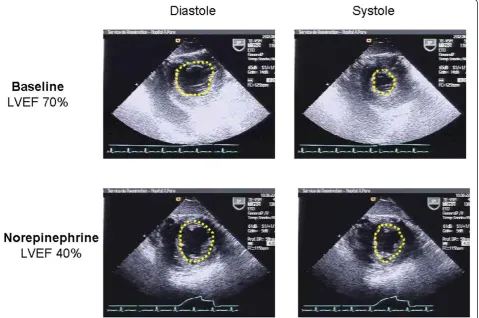
after 24 hours of resuscitation [25]. In the same study, the incidence increased to 60% after 2 and 3 days [25], probably because of the restoration of a normal LV afterload by norepinephrine or by the natural evolution of the infectious process. This is why echocardiography, when repeated at different times, may show how norepi-nephrine infusion may unmask poor intrinsic LV
contractility (Figure 3). Interestingly, in the study by Jar-din et al., the systemic vascular resistances were signifi-cantly lower in patients with a preserved LV ejection fraction than in patients with decreased ejection fraction [2]. A similar result was reported by Parker et al. [1]. In our study, 15% of patients after 6 hours had a hyperki-netic profile, associating tachycardia, supra-normal LV
Table 2 Incidence of LV systolic dysfunction in septic shock according to the time of evaluation
Time of study/admission Incidence of LV systolic dysfunction
Parker et al. [1]
PAC + radionuclide cineangiography
Day 1 65%
Jardin et al. [2]
TTE
0-6 hours 29%
Vieillard-Baron et al. [20]
TEE
0-6 hours 18%
Vieillard-Baron et al. [25]
TEE
Day 1, 2, 3 60%
Bouhemad et al. [16]
TEE
? 20%
Etchecopar-Chevreuil et al. [22]
TEE
12 hours 46%
PAC, pulmonary artery catheter; TTE, transthoracic echocardiography; TEE, transesophageal echocardiography.
ejection fraction, small LV cavity despite massive
volume expansion, and high cardiac index–a pattern
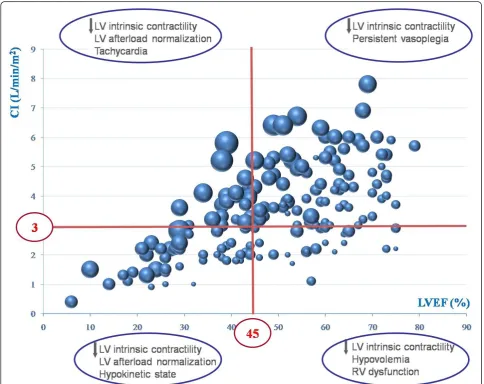
reflecting persistent and very profound vasoplegia [20]. In 2003, we reported a series of 183 patients with septic shock who were all monitored hemodynamically by using echocardiography through transthoracic or transe-sophageal route [5]. As shown in Figure 4, the relation-ship between LV ejection fraction and cardiac index may be separated into four parts, depending on LV afterload, volemia, and RV function.
Prognosis and treatment
It is very difficult to establish whether septic cardiomyopa-thy independently affects the prognosis of patients with septic shock, because many other variables are involved, such as age, patient history, type of microorganisms, and
time to resuscitation. Initially, Parker et al. suggested that development of septic cardiomyopathy was“protective” [1]. Ten of the 13 survivors had an LV ejection fraction <40%, but none of the nonsurvivors [1]. In appearance, we found different results with a mortality rate of 43% in patients with a hypokinetic profile compared with 24% in patients with a normokinetic profile [20]. We also found that patients with a hyperkinetic profile (small left ventri-cle, supranormal ejection fraction, tachycardia, high car-diac index) had a 100% mortality rate [20]. Actually, rather than a“protective” effect of LV systolic dysfunction, we can conclude that the prognosis is poor in the presence of a hyperkinetic state, which reflects persistent and pro-found vasoplegia, as explained above. Table 3 summarizes the main studies and their results in terms of survival and LV systolic function.
Three therapeutic interventions must be discussed. The first is volume expansion. Parker et al. suggested that“massive” fluid infusion maintains a normal cardiac index, despite a significantly impaired LV contractility, through LV preload adaptation [1]. However, we have learned that this dilatation is limited and that fluid over-load is deleterious for survival [26,27]. In the study by Ognibene et al., volume infusion was unable to restore normal left ventricular function and unmasked a flat Frank-Starling curve in the 21 patients with septic shock [28]. In our study, LV stroke index and LV end-diastolic volume did not correlate, whereas LV stroke index and LV ejection fraction were strongly correlated [20]. Nevertheless, volume expansion must always be pro-posed first to restore central blood volume in the case of absolute or relative hypovolemia.
The second therapeutic option is the infusion of an inotropic drug, such as dobutamine, a beta-agonist agent. We and others reserve this treatment for patients with persistent shock, lactic acidosis, and oliguria [25,29]. In this situation, dobutamine increases LV ejec-tion fracejec-tion and cardiac index [25,29]. To which extent such a treatment may improve the patient’s prognosis is unknown. However, it is well established that the cardi-ovascular response to dobutamine stress predicts out-come in sepsis. Vallet et al. using a dose of 10μg/kg per
min and Rhodes et al. using a dose of 5 μg/kg per min
reported that patients with an increased oxygen con-sumption (>15%) in response to dobutamine infusion have a much higher survival rate [30,31]. This was related to a significant increase in cardiac index and oxygen delivery [30,31]. More recently, Kumar et al. per-formed a“dobutamine challenge”at 5, 10, and 15 μg/kg per min in 23 patients with septic shock [32]. They also found that survival was associated with increased cardiac performance and LV contractility indices [32]. In parti-cular, a cutoff value of 8.5 mL/m2 increase in LV stroke index in response to dobutamine correctly categorized the outcome in 21 of 23 patients [32]. Levosimendan, a new calcium sensitizer, also has been proposed to treat
septic cardiomyopathy. It may improve not only LV but also RV function in the context of sepsis [33,34]. Bar-raud et al. in an endotoxin model in rabbits reported that LV systolic elastance was restored during levosi-mendan infusion [4].
Finally, a few words should be mentioned about nore-pinephrine administration. As explained above and shown in Figure 3, norepinephrine infusion may unmask the impairment of LV contractility. However, some authors recently have suggested that administration of norepinephrine for restoring mean arterial pressure in the early phase of septic shock also increased cardiac output through an increase in both cardiac preload and cardiac contractility [35]. Such findings remain to be confirmed.
Conclusions
Depression of LV intrinsic contractility is constant in patients with septic shock. Because most parameters of cardiac function are strongly dependent on afterload, especially in this context, cardiac performance evaluated at the bedside reflects intrinsic contractility but also the degree of vasoplegia. Recent advances in echocardiogra-phy have allowed better characterization of septic cardi-omyopathy. Unlike classic cardiomyopathy, it is not associated with high filling pressures for two reasons: increased LV compliance and frequently associated RV dysfunction. It is always reversible. Although it is unclear how septic cardiomyopathy affects outcome, a hyperkinetic state is indicative of profound and persis-tent vasoplegia associated with a high mortality rate. Preliminary data suggest that the hemodynamic response to dobutamine challenge has a prognostic value, but large studies are required to establish whether inotropic drugs should be used to treat this septic car-diac dysfunction.
Author details
1Service de Réanimation, Hôpital Ambroise Paré, Assistance Publique des Hôpitaux de Paris, 9 avenue Charles de Gaulle, 92104 Boulogne, France 2Faculté de Médecine de Paris Ile de France Ouest, Université de Versailles Saint Quentin en Yvelines, 78000 Versailles, France
Competing interests
The author declares that they have no competing interests.
Received: 11 February 2011 Accepted: 13 April 2011 Published: 13 April 2011
References
1. Parker M, Shelhamer J, Bacharach S, Green M, Natanson C, Frederick T, Damske B, Parrillo J:Profound but reversible myocardial depression in patients with septic shock.Ann Intern Med1984,100: 483-490. 2. Jardin F, Brun-Ney D, Auvert B, Beauchet A, Bourdarias JP:Sepsis-related
cardiogenic shock.Crit Care Med1990,18: 1055-1060. 3. Natanson C, Danner RL, Elin RJ, Hosseini JM, Peart KW, Banks SM,
MacVittie TJ, Walker RI, Parrillo JE:Role of endotoxemia in cardiovascular dysfunction and mortality. Escherichia coli and Staphylococcus aureus Table 3 LV ejection fraction and cardiac index in the
survivors and non-survivors of septic shock
Survivors (n = 99)
Nonsurvivors (n = 101)
Parker et al. [1]
20 patients
LVEF32 ± 4%
CI4.1 ± 0.4 L/min/m2 55 ± 3
5.4 ± 0.7 L/min/m2 Jardin et al. [15]
90 patients
LVEF44 ± 16%
CI3.6 ± 0.3 L/min/m2 52 ± 14%3.7 ± 0.4 L/min/m2 Vieillard-Baron et al. [25]
67 patients
LVEF49 ± 18%
CI3.1 ± 0.9 L/min/m2 55 ± 15%3.8 ± 1.3 L/min/m2 Kumar et al. [32]
23 patients
LVEF50 ± 5%
CI2.78 ± 0.3 L/min/m2
57 ± 4%
3.01 ± 0.3 L/min/m2
challenges in a canine model of human septic shock.J Clin Invest1989,
83: 243-251.
4. Barraud D, Faivre V, Damy T, Welschbillig S, Gayat E, Heymes C, Payen D, Shah A, Mebazaa A:Levosimendan restores both systolic and diastolic cardiac performance in lipopolysaccharide-treated rabbits: comparison with dobutamine and milrinone.Crit Care Med2007,35: 1376-1382. 5. Vieillard-Baron A, Prin S, Chergui K, Dubourg O, Jardin F:Hemodynamic
instability in sepsis. Bedside assessment by Doppler echocardiography.
Am J Respir Crit Care Med2003,168: 1270-1276.
6. Cunnion RE, Schaer GK, Parker MM, Natanson C, Parrillo JE:The coronary circulation in human septic shock.Circulation1986,73: 637-644. 7. Dhainaut JF, Huyghebaert MF, Monsallier JF, Lefevre G, Dall’Avasantucci J,
Brunet F, Villemant D, Carli A, Raichvarg D:Coronary hemodynamics and myocardial metabolism of lactate, free fatty acids, glucose, and ketones in patients with septic shock.Circulation1987,75: 533-541.
8. Parrillo JE, Burch C, Shelhamer JH, Parker MM, Natanson C, Schuette W:A circulating myocardial depressant substance in humans with septic shock. Septic shock patients with a reduced ejection fraction have a circulating factor that depresses in vitro myocardial cell performance.J Clin Invest1985,76: 1539-1553.
9. Natanson C, Eichenholz PW, Danner RL, Eichacker PQ, Hoffman WD, Kuo GC, Banks SM, MacVittie TJ, Parrillo JE:Endotoxin and tumor necrosis factor challenges in dogs stimulate the cardiovascular profile of human septic shock.J Exp Med1989,169: 823-832.
10. Hollenberg SM, Cunnion RE, Lawrence M:Tumor necrosis factor depress myocardial cell function: results using an in vitro assay of myocyte performance.Clin Res1989,37: 528-534.
11. Kumar A, Thota V, Dee L, Olson J, Parrillo JE:Tumor necrosis factor-alpha and interleukin-1 beta are responsible for depression of in-vitro myocardial cell contractility induced by serum from human septic shock.J Exp Med1996,183: 949-958.
12. Kumar A, Brar R, Wang P, Dee L, Skorupa G, Khadour F, Schulz R, Parrillo JE:
Role of nitric oxide and cGMP in human septic serum-induced depression of cardiac myocyte contractility.Am J Physiol1999,276: R265-R276.
13. Levy RJ, Piel DA, Acton PD:Evidence of myocardial hibernation in the septic heart.Crit Care Med2005,33: 2752-2756.
14. Tavernier B, Li JM, El-Omar MM, Lanone S, Yang ZK, Trayer IP, Mebazaa A, Shah AM:Cardiac contractility impairment associated with increased phosphorylation of troponin I in endotoxemic rats.Faseb J2001,15: 294-296.
15. Jardin F, Fourme T, Page B, Loubières Y, Vieillard-Baron A, Beauchet A, Bourdarias JP:Persistent preload defect in severe sepsis despite fluid loading: a longitudinal echocardiographic study in patients with septic shock.Chest1999,116: 1354-1359.
16. Bouhemad B, Nicolas-Robin A, Arbelot C, Arthaud M, Féger F, Rouby JJ:
Acute left ventricular dilatation and shock-induced myocardial dysfunction.Crit Care Med2009,37: 441-447.
17. Vincent JL, Reuse C, Frank N, Contempré B, Kahn RJ:Right ventricular dysfunction in septic shock: assessment by measurements of right ventricular ejection fraction using thermodilution technique.Acta Anaesthesiol Scand1989,33: 34-38.
18. Kimchi A, Ellrodt AG, Berman DS, Riedinger MS, Swan HJC, Murata GH:
Right ventricular performance in septic shock: A combined radionuclide and hemodynamic study.J Am Coll Cardiol1984,4: 945-951.
19. Parker MM, McCarthy KE, Ognibene FP, Parrillo JE:Right ventricular dysfunction and dilatation, similar to left ventricular changes, characterize the cardiac depression of septic shock in humans.Chest
1990,97: 126-131.
20. Vieillard-Baron A, Schmitt JM, Beauchet A, Augarde R, Prin S, Page B, Jardin F:Early preload adaptation in septic shock? A transesophageal echocardiographic study.Anesthesiology2001,94: 400-406.
21. Schneider AJ, Teule GJ, Groeneveld AB, Nauta J, Heidendal GA, Thijs LG:
Biventricular performance during volume loading in patients with early septic shock, with emphasis on the right ventricle: a combined hemodynamic and radionuclide study.Am Heart J1988,116: 103-112. 22. Etchecopar-Chevreuil C, François B, Clavel M, Pichon N, Gastinne H,
Vignon P:Cardiac morphological and functional changes during early septic shock: a transesophageal echocardiographic study.Intensive Care Med2008,34: 250-256.
23. Suffredini A, Fromm RE, Parker MM, Brenner M, Kovacs JA, Wesley RA, Parrillo JE:The cardiovascular response of normal humans to the administration of endotoxin.N Engl J Med1989,321: 280-287.
24. Robotham JL, Takata M, Berman M, Harasawa Y:Ejection fraction revisited.
Anesthesiology1991,74: 172-183.
25. Vieillard-Baron A, Caille V, Charron C, Belliard G, Page B, Jardin F:Actual incidence of global left ventricular hypokinesia in adult septic shock.Crit Care Med2008,36: 1701-1706.
26. Vincent JL, Sakr Y, Sprung CL, Ranieri VM, Reinhart K, Gerlach H, Moreno R, Carlet J, Le Gall JR, Payen D:Sepsis Occurrence in Acutely Ill Patients Investigators. Sepsis in European intensive care units: results of the SOAP study.Crit Care Med2006,34: 344-353.
27. Boyd JH, Forbes J, Nakada TA, Walley K, Russel JA:Fluid resuscitation in septic shock: a positive fluid balance and elevated central venous pressure are associated with increased mortality.Crit Care Med2011,39: 259-265.
28. Ognibene F, Parker M, Natanson C, Shelhamer J, Parrillo J:Depressed left ventricular performance. Response to volume infusion in patients with sepsis and septic shock.Chest1988,93: 903-910.
29. Vincent JL, Roman A, Kahn RJ:Dobutamine administration in septic shock: addition to a standard protocol.Crit Care Med1990,18: 689-693. 30. Vallet B, Chopin C, Curtis SE, Dupuis BA, Fourrier F, Mehdaoui H, Leroy B,
Rime A, Santre C, Herbecq :Prognostic value of the dobutamine test in patients with sepsis syndrome and normal lactate values: a prospective, multicenter study.Crit Care Med1993,21: 1868-1875.
31. Rhodes A, Lamb FJ, Malagon I, Newman PJ, Grounds RM, Bennett ED:A prospective study of the use of a dobutamine stress test to identify outcome in patients with sepsis, severe sepsis, or septic shock.Crit Care Med1999,27: 2361-2366.
32. Kumar A, Schupp E, Bunnell E, Ali A, Milcarek B, Parrillo J:Cardiovascular response to dobutamine stress predicts outcome in severe sepsis and septic shock.Crit Care2008,12: R35.
33. Morelli A, De Castro S, Teboul JL, Singer M, Rocco M, Conti G, De Luca L, Di Angelantonio E, Orecchioni A, Pandian N, Pietropaoli P:Effects of levosimendan on systemic and regional hemodynamics in septic myocardial depression.Intensive Care Med2005,31: 638-644.
34. Morelli A, Teboul JL, Maggiore SM, Vieillard-Baron A, Rocco M, Conti G, De Gaetano A, Picchini U, Orecchioni A, Carbone I, Tritapepe L, Pietropaoli P, Westpheal M:Effects of levosimendan on right ventricular afterload in patients with acute respiratory distress syndrome: a pilot study.Crit Care Med2006,34: 2287-2293.
35. Hamzaoui O, Georger JF, Monnet X, Ksouri H, Maizel J, Richard C, Teboul JL:
Early administration of norepinephrine increases cardiac preload and cardiac output in septic patients with life-threatening hypotension.Crit Care2010,14: R142.
doi:10.1186/2110-5820-1-6
Cite this article as:Vieillard-Baron:Septic cardiomyopathy.Annals of
Intensive Care20111:6.
Submit your manuscript to a
journal and benefi t from:
7Convenient online submission
7Rigorous peer review
7Immediate publication on acceptance
7Open access: articles freely available online
7High visibility within the fi eld
7Retaining the copyright to your article