http://www.sciencepublishinggroup.com/j/ajcst doi: 10.11648/j.ajcst.20180104.12
ISSN: 2640-0111 (Print); ISSN: 2640-012X (Online)
A Kind of Frequency Subspace Identification Method with
Time Delay and Its Application in Temperature Modeling of
Ceramic Shuttle Kiln
Zhu Yonghong
1, Yu Yuanjun
1, Wang Jianhong
21School of Mechanical and Electronic Engineering, Jingdezhen Ceramic Institute, Jingdezhen City, China 2
School of Electronic Engineering and Automation, Jiangxi University of Science and Technology, Ganzhou City, China
Email address:
To cite this article:
Zhu Yonghong, Yu Yuanjun, Wang Jianhong. A Kind of Frequency Subspace Identification Method with Time Delay and Its Application in Temperature Modeling of Ceramic Shuttle Kiln. American Journal of Computer Science and Technology. Vol. 1, No. 4, 2018, pp. 85-89. doi: 10.11648/j.ajcst.20180104.12
Received: November 9, 2018; Accepted: December 20, 2018; Published: January 22, 2019
Abstract:
In this paper, a problem in engineering area which the output variables are not corresponding to input variables is presented. To improve it, a kind of method to the identification and modeling of a common linear state system with delay factor are studied. The domain of this system with time-delay factor is transformed from the time-domain to the frequency-domain firstly, and then the subspace identification model with the hiding delay factor is constructed by using the data of frequency domain response. The coefficient matrix of the constructed model is identified by using the principal component analysis. And the engineering system can be modeled by knowing the state matrices in time domain which can be extracted from the coefficient matrices and using the least squares method from the frequency domain. On this basis, the time-delay factor of original system is split from input matrix by a kind of separated method. At last, the method proposed is used to identify the temperature system model of ceramic shuttle kiln. Simulation results show that the proposed method is effective and feasible.Keywords:
Subspace Identification, Time-Delay System, Principal Component Analysis1. Introduction
When it comes to the problems of real engineering control, the first step to solve them is to build a system model. Typically, this step is divided into two totally different methods including mechanism modeling and system identification methods. However, as the mechanism modeling method needs to know the physical principle inside the system accurately which is always very difficult, while the method of system identification is easier to build the model of systems, and the classical identification only needs a series of data and can be represented as following steps. Firstly we pick up the input and output data of some variables from the system. Secondly, we design several models and select one of them. Thirdly, we compare the data got and identify the parameters in the model chosen. Finally, we also have to use some other data to testify the model which can represent the real system. If the model is not ideal, we can go back to step two to select another model and repeat the whole process again. Finally, we
can obtain an available model which can pass the test, so the system model is established. However, in practical engineering, there often exists time-delay between input data and output data, which means the input data at this time do not correspond to the output data at the same time. Therefore, the identification without considering the delay factor often causes a large error.
Interior-point method of the nuclear norm approximation that can be applied to the system identification [5]. M. G. P applied the nuclear norm method to subspace identification [6]. S. T. N [7] studied the method of regression subspace identification based on the nuclear norm and its application in wind turbine flutter detection. Y Gu [8] proposes a least-squares identification method in state-space description form with time-delay factor. Wang. J. H applied the frequency-domain subspace identification model in the identification of aircraft vibration parameters [9]. Li Wang et al. constructed a new frequency-domain subspace identification model and studied
a frequency-domain time-delay subspace system
identification method of fractional order system [10].
Few of the above papers considered the case of time-delay factors in frequency-domain subspace identification or just suppose that the time-delay factors were already known when identifying the coefficient matrix of a system model [11-12]. For control and identification area, the information of the real system can be indicated in the state matrix of the mathematical expression of the system, for some time-delay system, there are some delay factories should be described too [13]. So that the results of identification for state matrix and delay factor mean that the information of real system could be known generally. And usually there are two mathematical perspectives to describe those systems, one is in time-domain and the other is in frequency-domain [14].
In this paper, the multivariate time-delay system with time-delay factor was transformed into a frequency-domain system by Laplace transformation, and then the multivariate system in frequency domain can be represented to a data matrix with no time-delay factor. To achieve that, the time-delay factor should be incorporated into the input coefficient matrix firstly, at the same time the data matrix can be structured and then the coefficient matrix of constructed matrix can be identified by principal component analysis method. The state matrix of the initial frequency domain system is identified by the matrix extraction method. The constructed input matrix is identified by using the least square method, and this input matrix can be expressed as the input matrix of original frequency-domain system multiplied by the part of time-delay factor. And finally the input matrix and delay-factor are separated so that the coefficient matrix and the time delay-factor in the frequency-domain time-delay system can be identified.
The structure of this paper is as follows: Section 1 is an introduction to introduce the subject background, application background and basic ideas of this paper; Section 2 describes the model and constructs the subspace model by using the frequency response data; Section 3 introduces the identification algorithm, including the methods to construct the coefficient matrix of the subspace model and frequency-domain model, and identify the time-delay factor of the coefficient matrix; Section 4
applies this method to the time-delay model of a typical ceramic shuttle kiln and then verifies the validity of the coefficient matrix and time-delay factor in it, and figure out the frequency-domain model of the subspace model; Section 5 gives the conclusion of this paper.
2. Model Description and Frequency
Domain Subspace Model Construction
There is a linear delay system following
( ) =( ) = ( ) +( ) + ( − )( − ) (1)
( ) mean the conditions of system, ( ) represent input variables, while ( ) are output variable, is the delay factor, are input matrices to describe the situation of input ( ), and are matrices to do the same thing for state ( ), ( ) mean the differential of ( ).
After the Laplace transformation and the system is changed into the frequency domain model, and it can be defined as initial frequency domain system
( ) = ( ) + ( )
( ) = ( ) + ( ) (2) Transform the first item above, the relationship between equation of state ( ) and equation of input ( ) is following
( ) = ( − ) ( ) (3) And then put the function of ( ) into the function of ( ) in the second item of equation group (2), and the relationship between output ( ) and input ( ) should be
( ) = ( ( − ) + ) ( ) (4)
Let = , = , as the new coefficient
matrices which are including the delay factor . It can be defined
( ) = ( − ) + , ( ) = ( − ) So that
( − ) ( ) =
And then a new equation set is constructed [11]
( ) = ( ) + ( )
( ) = ( ) + ( ) (5) The first equation of the set is converted by expression of ( ), Multiply the two sides of the second expression of the equation set by , so that
Multiply by again, and get the equation of
# ( ) = # + + + #
Iteration to $ th, then the following expression can be obtained
% ( ) = % + & ' % # ' % #
'()
+ %
From $ = 2 to $th, the data matrix of frequency domain %( ) can be obtained and the frequency subspace model is constructed. %( ) = + , -⋮ ⋮ % / 0 1= + , -⋮ ⋮ % / 0 1 + + ,
- 0 ⋯ 0⋯ 0 00
⋱ ⋮ ⋮
⋮ ⋮ ⋱ 0
% # % 5 ⋯ /
0 1 + , -6 6 0 ⋮ % 6/ 0 1 (7)
Where, 6 means a unit matrix with a dimension of 7. This article only considered the problem in the real number field, therefore, the real part of both constructed state matrix and constructed unit matrix of equation (7) were taken.
Shorthand it to following equation:
%89( ) = :8 89+ ;<689 (8)
And
:8=
+ , -⋮ ⋮ % / 0 1 , ; = + ,
- 0 ⋯ 0⋯ 0 00
⋱ ⋮ ⋮
⋮ ⋮ ⋱ 0
% # % 5 ⋯ /
0 1 ,
<689 =
+ , -6 6 0 ⋮
% 6/
0 1
3. Steps of Identification Algorithm
3.1. The Identification of Coefficient Matrices of Frequency Domain Construction Model
The equation (5) can be transformed to
( −;) = %89 <689> = :8
89
Multiply the both sides of above equation from left by orthogonal complement of :8?, and :8:8? = 0
So that
:8?( −;) = % 89 <689> = 0
Let @ = = % 89
<689>, analysis its principal component and then
it can be known
@A= BCA+ BCA= BCA
The BCA represents the extreme negligible part of @A= BCA+ BCA= BCA, so that it can be ignored.
It can represent as
= :8?
−;:8?> = C = D CE
− CF G
let :8= CE?, ; = −CFCE and then the estimated value of :8 and ; can be calculated.
3.2. The Identification of Coefficient Matrices with Frequency Domain Model
3.2.1. The Identification of Matrix H, I
It is already known that :8=
+ , -⋮ ⋮ % / 0 1 .
Multiply the both sides by , the following equation can be obtained
:8 =
+ , -⋮ ⋮ % / 0 1 = + , - # ⋮ ⋮ %/ 0 1
As it can be seen that the expression of matrix :8 without the last term is equal to the matrix :8from 2nd term to the last.
Therefore, the matrices of , can be abstracted directly, so that
= :8 (1: L − 1, : ):8(2: L, : ) = :8(1, : )
It is exactly the expression of matrices for , .
:8($: M, 7: N) is the matrix obtained by extracting the rows from number i to j and the columns from number m to n from the matrix :8. [1]
value of matrices of , .
3.2.2. The Identification of Matrix O, P
As is already known the estimated value of ; CFCE .
A matrix Q R0⋮
0
S can be constructed
And then
;Q
+ ,
- 0 ⋯ 0… 0 00
⋱ ⋮ ⋮
⋮ ⋮ ⋱ 0
% # % 5 ⋯ /
0 1
+ , -0
⋮ ⋮ 0/
0 1
+ ,
-⋮
% # /
0 1
=0 :8 : ,1: L 1 > = >0
By transforming above equation, the following relationship is obtained
= > =0 : 0
8 : ,1: L 1 > ;Q
It is the method to calculate the matrices of , .
3.3. The Algorithm of Separating the Input Matrices and the Time Delay Factor
After knowing the matrices of and , the value of B and can be obtained with some separated methods. There are these steps following.
(1) For the engineering applications, the first-order Taylor expansion of the time delay part is approximately equal to 1- .
(2) Extract common factor W 1- of matrix
, ,
constructing the matrix = > X Y !1- ", the expression of
matrix
, with the factor is obtained.
(3) The expression of dividing matrix by can be obtained by dividing the matrix by which can eliminate time delay factor. Consider the numerator of the expression to matrix B, and denominator defines to matrix , and the value of the factor can be obtained by combining the step (2).
4. Examples
In this section, the frequency-domain subspace identification method with time-delay factor was applied to the modeling of the ceramic shuttle kiln. The temperature control of the ceramic shuttle kiln is a typical time-delay system. Due to the effect of firing on the ceramic glaze and the carcass, it is important to model the furnace temperature system with time-delay factors and also to prepare for the follow-up control work.
To fulfil the identification work, 240 sets of data from a
small ceramic factory were used to identify the model of ceramic shuttle kiln, and 200 sets of them were used to identify and the rest were to testify the kiln.
As the result, the state matrix and can be obtained as
=1 9.8760 0.9753a >04 , 1 0
And the input matrix can be X6.5949 05
0.1314 Y,
since the input variables are not directly relevant with output variables in this case, the state matrix could be zero. For the end, the factor was identified to be 0.4.
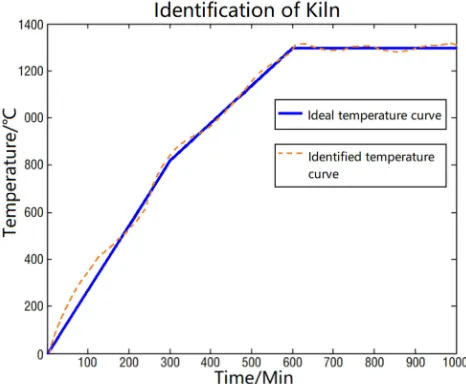
Finally, this identified model was testified with the other data and its result was to show in the figure 1 that the model basically satisfied the real situation.
Figure 1. The Identification Result of Ceramic Shuttle Kiln.
5. Conclusions
In this paper, a frequency-domain subspace identification method suitable for a time-delay system of a ceramic shuttle kiln is investigated. The frequency-domain subspace model is constructed through iteration of the frequency domain model. The principal component analysis and matrix extraction are adopted respectively, and the coefficient matrix of the model and the frequency domain model are identified by the least square method. Simulation results verify the feasibility of this identification method.
Acknowledgements
This article is supported by the National Natural Science Foundation of China (61563022) and Jiangxi Natural Science Foundation (20152ACB20009).
References
[2] Z. Ye, M. T. Kai, M. Carman, Grouping points by shared subspaces for effective subspace clustering, Pattern Recognition, 2018, 83: 230-244.
[3] C. Priori, M. De Angelis, R. Betti, On the selection of user-defined parameters in data-driven stochastic subspace identification, Mechanical Systems and Signal Processing, 2018, 100: 501-523.
[4] X. S. Luo, Y. D. Song, Data-driven predictive control of Hammerstein–Wiener systems based on subspace identification, Information Sciences, 2018, 422:447-461 [5] L. Zhang, V. Lieven, Interior-point method for nuclear norm
approximation with application to system identification, SIAM Journal on Matrix Analysis and Applications, 2009, 31(3): 1235-1256.
[6] M. G. Plessen, T. A. Wood, R. S. Smith, Time-domain Subspace Identification Algorithms using Nuclear Norm Minimization, IFAC-Papers Online, 2015, 48(28): 903-908. [7] S. T. Navalkar, J. W. van Wingerden, Nuclear Norm-Based
Recursive Subspace Identification for Wind Turbine Flutter Detection, IEEE Transactions on Control Systems Technology, 2017, 99:1-13.
[8] Y. Gu, R. Ding, A least squares identification algorithm for a state space model with multi-state delays, Applied Mathematics Letters, 2013, 26(7): 748-753.
[9] J. H. Wang, D. B. Wang, Z. S. Wang, Forgetting Factor Algorithm for Aircraft Flutter Modal Parameter Identification, Chinese Space Science and Technology 2009, (06): 7-14. [10] W. Li, C. Peng, Y. Wang, Frequency Domain Subspace
Identification of Fractional Order Time Delay System, International Journal of Control, Automation and Systems, 2011, 9(2): 310–316.
[11] T. McKelvey, H. Akcay, L. Ljung, Subspace-based multivariable system identification from frequency response data, IEEE Transactions on Automatic Control, 1996, 41(7): 960-979.
[12] B. Kim, C. Y. Ko, N. Wong, Tensor network subspace identification of polynomial state space models, Automatica, 2018, 95: 187-196.
[13] B. Telsang, S. T. Navalkar, J. W. van Wingerden, Recursive Nuclear Norm based Subspace Identification, IFAC-Papers Online, 2017, 50(1): 9490-9495.