R E S E A R C H
Open Access
VISION: a video and image dataset for
source identification
Dasara Shullani
1, Marco Fontani
1,2, Massimo Iuliani
1,2, Omar Al Shaya
1,3and Alessandro Piva
1,2*Abstract
Forensic research community keeps proposing new techniques to analyze digital images and videos. However, the performance of proposed tools are usually tested on data that are far from reality in terms of resolution, source device, and processing history. Remarkably, in the latest years, portable devices became the preferred means to capture images and videos, and contents are commonly shared through social media platforms (SMPs, for example, Facebook, YouTube, etc.). These facts pose new challenges to the forensic community: for example, most modern cameras feature digital stabilization, that is proved to severely hinder the performance of video source identification technologies; moreover, the strong re-compression enforced by SMPs during upload threatens the reliability of multimedia forensic tools. On the other hand, portable devices capture both images and videos with the same sensor, opening new forensic opportunities. The goal of this paper is to propose the VISION dataset as a contribution to the development of multimedia forensics. The VISION dataset is currently composed by 34,427 images and 1914 videos, both in the native format and in their social version (Facebook, YouTube, and WhatsApp are considered), from 35 portable devices of 11 major brands. VISION can be exploited as benchmark for the exhaustive evaluation of several image and video forensic tools.
Keywords: Dataset multimedia forensics, Image forensics, Video forensics, Source identification
1 Introduction
In the last decades, visual data gained a key role in pro-viding information. Images and videos are used to convey persuasive messages to be used under several different environments, from propaganda to child pornography. The wild world of web also allows users to easily share visual contents through social media platforms. Statistics [1] show that a relevant portion of the world’s popu-lation owns a digital camera and can capture pictures. Furthermore, one third of the people can go online and upload their pictures on websites and social networks. Given their digital nature, these data also convey several information related to their life cycle (e.g., source device, processing they have been subjected to). Such informa-tion may become relevant when visual data are involved in a crime. In this scenario, multimedia forensics (MF) has
*Correspondence: [email protected]
1Department of Information Engineering, University of Florence, Via di S. Marta, 3, 50139 Florence, Italy
2FORLAB, Multimedia Forensics laboratory, PIN Scrl, Piazza G. Ciardi, 25, 59100 Prato, Italy
Full list of author information is available at the end of the article
been proposed as a solution for investigating images and videos to determine information about their life cycle [2]. During the years, the research community developed sev-eral tools to analyze a digital image, focusing on issues related to the identification of the source device and the assessment of content authenticity [3].
Generally, the effectiveness of a forensic technique should be verified on image and video datasets that are freely available and shared among the community. Unfor-tunately, these datasets, especially for the case of videos, are outdated and non-representative of real case sce-narios. Indeed, most multimedia contents are currently acquired by portable devices that keep updating year by year. These devices are also capable to acquire both videos and images exploiting the same sensor, thus opening new investigation opportunities in linking different kind of contents [4]. This motivates the need for a new dataset containing a heterogeneous and sufficiently large set of visual data—both images and videos—as benchmark to test and compare forensic tools.
In this paper, we present a new dataset of native images and videos captured with 35 modern smartphones/tablets
belonging to 11 different brands: Apple, Asus, Huawei, Lenovo, LG electronics, Microsoft, OnePlus, Samsung, Sony, Wiko, and Xiaomi.
Overall, we collected 11,732 native images; 7565 of them were shared through Facebook, in both high and low qual-ity, and through WhatsApp, resulting in a total of 34,427 images. Furthermore, we acquired 648 native videos, 622 of which were shared through YouTube at the maximum available resolution, and 644 through WhatsApp, result-ing in a total of 1914 videos1.
To exemplify the usefulness of the VISION dataset, we test the performance of a well-known forensic tool, i.e., the detection of the sensor pattern noise (SPN) left by the acquisition device [5] for the source identification of native/social media contents; moreover, we describe some new opportunities deriving by the availability of images and videos captured with the same sensor to find a solution to current limits present in the literature. In particular, the proposed dataset contains several devices featuring in-camera digital stabilization, that is known to threaten source identification based on sensor pat-tern noise. Indeed, in most papers related to SPN [6–9], digitally stabilized videos are ignored, either by turning the stabilization off or considering non-stabilized devices only. This is unrealistic, considering that most common modern devices (e.g., Apple iPhones) are equipped with an in-camera digital stabilization system that cannot be turned off without resorting to third party applications.
The remaining part of the paper is organized as follows: in Section 2, we review the currently available datasets for image and video forensics and their current limitations; in Section 3, a complete description of the VISION dataset is provided for both native and social media contents; in Section 4, the dataset is exploited to evaluate some well-known forensic applications and to taste new research opportunities. Section 5 draws concluding remarks.
Eventually, we include in the Appendix additional infor-mation that can be useful to perform a deeper analysis on the available visual contents.
2 Motivation
In the field of digital image and video forensics, only few datasets have been made available to the research community, especially for the source device identifica-tion problem. This fact is a strong limitaidentifica-tion for research advancement in our area.
One of the first datasets adopted in the multimedia forensic community is the UCID database [10], originally designed for the evaluation of image retrieval techniques. Such dataset includes 1338 uncompressed images stored in the TIFF format, but their size is very small, either 512×384 or 384×512 pixels.
The first sufficiently large and publicly available image database specifically designed for forensic applications
is the Dresden Image Database [11, 12]. This dataset includes images of various indoor and outdoor scenes acquired from 73 devices, selected from 25 camera mod-els spanning most important manufacturers and quality ranges. All cameras were configured to the highest avail-able JPEG quality setting and maximum availavail-able reso-lution, and, when supported by the device, also lossless compressed images were stored. The image resolution ranges from 3072×2304 to 4352×3264 pixels, for a total of 16,961 JPEG images, 1491 RAW (unprocessed) images, 1491 RAW images processed in Lightroom 2.5, and 1491 RAW images processed in DCRaw 9.3. Since 2010, this dataset has been used by most of the works dealing with benchmarking of source identification methods.
More recently, RAISE (RAw ImageS datasEt) was pre-sented [13]: it is a collection of 8156 raw images including a wide variety of both semantic contents and technical parameters. Three different devices (a Nikon D40, a Nikon D90, and a Nikon D7000) are employed, and the images are taken at very high resolution (3008×2000, 4288×2848, and 4928×3264 pixels) and saved in an uncompressed for-mat (Compress Raw 12-bit and Lossless Compress Raw 14-bit) as natively provided by the employed cameras. Each image is also assigned one of seven possible cate-gories, namely, “outdoor,” “indoor,” “landscape,” “nature,” “people,” “objects,” and “buildings.” In the framework of the European project REWIND, a set of 200 uncom-pressed images acquired with a Nikon D60 camera were also made available [14] (among other sets for splicing detection, copy-move forgeries and recapture videos, all including a few number of samples). There are also other datasets, not cited here, that have been designed more for image tampering detection than for source identification, and thus no or little information is provided about the device generating the images.
platform, is composed by 33 downloaded videos, 16-s long, at 30 fps with a HD resolution. The original dataset is subdivided into four subsets: one containing unaltered videos; one with videos created by splicing; one with videos manipulated by copy-move; and one with videos tampered by swapping frames. Although they use a social media platform to acquire videos and provide interesting tampering techniques, there are not useful information related to the camera or device used.
The previous review shows that all currently available datasets consider mainly images, and the ones containing videos are not significant for video source identification; moreover, it is not possible to investigate relationships between images and videos acquired with the same sen-sor: this fact is a strong limitation, since 85% of shared media are captured using smartphones, which use the same sensor to capture both images and videos. Finally, another limit in the state-of-the-art is represented by the lack of a collection of controlled content coming from social media platforms, like Facebook, YouTube, and WhatsApp; indeed, recent multimedia forensic appli-cations would take advantage in having a large dataset containing such kind of contents: for instance, in [6], the authors address the performance of identifying the source of YouTube videos but limiting to a scenario with videos belonging to 8 webcams of the same model (Log-itech Quickcam STX). Similarly, Bertini et al. [18] pro-pose to extract the Sensor Pattern Noise from images to identify fake social media accounts, but the tech-nique was tested on 5 mobile devices only, with 200 images each.
3 The VISION Dataset
Images and videos have been acquired from each mobile device by following a specific procedure. First of all, the captured contents refer to the best-quality camera avail-able in the device; in general, the one positioned on the upper rear of the device. Moreover, the devices were con-figured, when possible, with the highest quality and reso-lution available (usually the default one for Apple devices but not necessarily for Android ones).
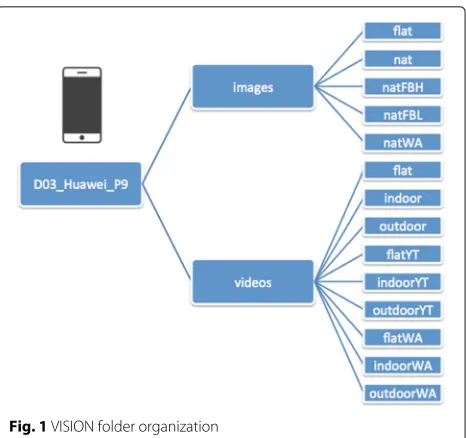
VISION is mainly thought for video and image source identification applications; as a consequence, we orga-nized the data collected from each device into two folders, (see Fig. 1 for an example), namely:
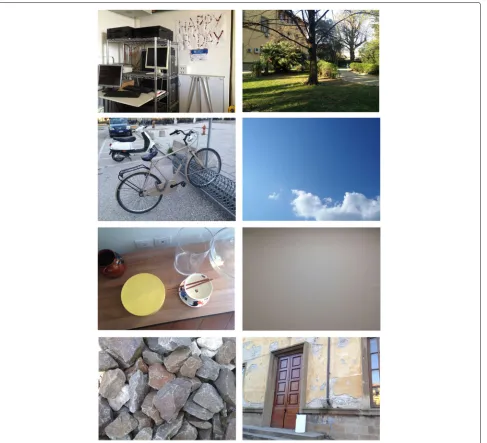
• Images: containing native and social exchanged images. We captured images, mainly in landscape mode, representing flat surfaces (e.g., skies or walls), here defined asFlat, and generic images, here defined asNat, for which there are no limitations on
orientation or scenario, as it can be seen in Fig. 2. In addition, theNat images were exchanged via the Facebook and WhatsApp social media platforms.
Fig. 1VISION folder organization
• Videos: containing native and social exchanged videos, acquired mainly in landscape mode. The collected videos represent flat, indoor, and outdoor scenarios. Theflat scenario includes videos belonging to flat surfaces such as walls and skies. Theindoor scenario comprises videos representing offices or stores, and theoutdoor scenario contains videos of open areas such as gardens. For each scenario, we used three different acquisition modes:still mode, where the user stands still while capturing the video; move mode, where the user walks while capturing the video;panrot mode, where the user performs a recoding combining a pan and a rotation.
Furthermore, the videos belonging to each scenario were exchanged via YouTube and WhatsApp social media platforms.
The structure depicted in Fig. 1 is maintained also in the naming convention. The contents collected from each device are stored in its root folder named
ID_Brand_Model as in D01_Samsung_GalaxyS3
Mini. Then, we distinguish between images and
videos, within each of them, we have the native con-tent folders and the social ones. A native flat image is called by convention as ID_I_flat_XXXX.jpg as
in D01_I_flat_0001.jpg, where ID is the device
identifier, I identifies it as an image content, flat identifies the subfolder and the type of image, while
XXXX.jpgis an incremental number. Similarly, the video
content naming isID_V_scenario_mode_XXXX.mp4
as in D01_V_flat_panrot_0001.mp4, where V
Fig. 2Some examples of the images included in the proposed dataset
convention is also applied to the social folders repre-sented in Fig. 1: an image uploaded to Facebook in low quality will be named D01_I_natFBL_0001.jpg, an image uploaded to Facebook in high quality will
be named D01_I_natFBH_0001.jpg, while a
video exchanged through WhatsApp will be named
D01_V_flatWA_panrot_0001.mp4.
3.1 Main features
VISION is composed by 35 mobile devices from low-, middle-, and high-price range. There are 13 Apple devices, including iPhones and iPads. There are 8 Samsung devices including Galaxy phones and tablets. There are 5 Huawei and 2 OnePlus phones. Furthermore, we gathered one
device for the following brands: Asus, Lenovo, LG elec-tronics, Microsoft, Sony, Wiko, and Xiaomi. We collected a few devices of the same brand and model namely: two iPhone 4S, two iPhone 5, three iPhone 5c, two iPhone 6, and two GalaxyS3Mini. The employed devices had installed the following operating systems: iOS from 7.x to 10.x, Android from 6.x Marshmallow to 7.x Nougat, and the Windows Phone OS 8.1 Update 2.
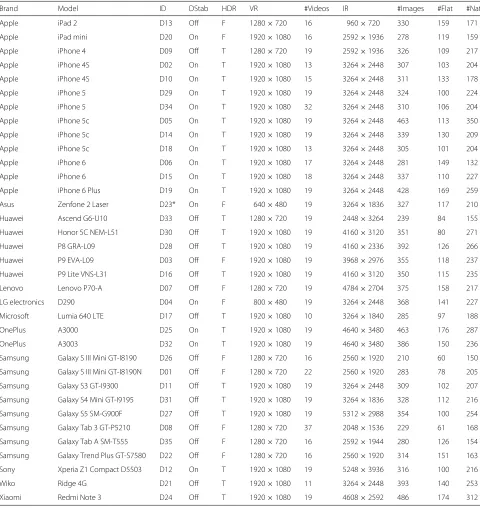
In Table 1, we summarize the main features of the com-plete dataset. For each device, we report theBrand,Model, a unique identifierID, and the number of collected videos and images with their corresponding resolutions.
Table 1Devices main features
Brand Model ID DStab HDR VR #Videos IR #Images #Flat #Nat
Apple iPad 2 D13 Off F 1280×720 16 960×720 330 159 171
Apple iPad mini D20 On F 1920×1080 16 2592×1936 278 119 159
Apple iPhone 4 D09 Off T 1280×720 19 2592×1936 326 109 217
Apple iPhone 4S D02 On T 1920×1080 13 3264×2448 307 103 204
Apple iPhone 4S D10 On T 1920×1080 15 3264×2448 311 133 178
Apple iPhone 5 D29 On T 1920×1080 19 3264×2448 324 100 224
Apple iPhone 5 D34 On T 1920×1080 32 3264×2448 310 106 204
Apple iPhone 5c D05 On T 1920×1080 19 3264×2448 463 113 350
Apple iPhone 5c D14 On T 1920×1080 19 3264×2448 339 130 209
Apple iPhone 5c D18 On T 1920×1080 13 3264×2448 305 101 204
Apple iPhone 6 D06 On T 1920×1080 17 3264×2448 281 149 132
Apple iPhone 6 D15 On T 1920×1080 18 3264×2448 337 110 227
Apple iPhone 6 Plus D19 On T 1920×1080 19 3264×2448 428 169 259
Asus Zenfone 2 Laser D23* On F 640×480 19 3264×1836 327 117 210
Huawei Ascend G6-U10 D33 Off T 1280×720 19 2448×3264 239 84 155
Huawei Honor 5C NEM-L51 D30 Off T 1920×1080 19 4160×3120 351 80 271
Huawei P8 GRA-L09 D28 Off T 1920×1080 19 4160×2336 392 126 266
Huawei P9 EVA-L09 D03 Off F 1920×1080 19 3968×2976 355 118 237
Huawei P9 Lite VNS-L31 D16 Off T 1920×1080 19 4160×3120 350 115 235
Lenovo Lenovo P70-A D07 Off F 1280×720 19 4784×2704 375 158 217
LG electronics D290 D04 On F 800×480 19 3264×2448 368 141 227
Microsoft Lumia 640 LTE D17 Off T 1920×1080 10 3264×1840 285 97 188
OnePlus A3000 D25 On T 1920×1080 19 4640×3480 463 176 287
OnePlus A3003 D32 On T 1920×1080 19 4640×3480 386 150 236
Samsung Galaxy S III Mini GT-I8190 D26 Off F 1280×720 16 2560×1920 210 60 150
Samsung Galaxy S III Mini GT-I8190N D01 Off F 1280×720 22 2560×1920 283 78 205
Samsung Galaxy S3 GT-I9300 D11 Off T 1920×1080 19 3264×2448 309 102 207
Samsung Galaxy S4 Mini GT-I9195 D31 Off T 1920×1080 19 3264×1836 328 112 216
Samsung Galaxy S5 SM-G900F D27 Off T 1920×1080 19 5312×2988 354 100 254
Samsung Galaxy Tab 3 GT-P5210 D08 Off F 1280×720 37 2048×1536 229 61 168
Samsung Galaxy Tab A SM-T555 D35 Off F 1280×720 16 2592×1944 280 126 154
Samsung Galaxy Trend Plus GT-S7580 D22 Off F 1280×720 16 2560×1920 314 151 163
Sony Xperia Z1 Compact D5503 D12 On T 1920×1080 19 5248×3936 316 100 216
Wiko Ridge 4G D21 Off T 1920×1080 11 3264×2448 393 140 253
Xiaomi Redmi Note 3 D24 Off T 1920×1080 19 4608×2592 486 174 312
DStab shows the presence or absence of digital stabilization on the acquired content, HDR indicates whether the device supports it, VR stands for video resolution and IR for image resolution
that for most Apple devices if the stabilization is present it is also enabled (the only exceptions are D9 and D13), as it is also for the Sony Xperia, D12. On the contrary, this is not true for all other devices where the in-camera digital stabilization is set off by default. In addition, Table 1 clar-ifies whether the device can acquire images in HDR-High Dynamic Rangemode: T (True) is used if HDR is avail-able and F (False) if it is not. Several additional metadata
and coding statistics are collected and reported in the Appendix.
3.2 Social contents
The collected contents in VISION were also exchanged through social media platforms; in particular, for images inNat, we provide their corresponding uploaded version on Facebook and WhatsApp. We chose to upload only nat-ural images since, from a forensic point of view, having flat surfaces shared through social media is rather unre-alistic. In addition, we shared all videos through YouTube and WhatsApp. In the rest of this Section, we explain the procedure used for uploading and downloading media contents through each social media platform.
Facebook web platform In order to exchange images via Facebook, we created two albums in which we uploaded all images belonging toNatin high and low quality respec-tively (FBH and FBL from now on), as allowed by the social media platform. Indeed, as deeply explained in [19], these uploading options cause a significantly different compression strategy for the image.
For what concerns the download, we performed single-image downloads and album downloads, although there is no difference between the resulting contents. Album download functionality was recently added to the Face-book website2 options. The one click album-download button allows downloading a zip version of each album; in each zip-file, the images are renamed by an incremental number as: 1.jpg, 2.jpg, ...n.jpg , wherenis the number of images in the folder.
Since the collection of VISION lasted over a year, we exchanged data both before and after this update. We took care to provide a matching naming between the original content and the social media one: we used the SSIM index [20] as a metric to determine whether the two images depict the same content. Consequently, if the native image name is D01_I_nat_0001.jpg, its Facebook high quality counterpart will be named
D01_I_natFBH_0001.jpg.
YouTube web platform All video contents were
uploaded to YouTube with the Public privacy flag and collected into a playlist. During the collection of VISION, we exploited different solutions to speed-up the down-loading process but maintaining the constraints of highest resolutions and no download compression. We encountered two software solutions to accomplish this goal, namely ClipGrab3 andYoutube-dl4. Both software are freely available and can be used on several operating systems such as Unix and Windows. The main difference between the two is that theClipGrabGUI can download one video at a time, while theyoutube-dlcommand line can download also playlists.
As an example, we provide the following youtube-dl
command line call to download a playlist:5.
youtube-dl -f 137+140/bestvideo+best
audio -o “%(title)s.%(ext)s” -yes-play
list “device_url_playlist”
The options after the -f refers to the quality of video resolution and audio settings; here, the meaning is to choose the highest video resolution and audio quality, if not available choose the second-best pair and so on from left to right. Then with option -owe set the out-put video name and extension to be the YouTube video name and the default extension, i.e. mp4. For the complete documentation we advise the reader to refer to [21].
Similarly to the image naming convention, a video recorded in an outdoor scenario with a panrot
movement has the following name: D01_V_
outdoor_panrot_0001.mp4, while its YouTube
counterpart will be named D01_V_outdoorYT_
panrot_0001.mp4.
WhatsApp mobile application: All native video con-tents and images belonging to Nat were exchanged via WhatsApp v2.17.41 using an iPhone7 A1778 with iOS v10.3.1. We decided to use the mobile-application instead of the desktop one since the latter does not compute any compression to the shared file, while the mobile one does so. We used an iPhone since it produces a media file that is less compressed than the Android one, due to What-sApp implementation choices. In this way, we provided an equilibrate spectrum of social image contents qualities: namely high and low provided by Facebook, and medium from WhatsApp. As to the naming convention, for these files we had the same issue as in Facebook: since down-loaded images are renamed, we matched images using the SSIM index.
The videos downloaded from WhatsApp follow the same name structure, (e.g., D01_V_outdoorWA
_panrot_0001.mp4.
4 Possible applications with experimental evaluations
This dataset was created to provide a benchmark for the forensic analysis of images and videos. In this Section, we exploit all the collected contents to test the source iden-tification technique based on the sensor pattern noise. In this scenario, the aim is to identify the source of an image or video by evaluating the correlation between the SPN fingerprint estimated from the investigated content, and the device reference fingerprint, computed from a set of images or a video taken by this device.
We tested different application scenarios:
• Video source identification (VSI), where a query video is matched with a device reference computed from the frames of a video taken by the device.
The identification is performed according to the clas-sical workflow [22]: a camera fingerprintKis estimated fromNstill images or video framesI(1),. . .,I(N)captured by the source device. A denoising filter [5] is applied to each image/frame, and the noise residualsW(1),. . .,W(N) are obtained as the difference between each frame and its denoised version. Then, the camera fingerprint estimate
Kis derived by the maximum likelihood estimator [22]:
K=
N
i=1W(i)I(i)
N
i=1
I(i)2 . (1)
The fingerprint of the query is estimated in the same way by the available image or video frames. Then, the Peak to Correlation Energy (PCE) between the reference and the query pattern is computed and compared to a thresh-old [23]: if the PCE is higher than the threshthresh-old, then it is decided that the query content has been acquired by the reference device.
4.1 Image source identification
In this scenario, the reference SPN for each device is esti-mated using 100 still flat field images. Then, we run four
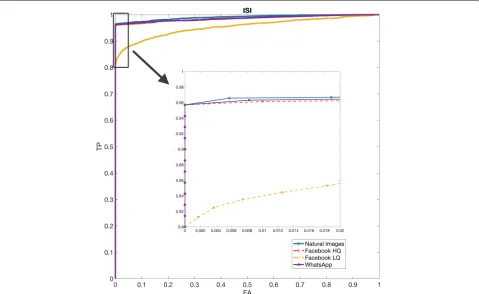
experiments using natural, WhatsApp, Facebook high-quality, and Facebook low-quality images as queries. In all experiments, we consider for each device 100 match-ing cases (images from the same device) and the same number of mismatching cases (images randomly chosen from other devices). The achieved results are reported using ROC curves that plot true positive rate against false positive rate (see Fig. 3). The overall performance are sum-marized in Table 2 where, for each experiment, we also reported the dataset path of the query images and the Area Under Curve. ID_Brand_Modelstands for any of the available device e.g.,D03_Huawei_P9.
4.2 Video source identification
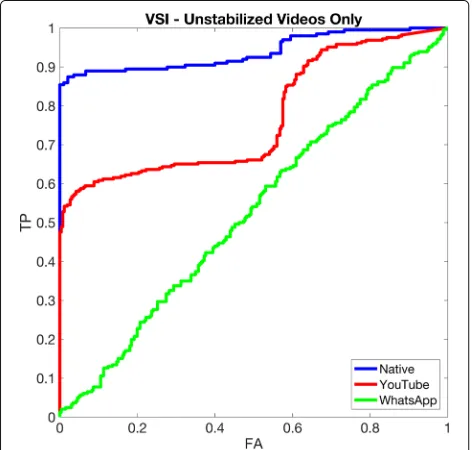
Here, the source of a test video is determined based on ref-erences estimated from a flat-field video. In particular, the reference SPN for each device is estimated from the first 100 frames of a flat video. Then, three experiments are performed using natural, YouTube and WhatsApp videos as queries, respectively. The fingerprint of each tested video is estimated from the first 100 frames. We consider for each device all available matching cases (videos from the same device) and the same number of mismatching cases (videos randomly chosen from other devices). The achieved results are reported in Fig. 4, where only non-stabilized cameras are analyzed, and in Fig. 5, where all
Table 2Performance of image source identification in growing difficulty scenarios
Experiment Test Path AUC
1 ID_Brand_Model/images/nat 0.9906
2 ID_Brand_Model/images/natWA 0.9860
3 ID_Brand_Model/images/natFBH 0.9859
4 ID_Brand_Model/images/natFBL 0.9544
devices in the dataset are considered. This experiment shows that performance of VSI strongly drop when digi-tally stabilized videos are involved. In Table 3, we briefly summarize for each test the paths in the dataset of tested videos and the Area Under Curve values obtained with and without stabilized videos.
For in-camera stabilized videos, possible solutions are still under development, as the one proposed in [24]. Any-way the solution in [24] is proved to be effective only on third party (out-camera) digital stabilization (ffmpeg), and when a non-stabilized video is available as reference. Unfortunately, most of the considered devices enforce in-camera digital stabilization, without an option to turn it off in the standard camera application.
4.3 Image vs video SPN fingerprint
In the research community, ISI and VSI applications are separately studied so that there is still no better way to per-form image and video source identification for the same
Fig. 4(Best viewed in colors) The VSI performance on Native, YouTube, and WhatsApp videos (in blue, red and green respectively) considering only devices devices without in-camera digital stabilization
Fig. 5(Best viewed in colors) The VSI performance on Native, YouTube, and WhatsApp videos (in blue, red and green respectively) considering all available devices
device than computing two different reference SPNs, one for still images and one for videos, respectively.
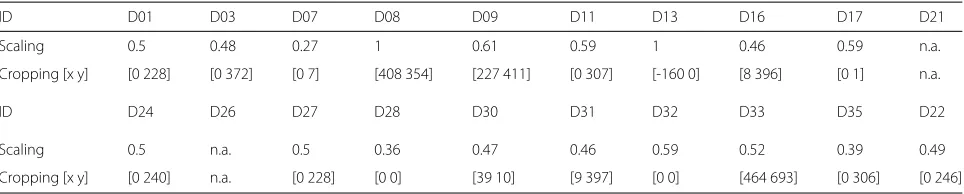
A first step towards an integration of these cases is a hybrid source identification (HSI) approach that exploits still images for estimating the fingerprint that will be used to verify the source of a video, as proposed in [4]. Authors of [4] investigate the geometrical relation between image and video acquisition processes. Indeed, even if the sensor is the same, videos are usually acquired at a much lower resolution than images: top-level smartphones reach 4K video resolution at most (8 megapixels per frame), but can easily capture 20-megapixel images. To achieve that, in video recording, a central crop is carried so to adapt the sensor size to the desired aspect ratio (commonly 16:9), then the selected pixels are scaled to match the desired video resolution. As a direct consequence, the fingerprints extracted from images and videos cannot be directly com-pared and most of the times, because of cropping, it is not sufficient to just scale them to the same resolution. Instead, image-based and video-based fingerprints are linked by the cropping and scaling factors between image and video sensor portion, that usually change across dif-ferent device models.
Table 3Dataset paths for VSI experiments
Experiment Test path AUC
All Videos Unstab. Videos
ID_Brand_Model/videos/flat
1 ID_Brand_Model/videos/indoor 0.7069 0.9394
ID_Brand_Model/videos/outdoor
ID_Brand_Model/videos/flatYT
2 ID_Brand_Model/videos/indoorYT 0.6032 0.7700
ID_Brand_Model/videos/outdoorYT
ID_Brand_Model/videos/flatWA
3 ID_Brand_Model/videos/flatWA 0.5262 0.5437
ID_Brand_Model/videos/flatWA
cropping and scaling factors, for each device we esti-mated the video and image references from the videos
contained in ID_Brand_Model/videos/flat and
from the images inID_Brand_Model/images/flat, respectively. Specifically, we estimated each image refer-ence fingerprint from 100 flat field images and each video reference fingerprint from 100 frames of a flat field video. The cropping and scaling factors are estimated by a brute force search, as suggested in [25]. In Table 4 we report the scaling factor and the corresponding cropping corner (upper-left corner alongxandyaxes) yielding the max-imum PCE for each examined device. We consider the parameter search unsuccessful if the obtained maximum PCE is lower than 50 (denoted by “n.a.” in Table 4). For instance, with the deviceD11 an image fingerprint should be scaled by a factor 0.59 and then cropped on the upper left side of 307 pixels along theyaxis to match the video fingerprint (the right and down cropping are derived by the corresponding video size).D13 is a pretty unique case in which the full frame is applied for videos and the left (and right) cropping of 160 pixels is applied to capture images. We put a−160 meaning that the video frame is cropped by 160 pixel to capture images. Finally, we notice that we were not able to register the fingerprints for the devices D21 and D26 by means of the presented tech-niques. A deeper analysis of the registration techniques is still an open topic.
5 Conclusions
In this paper, we propose a new image and video dataset useful for benchmarking multimedia forensic tools. We collected thousands of images and videos from portable devices of most famous brands, including those featur-ing in-camera digital stabilization. We also prepared the “social version” of most contents, by uploading and down-loading them to/from well-known social media platforms, namely Facebook, YouTube and WhatsApp.
We showed examples of some popular applications that would benefit from the proposed dataset, such as the video source identification, for which there are no sizeable benchmarks available in the research community. Further-more, we showed how this dataset allows the exploration of new forensic opportunities such as comparing cam-era reference fingerprints estimated from still images and from videos. The whole dataset is made available6 to the research community, along with a guide that clari-fies its structure and several csv files containing technical information.
Although VISION is a huge collection of media con-tents, we believe that there is space for future improve-ments, indeed we are currently working to extend VISION with more videos, by means of a mobile application (MOSES [26]) from which videos can be captured and uploaded directly to our servers, following the main con-cept and guidelines of VISION. In conclusion, VISION
Table 4Estimated Cropping and Scaling factors for non stabilized videos
ID D01 D03 D07 D08 D09 D11 D13 D16 D17 D21
Scaling 0.5 0.48 0.27 1 0.61 0.59 1 0.46 0.59 n.a.
Cropping [x y] [0 228] [0 372] [0 7] [408 354] [227 411] [0 307] [-160 0] [8 396] [0 1] n.a.
ID D24 D26 D27 D28 D30 D31 D32 D33 D35 D22
Scaling 0.5 n.a. 0.5 0.36 0.47 0.46 0.59 0.52 0.39 0.49
provides the contents needed to assess the performance of next generation image and video forensic tools.
Endnotes
1Not all the videos were exchanged through social
media platforms. The technical details are explained in the Appendix
2Facebook website on March 2017.
3ClipGrab v3.6.3 - www.clipgrab.org
4youtube-dl v2017.03.10 -
http://rg3.github.io/youtube-dl/
5We recommend downloading less than 20 videos at a
time due to the YouTube policy. 6https://lesc.dinfo.unifi.it/en/datasets
7Note that the Rotation tag, related to the
correspon-dent video standard, of each video is reported in the additional material released together with the dataset.
Appendix
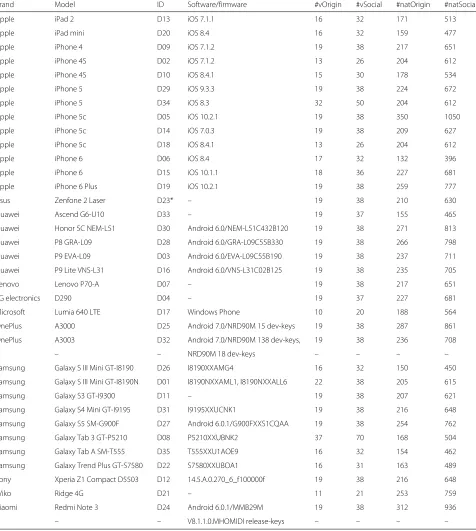
In this section, we provide more detailed information on the VISION dataset. First of all, in Appendix Table 5, we review the version of the software/firmware of each device, along with the number of native images and videos (in columns #natOrigin and #vOrigin) and their social counterparts (in columns #natSocial, #vSocial). We would like the reader to notice that the amount of social media videos should be two times the original amount, since we uploaded all the videos in YouTube and WhatsApp. The reader can easily see that this is not true for some devices, indeed we removed 30 videos from the social folders because of issues due to the uploading system used by YouTube and WhatsApp. We acquired videos from each device using the landscape-mode, but a small amount of the overall acquisitions were captured in portrait mode. Unfortunately this was an issue with the YouTube upload-ing, because in this case, the video is modified by black padding: this raised a consistency problem and we decided to remove these contents. On the other hand, WhatsApp was not affected by this kind of problems, and the same portrait-mode videos were uploaded and downloaded cor-rectly. Unfortunately, we could not upload 4 videos with the WhatsApp iOS application, and so far did not under-stand the reason causing this problem.
The devices affected by these problems were the D34 in which we exluded 14 videos, the D01 with 6 videos miss-ing, the D08 with 4 files, the D06 with 2 files and one file from devices D04, D21, D22, and D33. Detailed infor-mation are given, in form of multiple CSV file, with the current Dataset.
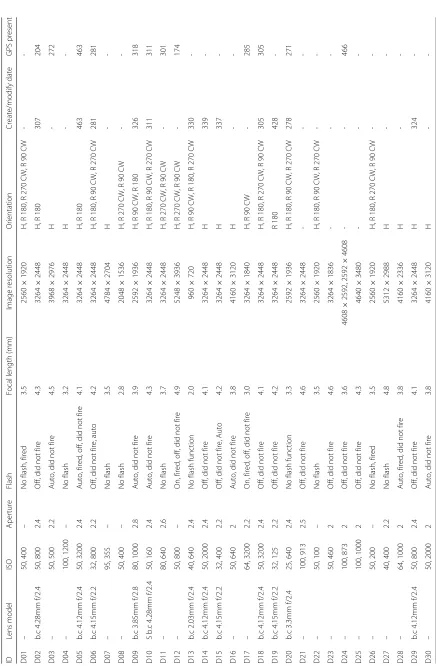
In Appendix Table 6 we report for each device some statistics computed over all native images by means of
Exiftool 10.10. In detail, the metadata tags that can be extracted withExiftoolare theLens Model,ISO,Aperture,
Flash, Focal Length, Image Size (represented in column Image Resolution) andOrientation.
All images were acquired in the JPEG format using the encoderJPEG old-style, and for most devices the color sub sampling is set to YCbCr 4:2:0 (2,2), while D07 and D11 use YCbCr 4:2:2 (2,1) and only D28 supports both sub samplings.
The columns create/modify date and GPS present are counters: the first one counts the number of images in which the metadatacreate dateandmodify dateare not identical. The second refers to the metadataGPS Position
and counts the number of images in which this tag is not empty.
In Appendix Table 6, we collected information related to the Lens specifics such as thefocal length, theaperture valueor theISO. It is worth noting that theLens model
tag is present only for Apple devices, and specifies which camera is used and some features of the lens. TheISO col-umn contains a range of values for each device, that is the minimum and the maximum ISO value observed in the images metadata from that device. The Flash column lists all encountered values, indeed for some devices such as D05, we have images acquired with Flash in auto mode, off mode, fired, or not fired mode. In case of devices D13 and D20, namely iPad 2 and iPad mini, the flash function does not exists, since these devices are not equipped with a flash.
TheImage Sizetag is present in columnimage resolution
and reports the resolution as width×height; let us note that in devices D24 and D33 the image Orientation tag is not always present, when needed it is derived from their resolution in order to distinguish between landscape and portrait acquisitions such as 4608×2592 and 2592×4608 for D24. In all the remaining devices, each image is stored inlandscapemode, that is horizontally (H); if the image was actually acquired with a different orientation, this is reflected in the Orientation tag, which may contain the values: Rotation 180 (R 180), Rotation 90 Clock-Wise (R 90 CW) or Rotation 270 Clock-Wise (R 270 CW).
From a forensics point of view the create/modify date
is very interesting: in Appendix Table 6 the reader can see that for all Apple devices in this Dataset, the Create Date and Modify Date tags are different (when available), meaning that Apple devices store into Create Date the moment in which the photo shoot is computed and in Modify Date the moment in which the image is stored, that is, typically, a few seconds later. All the other devices set these tags to the same initial value.
Table 5Devices featured in VISION
Brand Model ID Software/firmware #vOrigin #vSocial #natOrigin #natSocial
Apple iPad 2 D13 iOS 7.1.1 16 32 171 513
Apple iPad mini D20 iOS 8.4 16 32 159 477
Apple iPhone 4 D09 iOS 7.1.2 19 38 217 651
Apple iPhone 4S D02 iOS 7.1.2 13 26 204 612
Apple iPhone 4S D10 iOS 8.4.1 15 30 178 534
Apple iPhone 5 D29 iOS 9.3.3 19 38 224 672
Apple iPhone 5 D34 iOS 8.3 32 50 204 612
Apple iPhone 5c D05 iOS 10.2.1 19 38 350 1050
Apple iPhone 5c D14 iOS 7.0.3 19 38 209 627
Apple iPhone 5c D18 iOS 8.4.1 13 26 204 612
Apple iPhone 6 D06 iOS 8.4 17 32 132 396
Apple iPhone 6 D15 iOS 10.1.1 18 36 227 681
Apple iPhone 6 Plus D19 iOS 10.2.1 19 38 259 777
Asus Zenfone 2 Laser D23* – 19 38 210 630
Huawei Ascend G6-U10 D33 – 19 37 155 465
Huawei Honor 5C NEM-L51 D30 Android 6.0/NEM-L51C432B120 19 38 271 813
Huawei P8 GRA-L09 D28 Android 6.0/GRA-L09C55B330 19 38 266 798
Huawei P9 EVA-L09 D03 Android 6.0/EVA-L09C55B190 19 38 237 711
Huawei P9 Lite VNS-L31 D16 Android 6.0/VNS-L31C02B125 19 38 235 705
Lenovo Lenovo P70-A D07 – 19 38 217 651
LG electronics D290 D04 – 19 37 227 681
Microsoft Lumia 640 LTE D17 Windows Phone 10 20 188 564
OnePlus A3000 D25 Android 7.0/NRD90M 15 dev-keys 19 38 287 861
OnePlus A3003 D32 Android 7.0/NRD90M 138 dev-keys, 19 38 236 708
– – – NRD90M 18 dev-keys – – – –
Samsung Galaxy S III Mini GT-I8190 D26 I8190XXAMG4 16 32 150 450
Samsung Galaxy S III Mini GT-I8190N D01 I8190NXXAML1, I8190NXXALL6 22 38 205 615
Samsung Galaxy S3 GT-I9300 D11 – 19 38 207 621
Samsung Galaxy S4 Mini GT-I9195 D31 I9195XXUCNK1 19 38 216 648
Samsung Galaxy S5 SM-G900F D27 Android 6.0.1/G900FXXS1CQAA 19 38 254 762
Samsung Galaxy Tab 3 GT-P5210 D08 P5210XXUBNK2 37 70 168 504
Samsung Galaxy Tab A SM-T555 D35 T555XXU1AOE9 16 32 154 462
Samsung Galaxy Trend Plus GT-S7580 D22 S7580XXUBOA1 16 31 163 489
Sony Xperia Z1 Compact D5503 D12 14.5.A.0.270_6_f100000f 19 38 216 648
Wiko Ridge 4G D21 – 11 21 253 759
Xiaomi Redmi Note 3 D24 Android 6.0.1/MMB29M 19 38 312 936
– – – V8.1.1.0.MHOMIDI release-keys – – – –
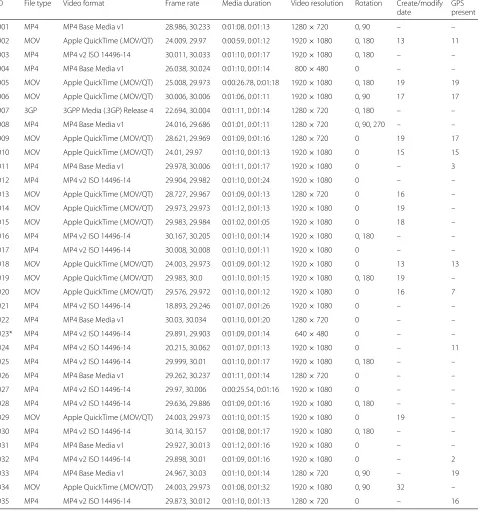
rate,media duration,audio channels,audio sample rate,
image size, androtation7.
In order to make Appendix Table 7 clearer, we used
video resolution instead of the tag Image Size, and we did not report the tags related to the audio acquisition, although they will be described in the following paragraphs.
All videos were acquired using the video encoder
-Table
6
Devices’
image
characteristics
in
VISION
ID
Lens
model
ISO
Aperture
Flash
Focal
length
(mm)
Image
resolution
Orientation
C
reate/modify
date
G
PS
present
D31
–
50,
1000
2.6
N
o
flash
3.7
3264
×
1836
H,
R
180,
R
270
CW,
R
90
CW
-D32
–
100,
2500
2
O
ff,
did
n
ot
fire
4.3
4640
×
3480
-58
D33
–
100,
2400
2
Auto,
fired,
did
n
ot
fire
3.0
2448
×
3264,
2448
x
3264
H
-236
D34
b.c
4.12mm
f/2.4
50,
80
2.4
O
ff,
did
n
ot
fire
4.1
3264
×
2448
H,
R
180,
R
90
C
W
310
-D35
–
50,
160
2.2
N
o
flash
3.3
2592
×
1944
H,
R
180,
R
90
C
W,
R
270
CW
-2
Table 7Devices’ video characteristics in VISION
ID File type Video format Frame rate Media duration Video resolution Rotation Create/modify date
GPS present
D01 MP4 MP4 Base Media v1 28.986, 30.233 0:01:08, 0:01:13 1280×720 0, 90 – –
D02 MOV Apple QuickTime (.MOV/QT) 24.009, 29.97 0:00:59, 0:01:12 1920×1080 0, 180 13 11
D03 MP4 MP4 v2 ISO 14496-14 30.011, 30.033 0:01:10, 0:01:17 1920×1080 0, 180 – –
D04 MP4 MP4 Base Media v1 26.038, 30.024 0:01:10, 0:01:14 800×480 0 – –
D05 MOV Apple QuickTime (.MOV/QT) 25.008, 29.973 0:00:26.78, 0:01:18 1920×1080 0, 180 19 19
D06 MOV Apple QuickTime (.MOV/QT) 30.006, 30.006 0:01:06, 0:01:11 1920×1080 0, 90 17 17
D07 3GP 3GPP Media (.3GP) Release 4 22.694, 30.004 0:01:11, 0:01:14 1280×720 0, 180 – –
D08 MP4 MP4 Base Media v1 24.016, 29.686 0:01:01, 0:01:11 1280×720 0, 90, 270 – –
D09 MOV Apple QuickTime (.MOV/QT) 28.621, 29.969 0:01:09, 0:01:16 1280×720 0 19 17
D10 MOV Apple QuickTime (.MOV/QT) 24.01, 29.97 0:01:10, 0:01:13 1920×1080 0 15 15
D11 MP4 MP4 Base Media v1 29.978, 30.006 0:01:11, 0:01:17 1920×1080 0 – 3
D12 MP4 MP4 v2 ISO 14496-14 29.904, 29.982 0:01:10, 0:01:24 1920×1080 0 – –
D13 MOV Apple QuickTime (.MOV/QT) 28.727, 29.967 0:01:09, 0:01:13 1280×720 0 16 –
D14 MOV Apple QuickTime (.MOV/QT) 29.973, 29.973 0:01:12, 0:01:13 1920×1080 0 19 –
D15 MOV Apple QuickTime (.MOV/QT) 29.983, 29.984 0:01:02, 0:01:05 1920×1080 0 18 –
D16 MP4 MP4 v2 ISO 14496-14 30.167, 30.205 0:01:10, 0:01:14 1920×1080 0, 180 – –
D17 MP4 MP4 v2 ISO 14496-14 30.008, 30.008 0:01:10, 0:01:11 1920×1080 0 – –
D18 MOV Apple QuickTime (.MOV/QT) 24.003, 29.973 0:01:09, 0:01:12 1920×1080 0 13 13
D19 MOV Apple QuickTime (.MOV/QT) 29.983, 30.0 0:01:10, 0:01:15 1920×1080 0, 180 19 –
D20 MOV Apple QuickTime (.MOV/QT) 29.576, 29.972 0:01:10, 0:01:12 1920×1080 0 16 7
D21 MP4 MP4 v2 ISO 14496-14 18.893, 29.246 0:01:07, 0:01:26 1920×1080 0 – –
D22 MP4 MP4 Base Media v1 30.03, 30.034 0:01:10, 0:01:20 1280×720 0 – –
D23* MP4 MP4 v2 ISO 14496-14 29.891, 29.903 0:01:09, 0:01:14 640×480 0 – –
D24 MP4 MP4 v2 ISO 14496-14 20.215, 30.062 0:01:07, 0:01:13 1920×1080 0 – 11
D25 MP4 MP4 v2 ISO 14496-14 29.999, 30.01 0:01:10, 0:01:17 1920×1080 0, 180 – –
D26 MP4 MP4 Base Media v1 29.262, 30.237 0:01:11, 0:01:14 1280×720 0 – –
D27 MP4 MP4 v2 ISO 14496-14 29.97, 30.006 0:00:25.54, 0:01:16 1920×1080 0 – –
D28 MP4 MP4 v2 ISO 14496-14 29.636, 29.886 0:01:09, 0:01:16 1920×1080 0, 180 – –
D29 MOV Apple QuickTime (.MOV/QT) 24.003, 29.973 0:01:10, 0:01:15 1920×1080 0 19 –
D30 MP4 MP4 v2 ISO 14496-14 30.14, 30.157 0:01:08, 0:01:17 1920×1080 0, 180 – –
D31 MP4 MP4 Base Media v1 29.927, 30.013 0:01:12, 0:01:16 1920×1080 0 – –
D32 MP4 MP4 v2 ISO 14496-14 29.898, 30.01 0:01:09, 0:01:16 1920×1080 0 – 2
D33 MP4 MP4 Base Media v1 24.967, 30.03 0:01:10, 0:01:14 1280×720 0, 90 – 19
D34 MOV Apple QuickTime (.MOV/QT) 24.003, 29.973 0:01:08, 0:01:32 1920×1080 0, 90 32 –
D35 MP4 MP4 v2 ISO 14496-14 29.873, 30.012 0:01:10, 0:01:13 1280×720 0 – 16
GPS present. The former counts the number of videos in which metadatacreate dateandmodify dateare not iden-tical, while the latter counts the number of videos in which theGPS locationtag is not empty.
We highlight that the values in the create/modify date column are different than 0 for Apple devices only: indeed, in these devices the create date differs from the modify date by the duration of the video.
and D27 where the shortest video duration is 25 sec-onds. Most devices record videos at a frame rate of 24 fps or more; as exceptions we have some videos from D07, D21 and D24.
As to the characteristics of the encoded audio, as a gen-eral distinction Apple devices acquire audio using one channel at sample rate of 44100 bit/s, whereas Android devices usually acquire two audio channels at 48000 bit/s. The Microsoft device (D17) uses one audio chan-nel at 48000 bit/s, like some Samsung Devices, namely: Galaxy S III Mini (D01, D26) and the Galaxy Trend Plus (D22).
Abbreviations
Exif: Exchangeable image file format; HSI: Hybrid source identification; ISI: Image source identification; MF: Multimedia forensics; PCE: Peak to correlation energy; ROC: Receiver operating characteristic; SMP: Social media platform; SPN: Sensor pattern noise; VSI: Video source identification
Availability of data and materials
As stated in Section 5, the whole dataset will be made available at no cost to the research community at the following web address https://lesc.dinfo.unifi. it/en/datasets, with the goal of providing the content needed to assess the performance of next generation of image and video forensic tools. In addition to the dataset we release a guide to the dataset structure and several csv files containing names and technical information, such as metadata tags, of all the collected media.
Authors’ contributions
DS contributed to acquisition of data (especially for obtaining the social-network version of videos), prepared all the statistics about data and corresponding metadata, and drafted part of the manuscript. MF took care of writing code, analyse and present results for the experimental section about image and video source identification. MI contributed to drafting the paper and writing code, and analysed the relationships between sensor pattern noise in images and videos. OAS carried out most of the data acquisition, checked the gathered material and contributed to obtaining the
social-network version of images. AP conceived the study, participated to its design and coordination, and helped to draft the manuscript. All authors read and approved the final manuscript.
Ethics approval and consent to participate Not applicable.
Consent for publication Not applicable.
Competing interests
The authors declare that they have no competing interests.
Publisher’s Note
Springer Nature remains neutral with regard to jurisdictional claims in published maps and institutional affiliations.
Author details
1Department of Information Engineering, University of Florence, Via di S.
Marta, 3, 50139 Florence, Italy.2FORLAB, Multimedia Forensics laboratory, PIN
Scrl, Piazza G. Ciardi, 25, 59100 Prato, Italy.3Department of electronic Media,
Saudi Electronic University, Abi Bakr As Sadiq Rd, Riyadh, 11673, Saudi Arabia.
Received: 10 May 2017 Accepted: 18 September 2017
References
1. Statista Inc., Statista. http://www.statista.com/statistics/263437/global-smartphone-sales-to-end-users-since-2007/. Accessed 22 Sept 2017 2. A De Rosa, A Piva, M Fontani, M Iuliani, in2014 International Carnahan Conference on Security Technology (ICCST). Investigating multimedia contents (IEEE, Rome, 2014), pp. 1–6
3. A Piva, An overview on image forensics. ISRN Signal Proc.2013, 496701–22 (2013)
4. M Iuliani, M Fontani, D Shullani, A Piva, A hybrid approach to video source identification. arXiv:1705.01854[cs.MM] (2017)
5. J Lukas, J Fridrich, M Goljan, Digital camera identification from sensor pattern noise. IEEE Trans. Inf. Forensic Secur.1(2), 205–214 (2006) 6. W Van Houten, Z Geradts, Source video camera identification for multiply
compressed videos originating from youtube. Digit. Investig.6(1), 48–60 (2009)
7. M Chen, J Fridrich, M Goljan, J Lukáš, inProc. of SPIE 6515 Electronic Imaging 2007. Source digital camcorder identification using sensor photo response non-uniformity, (2007), pp. 65051–65051. International Society for Optics and Photonics
8. W-H Chuang, H Su, M Wu, inIEEE International Conference on Image Processing (ICIP). Exploring compression effects for improved source camera identification using strongly compressed video (IEEE, Brussels, 2011), pp. 1953–1956
9. S Chen, A Pande, K Zeng, P Mohapatra, Live video forensics: source identification in lossy wireless networks. IEEE Trans. Inf. Forensic Secur. 10(1), 28–39 (2015)
10. G Schaefer, M Stich, inProc. SPIE 5307 Electronic Imaging 2004. Ucid: an uncompressed color image database, (2003), pp. 472–480. International Society for Optics and Photonics
11. T Gloe, R Böhme, The Dresden image database for benchmarking digital image forensics. J. Digit. Forensic Pract.3(2-4), 150–159 (2010) 12. T Gloe, R Böhme, inProceedings of the 25th Symposium On Applied
Computing (ACM SAC 2010). The ‘Dresden Image Database’ for benchmarking digital image forensics, vol. 2 (ACM New York, Sierre, 2010), pp. 1585–1591
13. D-T Dang-Nguyen, C Pasquini, V Conotter, G Boato, inProceedings of the 6th ACM Multimedia Systems Conference.MMSys ’15. Raise: a raw images dataset for digital image forensics (ACM, New York, 2015), pp. 219–224 14. D Vázquez-Padín, F Pérez-González, in2011 IEEE International Workshop on
Information Forensics and Security. Prefilter design for forensic resampling estimation (IEEE, Iguacu Falls, 2011), pp. 1–6
15. G Qadir, S Yahaya, ATS Ho, inProceedings of the IET IPR 2012, 3-4 July, London. Surrey University Library for Forensic Analysis (SULFA), (2012) 16. L D’Amiano, D Cozzolino, G Poggi, L Verdoliva, inMultimedia & Expo
Workshops (ICMEW), 2015 IEEE International Conference On. Video forgery detection and localization based on 3d patchmatch (IEEE, Turin, 2015), pp. 1–6
17. OI Al-Sanjary, AA Ahmed, G Sulong, Development of a video tampering dataset for forensic investigation. Forensic Sci. Int.266, 565–572 (2016) 18. F Bertini, R Sharma, A Iannı, D Montesi, MA Zamboni, inThe International
Conference on Computing Technology, Information Security and Risk Management (CTISRM2016). Social media investigations using shared photos, (Dubai, 2016), p. 47
19. M Moltisanti, A Paratore, S Battiato, L Saravo, inImage Analysis and Processing - ICIAP 2015 - 18th International Conference, Genoa, Italy, September 7-11, 2015, Proceedings, Part II. Image manipulation on facebook for forensics evidence (Springer, Genoa, 2015), pp. 506–517
20. Z Wang, AC Bovik, HR Sheikh, EP Simoncelli, Image quality assessment: from error visibility to structural similarity. IEEE Trans. Image Process. 13(4), 600–612 (2004)
21. D Bolton, youtube-dl documentation. github.com/rg3/youtube-dl/blob/ master/README.md#readme. Accessed 22 Sept 2017
22. M Chen, J Fridrich, M Goljan, J Lukáš, Determining image origin and integrity using sensor noise. IEEE Trans. Inf. Forensic Secur.3(1), 74–90 (2008) 23. M Goljan, J Fridrich, T Filler, inPublisher: Proc. SPIE 7254 IS&T/SPIE Electronic
Imaging. Large scale test of sensor fingerprint camera identification, (2009), pp. 72540–72540. International Society for Optics and Photonics 24. S Taspinar, M Mohanty, N Memon, in2016 IEEE International Workshop on
25. M Goljan, J Fridrich, Camera identification from scaled and cropped images. Secur. Forensic Steganography Watermarking Multimedia Contents X.6819, 68190 (2008)
26. D Shullani, O Al Shaya, M Iuliani, M Fontani, A Piva, inProceeding of 2017 Tyrrhenian International Workshop on Digital Communications,