www.orientjchem.org
An International Open Free Access, Peer Reviewed Research Journal
2017, Vol. 33, No. (3): Pg.1414-1421
Corrosive Inhibitive Study of Stainless Steel in Hydrochloric
Acid Using Eco-Friendly Sesmum Indicum Oil
ANURAG SHARMA
1*, PREETI CHOUDHARY
2,
ANIL KUMAR VARSHNEY
2and SARITA VARSHNEY
21Swami Keshvanand Institute of Technology, Management & Gramothan, Jaipur, Rajasthan, India. 2Department of Chemistry, University of Rajasthan, Jaipur, Rajasthan, India.
*Corresponding author E-mail: [email protected] http://dx.doi.org/10.13005/ojc/330343
(Received: April 01, 2017; Accepted: May 16, 2017)
AbSTRACT
The inhibitive and adsorptive properties of Sesmum indicum eco-friendly oil for stainless steel corrosion in hydrochloric acid was investigated using weight loss technique as well as electrochemical technique. The result has proved that the oil is excellent inhibitor for stainless steel in hydrochloric acid. The inhibition efficiency of oil for stainless steel increased with increase the amount of oil. The mechanism of the oil on the surface of stainless steel was found to be spontaneous, exothermic and physical adsorption. The experimental data fitted well to Langmuir adsorption isotherms. Obtained results were justified from the galvanostatic polarization method.
Keywords: Langmuir adsorption, Weight loss technique, Sesmum indicum oil,
Electrochemical technique.
INTRODUCTION
Stainless steel’s strength, resistance to corrosion and low maintenance make it the ideal material for a wide range of applications such as pharmaceutical industry, architecture, medical, energy, heavy industry, construction, automotive, transportation, food and catering.
Corrosion is chemical or electrochemical reaction between materials, usually a metal, and
its environment that produces a deterioration of the material. The annual loss due to corrosion has been estimated for any country at about 4 percent of gross domestic product.
is a great problem, face by engineers. Generally the loss of equipment is done by pitting corrosion. Many organic compounds have been studied as corrosion inhibitor for different metals 1-8. Larger amount of organic compounds have been use as inhibitor but they are poisonous and expensive, some eco-friendly, less costly and green inhibitors are substitute of organic inhibitors 9-12. Due to above reason in the present study eco-friendly Sesmum indicum oil has been tested for corrosion inhibitive property for the stainless steel metal in 0.5N hydrochloric acid.
ExPERIMENTAL
Weight loss method Material preparation
Stainless steel coupons with major amount of iron (80%) and lesser amount of chromium (14%) with rectangular size 3×2×0.2 cm. were used for mass loss method. These coupons washed with acetone and double-distilled water, dried in electrical oven and then stored in dessicator. The same metal was used for polarization studies in which metal
was coated with araldite and only 1.0 cm2 area was opened for electrochemical study.
Solutions
0.5N HCl was prepared in AR grade
chemical for mass loss and polarization study. The amount of Sesmum indicum in corrosive medium was of 1.0g to 6.0g in 1000ml for mass loss method and 1.0g to 5.0g in 1000ml corrosive medium for polarization studies.
CR (Corrosion rate) computation
The data of mass loss was determined using following method reported earlier 13. Experiment was done in repeatedly in test solution. All of first the coupons of stainless steel weighted and after this all are dipped in test solutions, which containing 0.5 N HCl with absence and presence of oil by the hooks, which are made by glass. The stainless steel coupons got back from the tested solution. The coupons rubbed for clean and after this dried in electrical oven, again weight and loss of weight was evaluated. This method have been repeated for different immersion
Table 1: %IE, CR and surface covered by metal evaluated by mass loss experiment with stainless steel in hydrochloric acid (Experiment period : 1h)
Concentration Loss of metal Efficiency of CR Surface covered of oil(gram/liter) (gram) inhibitor (%) (mmpy) by inhibitor ( θ )
0.00 0.0115 - 9.093
-1.00 0.0028 75.65 2.214 0.7565
2.00 0.0025 78.28 1.97 0.7828
3.00 0.0021 81.73 1.66 0.8173
4.00 0.0018 84.34 1.56 0.8434
5.00 0.0015 86.95 1.18 0.8695
6.00 0.0012 89.56 0.94 0.8956
Table 2: %IE, CR and surface covered by metal evaluated by mass loss experiment with stainless steel in hydrochloric acid (Experiment period: 3h)
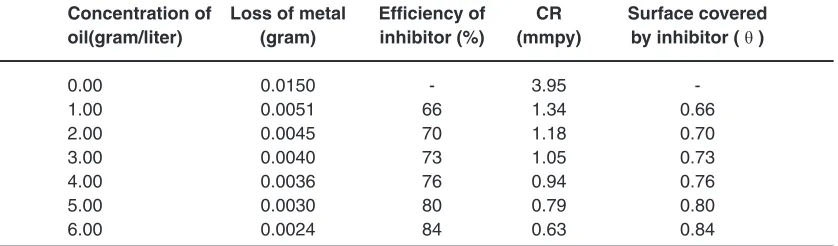
Concentration of Loss of metal Efficiency of CR Surface covered oil(gram/liter) (gram) inhibitor (%) (mmpy) by inhibitor ( θ )
0.00 0.0150 - 3.95
-1.00 0.0051 66 1.34 0.66
2.00 0.0045 70 1.18 0.70
3.00 0.0040 73 1.05 0.73
4.00 0.0036 76 0.94 0.76
5.00 0.0030 80 0.79 0.80
times 1hour, 3 hours, 6 hours, 15 hours and 24 hours at room temperature (298K).
The corrosion rate (CR) was evaluated by
following formula:
CR (mmpy) = ...(1) In above formula d = density of the coupon (gcm-3), W = mass loss of metal (mg), A = area of the coupon (square inch) and t = time (hrs).
The %IE with eco-friendly Sesmum indicum oil calculated using the following formula:
%IE= 1 - × 100 ...(2) Where Wo= Mass loss of the stainless steel specimens in the absence of Sesmum indicum oil and Wi= Mass lossof the stainless steel specimens in presence of Sesmum indicum oil.
The θ which is surface coverage was evaluated by following formula (3)
Surface coverage (θ)=1- ...(3)
Electrochemical procedure
The galvanostatic polarization was done with three-electrode polarization cell. Polarization method have a working electrode which was prepared by stainless steel metal with 1cm2 open area, auxiliary electrode which was prepared by platinum, reference electrode which was prepared by saturated calomel electrode.
Experimental results
The inhibitor efficiency (IE %) of Sesmum indicum oil, degree of surface coverage (θ) by Sesmum indicum oil and CR (corrosion rate) with variable amount of the inhibitor in 0.5N HCl for1hour, 3hours, 6hours, 15hours and 24hours immersion periods and different kinetic and thermodynamic parameters were evaluated by weight loss method.
Table 3 %IE, CR and surface covered by metal evaluated by mass loss experiment with stainless steel in hydrochloric acid (Experiment period: 6h)
Concentration of Loss of metal Efficiency of CR (mmpy) Surface covered by oil(gram/liter) (gram) inhibitor (%) inhibitor ( θ )
0.00 0.0180 - 2.37
-1.00 0.0071 60.55 0.93 0.6055
2.00 0.0068 62.22 0.89 0.6222
3.00 0.0064 64.44 0.84 0.6444
4.00 0.0055 69.44 0.72 0.6944
5.00 0.0047 73.88 0.61 0.7388
6.00 0.0038 78.88 0.50 0.7888
Table 4: %IE, CR and surface covered by metal evaluated by mass loss experiment with stainless steel in hydrochloric acid (Experiment period: 15h)
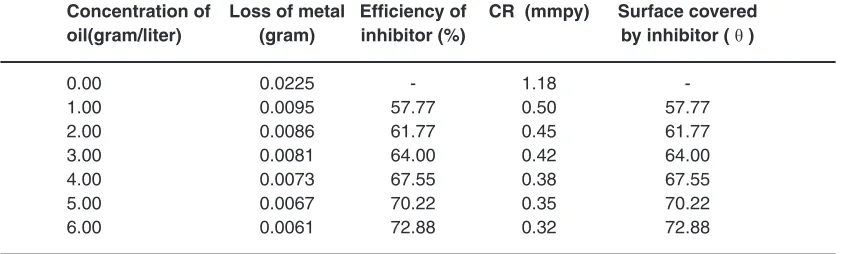
Concentration of Loss of metal Efficiency of CR (mmpy) Surface covered oil(gram/liter) (gram) inhibitor (%) by inhibitor ( θ )
0.00 0.0225 - 1.18
-1.00 0.0095 57.77 0.50 57.77
2.00 0.0086 61.77 0.45 61.77
3.00 0.0081 64.00 0.42 64.00
4.00 0.0073 67.55 0.38 67.55
5.00 0.0067 70.22 0.35 70.22
Table 5: %IE, CR and surface covered by metal evaluated by mass loss experiment with stainless steel in hydrochloric acid (Experiment period: 24h)
Concentration of Loss of metal Efficiency of CR (mmpy) Surface covered by oil(gram/liter) (gram) inhibitor (%) inhibitor ( θ )
0.00 0.0410 - 1.35
1.00 0.0181 55.85 0.59 0.5585
2.00 0.0172 58.04 0.56 0.5804
3.00 0.0163 60.24 0.53 0.6024
4.00 0.0154 62.43 0.50 0.6243
5.00 0.0148 63.90 0.48 0.6390
6.00 0.0140 65.85 0.46 0.6585
Fig. 1: Increasing of %IE with concentration of Sesmum indicum oil for stainless steel (immersion time periods: 1 hour, 3 hour, 6 hour, 15 hour and 24 hour) in 0.5N HCl.
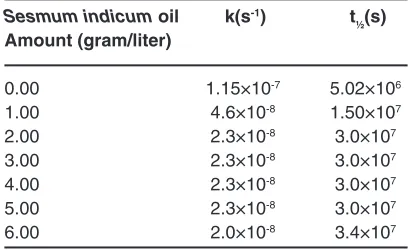
Table 6: Kinetic parameter study of protection and destruction of stainless steel in acidic
medium with and without of oil
Sesmum indicum oil k(s-1) t ½(s)
Amount (gram/liter)
0.00 1.15×10⁻⁷ 5.02×10⁶
1.00 4.6×10⁻⁸ 1.50×10⁷
2.00 2.3×10⁻⁸ 3.0×10⁷
3.00 2.3×10⁻⁸ 3.0×10⁷
4.00 2.3×10⁻⁸ 3.0×10⁷
5.00 2.3×10⁻⁸ 3.0×10⁷
6.00 2.0×10⁻⁸ 3.4×10⁷
Table 7: Adsorption parameters of Sesmum
indicum oil on the stainless steel surface in
hydrochloric acid for different experimental periods
Experimental Kad Slope -∆Gads R2
Time periods
1 hour 2.71 1.0 25.39 0.9979 3hour 1.77 1.1 20.02 0.9943 6 hour 1.27 1.1 17.17 0.9861 15 hour 1.63 1.2 19.22 0.9964 24 hour 2.10 1.4 21.91 0.9983 Electrochemical parameters were evaluated by galvanostatic polarization method. Different parameters evaluated from mass loss procedure are presented in tables 1 to 5. In 0.5N HCl at 1g/lit of Sesmum indicum oil, there is 75.65% inhibition observed for immersion time 1 hour. On increasing the concentration 1 to 6 g/lit, the inhibition increases up to 89.56%. When the duration of immersion varied from 1 hour to 24 hours inhibitor efficiency decreases.
Weight loss measurements indicate that the dissolution rate decreases to significant extent due to the presence of oil especially at high concentrations. The inhibition efficiency is maximum on immersion time 1 hour at 6g/lit Sesmum indicum. The maximum inhibition efficiency for immersion time 24 hours at 6g/lit Sesmum indicum is 65.85%.The graph which is present in figure 1 shows that %IE is varies with the amount of the Sesmum indicum oil with variable experimental times like 1 hour, 3 hours, 6 hours, 15 hours and 24 hours.
Corrosion kinetics of stainless steel in hydrochloric acid with inhibitor
Figure 2 present a graph which shows log Wf (weight of stainless steel at time t) is change with time, the evaluated data putted in to the rate law for first order reaction. The plots are linear, which concluded that the reaction with stainless steel in test solution follows first order kinetic 14-15. The rate constants measured from the figure 2 are concluded in table 6.
...(4)
The half-life (t1/2) evaluated from equation giving below.
(t ½)=0.69k ...(5) The half life were evaluated by above formula are shows in table 6 which clearly shows that rate constant inversely proportional of half life which conclude the protection of metal by inhibitor.
Thermodynamic parameters of stainless steel in hydrochloric acid with inhibitor
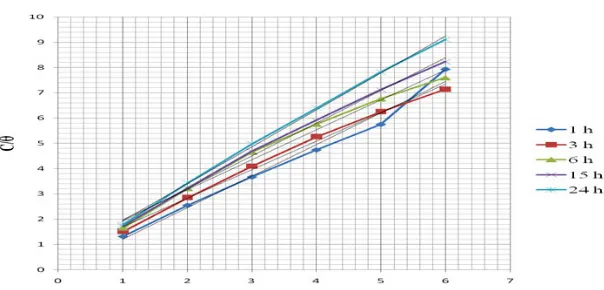
The graph of C/ θ vs C presents linearity in figure 3. This conclude that adsorption of oil molecules on stainless steel metal surface follows Langmuir isotherm. According to Langmuir adsorption isotherm degree of surface coverage (θ) of stainless steel and the concentration of the inhibitor in hydrochloric acid are related to following formula (6).
...(6) Average values for free energy of adsorption (∆Gads), were calculated using the following equations 7.
∆Gads=-RT In(55.5K) ...(7)
K = equilibrium constant, R = gas constant and T = temperature. It is found that the ∆Gads values for the studied compound are less than -40 kJ mol-1, indicating that the Sesmum indicum oil are physically adsorbed on stainless steel. The less and negative value of ∆Gads shows the spontaneous adsorption reaction of the oil on the stainless steel 16-18
Table 8: Electrochemical polarization parameters for stainless steel in hydrochloric acid without and with Sesmum indicum oil
Sesmum indicum -Ecorr (V) Tafel slopes Icorr(A.cm-2) IE%
oil Concentration (V.dec-1)
(gram/liter)
bc ba
0.00 0.429 7.601 6.765 3.163×10⁻⁴
-1.00 0.432 4.153 8.542 1.103×10⁻⁴ 65.13
3.00 0.430 8.647 14.88 5.929×10⁻⁵ 81.25
5.00 0.443 9.504 6.506 5.207×10⁻⁶ 98.35
Galvanostatic polarization studies
The polarization data of stainless steel working as a cathode and an anode in absence and presence of Sesmum indicum oil with hydrochloric acid isshown in figure 4. The electrochemical polarization parameters concluded from figure 4 like corrosion current Icorr, Tafel constantba, bc and
Ecorr aretabulated in table 8.
A decrease in the corrosion current and increase in the cathodic and anodic Tafel slopes have been observed with the grater in the amount of oil. Ecorr values have not significant change with the addition of inhibitor.The inhibition efficiencies determined from the values of corrosion current are found to be in comparable with those obtained from weight loss measurement. The inhibition efficiencies determined by following equation:
( Inhibitor efficiency ) IE%= 1-(I1
corr / Icorr)×100 ...(8) In the present equation Icorr = current densities with Sesmum indicum oil in 0.5N hydrochloric acid I1
corr = current densities without of Sesmum indicum oil in hydrochloric acid. The presence of passive region in the graph as shown in figure 4 may be due to the protection layers of chromium and iron oxide formed from their respective
Fig. 3: Langmuir adsorption isotherm with stainless steel in hydrochloric acid with different amount of oil for different experimental time
Fig. 4: Polarization curve of stainless steel in 0.5N HCl without and with of oil
metals present in stainless steel. Chloride ions which are present in hydrochloric acid destroy the protective layers which are made by oil and generate pits on the stainless steel surface. I critical is maximum when no inhibitor was added to 0.5N HCl (uninhibited solution) the values of I critical decreases with increased concentration of inhibitor suggesting inhibitor is capable of reducing corrosion.
CONCLUSIONS
By the evaluated data from weight loss and polarization study the following conclusion can be explain:
1. The eco friendly Sesmum indicum oil was concluded as a best inhibitor for stainless steel in 0.5N hydrochloric acid.
2. Inhibition efficiency directly proportional with the amount of Sesmum indicum oil content up to 6g/liter to reach 89.56% in 0.5N HCl at room temperature.
3 Kinetics analyses of data showed linear variations, which confirm a first order kinetics in hydrochloric acid.
4. The above research concluded that
adsorption of oil molecules on stainless steel metal surface follows Langmuir isotherm in hydrochloric acid medium.
5. The less and negative value of ∆Gads shows the spontaneous adsorption reaction of the Sesmum indicum oil on the stainless steel surface.
6. Obtained results were justified from the galvanostatic polarization method.
7. The values Ecorr obtained from galvanostatic polarization method are mostly constant, by this we can conclude that Sesmum indicum oil work as mixed type in hydrochloric acid and retard both the reaction in equal amount on anodic and cathodic ends.
ACKNOWLEDGEMENTS
The authors gratefully acknowledge the Head of department, Chemistry, University of Rajasthan, Jaipur and Prof.(Dr.) S. L. Surana Director (Academic), Swami Keshvanand Institute of Technology, Management & Gramothan, Jaipur for providing necessary facilities.
REFERENCES
1. Chadli, R., Elazouzi, M., Khelladi, I., Elhourri, A.M., Elmsellem, H., Aouniti, A., Mulengi, J. K., Hammouti, B., Port. Electrochim. Acta,
2017, 35(2), 65-80.
2. Fouda, A.S., Diab, M. A., Fathy, S., Int. J. Electrochem. Sci., 2017, 12, 347 - 362.
3. Yadav M., Gope L., Kumari N., Yadav P, ELSEVIER, Journal of Molecular Liquids,
2016, 216, 78–86.
4. Fouda, A. S., Abdallah, Y.M., Nabil, D., Int. Journal of Innovative Research in Science, Eng. and Tech., 2014, 3 (5), 12965- 12982.
5. Srivastava, K., Singh, P., Quraishi, M.A., Int. J. Innovative Research in Science, Engineering and Technology, 2016, 5 (3), 3401-3405.
6. Ezhilarasi, M. R., Prabha, B. , Santhi, T., Rasayan J. Chem., 2015, 8 (1), 71-83.
7. Vinutha, M.R., Venkatesha, T.V., Portugaliae Electrochimica Acta, 2016, 34(3), 157-184.
8. Fouda, S., Abd El-Maksoud, S., Gomaa,
S.A., Elsalakawy, A., Journal of Applicable Chemistry, 2017, 6 (1), 160-175.
9. Sharma, A., Varshney, A. K., Varshney, S., Orient. J. Chem., 2016, 32(5), 2769-2775.
10. Sharma, A., Rawat, J. Varshney, A. K., Verma, P. S., Varshney, S., J. Indian Chem. Soc.,
2010, 87, 573-577.
11. Gobara, M., Baraka, A. , Zaghloul, B., Springer, 2015, 41, 9885–9901.
12. Afia, L., Benali, O., Salghi, R., Ebenso, E. E., Jodeh, S., Zougagh, M., Hammouti, B., Int. J. Electrochem. Sci., 2014, 9, 8392-8406.
13. Afolabi, A. S., Muhirwa, A. C. , Abdulkareem, A. S, Muzenda E., Int. J. Electrochem. Sci.,
2014, 9, 5895 – 5906.
14. Mani, N., Venkatakrishna Iyer, S., Bahadur, L., Transactions of the SAEST, 2003, 38(2),
67-71.
16. Joseph, T. N., Okafor, V. N., Journal of Minerals and Materials Characterization and Engineering, 2012, 11, 885-890.
17. Abdallaha, M., Zaafaranya, I. A., AL Jahdalya, B.A., J. Mater. Environ. Sci., 2016, 7 (4),
1107-1118.
18. Al-Baghdadi, S.B., Noori, F.T.M., Ahmed, W.K., Al-Amiery A.A., J. of Advanced electrochem.,